Brookston Beer Bulletin

Jay R. Brooks on Beer

  • Home
  • About
  • Editorial
  • Birthdays
  • Art & Beer

Socialize

  • Dribbble
  • Email
  • Facebook
  • Flickr
  • GitHub
  • Instagram
  • LinkedIn
  • Pinterest
  • RSS
  • Twitter
  • YouTube

Powered by Genesis

Beer In Ads #5145: Enjoy Big D, Drewrys Bock Beer

March 5, 2026 By Jay Brooks

Two years ago I decided to concentrate on Bock ads for awhile. Bock, of course, may have originated in Germany, in the town of Einbeck. Because many 19th century American breweries were founded by German immigrants, they offered a bock at certain times of the year, be it Spring, Easter, Lent, Christmas, or what have you. In a sense they were some of the first seasonal beers. “The style was later adopted in Bavaria by Munich brewers in the 17th century. Due to their Bavarian accent, citizens of Munich pronounced ‘Einbeck’ as ‘ein Bock’ (a billy goat), and thus the beer became known as ‘Bock.’ A goat often appears on bottle labels.” And presumably because they were special releases, many breweries went all out promoting them with beautiful artwork on posters and other advertising. With Spring approaching, there are so many great examples that I’m going to post two a day for a few months.

Thursday’s first ad is for Drewrys Genuine Bock Beer, which was published on March 5, 1960. This ad was for the Drewrys Brewing Co., of McHenry, Illinois, which was originally founded in 1877 by E.L. Drewry. This ad ran in The Seymour Daily Tribune of Seymour, Indiana.

Filed Under: Art & Beer, Beers, Breweries, Just For Fun Tagged With: Advertising, Bock, History, Illinois, Indiana

Beer In Ads #5144: Now… From Old Dutch Draft Bock Beer In Bottles, Too

March 4, 2026 By Jay Brooks

Two years ago I decided to concentrate on Bock ads for awhile. Bock, of course, may have originated in Germany, in the town of Einbeck. Because many 19th century American breweries were founded by German immigrants, they offered a bock at certain times of the year, be it Spring, Easter, Lent, Christmas, or what have you. In a sense they were some of the first seasonal beers. “The style was later adopted in Bavaria by Munich brewers in the 17th century. Due to their Bavarian accent, citizens of Munich pronounced ‘Einbeck’ as ‘ein Bock’ (a billy goat), and thus the beer became known as ‘Bock.’ A goat often appears on bottle labels.” And presumably because they were special releases, many breweries went all out promoting them with beautiful artwork on posters and other advertising. With Spring approaching, there are so many great examples that I’m going to post two a day for a few months.

Wednesday’s second ad is for Old Dutch Bock Beer, which was published on March 4, 1965. This ad was for the Old Dutch Brewery, a division of International Breweries, Inc., of Findlay, Ohio, which was originally founded in 1898 as the Krantz Brewing Co. This ad ran in The News Journal of Mansfield, Ohio.

Filed Under: Art & Beer, Beers, Breweries, Just For Fun Tagged With: Advertising, Bock, History, Ohio

Historic Beer Birthday: Leonhard Eppig

March 4, 2026 By Jay Brooks

eppig
Today is the birthday of Leonhard Eppig (March 4, 1839-April 9, 1893). He was born in Großwallstadt, Bavaria, and at age fifteen, in 1854, he came to New York on the S.S. Rotterdam and settled in Brooklyn. He learned to brew working for a Brooklyn brewer, Michael Seitz. In 1866, he and a partner formed the Hubert Fischer & Leonhard Eppig Brewery. Ten years later, he bought out his partner and it became simply the Leonard Eppig Brewing Co., but traded under the name Germania Brewery. From what I can tell Eppig’s name was spelled Leonhard, but it was often anglicized to Leonard, even on advertising. When Eppig died, his sons continued running the brewery until it was closed down by prohibition in 1920. They reopened the brewery after repeal, but in 1935 sold it to George Ehret Brewery.

leonard-eppig-photo
Here’s a short biography from Find-a-Grave:

Leonhard was born in Bavaria, Germany. He married Margarehta about 1854 and had at least 10 children, Anna, Euginia, John, Henry, Franz, Barbara, Theresa, Mary, Margaret and Regina, some of which are entombed in his mausoleum. Leonhard owned the Eppig Germania Brewery Company, which was located in Brooklyn.

leonard-eppig-1885
And here’s his obituary from the Brooklyn Daily Eagle:

Leonard-Eppig-obit

Leonhard_Eppig_Brewery_Poster_Historic

This lengthy story is from “A History of Long Island: From Its Earliest Settlement to the Present Time, Volume 3,” by Peter Ross and William Smith Pelletreau, published in 1905:

leonhard-eppig-bio-1
leonhard-eppig-bio-2
leonhard-eppig-bio-3
leonhard-eppig-bio-4
leonhard-eppig-bio-5
Eppig-mausoleum

Busts of Eppig and his wife on the family mausoleum.

eppig-bottle
Last year, a descendant of the Eppig family opened a craft brewery in San Diego, which they named Eppig Brewing, and included this infographic in their website:

eppig-history-infographic

Filed Under: Birthdays, Breweries, Just For Fun Tagged With: Brooklyn, Germany, History, New York

Historic Beer Birthday: George Klotter

March 4, 2026 By Jay Brooks

bellevue-ohio
Today is the birthday of George Klotter (March 4, 1805-July 29, 1882). He was born in Baden, Germany, but moved to Cincinnati, Ohio and established the Hamilton Brewery with partner Johann G. Sohn in Cincinnati, Ohio in 1846. Klotter left that brewery, while Sohn continued alone, and Klotter started another brewery, the George Klotter Brewery in 1866 The following year George Jr., and his brother Louis, joined the brewery, and it was renamed the George Klotter and Sons Brewery, which it remained until 1888. Unfortunately, there’s very little information I could find about Klotter or his brewery.

Here’s a short biography from Find-a-Grave:

Clyffside Brewing Company (242 McMicken) is a defunct brewery in Cincinnati, located on the site of Hamilton Brewery, founded in 1845 by Johann Sohn and George Klotter as the Hamilton Brewery. By 1853, the company became known as the Klotter, Sohn and Company. In 1866, Sohn bought out Klotter, and Klotter went on to establish his own brewery on Klotter Street.

And this is his obituary, also from Find-a-Grave:

Bellevue-postcard

It 1888, it was renamed the Bellevue Brewery until finally closing in 1919.

Filed Under: Birthdays, Breweries, Just For Fun Tagged With: History, Ohio

Beer In Ads #5143: The Bockiest Bock Beer In Town

March 4, 2026 By Jay Brooks

Two years ago I decided to concentrate on Bock ads for awhile. Bock, of course, may have originated in Germany, in the town of Einbeck. Because many 19th century American breweries were founded by German immigrants, they offered a bock at certain times of the year, be it Spring, Easter, Lent, Christmas, or what have you. In a sense they were some of the first seasonal beers. “The style was later adopted in Bavaria by Munich brewers in the 17th century. Due to their Bavarian accent, citizens of Munich pronounced ‘Einbeck’ as ‘ein Bock’ (a billy goat), and thus the beer became known as ‘Bock.’ A goat often appears on bottle labels.” And presumably because they were special releases, many breweries went all out promoting them with beautiful artwork on posters and other advertising. With Spring approaching, there are so many great examples that I’m going to post two a day for a few months.

Wednesday’s first ad is for Brucks Bock Beer, which was published on March 4, 1941. This ad was for the Bruckmann Co. of Cincinnati, Ohio, which was originally founded in 1905 as the Ohio Union Brewing Co. This ad ran in The Grand Rapids Press of Grand Rapids, Michigan.
Filed Under: Art & Beer, Beers, Breweries, Just For Fun Tagged With: Advertising, Bock, History, Michigan, Ohio

Beer In Ads #5142: First Taste Of Spring Sunshine Bock Beer

March 3, 2026 By Jay Brooks

Two years ago I decided to concentrate on Bock ads for awhile. Bock, of course, may have originated in Germany, in the town of Einbeck. Because many 19th century American breweries were founded by German immigrants, they offered a bock at certain times of the year, be it Spring, Easter, Lent, Christmas, or what have you. In a sense they were some of the first seasonal beers. “The style was later adopted in Bavaria by Munich brewers in the 17th century. Due to their Bavarian accent, citizens of Munich pronounced ‘Einbeck’ as ‘ein Bock’ (a billy goat), and thus the beer became known as ‘Bock.’ A goat often appears on bottle labels.” And presumably because they were special releases, many breweries went all out promoting them with beautiful artwork on posters and other advertising. With Spring approaching, there are so many great examples that I’m going to post two a day for a few months.

Tuesday’s second ad is for Sunshine Bock Beer, which was published on March 3, 1937. This ad was for the Sunshine Brewing Co. of Reading, Pennsylvania, near my hometown growing up, which was originally founded in 1859 by Peter Barbey. This ad ran in The Shamokin News Dispatch of Shamokin, Pennsylvania.

Filed Under: Art & Beer, Beers, Breweries, Just For Fun Tagged With: Advertising, Bock, History, Pennsylvania

Historic Beer Birthday: Geörg Ziegelmaier

March 3, 2026 By Jay Brooks

Today is the birthday of Geörg Ziegelmaier (March 3, 1852-December 27, 1908). He was born in Württemberg, Germany, but emigrated to the U.S. on July 2, 1854. He was originally trained as a baker and a miller, but became a brewer and founded the George Ziegelmaier Brewery in 1966, which was located in Boscobel, Wisconsin. He ran the brewery for nearly twenty years before selling it to William Bruer. It then went through a series of owners before becoming the Boscobel Brewing Co. in 1920, before closing for good in 1942.

Here’s his biography from Tavern Trove:

He became a farmer in New Hartford, Connecticut, then opened a milling business after the first harvest. In 1856 he established a farm in Crawford County, Wisconsin, but moved away after only one season. History next finds Ziegelmaier forty miles to the west, in McGregor, Iowa, a port city on the Mississippi River.  He stayed long enough there to get married, to Mary Koss, and have two children.

In 1857 he moved his family back to Wisconsin to the town of Boscobel, where he opened a brewery and bakery shop. The brewery burned soon after, and he returned once again to McGregor. He came back to Boscobel in 1866 where he purchased the old brewery property and rebuilt it.  He ran the brewhouse until 1884, when he sold it to William Bruer.

By 1890 Ziegelmaier had relocated to Milwaukee. The next decade saw him follow several of his children, now numbering an even dozen, to Washington state. Geörg died there on December 27th, 1908. He was 76 years old.

This is from another history of Boscobel beer that discusses the early history of the brewery.

This short biography is from “The History of Grant County, Wisconsin,” by Willshire Butterfield, and published in 1881.

Filed Under: Birthdays, Breweries, Just For Fun Tagged With: Germany, Wisconsin

Beer In Ads #5141: Out Today Sunshine Genuine Bock Beer

March 3, 2026 By Jay Brooks

Two years ago I decided to concentrate on Bock ads for awhile. Bock, of course, may have originated in Germany, in the town of Einbeck. Because many 19th century American breweries were founded by German immigrants, they offered a bock at certain times of the year, be it Spring, Easter, Lent, Christmas, or what have you. In a sense they were some of the first seasonal beers. “The style was later adopted in Bavaria by Munich brewers in the 17th century. Due to their Bavarian accent, citizens of Munich pronounced ‘Einbeck’ as ‘ein Bock’ (a billy goat), and thus the beer became known as ‘Bock.’ A goat often appears on bottle labels.” And presumably because they were special releases, many breweries went all out promoting them with beautiful artwork on posters and other advertising. With Spring approaching, there are so many great examples that I’m going to post two a day for a few months.

Tuesday’s first ad is for Sunshine Genuine Bock Beer, which was published on March 3, 1939. This ad was for the Sunshine Brewing Co. of Reading, Pennsylvania, near my hometown growing up, which was originally founded in 1859 by Peter Barbey. This ad ran in The Intelligencer Journal of Lancaster, Pennsylvania.

Filed Under: Art & Beer, Beers, Breweries, Just For Fun Tagged With: Advertising, Bock, History, Pennsylvania

Beer In Ads #5140: The Talk Of The Town, Jacob Ruppert Bock Beer

March 2, 2026 By Jay Brooks

Two years ago I decided to concentrate on Bock ads for awhile. Bock, of course, may have originated in Germany, in the town of Einbeck. Because many 19th century American breweries were founded by German immigrants, they offered a bock at certain times of the year, be it Spring, Easter, Lent, Christmas, or what have you. In a sense they were some of the first seasonal beers. “The style was later adopted in Bavaria by Munich brewers in the 17th century. Due to their Bavarian accent, citizens of Munich pronounced ‘Einbeck’ as ‘ein Bock’ (a billy goat), and thus the beer became known as ‘Bock.’ A goat often appears on bottle labels.” And presumably because they were special releases, many breweries went all out promoting them with beautiful artwork on posters and other advertising. With Spring approaching, there are so many great examples that I’m going to post two a day for a few months.

Monday’s second ad is for Braumeister Bock Beer, which was published on March 2, 1936. This ad was for the Jacob Ruppert Brewery of New York, New York, which was originally founded in 1856 by Matthias Haffen as the Haffen Brewery until 1914 when Ruppert’s father bought it a year before he died, leaving it to Jacob, who changed the name. This ad ran in The Brooklyn Eagle, of Brooklyn, New York.

Filed Under: Art & Beer, Beers, Breweries, Just For Fun Tagged With: Advertising, Bock, History, New York

Historic Beer Birthday: Henry Gund

March 2, 2026 By Jay Brooks

gund
Today is the birthday of Henry Gund (March 2, 1859-July 2, 1945). He was the son of John Gund, who co-founded what would become the The G. Heileman Brewing Company with Gottlieb Heileman. They formed a partnership in November 1858 to operate the City Brewery in La Crosse, but “after nearly fifteen years in business together, Heileman and Gund dissolved their partnership in 1872.” After leaving City Brewing, Gund immediately “established a new brewery on the southern edge of La Crosse that he named the Empire Brewery, and which was incorporated in 1880 as the John Gund Brewing Company.” Gund employed all three of his sons in his new venture, and eventually Henry Gund became president of the brewery after his father’s death.
henry-gund

There’s not much biographical information on Henry, and I couldn’t find a photo of him, either. But there was a short write-up in the Biographical History of La Crosse, Trempealeau and Buffalo Counties, Wisconsin, published in 1892, when Henry was still alive, and so was his father. This biography starts with John Gund, and then has limited information about each son.
gundbrewery1892

henry-gund-bio-1
henry-gund-bio-2

gund-letterhead
Immigrant Entrepreneurship, under German-American Business Biographies, has a lengthy tale of both John Gund and Gottlieb Heileman

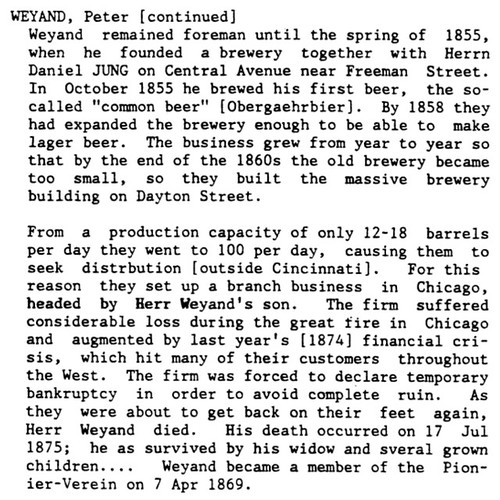
In May 1910, John Gund passed away a few months shy of his eightieth birthday. Fifty-one-year-old Henry Gund assumed control of the firm, which had expanded significantly to become the largest brewery in the Old Northwest outside Milwaukee. It employed 450 workers and owned numerous saloons throughout the region that carried Gund beer exclusively. Despite the firm’s success, the second decade of the twentieth century would be a trying time for Gund Brewing. The First World War fueled the prohibitionist movement in the United States and denunciations of German-American brewers became commonplace. In November 1918, shortly after the armistice ending the war had been signed, Congress passed the curiously misnamed Wartime Prohibition Act banning the production of intoxicating beverages starting in May 1919 and the sale of such beverages starting on July 1. Legal wrangling in the federal courts regarding the definition of “intoxicating beverages” occupied much of the spring of 1919. Many brewers including Gund held that beer with an alcohol content lower than 2.75 percent was non-intoxicating and resumed low-alcohol beer production. Later in the fall, Congress ratified the Volstead Act enacting national Prohibition and set January 16, 1920, as the start date.
gund-brewery-1902
The Gund Brewery in 1902.

Despite the enactment of national Prohibition in early 1920, Gund and many other breweries continued producing 2.75 percent beer as various lawsuits made their way through the federal courts challenging the legality of the law and the meaning of various provisions. While the officers of the Gund Brewery awaited the outcome of the national legal battles, they faced a more immediate crisis. Local 81 of the International Brotherhood of Brewery Workers went on strike against local La Crosse breweries to ban open shops. Henry Gund refused to negotiate with the strikers and instead hired replacement workers to fill the vacant positions. The situation remained unresolved when the United States Supreme Court upheld the Volstead Act in the summer of 1920 and reinforced the complete ban on sales of alcoholic beverages. The ongoing labor unrest combined with the ban on beer production eventually led Henry Gund and the other corporate officers of the company to shutter the brewery. The corporation was dissolved in 1938 and the Peerless trademark was sold to the Michel brothers who resumed production of the brand. The Heileman Brewery later purchased Gund’s brew house.

John-Gund-Brewing-Co-Workers

John Gund’s vision of his brewery evolving into a major shipping brewery did not come to pass, and La Crosse did not emerge as a major rival to Milwaukee, St. Louis, or Cincinnati. Nevertheless, Gund had a major economic impact on the community and he influenced the entrepreneurial path of his sons. All three pursued careers in brewing: George in Washington and Ohio, John Jr. in Illinois and Kentucky, and Henry in Wisconsin. They also diversified their business activities into other fields. George entered the financial and mining sectors and earned a fortune through banking and real estate. John Jr. operated a malting facility in Chicago, the Lexington Brewery in Lexington, Kentucky, eventually became head of the Swiss Oil Company and the president of the First National Bank of Lexington. Henry stayed in La Crosse and became a director and later president of the National Bank of La Crosse (later the First National Bank La Crosse) and the president of the Pioneer Real Estate Company, a holding company for the defunct Gund Brewery’s real estate.

gund-brewery

Filed Under: Birthdays, Breweries, Just For Fun Tagged With: History, Wisconsin

« Previous Page
Next Page »

Find Something

Northern California Breweries

Please consider purchasing my latest book, California Breweries North, available from Amazon, or ask for it at your local bookstore.

Recent Comments

  • Bob Paolino on Beer Birthday: Grant Johnston
  • Gambrinus on Historic Beer Birthday: A.J. Houghton
  • Ernie Dewing on Historic Beer Birthday: Charles William Bergner 
  • Steve 'Pudgy' De Rose on Historic Beer Birthday: Jacob Schmidt
  • Jay Brooks on Beer Birthday: Bill Owens

Recent Posts

  • Beer Birthday: JJ Jay May 17, 2026
  • Historic Beer Birthday: Bert Grant May 17, 2026
  • Beer Birthday: Gary Spedding May 16, 2026
  • Historic Beer Birthday: Maria Best May 16, 2026
  • Historic Beer Birthday: John Schneider May 16, 2026

BBB Archives

Feedback

Head Quarter
This site is hosted and maintained by H25Q.dev. Any questions or comments for the webmaster can be directed here.