I got a press release this morning announcing that Great Divide Brewing has been acquired by Wilding Brands, which is a local business group consisting of several Colorado business, including Denver Beer Co., Funkwerks, and others.
Though few details were released, here’s the gist of the press release:
Wilding Brands, (https://wildingbrands.com), an innovative, local, founder-owned family of craft beverage brands, and Great Divide Brewing Company (https://greatdivide.com), the renowned Colorado craft brewery founded in 1994 and known for its bold character beers, today announce that Great Divide is joining the Wilding family. The acquisition marks an exciting new chapter for Wilding Brands as it continues brewing world-class craft beverages while expanding opportunities for growth.
Great Divide has played a pivotal role in shaping Colorado’s craft beer industry, earning national recognition for its award-winning lineup including the legendary Yeti Imperial Stout, Titan IPA, and Colette Farmhouse Ale. Under Wilding Brands’ ownership, Great Divide will maintain its commitment to quality and innovation, ensuring that fans continue to enjoy the craft beverages they love.
Formed in 2024 in a true merger between Stem Ciders, Denver Beer Co. and Funkwerks, Wilding Brands is led by Colorado craft beverage innovators and founders Eric Foster, Brad Lincoln, and Charlie Berger, who started his career on the bottling line at Great Divide before founding Denver Beer Co.
“We’re honored to welcome Great Divide into the family,” said Charlie Berger, Chief Development Officer, Wilding Brands. “At the end of the day, it’s all about the craft and quality of the product, and Great Divide has a rich history and a well-earned reputation for brewing some of the best beers in Colorado and arguably the country. Our goal is to honor that legacy while bringing new energy and resources to help the brand grow and continue to be a foundation of the Colorado craft beer story.”
“The dedication to evolving the business and a passion for Colorado make Wilding and Great Divide a perfect match. I couldn’t be happier knowing that Eric, Charlie, and Brad will be carrying the torch forward,” said Brian Dunn, Founder of Great Divide. “I’ve seen a lot of change in the craft beer industry over the years, and Wilding is building with a clear vision. This is exciting news for Colorado and the industry.”
The acquisition includes Great Divide’s wholesale business and any future brick-and-mortar locations. There will be no changes to the Great Divide Colorado outpost locations in Castle Rock, Lone Tree, Belmar, DEN Concourse C, or the Tap Room and Barrel Bar locations in Denver. Production brewing will move to Wilding’s Canworks facility in Denver’s Sunnyside neighborhood, and the acquisition retains and creates many employment opportunities in the Wilding Brands organization. Customers can continue to expect to see their favorite Great Divide beers on shelves and on tap, with exciting new offerings in the future.
Me and Great Divide founder Brian Dunn at GABF last year.
I’m certainly glad for Great Divide founder Brian Dunn, who’s been a friend for several decades. It’s been great to watch Great Divide grow over the years and I spent many a happy afternoon drinking at the brewery, especially his annual media brunches that were legendary for beer journalists of a certain age. Cheers to a 30+ years run.
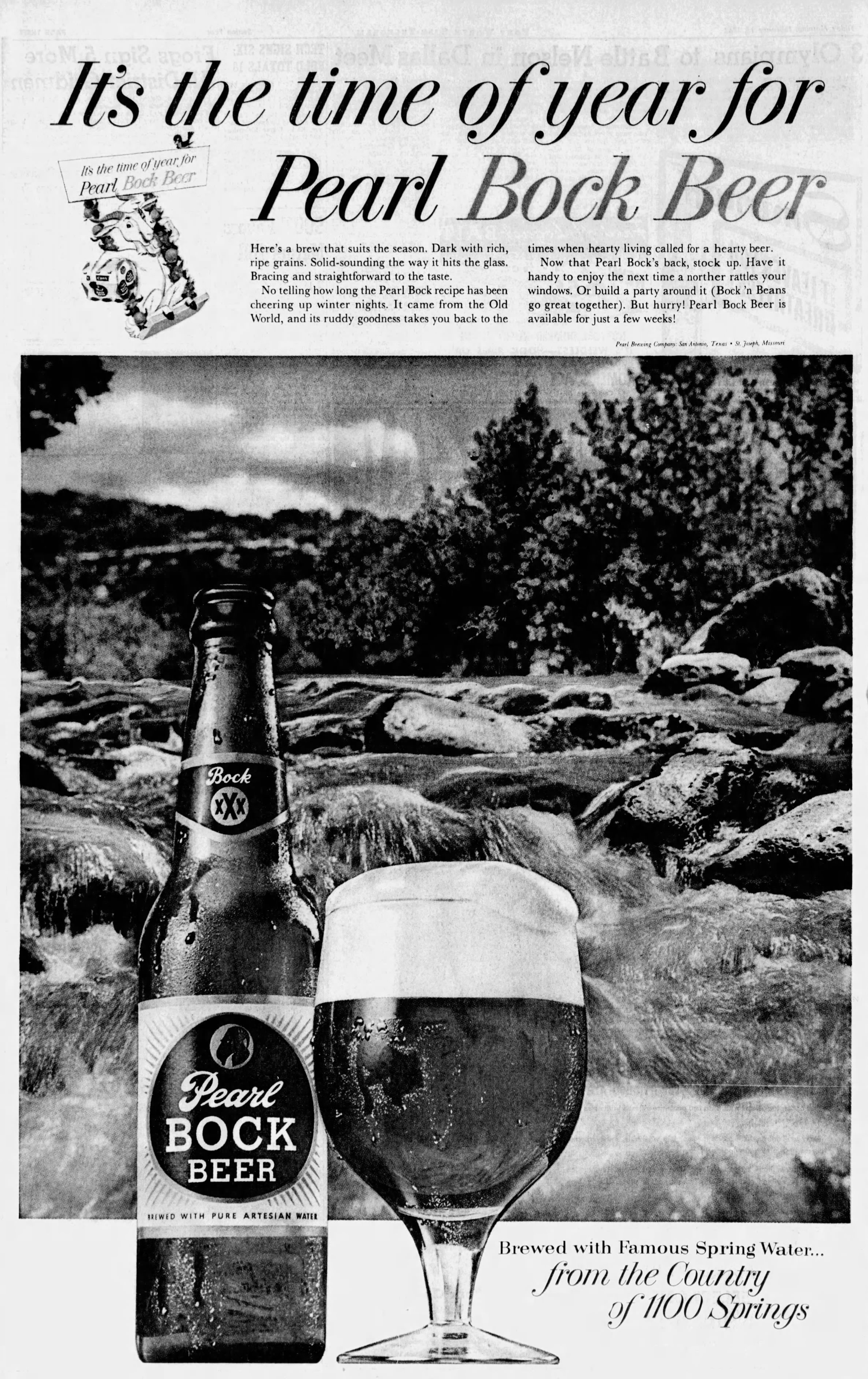
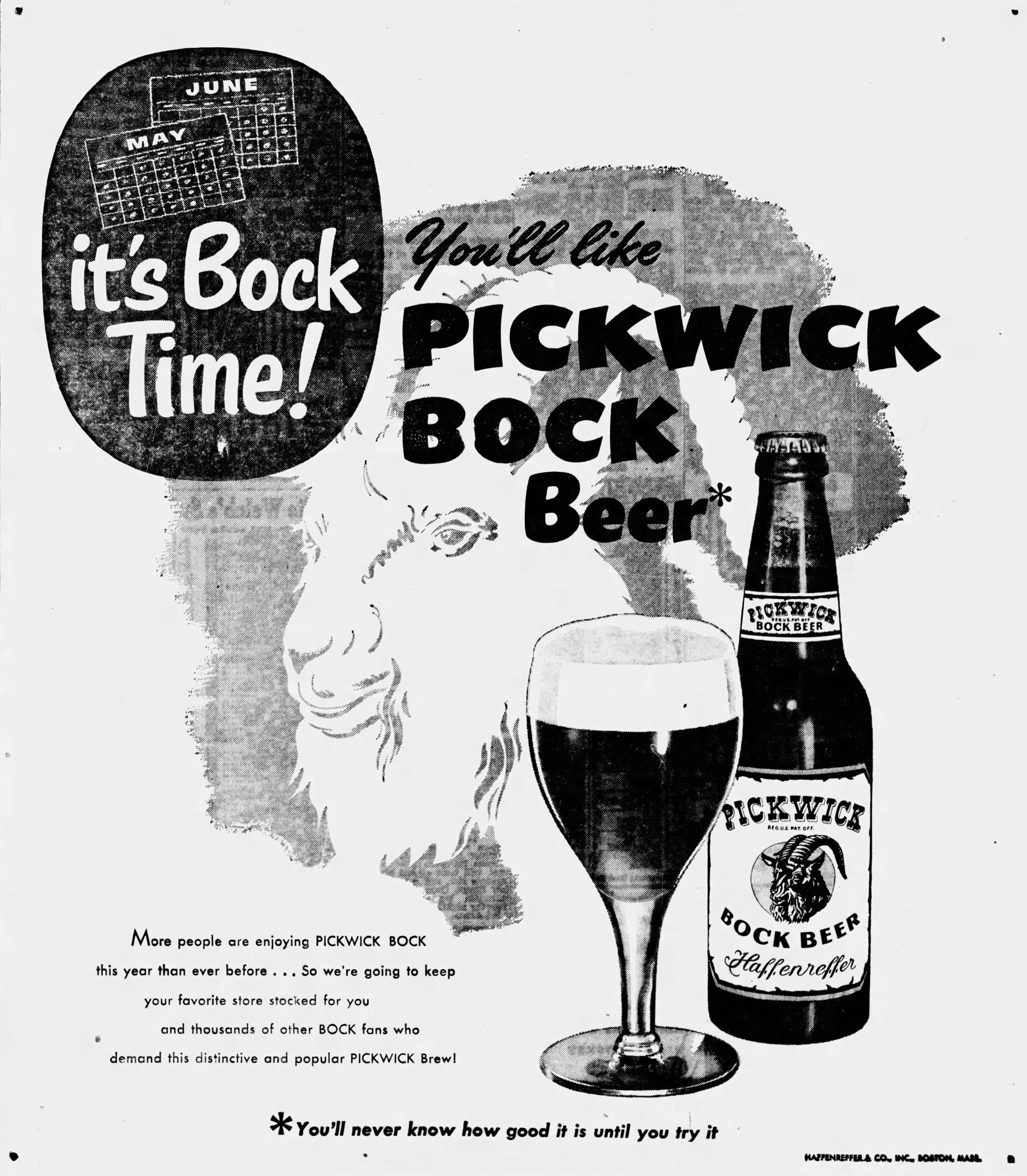
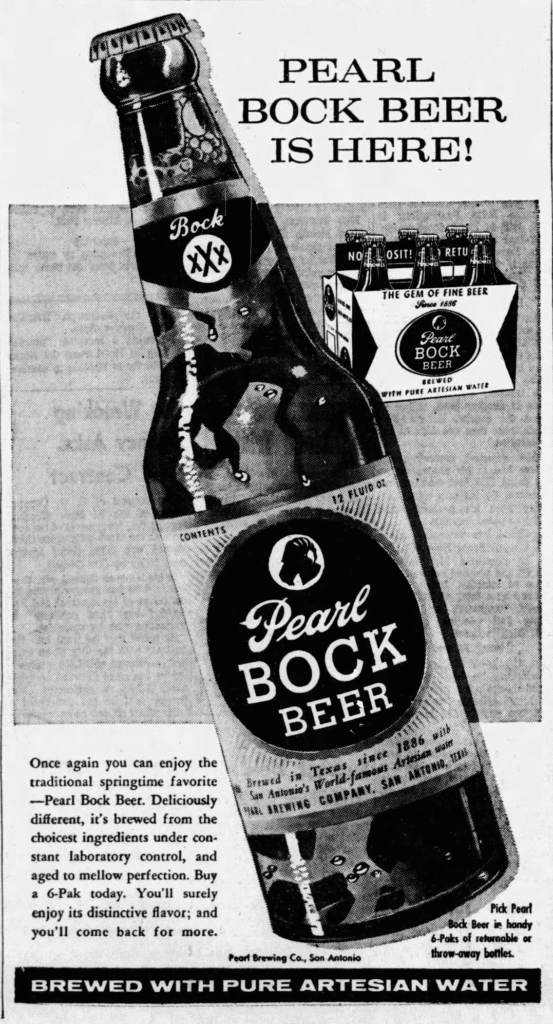
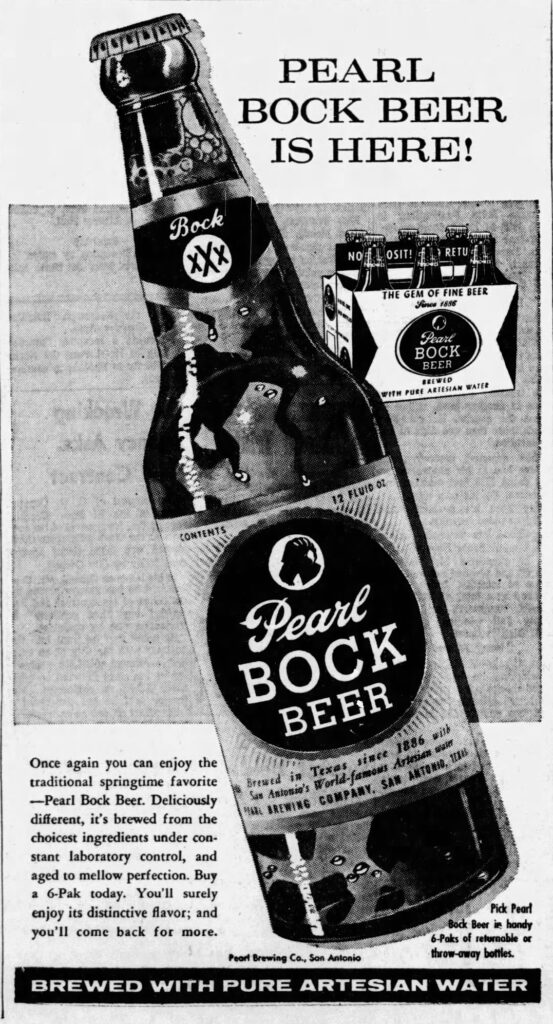
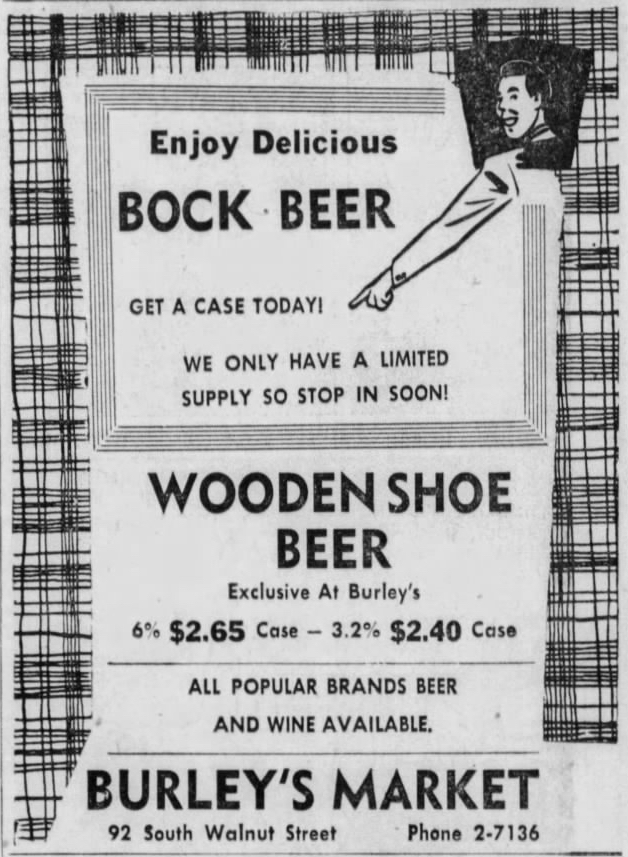
Last year I decided to concentrate on Bock ads. Bock, of course, originated in Germany, in the town of Einbeck. Because many 19th century American breweries were founded by German immigrants, they offered a bock at certain times of the year, be it Spring, Easter, Lent, Christmas, or what have you. In a sense they were some of the first seasonal beers. “The style was later adopted in Bavaria by Munich brewers in the 17th century. Due to their Bavarian accent, citizens of Munich pronounced ‘Einbeck’ as ‘ein Bock’ (a billy goat), and thus the beer became known as ‘Bock.’ A goat often appears on bottle labels.” And presumably because they were special releases, many breweries went all out promoting them with beautiful artwork on posters and other advertising.
Tuesday’s ad is for Acme Bock Beer and was published April 1, 1935. The brewery was the Acme Brewing Co. of San Francisco, California, which was originally founded in 1907, though they also opened a location in the Los Angeles area. Today the brand is opened by North Coast Brewing. This ad ran in the Sacramento Bee of Sacramento, California, and shows what appears to be.a midsummer dance with several women and goats frolicking with the tagline” “Spring is here, Acme Bock Beer thrills every beer lover!”
Last year I decided to concentrate on Bock ads. Bock, of course, originated in Germany, in the town of Einbeck. Because many 19th century American breweries were founded by German immigrants, they offered a bock at certain times of the year, be it Spring, Easter, Lent, Christmas, or what have you. In a sense they were some of the first seasonal beers. “The style was later adopted in Bavaria by Munich brewers in the 17th century. Due to their Bavarian accent, citizens of Munich pronounced ‘Einbeck’ as ‘ein Bock’ (a billy goat), and thus the beer became known as ‘Bock.’ A goat often appears on bottle labels.” And presumably because they were special releases, many breweries went all out promoting them with beautiful artwork on posters and other advertising.
Monday’s ad is for FrankenMuth Bock Beer and was published March 31, 1965 in the Grand Rapids Press, of Grand Rapids, Michigan. The ad was for the International Breweries Inc., of Findlay, Ohio, and had this delightful headline: ‘If you like beer hearty … you’re in for the heartiest treat of your life … FrankenMuth Bock Beer.”
Last year I decided to concentrate on Bock ads. Bock, of course, originated in Germany, in the town of Einbeck. Because many 19th century American breweries were founded by German immigrants, they offered a bock at certain times of the year, be it Spring, Easter, Lent, Christmas, or what have you. In a sense they were some of the first seasonal beers. “The style was later adopted in Bavaria by Munich brewers in the 17th century. Due to their Bavarian accent, citizens of Munich pronounced ‘Einbeck’ as ‘ein Bock’ (a billy goat), and thus the beer became known as ‘Bock.’ A goat often appears on bottle labels.” And presumably because they were special releases, many breweries went all out promoting them with beautiful artwork on posters and other advertising.
Sunday’s ad is for Coors Genuine Bock Beer and was published March 30, 1934 in the Waco Times Herald, of Waco, Texas. The ad was for the Coors Brewing, of Golden, Colorado, and it’s apparently their first release of Bock post-prohibition.
Last year I decided to concentrate on Bock ads. Bock, of course, originated in Germany, in the town of Einbeck. Because many 19th century American breweries were founded by German immigrants, they offered a bock at certain times of the year, be it Spring, Easter, Lent, Christmas, or what have you. In a sense they were some of the first seasonal beers. “The style was later adopted in Bavaria by Munich brewers in the 17th century. Due to their Bavarian accent, citizens of Munich pronounced ‘Einbeck’ as ‘ein Bock’ (a billy goat), and thus the beer became known as ‘Bock.’ A goat often appears on bottle labels.” And presumably because they were special releases, many breweries went all out promoting them with beautiful artwork on posters and other advertising.
Saturday’s ad is for Poth’s Bock Beer and was published March 29, 1907 in the Philadelphia Inquirer, of Philadelphia, Pennsylvania. The ad was for the F.A. Poth & Sons Brewery, also of Philadelphia, and it’s an interesting advertising approach told in a story involving a waiter and restaurant patron having a conversation about bock beer.
Today is the birthday of William Alton Carter III, better known as Billy Carter (March 29, 1937–September 25, 1988). He “was an American farmer, businessman, and politician. Carter promoted Billy Beer, and was a candidate for Mayor of Plains, Georgia. He was also the younger brother of former Georgia Governor and U.S. President Jimmy Carter,” who signed into law the bill re-legalizing homebrewing.
He was a proud redneck, and capitalized on his image as a beer-drinking roughneck bumpkin to sell Billy Beer.
Billy Beer was a beer first made in the United States in July 1977, by the Falls City Brewing Company. It was promoted by Billy Carter, whose older brother Jimmy was the incumbent President of the United States. In October 1978, Falls City announced that it was closing its doors after less than a year of Carter’s promotion. The beer was produced by Cold Spring Brewing, West End Brewing, and Pearl Brewing Company.
Each can from the four breweries that produced it were slightly different. And you can see those differences in the cans below.
“After Billy Beer ceased production, advertisements appeared in newspapers offering to sell Billy Beer cans for several hundred to several thousands of dollars each, attempting to profit from their perceived rarity. However, since the cans were actually produced in the millions, the real value of a can ranged from 50 cents to one dollar in 1981.”
“Billy Beer was also featured on an episode of the reality series Auction Kings, where an appraiser deemed a case of unopened Billy Beer to be worthless; however, at the featured auction, the case was sold for $100.”
Here’s part of his story from 6 Presidential Siblings and the Headaches They Caused, published in Mental Floss:
Truly the standard by which all other presidential sibling’s antics are judged, Billy burst onto the national scene as the boisterous, hard-drinking counterpoint to his pious, reserved brother Jimmy. Billy’s early antics were amusing and fairly innocuous: he endorsed the legendarily terrible Billy Beer in an effort to make a little cash off of his hard-living image, and he made quips like, “My mother went into the Peace Corps when she was sixty-eight. My one sister is a motorcycle freak, my other sister is a Holy Roller evangelist and my brother is running for president. I’m the only sane one in the family.” While he worked hard to convey a roughneck bumpkin image to the press, Billy’s confidantes claimed that he was in fact well-read and an able businessman who used his Southern bona fides to help his older brother’s political cause. On the other hand, Billy’s drinking turned from amusing to tragic as his fame grew.
In 1979, he had to go into rehab to curb his drinking. Around the same time he nearly lost his Georgia home to the IRS for failing to pay a six-figure federal income tax bill for 1978.
The real capper, though, came when Billy began consorting with Libya at a time when relations between the North African nation and the U.S. were starting to strain. In 1978 he made a trip to Libya with a group of Georgia businessmen who were interested in expanding trade with the country; Billy then hosted a Libyan delegation in Atlanta. When questioned about his dealings, Billy responded, “The only thing I can say is there is a hell of a lot more Arabians than there is Jews,” a public-relations nightmare for which he later apologized. The damage got worse in 1980 when Billy registered as an agent of the Libyan government and received a $220,000 loan from the Libyans for helping facilitate oil sales. This transaction led to accusations of influence peddling and a Congressional investigation. In short, it was enough to make Jimmy Carter long for the days when his brother’s antics only included such little quirks as urinating in public in front of a group of reporters and dignitaries.
Mental Floss has an article entitled A Brief History of Billy Beer, which is actually a reasonably thorough account.
Folk Figure, Businessman. Known for his outlandish public behavior, he was a younger brother of former Georgia Governor and US President Jimmy Carter. After graduating from high school, he attended Emory University in Atlanta, Georgia but did not complete a degree. He then served four years in the US Marine Corps and after his discharge, he returned to Plains, Georgia to work with his brother in the family business of growing peanuts. In 1972 he purchased a gas and service station in Plains and operated it for most of the 1970s. In 1976 he attempted to enter the political ring when he ran for mayor of Plains but lost the election. In 1977 he endorsed Billy Beer, capitalizing upon his colorful image as a beer-drinking Southern “good ol’ boy” that developed in the press when his brother ran for US President. After Billy Beer failed, he was forced to sell his house to settle back taxes owed to the Internal Revenue Service. In late 1978 and early 1979, he visited Libya three times with a contingent from Georgia, eventually registering as a foreign agent of the Libyan government and received a $220,000 loan. This led to a US Senate hearing on alleged influence peddling which the press named “Billygate.” In the autumn of 1987, he was diagnosed with pancreatic cancer, and after receiving unsuccessful treatments for the disease, he died the following year at the age of 51. In 1999 his son, William “Buddy” Carter, published a biography of his father titled “Billy Carter: A Journey Through the Shadows.”
The hit television show The Simpsons featured Homer drinking a can of Billy Beer in the 1997 episode “Lisa the Skeptic”; after Bart tells him that the skeleton he is trying to hide is probably old enough already, he counters Bart’s remark by introducing his Billy Beer stating that people said the same thing about the beer. After he drinks the beer, he says “We elected the wrong Carter”. Also in the 1992 episode “The Otto Show”, Homer excitedly finds a can of Billy Beer in the pocket of his old “concert jacket”, and drinks it.
Last year I decided to concentrate on Bock ads. Bock, of course, originated in Germany, in the town of Einbeck. Because many 19th century American breweries were founded by German immigrants, they offered a bock at certain times of the year, be it Spring, Easter, Lent, Christmas, or what have you. In a sense they were some of the first seasonal beers. “The style was later adopted in Bavaria by Munich brewers in the 17th century. Due to their Bavarian accent, citizens of Munich pronounced ‘Einbeck’ as ‘ein Bock’ (a billy goat), and thus the beer became known as ‘Bock.’ A goat often appears on bottle labels.” And presumably because they were special releases, many breweries went all out promoting them with beautiful artwork on posters and other advertising.
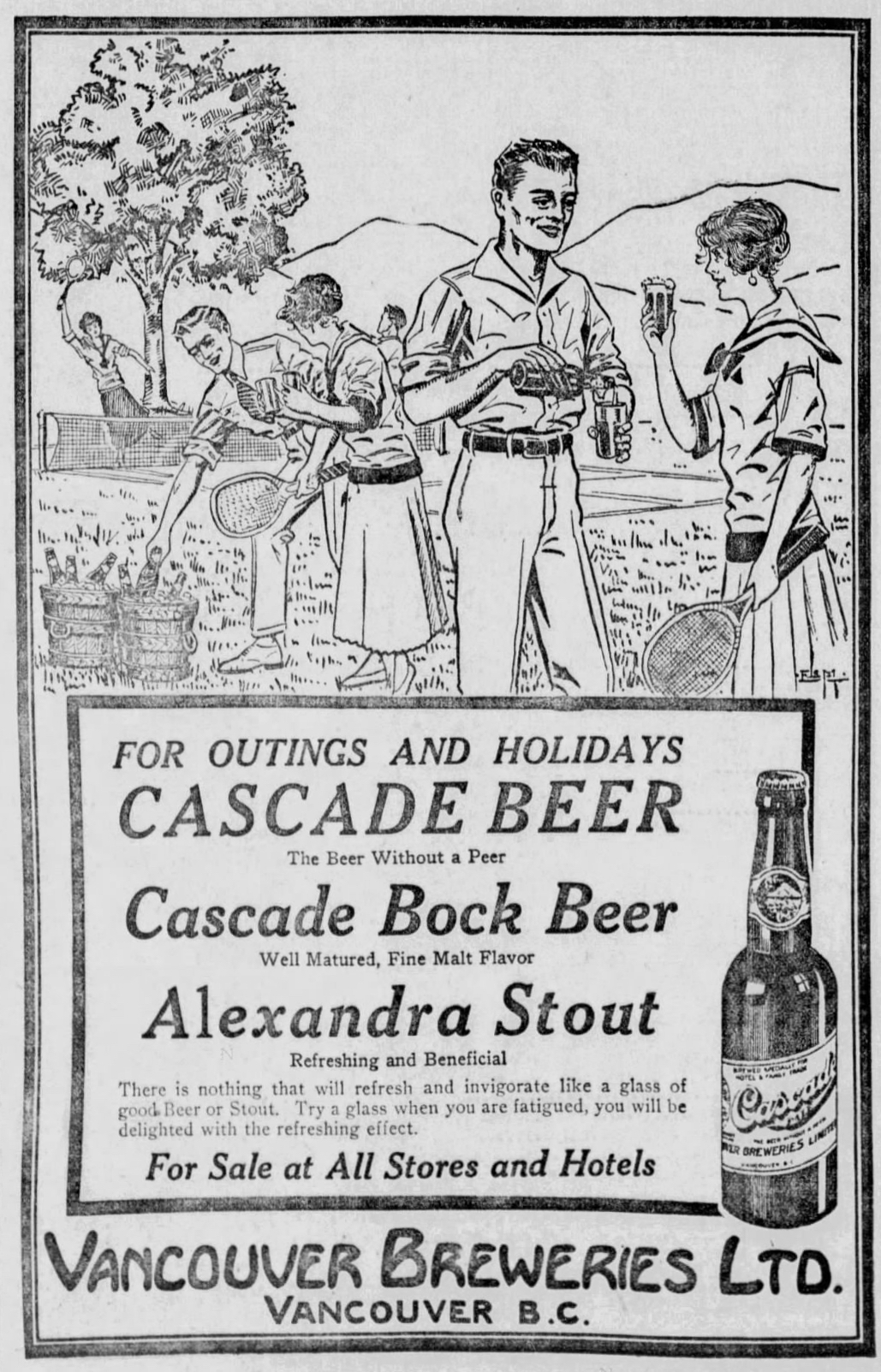
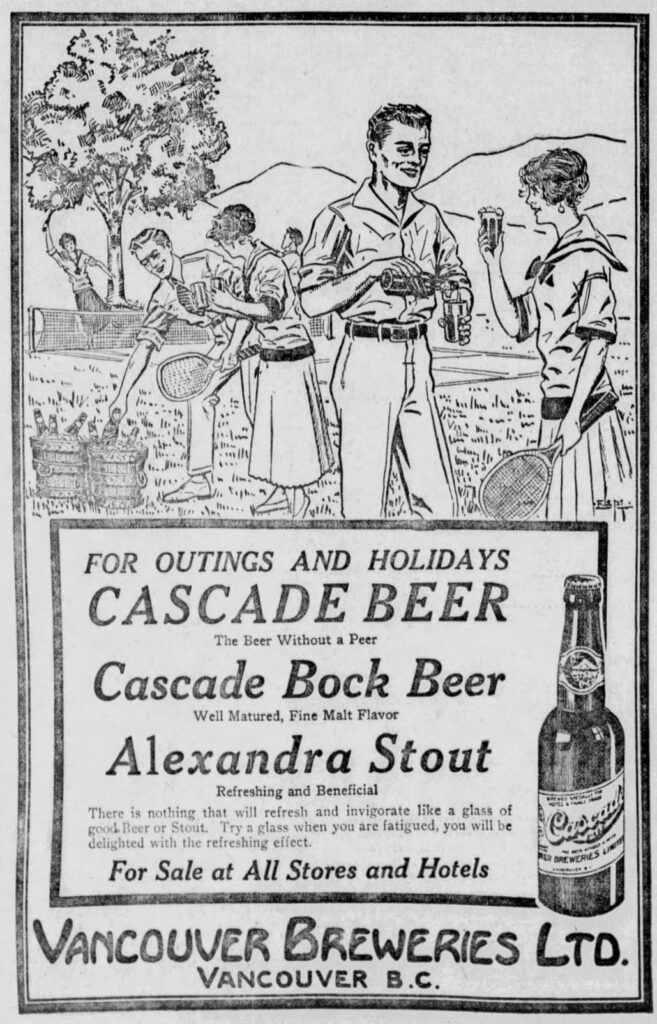
Friday’s ad is for Bock Beer for several Canadian breweries and was published March 28, 1928 in the Vancouver Sun. The ad mentions that bock will be available at Government Liquor Stores beginning on April 7, and includes bock beer from Vancouver Breweries, Westminster Brewery, Rainier Brewing Co. of Canada, Silver Spring Breweries, and Victoria-Phoenix Brewing Co. But it’s the fable that’s the most interesting part of this ad.
Last year I decided to concentrate on Bock ads. Bock, of course, originated in Germany, in the town of Einbeck. Because many 19th century American breweries were founded by German immigrants, they offered a bock at certain times of the year, be it Spring, Easter, Lent, Christmas, or what have you. In a sense they were some of the first seasonal beers. “The style was later adopted in Bavaria by Munich brewers in the 17th century. Due to their Bavarian accent, citizens of Munich pronounced ‘Einbeck’ as ‘ein Bock’ (a billy goat), and thus the beer became known as ‘Bock.’ A goat often appears on bottle labels.” And presumably because they were special releases, many breweries went all out promoting them with beautiful artwork on posters and other advertising.
Thursday’s ad is for Braumeister Bock Beer and was published March 27, 1950. “Braumeister Bock Beer: The Only Genuine Milwaukee Bock Beer at the Regular Price,” which was originally published March 22, 1955 in the Saginaw News, which I believe was in Saginaw, Michigan, a medium-sized town in Eastern MIchigan located just below Saginaw Bay by Lake Huron. The brewery was the Independent Milwaukee Brewery of Milwaukee, Wisconsin, which was founded in 1901 by five partners: Henry N. Bills, William Gutknecht, Charles Evers, Emil Czarnecki, and William Jung. It’s flagship brand was Braumeister. The survived Prohibition and lasted until 1962, when the G. Heileman Brewing Co. of nearby Lacrosse bought the brewery and closed it down the following year. This ad ran in the Cincinnati Post, of Cincinnati, Ohio, and includes the headline: “It’s WISE to Ask for ‘Milwaukee’s Choicest’ Bock beer” and features our intrepid genius goat, wearing glasses and mortarboard and tassel. The same ‘wise’ goat was featured in an earlier ad for Braumeister Bock and elicited several comments pondering why it was wearing eyeglasses. I think we can safely say it was to make him appear smarter.
Last year I decided to concentrate on Bock ads. Bock, of course, originated in Germany, in the town of Einbeck. Because many 19th century American breweries were founded by German immigrants, they offered a bock at certain times of the year, be it Spring, Easter, Lent, Christmas, or what have you. In a sense they were some of the first seasonal beers. “The style was later adopted in Bavaria by Munich brewers in the 17th century. Due to their Bavarian accent, citizens of Munich pronounced ‘Einbeck’ as ‘ein Bock’ (a billy goat), and thus the beer became known as ‘Bock.’ A goat often appears on bottle labels.” And presumably because they were special releases, many breweries went all out promoting them with beautiful artwork on posters and other advertising.
Wednesday’s ad is for Acme Bock Beer and was published March 26, 1936. The brewery was the Acme Brewing Co. of San Francisco, California, which was originally founded in 1907, though they also opened a location in the Los Angeles area. Today the brand is opened by North Coast Brewing. This ad ran in The Tribune, of San Luis Obispo, California, and includes the headline: “Too Good To Last” and features a woman in a fancy dress holding a glass of beer.
I’ve been sharing bock beer ads and posters in my daily Beer in Art series and while researching and collecting ads to post came across this interesting tidbit at the Library of Congress website detailing a trademark application for the True W. Jones Brewing Co. of Manchester, New Hampshire. The brewery was founded in 1879 as the New Hampshire Brewing Co., but in 1891 changed its name to the True W. Jones Brewing Co., which it remained until it closed in 1917.
But this trademark application was approved today, March 26, 1895, for their “Jones Bock Ale.” You can see that the submitted artwork was hand drawn when examined close-up, which is pretty cool.
But perhaps even more interesting is to see the whole page application submitted by the brewery. According to the paperwork, they started using the mark November 1, 1893. It’s fun to see all the notes and signatures around the margins. Unfortunately, presumably since this was 130 years ago and the brewery’s been closed for 108 years, there’s no additional information about the beer, or for that matter about the brewery. His arguably more famous brother, Frank Jones, owned a very successful brewery (by the 1870s was the largest ale brewery in the country) in nearby Portsmouth, and in addition was a politician who the mayor of Portsmouth and later was elected to the U.S. Congress. But both appear to have been ale breweries, so I suspect they brewed an ale version of a bock to satisfy customer demand.