
Our 46th Guinness poster by John Gilroy features our intrepid zookeeper waking up Christmas morning to find a bottle of Guinness in his stocking, hung on his bedpost. The slogan is again “My Goodness, My Christmas Guinness.” Hoppy Christmas.
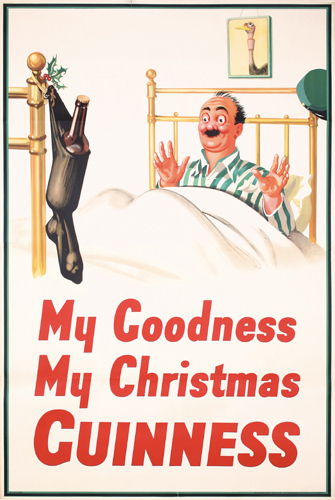

Our 46th Guinness poster by John Gilroy features our intrepid zookeeper waking up Christmas morning to find a bottle of Guinness in his stocking, hung on his bedpost. The slogan is again “My Goodness, My Christmas Guinness.” Hoppy Christmas.

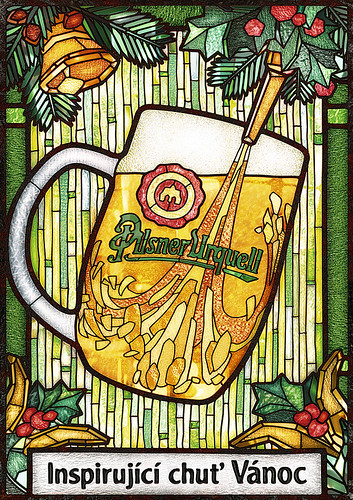
Friday’s holiday ads are for Pilsner Urquell, in honor of it being National Lager Day. And one of the best is without a doubt is the original pilsner, Pilsner Urquell. I don’t believe the ads are more than a few years old, but I love the faux stained glass look of them. Who wouldn’t love those in their beer room, with the light streaming through into your own private church of beer?
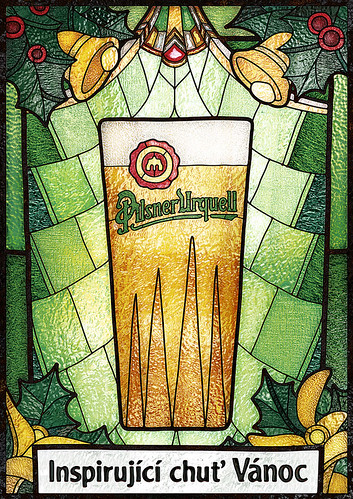
The first two words mean “Inspiring taste” in Czech, but I don’t know what the third word means. Anybody know?

I think the iconic bottle ad is my favorite, but they’re all pretty cool.
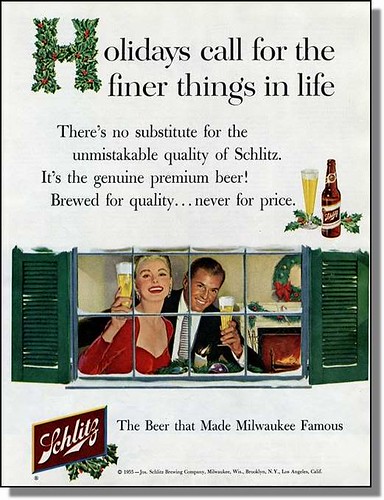
Thursday’s holiday ad is for Schlitz, from 1955. The slogan is “Holidays call for the finer things in life,” and since I’m in my way to a fancy party tonight, this ad made the most sense. Too true.

For reasons passing understanding, apart from anti-alcohol propaganda, beer is forbidden from advertising its many recognized health benefits. For people against alcohol, saying beer is good for you, or at least isn’t bad for you (in moderation), is apparently the same as saying “drink up.” And for goodness sake, we’d never want to tell people to do something that might be good for their health, especially if a small minority can’t handle the truth … er, the beer.
But despite our peculiar inability to be reasonable regarding alcohol, beer and health have been inextricably linked since the beginning of civilization when drinking beer was safer than the water. But there may have been at least one more medicinal use of beer, at least in the variety brewed by ancient Nubians, “an ethnic group originally from northern Sudan, and southern Egypt now inhabiting East Africa and some parts of Northeast Africa.” And for a time, they even ruled over ancient Egypt, beginning in the 25th Dynasty.
Conventional wisdom has it that the use of antibiotics is a modern invention, thought to be no more than eighty years old, but archeologists have found in the bones of ancient Nubian skeletons traces of tetracycline, “a broad-spectrum polyketide antibiotic produced by the Streptomyces genus of Actinobacteria, indicated for use against many bacterial infections.” This suggests that the use of antibiotics may be 2,000 years older than previously thought.
From Discovery News’ coverage:
Some of the first people to use antibiotics, according to the research, may have lived along the shores of the Nile in Sudanese Nubia, which spans the border of modern Egypt and Sudan.
“Given the amount of tetracycline there, they had to know what they were doing,” said co-author George Armelagos, a biological anthropologist at Emory University in Atlanta. “They may not have known what tetracycline was, but they certainly knew something was making them feel better.”
Armelagos was part of a group of anthropologists that excavated the mummies in 1963. His original goal was to study osteoporosis in the Nubians, who lived between about 350 and 550 A.D. But while looking through a microscope at samples of the ancient bone under ultraviolet light, he saw what looked like tetracycline — an antibiotic that was not officially patented in modern times until 1950.
And Physorg.com adds this, from Emory anthropologist George Armelagos and medicinal chemist Mark Nelson of Paratek Pharmaceuticals:
“We tend to associate drugs that cure diseases with modern medicine,” Armelagos says. “But it’s becoming increasingly clear that this prehistoric population was using empirical evidence to develop therapeutic agents. I have no doubt that they knew what they were doing.”
Armelagos is a bioarcheologist and an expert on prehistoric diets. In 1980, he discovered what appeared to be traces of tetracycline in human bones from Nubia dated between A.D. 350 and 550. The ancient Nubian kingdom was located in present-day Sudan, south of ancient Egypt.
Armelagos and his fellow researchers later tied the source of the antibiotic to the Nubian beer. The grain used to make the fermented gruel contained the soil bacteria streptomyces, which produces tetracycline. A key question was whether only occasional batches of the ancient beer contained tetracycline, which would indicate accidental contamination with the bacteria.
Their results were published in the September issue of the American Journal of Physical Anthropology Here’s the abstract:
Histological evidence of tetracycline use has been reported in an ancient X-Group population (350–550 CE) from Sudanese Nubia (Bassett et al., 1980). When bone samples were examined by fluorescent microscopy under UV light at 490 Å yellow–green fluorophore deposition bands, similar to those produced by tetracycline, were observed, suggesting significant exposure of the population to the antibiotic. These reports were met skeptically with claims that the fluorescence was the result of postmortem taphonomic infiltration of bacteria and fungi. Herein, we report the acid extraction and mass spectroscopic characterization of the antibiotic tetracycline from these samples. The bone samples were demineralized in anhydrous hydrogen fluoride which dissolved the bone-complexed tetracycline, followed by isolation by solid phase extraction on reverse-phase media. Chemical characterization by high pressure liquid chromatography mass-spectroscopic procedures showed that the retention times and mass spectra of the bone extract were identical to tetracycline when treated similarly. These results indicate that a natural product tetracycline was detectable within the sampled bone and was converted to the acid-stable form, anhydrotetracycline, with a mass + H of 427.1 amu. Our findings show that the bone sampled is labeled by the antibiotic tetracycline, and that the NAX population ingested and were exposed to tetracycline-containing materials in their dietary regime.
As they discovered, the most likely source of their “dietary regime” that included the antibiotic was Nubian beer. Back in 2000, Armelagos figured out it was most likely the beer, and he published his findings in the magazine Natural History, in an articled entitled Take Two Beers and Call Me in 1,600 Years.
But back to Discovery News:
His team’s first report about the finding, bolstered by even more evidence and published in Science in 1980, was met with lots of skepticism. For the new study, he got help dissolving bone samples and extracting tetracycline from them, clearly showing that the antibiotic was deposited into and embedded within the bone, not a result of contamination from the environment.
The analyses also showed that ancient Nubians were consuming large doses of tetracycline — more than is commonly prescribed today as a daily dose for controlling infections from bad acne. The team, including chemist Mark Nelson of Paratek Pharmaceuticals, reported their results in the American Journal of Physical Anthropology.
They were also able to trace the antibiotic to its source: Grain that was contaminated with a type of mold-like bacteria called Streptomyces. Common in soil, Strep bacteria produce tetracycline antibiotics to kill off other, competing bacteria.
Grains that are stored underground can easily become moldy with Streptomyces contamination, though these bacteria would only produce small amounts of tetracycline on their own when left to sit or baked into bread. Only when people fermented the grain would tetracycline production explode. Nubians both ate the fermented grains as gruel and used it to make beer.
The scientists are working now to figure out exactly how much tetracycline Nubians were getting, but it appears that doses were high that consumption was consistent, and that drinking started early. Analyses of the bones showed that babies got some tetracycline through their mother’s milk.
Then, between ages two and six, there was a big spike in antibiotics deposited in the bone, Armelagos said, suggesting that fermented grains were used as a weaning food.
Today, most beer is pasteurized to kill Strep and other bacteria, so there should be no antibiotics in the ale you order at a bar, said Dennis Vangerven, an anthropologist at the University of Colorado, Boulder.
But Armelagos has challenged his students to home-brew beer like the Nubians did, including the addition of Strep bacteria. The resulting brew contains tetracycline, tastes sour but drinkable, and gives off a greenish hue.
Maybe that could be used for St. Patrick’s Day? As for the antibiotics, they’re not even the only medicinal uses of beer in ancient in times, according to Armelagos:
The first of the modern day tetracyclines was discovered in 1948. It was given the name auereomycin, after the Latin word “aerous,” which means containing gold. “Streptomyces produce a golden colony of bacteria, and if it was floating on a batch of beer, it must have look pretty impressive to ancient people who revered gold,” Nelson theorizes.
The ancient Egyptians and Jordanians used beer to treat gum disease and other ailments, Armelagos says, adding that the complex art of fermenting antibiotics was probably widespread in ancient times, and handed down through generations.
Pretty fascinating stuff. It’s too bad you can’t get antibiotics today by the case … or keg.
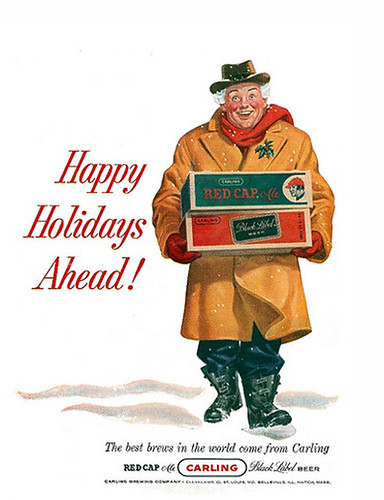
Wednesday’s holiday ads are for Carling, both their Black Label and Red Cap beers. Both of the ads are from the 1950s. They show the same jolly fellow carrying home a case or two of beer in the snow and promising they’ll provide “Happy Holidays Ahead!” Frankly, he already looks so happy I believe him.
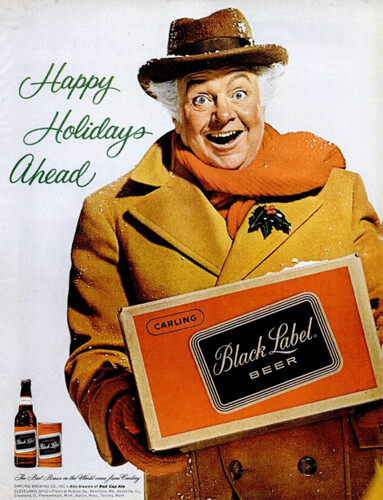
The second ad is for just Carling Black Label.

Thanks to Pete Slosberg — he of the formerly wicked persuasion — for passing this along. It’s not strictly about beer, so feel free to ignore it if math and history isn’t your cup of beer. Today’s New York Times Science has a fun article, Math Puzzles’ Oldest Ancestors Took Form on Egyptian Papyrus, about how the Rhind Mathematical Papyrus contains several clever math puzzles, including some thought to be more modern and also having to do with beer.
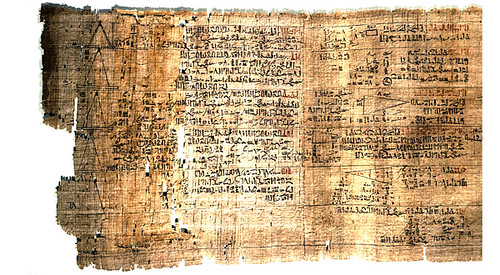
For example, some of the puzzles “involve a pefsu, a unit measuring the strength or weakness of beer or bread based on how much grain is used to make it,” such as this one:
One problem calculates whether it’s right to exchange 100 loaves of 20-pefsu bread for 10 jugs of 4-pefsu malt-date beer. After a series of steps, the papyrus proclaims, according to one translation: “Behold! The beer quantity is found to be correct.”
Fun stuff. I wonder what “pefsu” is compared to say a.b.v.?
Tuesday’s holiday ad is for Michelob, from 1977, where “Holidays were made for Michelob.” Check out the disco outfits the party-goers are wearing and at least they show several Michelob logo glassware in the foreground. And notice the people are actually using glasses to drink their beer. That’s a rarity in older ads. Must be a holiday thing.
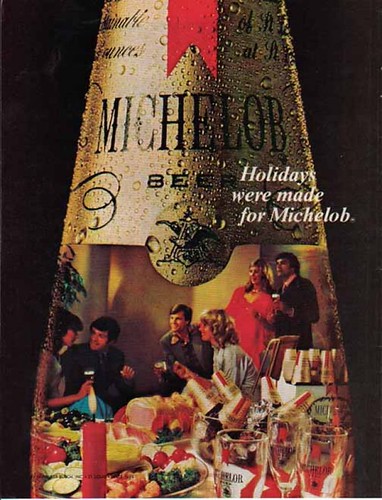
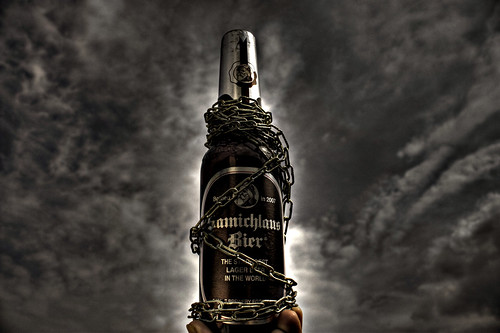
Monday’s holiday ad is for Samichlaus Bier, now brewed at Schloss Eggenberg in Austria each year on December 6 — today — because the beer’s namesake, Santa Claus, or at least St. Nicholas, has his feast day today.
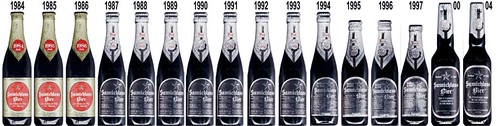
Below is an interesting graphic of the changes in Samichlaus bottles over the years from 1984 to 2004.

This week’s work of art comes courtesy of Eric Steen, who also writes the beer blog Beer and Sci-Fi. We got to talking about beer and art during the recent Beer Bloggers Conference in Boulder last month and Eric told me the story of how the Portland Art Museum commissioned him to do an art & beer project the last two years as a part of their Shine A Light, a non-traditional one-night experience showing art in a different light. For the project, Steen “invited three breweries to tour the museum. They each selected an art piece and then brewed beer inspired by that artwork. For the first Shine A Light exhibition in 2009, Chad Kennedy, from Laurelwood Public House & Brewery, chose Homesteaders, by Arthur Runquist, which was painted in 1939.
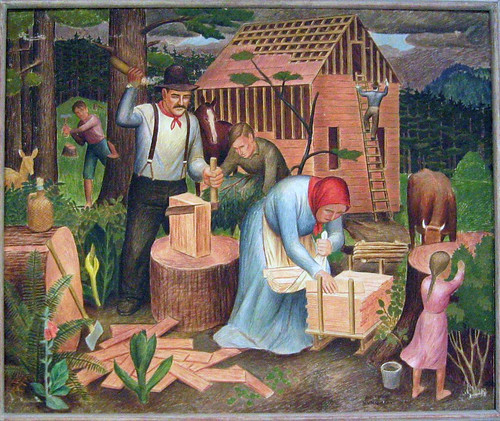
Homesteaders is an oil painting, on canvas, 38.5 in. wide by 32.5 in high and is the Fine Arts Collection, Public Buildings Service, U.S. General Services Administration. It was created as a part of the WPA, or the Works Progress Administration, back in the day when the government actually cared about art and supported it. Today, the painting is owned by the Portland Art Museum.
For Steen’s art & beer project, he curated his concept by putting together art with beer to fulfill his concept of the two being paired together.

Chad Kennedy with the beer he made, inspired by Homesteaders, that was served for free to museum guests. (photo by Vivian Johnson)
As Kennedy explained his choice of the Homesteaders:
Homesteaders by Arthur Runquist drew me in for several reasons. The simplest and perhaps most obvious connection between my beer brewing and this painting was the corked bottle sitting on a log in the foreground of the painting. While this piece is about the hard work and perseverance of pioneers and laborers (this is a WPA funded piece), the bottle in the forefront signals the rewards of hard work – this is very similar to how I see our beers’ role in society.
Secondly, the subjects in this painting are working as a team to achieve a common goal. As a small brewery this reminds me of our work environment. Not only are we a small team of brewers, but as craft brewers, we’ve made the conscious choice of striking out on our own; sometimes taking big risks in hope of new experience, and if we’re lucky others will follow us and the journey will be a benefit for the greater good — In our case, making our beer culture stronger, moving away from mass marketed, lifeless beer.
Drawing inspiration from Homesteaders meant designing a beer that was out of the ordinary, took chances and struck out on its own. I considered the historical perspective of the painting and decided to utilize some non-traditional brewing ingredients – ingredients that likely would have been used by people in the painting to create a drink to help them relax when all the work was done.
Our beer still uses malted barley, but also contains malted wheat, corn and molasses for sources of sugar to ferment. In a nod to the fermentation vessels of the paintings day — we added a small dose of American oak to the fermented beer giving it a slight “woody” character. The beer doesn’t fall into a style but tries to take us flavor-wise to a place we’ve never been. In doing so, I hope the beer, as well as the painting, take you on a unique and inspiring journey.
In the video below, local artist Carson Ellis gives a short talk about Homesteaders, by Arthur Runquist.
To learn more about Runquist, the Laura Russo Gallery has a biography and a small gallery of his work.

Thanks to Rob Fullmer (a.k.a. olllllo) at Beer PHXation for letting me know about this weirdness. Arizona recently relaxed its 2005 law regarding the sampling of beer, wine and spirits in grocery stores. But one town mayor, John Lewis of Gilbert, Arizona, isn’t happy that someone might be able to have an ounce or two of alcohol, especially if he happens to be in the vicinity of that tasting with his children.
According to the Arizona Republic, he thinks having his kids see people even sipping alcohol will have untold consequences and will undo his careful parenting to, presumably, keep his children from ever seeing demon alcohol anywhere throughout their lives. Here’s how the Gilbert mayor put it:
Lewis recently called on local grocers to “withstand the temptation” to offer free taste-testing of beer, wine and spirits at their stores. He said his family frequently shopped at Sam’s Club, for example, and he would not want his children to be in an atmosphere where alcohol could be sipped.
“For the image and preservation of what has been building Gilbert as a family-centered community, I hope we would not approve the sampling privileges in a family environment,” Lewis said.
I love Fullmer’s response in Beer PHXation:
Apparently Lewis, a grown man, finds the task of teaching his children about the responsible and legal enjoyment of alcohol (or the abstention of it for that matter) in the mere presence of adults tasting 1 or 2 ounces — while still maintaining a code of conduct suitable for the likes of a Sam’s Club — capable of erasing years worth of parental upbringing.
Having a family environment and an educational and informative environment for alcohol use are not mutually exclusive, in fact, the family environment IS the proper environment.
Precisely. What exactly is the problem with seeing adults having a simple taste of alcohol in a responsible, legal environment? This is the sort of modeling behavior we should want our kids to see. Lewis is so far off the deep end that he’s not just upset that his kids might actually see people drinking, he’s even bothered by “an atmosphere where alcohol could be sipped.” [my emphasis.] That means just the thought of there being a place where alcohol “could be sipped,” that there’s a possibility it might happen, is enough to worry him. That he could walk past even an empty roped off area, children in tow, is just too much for him to bear.
Not to get too personal, but according to his bio, he’s been married for 29 years, has 8 kids and 4 grandchildren. The likelihood that he even has impressionable little kids to actually walk through the grocery store with seems somewhat unlikely. So what he’s doing is just political grandstanding.
But his suggestion that somehow sampling alcohol is incompatible with family I find most offensive. I have a family. Countless brewers and beer lovers have families and see no contradiction with the two. That’s because there is no contradiction. Adults can enjoy a drink responsibly without damaging their family. People have being doing so for time immemorial. Why is is that some people believe that there is only one way to parent … their way?
When the bill passed the state legislature, only one representative voted against it, republican Andy Biggs, whose district includes — you guessed it — Gilbert. For him, it was all about the doughnuts, to wit:
“I go in with my kids to go get doughnuts at the Safeway,” Biggs said. “It’s one thing to walk through the liquor department to go to the bakery, but it’s something else when you’ve got people there serving alcoholic beverages.”
Seriously, it’s about his freedom to buy doughnuts without seeing alcohol? What exactly is wrong with these people? Why is it “something else,” whatever that even means, if there is beer sampling? I feel confident he could take another route to reach the bakery. But failing that, if it’s such a big deal couldn’t he just buy his doughnuts somewhere else? Nothing against Safeway, but they’re not exactly the gold standard for pastry.
It just feels like, based on their nonsensical comments, that this is personal for both politicians. And they’re using their positions to force their own issues with alcohol on the rest of the people they represent, in a way that feels out of touch with the average person’s opinion. Obviously, it’s hard to know how any community feels about so complex an issue as alcohol, but I feel confident in saying that a majority of people there do at least drink it.
The original impetus for the bill was to give local alcohol manufacturers a chance to compete locally by allowing Arizona beer and wines to be sampled. As you might expect, Todd Bostock, president of the Arizona Wine Growers Association, believes that “most families wouldn’t be offended by in-store sampling because they already consume alcohol at the dinner table in front of their children. The more kids are exposed to responsible drinking, it won’t be a foreign thing to them,” Bostock said. “It’s not taboo.”
It certainly shouldn’t be, and based on the 54-1 vote it would appear most people agree.