Brookston Beer Bulletin

Jay R. Brooks on Beer

  • Home
  • About
  • Editorial
  • Birthdays
  • Art & Beer

Socialize

  • Dribbble
  • Email
  • Facebook
  • Flickr
  • GitHub
  • Instagram
  • LinkedIn
  • Pinterest
  • RSS
  • Twitter
  • YouTube

Powered by Genesis

PNC To Create Exclusive Beer At Allagash

September 5, 2009 By Jay Brooks

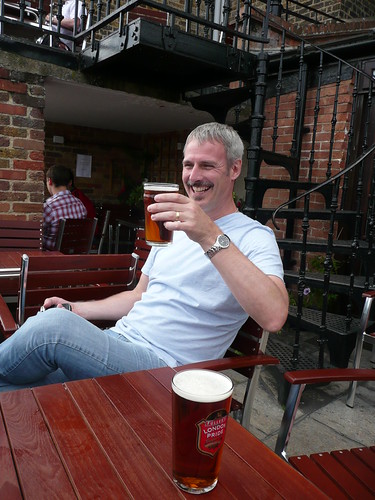
pnc-duvel
The Publican National Committee, or PNC — if you’re not familiar with them — is a group of Publicans that own some of the best beer bars in America. Current members include the owners of Brouwer’s Cafe, the Falling Rock Taphouse, the Horse Brass, Monk’s Cafe and the Toronado. One of the things they’re doing is working with brewers willing to make them a custom, exclusive beer that only members serve. The first PNC beer was brewed at Russian River Brewing and all the members got together there to help make the beer, which was dubbed Publication.

They’ve just announced that in October, they’ll be creating their second beer, this time at Allagash. No word yet on what kind of beer it will be, but I’m guessing it will be worth seeking out.
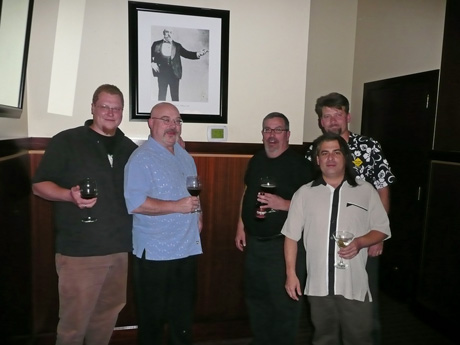
pnc08-6
At the PNC’s Second Convention in Denver 2008, all the members except Don Younger, who preferred to remain in the bar

Filed Under: Beers, Just For Fun Tagged With: Pubs

Session #31: Summer Beers

September 4, 2009 By Jay Brooks

summer
As this month marks the end of summer, our last summer Session takes on summer beers, courtesy of Peter Estaniel of the BeerBeerBlog. His take:

With the summer coming to a close, what was your favorite beer of the summer? It doesn’t even have to be from this summer. Is it a lager or maybe a light bodied wheat ale? Maybe you’re drinking anti-seasonally and are having a barleywine or Russian Imperial Stout. Why is this beer your favorite? Is there a particular memory associated with this beer? How about a city? Maybe there was a particular dish that made this beer memorable? Spare no detail.

For me, the most memorable summer drinking I did was in London, where I spent a week with fellow beer writer Stephen Beaumont visiting pubs, attending the Great British Beer Festival and endless (and vainly) searching for late night food. While by no means sweltering heat, London was, as always, more moist than the average California summer. They’d just come off a heatwave during the weeks before we arrived, and welcomed some rain. But it was certainly warm enough, staying in the narrow range of mid-70s to high 80s, even late into the evening.

session_logo_all_text_200

We walked around a fair bit of London, taking the tube whenever possible, but also sometimes we just wanted to be above ground, taking in the sights and sounds of the city. To be fair, there was another reason waking was more attractive at times. Besides even the mild summer weather, below ground it could be stiflingly hot, especially when we were sandwiched into the trains during busier times of the day, sweat pouring off of us.

To compensate ourselves, we’d often duck into a pub just for a quick pint, even though we were on our way to another pub, and one which quite possibly was only be fifteen minutes or so away. But thirst must be obeyed, and by god we were often thirsty. And there’s really nothing quite like a English ale on cask, the way nature intended, to quench one’s thirst. Not too cold, which would undoubtedly be a shock to the system, fairly low in alcohol (especially as compared with American beers), which meant we could enjoy more of them, and tasty as all get out. My favorite aspect of cask beer is just how much more flavor can be perceived; more complexity and, perhaps most importantly, more delicate characters. What more could you ask for in a summer beer?

Beaumont at the Dove
Stephen Beaumont at The Dove, a Fuller’s pub along the Thames near Hammersmith where we rested and recharged with a pint.

Even when most of the beers we enjoyed weren’t summer seasonals, but everyday offerings, they were ideally suited to the climate and the warm August weather. And they slaked our thirst almost perfectly.

Filed Under: Beers, The Session Tagged With: Seasonal Release, Summer

Macro Beer Prices Finally Going Up

August 28, 2009 By Jay Brooks

abib
(updated below)

Anheuser-Busch InBev (ABIB) announced a couple of days ago that come fall, their prices would be going up. MillerCoors also made it clear that they would be taking a price increase as well. The Wall Street Journal reported that “Anheuser-Busch InBev NV, the largest U.S. beer seller by revenue, and MillerCoors LLC will increase beer prices in the majority of their U.S. sales regions, the two companies said Tuesday.” Bloomberg added that, at least for ABIB, “the plan has met with “general acceptance” from retailers.”

Finally. This will probably end up being controversial — though it shouldn’t be — but I think that’s very good news. For a long while now, the major beer companies have all kept their prices to consumers artificially low to maintain their volume sales. Part of the reason is simply the competition among one another — the big guys that is — and none of them wanting to be the company that blinks first. I’ve watched this for many years, especially when I was a beer buyer for a chain of California stores, when each year the big companies would try to keep their price increases as small as possible. Now obviously, no company wants to raise its prices too much, but in the big beer business the increases over time have not kept pace with inflation and especially with the rise of ingredient costs and other factors, such as transportation, fuel, etc. There are likely several reasons for that, but chief among them is needing to keep sales volume up in order to maintain and increase the share price. And so over the past decade or two, none of the big beer companies have taken prices increases up as far as they otherwise would have if they were just looking at the cost to wholesale/retail price ratio. Even with the economy tanking, eventually someone has to blink. ABIB, with the InBev predisposition toward profit at all costs, seems poised to end this period of artificially low price points.

A side benefit for them, though most likely merely an externality, is that the price difference between the average big beer and a craft beer has widened, giving the impression that the macro beers are a far greater value. That’s because most craft brewers have not had the resources to do likewise and the price of their beer is more realistic, taking into account all their costs for ingredients, transportation, staff, and costs of doing business. A few have tried to keep the price to wholesalers down, but the increase in hops, barley and fuel over the last two years has made that increasingly difficult, even for the larger craft breweries. If ABIB raises their price (and MillerCoors follows suit, as they usually do) to more realistic levels, the price differential between a big beer and a craft beer should decrease, making it more likely that consumers might trade up to a craft beer, if the difference isn’t as great in doing so. Because of the economy, that’s already happening to some extent, with craft beer being seen as an affordable luxury from two directions. One, some people are trading down from more expensive bottles of wine or spirits to more affordable craft beer and, two, people trading up and treating themselves to a nice of bottle of beer, which isn’t stretching their wallet as much as a more expensive beverage. But if the price gap shrinks, we should see an increase in craft beer sales.

On the other hand, although it’s not a popular stance, I’ve long thought that craft beer should be more expensive than it is. It should be priced according to its value instead of against the more popular, but inferior tasting products. Organic food offers a good analogy. Organic food is more expensive to grow for a variety of reasons and thus costs more in the grocery store. But if people aren’t willing to pay a little bit more for it, it will disappear entirely and we’ll have little choice in the food we eat. Luckily, many people recognize that organic food, despite its more expensive price tag, offers additional benefits that make its increased price worthwhile. In a sense, you get what you pay for. If organic food tastes better, is healthier for you, often keeps money in the local economy, and is better in the long run for the planet’s sustainability, paying a little bit more for it isn’t just a good idea, but a moral imperative. I believe the same applies to craft beer.

We all tend to look for whatever is the cheapest and often forget about what “value” even means. I’m as guilty as the next guy, but I try to consider it whenever possible. We’ve all been indoctrinated with the idea — the “Wal-Mart Syndrome” — that value means cheaper, but that’s just not the case. If I pay more for a better constructed (and probably more comfortable) pair of shoes, and they last twice as long as the cheap pair, the expensive ones are the better value. Similarly, if I spend more more for a bottle of good beer, it will taste better and I’ll enjoy it more, making it a far better value.

A motto for this idea could be “drink less, enjoy it more.” That might not work for large companies that depend on volume, but there plenty of small sustainable craft breweries for whom that model would work perfectly. All we have to do is be willing to pay the price.

UPDATE: The L.A. Times ran a story yesterday entitled Is the Price Increase Justified?, citing a supply management expert, Bob Zieger, who took “issue with the idea that “general commodity prices” are behind beer price increases.” He continued:

“After all, beer is not made from a combination of pork bellies, copper and cocoa. Its key price drivers, like hops and barley, are actually not experiencing a serious price increase right now. If there was ever a time to blame commodity costs for a necessary price increase, it was last year,” Zieger said.

As any brewer can tell you, hop prices have not returned to the levels they were three years ago, nor have barley prices, though they have abated a little better than hops. Of course, hops and barley aren’t the only cost increases, as fuel and transportation costs have skyrocketed, too. Naturally, Zieger has a blog — doesn’t everybody? — called Supply Excellence where he expands his criticism. I think it’s unfortunate that the L.A. Times cited him as an expert because while he may know a lot about supply management and commodities generally, he doesn’t know the brewing industry, its particularities and the history of this issue. This gives a bad impression, I think, since it’s the only criticism they cite and in fact his thoughts were the story. While he’s certainly welcome to voice his opinion — and it was interesting to read his full blog post — it seems odd, and perhaps even a little wrong, for the L.A. Times to do a story calling into question one of the reasons given for an increase of beer prices without having any contrary opinion or indeed any person connected with the beer industry who knows anything about it. That just seems like irresponsible journalism to present one man’s opinion as a news story. Isn’t that what the op-ed section is for?

Filed Under: Beers, Breweries, Editorial, News Tagged With: Anheuser-Busch InBev, Economy, MillerCoors

I Am A Homebrewer Answers The Call

August 21, 2009 By Jay Brooks

aha
I’m not sure who’s actually responsible for this, but it’s a great answer from the homebrewing community to Greg Koch’s video I Am A Craft Brewer.

Filed Under: Beers, Just For Fun Tagged With: Homebrewing, Video

A Marketeer’s Take On Bud Light

August 19, 2009 By Jay Brooks

bud-light
Thanks to Anat Baron from Beer Wars, who tweeted this. Laura Ries, one half of the father-daughter Ries & Ries marketing consultants, who together wrote The 22 Immutable Laws of Branding and four other books.

She wrote a piece on her far-too-cleverly named Ries’ Pieces blog about the Bud Light brand. It’s interesting to read the take of someone who knows marketing but not the beer industry’s peculiarities.

Filed Under: Beers, Editorial Tagged With: Advertising, Anheuser-Busch InBev, Light Beer, Marketing

FDA Finally Rules On Gluten-Free

August 18, 2009 By Jay Brooks

gluten-free
I first became interested in gluten-free beer, and gluten-free generally, when my son was diagnosed as autistic. The autism spectrum is very wide and as my wife and I learned all we could about it, we discovered that many kids with ASD have what’s called a “leaky gut” which causes abdominal and/or intestinal problems. It is often treated by modifying their diet and restricting glutens, among other things, like caseins. As it happened, Porter never developed that symptom so it was never something we had to deal with, but it stuck with me.

So when Celiac Disease (CD) started becoming more common, and with it gluten-free diets, I was immediately intrigued by the idea of gluten-free beer. I attended a seminar at a Craft Brewers Conference four years ago on gluten-free beer and was surprised to find it standing-room only. Obviously, I was on to something and wrote an article for New Brewer magazine in 2006. In the course of researching the story, I discovered that Anheuser-Busch was developing a gluten-free beer, to be named Redbridge. I obtained a bottle from a test batch from UC Davis professor Michael Lewis, who I also discovered had recently developed CD himself. At that point, only three or four gluten-free beers were being packaged, though many other breweries were experimenting with draft versions.

But here’s the other weird thing I discovered, which was that these beers were not allowed to say “gluten-free” on the label. In Europe they’d adopted a standard as early as 2000, but the U.S. didn’t have one. Here’s what I wrote at the time:

What makes a product gluten-free is not without controversy, however. Generally, of course, it means products without glutens. But as with N/A beers, some trace amounts may be acceptable. The EU, in the Codex Alimentarius, adopted standards in 2000 that “gluten-free” could have either 20 ppm or 200 ppm, depending on the method of manufacture and the raw ingredients selected. The U.S. has not yet established a standard. In July of 2004, Congress passed the Federal Allergic Labeling and Consumer Protection Act, which required the FDA to write a definition of “gluten-free” for labeling. To date, they have not yet done so.

This means that currently beers cannot have “gluten-free” on the label. The TTB is presently waiting for the FDA’s definition, which they are currently working on with celiac organizations and other interested parties. Brewers currently work around this using marketing materials and through distributors and retailers, since they may put “gluten-free” on shelf talkers and the like.

So apparently we had to wait through the Bush years — five years — for the FDA to decide, which as of Monday, what they decided finally went into effect. According to the USA Today’s account:

Brewers of gluten-free beers have until Jan. 1, 2012, to begin adding nutrition labels to their products, including a declaration of major food allergens, which includes wheat. That’s the information people with celiac disease have been waiting for.

Up until now, they couldn’t be certain that a beer that claimed to be gluten-free really was. Under FDA regulations, there’s a standard for it.

Gluten-free beer makes up less than 0.1% of the beer market, says Paul Gatza of the Brewers Association in Boulder, Colo. The biggest players in the gluten-free beer market are Anheuser-Busch’s Red Bridge, Klisch’s Lakefront in Milwaukee, Wisconsin and Bard’s Tail from Norwalk, Conn., he says.

Celiacs have been buying these gluten-free beers for years, says Elaine Monarch, executive director of the Celiac Disease Foundation in Studio City, Calif. But accurate labels will be nice and the new FDA regulations may make it easier for European gluten-free beverages to enter the market, she says.

The standard they adopted is the 20 ppm one, the more rigid of the two used in Europe.

Filed Under: Beers, News Tagged With: Gluten-Free

Today Show Again Asks Wine Experts To Explain Beer

August 18, 2009 By Jay Brooks

today-show
For the second time in less than a year, the lazy producers at the Today Show had a segment about beer hosted by someone from Food & Wine magazine. This time it was Gail Simmons, who’s perhaps better known as a judge on the Bravo television show Top Chef. I’ve looked over her biography and I can’t for the life of me find any mention of beer whatsoever.

The advice she gives isn’t terrible, though it’s pretty basic to the point where she couldn’t really go too far off the rails. Most of the beers are fairly pedestrian, but they most likely have to be available for a national audience. It was nice at least to see Lagunitas IPA and Victory Prima Pils highlighted. Although I can’t for the life me understand why they put the IPA in a pilsner glass!?!

I know most people’s take on this is that we should be glad beer is getting any positive attention — and I am — but I’m also enough of a curmudgeon to want it to be on our terms. I know I keep hammering this point, but it just doesn’t seem that unreasonable to want wine experts to talk about wine, food experts to talk about food and plumbing experts to talk about plumbing. For almost any expertise you could name, that’s the way it’s done and most people would agree that makes sense. But when it comes to beer, mass media seems to believe almost anyone can be an instant expert on beer for no better reason than a familiarity with another alcoholic beverage or food more generally. And that’s likely because of their own ignorance, believing that beer is only the commodity it’s portrayed as by the big beer company’s advertising and marketing. That, plus being too lazy to take the time to learn anything different. But for fuck’s sake, there are plenty of beer magazines around these days. Surely they must have run across one of them. Perhaps they’ve heard of Google? A quick search would reveal hundreds, if not thousands, of people who know more about beer and food pairing than Gail Simmons.

Evidence of their ignorance comes out loud and clear when segment host Lester Holt tells Simmons the following. “Thanks for legitimizing beer. I’m one of those beer drinkers that feels funny ordering a beer in a nice restaurant instead of wine sometimes.” First of all, and no offense to Simmons, but she’s done nothing, absolutely nothing, to “legitimize” beer. That work has been done by thousands of dedicated craft brewers, beer writers and aficionados over thirty years of hard, patient work. Her magazine is now addressing craft beer because of the groundwork laid by all those people; she’s reacting to the market, not leading it. That Holt offhandedly gives her “credit” for so many other people’s hard work is deeply offensive and just plain pisses me off.

Secondly, why on Earth would anyone “feel funny” ordering what they want with a meal? How sad that anyone would feel they “must” order wine with any meal in a restaurant. When he made that statement, you could almost hear the collective marketing world patting themselves on the back. When you convince people that wine is the only thing to order in a fine restaurant to the point where they “feel funny” doing anything different, that’s a great victory for advertising. But when any industry persuades society to believe what they want them to wholesale and unquestioning, that can be deeply damaging to the world as a whole. Life becomes skewed, and I would argue that’s our world today. A century of advertising has made us “feel” certain things about brands, specific companies and their products. You have to marvel at the success of it all when you see millions of people voluntarily wear clothing with corporate logos on them, essentially paying for the privilege of advertising for them. That no one thinks twice about it boggles the mind.

With wine, this manifests itself in the way newspapers and other media have “wine sections” or “wine and food sections” that cover all beverages. Even the Today Show’s website has a Food & Wine section. Can somebody explain to my why it can’t be Food & Drink or Food & Beverage? Why is it always exclusive and not inclusive? Of course, like Food & Wine magazine, they all do occasionally include articles about beer, spirits and even coffee, so why not call it by a name that reflects that? Perhaps they’d cover beer more often if wine wasn’t in the title? I’d at least feel better if the Today Show’s “expert” came from, if not a beer magazine, at least a Food & Drinks magazine. That might go a long way to “legitimize beer” and their coverage of it.

Filed Under: Beers, Editorial Tagged With: The Today Show, TV, Video

Fishnet Cans

August 17, 2009 By Jay Brooks

beer-gal-2
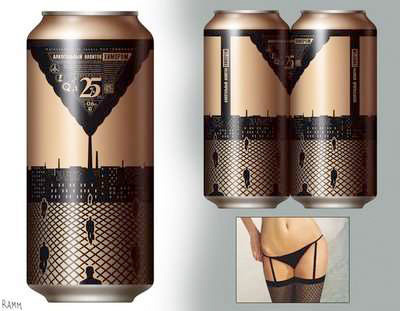
First there was Nude Beer (in its many incarnations), then Wanker, Skinny Blonde Ale and now comes the latest beer to play to the basest instincts of the male beer drinker: lingerie canned beer with fishnet stockings.

lingerie-beer

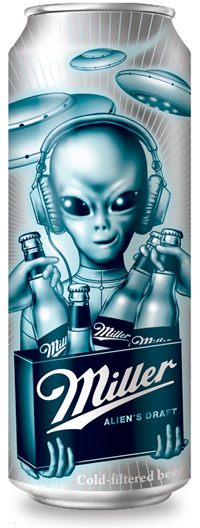
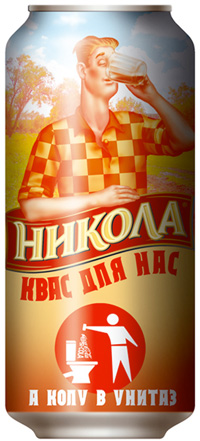
At least that was my original thought. The Fishnet Cans have been blogged and re-blogged all over that series of tubes known as the internet. But, as it turns out, they are just one of a pretty big series of can designs by Russian artist/illustrator Ramm ND. It’s not necessarily his or her fault that so many chose to highlight the one prurient themed can and ignored the more poignant works. Human nature is what it is. Take a closer look at the Fishnet Cans and you’ll begin to see new details that defy it being simply to titillate. Then take a look at his entire oeuvre of cans. Some are beer and some are soda, but they’re all more interesting than I would have guessed from just seeing the one in fishnets.

ramm-miller

In fact, going through Ramm’s entire portfolio is eye-opening. And I think he’s making some larger points. These aren’t just can designs, they’re works of art using cans as the medium.

ramm-hhkoaa

Ramm also has another portfolio on Coroflot.

Filed Under: Art & Beer, Beers, Editorial Tagged With: Cans, Packaging, Women

Asheron’s Call Brewing

August 16, 2009 By Jay Brooks

dice-2
Now don’t get me wrong. I am a geek of many stripes. So I mean no disrespect to my (possibly) geekier brethren who play online games in MMORPGs (which stands for Massively Multiplayer Online Role-Playing Games), the most popular of which are probably World of Warcraft, Second Life, Civilization IV and Runescape, to name but a few of the literally hundreds of them. I confess I’m no stranger to D&D, but it’s been nearly 30 years since I picked up an 8-sided die. When such games went online, they left me behind. It wasn’t that they weren’t without interest, but I recognized that I needed another time suck like a hole in the head, and simply stayed away. These online worlds have since increased exponentially in terms of detail, sophistication and complexity.

Asheron's_Call

Which brings me to Asheron’s Call, a ten-year old MMORPG. Originally created by Microsoft, since 2004 it’s been maintained and expanded by Turbine that takes place in the land of Dereth and its surrounding islands. In addition to the “official” game site, there are several fansites that add additional dimensions to the game. One of these is called Asheron’s Call Vault. Like all of these games, your character (or Avatar) needs some kind of nourishment to survive so there’s food you can find or make to eat. But Asheron’s Call added another way to nourish yourself: brewing beer. Here’s an overview:

Serious Beer Drinking
(Brews that can make you stronger)

Break out the beer mugs, open up the pubs 24 hours a day, and get ready to drink some brew that can make you smarter, healthier, more coordinated, or more focused!

Up until the invention of these brews, tinker characters relied on those brave Olthoi Queen slayers, to bring them back eggs to bake up tasty treats that increased their attributes. The downsides to these were that first, the eggs were not terribly abundant, they were heavy, and the resulting effects only lasted 15 minutes. There did not seem to be recipes for all attributes, either.

Then an intrepid hunter found some Tusker Spit one day, and brought it to his cook, who went to Sanamar to shop for goods, and happened upon some wonderful recipes for brewing! Some time later, Moarsmuck was discovered, and cooks had additional recipes at their disposal.

The advantages to these brews over Olthoi Food is obvious. They are longer lasting, which means hunters can take them into the field and use them while hunting. The core ingredients of Tusker Spit and Moarsmuck are far easier to come by, and more abundant than Olthoi Eggs, so one needn’t save the brew for “Special Occasions”.

So, whether you prefer the hearty tangy bite of the saliva from a Tusker, or the more mellow, slightly slimy taste of the Moarsman’s remains, below you will find recipes for all six of the wonderful brews that you can take along with you on a daily basis, and shower on your favorite tinker character without reservation.

To brew beer, you need to go on a Quest for the Brewmaster’s Bible, pieces of which are hidden in four separate places. Once you acquire the Brewmaster’s Bible, you can learn “the arcane secrets of that most magical craft known to all Isparian-kind as Brewing!”

Here’s an excerpt from the beginning of the bible:

There are four main ingredients in any good brew: barley, yeast, hops, and water. The color of your barley controls the color of your brew. Amber barley nets you an amber brew, dark barley gets you a nice stout, and plain barley will give you a clear lager.

Yeast is used to ferment your beer. The higher the quality of the yeast the better. Dried yeast tends to get you a much higher quality brew than liquid yeast.

As for hops, the greener the better! Hops provide that bitter taste that makes beer so deliciously delicious. But some beers can be too bitter – bordering on undrinkable (though no beer is truly undrinkable, truth be told). These beers are usually crafted from yellowish, nasty hops. Discerning beer drinkers prize only those beers made from the greenest of hops.

And the final ingredient – the one that ties it all together – is water. Many people ignore the importance that water plays in the brewing process, but those of us who have spent our lives mastering this craft truly understand that without this life-giving liquid, we would have no beer at all!

The basic process for brewing is simple: First you fill your Brew Kettle with Water. Then you add Barley to create a Wort. Once that is done, you add Hops to finish your Wort. Once the Wort is finished, you add your Yeast. At this point, you have a Fermented Brew.

Now, you can do one of two things with a Fermented Brew. You can keg it or you can add an additive. Kegging a Fermented Brew will get you a nice, tasty beer of which you can be very proud. But the truly spectacular beers obtain their unique flavors from those additives which set them apart from the rest of the pack. On Ispar, I had any number of additives in my possession that allowed me to create those beers which made my family so famous. So far, the harsh climate of these wintry islands has not allowed me to find many additives worthy of the great craft of brewing.

The process itself is nicely complex and reasonably accurate, for a RPG. Here’s a visual overview:

First, get yourself a brew kettle: kettle

Fill it with water (water) + barley (barley) = fullkettle A Full Kettle.

There are even different kinds of barley you can use, including plain, amber and roasted. If you have a baking pan, you can even roast your own barley.

Then add hops (ultra green hops) + yeast (yeast).

And depending on the recipe, you also add something called a “monster component” such as Moarsmuck or Tusker Spit: muck

There appear to be literally dozens, easily more than a hundred, different beers one could brew, such as Amber Ape Brew, Angree’s Angry Ale, Apothecary Zongo’s Stout, Distasteful Dark Wort, Duke Raoul’s Distillation, Glorious Lager or Putrid Tusker Spit Ale. Depending on the kind of beer, it can add to your character’s coordination, endurance, focus, quickness or strength; just like in real life.

These can either be put in a keg (keg) or bottles (bottles) to create the final product = beer (beer).

And that’s just one infinitesimal piece of the world of Asheron’s Call. I have enough trouble keeping up in the real world, but I can’t help but be impressed by the beer in Asheron’s Call. I have to wonder, though, just what does Tusker spit taste like?

Filed Under: Beers, Breweries, Just For Fun Tagged With: Games

Heady Days in the Philadelphia Inquirer

August 16, 2009 By Jay Brooks

pennsylvania
There was an interesting look at the current state of the craft beer movement in today’s Philadelphia Inquirer by food columnist Rick Nichols. Though it’s Sam-centric, Heady Days for Craft Breweries is worth a read.

Filed Under: Beers, News Tagged With: Eastern States, Mainstream Coverage, Pennsylvania, Philadelphia

« Previous Page
Next Page »

Find Something

Northern California Breweries

Please consider purchasing my latest book, California Breweries North, available from Amazon, or ask for it at your local bookstore.

Recent Comments

  • Bob Paolino on Beer Birthday: Grant Johnston
  • Gambrinus on Historic Beer Birthday: A.J. Houghton
  • Ernie Dewing on Historic Beer Birthday: Charles William Bergner 
  • Steve 'Pudgy' De Rose on Historic Beer Birthday: Jacob Schmidt
  • Jay Brooks on Beer Birthday: Bill Owens

Recent Posts

  • Beer In Ads #5371: Miller Bock Beer October 11, 2026
  • Beer Birthday: Kirby Shyer October 11, 2026
  • Beer Birthday: Kushal Hall October 11, 2026
  • Beer Birthday: Jaime Ojeda Selamé October 11, 2026
  • Beer In Ads #5370: Salmon Bock October 10, 2026

BBB Archives

Feedback

Head Quarter
This site is hosted and maintained by H25Q.dev. Any questions or comments for the webmaster can be directed here.