Brookston Beer Bulletin

Jay R. Brooks on Beer

  • Home
  • About
  • Editorial
  • Birthdays
  • Art & Beer

Socialize

  • Dribbble
  • Email
  • Facebook
  • Flickr
  • GitHub
  • Instagram
  • LinkedIn
  • Pinterest
  • RSS
  • Twitter
  • YouTube

Powered by Genesis

Next Session Takes On Summer Beers

August 15, 2009 By Jay Brooks

session-the
Peter Estanial, of the Better Beer Blog, has announced the topic for September’s Session: Summer Beers.

With the summer coming to a close, what was your favorite beer of the summer? It doesn’t even have to be from this summer. Is it a lager or maybe a light bodied wheat ale? Maybe you’re drinking anti-seasonally and are having a barleywine or Russian Imperial Stout. Why is this beer your favorite? Is there a particular memory associated with this beer? How about a city? Maybe there was a particular dish that made this beer memorable? Spare no detail.

Get drinking, summer’s a’wasting.

Filed Under: Beers, The Session Tagged With: Seasonal Release, Summer Beers

The Angry Arm Of Alcohol

August 9, 2009 By Jay Brooks

angry-arm
I was outside the news bubble all last week, happily ignorant of most of the goings on stateside. I left just after the infamous Beer Summit, a relatively non-event that was blown completely out of proportion but which allowed the news media to avoid talking about more important issues for a while. The San Jose Mercury News even asked me to weigh in on the beer choices. And I was certainly not the only one, as the Brewers Association had a summary of links about it. Consensus seemed to be that we were all glad beer was in the public spotlight, we just wished it had been better beer. Of course, not everyone was happy about beer getting a moment in the sun, and the usual chuckleheads started complaining even before it took place. But afterward, it got even worse.

The head of the Delaware chapter of the notorious neo-prohibitionist group Mothers Against Drunk Driving, Nancy Raynor, said she “hopes those images don’t send the wrong message to the millions of young people who saw the president drinking on TV” during a radio interview on WDEL Radio 1150 AM. I’m not exactly sure how an adult being shown doing something that’s perfectly legal sends the “wrong message,” whatever that even means, but logic is not apparently her strong suit. She also said that “it’s a well-known fact that young people tend to mimic the actions that they see be adult (sic).” I’d think she might then be more concerned about images on TV of people shooting each other with guns. That would be a greater threat than drinking if indeed young people are mimicking what they see on television.

And that might have been the end of it except that the American Beverage Institute (ABI), a trade organization representing primarily restaurants serving alcohol, issued a press statement taking MADD to task for what Raynor said during her interview.

“MADD is no longer an organization that opposes drunk driving, but an anti-alcohol group that has been hijacked by the modern day temperance movement,” said Sarah Longwell, ABI Managing Director. “That someone in a position of leadership at MADD would criticize President Obama for simply drinking beer, illustrates the neoprohibitionist mentality that now dominates the group.”

Last week, President Obama met with the men involved in the Cambridge police incident in an attempt to diffuse the situation. Obama, Vice President Joe Biden, Harvard professor Henry Louis Gates, and Cambridge police Sergeant James Crowley enjoyed cold beers while working out their differences. But in an interview this weekend, the President of the Delaware chapter of MADD, Nancy Raynor, expressed concern that the event could send the wrong message to young people who saw the president drinking on TV.

“MADD’s position on the ‘Beer Summit’ should remind Americans that the group once dedicated to preventing drunk driving has transitioned into leading the anti-alcohol movement,” said Longwell. “MADD has even been denounced by its founder Candy Lightner as ‘very neo-prohibitionist.’”

“MADD should return to its original mission of stopping drunk driving,” said Longwell. “The more time and resources the group spends pushing an anti-alcohol agenda, the more irrelevant it becomes.”

I’d say that the ABI statement is accurate from my experience watching how MADD operates and what they do, say and support. But MADD at the national level chimed in to defend both their position and the organization’s Delaware chapter head. Frank Harris, a spokesman with MADD’s national office in Washington, D.C. (though some accounts label him a “state policy specialist”), “emphasizes that his organization has no problem with safe alcohol consumption” and “is not against responsible drinking of alcohol for those over 21 years of age.” If that were true, of course, there would be no reason for Raynor to have been “concerned” about the Beer Summit sending “the wrong message.” She’s the head of an entire state, after all. She wouldn’t have attained that position without drinking the Kool-Aid. Everything that followed her statements was just damage control. And one of the most common tactics used to is to simply discredit your opponent. Harris attempted to do just that in hilarious fashion, by claiming that the ABI represents “the angry arm of the alcohol lobby.”

After I stopped laughing, it got me to thinking. The real question shouldn’t be that some people are angry, but that why aren’t more people angry? Why shouldn’t we be angry? For many years now, the anti-alcohol neo-prohibitionist groups have set the agenda. The media and politicians more often than not fall into lockstep in letting their side of the story be told, and very rarely give any meaningful time to any contrary position. That’s primarily because neo-prohibitionists pretend to own the moral high ground, forcing everyone into a defensive position. But there’s nothing remotely moral or immoral about alcohol. It just is. Like any other consumable food, it cannot be good or bad, just delicious or unappetizing. Despite our dysfunctional history of puritanical posturing, it can only be a sin to drink if you believe it’s a sin to drink. Not even different religions agree on this point. Not even different denominations of Christian religions can agree on whether or not drinking is a sin. That it’s wrong to decide for everyone through legislation what is essentially just personal preference should be obvious. That it didn’t work here, or anywhere else Prohibition was tried, should be a potent reminder that what they want is already a failed idea. Yet still they persist.

But as much as they wish it were otherwise, alcohol is legal is the United States, and the majority of people who drink do so responsibly and without the societal burdens or problems that are ascribed to alcohol by these groups. So something perfectly legal, used correctly by most people, is under constant attack by a minority who distort facts, prey on fear and will use almost any tactic to stop people from enjoying it. And people aren’t angry? Why not?!? I firmly believe we have every right to be angry — and not just the ABI — but everyone who drinks responsibly, isn’t a burden on society, and whose life didn’t turn into a bad country song the moment alcohol touched their lips should be angry that there are people who just won’t let them be. This is an issue that should have been settled over 75 years ago, but anti-alcohol groups not only won’t just admit defeat but have been fighting just as relentlessly as ever. They’re like that Japanese soldier on the deserted island who didn’t get the word that World War II was over, except that neo-prohibitionists are actually making headway and many people listen to these cranks because of the way they frame their arguments and because people are afraid to stand up to them, especially politicians.

So when they accuse the ABI of being the angry arm of the alcohol lobby, I say we embrace that idea and be angry. I am. I’m angry. Why aren’t you?

hurra-bier

My wife had the wonderful idea that we should make t-shirts, and she’s rarely, excuse me, never wrong. Anyone out there with some artistic skills want to create a logo for the “Angry Arm of Alcohol?” I’m picturing simply an outstretched horizontal arm holding a full pint glass or other beer glass. Perhaps with “The Angry Arm of Alcohol” tattooed on the forearm.

Filed Under: Beers, Editorial, News, Politics & Law Tagged With: Prohibitionists

Bistro IPA Festival Winners 2009

August 8, 2009 By Jay Brooks

bistro
Head Hunter IPA from Fat Heads Brewery & Saloon in Cleveland, Ohio was chosen best in show at the 12th annual IPA Festival earlier today at the Bistro in Hayward, California. The keg of Fat Head beer was sent via FedEx in a blue suitcase to The Bistro. Bistro owner Vic Kralj recounts that when he called Fat Heads brewer Matt Cole, who coincidentally was enjoying a beer in Wisconsin with Bay Area brewers Arne Johnson and Alec Moss, that his screams of delight could be heard through the phone by everyone around Vic. The full list of winners is below.

  • 1st Place: Head Hunter IPA (Fat Heads Brewery & Saloon)
  • 2nd Place: Wipeout IPA (Port Brewing)
  • 3rd Place: Aroma Coma (Drake’s Brewing)
  • People’s Choice: The Hopfather (Russian River Brewing)

Filed Under: Beers, Events Tagged With: Awards, Bay Area, Beer Festivals, California, Northern California

The Hopfather: A Beer You Can’t Refuse

July 31, 2009 By Jay Brooks

russian-river
At the Bistro IPA Festival next Saturday, Russian River Brewing will debut their latest beer: The Hopfather. The Hopfather is a 7% IPA that’s loosely based on an IPA recipe Vinnie Cilurzo contributed to Sam Calagione’s book Extreme Brewing, though Vinnie says he’s changed things up considerably. It starts with CTZ and Magnum hops, but uses primarily Amarillo and Centennial for flavor and aroma to the tune of around 10 pounds per barrel. While Vinnie assures me it will have a big malt backbone, he also promises the flavors and aroma will be “balls to the wall hops.” As if you needed another reason to go to the Bistro IPA Festival, this should make your attendance all but mandatory if you love hops.

Filed Under: Beers, Breweries, News Tagged With: California, Russian River

The Teachable Moment

July 30, 2009 By Jay Brooks

red-stripe bud-light blue-moon
In a few hours, our President, Barack Obama, will sit down at a picnic table with two men in an event that’s been blown way out of proportion with the even more ridiculous title “Beer Summit.” The idea is to discuss race relations in America after events that unfolded much like the beginning of the Nicholas Cage film Amos & Andrew last week in Cambridge, Mass. I won’t go into all the controversy about the incident, and who was right or wrong, and what can be done about it. That’s been talked about to death. But there’s something else, a bit more under the radar, which has to do, I think, with the “teachable moment” that Obama was hoping to accomplish with his “Beer Summit.”

For me, the over-looked “teachable moment” is that three adults can sit down and discuss an issue, any issue really, over a beer. Sharing a beer is a way people have bonded for centuries. It’s the reason the Tavern was so critical to the success of the American Revolution. Drinking beer, I think, is particularly good as a shared experience and that adults can enjoy having a convivial conversation while responsibly enjoying a beer or two is beer’s power and an underlying reason for its popularity.

That should be obvious, but I’ve noticed a number of odd statements towards the end of various news reports, presumably in an effort to get a balanced perspective. But since having a couple of beers to talk over a problem seems like such an ordinary experience for a majority of people, they’ve had to go pretty far into the fringes to find dissenting opinions.

Take this example, from the Wall Street Journal, where the Woman’s Christian Temperance Union chimes in. I confess, I was unaware of their continued existence. But here’s what they had to say:

Rita K. Wert, the group’s national president, said her organization is disappointed that the president is serving beer at all. “There are so many other beverages he could have chosen that would have served just as well,” she said, mentioning lemonade or iced tea.

Served, maybe, but as well, doubtful. I love Iced Tea more than anyone really should [I drink at least a liter a day, usually more], but neither it nor lemonade is appropriate for a discussion of race relations. They might be fine if you were planning a high school dance. But for the harder issues, you need the harder stuff.

Then there’s this gem, from Politico:

But it wouldn’t be a contrived Washington event without a contrived Washington protest. Already, “Citizens Against the Beer Summit at White House”, a makeshift gathering spearheaded by Baltimore pastor Dr. Emmett Burns, will picket the White House today between 12 and 3 p.m. “The president’s actions are sending the wrong message to our nation’s youth who are becoming alcoholics at young ages,” reads an announcement for the protest. “This pernicious habit is also the reason for the large number of teen motor vehicle accidents throughout the country.”

Burns is not exactly just a pastor, but also a politician, a 4-term Democrat in Maryland’s House of Delegates. And he’s a Baptist minister, a denomination that generally comes out against alcohol, so it’s not too surprising.

But there are two things I just don’t get about what’s he’s saying. How are three adults, legally entitled to drink alcohol, sending a bad message to kids, who aren’t yet allowed alcohol? That makes no sense whatsoever. People allowed to do something, doing it (and doing it responsibly) does not send any rational person the message that it’s alright for anyone to do that same thing, especially if they’re not permitted to do it. A torturous sentence to be sure, but it’s a ridiculous notion, but one that’s often trotted out. “What about the kids.” Well, I’d say they’ll get to see a great model of responsible behavior, and perhaps learn that drinking can be done in a responsible manner instead of the scare tactics employed by Burns and people of his misguided ilk. That’s exactly the teachable moment I see. To say that seeing adults enjoy something legally can be the cause of teenagers having car accidents is so utterly a stretch of logic, that I have to seriously wonder about the mind of the author who included the quote. As I, and literally millions of responsible adults can attest, drinking beer does not always, or even usually, lead to a “pernicious habit” (defined as “highly injurious or destructive”). What does it add to the conversation, except to give voice to the fringe element?

Despite these rather pathetic attempts to admonish the President for doing something perfectly legal, something that’s a time-honored tradition, and take any opportunity to get their crazed anti-alcohol message out there, the real message is just the opposite. No matter what you think about Obama’s politics, having people sit down to talk over a beer is always a good idea. Beer as social lubricant: it bonds people, opens them up to talk more freely and discuss uncomfortable issues head on. If the three men walk away from the “Beer Summit” with a successful result — and how could it be otherwise? — beer will have played the role it’s been facilitating throughout history. This is nothing new. When enjoyed responsibly, like the vast majority of legal drinkers do, beer can have countless positive effects on society. If only all our differences could be tackled over a beer, now that would be real progress. We might actually get somewhere. But the real message is that anybody, from President to average citizen, can sit down and discuss the world, and any issue in it, over a beer in a positive, responsible and effective manner. To me, that’s the “teachable moment.”

Filed Under: Beers, Editorial, Events Tagged With: Big Brewers, Prohibitionists

All Beer Is The Same!?!

July 30, 2009 By Jay Brooks

beer-bottle-brown
I try to keep my criticisms of beer coverage by the mainstream media civil, especially since at times I’m one of them. But an article posted yesterday on MSNBC, Will You Drink Beer In A Box?, is so completely riddled with error and ridiculousness that the gloves are off. Author James Dlugosch may know stocks and the world of finance, but when it comes to beer, he’s an unmitigated idiot.

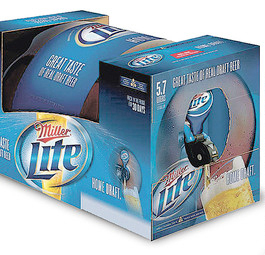
First of all, the premise of his article, taken from a Wall Street Journal article, is that Molson Coors, actually MillerCoors but I’ll try not to nitpick, is testing beer in a box, which he finds as distasteful as box wine. Which is all well and good, but it’s not in a box at all. It’s a small keg that fits in your refrigerator, similar to the mini-kegs the Germans have been selling for decades. See below. You can also see another view of it from the front at Gizmodo. The keg itself is in a cardboard box, presumably for easier carrying, but the beer is in a container no different than any other keg or can of beer. It’s like saying that since a six-pack of bottles are packaged in a cardboard six-pack carrier that the beer is in cardboard, too. What a maroon.

miller-lite-home-keg
But it gets better. The reason he’s so opposed to a box has less to do with the container and more to do with his own twisted sense of how things ought to be. Here’s how he sees it:

Now, with beer, the box might be less objectionable since, in my opinion, the quality issue is not really in play. Despite what the microbrewers will tell you, all beer is pretty much the same. Consumers who pay a premium do so more for the experience than the taste.

So apparently an Old Rasputin Imperial Stout is exactly, excuse me, pretty much the same as Miller Lite. In the words of Bill Cosby channeling Noah. “Right ….” At this point, I almost feel sorry for him. Imagine having so little understanding or familiarity with taste and smell or such an underdeveloped palate that you could write those words and, presumably, believe them. It’s not that beer tastes differently, it’s just that we experience them differently. “Right …” Well that will certainly make judging at GABF this year considerably easier since we can just pile them all together instead of having to sit for hours with 78 different style categories and countless sub-categories, each pretending to have their own unique taste profile. Not that there’s much danger of this, but I sure hope I don’t get invited to the White House for a beer summit with this knucklehead.

But as ridiculous as that statement was, wait, this one’s even better:

But for me, the issue is the bottle. I like drinking my suds from a cold bottle. Period.

Put it in a glass, and the experience just isn’t the same.

Wow. I’ve found my complete opposite. I won’t drink beer in a bottle or can, but insist on a glass. I’m frankly quite glad the experience isn’t the same, how could it be? Beer in a glass is so much better that I’m continually amazed that people really will drink directly from a bottle or can and now here’s someone who only does what I find abhorrent and refuse to do. Of course, I do this for a reason. Much of beer’s aroma, an integral component of its overall taste, is locked in the bottle and is released through the head when it’s poured into a glass. That’s not just my opinion, but is backed up by at least a century of scientific research, not to mention the experience of billions throughout history. It also releases excess carbon dioxide and makes your beer much less gassy and filling, too. Then, of course, there’s the pleasure of enjoying a beer from its proper glass, all lost on Dlugosch.

Naturally, Dlugosch is entitled to his opinion but I’m so weary of such ignorance being passed off as expertise. His opinion is obviously the by-product of living in a society that has commodified beer as one thing, interchangeable but for brand names differentiated by marketing and advertising. And, but for a few exceptions, his statement about beer being pretty much the same might have been correct 35-40 years ago, at least with regard to American beer. But saying so today, with over 1500 breweries making craft beer in a myriad of styles and unique compositions, makes Dlugosch a doofus. Period.

Filed Under: Beers, Editorial, News Tagged With: Mainstream Coverage, MSNBC

North Korea’s First Beer Commercial

July 11, 2009 By Jay Brooks

korea_north
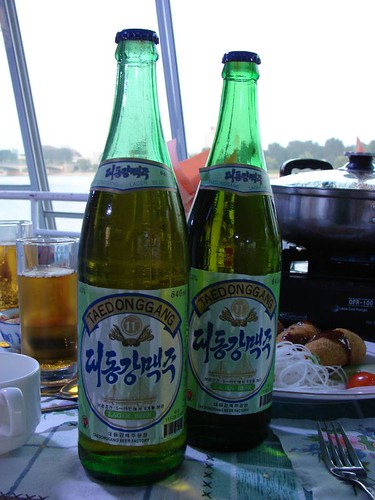
Taedonggang is a brand of beer from North Korea. It’s brewed by the state-owned Taedonggang Brewing Company based in Pyongyang, and is named for the nearby Taedong River. The North Koreans bought an English brewery, Usher’s Brewery in Trowbridge (part of Wiltshire), in 2002 and shipped it back to Asia. They produce 4 brands of beer, of which Taedonggang Beer is the flagship.

In a somewhat surprising move for a fiercely communist country, the state-owned Korean Central Television aired their first ever commercial, and it was a beer ad for Taedonggang beer.

A BBC article describes the ad:

Young women in traditional Korean dress are shown serving trays of beer to men in Western suits.

Billed as the “Pride of Pyongyang”, the advert promises drinkers that the beer will help ease stress.

“It represents the new look of Pyongyang,” the two-and-a-half minute advert says. “It will be a familiar part of our lives.”

I don’t know Korean, but according to a CBS report, “the commercial said the beer relieves stress and improves health and longevity” and went on to assure “viewers of the beer’s quality and nutritional value, saying it was made of rice and contained protein and vitamin B2.”

To see the strange, at times surreal, commercial, click on the image below.


Taedonggang beer, originally uploaded by Rikke Søvsø Nielsen.

Filed Under: Beers, News, Politics & Law Tagged With: Advertising, North Korea, Video

Beer Tasting Terms

July 1, 2009 By Jay Brooks

pint
My good friend Fal Allen, who’s currently brewing in Singapore (and used to be the GM at Anderson Valley), apparently had a block of time he could devote to thinking about tasting beer. He’s compiled a great list of tasting terms specific to beer. He’s invited people to re-post it so I’m taking him up on it because it’s an interesting topic and worthy of discussion. I’ve also added a couple of additional entries and will continue to add to it if it makes sense.

Here’s Fal’s introduction:

Throughout the later 20th century wine makers have done a fantastic job of convincing people that wine is the complex, sophisticated drink for erudite people with discerning taste – and during that same time period beer marketeers have done just the opposite for their product. It turns out that these marketeers did all of us (brewers and consumers alike) a great disservice. Many people really believe that beer is just a one dimensional pedestrian beverage, suitable only for chugging on a hot day at the beach — well — a big part of my job is to change their minds about that.

Beer can be many things; from thirst quenching, sprightly and light to complex, full and contemplative – and everything between. Today in America (of all places) there is more diversity in beer and more breweries making beers than any other country. From traditional style from around the globe, to experimental style using unusual ingredients, to barrel aged beers that take years to make — beer in all its complexity is blossoming to its full expression. And this passion for a greater beer diversity is spreading around the world.

For all those who are part of this, for all those who want to elevate beer to its proper place, I have gathered together some terms that will help you in your quest. Below is my list of beer tasting terms (those of you familiar with wine terms will recognize some of these terms, but you will also quickly realize that many of these can not be applied to wines. This is because as good as wine may be, wine just does not have the same breadth of flavors and aromas that beer does. Beer has a bigger palate). I hope you enjoy.

So here’s his list, plus a few terms I added, along with a few that other people suggested:

Beer Tasting Terms

Accessible A beer that is easy to drink
Acetaldehyde A green apple aroma or taste. A yeast (or bacteria) by-product. Often a constituent of young beer
Acetic Aroma or flavor similar to vinegar formed by aerobic bacteria producing acetic acid
Acidic A beer with a noticeable sense of acidity. In beer where acid is appropriate the acid should not come from excessive aerobic fermentation (producing acetic acid)
Aftertaste A term for the taste left on the Palate after beer has been swallowed. “Finish” is a synonym.
Aggressive A beer with pronounced or over the top flavors. The opposite of a beer described as “smooth” or “soft”
Alcoholic A beer that has a noticeable or an out of balanced presence of too much alcohol. Often noted as hot or spicy
Almondy Aromas of almonds or Marzipan
Astringent An overly dry or astringent beer or a beer with harsh grainy flavor. Often perceived in the aftertaste
Aroma The smell of a beer. The term bouquet can also be used
Autolytic or Autolysed Aroma of “yeasty” or acacia -like floweriness commonly associated with beers that have been aged on yeast too long. It can also sometimes be described as meaty
Baked A brewer with a high blood alcohol content that has remained so for too long. Often the result of over-consuming their own products.
Balanced A beer that incorporates all its main components in a manner where no one single component stands out. This usually refers to a Hop vs. Malt balance
Banana Aromas like banana or notes of Bazooka Joe Bubble gum – from Isoamyl acetate; a fermentation by-product
Barnyard Used to describe the earthy and sometimes vegetal undertones (often with hints of sweat or urine mixed in). These aromas are most common in spontaneously fermented beers. At low levels some beer drinkers may find this appealing, for others it may offend .At higher levels most people find these notes unpleasing (see Farm Yard)
Big A beer with intense flavor, or that is high in alcohol.
Biscuity A beer descriptor often associated with malt flavor. It is sense of yeasty or bread dough aroma and flavors.
Bite A firm and distinctive perception of hops, tannins, husk or acidity. This can be a positive (as in controlled hop bit) or negative attribute depending on whether the overall perception of the beer is balanced.
Bitter A noticeable flavor of hops, can denote lack of balance (but not always).
Black Currant An aroma or flavor of black currant, raisons or Cassis
Body The sense of feeling in the mouth. The sense of fullness from malt or alcohol in the beer. Some common descriptors are thin, winey, delicate, light, medium, balanced, robust, full, heavy, dense, viscous, overwhelming
Boozy An exaggerated alcohol aroma. Commonly associated with barleywines or other high gravity beers
Bouquet The layers of smells and aromas perceived in a beer.
Bright When describing the visual appearance of the beer, it refers to high clarity, very low levels of suspended solids. Lacking haze
Brussels Lace or Lace When the tracks of liquid that cling to the sides of a glass after the contents have been swirled display a delicate pattern that resembles lace. (see also Legs)
Burnt Having an aroma or flavor of smoke or burnt wood. A negative component that can be caused by excessive temperature during boiling (heating with a gas ring or electrical elements) or from fouled heating surfaces
Buttery A beer with a noticeable yet acceptable level of Diacetyl – giving a rich, creamy mouthfeel & flavors reminiscent of butter. Too much of this flavor is considered a defect. (also see Diacetyl)
Butyric Aromas of rancid butter. Always a flaw
Caramel Aromas or flavors of caramel, browned or burnt sugar, toffee.
Carbonated/Carbonation The amount of carbon dioxide dissolved in the beer (usually between 4.5 and 6 grams per liter). This is what gives beer its effervescence. Some common descriptors are spritzy, sprightly, zesty, prickly, gassy, sharp, round, smooth, creamy, delicate, piquant, champagne-like
Cardboard or Wet Cardboard Having an aroma of wet cardboard (see papery)
Catty Having an aroma of cat urine – always a flaw in beer (similar to skunky)
Chalky having a mouthfeel that is powdery dusty, chalky, or of particulate
Chewy The sense of malt that is tending toward overwhelming on the palate.
Cheesy An aroma of cheese – an element characteristic of aged hops. It is caused by the use of old and improperly stored hops.
Chill Haze A haze formed by protein complexes when the beer is chilled, effects clarity and can effect flavor at higher levels
Chocolaty A term most often used to describe rich brown beers such as Porters and Stouts, it describes the flavors and aromas associated with chocolate or dark malts
Cigar-box A term used to describe aromas of tobacco
Citrus A beer with the aromas and flavor from the citrus family of fruits (grapefruit, orange, lemon, etc), these notes are usually derived from hops .
Clean A beer that is not demonstrating any obvious faults, flaws or unwanted aromas and flavors.
Clear A beer with no visible particulate matter.
Closed A beer that is not very aromatic.
Clovey An aroma associated with German wheat beers that give the perception of cloves spice (Syzygium aromaticum). It is caused by the yeast’s creation of esters and is due to the brewer’s choice of yeast strain.
Cloying A beer with a sticky or sickly sweet character that is not balanced. Often associated with too much malt or not enough hops to balance
Coarse A term for a beer with a rough texture or mouthfeel. Usually applies to the perception of tannins, husk flavors or a harsh bitterness.
Coconut Aroma perception of coconut derived from treatment in American oak in barrel aged beers.
Coffee Having a roasty aroma and or flavor of coffee. Roasty with out being burnt
Color Listed here to reduce entries; a beer’s color can range from light yellow through golden to red , brown, black and even deep inky black.
Compact Opposite of “open”. A beer with a dense perception of flavors and aromas.
Complex A beer that gives a perception of being multi-layered in terms of flavors and aromas.
Cooked A term where the fruity flavors of the beer seem like they have been cooked, baked or stewed.
Cooked Vegetables An unfavorable characteristic in beer. Aromas and flavors of cooked cabbage, parsnip, broccoli or celery. See vegetable below
Corked A tasting term for a beer that has cork taint (only to be found in cork finished beers)
Creamy A term to describe the perception of a smooth, creamy mouthfeel. The perception of creaminess is generally picked up at the sides and back of the throat and through the finish of the beer.
Crisp A pleasing sense of bitterness in the beer.
Crust or Sediment The detritus, generally yeast and protein precipitates, that adhere to the inside (usually bottom) of a aged bottled beer
Definition A beer that is the perfect or original example of the style
Delicate A term that relates to the more subtle notes of a beer – – usually in relation to hops and / or ester aromas, but not always.
Depth A term used to denote a beer with several layers of flavor. An aspect of complexity.
Diacetyl (“D”) A buttery, butterscotch or buttered popcorn flavor or aroma. Acceptable at very low levels (0.1 ppm or less) but considered a fault at higher levels. One of the vicinal diketones (VDK) it is detectable by some people as low as 0.05parts per million. The source can be yeast metabolism or at higher levels may indicate bacterial contamination (esp when coupled with sourness) (also see Buttery)
Dimethyl Sulfide (DMS) A sulfur aroma of cooked corn or rancid cooked cabbage. A yeast or bacteria by-product.
Dirty A beer with off flavors and aromas that most likely resulted from poor hygiene during the fermentation or packaging process
Dry A beer that is lacking the perception of sweetness, especially those beers that finish clean on the palate
Earthy A beer with aromas and flavor reminiscent of earth or soil –such as forest floor or mushrooms.
Edgy A beer with a noticeably level of sharpness that heightens the flavors on the palate.
Elegant A term to describe a beer that possess finesse with subtle flavors that are in balance.
Enteric A term to describe the vinegar-like sourness common to a young lambic.
Estery Aromas of yeast esters from fermentation, often fruity (peach, apple, pear, passion fruit, etc.)
Ethyl Acetate Aromas that are light fruity, pear or solvent-like
Expansive A beer that is considered “big” but still accessible.
Expressive A beer with clearly projects its aromas and flavors.
Farmyard A generally more positive term than “Barnyard” used to describe low levels of the earthy and vegetal undertones of some spontaneously fermented beers. It may develop after maturing in the bottle. (see Barn Yard)
Fat A beer that is full in body and has a sense of viscosity. A beer with too much fat is not balanced and is said to be “flabby” (also see Full)
Finish The sense and perception of the beer after swallowing.
Finesse A very subjective term used to describe a beer of high quality that is well balanced.
Firm A stronger sense of flavor (see tight) .
Flabby Lacking sense of balance, too full or overly thick. The opposite of tight
Flat In relation to carbonated beers flat refers to a beer that has lost its effervescence. In all other beers it denote a beer that is lacking complexity and finesse
Flowery Aromas of fresh flowers often from hops or a combination of hops and yeast esters.
Fresh A beer with a noticeable perception of liveliness
Fruity The high perception of fruit characteristics – including but not limited to pineapple, apricot, banana, peach, pear, apple, mango, prickly pear, nectarine, raisins, currant, plum, dates, prunes, figs, blackberry, blueberry, strawberry
Full or Full Bodied A term usually used in context of beer with heavy weight or body. It can also refer to a beer that is full in flavor as well
Gassy over carbonated with excessive dissolved carbon dioxide (CO2)
Goaty Having the musky aroma of a goat.
Grainy Aromas or flavors of raw grain or cereals, usually a negative descriptor
Grapefruit Aromas of grapefruit and citrus. Hop derived
Grapey A beer with the aromas and flavors reminiscent of fresh grapes
Grassy A term used to describe an herbaceous element in a beer ranging from freshly mown lawn grass to hay, alfalfa, straw or open fields.
Gravity (high or low) The original sugar content of a wort before the yeast ferments it into beer
Green Typically used to describe a beer that is not yet finished maturing in its flavor and aroma profile
Harsh Similar to “coarse” but usually used in a more derogatory fashion to denote a beer that is unbalanced in tannins, husky notes, phenols or acidity.
Hazy Having haze, particulates or cloudiness. Not bright
Head This refers to foam on the top of the beer. The foam head should be thick, dense and tight for most beer styles. Some terms for describing a beers head are; persistent, rocky, fluffy, dissipating, lingering, frothy, tight, dense, smooth
Heavy A beer that is alcoholic and has a big sense of body
Herbaceous The herbal, vegetal aromas and flavors
Hollow A beer lacking the sense of malt or body.
Hoppy Having the character of hops. It can refer to high hop aroma, flavor and bitterness. Hop aromas can range from flowery to fruity, to herbal, but aromas should be clean and fragrant. Hop Flavors have a wide range as well. Bitterness should be clear, clean and sharp
Horsey / Horse Blanket An aroma of mustiness with earthy undertones and often a hint of horse sweat. Usually a by-product of Brettanomyces yeast and is a character of some beers – notably lambic beers.
Hot An overly alcoholic beer.
Husky a flavor of harsh astringent bitterness from grains
Inky A term that may refer to a beer’s dark coloring and opacity – associated with Stout beers
Intense Strong in character, aroma and flavor
Intensity The degree of character or strength of a beer. Some common descriptors are assertive, mild, delicate, refined, balanced, complex, hearty, robust, bold, intense,
Jammy A beer that is rich in fruit flavors
Lean The sense of thinness, somewhat lacking in overall complexity, a kinder term than watery (see watery)
Leathery Having an aroma of leather
Legs The tracks of liquid that cling to the sides of a glass after the contents have been swirled. Often said to be related to the alcohol content of a beer.
Lemony A term referring to the tangy hoppiness of a beer with fruit flavors reminiscent of lemons.
Lightstruck A tasting term for a beer that has had exposure to light causing “skunky” type aroma and flavor.
Linalool The characteristic flowery-peach aroma. Derived form yeast ester production
Liquorice A term used to describe the concentrated flavor from rich sweet beers, some times with hints of wood or Anis.
Luscious Similar to “voluptuous” but more commonly associated with sweet beers that have a rich, concentrated mouthfeel.
Meaty A beer with a yeast bit, also can be described as brothy, cooked meat, meat extract, peptone, yeast broth – often from autolysis of yeast cells
Medicinal Having an aroma of medicine, phenols, plastics or disinfectants. Sometimes referred to as “band-aid” aroma
Mellon having an aroma of ripe melons
Mellow A beer with a soft round texture that is nearing or at the peak of its maturity having had any hard edges rounded out.
Mercaptan Aromas of mercaptans, rotting garlic, dirty drains, fecal, or an outhouse stench. Uncommon in beer and always a flaw.
Metalic Aroma or flavors of metal or rust, especially that of iron
Midpalate A tasting term for the feel and taste of a beer when held in the mouth.
Minerality A sense of mineral notes in the beer, flavors of slate, rock or minerals. Usually from hard water in the brewing process
Molasses Aromas and flavors of raw sugar cane, molasses, or black treacle, treacley, also sometimes referred to as Cracker Jack flavor. Molasses notes may occur in sorghum-based beers (used for making gluten-free beers).
Moldy Aromas that are Cellar-like, leaf-mold, woodsy notes of decay
Mouthfeel A tasting term used to describe the feel of a beer in the mouth. Some common descriptors are creamy, smooth, silky, velvety, opulent, voluptuous, tingly, warming, viscous, oily, coating, thin, watery
Musky A complex aroma of sweat, sweetness, and earthiness, with light under tones of the sea, sandalwood and hair, but lacking the sharper acidic note of horse blanket
Musty Aromas of mold, mildew or decay. A defect at medium or high levels. (see moldy)
Nose A term for the aroma or bouquet of a beer.
Nutty Flavors and aromas of various types of nuts (Brazil nut, hazelnut, walnut, etc.)
Oaky A beer with a noticeable perception of the effects of oak. This can include the sense of vanilla, butteriness, sweet spice, diacetyl , toasted flavor or woodiness.
Oily A generally full bodied beer with a viscous mouthfeel. Unusual in beers.
Opulent A rich tasting beer with a pleasing texture and mouthfeel that is well balanced.
Over Carbonated An excessive amount of carbon dioxide dissolved in the beer (usually over 6 grams per liter). This will cause a carbonic bite and or excessive fizziness
Overtones The more obvious characteristics, aromas and flavors of beer.
Oxidized A negative term describing a beer that has experienced too much exposure to oxygen giving it the typical “wet cardboard” or papery type aroma and flavor. On occasion in aged beers that has been mildly oxidized, it may not be considered a fault if it exhibit sherry like aromas.
Palate A term used for the feel and flavor of a beer in the mouth.
Papery Having an aroma of paper (see Oxidized)
Peppery A beer with the aromas and flavors reminiscent of the fruit from the pepper family of plants such as peppercorn
Perfumy A generally negative term used to describe an aspect of a beer’s aroma or bouquet that seems artificial or overly flowery.
Phenolic Aromas of plastic, burnt plastic, Bakelite or tar. In low levels it is acceptable in certain beer styles (like German Wheat beers)
Phenylethanol Aromas of a Rose-like nature
Plummy A beer with the fruit flavors of plum, more common in aged and darker beers
Powerful A beer with a high level of alcohol that is not excessively alcoholic.
Raisony A beer with the aromas and flavors reminiscent of dried grapes
Resinous Aromas of resin, cedar wood, pine, pinewood, sprucy, terpenoid, sap
Rich A sense of depth or fullness in the beer that is not excessively sweet.
Robust A full bodied beer
Round A beer that has a good sense of body and balance
Salty Mouth coating and slick feel (uncommon in beer)
Sharp A term normally used to describe the acidity of a beer though it can refer to the degree of bitterness derived from a beer’s hops.
Silky A rich mouthfeel of smoothness
Sherry like A term used to describe a beer that exhibits sherry like oxidized aromas
Skunky Aromas like a skunk, see light struck
Smokey A beer exhibiting the aromas and flavors of the various types of smoke, either from smoked malt or from roasted malts or a toasty smoke derived from oak influences.
Smooth A beer with a pleasing texture. Typically refers to a beer with soft notes and flavors and a creamy texture
Soapy Having the aroma or flavor of soap
Soft A beer that is not overly hoppy or overly carbonated
Sour A tart flavor, often acidic, sometimes puckering. Appropriate in some beer styles (Belgian browns, Lambic beers, etc)
Spicy A beer with aromas and flavors reminiscent of various spices. While this can be a characteristic of the yeast strain, many spicy notes are imparted from hop influences or even the use of spices in the beer. Also may be from high alcohol content
Stale Aromas and flavors of old and oxidized beer, flat and papery, possibly over aged, or over pasteurized
Stalky A woody, green herbaceous note in a beer.
Structure A term used to describe the solid components of a beer’s balance; malt sweetness, yeast notes, hop aroma & flavors, all in relation to the overall balance and body of the beer.
Sulfur Aromas of sulfur– when obvious a defect in all beer styles but at very low levels it can add to fullness
Sulfidic Having aromas of strong sulfur, rotten eggs, or natural gas – a defect in all beer styles
Sulfitic Having noticeable aromas of a burnt-match or burnt rubber – a defect in all beer styles
Supple A beer that is not overly dynamic
Sweet A beer with a noticeable sense of malt sugar. Also usually lacking in hop balance
Tannic A beer with aggressive tannins.
Tart A beer with high levels of acidity. As related to sour beers or possibly an infection in other beer styles.
Texture A term for the mouthfeel of beer on the palate.
Thick A beer that is overly full in palate and mouthfeel
Thin A beer that is lacking body and complexity
Tight A beer that is well put together, properly matured and optimally served.
Toasty Notes from malt character like that of toasted bread. Can also be a sense of the charred or smoky taste from an oaked beer in wood aged beers
Toffee Aromas or flavors of caramel, browned sugar, treacle.
Turbid Cloudy and opaque
Under Attenuated A term for a not fully fermented beer. Having flavors or components of wort or wortiness. (see worty)
Undertone The more subtle nuances, aromas and flavors of beer. Having flavors or components of wort or wortiness. (see worty)
Upfront A beer with very perceivable characteristics and quality that do not require much thought or effort to discover.
Vanilla Characteristic aroma reminiscent of vanilla – often oak induced
Vegetal A beer with aromas and flavor reminiscent of vegetation either cooked or raw. In the case of cooked, as in cooked greens or cooked cabbage, parsnip or celery
Viscous thick in a fluid nature, having excessive heaviness of character in the body or mouthfeel
Vinous An aroma, flavor or texture suggesting wine – usually in higher alcohol beers
Voluptuous A beer with a full body and rich texture.
Warm or Warming A beer with noticeable but balanced alcohol as opposed to a beer with excessive alcohol that maybe described as “hot”.
Watery A beer that is excessively “thin” in body
Woody A collective term used to describe the woodsy aroma of a beer that has been treated with oak or other wood.
Worty Having a taste of wort or unfermented beer, usually disagreeably sweet and lacking complexity
Yeasty Often uses to describe a yeast noticeable aroma – can be also be described as somewhat “biscuity”, bready or of fresh yeast, flavor of heated thiamine (see “biscuity” above)
Young Beer that is not matured (see Green)
Zesty A beer with noticeable active carbonation.

Anything missing? What would you add?

Filed Under: Beers, Just For Fun Tagged With: Tasting

Session #28: Thinking & Drinking Globally

June 5, 2009 By Jay Brooks

Today is National Doughnut Day, among other things, and time once again for The Session, in fact our 28th such outing. This time our host is Brian Yaeger, who writes at Red, White & Brew. His chosen topic is “Think/Drink Globally,” which he described as follows:

In honor of Global Craft Beer Forever, I propose everyone writes about the farthest brewery (including brewpubs) you have visited and specifically the best beer you had there. Again, not your favorite or any old brewery you’ve been to, but the one that is the longest haul away, be it by airplane, car, ferry, rickshaw, whatever. (If you blog about beer but have never been to a House of Brewing, get on it!)

Then, the last part, since this exercise gives us an excuse to drink beer, do one of the following:

  1. if you brought home a bottle while visiting the brewery and have it secreted away, crack it open.
  2. if you don’t have any left from that visit but the particular beer is available where you live (or if not your fave from said brewery, another brand from it), go get one.
  3. otherwise, find a local beer of the same style and do a little compare and contrast.

Well it certainly isn’t to hard to figure out the farthest place I’ve traveled so far for a beer was to New Zealand. The whole family went there for two weeks last year around this same time, plus my in-laws, too. We had a great time, and stayed most of the time in a beach house north of Auckland in the middle of nowhere. And since a lot of New Zealand feels like the middle of nowhere, that’s really saying something. We explored caves, went on hikes, lounged at the beach and tried our damnedest not to hit anything driving on the wrong (for us) side of the road. There were sheep everywhere and the joke is that there are more of them than people in New Zealand, and it’s not hard to believe.

The last few days were spent in the capital city of Auckland, where there was more beer, I’m happy to say. Though, sadly, only a minority was actually worth drinking. I did an article on beer in New Zealand for All About Beer. There were several decent breweries, the best I tried were from Emerson, Epic, Galbraith, and Hallertau.

Of those four, I spent the most time at Hallertau, as they also sell bottled beers and owner Stephen Plowman and Luke Nicholas (who brews the Epic Beer line) and I opened a couple dozen ebers so I could get a good cross section of the islands’ beer. Here’s what I wrote about the place in All About Beer:

Near the edge of the city limits, in Riverhead, is Galbraith’s polar opposite, the Hallertau Brewbar & Restaurant. Opened just three years ago by Stephen Plowman, the restaurant is thoroughly modern in both décor and cuisine, with an emphasis on local ingredients wherever possible. The menu includes esoteric fare as well as new takes on traditional dishes, and everything tastes homemade and delicious. The brewing equipment, though much less modern, and looking as if designed by MacGyver, still manages to create some terrific beers. Plowman makes an interesting range of beers, and likes to play around with his seasonals. His regular beers include a Kölsch-style ale, an American pale ale, an Irish red and a German-style Schwarzbier. His seasonal offerings have included an Imperial IPA (big, hoppy beers are a veritable rarity in New Zealand), a Belgian-style Tripel and a Saison flavored with Manuka tips, a local shrub sometimes also called a tea tree.

But by far my favorite of his beers was an experimental beer he was making, and I bought a couple bottles of it to bring home and age. Here’s what I wrote about it at the time:

But Plowman’s most ambitious beer may also be his best. His Porter Noir is a barrel-aged beer, which may be the first beer in New Zealand to use Brettanomyces. He brewed a strong Porter (6.6% abv) and aged it in local Pinot Noir barrels for four months before bottling. In the bottle, Brettanomyces was added and left to condition for another six months, before being released for purchase. It’s a wonderful beer, with rich, complex flavors of thick figs, raisins and the like, with strong Brett horse stable character. I can’t say for sure whether or not the people of New Zealand are ready for a beer so vastly different from their popular, but insipid, draught style. But ready or not, here it comes.

The second time I tried it, with Vinnie Cilurzo, from Russian River Brewing, here’s what I found:

Dark in color and a very thick tan head. The nose was marked by characteristic barnyard aromas with just a touch of malty sweetness. The nose was slightly less pungent than the sample I had in New Zealand, but Vinnie and I both declared it to be quite tasty. The Brett character married quite nicely with the nutty, malty porter flavors.

So let’s see what a year has done to it. The Bretty barnyard is still there, possibly even stronger, at least as I remember it. It’s still very malty but seems more complex to me as well, with all sorts of aroma and tastes mixing about on the nose and on the tongue. Dark fruit and some spiciness predominate, but there’s more there, too. I don’t know if Plowman is making new batches of this beer, but I certainly hope so, it’s definitely one of the most adventuresome being made in New Zealand.

I realized that I never posted photos from the New Zealand trip because I was saving them for the All About Beer article, but it’s been a year now, so I think it’s okay to post some of them now. So here’s a gallery of beer-related photos and also some non-beer related photos, in case you’re curious about what else we saw when we were there. [Note: the photos have no captions because I didn’t have time to put them in before leaving for Monterey. I’ll try and put them in Sunday after we get back, so check back Monday if you want to have more information about what’s in the photos.]

Filed Under: Beers, The Session Tagged With: New Zealand, Travel

Beer Excise Taxes By State

June 1, 2009 By Jay Brooks

tax
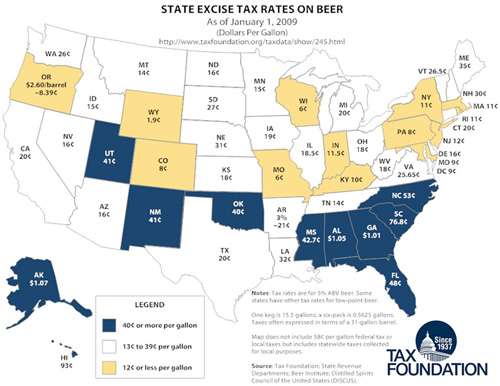
I found this nice map of the 50 states with the individual beer excise tax brewers in each state has to pay in addition to the federal excise taxes at Charlie Papazian’s blog, too. It’s originally from Don’t Tax Our Beer, a website maintained by the Tax Foundation.

The map provides an interesting snapshot of all the states. It’s worth noting that all the southern states have high excise taxes on beer, where the idea of drinking being sinful is, I think, more prevalent.

excise-taxes-2009

Filed Under: Beers, Politics & Law, Related Pleasures Tagged With: Taxes, United States

« Previous Page
Next Page »

Find Something

Northern California Breweries

Please consider purchasing my latest book, California Breweries North, available from Amazon, or ask for it at your local bookstore.

Recent Comments

  • Bob Paolino on Beer Birthday: Grant Johnston
  • Gambrinus on Historic Beer Birthday: A.J. Houghton
  • Ernie Dewing on Historic Beer Birthday: Charles William Bergner 
  • Steve 'Pudgy' De Rose on Historic Beer Birthday: Jacob Schmidt
  • Jay Brooks on Beer Birthday: Bill Owens

Recent Posts

  • Beer In Ads #5371: Miller Bock Beer October 11, 2026
  • Beer Birthday: Kirby Shyer October 11, 2026
  • Beer Birthday: Kushal Hall October 11, 2026
  • Beer Birthday: Jaime Ojeda Selamé October 11, 2026
  • Beer In Ads #5370: Salmon Bock October 10, 2026

BBB Archives

Feedback

Head Quarter
This site is hosted and maintained by H25Q.dev. Any questions or comments for the webmaster can be directed here.