Brookston Beer Bulletin

Jay R. Brooks on Beer

  • Home
  • About
  • Editorial
  • Birthdays
  • Art & Beer

Socialize

  • Dribbble
  • Email
  • Facebook
  • Flickr
  • GitHub
  • Instagram
  • LinkedIn
  • Pinterest
  • RSS
  • Twitter
  • YouTube

Powered by Genesis

Coast Range Closed?

January 10, 2008 By Jay Brooks

coastrange
I heard a rumor today from a fairly reliable source that Coast Range Brewing in Gilroy, California has closed their doors for good. My understanding is that they’re a Chapter 11 Reorganization Bankruptcy and are actively looking for a buyer.

I’m sorry to say that’s it’s not a huge surprise as they’ve been having financial difficulties … well, for a very long time now. For several years at least they’ve managed to stay afloat due mainly to doing contract beers for a variety of clients, having picked up quite a lot of new business when Golden Pacific Brewing was sold to Gambrinus a few years back. Before that they picked up a tidy sum from a French brewery by selling them the U.S. rights to the name Desperado, which had been the name of their Pale Ale, so that the tequila flavored French Desperado beer could try to take over the American beer market during those thirty seconds when tequila flavored beers were the “in” thing — A-B’s Tequiza, which they still make, managed to own the category.

Coast Range’s passing, though, is quite a shame as I thought brewer Peter Licht was quite talented. Back when fruit beers were more popular, he made a Blackberry Wheat that I thoroughly enjoyed. And he did several fine contract brews for me when I was the beer buyer at BevMo, too. The only reason they never seemed to reach very far beyond their own backyard had more to do with distributor networks, retailers and some poor management decisions than bad product. I will mourn their passing tonight with one of their Farmhouse beers, a new label they debuted two years ago.

Filed Under: Breweries, News Tagged With: Bay Area, Business, California, Northern California

A Bender That Brews Beer

January 10, 2008 By Jay Brooks

Remember the television show Futurama? It was the Simpsons’ Matt Groening’s other animated series that ran on Fox for four seasons beginning in 1999.

There was a robot — or perhaps more accurately a “foul mouthed, cigar smoking, booze drinking, shiny metal arsed, bending robot” — in the show whose name was Bender. Besides his name and the character’s predilection for going on one, you may be asking yourself what that has to do with beer? Well, even though the show was canceled, like many such shows it has a pretty good cult following. There are fans, of course, and then there are fans.

One such uber-fan, Simon Jansen, in New Zealand, if not an engineer by trade then one of the most impressive hobby engineers I’ve encountered. He’s also a sci-fi fan generally and it appears he started his website with the extremely impressive Star Wars Asciimation, which is the entire Star Wars movie done in Java using nothing but ASCII art. For those of you new to the web, ASCII art is pictures created using nothing but the characters that can be found on an ordinary keyboard, which were used in early e-mails before graphics became ubiquitous throughout the internet.

Those emoticons, like 😉 for example, are a simple, though enduring, form of ASCII art. But they can get extremely complicated and detailed, too. Check out the Great ASCII Art Library for hundreds, if not thousands of these.

Okay, so as usual I’m veering off on a tangent, back to the Bender. Last summer (his winter) Jansen was challenged by a friend to make an actual Bender robot. Jansen also took as inspiration a third season episode, The Route of All Evil, in which while the main plot was going on, there was a subplot involving the two characters, Fry and Leela, along with Bender himself where they undertook to “brew beer inside Bender, treating the robot like an expectant mother.” Jansen reasoned that “just having a Bender that doesn’t do anything would be a waste of time so mine shall be used for a practical purpose. One Bender himself would be proud of. I’ll use him to make beer!”

The Bender Brewer Project, as it’s known, took over six months to complete and yielded its first brew last week. The website includes four pages of detailed information showing every step of the way with copious photographs of the various stages along with diagrams and source code. But for my purposes, it gets really interesting in mid-December on page four when the brewhouse went online, so to speak.

Basically, it’s only a rudimentary homebrewing kit but you have to admire the sheer amount of work and effort to take this project from drawing board to actual robot that produces beer. His initial specific gravity was 1.034. In early January, the beer was ready to bottle and he had his first taste f it, describing it like this.

By the way I did have a little taste of the beer before I bottled it. It wasn’t totally unpleasant. It tastes very green but it had a fair amount of body. Yeasty with maybe just a hint of Mom’s Old-Fashioned Robot Oil!

How odd and cool is that?


Bender with brewing system inside. Reminds me a bit of the Wizard of Oz’s Tinman, but this time he’s wishing for something different. “If I only had a beer!”


Bottled on January 2, the new robot-brewed Bendërbrau, with labels designed by Jen, one of Jansen’s friends.


Filed Under: Just For Fun, News Tagged With: Australia, Homebrewing, Strange But True, Websites

Tender Is The Beer

January 10, 2008 By Jay Brooks

Here’s an interesting looking gadget. Heineken teamed up with Krups, the people who make those high end coffee machines, to create the BeerTender. Essentially, the BeerTender is a mini kegerator that holds 5-liter kegs. As fr as I can tell it’s already available in eight European nations and beginning March 1 will be sold in the U.S. at Williams-Sonoma stores. At least that was the announcement made at this year’s CES in Las Vegas, which began on Monday.

It’s a beautiful looking piece of equipment and would be great if it could be used with those 5-liter kegs of German beer you see everywhere. I sort of doubt they will, though, they’ll probably only work with Heineken mini-kegs and the other brands they deign to package them in the minis.

Here’s some info about the BeerTender from the Unofficial Heineken USA BeerTender Fan Site, BeerTenderUSA:

Imagine…fresh Heineken and other European beers on tap whenever you want it.

The Heineken BeerTender … is a personal draft beer (or draught beer, if you prefer) system for home use. The system consists of a draft beer dispenser and the exchangeable BeerTender kegs each holding and chilling four liters of premium European beer. While at-home beer taps are nothing new, the BeerTender system is unique in its size, style and function.

The recyclable BeerTender four liter keg is inserted from above into the BeerTender, which keeps the beer cold and fresh for up to 30 days from the first glass. Then run the keg’s plastic tube to the BeerTender’s tap and you’re done. It’s that simple. Inserting a keg takes less than 15-seconds.

Heineken has also made the Krups BeerTender sold in France and the ones coming to the US compatible with its standard five liter DraughtKeg kegs (which are available in most US supermarkets) by using a special tube (a five-pack comes with the BeerTenders sold in France and to be sold in the US). Replacement five-packs will be available after March 1 at www.BeerTender.com.

In the US, Heineken is preparing for the launch of the BeerTender on March 1, 2008 after performing a market test in Rhode Island. The current US DraughtKegs, while compatible with all BeerTenders (with the special tube) will not dispense all the beer. To answer this, Heineken is introducing a BeerTender compatible US DraughtKeg (five liters) that comes with the special tube and has a bigger carbonator inside. That keg is will be available nationwide in both Heineken and Heineken Light. Other European beers are available in Europe.

Operating the BeerTender is a snap. While some models have computer operation and temperature controls with an LCD display, pulling a beer is as simple as pulling the BeerTender’s handle. And if you’ve got kids, you can easily remove the BeerTender’s handle. Best of all, the beer only touches the easily removable spout under the handle, making clean-up between kegs a breeze.

BeerTenders are not cheap. List price in the US will be $400, with street prices down to $299. European versions are just as expensive.

It would certainly look great sitting on the bar, if only it didn’t have that Heineken label on it. Damn.


Filed Under: News Tagged With: Brewing Equipment, Europe

The Primo Return of Primo

January 9, 2008 By Jay Brooks

primo-new
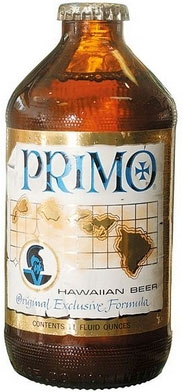
This was first reported back in late November during what I’ll continue to call “The Great Ennui of Late ’07” when the Bulletin was looking pretty sparse. I’m returning to the new year reinvigorated, or at least willing myself to try, and so I’m trying to catch up on old news people have sent in, and this comes to me by way of my island connection, a regular Bulletin reader living in Hawaii. Thanks Doug. It seems the old iconic Primo Beer brand has returned as of December, so far in kegs only. Bottles will be back sometime in April.

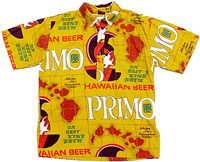
primo-shirt

First, a little history. Primo Beer was originally made by the Honolulu Brewing & Malting Co., which was founded in 1898. After Prohibition ended, it was renamed the Hawaii Brewing Co. and by the 1950s became the best-selling beer on the islands. In 1963, Schlitz Brewing bought the brand, building a new brewery in ‘Aiea, and they continued making Primo until closing it in 1979. At its height, the Hawaiian brewery produced over 400,00 barrels per year. A few years later, in 1982, Stroh Brewing bought the brand and changed the label as well as the formula, trying to sell the brand outside Hawaii in several states. With mixed success, sales grew and then fell again, and eventually Stroh stopped making Primo in either 1997 or 98 (accounts differ on this point). A year or two later, Pabst acquired the brand, along with several others brands from Stroh’s and they are the current owners of the brand.

So last year, Pabst made the decision to bring back the label. And that makes sense, Primo was one of those iconic brands that people couldn’t help but associate with Hawaii. Using a silhouetted image of King Kamehameha, who in 1810 united the Hawaii Islands under his leadership of the Kingdom of Hawaii, was a genius marking move and the bold Hawaiian shirts made in the 1960s-70s with the Primo label continue to be collector’s items right up to the present.

The new Primo is being launched by the Primo Brewing Co., a division of Pabst Brewing. A new recipe was created by brewmaster Phil Markowski, who justly won fame and fortune for his beers at the Southampton Publick House on Long Island, New York.

The beer itself is being brewed by a craft brewery on the island of Kauai, Keoki Brewing, who initially will brew around 200 kegs each month. Once bottled production starts up, that will be handled stateside by Pabst in Irwindale, California. But since Pabst doesn’t own any breweries, that means Miller Brewing — who does own a brewery in Irwindale — will be contract brewing the beer for Pabst. According to a press release, “the draft and bottled versions will be distributed by Paradise Beverage Co.”

It will be interesting to see if they can successfully revive the brand. I imagine it will be great as a tourist beer and for locals looking to support a well-known local brand, at least as far as the draft beer is concerned. The bottles stateside may prove trickier, especially after the initial novelty wears off, as it inevitably will.

primo-btl

Filed Under: Beers, News Tagged With: Business, History, Western States

Bay Area Firkin Fest Announced

January 9, 2008 By Jay Brooks

Mark your calendars. The 5th annual Bay Area Firkin Gravity Festival has just been announced. It will take place beginning at 11:00 a.m. on April 5 at Triple Rock Brewery in Berkeley, California. The cost will be $25, which includes a commemorative glass along with a certain number samples (still to determined) with additional tastings available for a nominal fee. This event has quickly become “the” real ale festival in the Bay Area and I’m sure they’ll have something special lined up for their fifth anniversary. Last year there were two dozen breweries in attendance and I suspect we’ll see even more again this year. See you there.


4.5

Bay Area Firkin Gravity Festival (5th annual)

Triple Rock Brewery, 1920 Shattuck Avenue, Berkeley, California
510.843.2739 [ website ]


Filed Under: News Tagged With: Announcements, Bay Area, California, Press Release

Pelican Potluck

January 8, 2008 By Jay Brooks

The Beer Chef, Bruce Paton, has announced that his first beer dinner of 2008 will feature Darron Welch and the beers of Pelican Pub & Brewery along the coast in Pacific City, Oregon. It will be a four-course dinner and well worth the $75 price of admission. It will be held at the Cathedral Hill Hotel on Friday, January 18, 2008, beginning with a reception at 6:30 p.m. Call 415.674.3406 by next Monday the 14th for reservations.


The Menu:


Reception: 6:30 PM

Beer Chef’s Hors D’Oeuvre

Beer: India Pelican Ale

Dinner: 7:30 PM

First Course

Ceviche of Day Boat Scallop with Lobster Emulsion

Beer: Saison du Pelican

Second Course:

Crispy Pork Belly with Slow Poached Egg and Ancho Chili Hollandaise

Beer: Stormwatcher’s Winterfest

Third Course:

Slow Roasted Duck Breast with Bellwether San Andreas Cheese Grits, Satsuma Mandarins and Fig Gastrique

Beer: Grand Cru de Pelican

Fourth Course:

Nutmeg Flan with Vanilla Bean Chocolate Barbecue Sauce

Beer: Le Pelican Brun

Darron Welch (2nd from right) and the gang from Pelican Pub & Brewery on stage winning a Gold Medal for their Kiwanda Cream Ale in Category: 32 Golden or Blonde Ale.

 
1.18

Dinner with the Brewmaster: Pelican Pub & Brewery

Cathedral Hill Hotel, 1101 Van Ness Avenue, San Francisco, California
415.674.3406 [ website ]
 

Filed Under: Food & Beer, News Tagged With: Announcements, California, San Francisco

Pearls to Schwarzbier

January 8, 2008 By Jay Brooks

London’s famous Pearl Restaurant, located a stone’s throw from the Holborn tube station, is situated in a grand old bank building, the former Pearl Assurance Company’s headquarters. Inside there’s granite everywhere, opulent chandeliers and modern decor. Their food seems to be reviewed favorably by just about everybody and executive chef Jun Tanaka has one of the best reputations in the London restaurant scene, having worked at at least seven Michelin-rated places over the past decade before his own oyster opened to reveal the Pearl. He’s now “worked with beer gourmand Gustavo Bertolucci to find the best beers to match his dishes.”

While I don’t know if a schwarzbier will be on the actual beer list, it was the closest style to swine I could find. What hints that are given, in a story in Wine & Spirit Magazine, sound quite tasty.

Combinations include Kasteel Cru from Alsace to match salmon in filo with pomegranate, cauliflower and walnut salad and Innis & Gunn Oak Aged Ale with spiced loin of venison. Greenwich’s Meantime brewery’s Chocolate Stout is also being recommended as a partner to desserts.

It’s certainly nice to see more and more high end restaurants finally embracing beer as a part of the fine dining experience.


Filed Under: Food & Beer, News Tagged With: Europe, Great Britain

Reunion’s Reunion

January 7, 2008 By Jay Brooks

The second annual release of Reunion — A Beer for Hope will take place during the week of February 17, 2008. This year’s beer celebrates the life of Virginia MacLean, the inspiration and one of the founding partners of the Reunion beer collaboration. (See links page at Reunion Beer for stories on the 2007 release.)

This year’s beer is an Organic Red Rye Ale, once again brewed in cooperation with Bison Brewing in Chico, CA. It is a reddish-amber colored beer, with a pronounced malt forward profile balanced by the delicate spices of the hops and rye. It is 6.5% alcohol by volume.

The beer will be distributed through the SBS-Imports distributor network, to approximately 20 states, suggested retail price of $4.99-$5.99 per 22 ounce bottle.

Consumers may also mail order (starting mid-February) via the Michael Jackson Rare Beer Club. 100% of the profits generated by SBS-Imports will benefit the Institute for Myeloma & Bone Cancer Research (IMBCR). Donations to IMBCR accepted via Reunion Beer or directly at the IMBCR site. Bottle and label art available upon request. Full press release to follow in early February.

If you missed this story last year, here’s how it started.

Once upon a time, Pete Slosberg created Pete’s Wicked Ale. And the brown ale was good. He had help spreading the word, of course, and in the early days Alan Shapiro and Virginia MacLean also helped Pete’s become a nationally known microbrewery. Pete, of course, moved on to chocolate and Alan Shapiro worked for a time with Merchant Du Vin and now heads his own import company, SBS Imports. Virginia MacLean, in the meantime, left the beer business but as she approached her fortieth birthday was diagnosed with Multiple Myeloma, which is a type of bone cancer that currently has no known cure. For more information about the disease, see the MMRF or the Institute for Myeloma & Bone Cancer Research.

Last February, Pete Slosberg and Alan Shapiro got together and decided to help their friend by creating a new beer to help raise awareness and money to fund research into this disease. The beer was named “Reunion,” and it was a big, imperial brown ale and was the first commercial beer Slosberg had done since selling Pete’s Wicked Ale to Gambrinus in 1998. He worked with award-winning brewer Daniel Del Grande at Bison Brewing in creating the organic beer.

Unfortunately, last June Virginia McLean passed away in her home in Mountain View, California. But Pete and Alan decided to continue the fight against the disease that took their friend in her name and in her honor. When you start seeing this beer again this February, please buy a bottle or two to support this worthy cause.


About Multiple Myeloma & IMBCR:

Multiple Myeloma is a unique cancer of plasma cells that attacks and destroys bone. The term is derived from the multiple areas of bone marrow that are usually affected by the disease. Worldwide, over 1,000 people a day are diagnosed with this currently incurable form of bone cancer. Led by Dr. James Berenson, IMBCR is one of the world’s leading research organizations combating this disease. IMBCR specializes in developing novel chemotherapy drugs and treatments. For further information on multiple myeloma or IMBCR, please visit www.imbcr.org or contact 310-623-1210.


Filed Under: Beers, News Tagged With: California, Health & Beer, Northern California, Press Release

Anheuser-Busch Up 2% in 2007

January 7, 2008 By Jay Brooks

Anheuser-Busch announced today that shipments were up 2% in 2007 over the previous year. While the news is presumably good for shareholders, it’s not exactly all that different from recent years when increases have been meager at best.

From the press release:

“Anheuser-Busch achieved increased shipments in 2007 due to the success of our initiatives to broaden the company’s beer portfolio, including the addition of InBev European brands,” said Busch. Wholesaler sales-to-retailers grew 1.3 percent for the full year. Acquired and import brands contributed 170 basis points of growth to shipments and 160 points to wholesaler sales-to-retailers for the full year.

For the fourth quarter 2007 wholesaler sales-to-retailers were up 1.3 percent, on a selling day adjusted basis. The fourth quarter of 2007 had one more selling day than the fourth quarter of 2006. U.S. beer shipments to wholesalers increased 3.4 percent in the same timeframe. Shipments to wholesalers are not selling day adjusted. Import brands contributed 230 basis points of growth to shipments and 180 points of growth to wholesaler sales-to-retailers for the quarter. Wholesaler inventories at year-end were approximately the same as year-end 2006.

“Our expanded beer portfolio along with our enhanced marketing and sales strategies to accelerate core beer sales position Anheuser-Busch for growth in volume and earnings in 2008,” concluded Busch.

Anheuser-Busch Cos., Inc. will announce worldwide beer volume and consolidated earnings results for the fourth quarter and full year 2007 on Jan. 31, 2008.

I’m no economist, but I confess I read economics as a hobby, and the fact that the press release keeps switching between percentages and basis points (which are 100ths of a percentage, e.g. 150 basis points = 1.5%) seems to me like they’re engaging in a bit of prestidigitation. Maybe that is standard practice, I don’t know. But just in case, let’s look at the first paragraph. “Wholesaler sales-to-retailers grew 1.3 percent” and “import brands contributed … 160 points to wholesaler sales-to-retailers.” So unless I’m mis-reading it, doesn’t that mean if imports made up 1.6%, then other products — which would have to be domestic beer, the core brands — fell by 0.3% or 30 basis points? Because if imports “contributed” more than the total, wouldn’t that have to mean the rest of the percentage came from somewhere else?

Similarly, in the next paragraph it is stated that “beer shipments to wholesalers increased 3.4 percent” and “[i]mport brands contributed 230 basis points of growth to shipments.” That would also seem to suggest that domestic beer only increased 1.1%, wouldn’t it? That would seem to contradict Busch’s statement that these numbers would cause one to “conclude” core brands will likely grow “in volume and earnings in 2008.”

Maybe I’m nitpicking, but there is a fishy looking codicil below the press release that begins:

This release contains forward-looking statements regarding the company’s expectations concerning its future operations, earnings and prospects. On the date the forward-looking statements are made, the statements represent the company’s expectations, but the company’s expectations concerning its future operations, earnings and prospects may change. The company’s expectations involve risks and uncertainties (both favorable and unfavorable) and are based on many assumptions that the company believes to be reasonable, but such assumptions may ultimately prove to be inaccurate or incomplete, in whole or in part. Accordingly, there can be no assurances that the company’s expectations and the forward-looking statements will be correct.

And that’s only about 20% (or 200 basis points) worth of the qualifying fine print. It goes on and on in soporific legalese that no one will bother to read, except perhaps the most anal-retentive among us — yes, that means me, dear readers. But what that whole exercise boils down to is this. We think we’re going to do great in 2008 … unless we don’t. Please buy or hold on to your A-B stock because 2008’s going to be great year … unless it isn’t. The political punditry calls it spin, but there are unkinder words for what it really is.

 
UPDATE 1.8: As if you needed more proof that framing, spin and propaganda works, the next day’s St. Louis Post-Dispatch reported that “[i]nvestors reacted happily to Anheuser-Busch Cos.’ announcement Monday that its beer shipments increased last year and in the most-recent quarter. Shares of the country’s biggest brewer soared nearly 5 percent, their steepest climb in more than 20 months, despite slow growth among the company’s trademark beers.” See, nobody, especially the business press, bothers to check the math or read the fine print.
 

Filed Under: Editorial, News Tagged With: Business, National, Press Release

Iron City’s Solvency Plan

January 6, 2008 By Jay Brooks

Last fall the bankrupt Pittsburgh Brewing got a new Plan of Reorganization confirmed which included new investors, a settlement with creditors, a new CEO and a new name: Iron City Brewing. The new boss, Tim Hickman, today outlines his four-prong plan to increase revenues this year by a staggering 35%, certainly an audacious goal. Perhaps their biggest hurdle is that the perception of the brewery, as a direct result of the bankruptcy, has diminished and many locals assume the quality of the beer has likewise decreased. This despite the fact that the brewery was founded in 1861, making it one of the oldest breweries in America still operating today (#1 is another Pennsylvania favorite, Yuengling, which was founded in 1829).

To combat these problems, Here’s the four things Hickman hopes to accomplish:

  1. Upgrade the facility on Liberty Avenue to assure consistent production.
  2. Stop competing with beer-producing giants.
  3. Saturate the bar scene.
  4. Redesign packaging and labels.

With a modernized brewery, “Iron City expects to produce more than 233,000 barrels of beer in 2008. Last year, the brewery turned out about 172,000 barrels. The 2008 projection would be the most beer brewed at Iron City since 2004.” Sales VP Tony Ferraro has made the sensible observation that they can’t really complete on price with the bigger breweries and will be looking at themselves as a regional brewery. As a result, they’ll raise their prices slightly in line with a reasonable mark-up and will promote the beer as local, tying themselves to Pittsburgh’s 250th birthday celebration, which takes place this year. They’re also finally replacing their Hoff-Stevens kegs with new Sankey’s in an effort to get more tap handles in local bars and restaurants.

They’ll also be redesigning their packaging and labels, although apparently the iron city logo is off-limits. A new slogan will also be introduced. “The official beer of the Pittsburgh Nation.” And apparently some locals agree. A pair of Pittsburgh natives have set up Drink Iron City, “a blog about supporting the Iron City [Brewing] Company.”

Currently, Iron City Beer has a 6% market share in the greater Pittsburgh area and the plan is to shoot for 10% over the next few years. As Hickman puts it. “We’ll get there,” he said. “We have a quality product here, and we have consumer loyalty behind our brands.”

My friend and colleague, Julie Bradford, who is the editor of All About Beer magazine, agreed and is quoted in a Pittsburgh Tribune-Review article.

She said she approved of every step Iron City is taking, and even praised Hickman for raising prices.

“In fact, it’s a smart idea to raise prices,” she said. “That raises perceived value.”

Bradford also agreed that Iron City should concentrate on local loyalty, “because that’s what Iron City has going for them.”


The old Pittsburgh Brewery during better times.
 

Filed Under: Editorial, News Tagged With: Business, Eastern States

« Previous Page
Next Page »

Find Something

Northern California Breweries

Please consider purchasing my latest book, California Breweries North, available from Amazon, or ask for it at your local bookstore.

Recent Comments

  • Bob Paolino on Beer Birthday: Grant Johnston
  • Gambrinus on Historic Beer Birthday: A.J. Houghton
  • Ernie Dewing on Historic Beer Birthday: Charles William Bergner 
  • Steve 'Pudgy' De Rose on Historic Beer Birthday: Jacob Schmidt
  • Jay Brooks on Beer Birthday: Bill Owens

Recent Posts

  • Beer In Ads #5137: Bock Is Back… Look For It March 1st February 28, 2026
  • Historic Beer Birthday: John Holme Ballantine February 28, 2026
  • American Craft Beer Hall of Fame: 2nd Year Inductees February 28, 2026
  • Beer Birthday: Jeff Bell February 28, 2026
  • Beer In Ads #5136: American Bock Beer Is Being Served Today! February 28, 2026

BBB Archives

Feedback

Head Quarter
This site is hosted and maintained by H25Q.dev. Any questions or comments for the webmaster can be directed here.