Brookston Beer Bulletin

Jay R. Brooks on Beer

  • Home
  • About
  • Editorial
  • Birthdays
  • Art & Beer

Socialize

  • Dribbble
  • Email
  • Facebook
  • Flickr
  • GitHub
  • Instagram
  • LinkedIn
  • Pinterest
  • RSS
  • Twitter
  • YouTube

Powered by Genesis

Target: Alcohol

October 23, 2007 By Jay Brooks

target-alcohol
I happened upon this item from across the pond at Zythophile, who appears to be a soul mate when it comes to disliking neo-prohibitionists and their attendant propaganda. The UK’s Times Online made a rather startling, if not altogether surprising, revelation that the Department of Health in Great Britain, in defining what it means to be a “hazardous drinker” in 1987 did so by essentially just making it up and pulling the numbers out of thin air. I’ll let that sink in. As the Times’ article puts it, the “guidelines have no basis in science. Rather, in the words of a member of the committee that drew them up, they were simply ‘plucked out of the air’.” The twenty year-old standards by the Royal College of Physicians set “safe limits” at 21 units of alcohol a week for a man and 14 for a woman, apparently without regard to weight so far as I can tell. Britain defines one unit of alcohol as “8 grams of pure ethanol.”

In the article, a doctor involved in creating the standard, reminisces:

Richard Smith, the former editor of the British Medical Journal and a member of the college’s working party on alcohol, told The Times yesterday that the figures were not based on any clear evidence. He remembers “rather vividly” what happened when the discussion came round to whether the group should recommend safe limits for men and women.

“David Barker was the epidemiologist on the committee and his line was that ‘We don’t really have any decent data whatsoever. It’s impossible to say what’s safe and what isn’t’.

“And other people said, ‘Well, that’s not much use. If somebody comes to see you and says ‘What can I safely drink?’, you can’t say ‘Well, we’ve no evidence. Come back in 20 years and we’ll let you know’. So the feeling was that we ought to come up with something. So those limits were really plucked out of the air. They weren’t really based on any firm evidence at all. It was a sort of intelligent guess by a committee.”

Well how scientific. And I’d think all well and good if it were just a guideline, some advice to tell a patient. But, of course, that’s not how the government used these numbers. They instead not only endorsed the numbers — and indeed why shouldn’t they having come from a supposedly reputable health organization — they essentially set them in stone, terrorizing citizens with them the same way America’s health bureaucracy does likewise by defining binge drinking at a ridiculous “five or more drinks in a row.”

Not only that, but they continued to cling to the numbers as gospel, despite numerous subsequent studies that contradicted those numbers. For example, here are the results of a 2000 study by the World Health Organization:

The WHO’s International Guide for Monitoring Alcohol Consumption and Related Harm set out drinking ranges that qualified people as being at low, medium or high-risk of chronic alcohol-related harm. For men, less than 35 weekly units was low-risk, 36-52.5 was medium-risk and above 53 was high-risk. Women were low-risk below 17.5 units, medium between 18 and 35 and high above 36.

Government bureaucracy has a habit of becoming entrenched even in the face of contrary evidence. At least one blogger I respect sees this as no big deal, that everyone simply knew the numbers were made up. Perhaps I wouldn’t be so bothered by that if I didn’t strongly believe my own government, in collusion with Big Pharma and much of the guilt-ridden medical community, has been lying — and continues to lie — to my face about my own son Porter’s autism. I think it’s a mistake to take lying so cavalierly, especially when it comes from an area of society that we’re conditioned to place great trust in: the medical community. The Hippocratic Oath was undoubtedly a good start, but the more I learn about the way doctors, their protectionist professional groups, along with medical insurers, pharmaceutical companies, hospital administrators and the like manipulate patients and society at large for their own purposes, the more that oath seems hypocritical and largely an anachronism in our modern world that medical science seems quick to ignore whenever it doesn’t suit them.

I think it’s precisely because people tend to trust doctors and so-called medical science that they often can’t conceive of it being used as propaganda or to support an extreme agenda. And that’s why I find this sort of lying so dangerous. We may take for granted that our government will lie to us or that people trying to persuade us of something might do likewise, but I don’t see how that makes it acceptable or something we shouldn’t get worked up about. Have we really all been lied to so much that we no longer recognize it? That it becomes acceptable if it’s for our own good? I can see how telling a fib to a child to keep him or her safe as a temporary solution has some merit, but if we don’t fess up when they get older, that’s an entirely different matter. Though personally, I think nowadays we overprotect children and go too far in trying to keep them from experiencing any adversity. As a result, they are incapable of dealing with even the smallest slight as young adults. This also makes it easier for our own government to continue becoming more and more paternalistic as each successive generation becomes increasingly comfortable with being told what to think and within what narrow range is acceptable. We’re all adults and yet more and more governments treat their citizens like children to be taken care of instead of allowing everyone to have a real say in decisions made on our behalf. That’s a classic example of a slippery slope. If you accept one lie because you believe it’s for your own good, then it becomes easier for you to accept the next one, and the next one after that, etcetera. I find this whole subject fascinating, and if you want to read more about it, I recommend Lying: Moral Choice in Public and Private Life, by Sissela Bok, and The Liar’s Tale, A History of Falsehood, by Jeremy Campbell.

As usual, I’ve veered off on a tangent, so let’s hear from another British doctor who also conveniently believes that the specific limits are superfluous.

Christopher Record, a liver-disease specialist at Newcastle University, suggested that “it doesn’t really matter what the limits are”. “What we do know is, the more you drink, the greater the risk. The trouble is that we all have different genes. Some people can drink considerably more than [the limits] and they won’t get into any trouble.”

Well that doesn’t mean it doesn’t matter. That means using a standard that doesn’t work is useless and counter-productive for predicting how a person will react to a given amount of alcohol. And if government continually uses false statistics to manage its population, it does them great harm, both psychologically and possibly physically. It would be one thing if for the last twenty years health officials told people that drinking too much had dire consequences and advocated that people take care in that regard. That would be quite sensible and without question in the public interest. But that’s not what the health agencies did. Instead, they made up a number and told people not to drink more than this amount or there would be dire health consequences, knowing full well that the the levels they set had no basis in science whatsoever.

I’m confident that our own definition of binge drinking had a similarly unscientific genesis and I know how that definition has been used to skew statistics toward a specific agenda by neo-prohibitionists. I would be shocked to learn that our British cousins never did likewise. When you officially and purposely set what it means to be a heavy drinker at a level you know to be too low, you can claim with a straight face that there are many more alcoholics plaguing society than there really are. Armed with these false statistics, committed anti-alcohol organizations can do a lot of harm to society.

I’m not entirely sure why governments tend to embrace neo-prohibitionist agendas, but Zythophile’s hypothesis bears examining.

My personal guess is that too many politicians — and members of public health committees — are in the game because they want to control others, and they associate drinking with loss of control, and therefore want to stop it: except they know, after the failure of prohibition in the United States, that stopping people drinking is impossible, and so they try to make us feel as guilty as possible about one of life’s best pleasures.

But whether they meant well or were being maliciously manipulative, this sort of lying by those entrusted with the public health is pretty hard to swallow.

Filed Under: Editorial, News Tagged With: Europe, Great Britain, Health & Beer, International, Statistics

Coors & Miller To Collaborate?

October 9, 2007 By Jay Brooks

+

Holy Cow! You get on a plane for a few hours and all hell breaks loose. While I was flying to the Great American Beer Festival in Denver, SAB Miller and Molson Coors announced that they will “combine their U.S. operations to create a business that will have annual sales of $6.6 billion and be the second-biggest market player behind Anheuser-Busch.” The new venture will be known as MillerCoors. Wow, that’s big news. I’m sure we’ll hear a lot from business analysts and beer people over the next few days about what this will mean for the beer industry, but for right now I need to digest it all and just drink it in. Wow.


Filed Under: News Tagged With: Business, National

Greenpeace Asserts GE Rice Used in Bud

October 8, 2007 By Jay Brooks

budweiser
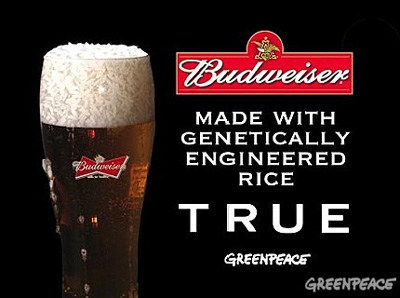
Greenpeace today released the results of an independent analysis of rice at an Arkansas mill which supplies rice to Anheuser-Busch for use in their beer. The lab found genetically engineered rice in 75% of the samples. From the press release:

An independent laboratory, commissioned by Greenpeace, detected the presence of GE rice (Bayer LL601) in three out of four samples taken at the mill. The experimental GE rice is one of three rice varieties that were first found in 2006 to have contaminated rice stocks in the US. Since then, GE contamination has been found in approximately 30 per cent of US rice stocks. This has had a massive negative impact on the US rice industry as foreign markets, where GE rice has not been approved, have been closed to US rice.

“Anheuser-Busch must make a clear statement about the level of GE contamination of the rice used to brew Budweiser in the US and spell out what measures are in place to ensure this beer does not reach the company’s export markets,” said Doreen Stabinsky, Greenpeace International GE Campaigner.

“US beer drinkers need Anheuser-Busch to explain why it is not preventing use of this genetically-engineered rice in the US. If, as the company has informed Greenpeace, all of the Budweiser exported from the US or manufactured outside of the US is guaranteed GE free then Anheuser-Busch needs to state this publicly, and explain the double standard,” said Stabinsky.

Greenpeace informed Anheuser-Busch of the test results prior to their release and sought clear information from the company on the extent of contamination and its global policy on the use of GE ingredients. Anheuser-Busch responded that the rice is approved in the US and is not used in brewing Budweiser destined for export. The full extent of the contamination remains unclear, however.

LL601 GE rice was retroactively granted approval by the US Dept of Agriculture in an effort to reduce public concern and company liability despite 15,000 public objections. The European Food Safety Authority stated that there was insufficient data to make a finding of safety. Greenpeace says that US consumers have a right to know if this GE rice is used to make Budweiser. This GE rice is not approved outside the US so the Budweiser brewed with it could not be sold abroad.

Anheuser-Busch is the largest single rice buyer in the US, buying 6-10 per cent of the annual US rice crop. Budweiser is one of only a few beers having rice as an ingredient. The brand is found in around 60 countries through a mix of exports and local brewing arrangements.

I recently did an article on green breweries and interviewed the Senior Group Director of Environmental, Health and Safety for A-B. I was pleasantly surprised at just how many things they were doing to be “green” so it seems surprising that they’d overlook genetically engineered rice being used in the beer itself. One thing you can say about Anheuser-Busch is that they do care about their public perception, so it will be interesting to see their reaction to this revelation.

bud-gerice

Doug Muhleman, Anheuser-Busch’s Group Vice President of Brewing, Operations and Technology, released a statement yesterday which I think suggests that Greenpeace is not the virtuous one in this story. On closer examination, this may be more about international politics than beer. Here’s Muhleman’s statement:

Greenpeace’s statements regarding our beer brands are false and defamatory. All of our products are made according to the highest quality standards and in complete compliance with the laws in each country where we sell our beers.

We stand in support of U.S. farmers, who are partners with us in the quality of our products. Greenpeace recently asked us to join their advocacy campaign on genetically modified crops. We refused their calls to boycott U.S. farmers, and they are now retaliating.

The use of genetically modified crops in the United States is not new. The vast majority of the commercial corn and soybean supply in the United States contains genetically modified versions that are certified to be safe for human consumption by the U.S. Government.

We use U.S. rice for brewing our products for U.S. consumption. U.S.-grown long-grained rice that may have micro levels of Liberty Link proteins present is fully approved by the U.S. Government, having determined that it is perfectly safe for human consumption. Moreover, the Liberty Link protein, like all proteins, is substantially removed or destroyed by the brewing process. Liberty Link has not been found in any of our tests of our beers brewed in the United States.

We fully comply with all international regulatory standards on the use or presence of genetically modified ingredients wherever our beers are sold internationally, as well. Neither Anheuser-Busch, nor our international licensed brewing partners use genetically modified ingredients, including genetically modified rice, in brewing products sold in any country with legal restrictions.

We talked with Greenpeace, hoping to help them understand the facts. We are disappointed that they instead chose to pursue pressure tactics.

Now I’m no fan of GMO’s, but they have been used here for many years and, like it or not, they’re a part of our massive food system. Short of pulling out every crop in the country and starting over, I’m not exactly sure what would satisfy Greenpeace. Certainly the way Greenpeace is seeking to sensationalize this seems more bullying than anything. I confess I was alarmed when I first read the story but having looked at it more closely in the interim I’m not sure their tactics are entirely warranted.

ab-muhleman
Me with Doug Muhleman at an A-B reception at GABF last year.

Filed Under: News, Politics & Law Tagged With: Business, Health & Beer, Ingredients, International, National, Press Release

Critiquing the Critiquers

October 4, 2007 By Jay Brooks

olympia
The tagline from one of my favorite graphic novels, The Watchmen by Alan Moore, is “Who Watches the Watchmen,” which itself is taken from one of the Roman writer Juvenal’s Satires. The notion of who keeps honest the people entrusted to keep people honest is as relevant today — and possibly more so — as it was in First Century Rome when Juvenal first penned the phrase. With blogs this is done quite simply, with the blogosphere policing itself, in effect, as we endlessly comment on one another’s work. This often leads to a healthy exchange of ideas and is personally one of my favorite aspects of writing online.

oly-cakes

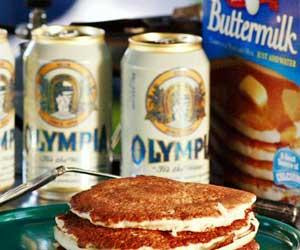
Back in July, I picked up on a item from the Oakland Tribune in which staff food writer Steve Dulas wrote about making pancakes with Olympia Beer, insisting it must be Oly or nothing. I didn’t think it would make much of a difference, and said so in my own post about Oly Pancakes.

Over at SF Weekly there’s a regular blog called The Snitch written by Joe Eskenazi and at the same time he also questioned the Oly mandate and tried making the pancakes using different beers for comparison. At the time I wrote my post, I commented on both the original piece from the Oakland Tribune along with The Snitch’s take. As what goes around, comes around, the Snitch today made my critique the story of the day.

In Joe’s original take on this story, he felt that Arthur Guinness would roll over in his grave should anyone have the temerity to try using his Irish stout for making pancakes. I took exception to that and this time around The Snitch tried making pancakes with Guinness, just to see if Artie’s ghost would indeed haunt him, and the results are as funny as they are illuminating. I just love the circular nature of the internet, it reminds of … well, pancakes. Well done, Joe, now I’m hungry again.

Filed Under: Editorial, Food & Beer, Just For Fun, News Tagged With: Bay Area, California

A Sad, Sad Sight

October 4, 2007 By Jay Brooks

My friend Melissa, who brews at Drake’s, sent me a link to the BBC’s Day in Pictures, commenting simply. “That’s a sad sad sight.”

And I see what she means. Although there aren’t too many details about the photos apart from the caption, it’s the sort of thing you hate to see no matter what the circumstances.

Indonesian officials destroy alcohol confiscated from unlicensed stores in Jakarta.
 

Filed Under: News Tagged With: Asia, International, Law

Budvar Not For Sale

October 1, 2007 By Jay Brooks

The Prague Daily Monitor reported today that the Czech Republic government has changed its mind for the time being about privatizing Budejovicky Budvar brewery. Prime Minister Mirek Topolanek was quoted as saying there’s “no privatization,” adding that it would take at least 12-18 more months before Budvar would become a joint-stock company. He also laid to rest rumors that Marek Dalik, Topolanek’s advisor, was in negotiations with Anheuser-Busch to purchase the Czech brewery, as had been widely reported in the business press.


Filed Under: News Tagged With: Business, Europe, International

New Beer Magazine Covers Pacific Northwest

September 25, 2007 By Jay Brooks

According to the Portland Beer Blog Guest on Tap there’s another new beer magazine that’s hit the street. It’s Beer Northwest and will focus primarily on the Pacific Northwest. I met the publisher, Megan Flynn, at this year’s Oregon Brewers Festival and she seems like she has a good shot at succeeding with the new quarterly. Of course I may be slightly biased, I wrote the Washington Hops story listed on the cover. Go ahead, subscribe. You know you want to.


Filed Under: News Tagged With: Oregon, Washington

Budweiser Negotiating to Buy Budweiser

September 14, 2007 By Jay Brooks

No, you read that right. In April it was announced that the Czech Republic, who owns and operates Budejovicky Budvar — from the Bohemian town of Budweis — was considering selling it to the highest bidder to help with the country’s budget woes. Naturally they used the gentler word privatize, but the result is the same. Forbes is reporting that Anheuser-Busch has been in negotiations for some time now.

A-B and Budvar have been bickering over the Budweiser trademark for over a century, though recently A-B agreed to distribute Czechvar (Budvar’s trade name in the U.S.) in the American market. Buying the Czech brewery would make good sense from a business point of view, because the still numerous pending trademark disputes would simply vanish, saving untold millions in legal fees. Plus A-B would be able to market its own Budweiser uniformly throughout the world. Currently there are a number of nations where Budvar has prevailed in litigation and the American Budweiser must be sold in those countries under a different name. Buying the brewery then seems like it would be worth its weight in gold. Of course, the Czech government is apparently not one to let an opportunity pass it by and is exploiting the situation. They’re asking $1.5 billion, even though that’s twelve times its annual sales of just over $125 million. Most valuations use a formula of around 2.5 times annual sales, making a pricetag of $300 million or so a bit more reasonable, at least to prospective buyers.

A-B began selling beer under the name Budweiser (admittedly taking the name from the Bohemian town of Budweis) in 1876 (registering the trademark in 1878), whereas the present brewer, Budejovicky Budvar, didn’t begin brewing until 1895. But as the Czechs are quick to point out, beer was being brewed in the town of Budweis since the 13th century, since 1265 to be exact. And in that time before trademarks and brand names per se, beer brewed in the town was called Budweiser to distinguish it from beer made in other towns, it just wasn’t made by the same company. To a number of people, however, the dispute is about more than just who used the brand name first. To the Czechs it’s understandably a matter of national pride. How do you tell someone they can’t use the name of their own town on their own labels with a company name that also includes the name of the town?


Well if you’re Anheuser-Busch, you rely on the fact that you’ve spent millions and millions of dollars building a brand name and some upstart company shouldn’t be able to just waltz in and trade on all that hard work. And while I do understand A-B’s position, I’d be more sympathetic to it if this dispute just started recently after they really have created a worldwide brand name over many, many years spending untold dollars to do so. But that’s not exactly what happened. This dispute began early in the 20th century, only ten years or so after the modern Budvar was formed and only 30-odd years after Anheuser began using the Budweiser name. At that time they were certainly a successful company, but nowhere near the international behemoth they are today. Looked at today, it’s much easier to accept A-B’s arguments, but not when the dispute began. The vast majority of the effort and resources that A-B has spent building up the value of the brand name took place after Budvar began complaining that A-B was using their town’s name. I’m not sure that matters from a legal standpoint (though perhaps it should) but it just feels wrong. I know that’s idealistic and isn’t how the world really works, but I’m not convinced that most people want to live in a world where the bully with the most money usually wins. A-B may have even figured out a way to market Budweiser in the Czech Republic, by buying another local brewery, Jihocesky Pivovary, which is currently located in southern Bohemia. But in 1997 they found documents indicating they were the first brewery in Budweis, having been founded in 1795.

But buying Budejovicky Budvar would finally and forever put this dispute to bed. I just don’t know if that’s really the right result. It certainly doesn’t feel like it would end the controversy or really answer the question of who really should be entitled to use the name “Budweiser.”


Filed Under: Editorial, News Tagged With: Business, Europe, History, International, Law, National

Michael Jackson Passes Away

August 30, 2007 By Jay Brooks

NOTE: An updated version of this post, and one which I’ll continue to update with new information, photos and links, can be found at my new tribute page: Michael Jackson 1942-2007.

I just got word from a friend and colleague that Michael Jackson passed away early this morning in his London home. He got the news from Roger Protz, a beer writer in England, that he had been found in his tub. It now appears that the cause of death is a heart attack. This is very sad day for the beer world. Michael was larger than life and his influence cannot be overestimated. To say he will be missed seems a grand understatement.

After getting the news early this morning, I’ve just spent the last eight hours flying home from Yakima, Washington, where I’d been attending Hop School. In that time, a little more information has come to light and some memorials have already been created. Here are a few from around the beer world:

News Reports:

  • AP Story at Beverage World
  • Michael’s Last Column for All About Beer
  • CNN
  • Morning Advertiser (UK)
  • The Oregonian
  • Philadelphia Daily News
  • Seattle Post-Intelligencer
  • Washington Post


Memorials & Remembrances:

  • All About Beer Memorial
  • Tomme Arthur at The Lost Abbey
  • Roger Baylor at The Potable Curmudgeon
  • Brewers Association’s Remembering Michael Jackson
  • British Beer Writers Memorial
  • Lew Bryson on Seen Through a Glass
  • Tom Dalldorf at the Celebrator Beer News
  • Stan Hieronymus on Appellation Beer
  • Stan Hieronymus again on Appellation Beer
  • Stan Hieronymus on Real Beer’s Beer Therapy
  • Rick Lyke at Lyke 2 Drink
  • Carolyn Smagalski at BellaOnline


Photos:

  • Tom Dalldorf went through some of the Celebrator’s older photo archives and dug up some great pictures of Michael, which he’s posted at the Celebrator.
  • Mark Silva, from Real Beer, posted some great photos on his Flickr page from an event at the Beach Chalet in San Francisco from 2001.


Video:

    Interview in Michael’s London home with Dan Shelton of the Shelton Brothers beer importers (on YouTube).

 
Stan Hieronymus has now set up a special blog as a memorial entitled Michael Jackson The Beer Hunter In Memoriam

 
Here are some of my own memories:

I first became aware of Michael Jackson at about the same time I discovered different, more flavorful beers while stationed in New York City in the late 1970s. I was in a U.S. Army Band at the time, stationed under the Verrazano Narrows Bridge on Fort Hamilton, which is on Staten Island. My bandmates and I went into Manhattan whenever we could and spent a lot of our time in the many jazz clubs in the Village and other parts of the city. Beers like Bass Ale, Guinness and Pilsner Urquell were often served in these clubs and they were vastly different from the local pilsners I grew up drinking in southeastern Pennsylvania. I was smitten with them at once, and wanting to learn more about them, chanced upon Michael’s World Guide to Beer at a bookstore and devoured it whole.

Fast forward around 13 years later and I’d just published The Bars of Santa Clara: A Beer Drinker’s Guide to Silicon Valley and treated myself to my first trip to the Great American Beer Festival. This was 1991 or 92. Michael was signing books at a table and I was thrilled to finally meet someone who had been such an inspiration. I told him about my book and explained how grateful I was for his books and how helpful they were to me in writing a summary of beer history and styles for my guidebook’s appendices. He gave me his card and asked me to send him a copy, which I happily did.

My next encounter with Michael was at the Great Divide Brewery in Denver during a later GABF. At this point I was the beer buyer at Beverages & more and had been invited to one of the first of Great Divide’s annual Thursday morning open houses because I had recently started selling Great Divide in our California stores. I asked Michael if he had received my book, fully expecting him to have no recollection of it given that several years had passed. He told me he remembered it and particularly liked my appendix with historical events, birthdays etc. for every day of the year, a lifelong passion of mine that you can still see in the upper left-hand corner of the Bulletin every day.


A few years later I joined the Celebrator Beer News and saw Michael more and more at events around the country. I loved hearing him talk about beer, of course, but I figured out early on that it wasn’t the only thing he loved. As a result we started discussing literature, politics, music — especially jazz — and topics decidedly non-beery whenever we saw one another. He recommended many books and authors to me over the years, including ones I now cherish such A.J. Liebling. I think Michael liked being able to relax and not have to talk about beer constantly and I just enjoyed his company, he was insightful and a great storyteller.

But I think my favorite Michael memory took place at the Craft Brewers Conference when it was in San Diego in 2004. One night everyone was around the central pool area enjoying the many San Diego beers there. I was feeling hungry and thinking about getting dinner even though it was later in the evening. About that same time, Michael declared he was hungry and it turned out we were the only peckish ones in our group standing around chatting. I volunteered to take Michael to dinner so his people could stay at the party. We walked slowly over to the closest restaurant in Town & Country, the self-contained resort where CBC was being held, talking amiably about nothing and everything. But we arrived too late and a rude maitre’d would not seat us and suggested we try the last remaining open restaurant in the complex, though he wouldn’t guarantee it was open either. Outside the restaurant, I persuaded a Town & Country employee to take us to the other restaurant, Kelly’s Steakhouse, in his electric golf-cart because Michael was visibly tired. Kelly’s Steakhouse was open and we sat at a corner table, before spying Vinnie and Natalie Cilurzo out to dinner with some friends. They had just sat down, too, and invited us to join them and we all re-situated ourselves at a larger table. It was a great night of wine, beer and conversation. And there are a few funny stories I can’t tell here.

The outpouring of memories and reminiscences in the last 24-hours are a living testament to the influence Michael had throughout his thirty-plus-years writing about beer and spirits. It’s hard to imagine a single soul who did more for an industry. It’s a remarkable achievement that reminds me of one of my favorite stories, Jean Giono’s The Man Who Planted Trees. It’s a French tale about a solitary man living alone in the hills of a desolate part of rural France as a sheepherder. Every night he hand picks fifty acorns and the following day he plants them. He does this for years and then decades, totally changing the landscape. The trees flourish which brings back birds, animals, plants and water, which in turn brings life back to an entire region, including countless people who begin moving back into the area. It was made into a wonderful animated film several years ago which won an Academy Award for short animated feature (you can watch the video on Google Video). The story is about how the dedication and perseverance of one man — which could be you or me — can really make a difference. So often we feel like nothing we do can or will make much of a difference, but people like Elzéard Bouffier (the fictional tree man) and Michael Jackson prove that it is possible for an exceptional person to have a profound effect on peoples’ lives. It’s almost impossible to imagine what the American craft beer industry would be like today without Michael Jackson. He wrote with such passion and enthusiasm — and so beautifully — that he inspired countless brewers and beer enthusiasts. Without his voice, where would be today? He was a giant among men. Try as we might, none of us writing today are in his league. A few are very good — you know who you are — but there is no one as clearly gifted. Of course, through his work Michael will live on and continue to inspire us, as well as future generations of beer lovers.


Michael and Carolyn Smagalski at a recent Pilsner Urquell event. (Thanks for the photo Carolyn.)


Filed Under: News Tagged With: Europe, Great Britain

Today Alcopops, Tomorrow Beer

August 27, 2007 By Jay Brooks

Join Together, another one of those pesky neo-prohibitionist groups, is still crowing about the California Board of Equalization‘s wrong-headed decision last week to tax FMB’s (flavored malt beverages, a.k.a alcopops) using the same schedule as spirits. This will mean, beginning in mid-2008, makers of FMBS will be required to pay about 25% more in taxes. Neo-Prohibitionists groups who pushed this issue believe that making alcopops more expensive will somehow reduce underage consumption.

As I’ve said before, it’s quite easy to see why the BOE would vote in favor of higher taxes, especially during a statewide budget crunch, but even at that it was a narrow 3-2 decision. Insiders present at the meeting tell me that the BOE hinted at al present that in ruling they way they did, they were giving all concerned parties a chance to take the issue to the legislature where the BOE made clear they believe it should be decided. I’ve heard an unconfirmed story already that the anti-alcohol Marin Institute has talked to the state speaker, fully expecting his support, only to be shut down in no uncertain terms. It’s no surprise we’ve haven’t heard that side of the story from them.

Knowing that makes it much harder to swallow Join Together characterizing the ruling as “groundbreaking.” Their headline, Alcopops are Liquor, Not Beer, Calif. Tax Board Rules, is misleading at best and an out and out lie at worst. The BOE did no such thing. They only ruled that alcopops should be “taxed” as spirits, not that they “are” spirits. A small point, perhaps, but I think illustrative of how willing these groups are to torture the truth and bend it to their will.

Speaking of lying, here another pernicious one:

Michael Scippa, advocacy director for the Marin Institute, told Join Together that up to 90 percent of the alcohol contained in alcopops is derived from distilled spirits, and that California law states that a beverage with any amount of detectable alcohol from such sources is considered a distilled product, not a beer product.

“Up until now, alcopop manufacturers have gotten away with a cynical manipulation of California’s alcoholic beverage laws, mischaracterizing their products – which derive most of their alcoholic content from distilled spirits – as though they were beer to permit them to be sold cheaply and broadly throughout the state,” said Scott Dickey, an attorney with the San Francisco-based Public Law Group, which provided free legal services to the campaign to change the alcopops classification. “The BOE’s decision is a big step forward in holding alcopop manufacturers accountable for this deception.”

That’s not true, they are malt beverages with flavoring added. Distilled spirits are not added and it is not where their “alcoholic content” is derived from. They are most closely related to beer, which is precisely why they they are called flavored malt beverages and why they have been taxed like beer. Their alcohol content is likewise about the same as the average beer. They are fermented like beer and then chemical flavoring compounds are added, which give FMBs their distinctive sweet, fruity essence. Unlike attorney Scott Dickey’s assertions, which in fact are mischaracterizations, FMBs are exactly what their name suggests, no one has deceived anyone.

When Diageo first presented Smirnoff Ice to me in my capacity as the beer buyer for Beverages & more, they were quite candid about their reasons for launching the new product. Since they were prohibited from advertising their brand in certain media and likewise not permitted to sell their brand in certain stores, at least in California, such as convenience stores, gas stations, etc. By making an alcoholic product that was not spirit-based, they could now do so and it would further allow them to promote, market and advertise the core brand of Smirnoff to a wider audience. I think the fantastic success of Smirnoff Ice, and their countless imitators, surprised Diageo as much as it delighted them. But it was created precisely NOT to be a spirit, and if they had used distilled spirits in its manufacture, that would have defeated its original purpose.

Unlike the assertion of Marin Institute executive director Bruce Lee Livingston, whose grasp on reality seems to be slipping, that “[f]or generations, Big Alcohol has evaded proper taxation on these products,” they have been taxed at the exact rate they should have been for what the product actually is. And as I pointed out previously, Smirnoff Ice was introduced in 2001 and a generation is about thirty years. Clearly math is not his strong suit.

Now I’m no fan of FMBs. I don’t like them. I don’t like the way they often subvert young people’s conversion to craft beer. From a purely business point of view, I understand why the parent companies have used them to build their brand awareness while creating new profits at the same time. But I have been hearing a disturbing number of people inside the brewing industry willing to throw them under the bus, short-shortsightedly failing to recognize that the attack on FMBs is not an end unto itself, but merely the first battle in a much longer war. Don’t believe me? Just wait, do nothing, and see what happens.

I have it on good authority that the next salvo from the Marin Institute will be to ask the legislature/BOE to reclassify all malt beverages over 6% abv as distilled spirits! That means any strong beer like Belgian tripels, dubbels, bocks and doppelbocks, barleywines and even some IPAs will all be considered distilled spirits for taxation. I’m sure they’ll be spinning it as an attack on malt liquor, but some of our most cherished styles of beers will fall under such a definition, making them either more expensive or economically unfeasible for the breweries to continue making them.

Distillation, of course, is a specific process for separating, in the case of liquids, different components with different boiling points. There are a few kinds of distilling, such as freeze distilling, pot distilling and reflux distilling, and each of them does roughly the same thing or yields similar results. Liquids distilled are separate and distinct from either beer or wine, of course, as the process deviates wildly at one point and the resulting spirits are generally much, much stronger than either. Types of distilled products include absinthe, bourbon, brandy, calvados, cognac, gin, ouzo, rum, schnapps, scotch, tequila, vodka, whisky (and whiskey) to name just a few of the more common examples. Other non-alcoholic or lethal products which are distilled are gasoline, kerosene and paraffin.

So trying to call strong beers distilled spirits is not really in keeping with reality. Spirits — and wine for that matter — is generally much more alcoholic than beer, so trying to paint even a 10% strong beer with the same broad brush as whisky is akin to trying to fit a square peg in a round hole. It just doesn’t work. But it really has nothing to do with reality — or concepts of fairness — but instead is the drawing of the next battle line in a war whose goal is another national prohibition. We have to be vigilant of these groups and what they’re trying to accomplish. It’s our very complacency and disorganized apathy that they’re counting on to succeed. You can color me as reactionary as you like, but no harm can come from committing ourselves now to defeating the well-organized campaign for another prohibition. If we succeed, life continues as before. But if we lose, we’ll have no beer to cry into. Don’t let that happen.


Filed Under: Editorial, News Tagged With: Business, California, Law, Prohibitionists

« Previous Page
Next Page »

Find Something

Northern California Breweries

Please consider purchasing my latest book, California Breweries North, available from Amazon, or ask for it at your local bookstore.

Recent Comments

  • Bob Paolino on Beer Birthday: Grant Johnston
  • Gambrinus on Historic Beer Birthday: A.J. Houghton
  • Ernie Dewing on Historic Beer Birthday: Charles William Bergner 
  • Steve 'Pudgy' De Rose on Historic Beer Birthday: Jacob Schmidt
  • Jay Brooks on Beer Birthday: Bill Owens

Recent Posts

  • Beer In Ads #5137: Bock Is Back… Look For It March 1st February 28, 2026
  • Historic Beer Birthday: John Holme Ballantine February 28, 2026
  • American Craft Beer Hall of Fame: 2nd Year Inductees February 28, 2026
  • Beer Birthday: Jeff Bell February 28, 2026
  • Beer In Ads #5136: American Bock Beer Is Being Served Today! February 28, 2026

BBB Archives

Feedback

Head Quarter
This site is hosted and maintained by H25Q.dev. Any questions or comments for the webmaster can be directed here.