
Well, maybe not exactly primetime, but the award ceremony is on YouTube, at least. So without further ado, here are the award announcements for the 2007 Great Alaska Beer & Barley Wine Fest Awards from YouTube:
Latrobe Brewery Receives State Grants
The Associated Press is reporting that Wisconsin’s City Brewery, the new owners of the Latrobe Brewery, has been awarded state assistance to the tune of over $4.5 million. The Pennsylvania has been closed since early last summer. The grants and loans were announced by Governor Ed Rendell, who also said he believes 250 brewery employees should be back to work by June 1 of this year.
SacBrew Barley Wine Festival Winners
The results are also in for the 2007 SacBrew Barley Wine Festival. Since I wasn’t able to go north to Alaska, I was fortunate enough to be able to judge in Sacramento last night. Here are the top three Barley Wine winners:
- 1st Place: Sky Diver, Brew It Up!
- 2nd Place: Beermann’s Bourbon Barrel Barley Wine, Beermann’s Brewing
- 3rd Place: ’06 Barrel Aged Barley Wine, Sacramento Brewing
Great Alaskan Beer & Barley Wine Festival Winners
The results are in for the 2007 Great Alaskan Beer & Barley Wine Festival.
Here are the top three Barley Wine winners:
- 1st Place: Arctic Devil, Midnight Sun, Alaska
- 2nd Place: Stormwatcher’s Winterfest 2005, Pelican Pub & Brewery, Oregon
- 3rd Place: Cyclops, Elysian Brewery, Washington
Results courtesy of Tom Dalldorf, publisher of the Celebrator Beer News.
BB & A-B: The Unlikeliest of Unlikelihoods?
+ = ??
The rumor of Anhesuer-Busch in talks with Boston Beer left a foul taste in my mouth, and a few short weeks ago would not have given the idea a moment’s thought. The feud between Jim Koch’s Boston Beer Co. and Augie Busch’s little company is, though considerably shorter than Budvar’s, just as legendary. The production company “Ducks In A Row Entertainment Corporation” is supposedly even making a film about their famous feud with the tentative title “Beer Wars.” Last I heard, it was in the editing stage but that was some time ago. The point is, these are two companies that do not feel a great deal of affection for one another.
So my first reaction to this rumor would under normal circumstances be, “no F’ing way.” But that was before A-B inked deals with both InBev and longtime rival Budvar. With those deals, the Earth is already spinning off its axis, so why not Samuel Adams, too?
This particular rumor comes courtesy of Miller’s Brew Blog, who got it from the only other source to mention it so far, Beer Business Daily, a subscription-based beer news service. BBD reported that they have “been fielding about a half dozen inquiries a day from readers with the latest rumor du jour making the rounds out there: A-B and Boston Beer hooking up.” To no one’s surprise, neither side would comment on the rumors. But that was the same as the InBev rumors, at least, so who knows?
I’ve heard Jim Koch speak personally about his feelings concerning A-B and their business practices and given that, and all of the trouble they’ve tried to cause him over the years, it just seems incredibly unlikely that he’d entertain any offers from them. But at the risk of repeating myself, I keep coming back to how often the seemingly impossible has been happening these days.
Drinking Liberally
If you like your news leaning to the left, you could do no better than the AlterNet, a portal that brings in news that appeals to liberals from a variety of sources. They had a lengthy article posted today by author Nick Pinto called “Drinking Liberally: A New Strategy for Progressive Politics,” about the progressive organization that was founded in May of 2003. Drinking Liberally is pretty much what it sounds like, a group of politically like-minded progressives who get together on a regular basis to enjoy a beer and talk politics. Their motto is “Promoting democracy one pint at a time.” There are currently 175 chapters in 42 states (plus D.C.), including four here in the Bay Area: in Oakland, Palo Alto, San Francisco and San Jose.
|
The website provides a forum, information on each chapter (like when and where they meet) and how to start your own chapter, but the AlterNet article is a great overview of the organization’s origins, structure and goals. Founders Justin Krebs and Matt O’Neill met working together on a PBS-funded non-partisan project aimed at getting young voters involved in politics. Though they found modest success, both remained frustrated with the state of political discourse and decided to do something about it. From the article:
|
On a Thursday night in May of 2003, after e-mailing an invitation to some friends, Krebs and O’Neill held the first session of Drinking Liberally at Rudy’s, a popular Hell’s Kitchen bar known for its hot dogs and cheap pitchers.
The group grew slowly over the summer, with some Thursday nights finding only Krebs and O’Neill holding down the Drinking Liberally fort. A west-coast chapter opened when a regular attendee at Rudy’s moved to San Francisco, and the group’s profile rose somewhat when it hosted some events during the 2004 Republican National Convention. But what really catapulted the group into the national awareness was a photograph in a Newsweek article about young people’s political engagement that showed someone wearing one of the group’s buttons, which read, “I only drink liberally.”
“Over the course of that week so many people started Googling ‘I only drink liberally,’ finding our Yahoo group, and writing us to say, ‘Hey, how can I start my own chapter?'” O’Neill recalls.
After the website went up, things began to snowball and the movement grew quickly, taking only a few short years to extend its reach into over 80% of the states and almost 200 metropolitan and not-so-metropolitan areas. Today the average age of a member is 36, a little older than the founders originally envisioned, but as the author notes, the growth of Drinking Liberally mirrors the growth of liberal blogs, too. An interesting concept to be sure.
The idea has also spawned other similar liberal organizations such as Laughing Liberally and Screening Liberally, all hosted by Cosmopolity, whose mission is “political action through social interaction.”
Strong Beer Month Coming
Beginning on February 1, 21st Amendment Brewery and Magnolia Pub & Brewery, both in San Francisco, will team up again to host their fifth annual Strong Beer Month. Each brewpub will create five new and different seasonal beers — and if you haven’t figured it out yet, they’ll all be strong — that will be available at the two locations throughout February. Sample them all, and you’ll receive some sort of prize. I stopped by 21A this morning after waiting in line nearby to get an expedited passport (long story) and sampled a couple of the new brews, one of which was still aging in the brewery.
First, there was St. Martin’s Abbey Ale, a decidedly Chimay-like beer with nice chocolate notes. Second, and perhaps more interesting, was a Belgian strong ale that had been blended with a small amount (around 10 gallons per 300) of Lindemans Framboise which itself had been aged in an oak barrel. At 10% abv, the new beer’s strength is neatly masked by the lambic’s sweetness, which is evident in abundance. The thick malt presence comes through but only a hint of sourness peeks out of the sides. But the lambic sweetness and the Belgian strong combine to create something fairly unique. I’m not quite sure what yet, but more tasting is definitely in order.
Unfortunately, it will be hard to order because, so far, the beer has no name. Given the brewpub’s close proximity to [insert current corporate name here] Stadium, where the San Francisco Giants play, and the fact that the beer reminded me of a framboise on steroids, I suggested “Berry Bonds.” Despite the look brewer Shaun O’Sullivan shot me, I’m going to continue to call it that, though I’m pretty confident that will not end up being its official name. Too bad, I liked it.
Faux Canada
According to an article in today’s Montreal Gazette, Canadians are increasingly looking to buy better tasting beer. And like their American cousins, the big Canadian breweries are flooding the market with faux or stealth microbrews in order to compete with craft brewers. With these faux craft beers, they’re trying to fool customers into thinking they’re getting just want they want, a beer that’s been hand-crafted to taste great.
Labatt has a line called Alexander Keith, named for an early brewer in Nova Scotia. MolsonCoors, likewise, has Rickard’s family of brands. Both Rickard’s and Keith’s are listed on their respective company websites and acknowledged as their brands. Alexander Keith’s own website does disclose that it’s a Labatt brand, but only in the legal stuff like “terms of use.” They certainly don’t go out of their way to associate themselves with the parent company.
An interesting parallel, though the article goes on to discuss tarrifs between provinces and what their removal will mean for small players. I don.t know enough about the market to form an opinion, but it’s an interesting read.
Alexander Keith’s IPA, owned by Labatt; and Rickard’s Red, owned by MolsonCoors.
The Duchesse

Jon Bonné, the new big cheese at the San Francisco Chronicle’s wine section, had a little blurb in the Sipping News about a wonderful beer, the Duchesse de Bourgogne, imported by D&V International.
Bonné claims it’s a beer for wine lovers, though I assume he means others might enjoy it, too. His pairing suggestions are intriguing, matching it with “rich cream dishes (with mussels, for instance) or a firm, bold-flavored cheese like an aged Gouda.” He also mentions the City Beer store — 1168 Folsom (at 7th), 415.503.1033 — as a place to buy it, and it’s good to see them get some love. I could make a big deal out of Bonné’s selling as a beer for cork dorks, but I’m hoping what he’s trying to do is get people who might not otherwise try a sophisticated beer to try one, and because I’m trying to give him the benefit of the doubt after his gracious response to my earlier criticism about one of the first beer pieces he green-lighted after coming to the Chronicle.
Duchesse de Bourgogne is a favorite of mine, as I love the style — Flanders Red Ale — and I usually order one if I find it on a beer list. I was thrilled to see it in California beginning last year. It’s brewed at the Brouwerij Verhaeghe, located in Vichte, which is a ancient castle and farm in West Flanders, Belgium. By the way, it’s pronounced “Doo-shay.”
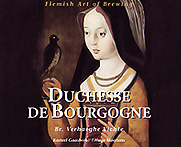
Beer aside, the history of the Duchesse is fascinating. Her anglicized name was Mary of Burgundy, though she was born in Brussels on February 13, 1457, the only child of Charles the Bold, Duke of Burgundy, and his wife Isabella of Bourbon. Needless to say she was quite a catch, especially after her father died in battle (at the siege of Nancy, not a particularly awful sounding name) in 1477, when she was nineteen. Louis XI of France tried to take Burgundy and the Low Countries for himself but was frustrated when Mary signed the “Great Privilege,” by which she gave Flanders, Brabant, Hainaut, and all of Holland autonomous rule (leaving for herself the remainder of the Low Countries, Artois, Luxembourg, and Franche-Comté). She then married Archduke Maximilian of Austria, who was later the Holy Roman Emperor Maximilian I, and part of the Hapsburg Austrian dynasty. This sparked a long-standing dispute over the Low Countries between France and the Hapsburg family.

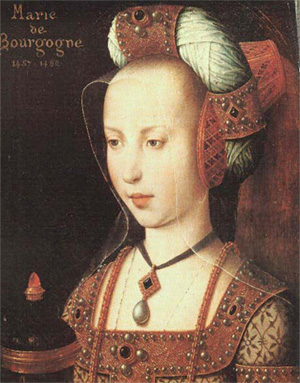
Two portraits of Mary of Burgundy, the Duchesse de Bourgogne.
One of Mary’s favorite hobbies was falconing, which was popular among royals in the day. Falconry is basically training and hunting using a falcon. While engaged in this pursuit, in 1482, Mary’s horse tripped, tossing her onto the ground where the horse then landed on top of her, breaking her back. A few days later she died. Mary was only 25. The beer label’s portrait pays homage to her love of falconry and her ultimate death because of it.
Her young son Philip became heir after her death, though Maximilian was in charge until he reached adulthood. King Louis forced Maximilian to sign the Treaty of Arras the same year, and it gave Franche Comté and Artois to France. But Philip was a virtual prisoner until 1485, and then it took Max another eight years to take back control of their lands in the Low Countries. The Treaty of Senlis, in 1493, finally established peace in the area, but Burgundy and Picardy remained French.
So during her short life, Mary had such great impact on European politics that they can be felt even now in the present. So it’s quite appropriate that she have so wonderful a beer that bears her name and her portrait. It’s a fitting legacy.
The description of the beer from the importer:
The Duchesse de Bourgogne from Brouwerij Verhaeghe is the traditional Flemish red ale. This refreshing ale is matured in oak casks; smooth with a rich texture and interplay of passion fruit, and chocolate, and a long, dry and acidic finish. After the first and secondary fermentation, the beer goes for maturation into the oak barrels for 18 months. The final product is a blend of younger 8 months old beer with 18 months old beer. The average age of the Duchesse de Bourgogne before being bottled is 12 months.
Crazy Dave Calling It Quits?
Dave Heist, better know in the brewing community as “Crazy Dave,” has been threatening to sell or quit, and hightail it to southern California for at least a couple of years. But he may really be serious this time, because now it’s in print. According to an article sent to me by two Bulletin readers, the Sunday Contra Costa Times is reporting Hoptown will close in two months.
Heist, along with a small group of investors is planning a new venture, in a larger location — possibly near Livermore — that will begin sometime with the year. It will be interesting to see what Crazy Dave does next. His beers are never boring and usually some of the tastiest around.
“Crazy Dave” Heist, owner of HopTown Brewing Co. in Pleasanton, California, along with fellow brewer Melissa Myers, currently at Drake’s Brewing. This was taken at GABF in 2002.