Brookston Beer Bulletin

Jay R. Brooks on Beer

  • Home
  • About
  • Editorial
  • Birthdays
  • Art & Beer

Socialize

  • Dribbble
  • Email
  • Facebook
  • Flickr
  • GitHub
  • Instagram
  • LinkedIn
  • Pinterest
  • RSS
  • Twitter
  • YouTube

Powered by Genesis

Americans Choose Bud As Favorite Beer In National Poll

May 5, 2011 By Jay Brooks

pulse-polls
According to a new poll taken on behalf of the Rasmussen Reports by Pulse Opinion Research, When Americans Drink Beer, They Go Domestic, or as the St. Louis Business Journal spun it, America’s Favorite Beer is Bud. (And thanks to James L. for sending me the story.)

I’m sure the poll is statistically accurate, they are professionals and this is their business, but it’s a little hard to swallow that a survey of 345 people can truthfully speak for 311 million Americans. But here’s what they claim to have learned from the answers to four questions gleaned from those 345 random adults, as reported in the St. Louis Business Journal.

Nearly seven in 10 American beer drinkers are choosing domestic beers over imported ones, while only 22 percent like imported beers more.

However, those people are more evenly divided when it comes to what kind of beer to drink: 49 percent prefer a light beer, while 46 percent prefer a regular one.

When given a choice, 25 percent said say they are most likely to drink Budweiser. Second choice is Miller (19 percent) and third place went to Sam Adams (7 percent). Coors, Heineken, Corona, Pabst and Guinness are next, in descending order, with each garnering between 3 percent and 6 percent. Another percent choose some other brand.

Miller is the top choice of 26 percent of male beer drinkers, while one-out-of-three women prefer a Bud.

Here’s how it shakes out.

  1. Budweiser (25%)
  2. Miller (19%)
  3. Samuel Adams (7%)
  4. Coors
  5. Heineken
  6. Corona
  7. Pabst
  8. Guinness
  9. Other (25%)

But most of the conclusions of this little polls seem odd, almost misleading, given the questions and the way in which they were asked. Here’s what people heard when Pulse phoned potential participants with this survey.

  1. Are you more likely to order a beer in a bar or restaurant or buy it to drink at home?
  2. Are you more likely to drink a domestic beer or an imported beer?
  3. Are you more likely to drink a light beer or a regular beer?
  4. Which brand of beer are you most likely to drink … Budweiser, Miller, Coors, Corona, Heineken, Pabst, Sam Adams or Guinness?

Question one seems fine (51% home; 38% in a bar or restaurant; I don’t know where the other 11% are doing their drinking, maybe both?), but it’s fairly straightforward.

For question two, the language used seems strange. Few people outside the industry use the term “domestic,” I would think, to describe American beer. But within it, it has a very specific meaning. It’s essentially beer made by one of the big brewers, as separate and distinct from craft beer. 69% said they prefer domestic, while 22% said imported, with another 9% holding a least a third choice. But what that really means, given the muddled definitions, is hard to tell.

Question three is simply personally obnoxious, because I utterly hate the very notion of low-calorie light beer. To me it’s an abomination, albeit a very popular one. So the fact that “49% choose a light beer, while 46% prefer a regular one,” is probably right but it’s just sad to me, not to mention a triumph of marketing.

But the last question is quite telling. By giving just eight choices in a multiple choices fashion, the survey leads the people being polled to pick one of the those beers, even if it’s not their favorite. Most people likely chose one from among the eight, as opposed to their favorite among the literally 10,000+ beers brewed or sold in America. That they didn’t even offer an “other” choice further makes this question somewhat misleading, and I can only imagine how a multiple choice question differs from a more open one. But what’s perhaps more interesting is that even trying to pigeonhole the answers to question four, 25% said they’d “choose some other brand.” So while the St. Louis newspaper spins this poll by claiming American’s “top choice is Budweiser” (and curiously omit the percentage number who chose “other”), an equal number prefer “not Budweiser,” that is some other beer not among the limited choices of the poll.

I realize that the macro brewers do continue to hold a commanding market share and in the poll does reflect that. For many years, the Top 5 selling beers in the U.S. have been the following.

  1. Bud Light
  2. Budweiser
  3. Miller Lite
  4. Coors Light
  5. Corona Extra

After that, it changes a little bit from year to year, but usually the bottom five include some combination of Heineken, Busch and Busch Light, Natural Light, Michelob Ultra Light and Miller High Life. Samuel Adams, Guinness and Yuengling usually fall somewhere in the 11-15 rankings. So the poll does reflect beer sales, which is what you’d expect. “Favorite” and “best-selling” are not exactly the same, but I’d argue that sales is how people vote for the favorites. In the real world, outside polls, people vote with their wallets.

So in a somewhat accurate poll that reflects current market share patterns, one in four respondents eschewed the eight choices given them (which wasn’t even an option) and chose a beer not on the list, which was equal to the top vote getter, Budweiser. It seems to me the headline should have been more along the lines of “Equal Number of Americans Prefer A Beer Other Than Bud As Pick Budweiser As Their Favorite.” Or even better, as suggested by James Wright, “35% of Americans prefer NOT Bud, NOT Miller and NOT Coors.” Alright, they’re both a little unwieldy, but to me that’s the biggest takeaway from this poll.

Filed Under: Beers, Editorial, News Tagged With: Big Brewers, Mainstream Coverage, Statistics

Wikio Beer Blog Rankings For May 2011

May 2, 2011 By Jay Brooks

wikio
The May 2011 standings will soon be released for Wikio’s Beer Blogs. Stan at Appellation Blog got a sneak peak at the new rankings, so here’s what happened to the Top 20 over last month:

Wikio May 2011 Beer Blog Rankings

1Brookston Beer Bulletin (+1)
2Beervana (-1)
3The New School (+1)
4Brewpublic (-1)
5A Good Beer Blog (+1)
6Appellation Beer: Beer From a Good Home (-1)
7Drink With The Wench (+/-0)
8Seen Through a Glass (+1)
9The Daily Pull (+1)
10Oakshire Brewing (Not in Top 20 for Apr.)
11Washington Beer Blog (-3)
12The Session Beer Project (-1)
13KC Beer Blog (+3)
14Seattle Beer News (-2)
15It’s Pub Night (-2)
16brewvana (Not in Top 20 for Apr.)
17Beer 47 (+2)
18Beer Therapy (+2)
19Beer-Stained Letter (Not in Top 20 for Apr.)
20The Not So Professional Beer Blog (-3)

Ranking made by Wikio

As usual, I added the relative movements of each blog from last month. This month, three new blogs made an appearance in the Top 20, some for the first time. Another curious change is that #1 & #2, #3 & #4, and #5 & #6 each switched places. As always, I continue to stress that this is just a bit of fun and that we shouldn’t take it too seriously, though I’d be lying if I said I wasn’t pleased to be back at #1 again. Vanity of vanities, all is vanity.

Filed Under: Just For Fun, News Tagged With: Awards, Blogging, North America, Websites

Cheese & Beer Pairing Session Next Friday

May 1, 2011 By Jay Brooks

session-the
A gentle reminder that the first Friday in May is less than a week away, and that means it will be time for the next Session, a.k.a. Beer Blogging Friday. I’ll be your host for the 51st Session, and I’m making it as difficult as possible, though not on purpose, I assure you. I thought it would be fun to take things a step farther and really do something different and challenging. So check out the original announcement for the full details, but in a nutshell here’s the dealio:

  1. Pick up three cheeses*:
    1. Maytag Blue, or another blue cheese.
    2. Widmer Cellars 1-yr old aged cheddar, or another aged cheddar.
    3. Humboldt Fog, or another goat cheese.
  2. Pick a few beers you think will pair well with each cheese.
  3. Drink them with the cheese.
  4. Write up your results and post them on or before Friday, May 6.
  5. Leave a comment here, the announcement, or my Session post, or send me an e-mail so I can find your Session post.

bluecheese-cashel

Rinse. Lather. Repeat.

That’s the easy part. Now here’s where I make things a little trickier. As soon as I can, probably Saturday morning May 7, I’ll post the round-up with a list of all the beers that every participant thought worked best with each cheese. Two weeks later, I’ll be hosting Session #51.5. Here’s how to then take part in round two:

  1. Pick a few beers from the round-up list, as few or as many as you wish.
  2. Have another session where you drink those new beers with the same cheeses.
  3. Write up your results and post them on or before Friday, May 20.
  4. Leave a comment on the round-up post, or my new 51.5 Session post, or send me an e-mail so I can find your new Session post.
  5. That’s it, you did it. Now wasn’t that easy?

cheese-edam
Even with making it a tad more complicated, I think it should be great fun to really dig in and experiment and learn about how best to pair cheese and beer together. What works and what doesn’t through trial and error will always trump abstract philosophies of how to pair the two.

So spread the cheese .. er, the word. Get some cheese and some beer, and start eating and drinking the two. I hope to hear how it went next Friday, May 6, for the Great Online Beer & Cheese-Off.

* NOTE: I’ve heard that many people have had some trouble finding some or all of the recommended cheeses. Sorry about that. I really thought they’d be easier to find. But don’t stress about it, using a substitute will be just fine. Please don’t let that keep you from participating. Hopefully, all of you can find a blue cheese, an aged cheddar cheese and a goat cheese to pair with some beer for this Session. I’m looking forward to hearing about how everybody’s tastings went.

Filed Under: Beers, Food & Beer, Just For Fun, News, The Session Tagged With: Announcements, Cheese, Pairing

The Science Of Manipulation: New Study Comparing Underage Drinking Riddled With Problems

April 28, 2011 By Jay Brooks

scientist-mad
Join Together and the Partnership For a Drugfree America yesterday sent out an item in their e-mail blast entitled Teens Who Drink with Adult Supervision Have More Drinking Problems, Study Finds. Alarming, right? Likewise, the Seattle Post-Intelligencer’s went even farther with this misleading headline: UW study: Teens don’t need parents as ‘drinking buddies’.

But do these headlines accurately convey what the study actually found? Unsurprisingly, no. Not even close. Naturally, most news organizations don’t really care about the news or how accurately they portray it. Many of the reporters do, I should hasten to add, but the companies themselves and people that run them, not so much. It’s one of those open secrets that they’re businesses and what they care about is revenue. Advertising. Making money. They cynically refer to the empty spots in their papers where there is no advertising as “news holes.” That’s not necessarily a criticism. They do, I realize, have to make a profit. But it’s important to remember that they understand that fear, danger and making people uneasy sells far more papers than telling us everything’s hunky dory. “If it bleeds, it leads” is another well-known news axiom. Headlines are designed to pull in readers, to make them want to read the article. As a result, the more salacious or fearful the headline is, the more likely we’ll be persuaded to read the paper (and see all that glorious advertising that surrounds it).

The people who are against alcohol and have their own agenda to advance — those pesky neo-prohibitionists — also know how the world works and create studies that can be used to advance their cause. Lying with statistics is perhaps one of the oldest forms of propaganda. It’s certainly one of the most effective, because people tend to believe “studies” created in academia. They get them published in so-called scientific or academic journals, which while they have the imprimatur of accuracy, are often not as accurate as they first appear to be. Firstly, there’s just the law of large numbers, with an estimated 50 million such papers having been published since anybody started tracking these things, around 1665. Then how many are truly accurate or are based on legitimate premises or science? A 2009 Scottish study (and yes, I see the irony in relying on a study to discuss the inaccuracy of studies) entitled How Many Scientists Fabricate and Falsify Research? A Systematic Review and Meta-Analysis of Survey Data revealed that a weighted average of nearly 2% “of scientists admitted to have fabricated, falsified or modified data or results,” and “up to 33.7% admitted other questionable research practices.” Worse still, when surveying their colleagues’ practices, scientists believed 14.2% of them falsified papers, “and up to 72% [engaged in] other questionable research practices.” At just one university, “81% were ‘willing to select, omit or fabricate data to win a grant or publish a paper.'” The point is that journal articles are hardly as sacrosanct as the media would have us believe. Common sense is still required. Asking about the agenda, where the money or support came from or how the study was conducted often reveals surprising results, yet the supposedly fair and balanced media more often takes them unquestioningly at face value, especially if they advance a particular agenda or can be used to scare people into reading an article.

In this case, the headlines state quite emphatically that if you drink along with your underage kids that more problems will ensue for your children. How did they arrive at that conclusion? According to the articles that conclusion was reached when “[r]esearchers looked at 1,945 adolescents in Washington state and Australia and compared two approaches to underage drinking: Zero-tolerance attitudes and ‘harm minimization.'” Join Together added that “[t]hey chose to include teens from both the U.S. and Australia because the two countries have different attitudes about teens and drinking.” And they further described the differences like this. “While the U.S. Surgeon General recently issued a call to action promoting a zero-tolerance position toward youth alcohol use, in Australia surveys indicate that 30 percent to 50 percent of teen drinkers get alcohol from their parents.”

So from that, the two articles conclude the following:

The study found that by ninth grade, 71 percent of Australian teens and 45 percent of U.S. teens used alcohol. More than a third (36 percent) of Australian students reported having experienced harmful consequences resulting from alcohol use, compared with 21 percent of U.S. teens.

“Providing opportunities for drinking in supervised contexts did not inhibit alcohol use or harmful use in either state,” the researchers wrote. They recommend that policies should not encourage parents to drink with their children and parents should not allow their children to drink under their supervision.

“Findings challenge the harm-minimization position that supervised alcohol use or early-age alcohol use will reduce the development of adolescent alcohol problems,” the researchers wrote.

But let’s look at the study itself, Influence of Family Factors and Supervised Alcohol Use on Adolescent Alcohol Use and Harms: Similarities Between Youth in Different Alcohol Policy Contexts. According to the Abstract, their objective was the following:

Harm-minimization policies suggest that alcohol use is a part of normal adolescent development and that parents should supervise their children’s use to encourage responsible drinking. Zero-tolerance policies suggest that all underage alcohol use should be discouraged. This article compared hypotheses derived from harm-minimization and zero-tolerance policies regarding the influence of family context and supervised drinking on adolescent alcohol use and related harms among adolescents in Washington State, USA, and Victoria, Australia, two states that have respectively adopted zero-tolerance and harm-minimization policies

And while I’ll agree that that sounds reasonable, comparing just two makes it an us vs. them scenario. And why Australia? The claim is that it’s because of the two policy differences, but there are, of course, other ones. For example, Australian youths become adults at 18 and that includes the ability to legally buy and consume alcohol, unlike here in the U.S., where we have essentially two levels of adulthood and our youth must wait until they’re 21 to legally imbibe. Then there’s the drinking culture. Here in the U.S., we’re ranked 13th in per capita alcohol consumption, drinking about 81.6 litres (21.5 gallons per year, or roughly 230 12 oz. bottles or 9.5 cases per year). Australia, by contrast, is ranked 5th and consumes 104.7 litres (27.6 gallons, or roughly 295 12 oz. bottles or 12.3 cases per year). By percentage, the difference is that Americans, on average, drink about three-quarters of what Australians do.

I can’t help but believe that choosing just two so disparate drinking cultures, with no control, essentially created a false dichotomy, an either or situation. It seems to me, a survey or multiple nations would be far more revealing.

The so-called “harmful consequences” were self-reported and included “loss of control (“not able to stop drinking once you had started”) and social conflict (“trouble at school the next day,” “arguments with your family,” and “become violent and get into a fight”). Other alcohol-related consequences were “got injured or had an accident,” “had sex with someone, which you later regretted,” “got so drunk you were sick or passed out,” and “were unable to remember the night before because you had been drinking (blackouts).” Just under 3% of the kids had their answers discounted because they were considered to be dishonest, which given the subject matter seems quite low, to me at least. But that aside, many of the behaviors listed, except of course the ones directly related to drinking (“loss of control” and “blackouts”) don’t require alcohol to be fairly common in adolescence. As a result, it seems to me that causality doesn’t necessarily have to be in the alcohol. Any of those experiences could have happened with or without alcohol. Young teenagers could even experience something similar to a “loss of control” without alcohol — I know my friends and I sometimes did at that age. Alcohol could cause such behaviors, or exacerbate them, but it seems to me it shouldn’t be a given that the two are conclusively linked to one another.

Predictably, the prevalence of alcohol use behavior in both states increased over time between seventh and ninth grades. Lifetime alcohol use by seventh grade among Victoria students was significantly higher than among Washington students (59% vs. 39%). By eighth grade, drinking in adult supervised settings was reported by two thirds of students in Victoria and 35% of Washington youth. By ninth grade, rates of alcohol use had increased to 71% in Victoria and 45% in Washington. More than a third of Victoria students (36%) also reported having experienced any harmful consequences resulting from their alcohol use, compared

What’s also not in the reports of the study is that the kids studied were 7th graders — 12 and 13-years olds — who were then followed over the subsequent three years. So another problem with that data is that an 8th grader in the U.S. is seven years from the minimum drinking age whereas an Australian is only three years from being allowed to legally drink. That, I think, would change any parents’ decision to educate their child about alcohol, and especially when and how they’d educate them regardless of the ages being the same. It would also go a long way in explaining the results.

Another issue I see is that the general terms “favorable parental attitudes toward alcohol use” and “adult-supervised alcohol use” is never really defined, suggesting it has only a general meaning that avoids any nuanced difference. For example, I think there’s a big difference between an alcoholic who lets their kids drink because they don’t care or don’t see any possible harm and a parent who carefully tries to educate their kids about responsible drinking. One might just allow drinking in the household without limit while the other’s goal would be to sample their kids and model behavior to show that moderation and enjoyment is the key. Those are two very different approaches that would both fall under the umbrella of “favorable parental attitudes toward alcohol use” and “adult-supervised alcohol use” as far as the study is concerned.

In the summary discussion, the researchers concluded that “although harm-minimization perspectives contend that youth drinking in adult-supervised settings is protective against future harmful use, we found that adult supervised drinking in both states resulted in higher levels of harmful alcohol use.” But even in their own discussion of the study’s limitations, they admit that the lack of specificity of which adult was doing the supervising and the problems inherent in adolescents self-reporting and further contend that “a more concrete
measure asking about parents or guardians overseeing youth alcohol use may have yielded different results.”

Though not mentioned specifically, they never even bring up or account for the nature and type of the adult supervision, and for me that’s the most important factor. Because it’s not just that adults should allow their children to drink in their presence. They should use such opportunities to educate and teach them about alcohol. Merely allowing such behavior I would contend, is reckless and even counter-productive and on that point, I agree with the premise of the study. But their methods do nothing to make that all-important distinction, which is the crux of the issue, at least to my way of thinking.

And while I do doubt the sincerity of the researchers and the study itself, the media and especially the anti-alcohol groups will use the study to their own ends and gloss over the study’s own admitted limitations. As the headlines make clear, they’re not interested in accurately portraying the study’s results. Few people will go to the trouble of actually reading it, and will take it at face value, never questioning the results. Especially egregious is lead researcher Barbara McMorris’ quote that “[k]ids need parents to be parents and not drinking buddies.” Did anyone suggest otherwise? Ever? No, but characterizing any adult supervised drinking as being a “drinking buddy” makes her intentions somewhat suspect. Because raising a child to be an independent and productive adult member of society is not merely saying no. We saw how well that worked when Nancy Reagen tried it in the 80s. Sometimes we have to show them the way, teach them the difference between good and bad in a way that’s not just black and white. Things are rarely all-good or all-bad, and alcohol is a prime example. Saying adults shouldn’t be allowed to educate their children about alcohol robs them of the ability of doing their job. And pushing a zero-tolerance policy with this faulty “study” does nothing to further the goal of parents’ raising responsible adults.

So when the study concludes that their “[f]indings challenge the harm-minimization position that supervised alcohol use or early-age alcohol use will reduce the development of adolescent alcohol problems” and in the final sentence they claim that the “[r]esults from the current study provide consistent support for parents adopting a ‘no-use’ standard if they want to reduce harmful alcohol use among their adolescents,” I have to question their motives. Because those statements are essentially false. That conclusion is sound only if you ignore the manner in which the parents supervise their children, and seems to assume there is no positive way to educate your children about alcohol under supervision. I, myself, wouldn’t want to start that process in the 7th grade, but by high school, I think every child should be taught about a great many things that our schools don’t tackle. And that leaves it to every parent to prepare their children for adulthood, including teaching them about the use of alcohol. Saying the only way to prepare them for becoming an adult is to make sure they never drink the stuff all but insures they’ll binge drink the first chance they get, whether as a freshman in college or whenever they’re unsupervised. There’s nothing like a taboo to create demand. And that strikes me as irresponsible. That strikes me as the science of manipulation.

mad_scientist

Filed Under: Editorial, News, Politics & Law Tagged With: Prohibitionists, Science, Statistics

No Beer At Royal Wedding?

April 25, 2011 By Jay Brooks

uk
Another royal wedding’s coming up this Friday. I care about it as much as the last one in 1981 — not one whit. In deference to my British colleagues and friends who cling to the notion that the royal family matters, I’ll spare you my usual diatribe. But it was announced recently that no beer will be served at the The Royal Wedding (with it’s own “official” website, how klassy) between Prince William and commoner — could there be a more insulting term to call someone to their face? — Kate Middleton.

That’s right, no beer at a British wedding. The reason, according to the Daily Mail, is that “while the younger royals enjoy a pint from time to time, neither Kate nor William is a big beer drinker so they decided to leave it off the menu.” Which is, of course, all well and good if you take the position that it’s their wedding, they can — and should — do as they like. Personally, I had my wedding reception in a brewery. And as British clergyman Sydney Smith quipped in 1934, “what two ideas are more inseparable than beer and Britannia?” So perhaps that makes more British than the man second in line to be king.

But, unlike my wedding or your wedding, this one hardly counts as a private affair, it’s a national event and should, I suspect, reflect the nation. At a time when British beer is suffering, pub closings are epidemic and neo-prohibitionists have their attack dogs out, you would think this might be a perfect time to celebrate the wedding with that most British of drinks, cask ale. But, no, apparently champagne is more to the liking of the royals, or at least the ones who planned the wedding. But here’s the part that should have every red-blooded Brit up in arms. This is the “official” reason given for the ban on beer at the wedding. “It is thought that guests knocking back pints of ale was considered rather unseemly for such a regal affair attended by royals and heads of state from around the world” or put even more bluntly by a Daily Mail source, “[l]et’s face it, it isn’t really an appropriate drink to be serving in the Queen’s presence at such an occasion.” Really, that’s the problem? That the Queen might object to the drink her people should be most proud of, that contributes greatly to her nation’s economy, and is enjoyed by the majority of her subjects being served at her grandson’s wedding? If the royal family was truly in touch with “their people,” I should think they’d come to a very different conclusion.

Their source added. “It was always their intention to give their guests a sophisticated experience and they have chosen the food and drink with this in mind.” And there the other shoe drops. Beer isn’t “sophisticated” enough for a royal wedding. Wow.

UPDATE: Pete Brown had a similar reaction to this news and wrote a post, Beer ‘Not Appropriate’ For Royal Wedding that made some similar points and then a great many more of them, all spot on. Though hilariously, you can see in the comments, there are many people who do think the royals are still above criticism and even that no one should use “bad” language when discussing them. Oh, dear, and we’re considered the provincial ones. Hilarious.

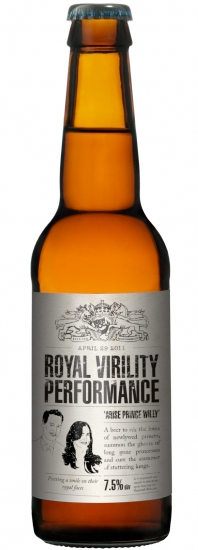
Luckily, Scotland’s BrewDog has just the thing for this sort of nonsense, a beer entitled Royal Virility Performance. With only 1,000 bottles to be released the day before the wedding, here’s how it’s described:

A limited-edition beer containing herbal viagra to mark the forthcoming royal wedding of Prince William and Kate Middleton on April 29th. Brewed using various well known aphrodisiacs, the limited edition artisanal beer will only be available to buy from the BrewDog.com website.

According to the specially commissioned label, the Royal Virility Performance contains herbal viagra, chocolate, Goat Weed and ‘a healthy dose of sarcasm’. The beer is a 7.5% ABV India Pale Ale and has been brewed at BrewDog’s brewery in Fraserburgh.

With this beer we want to take the wheels off the royal wedding bandwagon being jumped on by dozens of breweries; The Royal Virility Performance is the perfect antidote to all the hype. A beer should be brewed with a purpose, not just because some toffs are getting married, so we created something at our brewery that will undermine those special edition beers and other assorted seaside tat, whilst at the same time actually give the happy couple something extra on their big day.

BrewDog-royal-virility-btl

Filed Under: Editorial, Events, Food & Beer, News, Politics & Law Tagged With: new release, UK

Boycott Under Way On Beer Stocked By Alabama A-B Distributors

April 25, 2011 By Jay Brooks

alabama
Free the Hops, the organization in Alabama that successfully won the fight over hard opposition to allow beer over 6% abv in the state, is calling for a boycott of both Anheuser-Busch products along with those beers distributed by A-B Houses in Alabama. The boycott is a result of A-B distributor lobbyists “blocking the Legislature’s passing [of] the Brewery Modernization Act,” which Free the Hops helped pass “in the Alabama Senate earlier this month.” The Birmingham News has a full account of the story in an article entitled Free the Hops calls for boycott of beers stocked by Anheuser-Busch distributors in Alabama. Free the Hops also has a boycott statement on their website along with a list of the distributors involved. Essentially the law would simply allow brewpubs to no longer be subject to antiquated laws, such as having to be located in “a historic building” or be located in “a county that had a brewery prior to 1918.” Ridiculous stuff. It would be hard to argue that the law as it stands makes any sense or is a fair under any definition. But apparently the A-B beer distributors in Alabama see it as competition that cannot be allowed, despite the fact that in most of the other 49 states, brewpubs and beer distributors happily co-exist with one another.

I was originally in favor of the boycott, as it seems like there isn’t much choice insofar as what the Bud houses are doing. But as several people have pointed out, it will also harm a great number of craft brewery’s business in the state as well. Free the Hops obviously recognizes that fact and their concern is buying craft beer from one of the A-B distributors is still “channeling profits to wholesalers.” So in a way, it’s a bit like chemotherapy. Honestly, I’m conflicted. As Lew Bryson said in an exchange we had on Facebook. “This is odd territory for most beer drinkers: asking them to boycott a DISTRIBUTOR rather than a brand is confusing enough, but asking them to boycott craft beers to help craft beer…? Not going to work. If I were in Alabama, I would directly encourage people not to support a boycott of any craft brands for this reason. This is not the way to do it.” So I think we all agree that boycotting the ABI products is the way to go, but as for the craft brands … that seems like a much trickier, thornier issue. I can see both sides of the argument, and am left unsatisfied by either one. In the end, I think it’s going to be up to everyone’s individual conscience on what to boycott.

Filed Under: Beers, Breweries, Editorial, Events, News, Politics & Law Tagged With: Alabama, Anheuser-Busch, Beer Distributors, Law

Brew Your Own Beer TV Debuts Tonight

April 23, 2011 By Jay Brooks

byob-tv
B.Y.O.B. TV — Brew Your Own Beer TV — the new television show that will air on local KOFY Channel 20 debuts this evening at 10:30 p.m. KOFY TV20 / Cable13 will be airing the half-hour B.Y.O.B. TV this Saturday, April 23 at 10:30 p.m. If you miss its debut, it will also air on Saturdays at 1:00 a.m. and Sundays, starting April 24th, at 9:30 p.m. On Sunday, the re-runs will air during their “local’s only” programming block. You can catch it three ways: on TV Channel 20, Comcast Cable 13 and Comcast Cable HD 713.

B.Y.O.B. TV will be hosted by Justin Crossley and Jason Petros of The Brewing Network, the #1 on-line radio network dedicated to the art of beer making. The show follows 8 teams, each consisting of 3 eager home brewers as they’re challenged in various stages of the beer brewing process in hopes to escape weekly elimination. The final brewer left standing will win the ultimate prize, a trip to the Pilsner Urquell Brewery in the Czech Republic and become the B.Y.O.B. TV Brewing Champion.

byob-tv

“We want the average consumer to be able to watch this show, enjoy it from an entertaining perspective and gain an appreciation and knowledge for some of the best craft brews in the marketplace”, said Crossley, “at the same time we hope the show will encourage others to tackle the art of home brewing on their own.”

Various craft and import beers from around the region and the world are participating in the show to place emphasis on their commitment towards the innovation and brewing science behind beer making; partners include Pilsner Urquell, Lagunitas, Blue Moon, Grolsh and Blake Brewing. Additional breweries, brew masters and beer and food connoisseurs are participating as well.

While there’s no actual brewing in episode one, we do get to meet the teams and learn how the process will work. But don’t change the channel just yet, things will definitely start to pick up in episode two when the teams do their first batches of beer and things will just keep going from there. Should be fun.

Below is the trailer for the show:

Filed Under: Beers, Events, Just For Fun, News, Related Pleasures Tagged With: Announcements, Bay Area, California, Homebrewing, Television, Video

UK Gov’t Statistics On Women Drinking Found To Be Wrong

April 19, 2011 By Jay Brooks

ofc-nat-stats
For the second time in a few years, a UK Government agency has admitted to making a mistake regarding statistics used in the creation and furtherance of alcohol policy. The first, in 2007, was when the UK’s Department of Health revealed that the definition of a hazardous drinker, that is what the safe limits of alcohol intake were said to be, was completely made up, quite literally “plucked out of the air.”

On Monday, the UK’s Office for National Statistics (ONS) “admitted that it misrepresented the trends in alcohol consumption and has issued a sincere apology to the Portman Group, the drinks industry organisation that champions responsible drinking.”

According to Straight Statistics:

In a report about the productivity of the NHS published at the end of last month, the claim was made that the proportion of women drinking more than 14 units a week had increased by a fifth since 1998, leading to a greater demand for healthcare. As Straight Statistics reported here, there was no justification for such a claim.

A change in methodology for measuring alcohol consumption in 2006 creates a break in the time series. If not allowed for, this gives the impression that the number of women who exceed 14 units a week has indeed increased. Plenty of anti-drink campaigners are happy to spread this false message but it came as a shock when the ONS did so.

David Poley, chief executive of the Portman Group wrote to Stephen Penneck, Director General of the ONS, who has now replied admitting that Mr Poley’s concerns are “entirely justified”. He blames a “lapse in the quality assurance process by which we check carefully the accuracy and reliability of any information that is for publication … unfortunately in this rare instance a key issue went unnoticed.”

The article and press release have been amended. The article, accessible here, is now proceeded by a correction notice. The press release now reads: “The percentage of males and females consuming over the weekly recommended alcohol limits declined from 2006 to 2009.”

Mr Penneck’s response is prompt, straightforward, and makes no attempt to fudge the issue. If only it were equally easy to persuade the media to look more critically at its assumptions about drinking being out of control.

At least they admitted their error. I doubt the same would be true on this side of the pond, where statistical errors tend to live in perpetuity if they serve the anti-alcohol agenda. But the original stories that parroted the incorrect statistics that drinking for women has increased in The Daily Telegraph, the Daily Mail and the Daily Star are still out there and, as far as I know, have not been corrected. They can’t be, really, because the stories focused on the false problem at the heart of the mistake. And that’s the same here, too, as propaganda — even after it’s been disproved — is still used by numerous anti-alcohol groups. Repeat a lie often enough and … well, you know the rest.

Filed Under: Editorial, News, Politics & Law Tagged With: Prohibitionists, Statistics, UK, Women

When Science Becomes Propaganda: The Caffeine & Alcohol Conundrum

April 18, 2011 By Jay Brooks

science
Ugh. To me there’s nothing worse than junk science, especially when it’s in the service of an agenda. And that’s how this latest “study” in the journal Alcoholism: Clinical and Experimental Research comes across. The title of the “study” is Effects of Energy Drinks Mixed with Alcohol on Behavioral Control: Risks for College Students Consuming Trendy Cocktails and was conducted at the Universities of Northern Kentucky and the Maryland School of Public Health. Here’s how the press release for the study explains it:

  • A new laboratory study compares the effects of alcohol alone versus alcohol mixed with an energy drink on a cognitive task, as well as participants’ reports of feelings of intoxication.
  • Results show that energy drinks can enhance the feeling of stimulation that occurs when drinking alcohol.
  • However, energy drinks did not alter the level of behavioral impairment when drinking alcohol, particularly for impaired impulse control.
  • The combination of impaired impulse control and enhanced stimulation may make energy drinks combined with alcohol riskier than alcohol alone.

Energy drinks mixed with alcohol, such as Red Bull™ and vodka, have become trendy. While this consumption has been implicated in risky drinking practices and associated accidents and injuries, there is little laboratory research on how the effects of this combination differ from those of drinking alcohol alone. A recent laboratory study, comparing measures of intoxication due to alcohol alone versus alcohol/energy drink, has found that the combination of the energy drink enhanced feelings of stimulation in participants. However, the energy drink did not change the level of impairment for impulsive behavior. These findings suggest that energy drinks combined with alcohol may increase the risks associated with drinking.

But take a closer look at what that says. The caffeine stimulates. Well, duh. That’s what caffeine does. Did anybody doubt that? Then the study goes on to say that “energy drinks did not alter the level of behavioral impairment when drinking alcohol,” meaning it didn’t make people more drunk. Then they conclude combining caffeine and alcohol “may increase the risks associated with drinking [my emphasis].”

Here’s how they conducted it:

Marczinski [lead author] and her colleagues randomly assigned 56 college student participants (28 men, 28 women), between the ages of 21 and 33, to one of four groups that received four different doses: 0.65 g/kg alcohol, 3.57 ml/kg energy drink, energy drink/alcohol, or a placebo beverage. The participants’ behavior was measured on a task that measures how quickly one can execute and suppress actions following the dose. Participants also rated how they felt, including feelings of stimulation, sedation, impairment, and levels of intoxication.

“We found that an energy drink alters the reaction to alcohol that a drinker experiences when compared to a drinker that consumed alcohol alone,” said Marczinski. “A consumer of alcohol, with or without the energy drink, acts impulsively compared to when they had not consumed alcohol. However, the consumer of the alcohol/energy drink felt more stimulated compared to an alcohol-alone consumer. Therefore, consumption of an energy drink combined with alcohol sets up a risky scenario for the drinker due to this enhanced feeling of stimulation and high impulsivity levels.”

“To reiterate,” said Arria, “the investigators found that the presence of an energy drink did not change the level of impairment associated with alcohol consumption.” It did, however, change the perception of impairment.

“The findings from this study provide concrete laboratory evidence that the mixture of energy drinks with alcohol is riskier than alcohol alone,” said Marczinski. “College students need to be aware of the risks of these beverages. Moreover, clinicians who are working with risky drinkers will need to try and steer their clients away from these beverages.”

But that’s hardly “concrete” as she characterizes it. In fact, it’s the very opposite of concrete. It didn’t change impairment, just how people felt about it, how they perceived it. From that “insight” they concluded that since being stimulated “sets up a risky scenario for the drinker” that therefore the risk is greater. And they recommend that people should “be aware of the risks.” So far, so good. But if you didn’t realize drinking coffee after alcohol would stimulate you, perhaps you shouldn’t be in college after all. Maybe it’s time to lower your sights if that obvious bit of wisdom eluded you. I hear McDonald’s is hiring.

When Marczinski states that “[y]oung people are now drinking alcohol in different ways than they have in the past” I have to wonder what her evidence is for that nonsense. People have been mixing caffeine and alcohol for as long as the two have been around, I’d wager. This is one of those generational things, where the older one always believes the younger generation is worse than they were. The only difference between when I was a kid and now, at least regarding caffeine and alcohol, is that you don’t have to go to the trouble of mixing it yourself.

And I shouldn’t have to say this, but I’m not a fan of alcopops or alcoholic drinks with caffeine added (that is not naturally occurring like many coffee stouts, for example). But for me, that’s not the issue. The issue is society going out of its mind over a perceived problem for which there is only anecdotal evidence that there even is a problem. And this study seems like more of the same. I don’t like these drinks, don’t drink them myself, but I don’t think they should be banned just because some people don’t like them. There are obviously adults who bought them, and want to continue buying them, and they shouldn’t be removed from shelves just so that kids can’t buy them. Kids are already prohibited from buying them. If kids can still get them, that’s an entirely different problem. Kids can’t own guns either, but I don’t see any movement to ban all guns so that we can keep them out of the hands of children. That’s just not how a society should function. We shouldn’t make the world safe for our children by only allowing kid friendly products to be in it.

In the end, this “study” is hardly the hard evidence that the caffeine and alcohol conundrum has now been solved and they’ve found the data to close the book on this scourge. Even its authors know as much, as they use qualifying words all over the place. Their hesitation is right there in the title of the press release, which is “Drinking energy beverages mixed with alcohol may be riskier than drinking alcohol alone.” [my emphasis.] Up front, it tells you this is not as conclusive as you might otherwise think because they admit that a greater risk is simply possible. Beyond using an almost laughable 56 test subjects, the study simply jumps to anecdotal conclusions that are not supported by what passes for hard data. There really isn’t any hard data beyond people’s feelings after having consumed alcohol and then alcohol with caffeine and the authors then concluding those feelings might turn into actions that were riskier.

But even as honestly as the study states that their “findings suggest that energy drinks combined with alcohol may increase the risks associated with drinking,” naturally that’s not how it’s being reported. Every headline has essentially removed the qualifying “might” and made it sound far scarier and more conclusive than it really is. Here’s just a few examples.

Combining Energy Drinks with Alcohol More Dangerous Than Drinking Alcohol Alone at Partnership for a Drug Free America and as linked to a Join Together e-mail blast. And that report begins by stating that “A new study finds that consuming a caffeine-infused energy drink combined with alcohol is more dangerous than drinking alcohol alone.” But that’s not what the study concluded at all.

Likewise, HealthDay’s headline was Alcohol-Energy Drink Combo Riskier Than Booze Alone, Study Says, MedPage states Alcohol and Energy Drinks, a Risky Combination and News Feed Researcher claims Study: Alcohol, Energy Drinks Are Risky Combo. But again, those headlines are misleading. That’s not what the “study” claims. The “study” never even mentions drunk driving, but sure enough some of the news reports do. All the “study” says is that drinking alcohol and caffeine might make you feel more stimulated which might possibly lead you to act more impulsively, which might make you engage in riskier behaviors. Maybe. Maybe we can agree that’s not exactly science, but propaganda.

Filed Under: Editorial, News, Politics & Law Tagged With: Prohibitionists, Propaganda, Science, Statistics

The Brain and Alcohol Research Project

April 17, 2011 By Jay Brooks

trinity-college
Trinity College, in Hartford, Connecticut, at the end of March released some preliminary results after three years of a five-year study entitled the Brain and Alcohol Research Project. In a press release entitled What Students’ Brains Have Told Us about the Effects of Binge Drinking, they revealed the following:

Young adults who binge drink tend to perform worse in class than normally would have been expected, but only in the first year of college. After that, drinking to excess produces no discernible difference in academic performance.

So the obvious takeaway from that is that during a student’s first year away from home and away from parental rule, young adults tend to go a little wild that first year but then settle down into academic life for the remaining three years of their four-year college experience. They may not stop drinking, but they figure out how to hit the books, too. It seems rather predictable when you think about, especially when there’s virtually no alcohol education prior to college and in some states even parents are forbidden from educating their own children about drinking.

But it also seems to fly in the face of the neo-prohibitionist hue and cry about underage drinking being as bad for student performance as believed. And undoubtedly the worst of it is because it’s underground as a result of the minimum age being 21 instead of a more reasonable 18.

Also known as BARCS (for Brain and Alcohol Research with College Students), the project is “a large-scale longitudinal study that includes more than 2,000 college students from diverse backgrounds, set out to definitively address previously unanswered questions such as: Can heavy drinking in college affect brain structure and grades? If so, is it related to the overall amount of alcohol consumed or more to consumption patterns, such as binging and blackouts? Why is it that many students drink heavily in college but only a minority goes on to have alcohol problems after college? Are all adolescents affected equally by alcohol in terms of possible effects on brain and risk for later alcohol abuse? Is there a way to identify the people who will be longer-term problem drinkers?”

Unfortunately, I believe they begin with a failed premise. The study defines binge drinking “as a pattern of drinking that raises a person’s blood alcohol content to 0.08 percent or above.” That means drinking enough to be considered drunk at the lowest BAC allowed in most jurisdictions is the same as binge drinking. It’s amazing how what it means to binge drink keeps getting lower and lower, presumably in an effort to make the perceived problem seem increasingly worse. But this greater incidence of binge drinking is due entirely to continually redefining its meaning. Equating binge drinking with merely being drunk (under the legal definition) removes any distinction between the two and renders it meaningless.

Filed Under: Editorial, News, Politics & Law Tagged With: Prohibitionists, Statistics

« Previous Page
Next Page »

Find Something

Northern California Breweries

Please consider purchasing my latest book, California Breweries North, available from Amazon, or ask for it at your local bookstore.

Recent Comments

  • Bob Paolino on Beer Birthday: Grant Johnston
  • Gambrinus on Historic Beer Birthday: A.J. Houghton
  • Ernie Dewing on Historic Beer Birthday: Charles William Bergner 
  • Steve 'Pudgy' De Rose on Historic Beer Birthday: Jacob Schmidt
  • Jay Brooks on Beer Birthday: Bill Owens

Recent Posts

  • Historic Beer Birthday: John J. Schlawig February 27, 2026
  • Beer In Ads #5134: Lord Bushkill On Bushkill Bock February 27, 2026
  • Historic Beer Birthday: William Henry Beadleston February 27, 2026
  • Beer In Ads #5133: Going… Going… SB Bock February 26, 2026
  • Beer Birthday: Art Larrance February 26, 2026

BBB Archives

Feedback

Head Quarter
This site is hosted and maintained by H25Q.dev. Any questions or comments for the webmaster can be directed here.