Brookston Beer Bulletin

Jay R. Brooks on Beer

  • Home
  • About
  • Editorial
  • Birthdays
  • Art & Beer

Socialize

  • Dribbble
  • Email
  • Facebook
  • Flickr
  • GitHub
  • Instagram
  • LinkedIn
  • Pinterest
  • RSS
  • Twitter
  • YouTube

Powered by Genesis

Thirty Percent Of Americans Drink Once A Week

April 16, 2011 By Jay Brooks

harris-poll
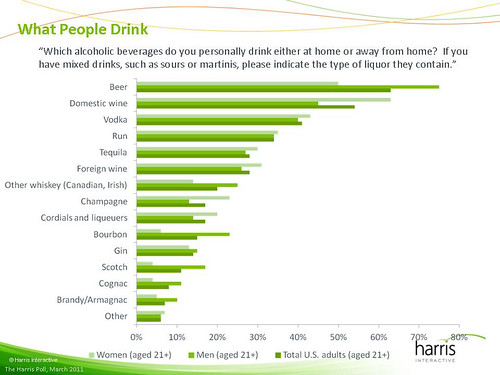
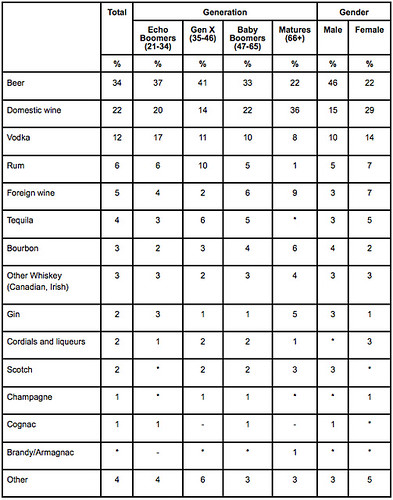
A Harris Poll conducted in March of this year concluded that Three in Ten Americans Drink Alcohol at Least Once a Week. The poll, conducted by Harris Interactive, surveyed 2,379 adults between March 7 and 14, 2011. Not surprisingly, beer continues to be the most popular alcoholic beverage, followed by American wine and vodka. And men still drink beer more than women “75% vs. 50%.”

Harris-What_People_Drink-2011

Here are some other findings from the poll:

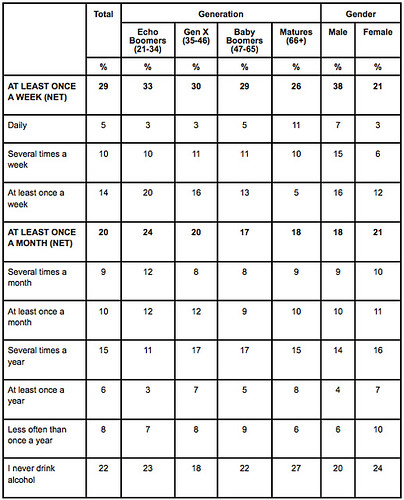
Question 1: “How often do you drink alcohol, including beer or wine?”

Harris-2001-1

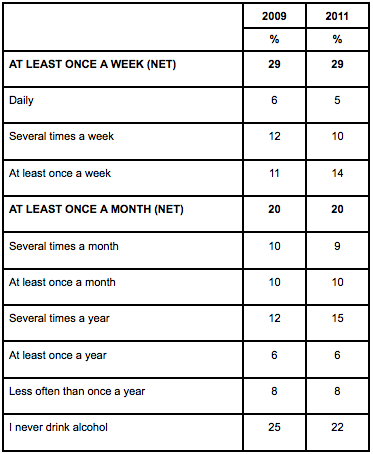
Question 2: “How often do you drink alcohol, including beer or wine?”

Harris-2001-2

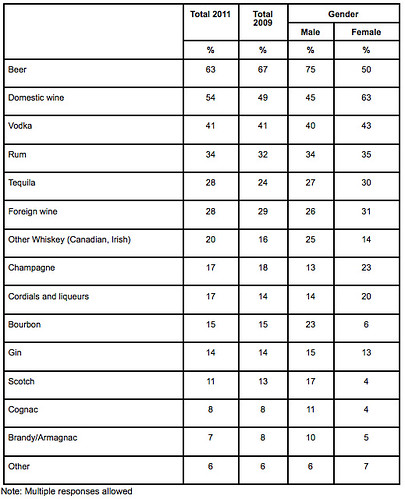
Question 3: “Which alcoholic beverages do you personally drink either at home or away from home? If you have mixed drinks, such as sours or martinis, please indicate the type of liquor they contain.”

Harris-2001-3

Question 4: “Although you may drink several types of alcoholic beverages, which one type would you say you drink most often?”

Harris-2001-4

Naturally, I have a couple of quibbles:

  1. Why did they separate out domestic and foreign wine, but not domestic and foreign beer?
  2. “It’s probably not surprising that men and women have different drinking preferences.” Maybe, but isn’t this something of a self-perpetuating prophecy? I know plenty of women who love beer and find wine too sweet. I also know women who claim to find beer too bitter but drink their weight in coffee. I can’t help but wonder if we keep reinforcing this by asking the question, and people respond with the answer they think is the case, which ends up making it real when maybe it’s not.
  3. “According to many doctors and medical studies, a glass of wine is good for one’s health. And even beyond wine, a drink, as long as it’s in moderation, is something that people shouldn’t be afraid of having.” Goddammit, why does this one persist, that “wine” is good for you but the rest are not? By omission, the statement implies that beer and other alcohol is not “good for one’s health” or at a minimum not “as” good which infuriates me. And adding the qualifying statement that “beyond wine” it’s okay to drink the other alcoholic drinks “as long as it’s in moderation” likewise implies that it’s healthful to drink as much wine as you like. How can they be so detail-oriented about the statistics involved in polling, and so ignorant in their statements of analysis? Sheesh.

Filed Under: Beers, Editorial, News Tagged With: Poll, Statistics, United States

Your Brain On Beer

April 14, 2011 By Jay Brooks

brain-2
A new study conducted at the Waggoner Center for Alcohol and Addiction Research at The University of Texas at Austin appears to indicate that alcohol actually helps your memory, at least at the synapse level; that “alcohol primes certain areas of our brain to learn and remember better.” The new study, published in the April 6 edition of the Journal of Neuroscience, is a mouthful, entitled Previous Ethanol Experience Enhances Synaptic Plasticity of NMDA Receptors in the Ventral Tegmental Area. And the Abstract isn’t much clearer:

Alcohol addiction (alcoholism) is one of the most prevalent substance abuse disorders worldwide. Addiction is thought to arise, in part, from a maladaptive learning process in which enduring memories of drug experiences are formed. However, alcohol (ethanol) generally interferes with synaptic plasticity mechanisms in the CNS and thus impairs various types of learning and memory. Therefore, it is unclear how powerful memories associated with alcohol experience are formed during the development of alcoholism. Here, using brain slice electrophysiology in mice, we show that repeated in vivo ethanol exposure (2 g/kg, i.p., three times daily for 7 d) causes increased susceptibility to the induction of long-term potentiation (LTP) of NMDA receptor (NMDAR)-mediated transmission in mesolimbic dopamine neurons, a form of synaptic plasticity that may drive the learning of stimuli associated with rewards, including drugs of abuse. Enhancement of NMDAR plasticity results from an increase in the potency of inositol 1,4,5-trisphosphate (IP3) in producing facilitation of action potential-evoked Ca2+ signals, which is critical for LTP induction. This increase in IP3 effect, which lasts for a week but not a month after ethanol withdrawal, occurs through a protein kinase A (PKA)-dependent mechanism. Corticotropin-releasing factor, a stress-related neuropeptide implicated in alcoholism and other addictions, further amplifies the PKA-mediated increase in IP3 effect in ethanol-treated mice. Finally, we found that ethanol-treated mice display enhanced place conditioning induced by the psychostimulant cocaine. These data suggest that repeated ethanol experience may promote the formation of drug-associated memories by enhancing synaptic plasticity of NMDARs in dopamine neurons.

Professor Hitoshi Morikawa, who wrote the paper, is slightly less jargon-laden and impenetrable on the University’s website, where he more generally lays out the goals of his research:

This lab specifically focuses on the dopaminergic neurons in the ventral midbrain. They are activated by the perception and expectation of rewards. Therefore, the dopaminergic projections from the midbrain to the limbic structures constitute an endogenous reward circuit. Behaviors that lead to the enhancement of dopamine release in this brain reward circuit tend to be repeated (reinforced). Addictive drugs induce stronger stimulation of dopaminergic transmission than almost any natural reinforcers (food, sex, etc). Thus, drugs are repeatedly used (abused) in vulnerable individuals, which will lead to plastic changes in the reward circuit.

The amount and temporal profile of dopamine release is controlled by the firing pattern of dopamine neurons, which is determined by the interaction of their intrinsic membrane properties and the afferent inputs they receive from other neurons. Accordingly, we make detailed analyses of the influence of addictive drugs on membrane ionic conductances and neurotransmitter inputs of dopamine neurons, and investigate the resulting alteration in the firing pattern. We use brain slices because they retain intact synaptic connections that are necessary for these studies. Brain slices are obtained from drug-naïve animals and animals that are chronically treated with drugs to elucidate the plastic changes induced by repeated exposure to drugs in vivo. Technically, we perform patch clamp electrophysiological recordings combined with confocal fluorescent imaging of intracellular ions. These methods will allow us to delineate the cellular events that determine the excitability of neurons with a preciseness that could not be attained by other conventional techniques. Therefore, this lab offers an ideal system to link the behavior of certain types of central neurons to that of a whole organism.

But a science news website, Physog.com has the most understandable account of the study, and what it means.

Essentially, and somewhat confusingly, the study shows that while common view that too much alcohol can be bad for memory retention and learning, that how your brain reacts to it is more complicated than that.

“Usually, when we talk about learning and memory, we’re talking about conscious memory,” says Morikawa, whose results were published last month in The Journal of Neuroscience. “Alcohol diminishes our ability to hold on to pieces of information like your colleague’s name, or the definition of a word, or where you parked your car this morning. But our subconscious is learning and remembering too, and alcohol may actually increase our capacity to learn, or ‘conditionability,’ at that level.”

So while short terms losses may occur, long term gains in subconscious memory may also be taking place. “Morikawa’s study found that repeated ethanol exposure enhances synaptic plasticity in a key area in the brain, [and] is further evidence toward an emerging consensus in the neuroscience community that drug and alcohol addiction is fundamentally a learning and memory disorder.”

When we drink alcohol (or shoot up heroin, or snort cocaine, or take methamphetamines), our subconscious is learning to consume more. But it doesn’t stop there. We become more receptive to forming subsconscious memories and habits with respect to food, music, even people and social situations.

In an important sense, says Morikawa, alcoholics aren’t addicted to the experience of pleasure or relief they get from drinking alcohol. They’re addicted to the constellation of environmental, behavioral and physiological cues that are reinforced when alcohol triggers the release of dopamine in the brain.

“People commonly think of dopamine as a happy transmitter, or a pleasure transmitter, but more accurately it’s a learning transmitter,” says Morikawa. “It strengthens those synapses that are active when dopamine is released.”

Alcohol, in this model, is the enabler. It hijacks the dopaminergic system, and it tells our brain that what we’re doing at that moment is rewarding (and thus worth repeating).

Among the things we learn is that drinking alcohol is rewarding. We also learn that going to the bar, chatting with friends, eating certain foods and listening to certain kinds of music are rewarding. The more often we do these things while drinking, and the more dopamine that gets released, the more “potentiated” the various synapses become and the more we crave the set of experiences and associations that orbit around the alcohol use.

Between that, and new research from the University of Michigan that may have identified a gene — the GABRA2 — that increases the risk of alcoholism in certain individuals, it seems clear that there are environmental and genetic factors that make some people more susceptible to becoming unable to drink responsibly, along with the obvious psychological factors, too. But what that also suggests is that alcoholism is more like a food allergy insofar as it does not effect everyone in the same way, and in fact the vast majority of people who do consume alcohol are able to do so responsibly and in moderation, which also allows them to take advantage of the many health benefits of drinking in moderation. Contrary to neo-prohibitionist propaganda, not everyone becomes an alcoholic with the first sip they take. Most, in fact, not only don’t, but never do, yet the anti-alcohol contingency tends to treat alcohol as a toxic substance that is dangerous to everyone equally or that everyone has the potential to become an alcoholic. I just don’t think that’s true. And the science seems to bearing that out. And because of all the beer I’ve consumed, I can remember all that, too. Thank you, beer.

Filed Under: Editorial, News, Politics & Law Tagged With: Science, Statistics

The Top 50 Annotated 2010

April 13, 2011 By Jay Brooks

ba
This is my fifth annual annotated list of the Top 50 so you can see who moved up and down, who was new to the list and who dropped off. So here is this year’s list again annotated with how they changed compared to last year.

  1. Anheuser-Busch InBev; #1 last five years, no surprises
  2. MillerCoors; ditto for #2
  3. Pabst Brewing; ditto for #3
  4. D. G. Yuengling and Son; Same as last year
  5. Boston Beer Co.; Same as last year
  6. Sierra Nevada Brewing; Same as last year
  7. New Belgium Brewing; Same as last year
  8. North American Breweries; new entity
  9. Craft Brewers Alliance; Moved down 1 for 2nd straight year
  10. Spoetzl Brewery (Gambrinus); Moved down 1
  11. Deschutes Brewery; Up 2
  12. Independent Brewers United (IBU); Same as last year, with a new name
  13. F.X. Matt Brewing; Moved down 1, after moving up 1 last year
  14. Minhas Craft Brewery; Down 2 over last year
  15. Bell’s Brewery; Up 4 from #19 last year
  16. Harpoon Brewery; Up 1 from #17 last year
  17. Boulevard Brewing; Down 1 from #16 last year
  18. Goose Island Beer; Up 2, for 2nd straight year, from #20 last year
  19. Dogfish Head Craft Brewery; Shot up 5 from #24, after being up 9, 5 and 4 the three previous years
  20. Alaskan Brewing; Down 2 from #18 last year
  21. Long Trail Brewing; Leapt up 14 from #35 last year
  22. August Schell Brewing; Up 4 from last year
  23. Stone Brewing; Same as last year, though they were up 5 each of last two years
  24. Abita Brewing; Up 4 from #28 last year
  25. Brooklyn Brewery; Up 2 from #27 last year
  26. Lagunitas Brewing; Jumped up 10 from #36 last year
  27. Full Sail Brewing; Down 5 for the 2nd straight year
  28. Shipyard Brewing; Down 3 from #31 last year
  29. Summit Brewing; Same as last year
  30. New Glarus Brewing; Up 2 from #32 last year
  31. Great Lakes Brewing; Up 2 from #31 last year
  32. Anchor Brewing; Down 2 from #30
  33. Iron City Brewing; Down 8, after dropping 12 last year, after a Chapter 11 bankruptcy and moving production out of Pittsburgh
  34. Kona Brewing; Fell 13 after being up 2 last year, and 14 the previous year
  35. Rogue Ales/Oregon Brewing; Down 1, after being up 2 last year, canceling being down 2 the previous year, and up 2 the year before that, essentially hovering
  36. Firestone Walker Brewing; Up 4 from #40 last year
  37. Winery Exchange Inc. / World Brew; Novato CA; new to the list this year
  38. Sweetwater Brewing; Up 1 from #39 last year
  39. Mendocino Brewing; Down 2 from #7 last year, after falling 8 the previous year
  40. Flying Dog Brewery; Up 2 from #42 last year
  41. Victory Brewing; Same as last year
  42. Gordon Biersch Brewing; Down 4 from #38 last year
  43. BJs Restaurant & Brewery; Down 1 from #43 last year
  44. Stevens Point Brewery; Up 6 from #50 last year
  45. Odell Brewing; Down 1 from #44 last year
  46. BridgePort Brewing (Gambrinus); Up 1 from #47 last year
  47. Cold Spring Brewing; Not in Top 50 last year
  48. Rock Bottom Brewery Restaurants; Down 3 from #45 last year
  49. Oskar Blues Brewing; Not in Top 50 last year
  50. Straub Brewery; Down 3 from #46 last year

Some new companies made the list, two from mergers — North American Breweries and Independent Brewers United — along with Winery Exchange Inc. as a result of doing a contract private label beer for the Walgreen’s pharmacy chain, Big Flats.

Two breweries are new to the list this year, Oskar Blues and Cold Spring Brewing again, who fell off last year but had been on the list the year before that under their former name, Gluek Brewing. Two more are off the list, Big Sky Brewing and Lost Coast Brewing, who had just cracked the list last year.

If you want to see the previous annotated lists for comparison, here is 2009, 2008, 2007 and 2006.

Filed Under: Beers, Editorial, News Tagged With: Big Brewers, Business, Statistics, United States

Top 50 Breweries For 2010

April 13, 2011 By Jay Brooks

ba
The Brewers Association has also just announced the top 50 breweries in the U.S. based on sales, by volume, for 2010. This includes all breweries, regardless of size or other parameters. Here is the new list:

  1. Anheuser-Busch InBev; St Louis MO
  2. MillerCoors; Chicago IL
  3. Pabst Brewing; Woodridge IL
  4. D. G. Yuengling and Son; Pottsville PA
  5. Boston Beer Co.; Boston MA
  6. Sierra Nevada Brewing; Chico CA
  7. New Belgium Brewing; Fort Collins CO
  8. North American Breweries; Rochester, NY
  9. Craft Brewers Alliance, Inc.; Portland, OR
  10. Spoetzl Brewery (Gambrinus); Spoetzl TX
  11. Deschutes Brewery; Bend OR
  12. Independent Brewers United (IBU); Burlington, VT
  13. F.X. Matt Brewing; Utica NY
  14. Minhas Craft Brewery; Monroe WI
  15. Bell’s Brewery; Galesburg MI
  16. Harpoon Brewery; Boston, MA
  17. Boulevard Brewing; Kansas City MO
  18. Goose Island Beer; Chicago IL
  19. Dogfish Head Craft Brewery; Lewes DE
  20. Alaskan Brewing; Juneau AK
  21. Long Trail Brewing; Burlington VT
  22. August Schell Brewing; New Ulm MN
  23. Stone Brewing; Escondido CA
  24. Abita Brewing; New Orleans LA
  25. Brooklyn Brewery; Brooklyn NY
  26. Lagunitas Brewing; Petaluma CA
  27. Full Sail Brewing; Hood River OR
  28. Shipyard Brewing; Portland ME
  29. Summit Brewing; Saint Paul MN
  30. New Glarus Brewing; New Glarus WI
  31. Great Lakes Brewing; Cleveland OH
  32. Anchor Brewing; San Francisco CA
  33. Iron City Brewing; Pittsburgh PA
  34. Kona Brewing; Kailua-Kona HI
  35. Rogue Ales/Oregon Brewing; Newport OR
  36. Firestone Walker Brewing; Paso Robles CA
  37. Winery Exchange Inc. / World Brew; Novato CA
  38. SweetWater Brewing; Atlanta GA
  39. Mendocino Brewing; Ukiah CA
  40. Flying Dog Brewery; Frederick MD
  41. Victory Brewing; Downington PA
  42. Gordon Biersch Brewing; San Jose CA
  43. BJs Restaurant & Brewery; Huntington Beach CA
  44. Stevens Point Brewery; Stevens Point WI
  45. Odell Brewing; Fort Collins CO
  46. Bridgeport Brewing (Gambrinus); Portland OR
  47. Cold Spring Brewing; Cold Spring MN
  48. Rock Bottom Brewery Restaurants; Louisville CO
  49. Oskar Blues Brewery; Longmont CO
  50. Straub Brewery; Saint Mary’s PA

Here is this year’s press release.

Filed Under: Breweries, News Tagged With: Big Brewers, Business, Statistics, United States

Top 50 Craft Breweries For 2010

April 13, 2011 By Jay Brooks

ba
The Brewers Association just announced the top 50 breweries in the U.S. based on sales, by volume, for 2010, which is listed below here. For the fourth year, they’ve also released a list of the top 50 craft breweries based on the new definition adopted by the Brewers Association a few years ago, and updated earlier this year. Here is the new craft brewery list:

  1. Boston Beer Co.; Boston MA
  2. Sierra Nevada Brewing; Chico CA
  3. New Belgium Brewing; Fort Collins CO
  4. Spoetzl Brewery (Gambrinus); Spoetzl TX
  5. Deschutes Brewery; Bend OR
  6. Independent Brewers United (IBU); Burlington, VT
  7. Matt Brewing; Utica NY
  8. Bell’s Brewery; Galesburg MI
  9. Harpoon Brewery; Boston, MA
  10. Boulevard Brewing; Kansas City MO
  11. Dogfish Head Craft Brewery; Lewes DE
  12. Alaskan Brewing; Juneau AK
  13. Long Trail Brewing; Bridgewater Corners VT
  14. Stone Brewing; Escondido CA
  15. Abita Brewing; New Orleans LA
  16. Brooklyn Brewery; Brooklyn NY
  17. Lagunitas Brewing; Petaluma CA
  18. Full Sail Brewing; Hood River OR
  19. Shipyard Brewing; Portland ME
  20. Summit Brewing; Saint Paul MN
  21. New Glarus Brewing; New Glarus WI
  22. Great Lakes Brewing; Cleveland OH
  23. Anchor Brewing; San Francisco CA
  24. Kona Brewing; Kailua-Kona HI
  25. Rogue Ales/Oregon Brewing; Newport OR
  26. Firestone Walker Brewing; Paso Robles CA
  27. Sweetwater Brewing; Atlanta GA
  28. Flying Dog Brewery; Frederick MD
  29. Victory Brewing; Downingtown PA
  30. Gordon Biersch Brewing; San Jose CA
  31. BJs Restaurant & Brewery; Huntington Beach CA
  32. Stevens Point Brewing; Stevens Point WI
  33. Odell Brewing; Fort Collins CO
  34. Bridgeport Brewing (Gambrinus); Portland OR
  35. Rock Bottom Brewery Restaurants; Louisville CO
  36. Oskar Blues Brewery; Longmont CO
  37. Blue Point Brewing; Patchogue NY
  38. Lost Coast Brewery; Eureka CA
  39. Big Sky Brewing; Missoula MT
  40. North Coast Brewing; Fort Bragg CA
  41. Mac and Jack’s Brewery; Redmond WA
  42. The Saint Louis Brewery; St Louis MO
  43. Bear Republic Brewing; Cloverdale CA
  44. Karl Strauss Breweries; San Diego CA
  45. Breckenridge Brewery; Denver CO
  46. Utah Brewers Cooperative; Salt Lake City UT
  47. Gordon Biersch Brewery Restaurants; Chattanooga TN
  48. Saint Arnold Brewing; Houston TX
  49. Real Ale Brewing; Blanco, TX
  50. Ninkasi Brewing; Eugene, OR

Two breweries are new to the Top 50 Craft Breweries list; Real Ale Brewing and Ninkasi. Here is this year’s press release.

I’ll have my annual annotated list shortly.

Filed Under: Breweries, News Tagged With: Statistics, United States

Old Enough To Fight, Old Enough For Beer

April 13, 2011 By Jay Brooks

under-21
You probably already saw that Alaska Republican state representative Bob Lynn, a Vietnam vet from Anchorage, is proposing changing his state’s law to allow active duty servicemen to drink as well as die for their country. Seems reasonable enough, but it puts at risk millions of dollars in federal highway funding, because the national minimum drinking age statute mandates that in order to receive federal highway money, a state has to keep its minimum drinking age at 21. The federal law, strong-armed into existence by MADD in the 1980s, effectively bullied states into towing the neo-prohibitionist line. The minimum age is supposed to be a state decision, but no state could afford to leave money on the table so reason and common sense never had a chance, not when the decision was between money and screwing over the rights of young adults who probably weren’t going to vote anyway.

As recently as yesterday, MADD was still crowing that they’re responsible for reducing drunk driving deaths despite the fact that every unbiased economist believe the two are essentially unrelated. The truth is that drunk driving was already in decline in the 1980s, as evidenced by the fact that all age groups saw declines, not just 18-21 year olds.

The Wall Street Journal today has an interesting op-ed piece by Glenn Harlan Reynolds, a law professor at the University of Tennessee, entitled Old Enough To Fight, Old Enough To Drink.

He starts with the obvious argument that an adult who can fight to defend our country (and potentially die in that effort) should at the very least have all the rights and privileges of adulthood. But as a nation we are virtually unique in the world at denying our soldiers between the ages of 18-20 the right to drink alcohol. When I was in the military, we had a soda machine in our day room filled with cans of beer (I think they cost 50 cents) and we were allowed to drink at the bar on base, both at the base I was stationed at in Virginia and then later at my permanent duty station in New York City. Not one person at either location ever abused that privilege. A few got drunk from time to time, but never in a way that affected their responsibilities and their duty.

Which is why I’m so surprised by the military reaction. According to an NPR report, state military commanders have stated they believe it “would encourage unhealthy behavior.” I’m starting to think the military just can’t stand change of any kind, and will complain about any and every proposed change. I recall quite vividly that when I was in the Army, they made a big deal out of us working for civilians, that they were in charge and it was our duty to serve and follow orders. Yet every time some change is proposed to the military, the higher military ranks ignore their own rule and whine to high heaven. But their job is the same as the lowliest private: to shut up and follow orders.

Other complaints include that “[t]he law could set a precedent, said Rep. Alan Austerman, R-Kodiak, where any young person whose profession puts them at risk of losing their life, such as police or firefighters, could be allowed to drink.” Yes, and it’s a valid argument. Adulthood should include all the rights and privileges, not all but one. I don’t really understand how these people can look someone in the face and say, ‘sure you can risk your life, but you’re still not quite an adult yet, we still can’t trust you with alcohol.’ That’s deeply disturbing.

Other protestations include that it “could further increase drunken driving arrests of young soldiers who would drive back from off-base bars” and “[a]lcohol is involved in a third of misconduct incidents on Alaska’s military installation, three generals said in a letter to Rep. Dan Saddler, co-chairman of the House Special Committee on Military & Veterans’ Affairs.” But those are both absurd defenses. Soldiers would still be subject to the same laws as before, and suggesting that they might start breaking the law shows very little faith in them, doesn’t it? Essentially, I think it comes back to our unhealthy perception of alcohol, that people can’t be trusted with it, and therefore it has to be heavily regulated.

My own experience is that as a soldier at 18, my peers who either got jobs or went to college stayed more immature than the people I served with in the military, despite being the same age. As a result, for a while I was in favor of mandatory one-year conscription after high school because the discipline I believe was good for me and I could see how it might have benefited others, too. A few other nations do this, and I haven’t heard any arguments against it. I doubt that’s changed much, so it seems doubly troubling to me that the military is so set against this that they’d accuse their own men and women of being unable to handle alcohol, while expecting them to handle guns, grenades and other weapons. And doesn’t the statement that alcohol is already involved on military bases suggest that it’s the same problem that’s on college campuses, that having it be illegal is what’s causing the problems because it drives it underground?

One of the most telling statements in Reynold’s article is the following:

Research by economist Jeffrey A. Miron and lawyer Elina Tetelbaum indicates that a drinking age of 21 doesn’t save lives but does promote binge drinking and contempt for the law.

Safety is the excuse, but what is really going on here is something more like prohibition. A nation that cares about freedom—and that has already learned that prohibition was a failure—should know better. As Atlantic Monthly columnist Megan McArdle writes, “A drinking age of 21 is an embarrassment to a supposedly liberty-loving nation. If you are old enough to enlist, and old enough to vote, you are old enough to swill cheap beer in the company of your peers.”

And I love his political analysis at the end:

Democrats traditionally do well with the youth vote, and one reason is that they have been successful in portraying Republicans as fuddy-duddies who want to hold young people down. This may be unfair—college speech codes and the like don’t tend to come from Republicans—but the evidence suggests that it works. What’s more, the first few elections people vote in tend to set a long-term pattern. A move to repeal the federal drinking-age mandate might help Republicans turn this around.

Republicans are supposed to be against mandates aimed at the states, so this would demonstrate consistency. Second, it’s a pro-freedom move that younger voters—not yet confronted with the impact of, say, the capital-gains tax—can appreciate on a personal level. Third, it puts the Democrats in the position of having either to support the end of a federal mandate—something they tend to reflexively oppose—or to look like a bunch of old fuddy-duddies themselves.

Principle and politics. If the Republicans in Congress don’t pick up on this issue, we’re going to have to wonder what they’ve been drinking.

My guess is propagandist kool-aid. And while I believe that every eighteen-year old should be allowed to consume and purchase alcohol, it seems monumentally wrong that at the very least our brave young men and women who volunteered to serve and defend our peculiar way of life can’t drink a beer.

UPDATE: Shortly after posting this, I received an interesting press release from the Competitive Enterprise Institute, an organization in Washington DC that appears to lean toward the right or possibly Libertarian.

From the press release:

In most European countries the drinking age is far lower than 21. Some, like Italy, for example, have no drinking age at all. Yet, the rates of alcoholism and teenage problem drinking are far greater in the United States. The likely reason for the disparity is the way in which American teens are introduced to alcohol versus their European counterparts. While French or Italian children learn to think of alcohol as part of a meal, such as a glass of wine at dinner, American teens learn to drink in the unmonitored environment of a basement or the backwoods with their friends. A 2009 study by the National Institute on Drug Abuse, National Institute of Health, and U.S. Department of Health and Human Services concluded that 72 percent of graduating high school seniors already consumed alcohol.

Statement by Michelle Minton, CEI’s Director of Insurance Studies:

The current age limit has created a culture of hidden drinking and disrespect for the law. Regardless of whether a person is in the military or simply an adult civilian, he or she ought to be treated as such. If society believes you are responsible enough to go to war, get married, vote, or sign a contract, then you are responsible enough to buy a bottle of beer and toast to living in a country that respects and protects individual rights. It is long past time the law caught up with that reality.

Filed Under: Beers, Editorial, News, Politics & Law Tagged With: Alaska, Law, Prohibitionists

Pierre Celis Passes Away

April 9, 2011 By Jay Brooks

hoegaarden
I just learned the sad news from my friend Pete Slosberg that brewmaster Pierre Celis passed away today, around 8:00 p.m. Belgian time. He was 86. A funeral is scheduled for next Saturday in Hoegaarden, after which, according to his wishes, he’ll be cremated.

Celis was a true brewing legend, he single-handedly revived the style witbier in the 1960s when he was a brewer at Hoegaarden. He later moved to Texas to start a microbrewery with his daughter Christine, which was sold to Miller in 1995. He was still brewing, making three cave-aged beers under the label Grottenbier at St. Bernardus in Belgium. Join me in raising a toast to Pierre’s memory this evening, with a Hoegaarden if you can get one, or if not a Belgian or Belgian-style witbier.

sat-aft-1
Me and Pierre at GABF five years ago in 2006.

Filed Under: News Tagged With: Belgium, obituary

Specialty Foods Trending Up, Paralleling Craft Beer

April 7, 2011 By Jay Brooks

specialty-food
Seems like it’s a food sort of day. There was an interesting press release from the National Association for the Specialty Food Trade (or NASFT) — the folks that put on the various Fancy Food Shows — entitled Specialty Food Industry Shows Renewed Strength. It’s a teaser for the actual report, The State of the Specialty Food Industry 2011, “an annual report from the NASFT prepared in conjunction with market researchers Mintel International and SPINS. The report tracks sales of specialty food through supermarkets, natural food stores and specialty food retailers, and includes research from interviews with food retailers, distributors, brokers and others involved in the supply chain.” The actual report will be presented April 13 in a “webinar” and for a mere $90 clams you can listen in, too. But the press release does reveal some of what to expect:

Consumers are spending on specialty food again after a period of holding back. Sales of specialty food and beverages rose 7.7 percent in 2010, topping $70 billion, according to new research released by the National Association for the Specialty Food Trade.

“The rebound is impressive,” says Ron Tanner, Vice President, Communications and Education for the NASFT. “As consumers feel more confident about the economy, they are coming back to specialty foods.” In 2009, sales rose by a more tepid 4.5 percent.

Cheese continues to dominate spending for this segment of the food industry, with $3.23 billion in sales in 2010. Rounding out the top five categories are meats, chips and snacks, bread and baked goods and condiments. Functional beverages are the fastest growing specialty food category, followed by yogurt and kefir.

Last year specialty food makers focused on their existing items, with new product introductions about even with 2009. Launches of premium private-label products, such as store brand cookies and sauces, declined to 455 in 2010 from 518 in 2009, demonstrating a return to branded products.

It’s interesting to see artisanal cheese continue to hum along, the 500-lb. gorilla of the specialty food world. I attended a cheese conference a few years ago with a panel that discussed the parallels between craft beer and American craft cheese. At that point, the experts on the panel claimed that our artisanal cheese industry was roughly 15 years behind where craft beer was at that point. But based on this, it would appear that cheese is indeed keeping pace and even catching up. Given how good the two are together — is there anything better the perfect beer and food pairing? — that’s very good news indeed.

Here are some more highlights from the report:

  • Total U.S. sales of specialty foods in 2010 were $70.32 billion, with $14.4 billion represented by sales to the food service industry.
  • Specialty foods represent 13.1 percent of all food sales at retail.
  • Natural food stores are the fastest growing retail channel; sales rose 14.7 percent between 2008 and 2010.
  • Mediterranean and Indian are the most influential emerging cuisines, importers say.
  • Seventy-six percent of specialty food manufacturers reported a sales increase in 2010, with 36 percent up more than 20 percent.
  • Gluten-free introductions showed sharp gains, with 119 new products in 2010 versus 67 in 2009.
  • Supermarkets remain the largest seller of specialty foods, with 72.3 percent of sales, but their share is dipping as specialty and natural food stores attract more consumers.
  • The average specialty food manufacturer produces 51 different items and brings in $2.3 million in annual sales.

Filed Under: Food & Beer, News, Related Pleasures Tagged With: Cheese, Food, Statistics

The Calorie Mix From The 1970s To Today

April 7, 2011 By Jay Brooks

cornucopia
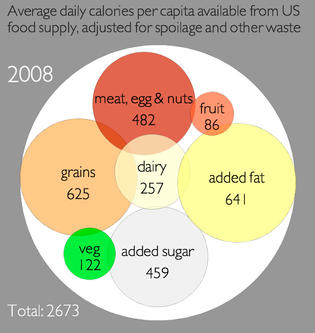
This is not a beer post, but we gotta eat, too. Tom Philpott, at Grist, details an interesting interactive chart created by Andrea Jezovit at Civil Eats.

Using USDA data for “average daily calories available per capita, adjusted for spoilage and waste,” it tracks our eating habits since 1970, separating our foodstuffs into basic categories: grains, dairy, vegetables, fruits, proteins (“meat, eggs, and nuts”), added sugars, and added fats.

calorie-mix-2008

Both Philpott’s The American diet in one chart, with lots of fats and sugars and Jezovit’s Where Do Americans Get Their Calories? are worth a read. Be sure to check out the interactive version of the chart which graphically shows how the mix of calories we eat has changed over the last 40 years.

Filed Under: Food & Beer, News, Politics & Law, Related Pleasures Tagged With: Food, Statistics

Cambridge Brewing Hinting At Bottling

April 6, 2011 By Jay Brooks

cambridge-blk
Tip of the hat to Todd Alstrom from Beer Advocate , who noticed that Cambridge Brewing Co.‘s Will Meyers tweeted out a link to a short survey asking his customers a few questions about buying beer in bottles, suggesting the brewpub is considering bottling some of the their beer. Here’s the introduction to the survey.

Thank you for taking the time to fill out this survey. Your answers will help determine the future of a Cambridge Brewing Company bottling program, and provide you with the beers you want in your local store. At this time, we are only in the beginning stages of planning our roll-out, but our success depends on you. So please let us know what you think, and what you want to drink.

Will later confirmed CBC’s plan to bottle, tweeting “Yup! Damn PSYCHED!” And to another, tweeted back that they’re “Considering it, but most interested in making our funkier beers. Lots of great ambers/pales out there already!” So that suggests they’re considering bottling the more interesting one-off and barrel-aged beers that Will has marinating in the basement … er, cellar. And that, I think, is most excellent news.

Filed Under: Breweries, News Tagged With: Bottles, Business, Massachusetts, Packaging

« Previous Page
Next Page »

Find Something

Northern California Breweries

Please consider purchasing my latest book, California Breweries North, available from Amazon, or ask for it at your local bookstore.

Recent Comments

  • Bob Paolino on Beer Birthday: Grant Johnston
  • Gambrinus on Historic Beer Birthday: A.J. Houghton
  • Ernie Dewing on Historic Beer Birthday: Charles William Bergner 
  • Steve 'Pudgy' De Rose on Historic Beer Birthday: Jacob Schmidt
  • Jay Brooks on Beer Birthday: Bill Owens

Recent Posts

  • Historic Beer Birthday: John J. Schlawig February 27, 2026
  • Beer In Ads #5134: Lord Bushkill On Bushkill Bock February 27, 2026
  • Historic Beer Birthday: William Henry Beadleston February 27, 2026
  • Beer In Ads #5133: Going… Going… SB Bock February 26, 2026
  • Beer Birthday: Art Larrance February 26, 2026

BBB Archives

Feedback

Head Quarter
This site is hosted and maintained by H25Q.dev. Any questions or comments for the webmaster can be directed here.