Brookston Beer Bulletin

Jay R. Brooks on Beer

  • Home
  • About
  • Editorial
  • Birthdays
  • Art & Beer

Socialize

  • Dribbble
  • Email
  • Facebook
  • Flickr
  • GitHub
  • Instagram
  • LinkedIn
  • Pinterest
  • RSS
  • Twitter
  • YouTube

Powered by Genesis

CBS Highlights Consumer Reports Beer Tasting

August 15, 2010 By Jay Brooks

tv
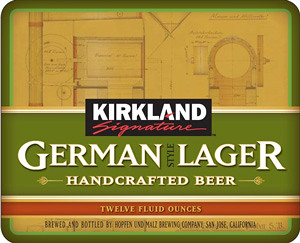
I almost forgot about this. The week before last I got a call from the local CBS television station, CBS 5, asking me to comment on a story they were working on regarding a recent Consumer Reports beer tasting that was published in their August issue. In Bargain beer from Costco, they had consumers taste blind the Kirkland brand beers, Costco’s private label beer, with prominent commercial brands of a similar style — Samuel Adams Boston Lager, Samuel Adams Boston Ale, Sierra Nevada Pale Ale, and Paulaner Hefe-Weizen.

The conclusion was that their “untrained panelists liked the Costco beers about as much as the same-style name-brand beers. (For each type, some people liked the Kirkland Signature better, some liked the brand name better, and some liked both equally.) Our consultants said that although the brand-name beers were more flavorful, clean-tasting, and complex, the Costco beers were quite quaffable and, to use the consultants’ technical term, ‘party-worthy.'”

The CBS producer asked me if I was “surprised” by those results. I explained that I wasn’t, and proceeded to tell her about the basics of how a private label beer is created, that licensed commercial breweries work with a retailer to create and brew the beer for them. I did a number of private label lines of beers when I worked at Beverages & more, beers like Coastal Fog, Brandenburg Gate and Truman’s True Brew. We also had a label in development to be called J.R. Brooks to do English styles like India Pale Ale, but I left before it saw the light of day. Anyway, I went on explaining that almost any private label beer done by a good brewery will likewise be pretty good, too. Nothing surprising about it all. It’s simply that most consumers probably don’t think about where the beer comes from, nor should they, I suppose. All that matters is that it tastes good. And then I added, almost as an afterthought, just to hammer home the point that private label beers that come from good homes are usually good beers, that it was Gordon Biersch that created and brewed the Costco beers.

At that point, the producer asked if they could come to my home in Novato and interview me on camera for the story they were working on. I agreed, but they called back and asked if there might be some beer-themed location that might also work. I suggested Moylan’s brewpub, since it’s only a mile or so from my house. We met there, they shot some B-roll of me walking with beer, sniffing a beer, drinking a beer, getting a beer poured. Then they picked a location and we sat down to talk on camera for about ten minutes. As I expected, they used under a minute in the finished story.

The video itself is online, but you’ll have to watch it there as they don’t seem to allow embedding.

You never know how these things will turn out, and the bit they zeroed on on, of course, was that the beer was made by Gordon Biersch. They treated it like a scoop of sorts, though it’s not exactly a secret. Whenever a contract private label beer is made, publicly available forms must be filed with the proper authorities, labels approved, etc. The labels, of course, by law must include the city and state where the beer was brewed, so it’s usually not that hard to figure out who made a private label beer. When you see Paso Robles, CA on a Trader Joe’s beer, you can pretty much guess that Firestone Walker brewed it. So when the Kirkland beers labels read “San Jose, California,” there aren’t too many production breweries in San Jose that could have made it. Really, anybody with just a little knowledge could have figured it out. When the labels were first approved, several people reported the news that Gordon Biersch would be making the Kirkland beers, myself included. I even spoke to Dan Gordon about it briefly at the time. But then they came out, and the news died away, as these things tend to do.
kirkland-lager

On the TV report, they said they tried to reach Gordon Biersch but got “no comment” so I hope I didn’t “out” Dan in some way that will make life tough for him, though in truth I doubt that’s possible. As I said, who does private label contract beers is more of an open secret, everybody in the beer community knows who does them and the records with the specifics are public. It’s just that the public at large doesn’t usually care enough or have the inside knowledge necessary to figure it out, even if they did want to know.

I think what’s more surprising is that neither Consumer Reports or CBS thought to question who made the beer. In a report about comparing the taste of two different beers, one by a commercial brewery and one a private label beer, shouldn’t that have been the first question Consumer Reports asked: who made the second beer? That would have gone a long way in explaining the result, don’t you think?

Filed Under: Beers, Editorial, Just For Fun, Reviews Tagged With: Mainstream Coverage, Video

MillerCoors Launches Craft & Import Division

August 13, 2010 By Jay Brooks

tenth-blake
While MillerCoors had already announced their intention to start up a new division dedicated to its smaller brands and imports, today they announced that Tenth and Blake Brewing Co. was open for business. There’s no website yet, but there is a Facebook page.

Here’s the press release:

Tenth and Blake Beer Company Opens for Business

Earlier this summer, MillerCoors announced plans for a new company focused on craft and import beers, aimed at strengthening relationships within the beer industry and enhancing the overall segment’s volume and growth. Today, to reflect the passion, great brewing tradition and entrepreneurial spirit of its beer brands, the company announced its new moniker. Tenth and Blake Beer Company is now officially open for business.

“This is a unique and exciting period in the beer business,” said Tom Cardella, the company’s CEO and President. “With the added focus on our craft and import brands and the talent within our brewing network, Tenth and Blake Beer Company has the opportunity to make an impact and continue to help grow this segment. We’re made up of passionate brewers and merchants of the world’s finest specialty brews, and we look forward to celebrating the joy of beer with beer drinkers throughout the U.S.”

The organization wanted a name that reflects its great beer heritage from MillerCoors, while highlighting its unique and differentiated position in the industry. The 10th Street Brewery in Milwaukee brews Leinenkugel’s and various specialty beers. And Blake Street in Denver is home to the Blue Moon Brewing Company at the Sandlot. These facilities will be primary sources of many of the company’s brews, while serving as incubators of ideas and future beers.

The company’s network of brewing expertise extends beyond Denver and Milwaukee, with the Leinenkugel’s Brewery in Chippewa Falls, Wis. and the AC Golden brewery in Golden, Colo. In addition to craft brews like Blue Moon, Leinenkugel’s, and Colorado Native, Tenth and Blake Beer Company features top imports, such as Peroni Nastro Azzurro, Pilsner Urquell and Grolsch.

“Employees of Tenth and Blake Beer Company will take beer passion, education and capabilities to the next level,” Cardella said. “All team members will participate in training at one of our breweries, take part in beer merchant sessions and go through sales training to better understand and serve our customers.”

As an independent yet connected company, Tenth and Blake will own the strategic business drivers — marketing, trade marketing and an independent sales organization dedicated to the craft and imports business. The company will in-source other capabilities from MillerCoors, including legal, communications, HR, marketing services and consumer insights.

Hmm, I’m not sure what to make of that. Is it an admission that such a large, global company is too big to think small in the way one needs to for promoting and successfully selling smaller, niche brands? Or is it simply easier to parse out the tasks to two independent groups, one that has to think big picture, freeing the other to think small and more local? On the other hand, with sales of core brands flat or soft, perhaps it makes sense to give more focus to the smaller brands that actually are doing well.

Harry Schuhmacher from Beer Business Daily, reports that “Tom, in a letter to distributors obtained by BBD, writes that they have built a team of ‘brewers and merchants of the world’s finest specialty brews, celebrating the joy of beer with our customers and consumers’ to build a ‘deeper relationship’ with customers.” That sounds a little too rah-rah for my tastes, but then that was probably its intention.

Schuhmacher spoke to Tenth and Blake head honcho Tom Cardella, and he told him the following:

Tom says that their “entire team will participate in specially designed on-boarding programs that will include spending several weeks working inside our breweries and being certified in our beer merchant training. And everyone from the janitor to the CEO will go through sales training to better understand and serve our distributor and retailer customers. We will be an organization of merchants sharing our love of our great beers and creating value in the market.”

The new unit will have a “dedicated new sales organization” that will bring “focus” and they will provide a “dedicated supply chain function to ensure coordination of the fine motor skills needed to service smaller specialty brands” while still providing the services of a big corporation with regards to “legal, communications, HR, marketing services and consumer insights.”

The new unit will develop “distributor beer merchants (DBMs) in a whole lot of markets working side-by-side with you, our distributor partners.” DBMs will be “soley” dedicated to their import and craft brands with dedicated brewery “managers” who will “own and execute the craft and import portfolio for each of their respective management units, delivering wins to our general managers.”

And the Milwaukee Business Journal added:

MillerCoors’ 10th Street Brewery in Milwaukee brews Leinenkugel’s and various specialty beers, and Blake Street in Denver is home to the Blue Moon Brewing Co. at the Sandlot. The facilities will be primary sources of many of the company’s brews, while serving as incubators of ideas and future beers, the Chicago-based brewer said.

MillerCoors also operates the Jacob Leinenkugel’s Brewing Co. in Chippewa Falls and the AC Golden brewery in Golden, Colo. In addition to craft brews like Blue Moon, Leinenkugel’s and Colorado Native, Tenth and Blake Beer Company will be responsible for imports such as Peroni Nastro Azzurro, Pilsner Urquell and Grolsch.

Actually, according to the Facebook page, here’s the list of beers Tenth & Blake will be responsible for:

  • AC Golden brands (see below)
  • Aguila
  • Batch 19
  • Blue Moon
  • Colorado Native (AC Golden)
  • Cristal
  • Cusquena
  • Grolsch
  • Henry Weinhard’s
  • Herman Joseph’s (AC Golden)
  • Kasteel Cru
  • Killian’s
  • Lech
  • Leinenkugel’s
  • Peroni
  • Pilsner Urquell
  • Sandlot brands (Brewmaster’s Special, Ski Brews, Barmen, Championship Amber Ale, Right Field Red, Slugger Stout, Power Alley ESB)
  • Tyskie
  • Winterfest (AC Golden)

That should keep them busy.

tenth-and-blake

Filed Under: Breweries, Editorial, News, Politics & Law Tagged With: Big Brewers, MillerCoors, Press Release

Local Union Blasts BevMo Over Employee Treatment

August 12, 2010 By Jay Brooks

bevmo
Wow, this is certainly an interesting development. BevMo, the company where I was the beer buyer for nearly five years in the late 1990s, is coming under fire by the United Food & Commercial Workers Union, Local 5, for their treatment of employees. They were never exactly great to their employees. Like almost every big or growing American company, they squeezed a lot out of their workers, expected long hours from salaried employees. Don’t get me wrong, I liked a lot of things about the job, and met a great many good people — though a fair number are no longer there — but it was demanding in a way that was beneficial to the company, but necessarily to the well-being of the people doing all the actual work. I know that’s a fairly common scenario, but it must have grown even worse, because for a Union to step in and go after BevMo the way they are suggests a level of poor treatment above and beyond the average company.

According to the BevMo Can Afford to Do Better website set up by UFCW-5, they launched a campaign last week against BevMo “[o]n the heels of the company’s August 1 announcement eliminating full time jobs across the chain and under [the subsequent] BevMo rules resulting in the loss of health benefits for the new part time employees, the workers are fighting back.”

BevMo Can Afford to Do Better

BevMo! currently operates 104 superstores, located in California & Arizona. In March 2007, TowerBrook formally announced its acquisition of BevMo! TowerBrook is a private equity firm with $2.5 billion under management. TowerBrook pursues control-oriented private equity investments in large and middle market companies and has committed to making BevMo even more successful. According to BevMo’s CEO, Alan Johnson, sales in 2000 were around $100 million and in 2009 reached well over $500 million. Since Towerbrook’s acquisition of the company, BevMo has opened 40 new stores with plans to open 100 more over the next few years. Clearly, BevMo CAN AFFORD TO DO BETTER.

bevmo-devil

A press conference was held earlier today at Embarcadero and Clay streets in Oakland to explain the campaign to the public. The demands of the workers were laid out, as follows:

  1. Restore Full Time Positions
  2. Restore Health Benefits
  3. Initiate a Wage Increase Immediately
  4. Restore the 401(K)
  5. Union Recognition by BevMo

They’ve also set up a Facebook page about the campaign. And they’ve released a video outlining it, as well.

Hmm, I wonder if they’ll start calling for a boycott?

Filed Under: Editorial, News, Politics & Law Tagged With: Business, Retail, Video

Latest Gallup Poll Reveals Drinking At 25-Year High With Beer #1

August 9, 2010 By Jay Brooks

gallup-poll
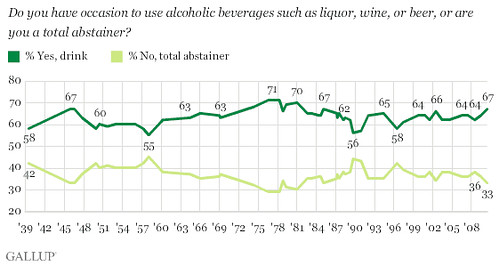
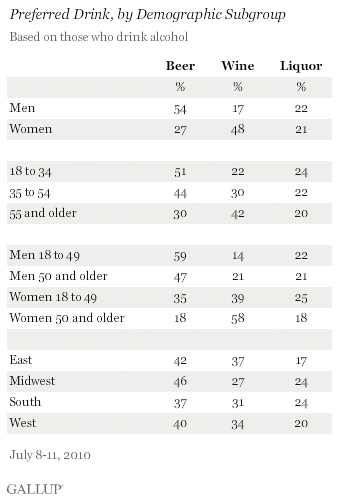
The annual Gallup Poll into American drinking habits was recently released. According to this year’s results, 67% of adults imbibe, a 1% increase from last year, and the highest percentage in 25 years. Also, the percentage of American abstaining hitting what looks to be the second-lowest number, 33%. Only around 1978-81 looks to have had fewer abstainers, which is great news since studies have shown that moderate drinkers tend to live longer than abstainers.

Gallup-2010-1

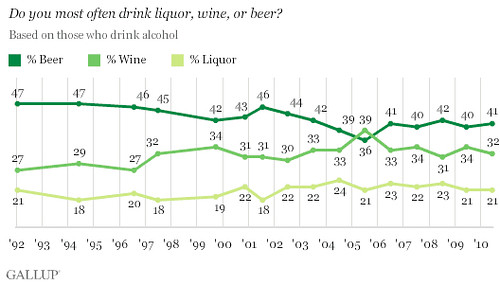
As has been the case in all but one suspect year, beer is the most consumer alcoholic beverage. I suspect, because even in the year people “reported” drinking more wine — 2005 — beer still outsold wine 4 to 1.

Gallup-2010-3

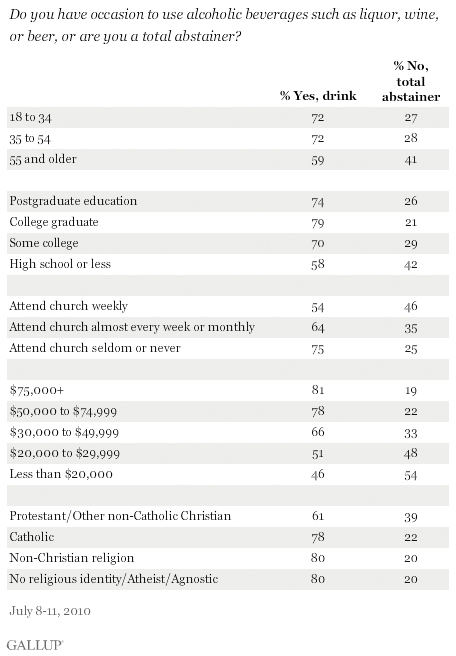
There’s some other interesting data about the demographics of current alcohol consumers. For instance, not surprisingly, there are more older abstainers. People with more education also drink more, and those with the least education comprise the majority of abstainers. Protestant Christians, followed by Catholics, have the largest number of abstainers.

Gallup-2010-2

And finally, by age and gender, men drink more beer, as do older people, regardless of gender. Somewhat surprisingly, the area of the country with the highest percentage of beer drinkers is the Midwest, followed by the East coast, the West coast with the South having the least.

Gallup-2010-4

Filed Under: Beers, Editorial, News Tagged With: Poll, Statistics

No More Gluek Beer

August 6, 2010 By Jay Brooks

gluek
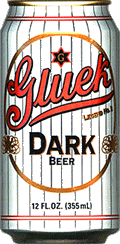
Cold Spring Brewing in Minnesota announced yesterday that they will no longer brew the historic Gluek brand. Gluek began brewing in 1857, before Minnesota was even a state.

In 1857 on the bank of the Mississippi River in an area which would someday be known as Minneapolis, German immigrant Gottlieb Gluek started the Mississippi Brewing Company. Soon the name was changed to the Gluek Brewing Company, and by 1964 Gluek became Minneapolis’s oldest continuously-operated business.

In 1858 the company brewed 3,996 barrels of beer, and by 1901 the annual capacity was second only to the two “giants” the Minneapolis Brewing Company (later renamed as the Grain Belt) and the Theo. Hamm Brewery of St. Paul.

But after 1964 it fell on hard times and, like many regional breweries, was bought by G. Heileman. The original brewery was torn down but a new one was later built back in Cold Spring, Minnesota in 1997. A couple of years ago, however, they renamed Gluek Brewing to Cold Spring Brewing as fewer and fewer consumers knew or cared about Gluek’s history in the region.

gluek-dark

As an AP story reports:

By September, Gluek will be phased out. But vice president and general manager Doug DeGeest says Cold Spring Brewing is keeping the Gluek trademark, and it’s possible the beer could come back.

DeGeest says it was a business decision to discontinue the Gluek brand. He says the Cold Spring-based company cannot keep up with production and needed to decide which product in its portfolio of beers to discontinue.

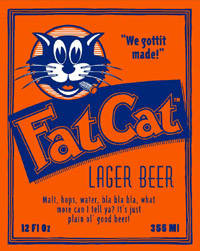
When I was the beer buyer at BevMo, we brought in some of the Gluek beer in cans and they also sold us a beer exclusively (for California, at least) which we sold as a private label beer. That was Fat Cat Lager, which was a decent enough all-malt generic lager. I believe Randy Mosher did the label design.

Fat-Cat-label

Regardless of Gluek’s ultimate place in American brewing history, it’s always sad to see another old brand consigned to the scrap heap of discontinued brands, but then I’m sentimental that way.

Filed Under: Beers, Editorial, News Tagged With: History, Minnesota

A Rose Is A Rose Is A Rose

August 4, 2010 By Jay Brooks

rose
As Gertrude Stein — who was born in Oakland — famously said, “A rose is a rose is a rose.” On the other side of that coin, an alcohol tax masquerading as a fee is a tax, and a terrible idea, no matter what you call it. Today’s San Francisco Examiner, in their Under the Dome section on City Hall Politics, is reporting that Avalos hopes renaming alcohol fee makes it more potable to business. Apparently small businesses don’t like the newly proposed alcohol tax, but supervisor Avalos has the solution. Forget addressing their concerns, admitting it’s a bad idea or even conceding he was duped by the Marin Institute, no. His answer is to change the name of the “alcohol mitigation fee” to “alcohol cost recovery fee” so that — and I quote — “businesses might find the proposal a bit more refreshing.” How stupid does he think people are? You have to wonder.

Filed Under: Editorial, News, Politics & Law Tagged With: California, San Francisco

Action Alert: SF Alcohol Fee Vote Fast Tracked

July 27, 2010 By Jay Brooks

san-francisco
Well we thought the vote was going to be delayed on the proposed ordinance in San Francisco to impose a fee on all alcohol sold in the city, but it turns out that’s no longer the case, which is a blow to fair play and common sense. Apparently the ordinance’s sponsor, supervisor John Avalos, recently realized that if Prop. 26 passes this November then a vote on the fee will be moot, because that proposition ends the practice of taxes masquerading as fees and all taxes, whether they pretend they’re fees or not, will be subject to a 2/3 margin instead of a simple majority. The proposition is sponsored by the group Stop Hidden Taxes.

To avoid that possibility, supervisor Avalos is instead fast tracking the ordinance and, according to the Small Business Commission, will present it “at the Budget and Finance committee meeting of the Board of Supervisors on August 4 — this is BEFORE the Small Business Commission will be able to make its recommendation (due to happen on August 9) and before he said he would be presenting the ordinance during the last Small Business Commission meeting. He is not sticking to his promises. He is changing the game.”

What Can You Do?

August 2:

If you own a small business in San Francisco, please consider attending the Small Business Commission meeting on Monday August 2 and most important at the Supervisor’s Budget and Finance Committee meeting at 1:00 pm on August 4 (though some earlier sources say the meeting is at 11:00 a.m., so check to be sure). There is expected to be a major rally at 11:00 in front of City Hall by proponents of the tax (firefighters union, healthcare union, etc.). At this hearing, the committee will take public comment.

August 10:

The ordinance will then go to the Board of Supervisors meeting on Tuesday, August 10th at 2:00 pm. If you’re a San Francisco consumer of alcoholic beverages, please consider attending this meeting and telling the board of supervisors that you drink responsibly and do not burden the city’s services and should therefore not be punished by having this tax imposed.

September 7:

On this day, the ordinance will go to the Board of Supervisors again for a second vote. There is no public comment or discussion — this is a formality vote.

September 8:

It then goes to the Mayor, who has 10 days to veto or sign. If he vetoes it, there will be a major effort by the Marin Institute to get the Supervisors to override the veto with a 2/3 vote.

The Two Most Important Things You Can Do

  1. Write or e-mail your supervisor and urge him or her to vote no against the Alcohol Mitigation Fee Ordinance. There is information to assist you in letter-writing or e-mailing at the California Alliance for Hospitality Jobs website.
  2. Attend the August 10th, 2:00 pm, Board of Supervisors meeting.

Filed Under: Editorial, News, Politics & Law Tagged With: California, Prohibitionists, San Francisco

Some Beery Trends

July 26, 2010 By Jay Brooks

trends
Over the weekend, I got the latest newsletter from Michael Kuderka of the DBBB, the book of Domestic Brewers and their Bottled Brands, published by MC Bassett. One highlight was some interesting trends from recent IRI data.

If you’re not familiar with IRI data, it’s one of the two major data reporters, along with Nielsen, of sales trends along a variety of products. IRI is short for Information Resources, Inc., though the company is now known as the Symphony IRI Group. IRI data only covers certain kinds of retailers that sell beer, primarily grocery stores and convenience stores, and usually only chains at that. So it’s of limited use, but because the sales data is collected from consistent sources, it is fairly reliable and can show trends. I used to see it all the time, when I was a beer buyer, because most package brewers subscribe to one or the other service and usually bring carefully mined data to show their own positive trends. Anyway, here’s the interesting bits.

Fat Tire, from New Belgium, apparently “made more gains than any other brand when considering both year-over-year case sales and total dollars,” with case sales up 26% and total dollars just under $50 million. What that doesn’t take into account, of course, is that New Belgium opened several new states and a good portion of that bump may have been from being in new markets that weren’t in the data last year. But that does catapult them into the number 3 spot, making the top three best-selling craft beers as follows:

  1. Samuel Adams Boston Lager
  2. Sierra Nevada Pale Ale
  3. New Belgium Fat Tire

And here’s some additional trends and brands to watch, at least according to IRI:

  • IPAs: Trending up 29%!
  • Sierra Nevada seasonals: Up 23%
  • Magic Hat #9: Up 22%
  • Alaskan Brewing seasonals: Up 21%
  • Amber Ale & Pale Ale also trending up

Filed Under: Beers, Breweries, Editorial, News Tagged With: Statistics

Lovin’ The Ladies: Beer Ads

July 24, 2010 By Jay Brooks

women
My wife pointed this one out to me, and it’s pretty funny despite highlighting some fairly ugly trends in beer advertising by the big breweries and imports towards women. From the Current TV show InfoMania, the clip is introduced as follows:

Everybody loves beer — men, women, children with fake IDs. But beer companies don’t want one of these groups to enjoy their beer: women. Modern Lady Erin Gibson is on the case of how beer companies like Miller, Budweiser, and Heineken have gone from depicting women in commercials as eye candy hanging out with Spuds MacKenzie to the target of aggression and humiliation.

Filed Under: Beers, Breweries, Editorial, Politics & Law Tagged With: Advertising, Humor, Video, Women

Stand-Up Truths

July 23, 2010 By Jay Brooks

microphone
Regular readers know I’m a huge fan of stand-up comedy, and that I often quote one of all-time favorites, Bill Hicks. In the Eighties I followed comedians like other people follow baseball players, but that ended when I got older and stopped going out every weekend. But I still love stand-up, and think it’s one of the few professions where people can tell the truth, and voice their real opinions, with little risk of retribution. Because it’s couched in humor, a lot of truth can get out that otherwise might not be expressed.

I often watch the Daily Show from the night before when I’m eating my lunch, but it’s in reruns, so I took a chance on Live at Gotham, a program showcasing new stand-up comedians. There wasn’t anybody on the show I knew by name, but I figured what the heck. As it happened, I watched the first episode from Season 1, from 2006.

The last comedian on was named Auggie Smith, originally born in Santa Rosa, California, but he grew up in Montana and now lives in Portland, Oregon. His set included a lot of material about social politics, things about smoking, gambling and drinking — generally pretty funny stuff, I thought. Below is his brilliant conclusion, an argument I’ve often made but never quite so humorously.

When we call drinking a sin, when we call smoking a sin, when we call gambling a sin it takes the responsibility off the people doing it. When we call drinking a sin it’s like saying that the problem is the booze. America, don’t blame the booze. Here’s the thing, no matter what your problems in life are, I assure you it is not the booze’s fault.

Let’s get this straight once and for all. If you’re a jackass when you’re drinking … it’s because you’re a jackass, okay. That’s what’s going on there. There ain’t no magical equation of add liquid, make jackass, no. In the insurance game it’s what they call a pre-existing condition.

Amen brother. If only the anti-alcohol folks could get that message.

Filed Under: Beers, Editorial, Just For Fun Tagged With: Prohibitionists

« Previous Page
Next Page »

Find Something

Northern California Breweries

Please consider purchasing my latest book, California Breweries North, available from Amazon, or ask for it at your local bookstore.

Recent Comments

  • Bob Paolino on Beer Birthday: Grant Johnston
  • Gambrinus on Historic Beer Birthday: A.J. Houghton
  • Ernie Dewing on Historic Beer Birthday: Charles William Bergner 
  • Steve 'Pudgy' De Rose on Historic Beer Birthday: Jacob Schmidt
  • Jay Brooks on Beer Birthday: Bill Owens

Recent Posts

  • Beer In Ads #5240: Rieker’s Bock Beer Is Now On The Market May 3, 2026
  • Historic Beer Birthday: Herman Adolph Schalk May 3, 2026
  • Beer In Ads #5239: The National Drink May 2, 2026
  • Beer Birthday: Anders Kissmeyer May 2, 2026
  • Beer Birthday: Bruce Paton May 2, 2026

BBB Archives

Feedback

Head Quarter
This site is hosted and maintained by H25Q.dev. Any questions or comments for the webmaster can be directed here.