Brookston Beer Bulletin

Jay R. Brooks on Beer

  • Home
  • About
  • Editorial
  • Birthdays
  • Art & Beer

Socialize

  • Dribbble
  • Email
  • Facebook
  • Flickr
  • GitHub
  • Instagram
  • LinkedIn
  • Pinterest
  • RSS
  • Twitter
  • YouTube

Powered by Genesis

Patent No. 1235231A: Apparatus For Cooling And Rousing Beer-Wort And For Precipitating Sludge From Same

July 31, 2015 By Jay Brooks

patent-logo
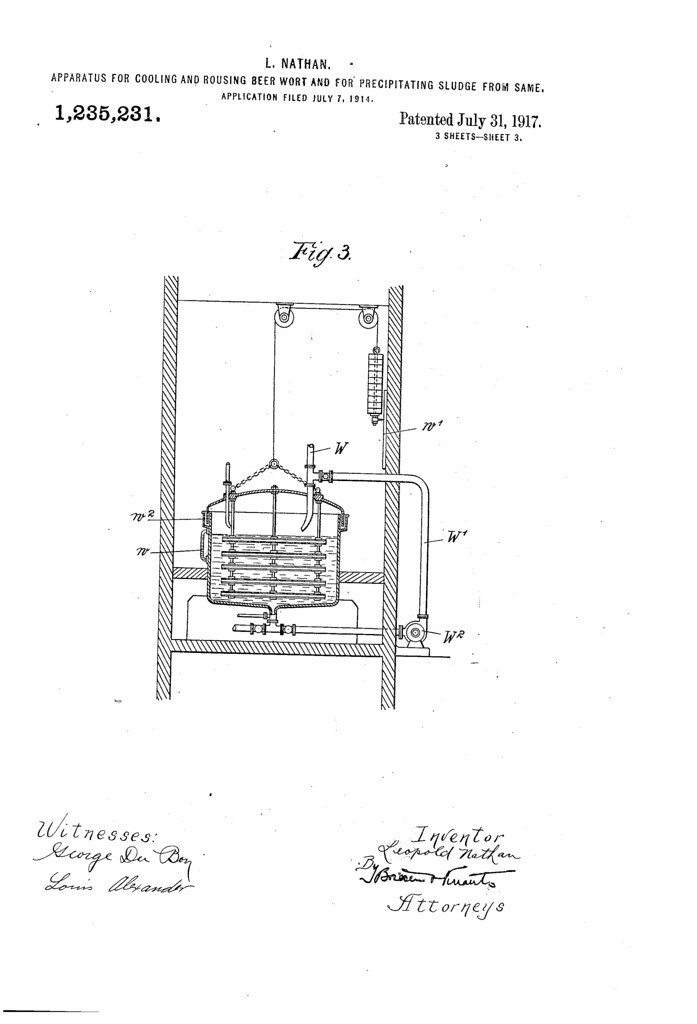
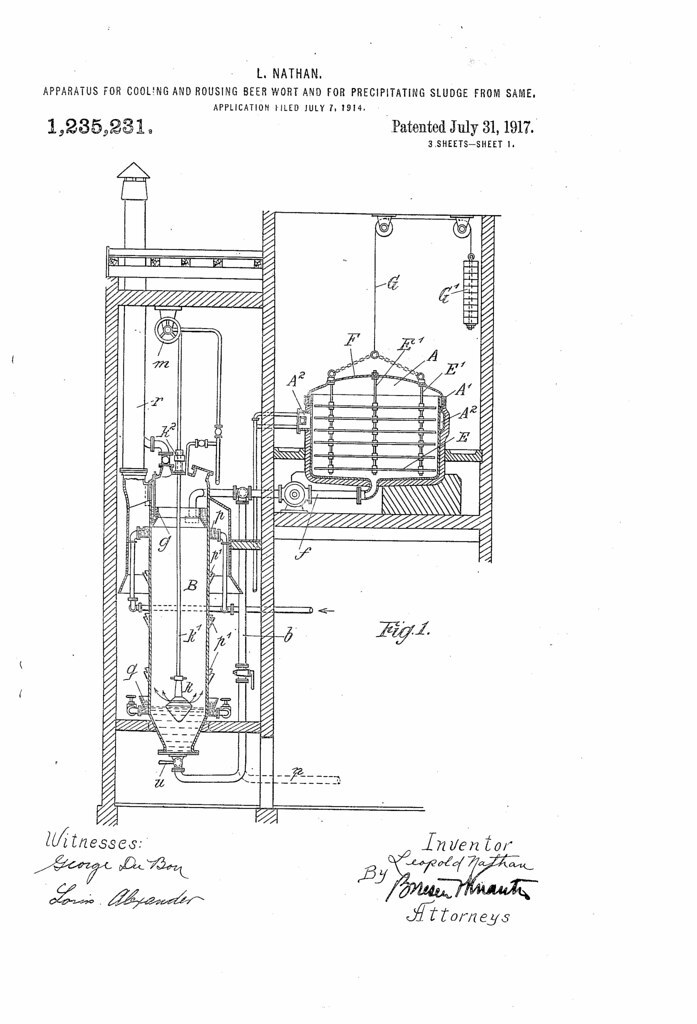
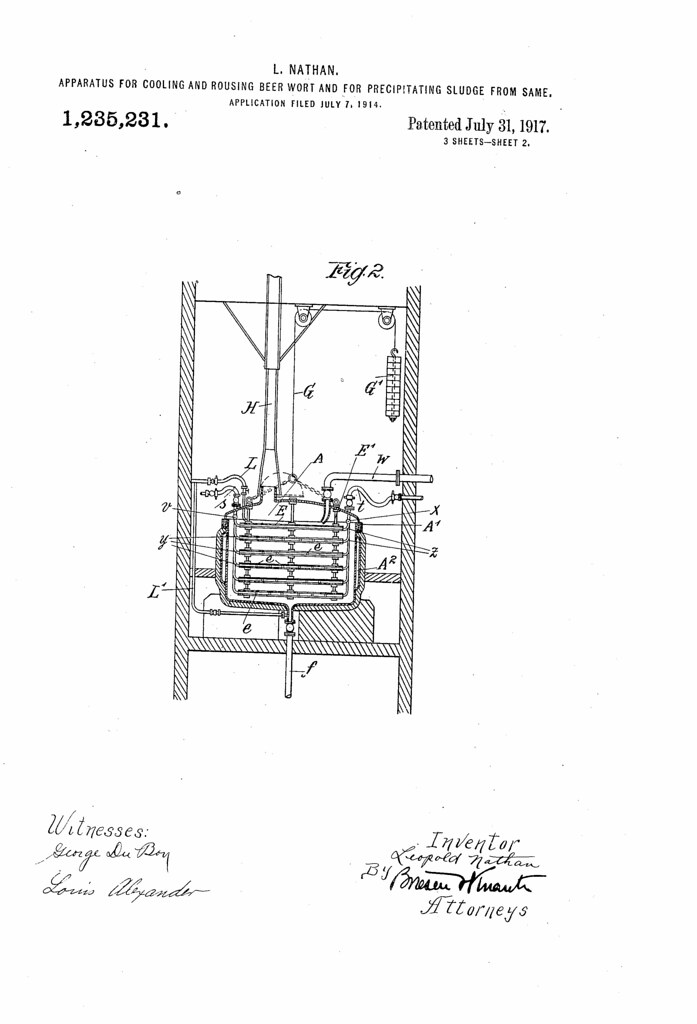
Today in 1917, US Patent 1235231 A was issued, an invention of Leopold Nathan, for his “Apparatus for Cooling and Rousing Beer-Wort and for Precipitating Sludge from Same.” There’s no Abstract, although in the description it includes this summary:

In the brewing of beer, especially in breweries in which special stress is laid on the production of high-class beers, the cooler is still in almost general use for cooling down the worts. The cooler, however, constitutes the primary and worst source of infection in the preparation of beer. Owing to the very rapid cooling of. the wort in the cooler, germs which have settled down on the cooler before it is charged with wort are not all killed. Moreover, fresh germs make their appearance during the cooling process, and these are not killed, especially at temperatures from 60 downward.

In spite of these defects of the cooler, it has been impossible hitherto, owing to its valuable properties for certain special types of beer, to dispense with this appliance. In addition to the cooling effect produced in the cooler, vapors are eliminated which carry off with them unpleasant odors formed in consequence of the inevitable access of air. Through the access of air and simultaneous cooling, considerable quantities of protein substances and hop resins are precipitated, and the only way in which these can be separated from the liquid is by allowing them to settle down, for which purpose the extensive surface of the cooler is highly advantageous.

The method employed by me in connection with the apparatus of the present invention consists in the first place in freeing the wort from the said aromatic and flavoring substances by the passage of a current of air or carbon dioxid, or both. If, as was hitherto the case, in this treatment the gas be forced or drawn into the wort from below, a very strong frothing is produced, which prevents the complete removal of the vapors.

The operation is directed, in the first place, to preventing this frothing or to nullifying its ill effects. With this object, the gas is carried, in a powerful current, along the wort in a finely-divided state so as to carry off the vapors from the surface of the liquid. At the same time a cooling effect is also produced; nevertheless the essential portion of the elimination effect can only be accomplished fully by treating the hot wort with a current of gas. The complete deposition of the cooler sludge, occurring as cooling progresses, is facilitated in a special manner, and the possibility of carrying it out in a closed, sterile vessel is afforded, by setting up in said vessel a frame containing a large number of superimposed stages having a total superficial area corresponding to that of the cooler. In order to remove the sludge this staged frame must be taken out of the vessel. The resulting infection is neutralized by allowing the next charge of wort to run into the vessel in a sufficiently hot condition.

This operation can be carried out in two vessels: one for the elimination treatment and one for the deposition of the sludge; or one and the same vessel may be used for both purposes.
Untitled
Untitled
Untitled

Filed Under: Beers, Breweries, Just For Fun, Politics & Law, Related Pleasures Tagged With: Brewing Equipment, History, Law, Patent, Science of Brewing

Patent No. 533747A: Beer-Cooling Device

July 30, 2015 By Jay Brooks

patent-logo
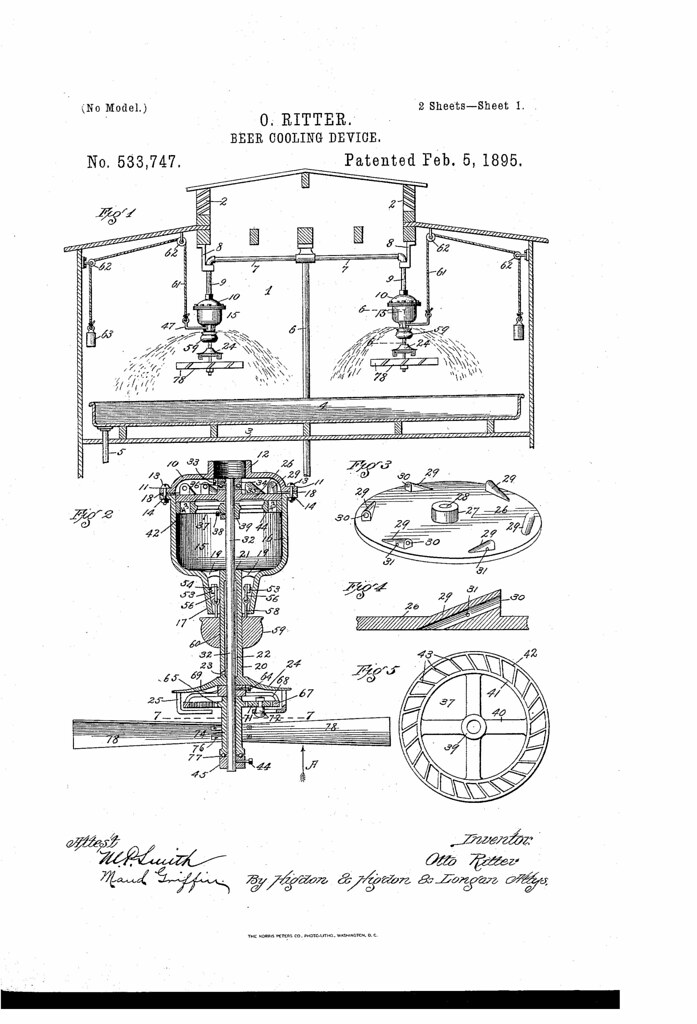
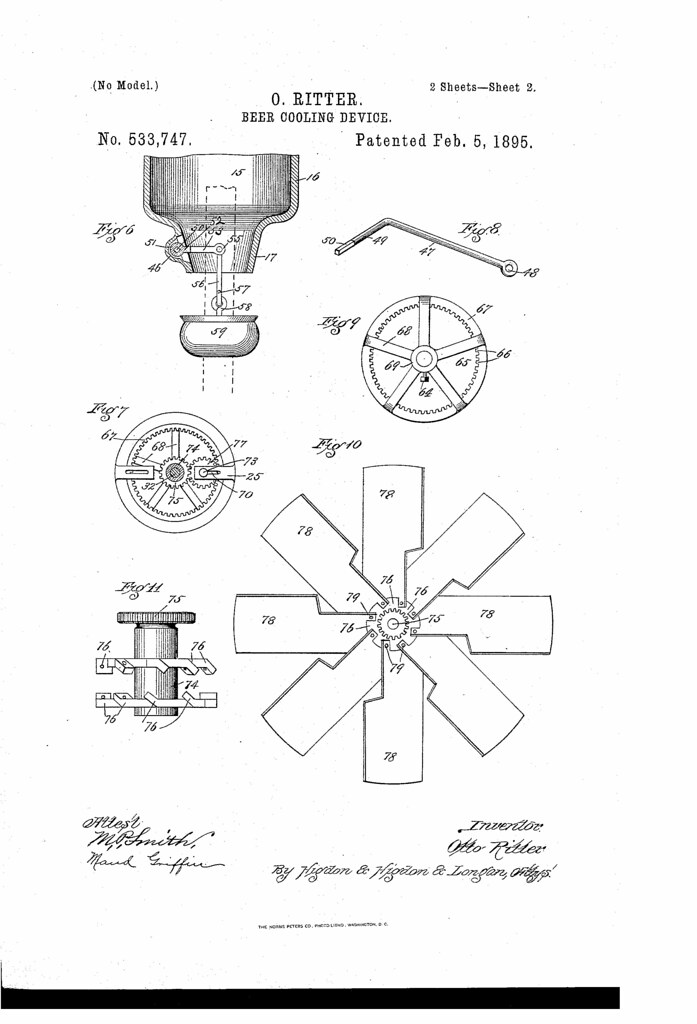
Today in 1895, US Patent 533747 A was issued, an invention of Otto Ritter, for his “Beer-Cooling Device.” There’s no Abstract, although in the description it includes this summary:

My invention relates to a beer cooling apparatus, the object of my invention being to so construct an apparatus as that when the wort or beer is passed through said apparatus it will operate a fan, which fan by its rotation sprays and cools the beer.

A further Object of my invention is to so gear the fan upon the central shaft as that said fan will rotate with greater rapidity than does the shaft.

My improved beer cooling apparatus is adapted to be located in an inclosure which is generally located in the top of brew houses, the beer being forced to said inclosure by a pump, or other suitable means, there to be passed through the apparatus and into the vats or pans adapted to receive it.

My invention consists in a suitable hollow casting adapted to besnpported in a position above the beer cooling receptacle, a shaft mounted vertically in said casting, a series of discharge nozzles or apertures located in said casting, a motor or turbine-wheel mounted to receive the beer that is discharged from said nozzles or apertures and to be revolved by the pressure of the beer, anda fan driven by and located below the said motor or turbine wheel in position to receive the beer sprayed above said fan by the movement ot’ said parts.

Untitled
Untitled

Filed Under: Beers, Breweries, Just For Fun, Politics & Law, Related Pleasures Tagged With: Brewing Equipment, History, Law, Patent, Science of Brewing

Patent No. 3749004A: Apparatus For Crushing And/Or Compacting

July 30, 2015 By Jay Brooks

patent-logo
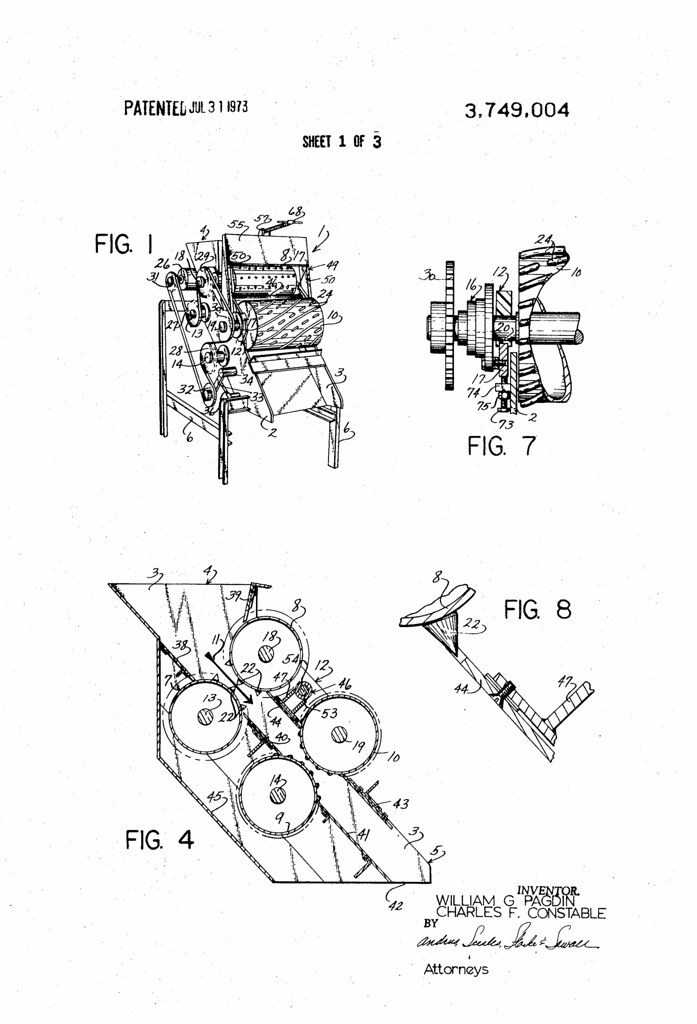
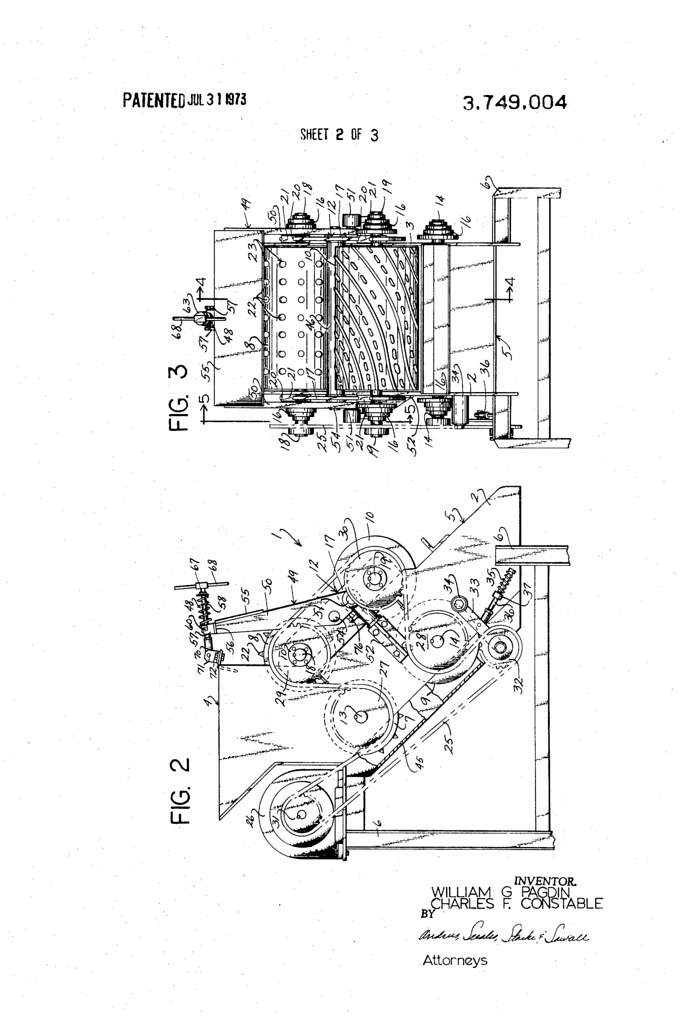
Today in 1973, US Patent 3749004 A was issued, an invention of William G. Pagdin and Charles F. Constable, assigned to the Schlitz Brewing Co., for their “Apparatus for Crushing and/or Compacting.” There’s no Abstract, although in the description it includes this summary:

The invention relates to that type of crushing and/or compacting machine or apparatus wherein a plurality of sets or pairs of opposing crushing rollers are arranged in series. Broadly according to the invention, a frame rotatably supports one roller from each set of rollers. The other roller from each set of rollers is rotatably supported by a member movable relative to the frame and the frame supported rollers. The rollers supported by the movable member move with that member relative to the frame supported rollers to provide for relief from shock loading between the sets of opposing rollers. Relative movement between the opposing rollers to relieve shock loading there between is resisted by resilient means.

Untitled
Untitled
Untitled

Filed Under: Beers, Breweries, Just For Fun, Politics & Law, Related Pleasures Tagged With: Brewing Equipment, History, Law, Patent, Science of Brewing

Patent No. 1138251A: Mash-Filter Plate

July 30, 2015 By Jay Brooks

patent-logo
Today in 1915, US Patent 1138251 A was issued, an invention of Joseph Schaefer, for his “Mash-Filter Plate.” There’s no Abstract, although in the description it includes this summary:

My invention relates to mash filters adapted for use in the arts of brewing, distilling or in the manufacture of compressed yeast, and in part is a continuation of my sugars and soluble matter are more completely removed from the lower part of the grains cakes because of the greater water pressure in the lower part of the frames. This results in the loss of more or less of the valuable sugars unless an excessive amount of water is used. The use of too much water is not desirable since this dilutes the wort to such an extent, that, to remove the excess of water, extended boiling is required which, it should be understood, is expensive and detrimental to the final product. To overcome these objections I have arranged the water chambers so that the grains cakes formed there between will be thicker at the bottom than at the top, or substantially trapezoidal in shape. It has been found that with cakes of this shape the sparging 18 more thorough, and with the use of a given quantity of water-the soluble sugars are more formaly and completely removed from the grains cakes.

Another object of my invention is .to facilitate the removal of the grains cakes from their frames when the sparging process is completed, and the series of frames are separated for this purpose. The frame as ordinarily constructed is provided with a flat floor or bottom from which ‘it is difficult to dislodge that part of the cake resting on the bottom, it usually being necessary’ for the workman to scrape it of with a paddle or other device. With my improved construction I overcome this objection by constructing the bottom or floor of each grains cake frame, wedge-shaped or like a tool edge in cross-section. This construction is adapted to save the time of the workman for, as the grains cakes are friable, it will be seen that a mere tap of a hammer will cause the bottom of the grains cake to separate and slide down on each side of the wedge-shaped bottom of the cake frame, and thus leave the frame clean without any further effort on the part of workman.

Untitled

Filed Under: Beers, Breweries, Just For Fun, Politics & Law, Related Pleasures Tagged With: Brewing Equipment, History, Law, Patent, Science of Brewing

Patent No. 5133233A: Bottle Opener Glove

July 28, 2015 By Jay Brooks

patent-logo
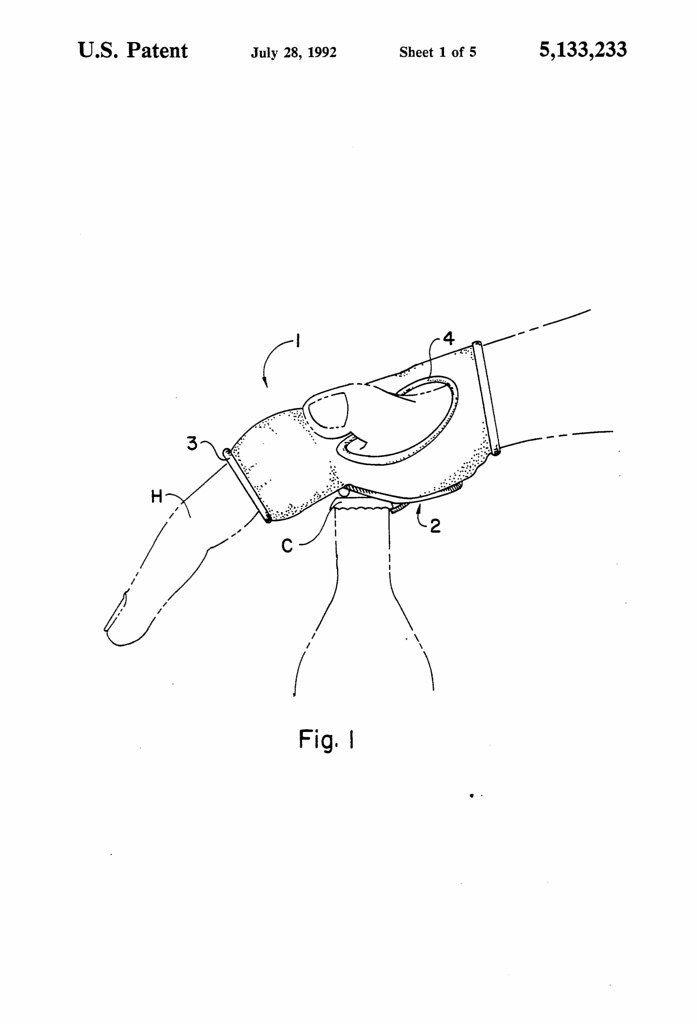
Today in 1992, US Patent 5133233 A was issued, an invention of Charles M. Erwin, for his “Bottle Opener Glove.” Here’s the Abstract:

Bottle opening tool having bottle cap-engaging hook and end fulcrum bar, each secured to a rigid back plate, is incorporated into the palm of a glove. Back plate is shaped to conform to the shape of the palm of the wearer hand. Bottle cap is removed by back of user’s hand applying lifting force to glove. Entire bottle opening tool member fits within palm of glove, thereby leaving fingers unrestricted to movement both while opening bottles and when not being used to open bottles.

Untitled
Untitled

Filed Under: Beers, Just For Fun, Politics & Law, Related Pleasures Tagged With: Bottles, History, Law, Patent

Patent No. 734985A: Apparatus For Converting Wort Into Beer

July 28, 2015 By Jay Brooks

patent-logo
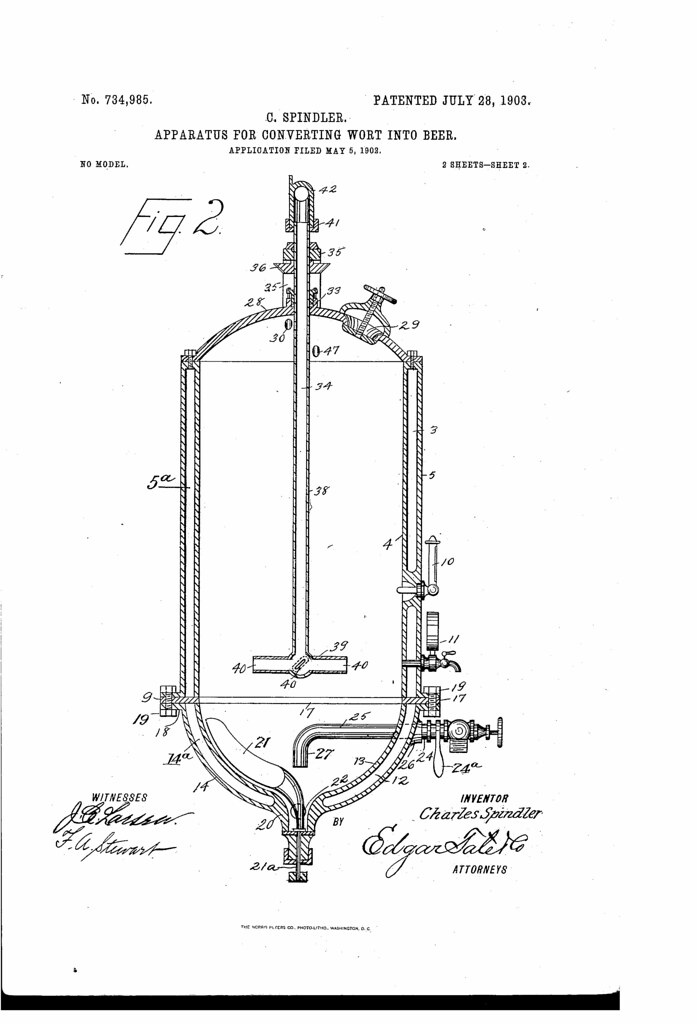
Today in 1903, US Patent 734985 A was issued, an invention of Charles Spindler, for his “Apparatus For Converting Wort Into Beer.” There’s no Abstract, although in the description it includes this summary:

This invention relates to improved apparatus for the manufacture of fermented liquors, particularly beer; and it has for its object to provide an improved apparatus of this class which shall be superior from a standpoint of continuity and efficiency of operation, comparative simplicity in construction, compactness in form, and in the obviation of the use of a number of separate apparatuses the use of which is customarily incidental to processes involving the employment of apparatus of this class.

Untitled
Untitled

Filed Under: Beers, Breweries, Just For Fun, Politics & Law, Related Pleasures Tagged With: Brewing Equipment, History, Law, Patent, Science of Brewing

Patent No. 3594995A: Hop-Picking Machine

July 27, 2015 By Jay Brooks

patent-logo
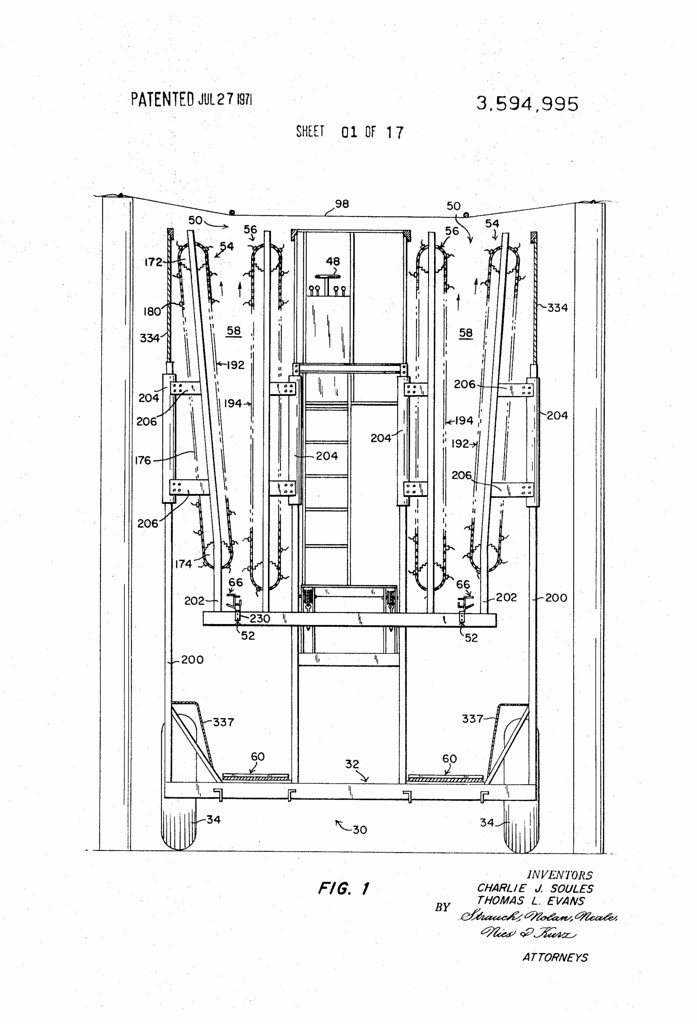
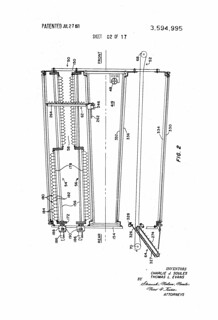
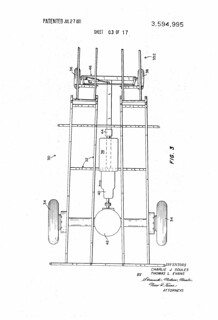
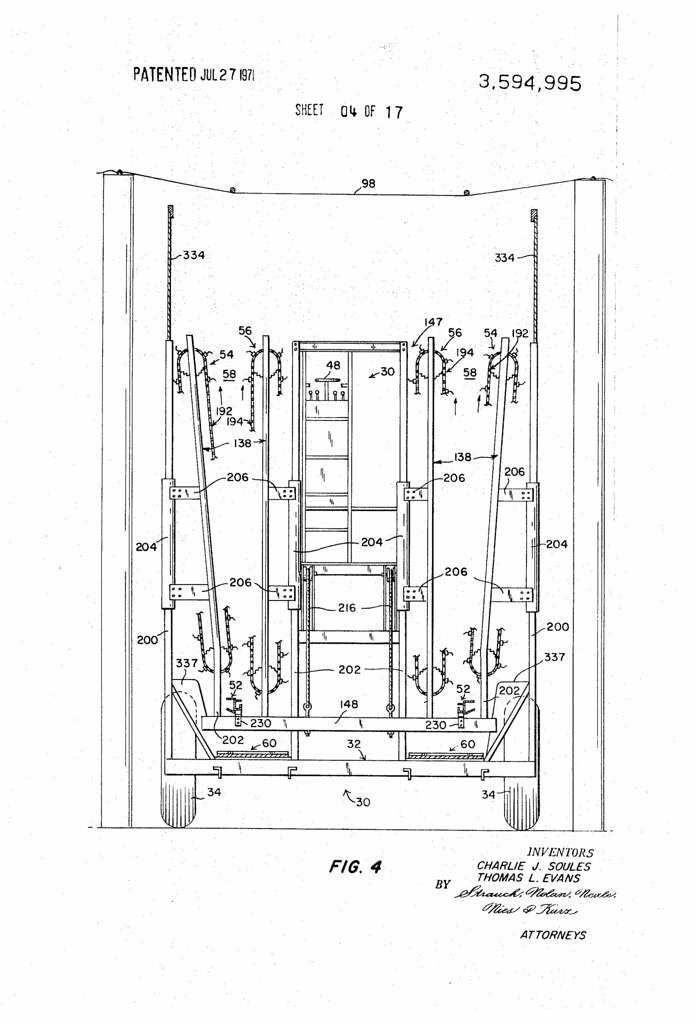
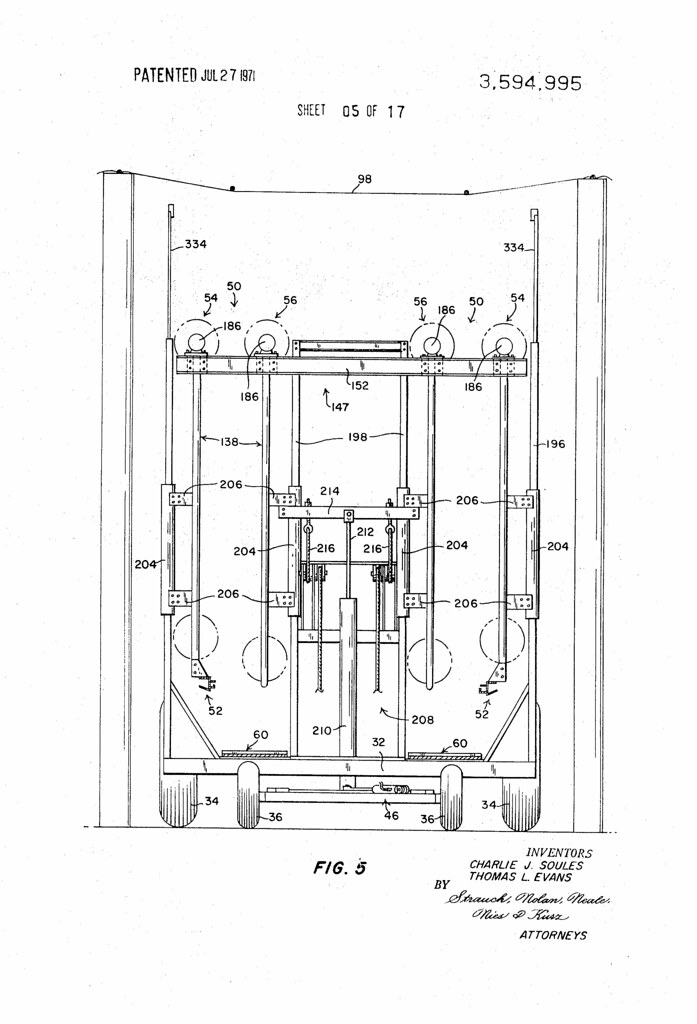
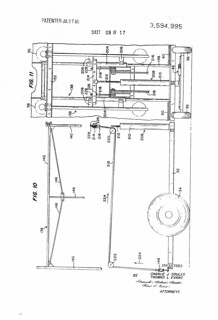
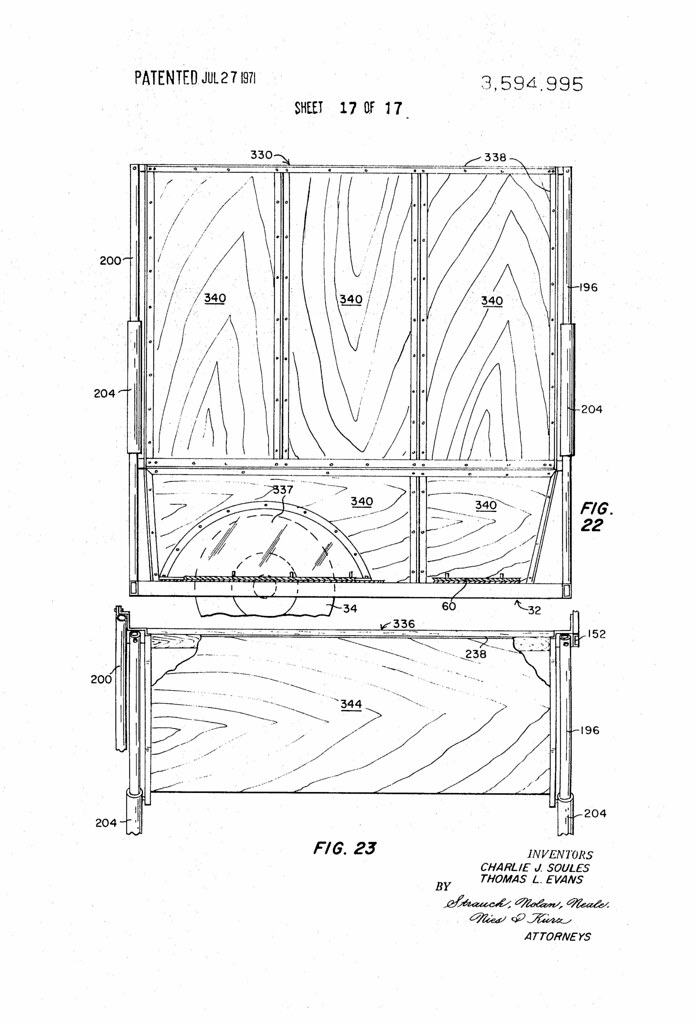
Today in 1971, US Patent 3594995 A was issued, an invention of Thomas Lee Evans and Charlie J. Soules, for their “Hop-Picking Machine.” There’s no Abstract, although in the description it includes this summary:

This invention relates to hop-picking machines and, more particularly, to novel, improved machines for field picking hops from vines hanging from overhead wires or trellises or other supports.

We have now developed a novel, improved machine for filed picking hops which does not have the drawbacks of machines heretofore proposed for this purpose and accordingly represents a significant advance in the art over the latter. The novel hop-picking machines of the present invention are preferably self-propelled and, generally speaking, include graspers for engaging the lower ends of the vines and maintaining them in picking position as they move through the machine, picking cuts for stripping the hops from the vines, a conveyor arrangement for carrying the hops away, a cutter for severing the vines to free them from the supports, and an arrangement for expelling picked vines from the machine.

One of the important advantages of the novel hoppicking machine described herein is that, being self-propelled, it can be maneuvered through a field more easily and much faster than the cumbersome pushed-type” picker described in the Horst patents identified above and is accordingly capable of picking hops at a much higher rate. Another advantage, also resulting in increased capacity, is that the machines of the present invention are capable of picking two rows of vines simultaneously in contrast to the patented Horst machines which are single-row pickers.

In the Horst machines, the vines are pulled down through the machine as they are picked. Accordingly, a field hand must accompany the machine and cut the vines free from the trellises as they move into the machine. Applicant’s novel machine in contrast does not depend on downward movement of the vines they are picked; and, moreover, it is provided with its own cutter for severing the vines to free them from the trellises. Accordingly, the necessity of employing hand labor for this purpose is eliminated by the present invention together with the attendant expense.

In conjunction with the foregoing, another novel and important feature ofthe present invention is that the picking cats are vertically adjustable. This makes it possible to quickly adjust the cats as the heights of the overhead supports change so that the vines can be picked clean up to the supports.

Another important feature of the present invention is a novel conveyor for the hops stripped from the vines which normally discharges into a truck or the like but can be employed to store picked hops so that the machine can continue to pick while a loaded truck is being replaced or the machine is turning at the end ofa row, etc. In similar circumstances the picking operation would have be stopped in heretofore proposed machines such as those .described in .the Horst patents, for example.

Yet another important feature of the present invention is a novel grasper line for holding the vines in the proper position for picking in which the grapsers are moved at a speed matching the ground speed of the picking machine. Further, the grapscr line is configured to compensate for sagging vinesupporting wires, thereby ensuring that the vines are grasped at the proper location.

Other important features of the invention are a novel cutter mechanism for severing the vines and freeing them from the trellises and a novel mechanism for expelling the picked vines from the machine. Yet another novel and important feature of the invention is that the operating mechanisms are powered entirely by hydraulic motors, substantially eliminating belt and chain and similar drives. This makes the novel machines disclosed herein significantly simpler than comparable prior art harvesters.

Untitled

Untitled Untitled

Untitled
Untitled
Untitled Untitled

Untitled

Filed Under: Beers, Just For Fun, Politics & Law, Related Pleasures Tagged With: History, Hops, Law, Patent

Patent No. 2477222A: Beer Dispenser With Coil Cleaning Means

July 26, 2015 By Jay Brooks

patent-logo
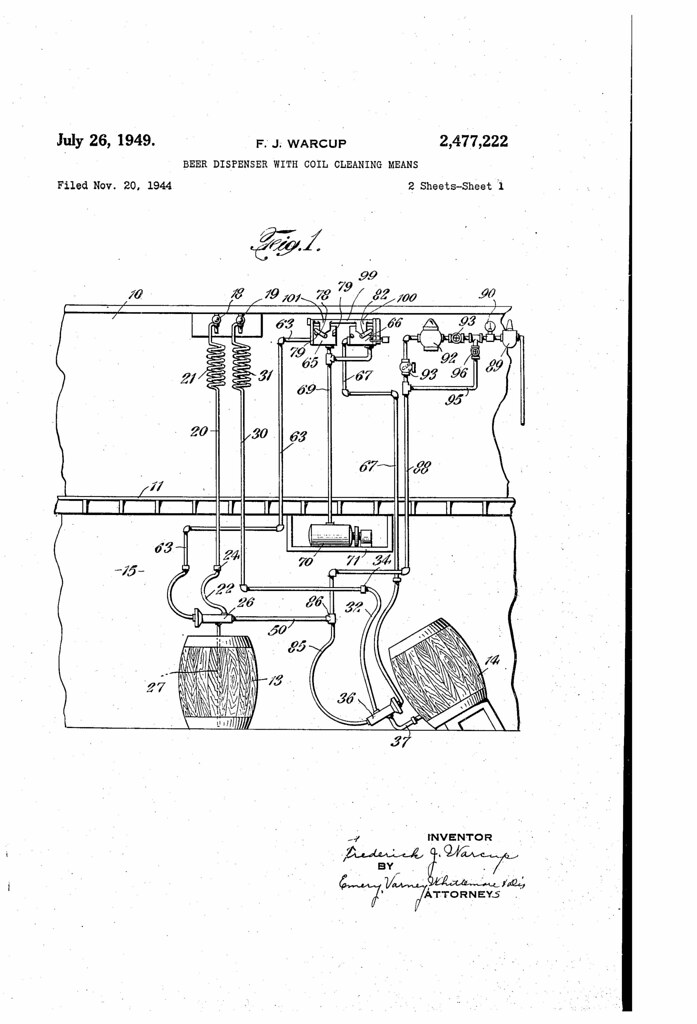
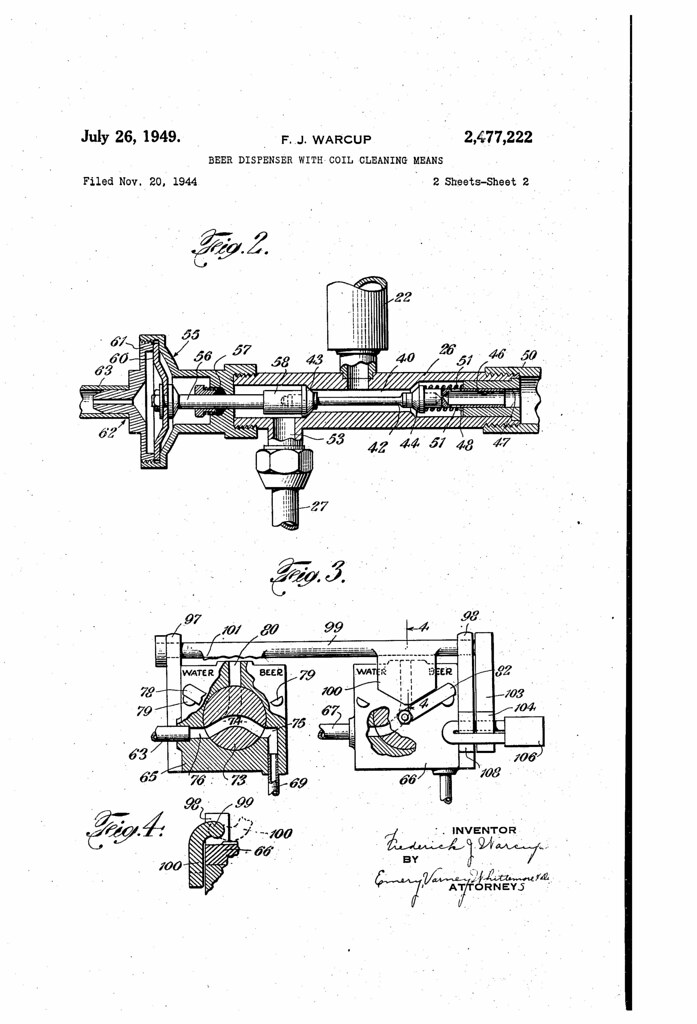
Today in 1949, US Patent 2477222 A was issued, an invention of Frederick J. Warcup, for his “Beer Dispenser with Coil Cleaning Means.” There’s no Abstract, although in the description it includes this summary:

This invention relates to beer distributing systems such as are used in taverns and saloons for conducting beer from kegs, in which the beer is delivered from the brewery, to taps located behind the bar. The length of piping between a keg and the tap includes a cooling coil through which the beer flows.

One object of the invention is to provide an improved beer distributing system in which water can be conveniently introduced into the beer lines and accurately controlled so as to avoid the loss of beer that results from having beer stand in the pipes, from draining of the lines for cleaning, and the loss that occurs when an empty keg is replaced with a full one.

It is another object of this invention to provide means by which tavern operators can clean their own lines without having to connect or disconnect any unions or fittings, and in the preferred embodiment of the invention the system is constructed so that the beer lines can be cleaned without even leaving the bar. The tavern operator can fill his beer lines with water preparatory to cleaning them and all of the usual loss of beer incident to cleaning line is avoided.

Another important saving is effected by this invention when a keg becomes empty and it is necessary to tap a new keg. Whenever the contents of one keg become exhausted, the beer line fills with foam and the first beer from a new keg surges into the line and foams to such an extent that the first glasses drawn after a new keg has been tapped cannot be used because of excessive foam. With this invention the line is filled with water before tapping a new keg and there is no surge of beer into the line.

Untitled
Untitled

Filed Under: Beers, Just For Fun, Politics & Law, Related Pleasures Tagged With: Bars, History, Kegs, Law, Patent, Pubs

Patent No. 3332748A: Extraction Of Hop Bitters From Beer With Iso-Octane Using Synchronized Pulses In A Helical Coil

July 25, 2015 By Jay Brooks

patent-logo
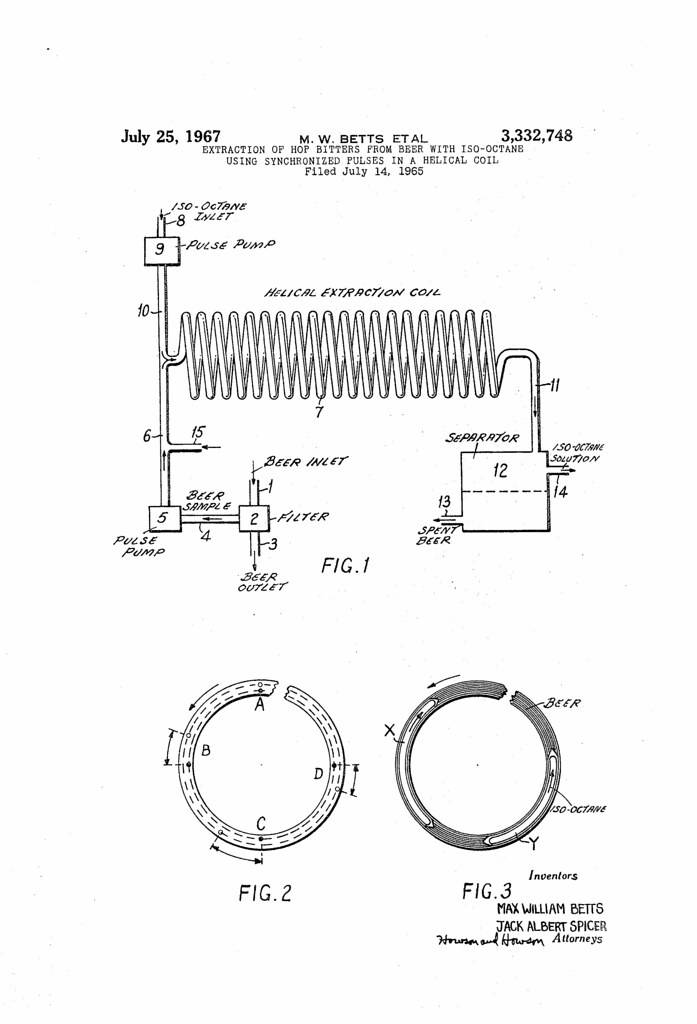
Today in 1967, US Patent 3332748 A was issued, an invention of Jack Albert Spicer and Max William Betts, for their “Extraction of Hop Bitters from Beer With Iso-Octane Using Synchronized Pulses in a Helical Coil.” There’s no Abstract, although in the description it includes this summary:

This invention relates to the extraction of chemical substances from liquid mixtures and in particular to the extraction of such substances from complex mixtures for purposes of analysis.

In the analysis of a complex mixture, it may be desired to separate one or more constituents of the mixture, by liquid/liquid extraction methods, in order to obtain a relatively simple solution, for example for spectrographic analysis. Thus, for example, it has been proposed to extract hop bitter substances from brewers wort or beer by liquid/liquid extraction with iso-octane, whereupon the solution of the hop bitter substances may be analyzed by ultra-violet spectrographic analysis. The present invention provides an extraction process suitable for use in the separation of desired compounds from such mixtures.

According to the invention, a process for the extraction of a chemical substance from a liquid mixture comprises feeding the liquid mixture and a solvent for the desired chemical substance in synchronized pulses through a horizontally disposed coiled tube, and separating the residual liquid mixture from the solution of the desired chemical substance in the solvent. Preferably the coiled tube is helically coiled.

US3332748-0

Filed Under: Beers, Just For Fun, Politics & Law, Related Pleasures Tagged With: History, Hops, Law, Patent

Patent No. 998815A: Beer-Making Apparatus

July 25, 2015 By Jay Brooks

patent-logo
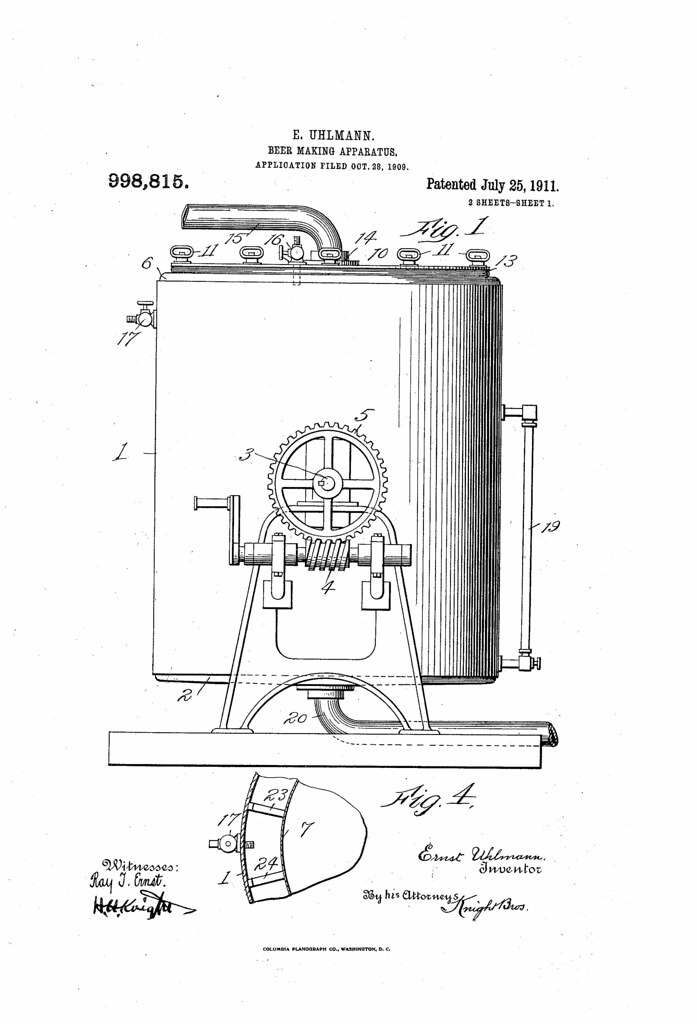
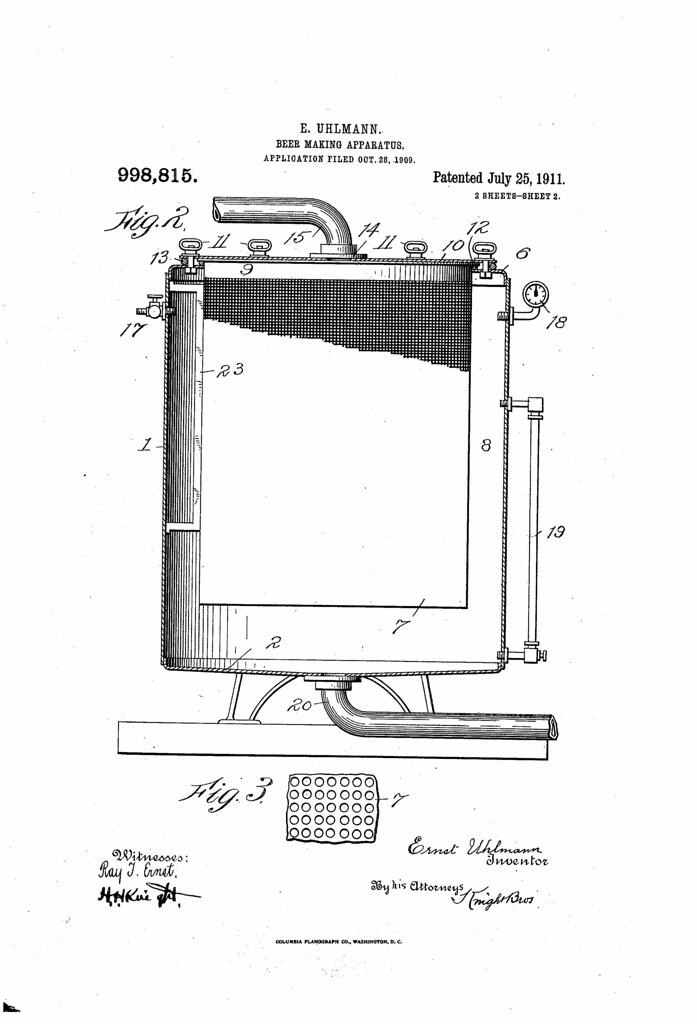
Today in 1911, US Patent 998815 A was issued, an invention of Ernst Uhlmann, for his “Beer-Making Apparatus.” There’s no Abstract, although in the description it includes this summary:

My invention relates to that portion of the beer making art wherein the wort is treated with hops, and it has for its objects to provide an apparatus for preventing the wort from acquiring an objectionable color and flavor and from a tendency to sour as a result of such treatment.

My invention is designed to overcome these objections and to provide a form of apparatus for rapidly removing the hops from the wort, which shall ‘be simple in construction and operation and require much less floor space for accommodation than apparatus commonly used for the purpose.

In carrying out my invention I remove the hops, albuminoids, and such matter from the wort while the latter is flowing from the brewing kettle to the coolers, so that the wort is freed from these matters almost immediately it leaves the brewing kettle, and does not remain in contact with the hops, etc., longer than a few seconds. Also I remove all the wort from the hops without employment of any mechanical or air pressure.

Untitled
Untitled

Filed Under: Beers, Breweries, Just For Fun, Politics & Law, Related Pleasures Tagged With: Brewing Equipment, History, Law, Patent, Science of Brewing

« Previous Page
Next Page »

Find Something

Northern California Breweries

Please consider purchasing my latest book, California Breweries North, available from Amazon, or ask for it at your local bookstore.

Recent Comments

  • Bob Paolino on Beer Birthday: Grant Johnston
  • Gambrinus on Historic Beer Birthday: A.J. Houghton
  • Ernie Dewing on Historic Beer Birthday: Charles William Bergner 
  • Steve 'Pudgy' De Rose on Historic Beer Birthday: Jacob Schmidt
  • Jay Brooks on Beer Birthday: Bill Owens

Recent Posts

  • Beer In Ads #5240: Rieker’s Bock Beer Is Now On The Market May 3, 2026
  • Historic Beer Birthday: Herman Adolph Schalk May 3, 2026
  • Beer In Ads #5239: The National Drink May 2, 2026
  • Beer Birthday: Anders Kissmeyer May 2, 2026
  • Beer Birthday: Bruce Paton May 2, 2026

BBB Archives

Feedback

Head Quarter
This site is hosted and maintained by H25Q.dev. Any questions or comments for the webmaster can be directed here.