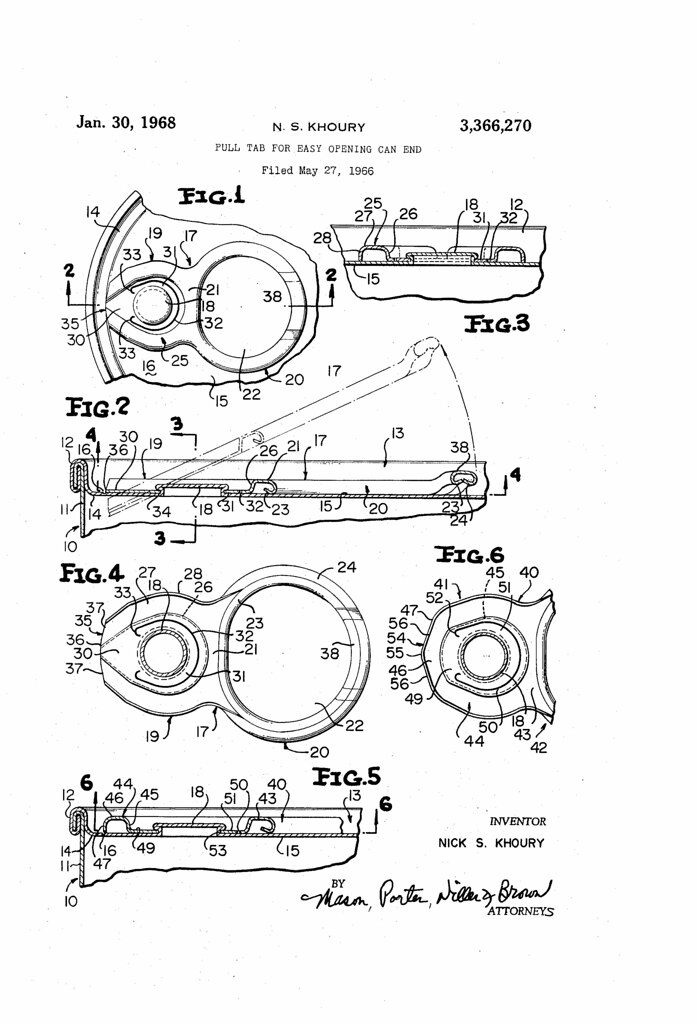
Today in 1968, US Patent 3366270 A was issued, an invention of Nick S. Khoury, assigned to Continental Can Co., for his “Pull Tab for Easy Opening Can End.” There’s no Abstract, but the description states that the “invention relates to a pull tab wherein in the initial rupture of the container panel, an inward pressure is exerted utilizing the pull tab with the pull tab functioning as a simple first-class lever.”
Patent No. 642460A: Apparatus For Producing Wort, Hop-Beer, Washing Filter-Pulp, &c.
Today in 1900, US Patent 642460 A was issued, an invention of Emil Kersten, for his “Apparatus for Producing Wort, Hop-Beer, Washing Filter-Pulp, &c.” There’s no Abstract, but the description states the “object of the invention is to provide a new and improved apparatus for use in breweries for washing and sterilizing the pulp used in filtering or for mashing and hopping purposes, to agitate and leach the pulverized or ground malt with water for producing wort, and to treat the wort with the hops in such a manner as to produce an unfermented liquor of a high quality and in such a state as to facilitate the fermenting process.”

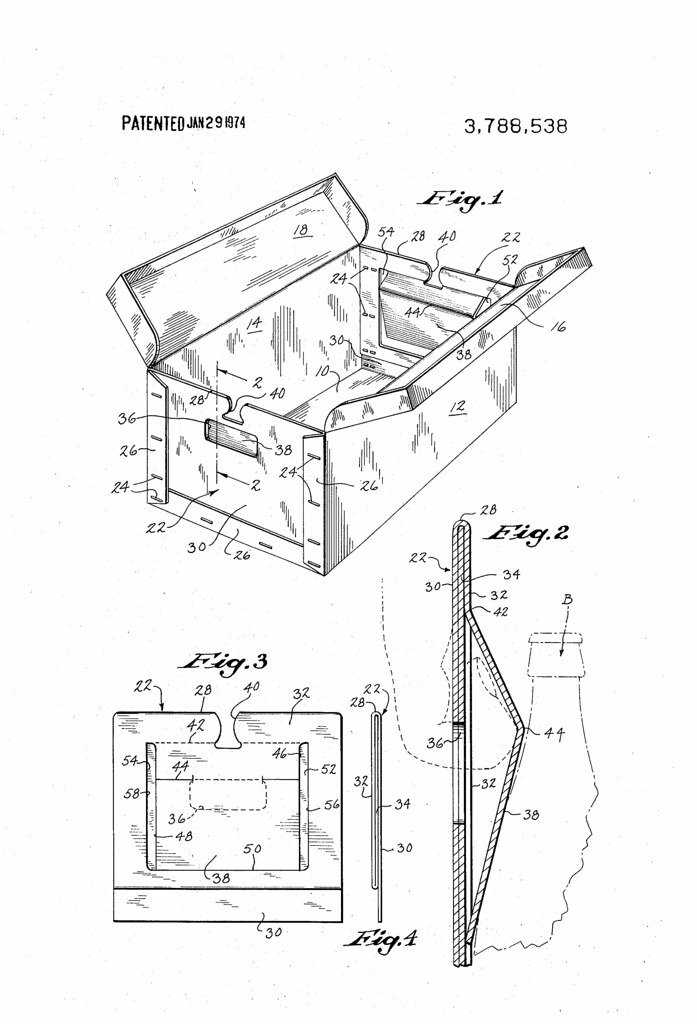
Patent No. 3788538A: Beer Carton
Today in 1974, US Patent 3788538 A was issued, an invention of William A. Kuenzi, assigned to Miller Brewing, for his “Beer Carton.” Here’s the Abstract:
The entry of light into the interior of a beer carton through the handholes thereof is prevented by flaps, one of which is hingedly attached to the inner surface of each end panel above the upper margin of the handhole. The flaps are preferably wider than the handholes, extend downwardly below the lower margin of the handholes, and have a free lower edge. The flaps are preferably deflectable inwardly along a fold line opposite the upper margin of the handholes to permit entry of fingers around the upper margin of the handhole and between the inner surface of the end panel and the adjacent surface of the flap. Each end wall panel is preferably made of triple-folded material with the flap being cut out of the inside face of the material and the handhole being cut through the other two thicknesses.
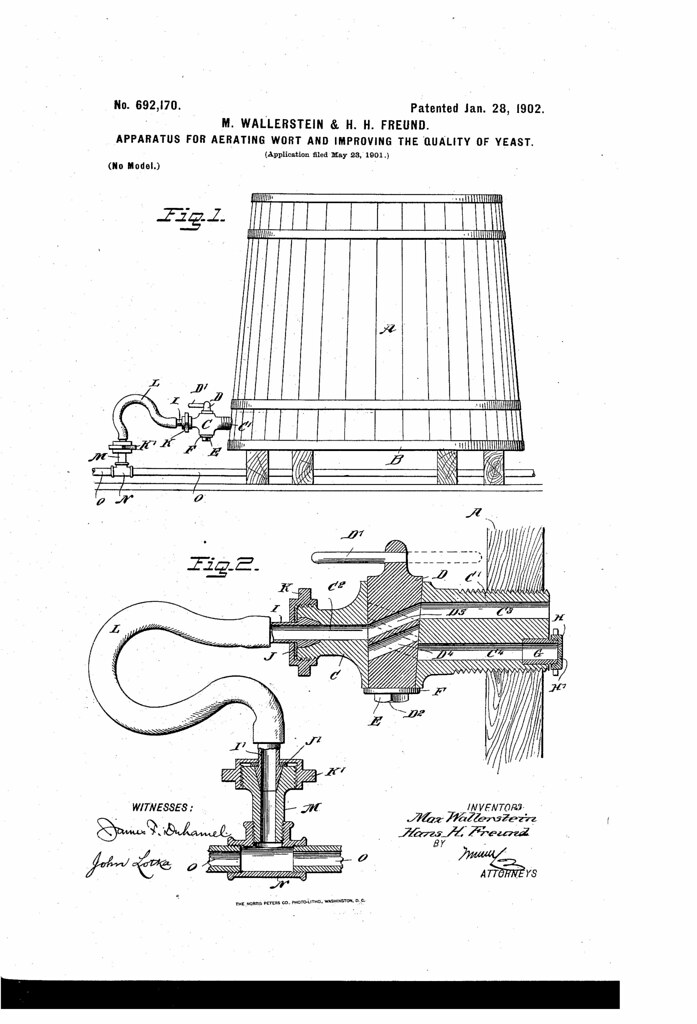
Patent No. 692170A: Apparatus For Aerating Wort And Improving The Quality Of Yeast
Today in 1902, US Patent 692170 A was issued, an invention of Max Wallerstein and Hans H. Freund, for their “Apparatus for Aerating Wort and Improving the Quality of Yeast.” There’s no Abstract, but this is from the description.
Our invention relates to apparatus for aerating Wort during fermentation and improving the quality of yeast, and has for its object to provide an apparatus of this class by the use of which wort is aerated with filtered air in any desired quantity during fermentation and yeast of healthy growth and great purity is obtained.
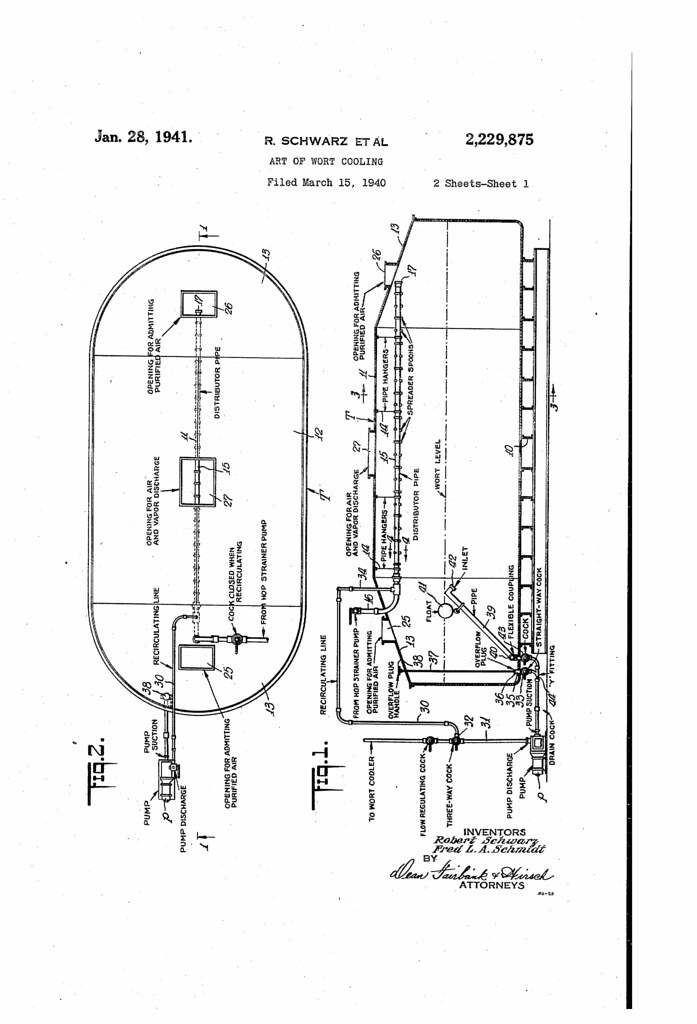
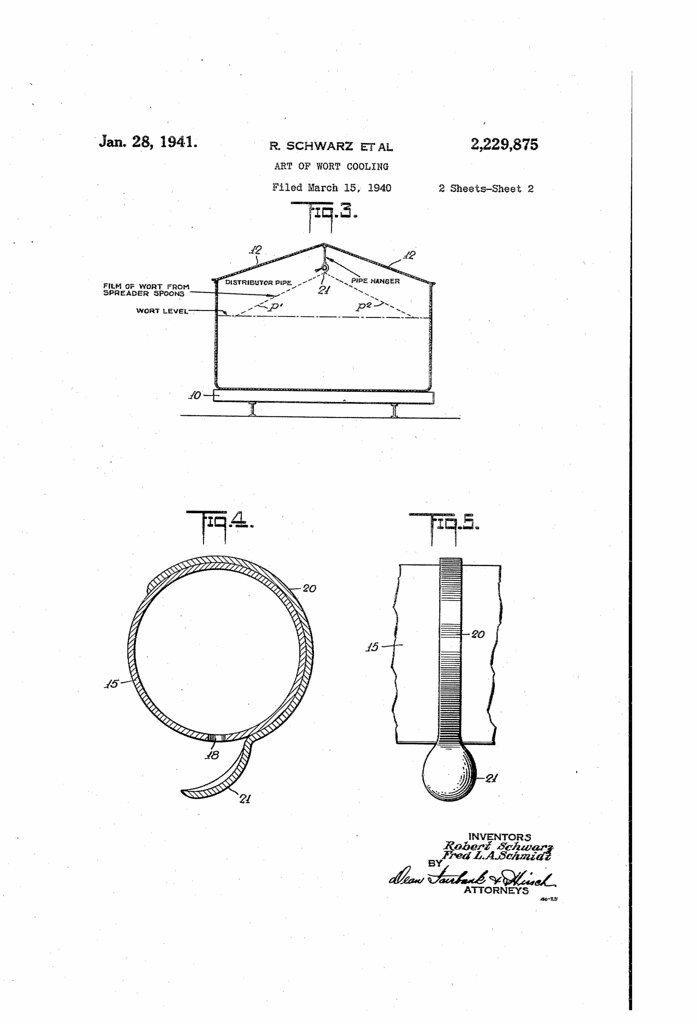
Patent No. 2229875A: The Art Of Wort Cooling
Today in 1941, US Patent 2229875 A was issued, an invention of Robert Schwarz and Fred L.A. Schmidt, for their “Art of Wort Cooling.” There’s no Abstract, but here’s the general idea.
Generally speaking, the invention involves cooling the wort by evaporation in a cycle which includes the passage of clean, filtered air or air 2o rendered germ-free by other methods, along or across the path of a flat expanded stream in which the wort is introduced into a closed chamber. Where the cooling after such operation is inadequate, the wort or some of it is pumped in go one or more repetitions of said cycle until the desired cooling has been effected.
Patent No. 135245A: Improvement In Brewing Beer And Ale
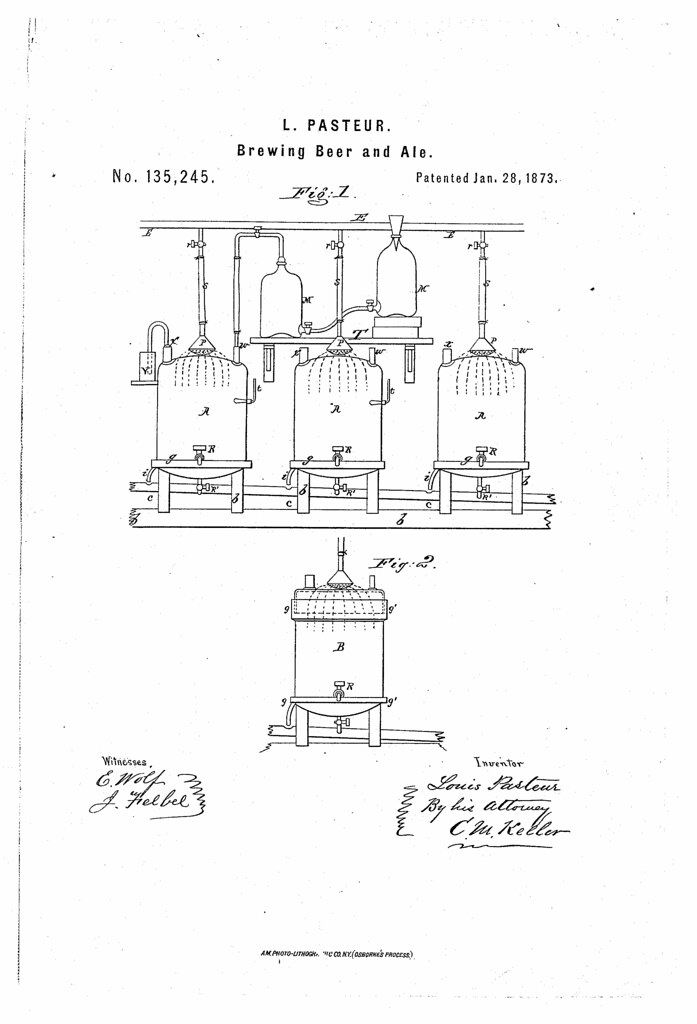
Today in 1873, US Patent 135245 A was issued, an invention of Louis Pasteur, for his “Improvement in Brewing Beer and Ale.” There’s no Abstract, but Pasteur explains in the description that this is a “process of brewing without the presence in the wort of atmosphericair, my invention has for its object to produce a better quality and greater quantity of beer from the same quantity and quality of wort, and to afford a beer which shall also embody the quality of greater degree of unalterableness during time and changes of climate, &c., in transportation and use; and to these ends my invention consists in expelling the air from the boiled wort while confined in a closed vessel or closed vessels, and then cooling it by the application of sprays of water to the exterior of such vessel or vessels, as will be hereinafter more fully explained.”

Patent No. 20110017737A1: Plastic Beer Keg
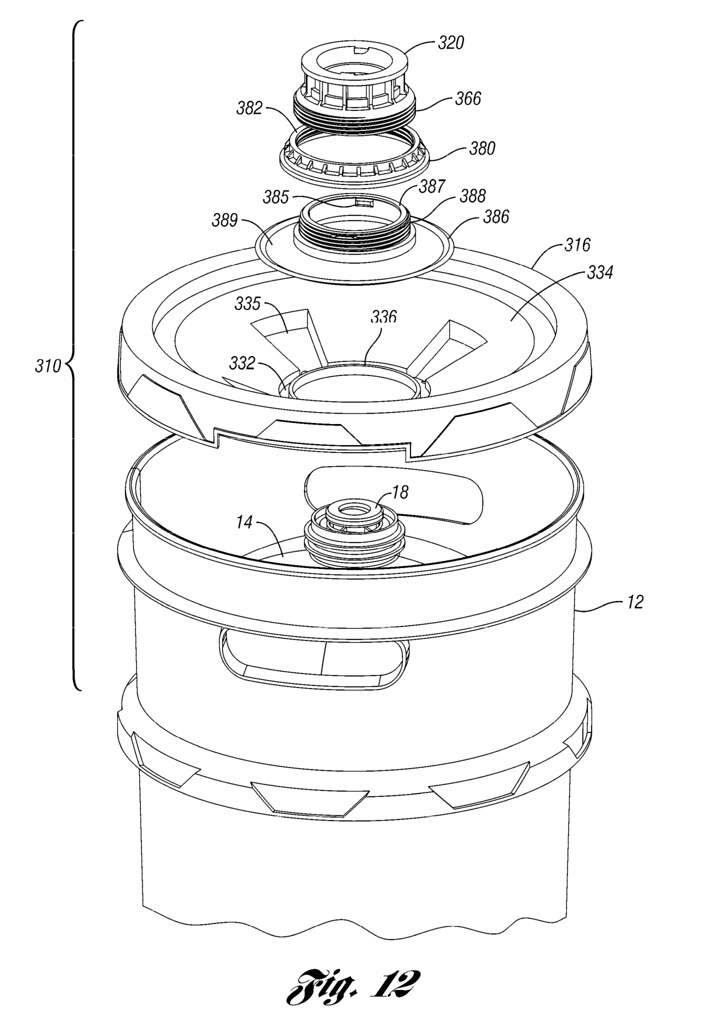
Today in 2011, US Patent 20110017737 A1 was issued, an invention of William P. Apps, for his “Plastic Beer Keg.” Here’s the Abstract:
A plastic beer keg includes an outer container and an inner liner. A removable lid is secured over an opening to the container to enclose the liner. The liner includes a neck portion and a body portion. A head contact member transfers axial forces imparted by handling equipment away from the neck portion.
From reading through the description, the idea of this invention is to replace the costlier metal kegs currently in use today. Only time will tell.


Patent No. 3558326A: Process For Isomerizing And Purifying Hop Extracts
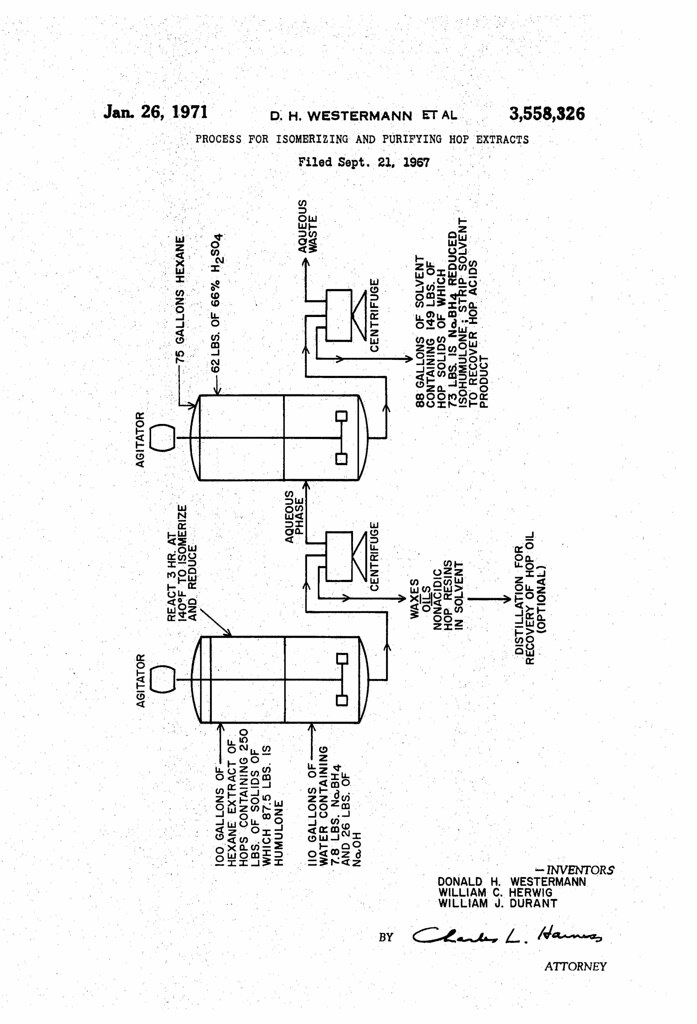
Today in 1971, US Patent 3558326 A was issued, an invention of William J. Durant, William C. Herwig, and Donald H. Westermann, assigned to Miller Brewing, for their “Process for Isomerizing and Purifying Hop Extracts.” There’s no Abstract, but they describe it as a “hop extract substantially free from waxes, oils, and nonacidic hop components is prepared by treating a waterimmiscible solvent solution of hop extract with an aqueous alkaline solution to isomerize acid hop components in the aqueous phase. The waxes, oils, and nonacidic hop components enter the nonaqueous phase and are removed with the latter. The aqueous phase is acidied, more solvent is added, and the hop acids enter the solvent phase and are recovered therefrom. The extract is used in making beer of improved light stability.”
The Three Europes: Beer, Wine & Vodka

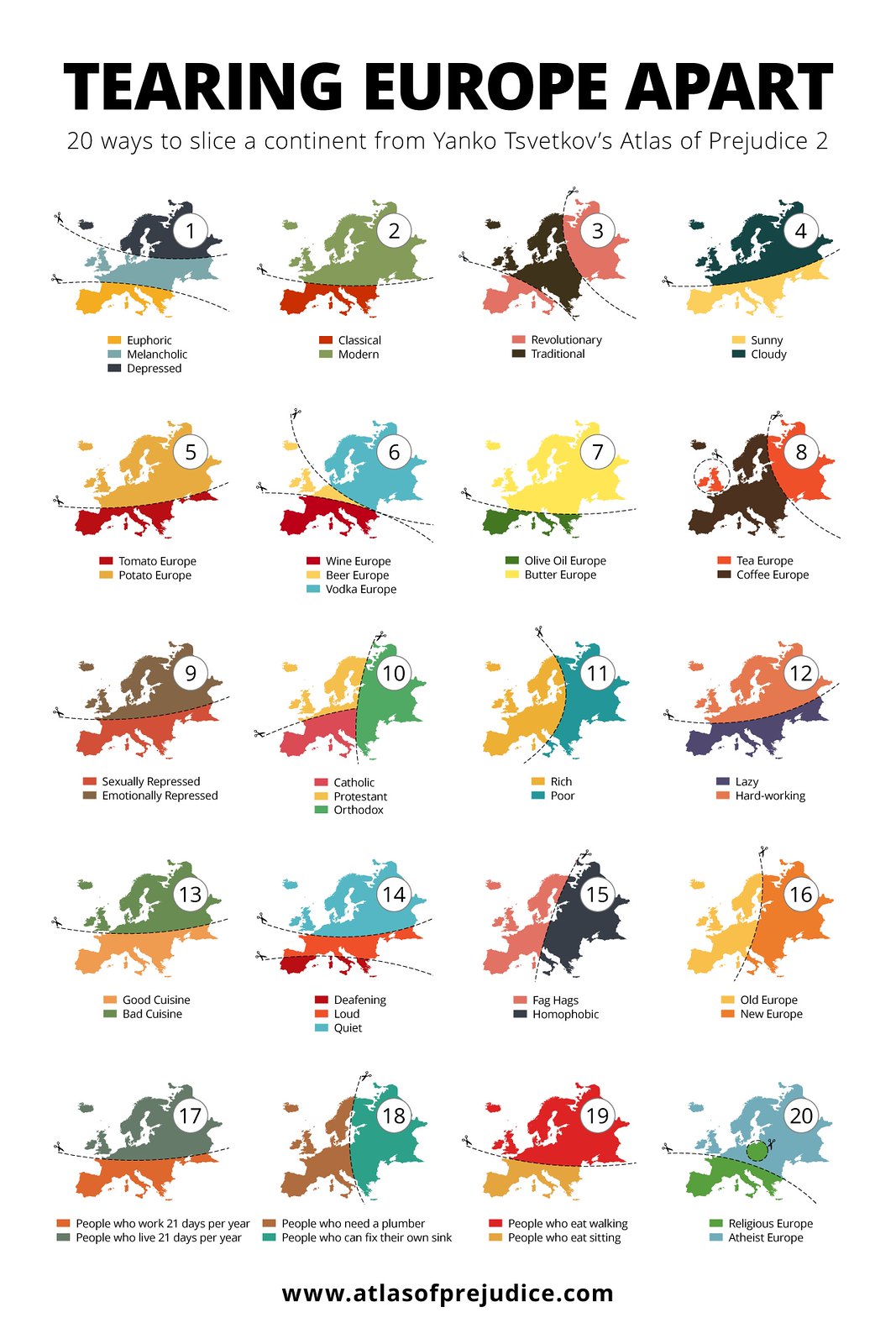
I love maps, I does, and especially the more interesting graphic ones that go beyond just showing you point a, b and so on, especially the kind often referred to as pictorial maps. So I was excited to find out about this collection, called The Atlas of Prejudice, by Yanko Tsvetkov, a Bulgarian graphic designer living in Spain. From what I can gather, it’s an amazing, sometimes hilarious, collection of maps and charts showing how different groups view themselves and the world around them. He’s recently published a second volume of the atlas, and in promoting the new volume put out this clever poster of 20 ways of “Tearing Europe Apart,” as an example of the kinds of charts to be found in Atlas 2.
Click here to see this chart full size.
Number 6, in the second row, shows how Europe can be divide into beer, wine or vodka loving/preferring regions.
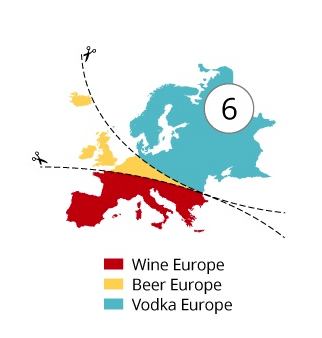
Take a look at that yellow sliver of a triangle in continental Europe. I suspect that the whole project is meant to be more thought-provoking and/or funny as opposed to being a completely accurate rendering of data, more using stereotypes or the author’s (and perhaps many other people’s) sense of these differences that are highlighted by the charts. But still, the slice of beer seems a bit too small to me, cutting through Belgium, obviously, the Netherlands, but only a portion of Germany, Austria and the Czech Republic, and also ignoring most of the Balkans and many far eastern European nations. I had always thought that those areas heavily favored beer, but maybe that’s outdated or was simply wrong. So I ask my Europeans friends and colleagues. Does that look right? Is vodka more popular than beer in most of those areas shown in in blue?
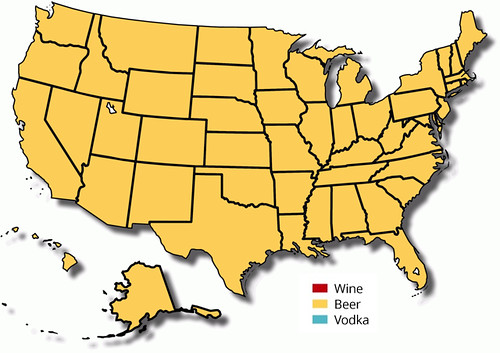
I don’t think he did a similar chart for the U.S. But I think it would look something like this:
Patent No. 3637117A: Keg Tapping Device
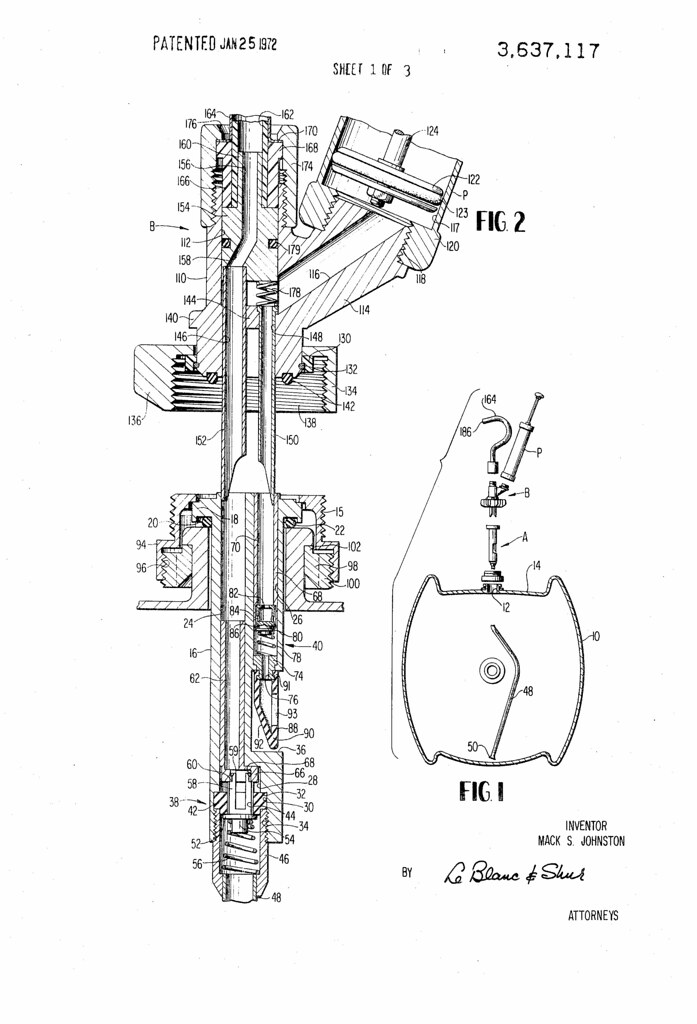
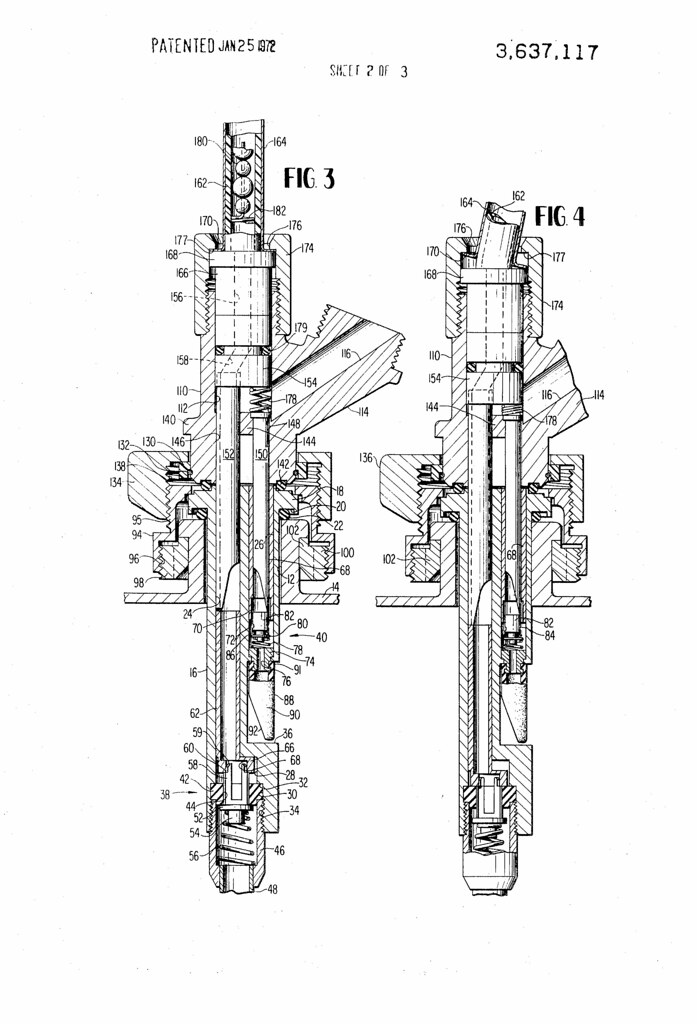
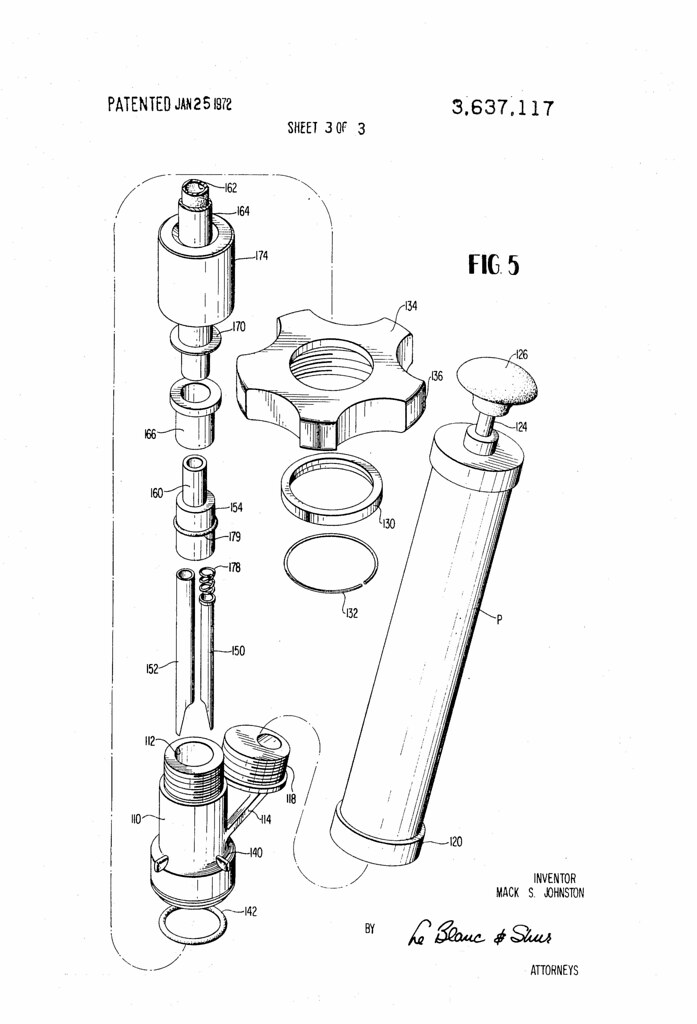
Today in 1972, US Patent 3637117 A was issued, an invention of Mack S. Johnston, assigned to Republic Corp., for his “Keg Tapping Device.” Here’s the Abstract:
The device comprises a keg adapter mounted about a keg opening and a dispenser coupler releasably coupled to the keg adapter having gas inlet and beer dispensing outlet passages terminating in two side-by-side probes depending from the coupler. The liquid probe is movably mounted in the coupler and biased in one direction. An inverted J-shaped tube is carried by the coupler in communication with the liquid probe and displacement of the tube moves the liquid probe in the opposite direction to open the beer valve in the keg adapter. The gas passage is in communication with a hand operated portable plunger-type pump whereby gas is provided through the keg adapter into the keg.