Brookston Beer Bulletin

Jay R. Brooks on Beer

  • Home
  • About
  • Editorial
  • Birthdays
  • Art & Beer

Socialize

  • Dribbble
  • Email
  • Facebook
  • Flickr
  • GitHub
  • Instagram
  • LinkedIn
  • Pinterest
  • RSS
  • Twitter
  • YouTube

Powered by Genesis

The Top Beer Brand Of 2012

January 4, 2013 By Jay Brooks

ace-metrix
I don’t want to wade neck deep into the “craft vs. crafty” debate — I’m not quite finished digesting it all — so I’m trying to not comment too much about this, yet in this instance, I’m going to at least stick my toe into the murky waters of this issue. (Oh, and a hat tip to Evan Benn for tweeting about this.)

Ace Metrix, a company based in nearby Mountain View, has just released their list of the Top Brands and Ads of 2012. Ace Metrix characterizes themselves as “the new standard in television and video analytics.”

They picked the top brand in fifteen different broad categories. The award does not go to the company with the best product, but to the one that had the best advertising last year, that is whoever received the “highest average Ace Score for their body of work in 2012.” This is best illustrated by reviewing some of the other category “winners.” For example, Olive Garden won for restaurants, so that should tell you something.

In the category “Beverages — Alcoholic” the winner was Blue Moon. You can even view the five Blue Moon commercials that got the highest scores. Now, I like Blue Moon. It’s not a bad beer. It may not be my favorite wit, but unlike many other beers made by big companies, I will drink it if my choices are limited. I know its creator, Keith Villa (who also stars in the commercials), and I’ve judged with him at GABF several times. It’s a great entry level beer, and has been phenomenally successful in that regard and also in marketing itself as not being part of Coors, in the same way that Saturn cars did in setting themselves apart from GM.

But that’s the way of the world, at least in our peculiar pro-corporate brand of capitalism. In brewing, I have to say, things are a lot more transparent than in many other industries. There was also a Geekologie chart of Parent Companies and their Subsidiary Brands, but the site’s been more recently hacked, to get an idea of how literally hundreds of brands are owned by just ten corporations. And I’ll bet dollars to doughnuts that most people weren’t aware of more than a few of those relationships, believing many of those brands to be independent or small companies, if they even cared at all.

Maybe it’s because in the world of beer geekdom we pay so much more attention, but most of the stealth brands like Blue Moon are open secrets. They may not talk about who owns the brands, but the information is out there and available if you bother to look. The thing is, most people don’t. If they like it, they drink it, and they buy it. Period.

Where the trouble comes in, I think, is when doing so infringes on another’s business ethos, or whatever. When small specialty breweries first started popping up, the big guys were initially somewhat helpful but as they began eating into their market share, things started to change. Over the years we’ve seen many attempts, with varying degrees of success, to copy or acquire anything that’s successful. In a sense it’s human nature, or certainly business nature. Do you think it’s an accident that after any successful film or television series, similar shows in the same genre proliferate with alarming alacrity?

But back to the Ace Metrix and their top brands of 2012. In their press release, in a section entitled “Brands of the Year Illuminate Many Notable Themes,” there’s this headline: “Craft Beer and Juice Beat Out Big Beer and Soda Brands.” Here’s the relevant bits about beer:

A changing of the guard was not only seen in the technology category, but also in the beverage category in which Blue Moon usurped the top spot from ‘big beer,’ and Ocean Spray ousted Coca-Cola from the winner’s platform. … Blue Moon swept the Alcoholic Beverage Category with an average Ace Score of 538, beating out big beer brands like Budweiser, Bud Light, Miller Lite and Coors Light, all of which failed to even make the Watch List this year, a stark comparison to 2011.

See the problem? How can Blue Moon have usurped anything from “big beer” when it really is a big beer. And that’s why the Brewers Association had to come out with its recent controversial statement, because even professional business analysts don’t realize who owns what, so what chance do consumers have?

I’m going to steer clear of the BA’s statement itself, at least for now, except to say that I thought the excellent rebuttal by August Schell was heart-wrenching and perfectly illustrated the problems of such statements and definitions. Because those characterizations only matter internally, among insiders and the businesses and professionals working in those industries. And while once upon a time those inner workings remained … well, internal … today almost everything is out in the open, on the internet, and often what might better be private insider discussions become full-blown public debates. Sometimes, it’s simply exhausting.

It’s a bit like beer styles themselves. They only really matter in very rarified situations, like competition judging. In the real world, they matter very little. It’s the same with trying to define beer, or craft beer, or whatever we’re calling it now. I completely understand why the BA needs to define craft beer, because their mission is to promote craft beer. You have to know exactly what and who it is you’re promoting in order to do your job. I get that. From private discussions I had a few years ago with people who were involved in crafting the newer definition over about a year’s time, it was apparently a very contentious process and was extremely difficult because with every changed word, someone was excluded or someone you didn’t think belonged remained. It reminds me a little of a famous quip made by a Supreme Court justice in Jacobellis v. Ohio when, in trying to define hardcore pornography and create an obscenity threshold, Justice Potter Stewart wrote that it was difficult to define, but that “I know it when I see it.”

And that’s the problem, because how you define craft beer is, and should be, different things to different people, with varying priorities and concerns. It may be one thing to the BA, but something else entirely for an average consumer and yet again something more stringent to a hardcore beer geek. The thing is, everybody’s both right and wrong on this one, at least as I see it. When you’re talking about personal preference, it’s ultimately just that: personal. Like pornography or even religion, whatever you believe is correct, for you. Whatever you choose to drink is right for you. I may disagree with your choice, but that’s okay. Happily, they come in these little 12, 16 or 22 oz. bottles and cans, or can be poured into single-serving sizes of glassware, so that we can all just drink what we want, definitions be damned.


Filed Under: Beers, Breweries, Editorial, News, Politics & Law Tagged With: Advertising, Big Brewers, Coors, Packaging

Pandering To Women

December 17, 2012 By Jay Brooks

women
I may not be a woman, but I grew up around them quite a lot as a child, perhaps more than some others (my folks divorced when I was one and I spent most of my formative years among my mother, grandmothers, aunts, etc.) and am fully in touch with my feminine side. Plus, I love quite a few women — one a lot more than others — but count quite a few among my closest friends. So I cringe every time I read about the efforts of big companies to market beer directly to women, believing all it will take to increase market share is more attractive packaging or sweeter flavors. How many of these failed efforts have we endured in just the last decade?

A few days ago, yet another one surfaced, in a Fast Company interview with Carlsberg Group CEO Jorgen Buhl Rasmussen entitled Carlsberg Taps The Next Big Beer Market (Really): Women. This morning, I saw quite a few exasperated tweets and posts from women in the beer industry that I respect, and decided to read the interview. It’s a head-shaker, alright. Riddled with so much wrong, it’s hard to address it all, so I won’t. I’m sure someone will dissect it better than I can.

But, just a few points. First, Rasmussen claims that the “beer category has been suffering in terms of image,” but for just “the last 10 to 15 years.” Um, I can’t actually remember a time when beer wasn’t marketed almost exclusively to men. There are a few post-World War 2 ads that reach out to women — primarily because they were the ones doing the grocery shopping — but by the 1960s it was all men, all the time. And it’s been that way ever since, from the Swedish Bikini Team to Miller’s infamous mud wrestling. But he soldiers on.

Rasmussen and others still think product innovation and marketing brewed drinks toward women is possible. Increasingly, women know about different, palate-friendly beers like Abbey Ales, fruit lambics, ciders, ginger beers, and dark stouts — as well as about the more varied glassware they require and how to pair them with foods. Women want “a less bitter, non-bloating beer that does not give you a malty/hoppy aftertaste and breath,” says Carlsberg spokesman Ben Morton. “Flavor proliferation has become a key feature of beer innovation.”

So what’s the plan? “[H]e wants to come up with new types of drink recipes that can be made in Carlsberg-owned breweries but are lighter in alcohol, refreshing in taste, and perceived as healthy enough to take on wine, champagne, and other drinks vying for women’s dollars.” Rasmussen used to work for Duracell, Gillette Group, Mars, and Unilever, and seems to believe that beer is just the same as marketing razors and candy, but I don’t think that’s true.

Then there’s this bit of wisdom, by Carlsberg’s VP of Marketing, Kirsten Ægidius. “Many young people aren’t keen on the bitter aftertaste of beer.” Uh, huh. That’s why IPA has been the fastest growing category for years.

So I know they can’t help themselves, but I really wish the big beer companies would just stop this insane, asinine belief that reaching women is a matter of finding beer that’s female friendly and is marketed to them like Virginia Slims’ “you’ve come a long way, baby” pandering.

Not surprisingly, I have a lot of female friends who love beer every bit as much as I do. My wife is a beer lover, and probably drinks more beer at home than I do. I know countless female brewers, beer writers and female fans who love craft beer. This is the same craft beer, mind you, that I love, and that every other beer-loving male loves, too. There doesn’t need to be gender-specific beer. That’s a ridiculous notion, but one that keeps resurfacing, even though it fails every single time. I remember an “I Love Toy Trains” video that Porter used to watch when he was younger that showed how in the 1950s Lionel created a toy train set aimed at girls in which all the cars were pastel colors, pink, lavender, etc. It bombed, because the girls who wanted to play with toy trains wanted the same trains that the boys had. It’s hard to imagine why anybody would have thought otherwise.
Young blond woman with glass of beer
So while I hate to speak for women beer lovers, who are quite capable of fending for themselves, I’m just as eager for this nonsense to stop. So here’s a few tips I have for the big beer companies on how to reach women:

  1. Stop pandering to women, just treat them like people.
  2. Stop the obvious sexism in most of your advertising.
  3. Stop ignoring your own involvement in creating the perception that beer is not for women.
  4. Stop assuming women won’t drink anything bitter; coffee is bitter and you don’t see this issue in the coffee industry, do you?
  5. Stop creating packages that you think will appeal to women.
  6. Stop believing that marketing is the answer.

Filed Under: Beers, Breweries, Editorial, News, Politics & Law Tagged With: Denmark, International, Interview, Women

Parents Drinking Weakens Children’s Vitality

December 9, 2012 By Jay Brooks

target-alcohol
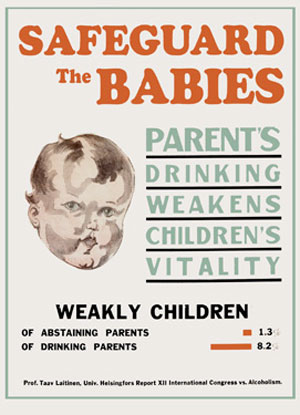
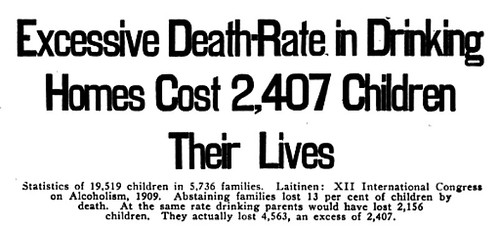
Here’s an interesting piece of history, during the temperance movement of the early 20th century, when propaganda as a science was still in its infancy. Propaganda has been around almost as long as we’ve had civilization, but really came into its own with World War I, so these prohibitionist efforts were just before that, around 1909. And it would just be a curiosity, an artifact of another time, if not for the fact that the neo-prohibitionists today continue in the sad tradition of this same kind of nonsense, never missing an opportunity to chastise adults for their parenting in an effort to demonize alcohol and remove it once more from society. For the sake of the children continues to be a popular rallying cry, and just as ridiculous today as a century ago.

safeguard-babies

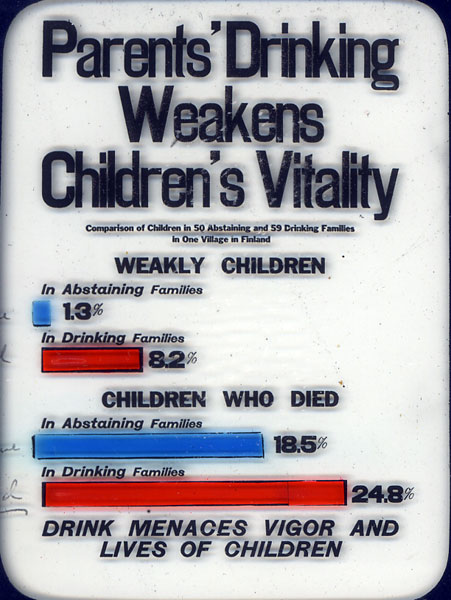
Safeguarding the Babies, apparently a popular poster from the time, argued that if you as an adult drank alcohol then you were creating weak children, ones with diminished “vitality,” a term never really defined. This, the poster claims, is based on science and states that families where the parents are teetotalers only have 1.3% weakly children while families where the adults drink have kids who are 8.2% weakly. Oh, the horror! It’s a little hard to read that in the poster, but a lantern slide made a few years later by the National Woman’s Christian Temperance Union in 1914, using the same data, is more clear and even goes on to suggest that in drinking families almost of a quarter (24.8%) of their children will die while abstaining families kids will perish only 18.5% of the time. So that must mean the 6.3% difference is due entirely to their being drink in the house, right? I mean, what else could it possibly be?

slides_parents_drinking

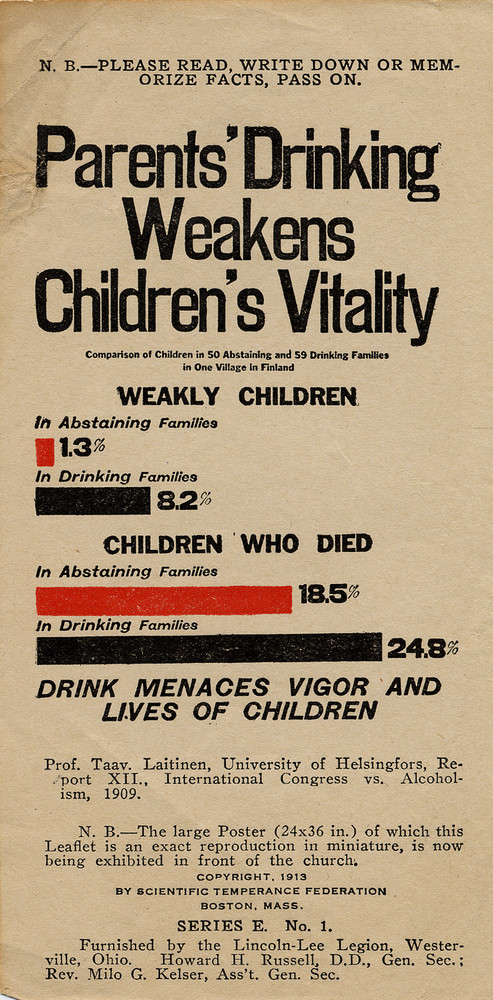
Yet another version, this one from 1913 and created by the Scientific Temperance Federation of Boston, Massachusetts, is one of at least 50 such poster that they made available to their followers, and through their “Scientific Temperance Journal,” which is about as scientific as you might expect. At least this one actually reveals the source of the “science,” which was a survey of 109 families in a single village in Finland. In 50 of those families, the adults didn’t drink, while in the other 59 they did. That’s the study, conducted by a professor Taav. Laitinen of the University of Helsingfors, which is the University of Helsinki, and apparently published as “Report XII International Congress vs. Alcoholism.”

parents-drinking

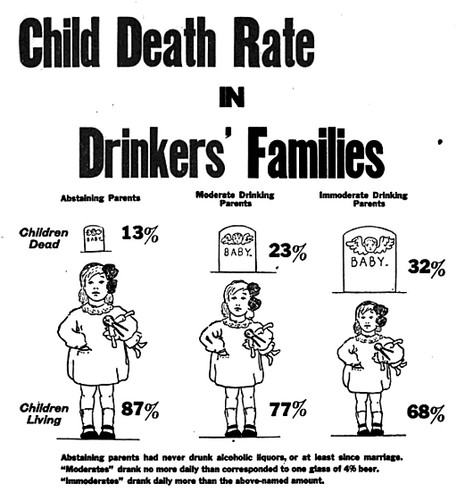
This study, and many other similar ones, was published in the “Handbook of Modern Facts About Alcohol” By Cora Frances Stoddard, a secretary in the Scientific Temperance Federation.

parents-drinking-1

It’s hard to say if the 109 families in Laitinen’s “study” is a statistically significant cohort, but it seems unlikely. But Laitinen continued to expand his research to include more finnish families, eventually including nearly 6,000, and he continued to get predictably similar results.

parents-drinking-2

But scientific hooey aside, the message was clear. Drink, and your children will suffer. Drink, and your children are more likely to die. I tend to view the early 20th century as a more gullible time, and I can only assume many more people believed this nonsense without questioning it. Neo-prohibitionist groups today employ the same pseudo-scientific balderdash, only now they dress it up with degreed researchers and publish in slightly less questionable scientific journals, or at least ones that hide their true purpose better. But then, as now, it’s still laced with naked agenda to promote a specific cause, not to enlighten or educate for the sake of that knowledge. It is propaganda, pure and simple. The scare tactics are particularly offensive, since it calls into question the parenting of virtually anyone who drinks alcohol as somehow caring less for their children than parents who abstain. I’d love to say we live in a more enlightened age, but today’s anti-alcohol organizations continue to stoop just as low as cries of “think of the children” ring just as hollow now as when they questioned the “vitality” of our children merely by growing up in a household where drinking took place.

Filed Under: Beers, Editorial, Politics & Law Tagged With: Anti-Alcohol, History, Prohibitionists, Statistics

Congratulations To The Craft Beer President

November 7, 2012 By Jay Brooks

politics-balloons
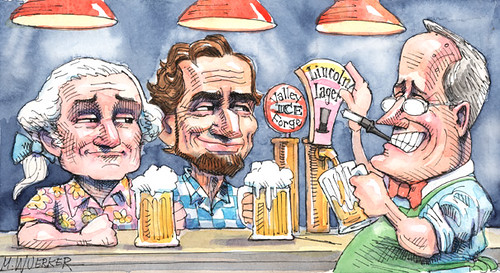
Okay, last political post for the next four years. Well, maybe not that long, but I’m probably as tired of the political cycle as you are reading me going on about it. With the election finally over, we can get back to what really matters: drinking beer. So, one final congratulations to the Craft Beer President (with a link to an Indiana student paper article from September), and now back to our regularly scheduled program.
Wade-POTUS
Illustration by Ben Wade, from the Indiana Daily Student’s Weekend in Bloomington.

Filed Under: Art & Beer, Just For Fun, News, Politics & Law Tagged With: Indiana

Beer In Ads #731: Let’s Get Together

November 6, 2012 By Jay Brooks


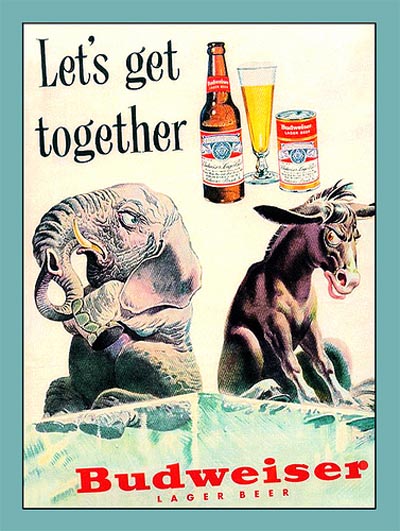
Tuesday’s election day ad is for Budweiser, from 1952. But the stubborn postures and acrimonious stares on the two political mascots are as recognizable today as they apparently were sixty years ago. Even though politics seem more divisive today than ever before, maybe there were always this bad? I don’t know if Budweiser has the power to get us all together, but perhaps craft beer?

budweiser-politics

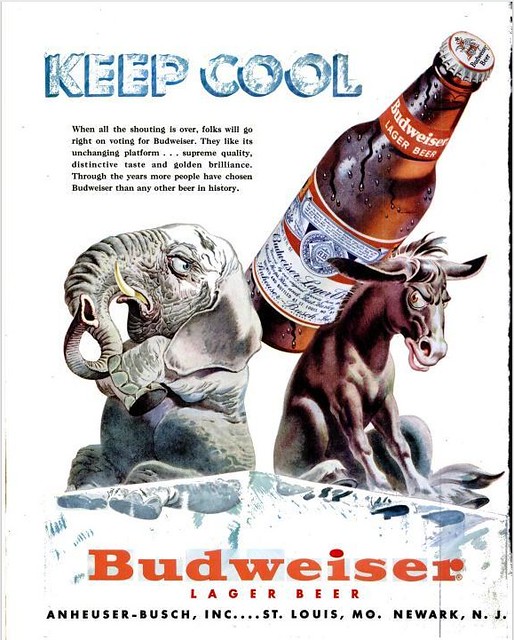
The same artwork was also used in another ad, with a different headline, “Keep Cool.” Given that the two political mascots are sitting on a block of ice, it seems likely that this may have actually been the earlier or original ad.

Bud-1952-keep-cool

Filed Under: Art & Beer, Beers, Politics & Law Tagged With: Advertising, Budweiser, History

Beer, The Great Political Leveler

November 6, 2012 By Jay Brooks

politics
I know I’m beating a dead horse — or is that donkey and elephant? — today, but as it’s election day and I’m of the opinion that most people don’t take politics seriously enough, it can’t be helped. Poking around today, when I should have been working, I found an interesting President’s Day piece from earlier this year on Politico. Entitled For Presidents, Beer is Great Leveler, it was written by Joe McClain, president of The Beer Institute. I wrote a similar article earlier this year, too, All the President’s Beer.

McClain and I certainly agree on beers’ importance to presidential politics. “Beer has come to symbolize the unique connection between presidents and the people they serve. Presidents are charged with bridging divides and finding common ground with citizens from all ideologies and backgrounds. There’s no common denominator like beer.” After dropping Eisenhower’s most famous beer quote, he continues. “Just as Ike used beer as a measure of the average American voter, voters used beer to measure presidential candidates.” But I absolutely love his conclusion.

Beer is a unifier and equalizer. It transcends party and ideology, geography and class, and is enjoyed by young and old, male and female, Democrat and Republican. It leads to common ground in politics and life. When so much in the world pulls us apart, beer has been there to bring us together.

Indeed. As I’ve been saying all day. Vote Beer!

prez-beer

Filed Under: Beers, Editorial, Just For Fun, News, Politics & Law, Related Pleasures Tagged With: History

Beer In Ads #730: Waiting In Line To Vote

November 5, 2012 By Jay Brooks


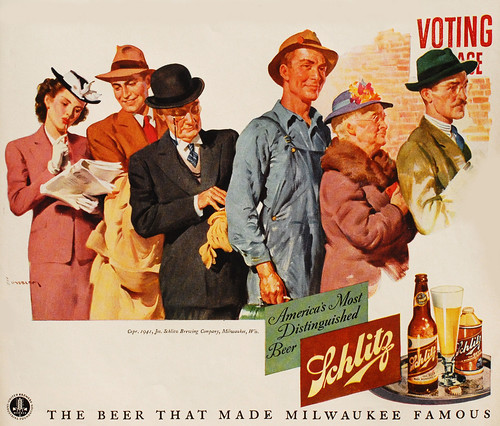
Monday’s ad is for Schlitz, from around election day in 1941. It shows a cross-section of 1940s persons waiting in line to vote. The year before, FDR won an unprecedented third term for U.S. president. So in 1941, I’m not sure what election would have been taking place or what the hot button issues of the day would have been, though I’m sure World War 2 was big on everybody’s mind. Given that voting districts are usually small neighborhoods, this one appears to be unusually diverse based on the appearance of the people in line. It’s amusing that the caricature of the “rich person” in bowler hat and monocle is the only one looking at his watch. He must be the only busy person with somewhere else to be.

Schlitz-1941-vote

But regardless of your socio-economic status, your party affiliation, or any other divisive category, please vote tomorrow. Cheers.

Filed Under: Art & Beer, Beers, Politics & Law Tagged With: Advertising, History, Schlitz

I’m A Craft Beer Drinker And I Vote

November 5, 2012 By Jay Brooks

politics-balloons
A couple of months ago, my friend and colleague, Don Russell — who often writes under the non de plume Joe Sixpack — wrote a provocative article declaring Craft-Beer Drinkers to Decide Election. With the presidential election tomorrow, I thought it fitting to take another look at that.

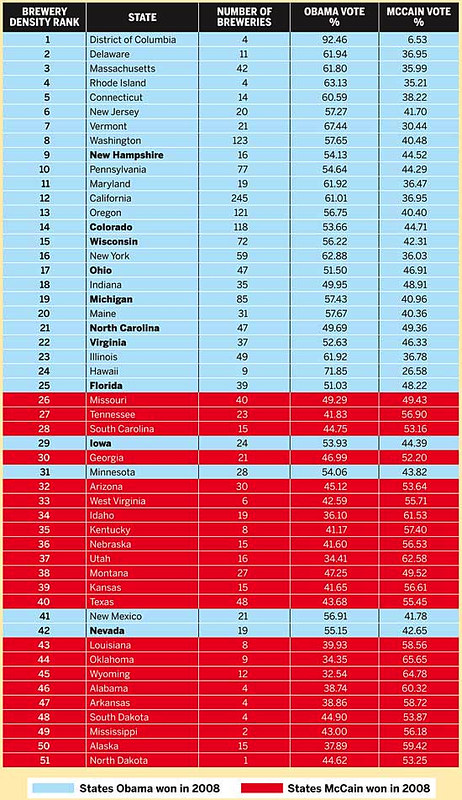
Russell ranked “the states by brewery density — the number of breweries per 1,000 square miles.” From that, a pattern emerged. Of the 25 states with the highest concentration of breweries, all of them voted for the Democratic candidate in 2008; what statisticians call a “positive correlation.” His interpretation:

The density of breweries in a state is at least partly related to the density of its population; the more people, the more breweries. Obama performs better in densely populated states because urban populations tend to be more diverse and liberal.

Naturally, the reverse is true: States with fewer breweries per square mile overwhelmingly vote Republican.

blue-vs-red-states-2010

Another colleague, Jeff Alworth in Portland, Oregon, disagreed with Russell’s analysis and said so in Gerrymandered! Craft Beer Is No Proxy for Political Leanings. He believes brewery density is the wrong metric to use, preferring breweries per capita. I confess that’s a statistic I’ve never warmed to, for no particular reason except that it seems to unfairly favor states with less people in many cases.

Russell doesn’t examine that, but he does also look at states by per capita beer consumption. In that instance, no illuminating trends appear. “Of the 10 biggest beer-drinking states, five voted for Obama in 2008, and five backed Sen. John McCain of Arizona.”

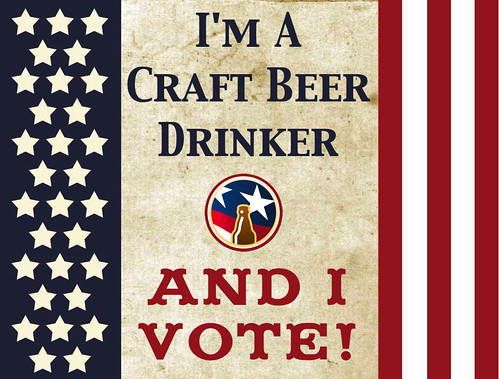
In the end, according to Russell. “What’s really important here is the type of beer voters are drinking.” Whichever way the election goes tomorrow, it will be interesting to see if any of this holds true. I can’t help but like the idea of craft beer deciding elections, however far-fetched. Still, the important thing is to drink craft beer … and vote. I want to see that bumper sticker: “I’m a craft beer drinker and I vote.”

craft-beer-voter

UPDATE: As Stan Hieronymus points out, I was remiss in not including Beer Drinkers For Obama.

Filed Under: Beers, Breweries, Editorial, Just For Fun, News, Politics & Law Tagged With: Statistics

Feeding The World

October 31, 2012 By Jay Brooks

food-good
I try to stay away from politics for the most part, because beer lovers come from all walks of life and are from all sides of the political spectrum, too. Beer brings people together, and I find it’s usually best to keep it that way. Regular readers know that I do break that rule from time to time, more often than not when it has something to with beer. So this one’s more of a stretch, except that as I do feel that “beer is agriculture,” and because we all eat food, usually paired with our beer, it’s still within the scope of the Bulletin. If you don’t agree, feel free to just skip this particular rant. Actual beer news will follow.

Here in sunny California, there are a number of contentious propositions on the November election ballot this year, but none, it seems to me, is more combative than Prop. 37, which is about the labeling of GMOs. Although it appears to be an imperfect proposition — aren’t most of them? — the very fact that big agribusinesses and other large mega-corporations are pouring money into the state to defeat it makes me, no compels me, to be supportive of it. I am swayed by the fact that over sixty other nations require GMO labeling. I can see no harm in knowing what’s in my food. I am not persuaded that it will be as costly as the opposition claims. They said the same thing about nutritional labels on food packages, but they’re all still in business today, having endured that “hardship.” I am not persuaded by the number of newspapers against it, because most of the food producers lining up to defeat it also advertise in newspapers. Coincidence? Don’t be so naive. Of course, that could come down to simply lying. I saw yesterday that although television ads against the proposition list the San Francisco Examiner as one of the papers against 37, in fact they have endorsed it.

Even if it passes, it isn’t likely to change peoples’ eating habits any more than warning labels on cigarette cartons stopped smoking. And that’s another argument I can’t abide. Even if true — which it probably is — I tend to err on the side of having more information rather than less, and tend to be suspicious of businesses that actively try to suppress information. Corporations telling me “trust us” or “don’t worry, it’s safe, because we say so” do not exactly inspire the same confidence that transparency does. Especially when the history of corporate malfeasance is so rich with examples of companies placing profits way, way ahead of people.

I suspect it won’t pass. Money does really make a difference in how these propositions fare, and I think most people’s default position is to vote “no” on any of them that are confusing, unclear or contentious. Better to leave things the way they are than change things in an uncertain way. I have certainly felt that way on more than a few occasions. And I suspect that the doubt placed in many voter’s minds by the $34 million barrage of “No on 37” ads will lead many to do just that. I have, however, questioned much of what I’ve seen in the attack ads trying to defeat the proposition, even as for some of it I haven’t known quite what to think. Earlier today, the Yes on 37 campaign posted this video, answering atleast some of those concerns:

I confess my mind’s not made up about GMOs across the board. I certainly don’t think they’re all bad, and there have certainly been instances throughout history where tinkering with nature has been a good thing for us humans. I also know this issue came up a few years ago when Greenpeace attacked ABI for using rice in their beer that may have contained GMOs. While I don’t often side with them, I did think that Greenpeace was out of line there. I should also note that some of the No on 37 ads mention that beer is exempt under the proposition, but that has more to do with the fact that the proposition applied the same standard currently used for labeling all food products, and under current regulations, beer is exempt. So it appears the reason is not conspiratorial.

But can you decide how to vote based on who’s supporting which side of an issue? Maybe. I certainly think there’s a story in who’s on which side. The “Yes on 37 supporters” is a long list that includes (according to the website) 3,643 endorsements that is made up of consumer and public health organizations, food groups (safety, manufacturers, retail), dietary advocacy groups, farmers, farmers markets, co-ops, farming associations, individual farms, medical groups and associations, doctors, political parties, local governments, elected officials, political organizations, natural health businesses, progressive and social justice groups, GMO activists (as you’d expect), labor unions, environmental groups, academics, food writers, chefs and quite a few more.

On the other side of the aisle, No on 37 Donors number around 68 companies, all of which appear to be food or chemical companies. Of the nearly $35 million donated to defeat Prop 37, Monsanto is apparently the leader, with around $7.1 million given to kill it, with Dupont in second place. But the whole lists reads like a who’s who list of ginormous corporations, and includes such well-known players as Bumble Bee Foods, the Campbell Soup Company, Cargill, Clorox Company, Coca-Cola, ConAgra Foods, Dole, Dow, General Mills, Heinz, Hershey, Hormel Foods Corporation, Kraft Food Group, Nestle, Ocean Spray Cranberries, PepsiCo, Sara Lee, Smithfield Foods, the Snack Food Association, Sunny Delight, J.M. Smucker and Unilever. At the bottom of the “No on 37” website, they claim that their efforts are “sponsored by Farmers, Food Producers, and Grocers. Major funding by Monsanto Company, E.I. DuPont de Nemours & Co., Grocery Manufacturers Association” and others. But the only “farmers” there are the giant agribusiness type, while the Yes supporters include what appear to be actual farmers, or, at a minimum, dozens of places with farm-like names.

Is that dispositive? Perhaps not all by itself, but it does, I believe, lead to additional questions about why the majority of the opposition to labeling GMO foods almost entirely have something to do with their creation, manufacture or use. Is their self-interest on the other side? Undoubtedly there is, but for many, if not most, of the supporters, it appears more to be part and parcel with their core beliefs already, not manufactured arguments against transparency.

Whether true or not, it certainly feels somewhat Goliath vs. David-like. I really wish people outside California would leave us alone to vote how we will, instead of pouring money into the state to influence our politics. That always feels intrusive to me, like when the Mormons in Utah spent their millions to defeat the proposition for gay marriage a few years ago. I’ve never understood why foreign nations and their citizens are not allowed to attempt to influence our elections, but people (whether corporate “people” or the regular individual kind) from any state can spend money to influence politics in other states where they don’t live. What’s the difference? I’m certain Monsanto, for example, does business in our state, but they’re a Missouri corporation. Likewise, Dupont is a Delaware corporation. They should stay the fuck out of our politics. That, or move their companies here and start paying state taxes like the rest of us do.

A couple of days ago, someone sent me an article by Frances Moore Lappé and Anna Lappé in the Huffington Post, entitled Seven Things to Tell Your Friends About GMOs. And while I’m no fan of HuffPo — Hey Arianna, how about paying your writers instead of pocketing the millions you make for yourself, you hypocrite — the piece is interesting and brings up a number of good points, at least for a newbie to the issue like myself. Which is, I suspect, the situation most California voters find themselves. We’ve all heard a lot about GMOs, but would be hard-pressed to call ourselves experts on the subject. Since they’re so new, I doubt many people could confidently claim to be experts, but lots of people have their cherished opinions. If you’re a California voter, I’d certainly recommend the Lappé’s 7 Things. At the bottom of the piece, there’s also a link to a video by Food MythBusters: the Real Story About What We Eat which, while not exactly on point for GMOs, is nonetheless interesting and talks more generally about the misinformation spread by the big agribusinesses that are currently spearheading efforts to quash Prop 37.

So hopefully everyone in California will get out and vote this election and will think carefully about this proposition, as well. The rest of the country, and especially the food industry, is closely watching which way this one goes. I personally would love to see it pass, but as I said, I suspect it won’t, and if that’s the case hopefully the architects of it will listen to both the opposition and the honest concerns that many people had with its implementation and fix those aspects of it before re-introducing it again. One final word about it, from a molecular biologist in the San Jose Mercury News, Belinda Martineau: A scientist says yes on Prop 37 to label genetically engineered food, who gives at least one scientist’s perspective on it. For additional reading, see the Ballotpedia entry, discussing both sides of Prop 37 and there’s also the California Voter Guide, which also strives to present both sides fairly.

UPDATE: A good friend of mine tells me that the Lappés’ piece contains numerous mis-statements, so perhaps it should be taken with a grain of salt after all. But here’s another worthy read. Vandana Shiva: Why Monsanto Is Fighting Tooth and Nail Against California’s Prop 37. And SF Weekly’s Anna Roth looked into both sides of the debate over Prop 37 in Three Things I Learned When I Forced Myself to Learn About Proposition 37.

Filed Under: Editorial, Food & Beer, News, Politics & Law Tagged With: California, Food, Video

Higher Alcohol Taxes Reduce Tax Revenue

October 24, 2012 By Jay Brooks

beer-tax
Given that the anti-alcohol folks, and especially my churlish neighbors Alcohol Justice, are continually beating the drum about alcohol taxes being too low, this news is not going to be particularly welcomed with open arms. A British think tank, the Institute of Economic Affairs (IEA), recently took a close look at the effect of higher taxes in alcohol and their report, Drinking in the Shadow Economy, found that the British “Treasury is losing as much as £1.2 billion every year to the illegal alcohol industry.” That, they conclude, is one of the effects of higher taxes on alcohol, because it creates an incentive for people to go outside the law and the safe world of regulated alcohol to make a quick buck. They found that “the illicit alcohol market is also closely associated with high taxes, corruption and poverty. The affordability of alcohol appears to be the key determinant behind the supply and demand for smuggled and counterfeit alcohol.” So place too high taxes on alcohol, and you invite in the wrong element, which we’ve seen in the U.S. before during Prohibition, and which we’re seeing right now with the war on drugs. If that futile policy was reversed, we’d save as much $13.7 billion annually by legalizing, regulating and taxing just marijuana, not to mention we’d remove the criminal element, make it safer and drastically reduce burdens on police, the justice system and prisons.

But back across the pond, the study also notes that the “demand for alcohol is relatively inelastic,” meaning people generally don’t drink less when prices go up, they instead find new ways to address the rising prices. As study after study has concluded, tax hikes are regressive and almost always hit poorer families the hardest, while not eliminating the problem the proponents of such measures claim they will fix.

But here’s that again, said another way:

Our analysis indicates that the affordability of alcohol does not have a strong effect on how much alcohol is consumed. Once unrecorded alcohol is included in the estimates, it can be seen that countries with the least affordable alcohol have the same per capita alcohol consumption rates as those with the most affordable alcohol.

I suspect that’s the case here, too. We know that price hikes cause people living near borders with other states to simply buy their alcohol in the next state over, causing further economic erosion. I don’t know if we have the same issue with counterfeit or illegal beer. Certainly there’s still Moonshine, but beer is probably not profitable enough on its own to warrant illegal breweries flaunting the tax code, not to mention how labor intensive and technology-dependent it is.

Another interesting portion of the report, answering the question “Why Tax Alcohol?”

Temperance and public health campaigners typically dismiss the black market as a problem that can suppressed through rigorous enforcement and tougher sentencing. At worst, they view a growing unofficial market as a price worth paying for a more sober society. This view is rooted in the belief that affordability is the main driver of alcohol consumption and that increasing prices by raising excise duty is therefore the single most effective way of reducing alcohol sales.

Ceteris paribus, economists would expect there to be some truth in this assertion, but there is too much real world evidence to the contrary for it to be taken as an iron rule. For example, alcohol consumption has fallen in most European countries since 1980 despite alcohol becoming significantly more affordable (OECD, 2011: 275).19 In Denmark, Sweden and Finland, the sudden drop in alcohol prices that resulted from EU accession did not bring about the kind of surge in alcohol consumption that the price elasticity models predicted.

A comparison of European countries suggests that affordability has a negligible and statistically insignificant negative effect on recorded alcohol consumption (see Figure 12). Moreover, as Figure 13 shows, when unrecorded alcohol consumption is included in the analysis, affordability does not appear to be a decisive factor in determining alcohol consumption from one country to the next.

Then there’s this long passage addressing some of the philosophy behind taxation which seems to fly in the face of much of the neo-prohibitionists propaganda playbook:

Contrary to temperance rhetoric, high alcohol taxes are not necessarily good for public health because, although excessive alcohol consumption undoubtedly carries risks to health, so too does moonshine. Counterfeit spirits and surrogate alcohol frequently contain dangerous levels of methanol, isopropanol and other chemicals which cause toxic hepatitis, blindness and death. These are the unintended consequences one associates with prohibition, albeit at a less intense level than was seen in America in the 1920s.

It should not be surprising that excessive taxation encourages the same illicit activity as prohibition since the difference is only one of degrees. As John Stuart Mill noted in 1859: ‘To tax stimulants for the sole purpose of making them more difficult to be obtained is a measure differing only in degree from their entire prohibition, and would be justifiable only if that were justifiable. Every increase of cost is a prohibition to those whose means do not come up to the augmented price’ (Mill, 1974: 170-171).

But in a less frequently quoted passage, Mill appears to approve of taxing alcohol to the apex of what we now call the Laffer Curve. Appreciating that governments need to raise funds and that these politicians must decide ‘what commodities the consumers can best spare’, Mill argues that taxation of stimulants ‘up to the point which produces the largest amount of revenue (supposing that the State needs all the revenue which it yields) is not only admissible, but to be approved of’ (Mill, 1974: 171).

This message tends to resonate more powerfully with politicians than Mill’s more libertarian pronouncements. Drinkers generally prefer low alcohol prices. Temperance campaigners nearly always demand higher prices. The politician, however, usually seeks to maximise tax revenues and will only react to the shadow economy when it becomes a serious threat to state finances. Nordlund and Österberg summarise the politician’s dilemma as follows:

‘Domestic economic actors can, of course, support the rules and regulations imposed by the state for controlling unrecorded alcohol consumption, but for these actors a better solution in combating unrecorded alcohol consumption would be the lowering of alcohol excise taxes… In most cases the state is not willing to follow this policy, as lower alcohol excise taxes in most cases mean lower levels of alcohol-related tax incomes. However, if the state is no longer able to control the amount of unrecorded alcohol consumption by different kinds of legal administrative restrictions the only remaining way to counteract, for instance, huge increases in travellers’ border trade with alcoholic beverages or an expansive illegal alcohol market is to lower the price difference between unrecorded and recorded alcohol by decreasing excise taxes on alcoholic beverages.’ (Nordlund, 2000: S559)

It scarcely matters to the politician whether unrecorded alcohol comes from legal or illegal sources. In either case, the treasury loses out on revenue. In Britain, HMRC estimates that the alcohol tax gap could be as much as £1.2 billion per annum, plus the costs of enforcement, and that this is largely because ‘duty rates on alcohol are far higher in the UK than in mainland Europe’ (National Audit Office, 2012: 2, 10). This is the price the state must pay for excessive taxation, but the politician is also aware that these high alcohol taxes raise £9 billion a year (Collis, 2010: 3). Being in possession of these facts he may conclude that reducing the illicit alcohol supply through tax cuts will probably reduce net alcohol tax revenues.

We argue that such a focus on maximising tax revenues is short-sighted and carries significant risks. Failing to deal with alcohol’s shadow economy threatens not only the public finances, but also public health and public order. Unrecorded alcohol has, as Nordlund and Österberg note, ‘the potential to lead to political, social and economic problems’ (Nordlund, 2000: S562). In addition to the health hazards presented by unregulated spirits, alcohol fraud in the UK is, according to the HMRC, ‘perpetrated by organised criminal gangs smuggling alcohol into the UK in large commercial quantities’ (HMRC, 2012: 8). Alcohol smuggling and counterfeiting is linked to other illegal activities, including drug smuggling, prostitution, violence, money-laundering and — in a few instances — terrorism.

Incidentally, you can download a pdf of the entire report here, and at the IEA website.

In the press release, the IEA concludes:

“The government’s focus on maximising tax revenues is short-sighted and dangerous. Aside from losing money by encouraging consumers to find cheaper illicit alternatives, public health and public order are also being put at risk by high prices. Policy-makers ought to take the threat of illicit alcohol production seriously when considering alcohol pricing in the future.”

“There is a clear relationship between the affordability of alcohol and the size of the black market. Politicians might view the illicit trade as a price worth paying for lower rates of alcohol consumption, but this research shows that the amount of drink consumed in high tax countries is exactly the same as in low tax countries.”

“Minimum alcohol pricing might seem like a quick fix to tackle problem drinking, but it is likely to cause many more problems by pushing people towards the black market in alcohol.”

While a fairly emphatic statement against higher taxes on alcohol, I assume that many will still wonder how applicable it is to the United States economy and society. Honestly, I’m sure there are differences, but the overall concept seems sound, at least to me. We can haggle over some of the details, but the idea that higher taxes isn’t always the answer just has the ring of truth to it.

Filed Under: Beers, Editorial, News, Politics & Law Tagged With: Anti-Alcohol, Business, Prohibitionists, Statistics, Taxes, UK

« Previous Page
Next Page »

Find Something

Northern California Breweries

Please consider purchasing my latest book, California Breweries North, available from Amazon, or ask for it at your local bookstore.

Recent Comments

  • Bob Paolino on Beer Birthday: Grant Johnston
  • Gambrinus on Historic Beer Birthday: A.J. Houghton
  • Ernie Dewing on Historic Beer Birthday: Charles William Bergner 
  • Steve 'Pudgy' De Rose on Historic Beer Birthday: Jacob Schmidt
  • Jay Brooks on Beer Birthday: Bill Owens

Recent Posts

  • Beer In Ads #5219: Good Old Point Special Bock Beer April 12, 2026
  • Beer In Ads #5218: The “Butter-In” Of The Season April 12, 2026
  • Beer In Ads #5217: The King Of All Beers April 11, 2026
  • Historic Beer Birthday: Gambrinus April 11, 2026
  • Beer In Ads #5216: The Finest Bock, As Usual April 11, 2026

BBB Archives

Feedback

Head Quarter
This site is hosted and maintained by H25Q.dev. Any questions or comments for the webmaster can be directed here.