Brookston Beer Bulletin

Jay R. Brooks on Beer

  • Home
  • About
  • Editorial
  • Birthdays
  • Art & Beer

Socialize

  • Dribbble
  • Email
  • Facebook
  • Flickr
  • GitHub
  • Instagram
  • LinkedIn
  • Pinterest
  • RSS
  • Twitter
  • YouTube

Powered by Genesis

Alcoholismo

May 14, 2010 By Jay Brooks

mexico
It appears the U.S. doesn’t have a lock on goofy, over-the-top anti-alcohol propaganda. Mexico has some pretty bad propaganda, too. This comes courtesy of I-Mockery, a humor website, and its founder, Roger Barr, who describes the Mexican Crazy Mexican Monografias: Alcoholismo propaganda:

When it comes to public service announcements, America is really quite tame compared to the rest of the world. While we have the ultra-corny NBC celebrity spots which always end with “The more you know…”, other countries aren’t nearly as sheepish when it comes to displaying the harsh realities of life. This became even clearer to me when I stumbled upon an incredible collection of Mexican monografias posters in the basement of a Philadelphia art gallery last year. Some of them were extremely graphic, and others were pretty friggin’ hilarious… needless to say I purchased one of each.

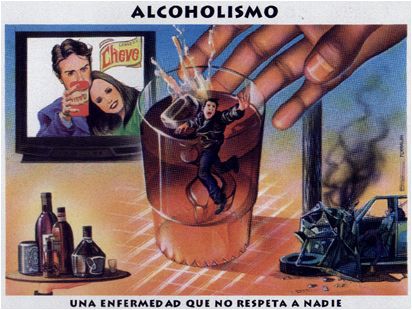
Barr then goes on, in often hilarious fashion, to translate and comment on each of the images, such as this example below.
alcoholismo

Hmmm, I’m getting a few mixed signals here. From what I can tell, if you become an alcoholic, one of several things can happen to you: a) you can crash your car into a telephone pole, b) you’ll appear in your very own television commercial, or c) you’ll somehow fall into a huge glass of liquor which a giant will then pick up to drink and you’ll die in his stomach. See what I mean? Those Mexicans aren’t gonna shy away from the truth about alcoholism. Harsh reality, people.

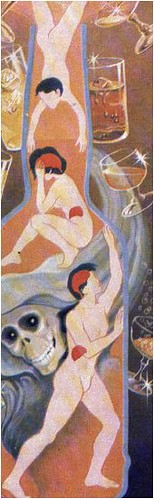
And this very surreal piece of art:
alcoholismo-2

“Some bottles of alcohol contain miniature humans who don’t have any genitals, and oh yeah, Death likes to hangout inside bottles too. Kind of like a genie, but the only kind of wish he’ll grant is your wish for the sweet release of death.”

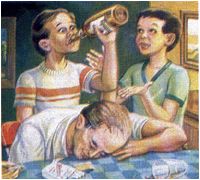
Barr has broken down every one of the nearly two dozen graphic works cautioning people about the dangers of alcohol. And before I get another rash of comments, I’m not making fun of those dangers, just this ridiculous attempt to warn people about them using these illustrations. But take a look for yourself at the Alcoholismo, it’s pretty funny stuff.
alcoholismo-3

Filed Under: Editorial, Just For Fun, Politics & Law Tagged With: Humor, Mexico, Prohibitionists

The Beer Genie Out Of The Bottle

May 13, 2010 By Jay Brooks

beer-genie
The British Beer & Pub Association (or BBPA), a UK trade association for pubs, launched a new website recently called the Beer Genie. It’s aimed at bringing the “magic of beer” to consumers. The site is “themed around beer’s power of sociability” and certainly seems to have a lot of decent information. It’s also got quite a number of sections, including Beer & BBQ’s, World Cup Beers, the History of Beer, beer & Women, Beer Facts, Knowledge and Links, Beer & Christmas, Beer & Entertaining, Beer & Weddings and a Gallery. It certainly seems like a better effort than Here’s To Beer, A-B’s failed attempt to do something similar a few years ago. At least this has the support of more than one big brewery.

Filed Under: Beers, Just For Fun, Politics & Law Tagged With: UK

Oklahoma Governor Signs Homebrewing Bill

May 11, 2010 By Jay Brooks

oklahoma
Oklahoma Governor Brad Henry signed HB 2348, which means homebrewers can legally brew starting November 1, 2010. “Oklahoma law already allowed for the home production of wine and cider, but until now excluded beer.” 48 down, 2 to go. Just Alabama and Mississippi continue to have homebrewing illegal in their state. See the full story at the American Homebrewers Association.

Filed Under: Beers, News, Politics & Law Tagged With: Homebrewing, Midwest, Oklahoma

Rethinking The Can

May 5, 2010 By Jay Brooks

beer-can-beer
John Heylin, who runs the Nor Cal Beer Guide, has an interesting article he posted today about the untold costs of aluminum cans, entitled Why Craft Breweries Should Stop Using Cans. In it, his main argument is that while cans have benefits once they’re made, that the process of creating aluminum cans have significant costs to the environment from the mining and processing of them. I hadn’t ever thought about it from that angle, and it’s certainly worth looking into further. He concludes with this.

The bottom line is this: aluminum is in no way environmentally friendly. Sure, after it is ripped from the Earth, smelted, shipped, refined, and made into a product it is easily recyclable and very light weight, but the cost is far too great. The cost to the environment and to the people living around these areas is just too much. Clean aluminum is like the myth of clean coal, it’s a total lie.

So what about glass? Heylin remarks that “at least glass comes from sand, is reusable, and when thrown away goes back to sand. Aluminum? It lasts forever.” I’m assuming, though, that taking sand and turning it into glass also has environmental costs associated with it, though what they are I don’t know off the top of my head.

In the end, I really don’t know how to balance which does the greater harm or is gentler on the planet. It seems no matter what we choose, some harm is done. I’m certainly not willing to give up packaged beer while so many other manufactured goods, and for that matter entire industries, are doing far worse damage. I guess today I’ll stick with draft beer. But wait, isn’t that one big aluminum can? Damn. Okay, I guess I’ll search out a wooden cask. Hold up, isn’t that chopping down forests for the wood? In the Joe Jackson song Cancer, a line in the chorus is “everything gives you cancer” and at one point in the song just after singing that line, a piano riff begins and Jackson yells out, “hey, don’t play that piano.” And in a sense, I guess my point is, like the song, that everything causes some harm and choices have to be made. Every brewery is built with mined metal, industrial processing plants, smelting, iron and steel, and goodness knows what else.

Should we try to make responsible choices? Of course. But in a world where every decision has consequences, and usually bad ones, even Thomas Hobson might have trouble making a choice.

Still, it’s always good to consider and rethink our assumptions on a regular basis. Any day that makes us think is a good day, in my opinion, at least, even if it’s driving me to drink.

Filed Under: Beers, Editorial, Politics & Law Tagged With: Cans, Environment, Packaging, Recycling

The Tyranny Of The Disgruntled Minority

April 30, 2010 By Jay Brooks

lost-abbey
Tomme Arthur, from the Lost Abbey, has an incredibly restrained post up about the travails created by a single individual person who went to the trouble to lodge a complaint about every beer tasting room in the San Diego area. “Apparently they were concerned that we didn’t have a GIANT BLUE “A” on our cold boxes!”

a-card

So Tomme and every other San Diego brewery has spent the week, and boat loads of money, getting up to “code” to satisfy an army of inspectors who didn’t know there was a problem — and in fact there wasn’t — until some pinhead decided to bring it to their attention. Perhaps most remarkably, winery and brandy tasting rooms are exempt from any regulations — so typical — but I certainly hope they find out who this “concerned” soul is. Read all about it at Tomme’s latest rant, I’d Like To Thank Some People.

Filed Under: Breweries, Editorial, News, Politics & Law Tagged With: California, Southern California

Tracking The Lost Pubs

April 23, 2010 By Jay Brooks

pub-sign
I don’t know how long it’s been going on, but I just learned of the Lost Pubs Project, a wonderful idea. The project is “Charting The Decline Of The British Pub” by listing, by county, every pub closing. They currently list 10,104 lost pubs. According to the website, “there are 60,000 pubs still in existence in the UK today, [and] they are closing at the rate of 25 per month. Once closed they rarely reopen as most are either demolished or converted to housing.” It’s a collaborative project, and they’re asking for help from locals all over Great Britain to let them know about any “pub which has closed at any time in the past,” and they”re also collecting “any memories, information or photographs” of the closed pubs. Sounds like a very worthwhile thing to do.

Filed Under: Politics & Law, Related Pleasures Tagged With: Pubs, UK

PLCB Bad For Business

April 18, 2010 By Jay Brooks

pennsylvania
I haven’t seen much yet from the joint hearing by the Senate Law Committee and House Liquor Control Committee looking into the PLCB that took place April 13, but Jack Curtin posted something from the Scranton Times-Tribune entitled PLCB Bad for Business.

Filed Under: Politics & Law Tagged With: Pennsylvania

Prohibition Through Taxation

April 1, 2010 By Jay Brooks

tax
Being April Fool’s Day, this might almost seem laughable, if it wasn’t so serious and obvious an attempt to bring about prohibition through taxation. (And thanks to the many people who sent me information about this, you know who you are, I appreciate it.) A San Diego couple, Kent and Josephine Whitney, have introduced a ballot initiative they’re calling the “Alcohol-Related Harm and Damage Services Act of 2010.” If that sounds innocuous, it’s not. If they collect the required 433,971 signatures by August 23, it will be on the California ballot this November. The “Act” seeks to raise alcohol taxes as listed below. If you have a drink in your hand, put it down first. If you’re standing up, sit down. Drum roll, please:

  • Spirits — 2,700% increase [from $0.65 per 750 ml bottle to $17.57]
  • Beer — 5,500% increase [from $0.11 per 6-pack to $6.08]
  • Wine — 12,775% increase [from $0.04 per 750 ml bottle to $5.11]

No, those aren’t typos. The anticipated revenue of $7-9 billion would be used to fund the Department of Alcohol and Drug Programs, whatever that is. It won’t be used to fix the state deficit apparently.

In the OC Weekly Blog, Dave Lieberman correctly comments that “this is Prohibition through taxation” [a phrase I hope he won’t mind me borrowing]. He continues.

“The armchair libertarians must be having sedentary conniption fits from Yreka to Ysidro. Nowhere does it say that alcohol has to be a zero-sum game, not to mention the fact that the vast majority of those who do drink do so responsibly, which means you’re taxing those who play by the rules to pay for those who don’t.”

Ballotpedia lists a dozen reasons for the ballot measure, each one more fallacious than the last. The Whitney’s blame alcohol for murders, pregnant women drinking, burdens on health care, underage drinking, binge drinking; pretty much everything any neo-prohibitionists has ever thrown up against the wall, while naturally ignoring all of the personal responsibility for any of those actions. It’s as if they’ve drank the anti-alcohol kool-aid and believe unquestioningly all of the propaganda from those groups. To blame the alcohol and not the people who engage in those behaviors is a common tactic lately but ignores logic, common sense and any notion of fairness. It also reveals quite a lot about the mindset of the people who believe such nonsense. Also, if the ballot measure should pass, it would declare all of that nonsensically bad propaganda masquerading as statistics as true!

It also ignores the physical and mental health benefits of responsibly drinking moderate amounts of alcohol. Numerous studies have shown many, many health benefits to moderate drinking, not least of which are the many studies that show that people who drink moderately tend to live longer and be healthier than people who either abstain or overindulge. So in effect, this ballot measure would most likely make people in California less healthy.

Curiously, the State Attorney General’s summary says:

Additional state revenues of between $7 billion and $9 billion annually from an increase in state excise taxes on alcoholic beverages, with the proceeds going to support alcohol-related programs and services. A decrease in state and local revenues from existing excise and sales taxes on alcoholic beverages of several hundred million dollars annually due to a likely decline in consumption of alcoholic beverages.

The Initiative’s Analysis from the state Legislative Analyst’s Office goes into more detail but remains similarly conservative in the negative consequences while swallowing wholesale the notion that it would actually bring in the estimated $7-9 billion in additional excise tax revenue. First of all, the loss of business and company’s going out of business outright would cause that figure to be greatly reduced from the start. If a bottle of wine has at least $5.11 in state excise taxes plus all of the other taxes, plus the costs of ingredients, manufacture, packaging, transportation, etc. even two-buck chuck is going to become ten-buck Ken or worse.

Similarly, if just the state excise tax on a six-pack of beer starts at $6.08, again plus every other cost of doing business, just who in their right mind believes that consumers will continue to merrily drink the same amounts at exponentially higher prices? Don’t even get me started on how many dollars will fly out of California by people driving to bordering states to buy their alcohol. You’re going to see a cottage industry in just-over-the-border liquor stores popping up wherever a road leaves California. It’s absurd to believe the revenue stream would continue at the same rate.

That analysis suggests that only several hundreds of millions of dollars would be lost in decreased consumption seems laughably conservative. Here’s some of their reasoning, from the analysis:

Effects on Existing State Excise and SUT Revenues. The decline in taxable consumption of alcoholic beverages that would likely be caused by this measure would reduce the revenues received for the General Fund from the existing state excise and SUT revenues. We estimate that this could potentially result in a loss of state revenues of several hundred million dollars annually.

Effects on Local Revenues. The likely decline in taxable consumption of alcoholic beverages due to the increase in the excise tax imposed under this measure would also affect local SUT revenues. We estimate that local governments, primarily cities and counties, would experience a decrease in sales tax revenues of approximately $100 million on a statewide basis due to the excise tax increase.

Indirect Economic Effects. If the measure were to result in declines in overall economic activity in California, it could produce indirect state and local revenue losses. Such effects could occur, for example, if businesses were to close because they could no longer remain profitable as the overall economy adjusted to a lower demand for alcohol in the long run. If these lost resources were not redirected back to California’s economy into equal or more productive activities, then it would likely lead to a net loss in taxable income and spending for state and local governments. The magnitude of these potential revenue losses is unknown.

See that last bit? “The magnitude of these potential revenue losses is unknown.” I can pretty much tell you it’s going to be staggering. It would be a near prohibition, with a return to illegal hooch. After homebrewers start selling their kitchen beers under the table, new law enforcement agencies will be created to stop them, every homebrew shop will be watched and anyone with a pair of rubber boots will be under suspicion.

So who the hell are the Whitneys and why are they trying to effect an alcoholic Armageddon? Those are good questions, I think, and there’s at least one very disturbing possibility. The V Bit Set speculates that it may be simply for money. Doing some detective work, internet style, he points out there is a Kent Whitney in the San Diego area who owns the 21st Century Wellness Initiative, and the ballot measure would provide “fifteen percent for the funding of grants for naturopathic treatment and recovery programs for alcohol addiction.” Are the two connected? He admits it’s wild conjecture at this point, but it is compelling nonetheless. If it turns out to be true, how vile and repugnant would this be? On an unimaginable scale, I’d have to say. To attack an entire healthy industry, putting thousands of workers and hundreds of businesses at risk of being removed from the economy for personal gain would be one of the most abominable acts of all time. If they’re sincere, it’s clear they either didn’t think through their actions or are entirely hostile to anyone who enjoys, makes or sells alcohol.

Filed Under: Editorial, News, Politics & Law Tagged With: California, Prohibitionists, Southern California

B.A.C. & The Definition Of Being Drunk

March 22, 2010 By Jay Brooks

drunk-in-public
Thanks to my friend Rick for sending this my way. In an editorial in the student newspaper for Temple University, the Temple News Online, student commentator Cary Carr writes about sudents getting drunk in a piece she called When Your BAC Exceeds .31 and the Label Reads Natty Ice, Trouble Brews. It’s mostly an anecdotal essay about student drinking and how kids should be more responsible and watch their intake. It’s all well and good, and there’s nothing I take issue with, but there’s just something that leaps out at you in the middle of it.

After all, there does tend to be a hierarchy to drunkenness, ranging from a happy tipsy to an invincible and shameless drunk to the stage we’ve all witnessed or experienced: how-are-you-even-alive drunk.

Of course there are more technical levels of intoxication, which Dr. Jeremy Frank, a psychologist from Tuttleman’s Counseling Services, explained.

“The best way to categorize stages of drunk is with Blood Alcohol Concentration,” Frank said. BAC is the ratio of alcohol to blood in the body. “Drunk is from .11 to .15. Very drunk is usually between .16 and .19. Once you get to .25 to .30 you generally are in a stupor, and from .31 and up would be the beginning of a coma.”

Hmm, according to the field of psychology, drunk is “from .11 to .15,” or above the 0.08% that MADD and other groups rammed down our throats in the early 1980s, when the standard was 0.10%, very much in line with Frank’s definition. Interesting. I wonder how other fields define being drunk?

Filed Under: Editorial, Politics & Law Tagged With: Prohibitionists

Poisoning People During Prohibition: A Disturbing Parable

March 19, 2010 By Jay Brooks

poison
This may well be the most disturbing story about our Nation’s Prohibition ever told, and one that’s certainly been kept fairly secret. While doing research on her book, The Poisoner’s Handbook, author Deborah Blum discovered that anti-alcohol factions of the U.S. government became so fanatical that they poisoned illegal alcohol either directly or indirectly, possibly killing, or more correctly murdering, as many as 10,000 U.S. citizens! Let that sink in. The whole sordid tale can be found on Slate, entitled The Chemist’s War: The little-told story of how the U.S. government poisoned alcohol during Prohibition with deadly consequences. I’d encourage you to read the entire article, but here are the nuts and bolts.

The government added chemical substances to alcohol used for other purposes, like paint thinner, and unscrupulous bootlegger’s were stealing industrial alcohol and then converting it to something that could be consumed. So the government, knowing full well that it would end up being drunk by people, started spiking it with chemicals that were very, very harmful, ones that the bootlegger’s chemists couldn’t deal with and the result was thousands of deaths. Why would our government do that? Here, Blum cites the frustration of lawmakers to stop people drinking along with prohibitionists who were surprised by our “country’s defiant response to the new laws [which] shocked those who sincerely (and naively) believed that the amendment would usher in a new era of upright behavior.”

During Prohibition, however, an official sense of higher purpose kept the poisoning program in place. As the Chicago Tribune editorialized in 1927: “Normally, no American government would engage in such business. … It is only in the curious fanaticism of Prohibition that any means, however barbarous, are considered justified.” Others, however, accused lawmakers opposed to the poisoning plan of being in cahoots with criminals and argued that bootleggers and their law-breaking alcoholic customers deserved no sympathy. “Must Uncle Sam guarantee safety first for souses?” asked Nebraska’s Omaha Bee.

Only a handful of people in fact spoke out against this practice. One was Charles Norris, chief medical examiner for New York City, who referred to the program as “our national experiment in extermination.”

“The government knows it is not stopping drinking by putting poison in alcohol,” New York City medical examiner Charles Norris said at a hastily organized press conference. “[Y]et it continues its poisoning processes, heedless of the fact that people determined to drink are daily absorbing that poison. Knowing this to be true, the United States government must be charged with the moral responsibility for the deaths that poisoned liquor causes, although it cannot be held legally responsible.”

Frankly, I don’t see why they couldn’t be held legally responsible since they were in effect knowingly poisoning people, especially after the first deaths occurred. That they didn’t stop it then says quite a lot about how determined they were. It often appears to me that modern day prohibitionists take an ends-justify-the-means approach to further their agenda and will employ just about any tactic, despite its consequences or ethical disconnect. It would appear that’s nothing new after all. The fact that more people don’t know about this dark chapter of our history of prohibition makes it easier for today’s anti-alcohol supporters to continue their quest for another national alcohol ban. Let’s hope we can all learn from this mistake of history and aren’t doomed to repeat it.

Filed Under: Editorial, Politics & Law Tagged With: History, Prohibitionists

« Previous Page
Next Page »

Find Something

Northern California Breweries

Please consider purchasing my latest book, California Breweries North, available from Amazon, or ask for it at your local bookstore.

Recent Comments

  • Bob Paolino on Beer Birthday: Grant Johnston
  • Gambrinus on Historic Beer Birthday: A.J. Houghton
  • Ernie Dewing on Historic Beer Birthday: Charles William Bergner 
  • Steve 'Pudgy' De Rose on Historic Beer Birthday: Jacob Schmidt
  • Jay Brooks on Beer Birthday: Bill Owens

Recent Posts

  • Beer In Ads #5225: Fabled Ambrosia Of The Ancients April 17, 2026
  • Historic Beer Birthday: William O. Poth April 17, 2026
  • Beer In Ads #5224: Harvard Bock Beer April 16, 2026
  • Historic Beer Birthday: William H. Biner April 16, 2026
  • Historic Beer Birthday: Alan Eames April 16, 2026

BBB Archives

Feedback

Head Quarter
This site is hosted and maintained by H25Q.dev. Any questions or comments for the webmaster can be directed here.