
Wednesday’s ad is from the 1960 and is for Schlitz, featuring the slogan “Know the real joy good living … move up to Schlitz!” Some of the good living go-togethers include pretzels, popcorn, crackers and burgers.
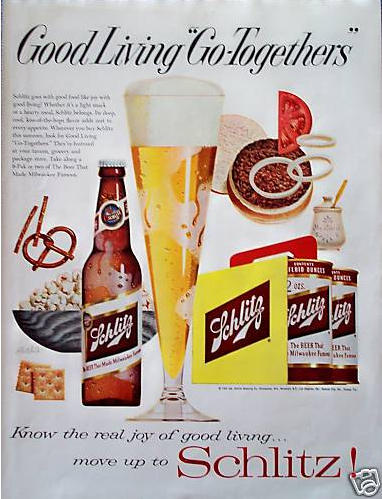

Wednesday’s ad is from the 1960 and is for Schlitz, featuring the slogan “Know the real joy good living … move up to Schlitz!” Some of the good living go-togethers include pretzels, popcorn, crackers and burgers.

According to a recent study by the NPD Group, a research firm, 5,204 restaurants have closed since the Spring of 2009, representing a 1% drop in the total number. As reported in the Nations Restaurant News, “[i]ndependent restaurants took the hardest hits, while chains kept their unit counts relatively stable.” As the Brewers Association revealed last week, brewpub openings increased slightly, reversing a trend where they’d been losing ground to the recession. Perhaps that’s tied to craft beer’s continuing increases, perhaps not. In any event, less restaurant visits means less opportunities to purchase beer, so that’s bad news for the production breweries who sell packaged and draft beer to restaurants.
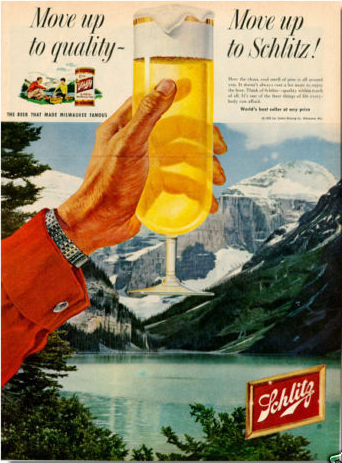
Tuesday’s ad is from the 1950s and is for Schlitz, featuring a beautiful natural vista with a man holding up a glass of beer against it as backdrop. And the slogan, “Move up to quality — move up to Schlitz,” is kind of a hoot. But I certainly want to be in that spot with a beer, if indeed it’s even a real place.

Drawing on the USA Today article Dry America’s Not-So-Sober Reality: It’s Shrinking Fast, Wayne Besen, the founder of Truth Wins Out, a non-profit organization that debunks anti-gay lies and myths, has an intriguing piece on the Huffington Post comparing anti-gay activist tactics to those of neo-prohibitionists. It’s called Beers and Queers, and is worth reading, regardless of how you feel about either issue.

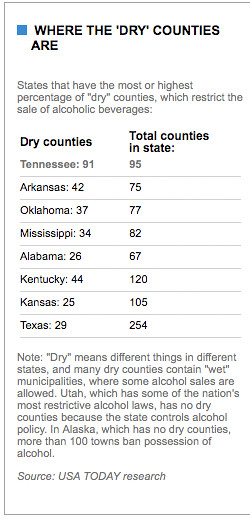
USA Today ran an interesting story earlier this month about the dry counties dotting still the landscape, areas within eight states where despite alcohol being legal statewide, it’s still illegal in those counties (along with some specific towns). According to Dry America’s Not-So-Sober Reality: It’s Shrinking Fast, many of the remaining 328 may soon become wet, too.
From the article:
Today, 1 in 9 counties is still dry. But drys are losing ground on all levels, from the state — since 2002, 14 states have ended bans on Sunday alcohol sales — to the very local. In April, a 19-block section of western Louisville (the M-107 precinct) voted 89-41 to go wet.
The number of Tennessee communities that allow sales of liquor by the drink (in bars and restaurants) has increased 56% since 2003. In the same period, 22 of Texas’ 254 counties and more than 235 of its municipalities have gone wet (or “moist,” a nebulous category in which beer and wine might be legal, but not liquor).
Even in Kansas — the state that produced the ax-wielding saloon-wrecker Carry Nation; that passed the first state prohibition law in 1881; and that did not repeal it until 1948 — 16 counties have gone wet since 2002.
One interesting side note is that economics is one of the most popular reasons, with communities wanting the tax revenue from alcohol sales. But that’s also the way that neo-prohibitionists have been going after alcohol, by trying to impose more and higher taxes. An interesting dichotomy, I’d say. Below is a nice chart of where the dry counties are and their number as compared to the total counties in each state.

Another d’uh study was just released by the Mintel Group, showing that Alcohol Manufacturers Drink in Profits From At-Home Consumption, almost as if the alcohol industry manufactured the recession.
With fewer jobs, less money circulating (at least in the bottom 99% of the economy) and the nation deep in recession, exactly what result would any reasonable person expect but the fact that more people are staying home? Here’s what Mintel’s study found:
Among alcohol drinkers, 90% consume alcoholic beverages at home, compared to 77% who drink outside the home. Furthermore, those surveyed consume almost twice the amount of drinks at home in an average month than they do in restaurants or bars (10 vs. 5.7).
The nearly $80 billion off-premise alcoholic beverage market has grown 21% since 2004 as more consumers cut back on eating out in light of trying economic times. Drinkers are also cutting back in terms of the alcohol they’re purchasing for at-home consumption — 28% of respondents who drink alcoholic beverages at home have traded down to less expensive brands than last year to save money.
“In a price-sensitive environment, consumers may shy away from discretionary expenses, like alcohol, to save a few bucks,” says Garima Goel-Lal, senior analyst at Mintel. “About half of those who report drinking alcohol at home are drinking less than they did a year ago, but the market is still enjoying viability.”
While beer enjoys the largest share of market sales (48%), wine is the most popular alcoholic beverage consumed off-premise, with 67% of those who drink alcohol at home indulging in a glass. Distilled spirits are consumed by 57% of respondents and regular beer by 53%.
To me, the most interesting statistic is that drinking at home is causing people to have almost twice as much when they imbibe. In a sense, it’s like a backlash against people being afraid to drink when they’re out due to the efforts of neo-prohibitionists to create such anti-alcohol atmosphere. I wonder how that registers with their community? In fact, Join Together led with the bit about people drinking more, though you’d think that perhaps they’d be celebrating the fact that less people are driving to do their drinking.
Monday’s ad is from 1959 and is for a brewery I’d not heard of before, Hampden Brewery of Willimansett, Massachusetts. The guy at the sparse desk is Karl H. Bissell, Sr., chairman of the board for the brewery, though at that time it was known as Hampden-Harvard Brewing. Eventually Piels bought it but the brewery was shut down in 1975. Curiously, it’s been restarted as a craft brewery earlier this year as Hampden Brewing Co.
Frankly, Bissell looks more like James Carville and I’m not quite sure how this guy with his cueball noggin sitting behind a big, empty desk was meant to inspire brand loyalty or switching brands. And the slogan “New England’s Finest Beer At New England’s Fairest Price” is not exactly Shakespeare, either.
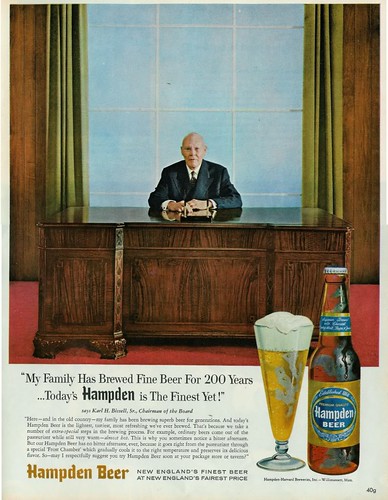
They appear to have brewed ales and lagers.

Mark Daniels, a British pub owner, had an interesting op-ed piece recently in the Publican about the UK considering lowering their BAC limit. In Drink Driving — It’s a Number’s Game, Daniels laments that “lowering the amount of alcohol allowed in blood before driving won’t stop people being killed on the road. It’ll just mean more deaths get attributed to drink driving than ever before, and ruin more lives in the process.”
That’s certainly what’s happened in the U.S., since thanks to MADD we moved from age 18 in many states to 21 as the minimum drinking age in all states (with a few limited exceptions) with the National Minimum Drinking Age Act of 1984, making us the most puritan of all the first-world nations. MADD, of course, claims this had led to safer roads, but the first mandatory seat belt law was also passed in 1984 and today all but one state has some type of mandatory seat belt law not to mention the 1980s is also when car companies began focusing more on car safety. Certainly, there are numerous studies that call into question MADD’s claim. But all it really did was create more criminals by turning responsible people aged 18-21 who continued to drink automatically into villains.

But that wasn’t nearly enough, they continued lobbying to have the BAC lowered from 0.1% to 0.08% and in “2000, this standard was passed by Congress and by 2005, every state had an illegal .08% BAC limit.” This had the effect once again of criminalizing more people while not really addressing the problem. The recidivist drunk drivers were not the ones in between 0.08% and 0.1%, but people who drank enough to blow 0.15% or above, the true problem drinkers. But MADD’s still not done and has their sight’s set on 0.05%. Naturally, they’ve wasted no time taking credit once again for the positive effects, despite their not really being any.
Here’s Wikipedia’s collaborative take:
However, NHTSA’s definition of “alcohol-related” deaths includes all deaths on U.S. highways involving any measurable amount of alcohol (i.e. >0.01% BAC) in any person involved, including pedestrians. In 2001, for example, the NHTSA’s Fatality Analysis Reporting System estimated an annual total of 17,448 alcohol-related deaths. The NHTSA breakdown of this estimate is that 8,000 deaths involved only a single car and in most of those cases the only death was the drunk driver, 5,000 sober victims were killed by legally drunk drivers, and there were 2,500 to 3,500 crash deaths in which no driver was legally drunk but alcohol was detected. Furthermore, some of the sober victims undoubtedly included those willing passengers of the drunk drivers. It should also be noted that vehicle safety has been improved since the 1980s, and this has likely resulted in a decrease in all auto fatalities, including alcohol-related deaths. Also, public attitudes are more negative toward drunk driving than they were in the early 1980s. The data also uses raw numbers rather than per capita rates. That being said, however, the number of “alcohol-related” deaths have dropped more so than non-alcohol-related ones (which actually increased in the late 1980s), which shows that the decrease in the former largely drove the substantial decrease in the total fatalities since 1982. It should also be noted that with the increasing age of the baby boomer generation,if you look at statistics on alcohol related crashes among consistent age groups (20-30 in 1985 versus 20-30 in 2005) there are no statistically significant changes in the number of drunk driver related deaths. In 1999, the Government Accountability Office (GAO) evaluated the effectiveness of state .08% BAC laws in reducing the number and severity of crashes involving alcohol. It stated, “Overall, the evidence does not conclusively establish that .08% BAC laws, by themselves, result in reductions in the number and severity of alcohol-related crashes.”
In other words, lowering the limit just led to more arrests and criminalized people but without actually addressing or fixing the problem of drunk driving. It was MADD’s increasingly neo-prohibitionist behavior that led founder Cathy Lightner to leave MADD in 1985. She has since spoken out against the direction the organization has taken. Now the UK is apparently considering the same draconian measures.
Here’s Daniels’ essay, almost in its entirety, though the whole piece can be read at the Publican:
[The UK Government’s] proposal is that the current limit of 80mg of alcohol per 100ml of blood be reduced to 50mg. This would bring us in to line with many other European countries and, Sir Peter believes, up to 300 lives could be saved by bringing in such a ruling.
I fear, however, that many more could be ruined by its introduction.
The review, which was initially commissioned by a government so health & safety obsessed that George Orwell’s prophecies steadily turned from fiction to fact, plays a dangerous game with numbers.
If we were to reduce the alcohol limit, [the government’s] report estimates that between 168 and 303 lives might be saved. Alternatively, the number of deaths might remain the same but the percentage caused by drink drivers might, instead, rise. In 2007 a report showed that Britain’s drink-driving incidents accounted for 16% of road deaths. By comparison, France has the proposed limit of just 50mg per 100ml, a similar-sized population to ours, but an alcohol-related road death rate of 27%.
While the Government’s intentions might be to bring the UK’s drinking laws in line with our European cousins, they don’t appear to be looking to change the penalties associated with the offence. Sweden, for example, is a country so obsessed with the draconian control of alcohol that it can only be purchased from Government managed outlets and has a drink driving limit of just 20mg/100ml of blood. Merely consuming Night Nurse to help with a cold could put you over the limit. However, unlike Britain’s mandatory minimum 1 year driving ban their penalty ranges from a disqualification of three months to three years. In the UK we also face imprisonment of 6 months to ten years depending on the severity of the offence; in Sweden it’s just one month to two years.
Portugal (50mg), carries no imprisonment for drink driving offences and disqualification of just 15 days to one year. Our immediate neighbours, France, get a minimum disqualification of just 1 month and a maximum of one year. Imprisonment, depending on circumstances, is just two months to two years.
So the proposal is to reduce the amount of alcohol you can have before driving, but not adjust the penalties to reflect the offence.
People who, up to now, have been decent, law-abiding citizens and safe road users would immediately become criminals. Because of one glass of wine they may lose their license, their job and their home in one fell swoop. The effect on their families and the economy could be devastating and the pub trade could simply crumble because its already-dwindling base of customers would be too scared to step outside their homes for a quiet drink with friends.
And what role does the publican hold in this? When the Licensing Act 2003 came in to force five years ago, more onus was put on to the Publican to ensure he served alcohol in a safe and responsible manner. It is already illegal for us to sell alcohol to an individual who we suspect is going to drink and drive, but how much more liability will be put on us in the event of lowering the drink/drive limit? And what about the responsibilities of the off-trade?
If the motor car were to be invented today it would surely be banned immediately. If they rewrote the rules right now, only sensible people with brown hair and Teflon trousers, aged between 38 and 52, would be allowed to have a license, and only then if the Locomotive Act of 1865 was reinstated.
But that is, of course, the problem with Britain today. We have become so safety obsessed that if alcohol or tobacco were invented right now, like the car they would be banned immediately. With the spread of sexually transmitted infections amongst promiscuous youths it is amazing that we are allowed to copulate in anything other than a Government-controlled environment.
Yesterday, as I waited at the bus stop for my children to return home from school, I couldn’t help but notice that at least half the traffic roaring through our village broke the speed limit, 22% of drivers were using mobile phones and three cars still had ridiculous flags hanging off their door frames.
Two drivers took their eyes off the road momentarily to wave a hello to me and one girl was so stupid she was actually eating an apple.
Statistically, then, driving is ruddy dangerous and we shouldn’t be allowed to do it. At all.
And so it is with the alcohol limit for driving. A reduction from 80mg to 50mg will mean that the average person drinking a mid-range pint of beer will immediately be over the limit to drive, and this makes having a limit complete nonsense.
Logically, then, if you’re going to lower the limit it should be to zero but to have such intolerance would be another step backwards for our nation – not to mention our industry – and would mean that anybody who had a glass of wine with their dinner wouldn’t be allowed to drive for a week.
I don’t seek to trivialise the offence and I feel grievously sorry for people who have had to endure such a calamity in their lives. Obviously, if one of my children were to be killed by a drink driver I would want them hanged from my pub’s sign by their genitals, but I am sensible enough to recognise that reducing the limit from 80mg to 50mg is unlikely to prevent such an accident from happening.
All that will have changed is the statistic: instead of being a tragic accident caused by a driver who lost control of their vehicle, it will become a tragic accident that was caused by a drunk driver.
Lowering the amount of alcohol allowed in the blood before driving, then, won’t necessarily save lives. Sadly, it’ll just change the numbers. And, without a sensible review of the penalties also imposed on offenders, potentially ruin more lives in the process.
The zero tolerance idea has already gained quite a bit of traction here, with some local and state jurisdictions adopting it unofficially, despite the fact that the law contradicts that. They’ve just decided what the law is on their own, with no thought to the implications of the police making the law instead of just enforcing it.

As I’ve long argued, if MADD and the other neo-prohibitionists were really serious about reducing alcohol-related driving accidents, they’d at least also be lobbying for better and more available public transit. Since it's a foregone conclusion that you can't stop people from drinking, making available alternative modes of transportation just seems like an incredibly obvious strategy, and one which every anti-alcohol group has utterly ignored. To me, that's always said something about their true intentions.
One commenter at the Publican, Fredrik Eich, had a nicely sarcastic point of view which I think gets to the heart of it:
[I]f we really wanted to reduce deaths on public roads we could start denormalising and changing perceptions of drivers now. Ban vehicle manufactures from advertising cars and bikes but give money to public transport companies to advertise; thus insuring media bias in favour of our campaign. We can start calling them “merchants of death”. We could make sure cars and bikes have tombstone warnings on them such as “Driving kills” or “Driving harms you and others around you”; which for a refreshing change, is provable beyond reasonable doubt. We could also put images of crash victims on cars and bikes so that people on buses have a clear understanding of what our message is and how selfish drivers are. Eventually, cars and bikes could be banned on public roads and this would be really easy to enforce and would cut out any form of drink driving as well — two birds with one stone. Why are we concerned about a driver having a glass of wine with their Sunday lunch when really we should be making all the drivers eating their Sunday lunch use public transport? If it really is just about saving lives why not!
Funny, but true when you get right down to it. With MADD still working toward lowering the acceptable BAC to 0.05%, we’re moving closer to zero tolerance, a defacto prohibition. That has actually been the prohibitionist strategy literally since 1933, when the 18th Amendment was repealed. Since that time, they’ve been doing whatever they could to make it more difficult for adults to obtain legal alcohol through advertising restrictions, zoning restrictions, minimum age laws, and a host of other end around measures. Today, the big push also involves taxes, as we see all over the country, taking advantage of our economic recession to push their unrelated agenda.

Ah, well, sorry for all this rambling, but a lot of interesting ideas came out of Daniels op-ed.

The always insightful Harry Schumacher has a thoughtful, well-reasoned piece on the question Are Mega-Brands in Permanent Decline? Definitely worth a look.

Today’s works of art are by John Skelton, an Irish artist who passed away last year, in 2009. Born in 1925, Skelton studied art in Belfast, Northern Ireland and later at St. Martins School of Art, London, where he began his career in the 1940s. The first painting of Skelton’s I stumbled upon is not part of the works featured in his online gallery, it’s title is Aran Pintmen. There’s a Guinness sign above a half dozen lads at the bar drinking their pints of Guinness that reads “Guinness Is Good For You” in Gaelic.

Here is the Guinness painting. Below is a larger version in a frame on a wall.
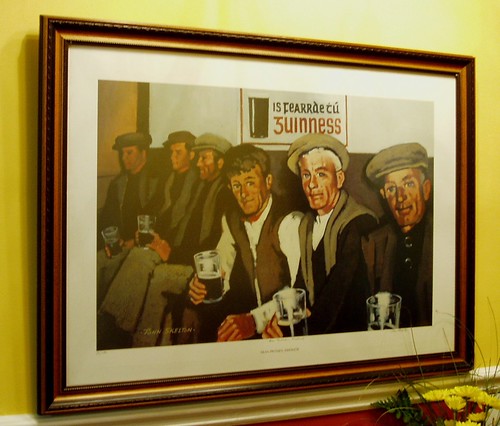
Several other of his paintings were also set in Irish pubs
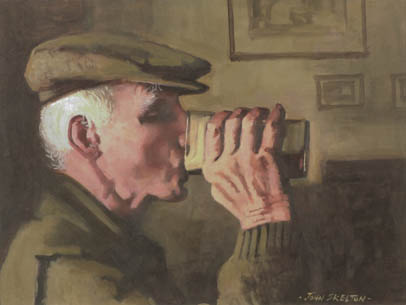
Donegal Man. Killibegs, Co. Donegal, from 1999.

A Corner In A Kerry Pub, from 2001.
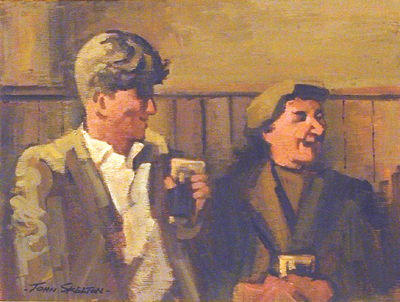
A Drink With Brendan, from 2001.
To see more of Skelton’s work, check out his paintings at Osin Gallery, where you can also read his biography. The artist’s son Michael is also setting up a new website, John Skelton Online, to honor his father’s memory and his legacy.