Brookston Beer Bulletin

Jay R. Brooks on Beer

  • Home
  • About
  • Editorial
  • Birthdays
  • Art & Beer

Socialize

  • Dribbble
  • Email
  • Facebook
  • Flickr
  • GitHub
  • Instagram
  • LinkedIn
  • Pinterest
  • RSS
  • Twitter
  • YouTube

Powered by Genesis

Session #8: Food and Beer

October 6, 2007 By Jay Brooks

+

Our eighth Session, hosted by Captain Hops at Beer Haiku Daily, involves the pairing of beer with food, a subject near and dear to my heart. I have been persuaded by extensive testing — better known as eating — that beer and food go together far better than wine will for the average meal. Oh, I’ll grant you that there are fine pairings that can be made with wine, but a diet of heavier flavors, potent seasonings and meat dishes will yield to beer’s superior ability to cut through this complex and thickly rich mélange of tastes. There are many people to thank for that awareness, from Michael Jackson to Garrett Oliver to Bruce Paton.

Friday night, I was happy enough to be invited to the 10th annual beer dinner at the Northern California Homebrewers Festival held at Lake Francis Resort in Dobbins, California. It was put on by Sean Paxton, the Homebrew Chef and ran to six courses. And many of the courses had several dishes, too, so the amount of food was truly staggering. Sean went all out for his tenth anniversary dinner. And with eight great beers being paired, it was sure to be a memorable evening. I had come with the entire family and because the weather had grown quite cold, we were all bundled up and brought our appetities, ready to eat. We were not disappointed. Chef Sean Paxton deserves much praise for not only his pairings, but also using the beer in the dishes, as well. When you consider the entire dinner was accomplished by amateurs, the achievement is all the more impressive. But enough praise, here’s a nutshell account of the evening’s culinary and fermented delights. But before we can begin, a haiku is both necessary and appropriate:

Pairing food and beer
To compliment or contrast
That is the question

Our chef for the evening, Sean Paxton, addresses the hungry and thirsty crowd.

The beer paired with our first course, a Belgian endive salad, was Watermelon Funk, a collaboration between 21st Amendment Brewery and Russian River Brewing. This is perhaps the fourth time I’ve had this beer and it just keeps getting better, it’s too bad it’s virtually all gone. Here Vinnie Cilurzo from Russian River tells the beer’s story in humorous fashion. They took a barrel of Shaun O’Sullivan’s popular Watermelon Wheat and aged it in an oak barrel, sparking it with brettanomyces. It worked nicely with the crisp flavors of the salad, especially the pomegranate seeds.

I sat with Vinnie Cilurzo at the dinner and happily he brought along a few extra beers for the table. Here my wife Sarah holds up one my personal favorites: The Damnation Batch 23.

A bit unusual for the typical beer dinner, but — and I can’t stress this enough — Frittes should become de rigeur for every beer dinner. You can just never have enough frittes for my tastes. Served with two kinds of aioli sauce (Duvel Shiso Aioli and Fou’ Foune Aioli), Sean’s frittes were spectacular.

Two of the other beers served at the dinner were brewed by these two gentlemen, Peter Hoey, from Sacramento Brewing, and Todd Ashman, from Fifty Fifty Brewing.

We weren’t the only ones thrilled that Vinne brought some of his beers along with him. Matt Bryndilson, from Firestone Walker Brewing, kisses a bottle of Russian River’s Toronado 20th Anniversary Ale.

Piping hot steamed mussels, steamed in beer that is. They were Prince Edward Island mussels, with shallots and thyme steamed in homebrewed wit, which was also the beer paired with them. Delicious!

For the vegetarians among us, pumpkin steamed in beer topped with spinach, sorrel, parsley and a Japanese mint (that Sean had grown in his garden). Yum.

At this point I got too busy eating and drinking and forgot to keep taking pictures of the food. The next beer was one of the GABF Pro-Am beers for this year. It was brewed at 21st Amendment Brewery and was Jamil Zainasheff’s award winning Belgian Strong Dark, which he named The Beer Hunter. It was paired with a thick stew of a dish, Les Carbonnade Flamandes, which Sean described as a Flemish stew cooked with beef, lamb, dark candy syrup cured bacon, leeks, shallots, thyme and, of course, the Belgian Strong Dark beer. It was piping hot and very rich. In the cold October night air, it warmed our souls.

An extra treat, Sean created a sorbet-like dish at our table using liquid nitrogen.

Much to the delight of my daughter Alice.

Sean stirring the sorbet looked more like a scene from Halloween than a restaurant. But the sorbet was delicious.

The fourth course paired Peter Hoey’s sour mashed farmhouse style saison with a Waterzooi, described as a classic Ghent milk stew made with cod, leeks, fennel, onions, shallots, saison, milk and herbs. A very nice saison, it worked well with the complex and diverse flavors of the stew.

The fifth course paired two beers from Russian River, Sanctification and Temptation, with two amazing dishes, duck legs cooked in a brett blonde and beer-braised veal cheeks. These were served with Brussels sprouts cooked in brown butter and nutmeg and cauliflower gratin, which had been blanced in an ale and topped with a Gruyere cheese sauce. Also, there was a bier risotto made with heirloom tomatoes and pearl barley served with a sauce made up of Temptation, lobster mushrooms and roasted thyme shallots. There were just so many different tastes going on here it made your head swim. Luckily the two Russian River beers cleared your head as they cleansed your palate so that each subsequent bite could be enjoyed as much as the first one.

Finally, the dessert course had two sweet pairings. First there was Todd Ashman’s Trifecta Belgian Style Tripel, from his new brewery in Truckee, California, Fifty Fifty Brewing. It went with a vanilla bean tripel infused pot de creme, a very creamy dessert using Todd’s beer along with vanilla beans infused into cream and slowly cooked in a water bath. If that sounded too light, then there were the dark chocolate framboise truffles. Sean took a Brendan’s wisky barrel and filled it with porter and dark chocolate, spiked it with Brettanomyces and let it age for seven months before blending it with Thirsty Bear’s Golden Hallucination and Brown Bear. It was served with Brendan Dobbel’s Thirsty Bear Menage a Framboise. I could have eaten these all night, as full as I was, because they were so damn good. I just kept telling myself with each one, “they’re wafer thin,” which, though a lie dead surely, allowed me eat as many as I possibly could guilt free.

After the dinner, chef Sean Paxton and my wife, Sarah, share a hug.
 

Filed Under: Events, Food & Beer, The Session Tagged With: California, Homebrewing, Northern California

Critiquing the Critiquers

October 4, 2007 By Jay Brooks

olympia
The tagline from one of my favorite graphic novels, The Watchmen by Alan Moore, is “Who Watches the Watchmen,” which itself is taken from one of the Roman writer Juvenal’s Satires. The notion of who keeps honest the people entrusted to keep people honest is as relevant today — and possibly more so — as it was in First Century Rome when Juvenal first penned the phrase. With blogs this is done quite simply, with the blogosphere policing itself, in effect, as we endlessly comment on one another’s work. This often leads to a healthy exchange of ideas and is personally one of my favorite aspects of writing online.

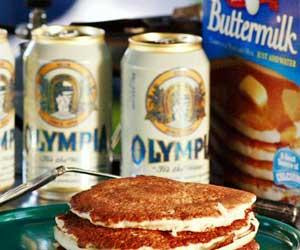
oly-cakes

Back in July, I picked up on a item from the Oakland Tribune in which staff food writer Steve Dulas wrote about making pancakes with Olympia Beer, insisting it must be Oly or nothing. I didn’t think it would make much of a difference, and said so in my own post about Oly Pancakes.

Over at SF Weekly there’s a regular blog called The Snitch written by Joe Eskenazi and at the same time he also questioned the Oly mandate and tried making the pancakes using different beers for comparison. At the time I wrote my post, I commented on both the original piece from the Oakland Tribune along with The Snitch’s take. As what goes around, comes around, the Snitch today made my critique the story of the day.

In Joe’s original take on this story, he felt that Arthur Guinness would roll over in his grave should anyone have the temerity to try using his Irish stout for making pancakes. I took exception to that and this time around The Snitch tried making pancakes with Guinness, just to see if Artie’s ghost would indeed haunt him, and the results are as funny as they are illuminating. I just love the circular nature of the internet, it reminds of … well, pancakes. Well done, Joe, now I’m hungry again.

Filed Under: Editorial, Food & Beer, Just For Fun, News Tagged With: Bay Area, California

Guinness’ Latest “What Were They Thinking”

October 4, 2007 By Jay Brooks

I’ve said it before and I’ll say it again. What the hell is Diageo doing with the Guinness brand? Are they trying to kill it, make it a mockery of its former self, or insult their customers even more than they already have? If so, they’re succeeding brilliantly. Diageo was created out of the merger between Grand Metropolitan and Guinness ten years ago. The new name was chosen for reasons passing understanding. Why take two recognizable names and trash them in favor of a new one nobody knows? The word Diageo came from the Latin word for ‘day’ and the Greek word for ‘world’. Apparently they couldn’t even make up their minds about what language to create the new company name from.

At any rate, over the last decade Diageo has displayed no respect whatsoever to the legacy, history or taste of the original Irish stout. Guinness had been brewing beer at St. James’s Gate in Dublin since 1759, with stout production beginning several years later, and now they’re even considering closing the brewery. Then there’s the $13 million widget bottle abomination that in 2001 tried to convince people to drink out of the bottle after all, setting the cause of better back again in the process. More recently, they’ve introduced “Extra Cold Guinness,” another useless novelty, and the test marketing of “Guinness Red” in England last year. The latest assault on their brand is “a plate-shaped device called the ‘Surger.’”

For a mere $25, Guinness wholesalers can stop selling Guinness on draft. Instead, they’ll pour it into a pint glass and put in on the “Surger.” Then “the bartender pushes a button to activate sound waves, which course through the liquid creating gas bubbles and ultimately the familiar cascading effect typical of a Guinness pint poured from draught.” One east coast distributor liked the idea, saying. “It gives me a new talking point that I can bring to my customers which is good for us.” Yes, forget about the beer itself, we need more talking points. This same guy “foresees the Surger eventually becoming available to consumers so they can drink a draught-like Guinness at home.”

Brandweek is spinning it like this. “One facet of marketing these days is to create an experience for the consumer. So Diageo will marry its new “Alive Inside” advertising message about the Guinness pour with a plate-shaped device called the ‘Surger.'” Given that there’s another, more important “surge” going on in the middle east involving more American soldiers fighting, was “the Surger” really the best Diageo could come up with? I always marvel at how the large companies strategize over their advertising and marketing messages. I suspect it’s embedded into the culture of big business, and in particular marketing, that nobody says “no” if the boss likes it or if a committee came up with it, once more proving that “group think” is a terrible danger. I always assume there’s some lone voice in the back, not being heard, saying “but what about the beer?” That guy will undoubtedly be fired within the week.

Here’s one of the new “Alive Inside” television spots:

Again, I must be the most out-of-step, uncool guy in the universe, because I find that ad more than a little creepy. Oh, I’ll grant you the music is slick and the effects are cool. But I can’t get past the idea that when I take that first sip, a million tiny men in white suits will be swimming down my throat. Yuck. It’s alive inside! What a terrible allusion to make. Isn’t that going to make the beer crunchy? Yeah, I know I shouldn’t take it so literally, but that’s how I roll. See, uncool to the bitter end.


Filed Under: Editorial Tagged With: Business, Europe, History, Packaging

A Sad, Sad Sight

October 4, 2007 By Jay Brooks

My friend Melissa, who brews at Drake’s, sent me a link to the BBC’s Day in Pictures, commenting simply. “That’s a sad sad sight.”

And I see what she means. Although there aren’t too many details about the photos apart from the caption, it’s the sort of thing you hate to see no matter what the circumstances.

Indonesian officials destroy alcohol confiscated from unlicensed stores in Jakarta.
 

Filed Under: News Tagged With: Asia, International, Law

MADD Takes On Gladys Kravitz Role

October 4, 2007 By Jay Brooks

The Florida chapter of the neo-prohibitionist group MADD is trying a novel approach to keep everyone but the teetotalers off the street: become Gladys Kravitz. If that doesn’t ring a bell, she was the very nosy neighbor on the 60’s-era television show Bewitched. Not only did she watch through the curtains from across the street, but also on occasion stalked Samantha and Darrin Stevens’ house, peering in the windows, looking for proof that “something was going on.” It seems that watching the neighbors was all she did, having little time left to live her own life outside of her singular pursuit.

In Tampa, MADD volunteers are set to test a pilot program throughout Hillsborough County called the Traffic Observation Program, with Florida’s executive director for MADD, Don Murray, hoping to take the program statewide.

Here’s how the St. Petersburg Times describes how the program would work:

Recruit 20 volunteers armed with donated cell phones and send them out in the middle of the night to watch for telltale signs of drunk drivers.

Murray envisions a program that will pair up community members who are willing to go through a screening process, including a criminal background check and an interview to ensure that those going out on the streets have proper training and experience.

“This isn’t like a vigilante program,” Murray said. “They won’t be attempting to stop or in any way interacting with these vehicles. They’re basically just observers.”

Volunteers will go out in teams. They will drive their own vehicles and take GPS equipment, so they’ll be able to find their way through unfamiliar areas for two to four hours of searching, Murray said. They’ll be told ahead of time of the sometimes-subtle clues for drunk drivers, such as driving under the speed limit or lingering too long at a green light, Murray said.

If participants spot a suspicious driver, they will jot down the license plate, a vehicle description and a location and notify the Sheriff’s Office. It’s up to the deputy to check out the vehicle to determine whether an arrest is appropriate, Murray said.

MADD’s New Watchdog Program

Maybe it’s just me, but when I have my kids in the car, I do drive slower, usually the speed limit, which in hurried California is almost always slower than the flow of traffic. So that would make me a target of drunken suspicion? Or if I don’t immediately peel out of an intersection during the fraction of a second when the light turns green, I’m a possible drunk driver? Maybe Florida has changed a lot since the last time I was there, but there used to be a disproportionately aged population, who tend to drive somewhat slower as a rule, at least in my experience. Under such conditions, I don’t see how driving slow will be much of a tip to anything, except perhaps to harass the more careful drivers in Tampa. Maybe all the slow drivers will become disillusioned over being wrongly accused all the time and begin driving faster to avoid MADD’s critical gaze. Now wouldn’t that make the roads less safe?

But most kidding aside, despite Murray’s protests to the contrary, this very much is a vigilante program. Giving anti-alcohol groups the power to lurk around and report anyone they want to local authorities who are already pre-disposed to take their side is a very bad idea in an increasingly police state. To me, this just has “bad idea” written all over it. Who wants to live in a society where you’re always looking over your shoulder and never being sure who you can trust or who might turn you in if you happen to accidentally stumble?

One of the rationalizations for this program that MADD’s John Murray gives is a concern that potential budget cuts would reduce the number of police officers on the road. This, to me, is a great illustration of how out of whack neo-prohibitionist priorities are. He’s not worried that a reduced police force would have a harder time contending with drive-by shootings, road rage, murder, robbery, rape, domestic disputes, or any of the things normal people might worry about. No, to MADD, less police means more alcohol drinkers might slip through the icy fingers of justice. That’s the biggest problem facing our society, that John or Jane Doe have one drink too many and drive home too slowly. These people need some perspective, and they need to get a life. Please, close the damn curtains.


Filed Under: Editorial Tagged With: Prohibitionists, Southern States

Toronado Toast

October 3, 2007 By Jay Brooks

A video of the National Toast to Michael Jackson that I went to at the Toronado in San Francisco Sunday night is now available on YouTube. Take a look:


Filed Under: Events Tagged With: California, Charity, Other Events, San Francisco

WhiskyFest Pouring Into San Francisco

October 3, 2007 By Jay Brooks

If you’re a regular Bulletin reader you might think I drink nothing except beer, but that’s not at all true. I enjoy many different alcoholic beverages such as wine, especially heavy reds and fortified wines like Late Bottled Vintage Port, along with sake, hard cider, gin and other spirits. But I’m especially fond of whisky and, naturally, single malt scotch though I don’t generally write about it because my knowledge of it is restricted to that of happy amateur. I’ve skimmed Michael Jackson’s book Whisky, Jim Murray’s and a few others but generally I leave it to the experts. Happily, I know a few of them. One is John Hansell who’s been in the business for going on twenty-five years now and for many of them has been publishing Malt Advocate magazine, undoubtedly the best American whisky periodical. He also recently started a blog on the world of whisky called What Does John Know? My good friends Stephen Beaumont and Lew Bryson also write regularly for Malt Advocate.

Malt Advocate has been putting on tasting and educational events called WhiskyFests in New York and Chicago for a number of years, and this year they’re finally coming to San Francisco. WhiskyFest is exactly like it sounds, a festival where you can sample whisky and other libations, but it also includes an educational component with a number of speakers. And not only that, it will be the biggest whisky event in the country. If you love whisky, join me at WhiskyFest. It should be a blast.

It will take place in three weeks, on October 23 from 6:30-10:00 pm at the Hyatt Regency at 5 Embarcadero Plaza in San Francisco. Tickets are $105 for regular admission or $145 for VIP admission, which gets you in an hour earlier. Tickets include all sampling, speakers and a gourmet buffet. You can get advance tickets online at Malt Advocate or by phone at 800.610.MALT.

From the website:

What will be poured?

More than 250 of the world’s finest and rarest whiskies will be available for sampling, featuring premium single malt and blended Scotch whiskies, the best bourbons and Tennessee whiskeys, top of the line Irish whiskeys, Japanese whisky and the best from Canada. Visit Malt Advocate for an up-to-the-minute list of what will be available for sampling.

Who will be speaking?

The focus is on education, and many well-known distillery managers and distillery representatives will be on hand at the pouring booths to explain how the whiskies are made. Thirteen of the world’s leading distillery managers and master blenders will be conducting seminars throughout the evening including:
 

  • Stephen Beal, Master of Whisky, Classic Malts
  • Parker Beam, Master Distiller, Heaven Hill
  • Simon Brooking, Global Brand Ambassador, The Dalmore & Laphroaig
  • John Campbell, Distillery Manager, Laphroaig
  • Ronnie Cox, Director, The Glenrothes
  • John Hall, Whisky Maker, Kittling Ridge
  • Lincoln Henderson, Whisky Expert, Suntory
  • Ian Millar, Master Distiller, Glenfiddich
  • Chris Morris, Master Distiller, Woodford Reserve
  • Fred Noe, Jim Beam’s Great Grandson
  • Richard Paterson, Master Distiller, The Dalmore
  • John Scharffenberger, President, ScharffenBerger Chocolate
  • Joy Spence, Master Blender, Appleton Rum


10.23

WhiskyFest San Francisco

Hyatt Regency Hotel, 5 Embarcadero, San Francisco, California
800.610.MALT [ website ] [ tickets online ]
 

Filed Under: Uncategorized Tagged With: Announcements, California, Related Pleasures, San Francisco, Tasting

Budvar Not For Sale

October 1, 2007 By Jay Brooks

The Prague Daily Monitor reported today that the Czech Republic government has changed its mind for the time being about privatizing Budejovicky Budvar brewery. Prime Minister Mirek Topolanek was quoted as saying there’s “no privatization,” adding that it would take at least 12-18 more months before Budvar would become a joint-stock company. He also laid to rest rumors that Marek Dalik, Topolanek’s advisor, was in negotiations with Anheuser-Busch to purchase the Czech brewery, as had been widely reported in the business press.


Filed Under: News Tagged With: Business, Europe, International

The Ethical Blogging Debate

October 1, 2007 By Jay Brooks

WARNING: This whole post is not really about beer at all, but instead is about blogging about beer and the ethics surrounding what beer bloggers write about. If that sounds dead boring, you can safely ignore reading this one. This is a very, very long post so I wanted to give everyone fair warning before investing a lot of time in reading it only to find out there was no light (beer) at the end of the tunnel.

At the beginning of the month I got an e-mail from Jack of the Stella Artois Blog inviting me to an “exclusive online premiere of the new Stella Artois cinematic website on 15th September, 3 days before it screens to the rest of the world.” The e-mail was personal enough to suggest he’d actually visited the Bulletin but otherwise seemed somewhat canned. I didn’t give it much thought as I was on some deadlines and didn’t reply. Less than a week later I got another e-mail that sounded much less personal and gave me a gentle nudging for having not RSVP’d despite the fact that the original e-mail made no such mention. It did, however, hold out the proverbial carrot that the promotional packets were “dwindling.” A few days later I got a similar introductory e-mail from a Matt, also from Stella Artois, asking me again if I’d watch and write about the new website. All told, I received six e-mails about this promotion. At any rate I did get the promo packet which included a poster, some coasters and the password. In the end I never did get a chance to actually go to the new web launch and watch the movie because I was just too busy with assignments.

In the meantime, every other beer blogger got a similar invitation. Some probably went to the new website and watched the movie, some didn’t. While I was working, Stonch, across the pond, was thinking about this and what it means for bloggers and the beer blogging community. Last week, he wrote a message to all of us. Here’s a part of that message:

The object, of course, is to start a “viral campaign” on the internet. Having recognised that between us we have many thousands of readers, they’re expecting beer bloggers to give free promotion to their product. The Stella Artois Blog lists and thanks those who have so far fallen into the trap. I’d ask those of my peers who have provided a link to or posted about the Stella site to reconsider. If this latest campaign to grab further market share for Stella Artois succeeds – at the expense of products we do like — let’s at least be able to say we weren’t part of it.

Remember what makes blogs unique, and what makes them popular. I’m not implacably against InBev or any other company (although sometimes I think I should be). Just remember that people don’t visit our websites to read press releases from macrobrewers — the trade press covers that nicely. I didn’t start a blog to provide a free service to InBev, and I suspect you didn’t either. Don’t get taken for a ride.

In deference to Stonch’s opinion and my own unsettled mind, I will not provide a link in this post, as I might normally have otherwise done.

What’s really interesting has been the response to Stonch’s post. He’s really sparked an interesting debate about ethics and beer blogging. Alan over at A Good Beer Blog added his take, which he titled Stonch’s New Campaign: Don’t Sell Out Beer Bloggers. Between the two posts, there have been at least 44 comments made, many of them running to several paragraphs, with a back and forth vibe and Stonch at the center defending and clarifying his opinion, as necessary. There were people who agreed wholeheartedly and some who did not. Clearly this issue is on our collective minds.

I started to add my own comments to Stonch’s post and Alan’s follow-up, but my typical verbosity started to run longer than usual so I gave up and started over here instead. If you want to read the originals instead of my cliff notes version, go ahead. I’ll wait right here until you get back. Otherwise, what follows here are the relevant bits of the discussion, at least for my purposes, along with my own take, following each comment, in italics.

Alan at A Good Beer Blog responded first:

How masterful of you and quite right. It is odd when these things come by in the emails — people expecting that their product and your hard won bandwidth/readership have a relationship. A while ago the makers of a movie with beer in the title which likely had a multi-million dollar ad campaign fund, wanted to trade the reputation of beer bloggers for free word of mouth. Backfired.

Bob Woodshed at [BW] Beer Blog disagreed, saying:

While I agree with you that their campaign is obviously viral marketing, the reason I accepted their invitation is because their idea of a cinematic website intrigued me. Stella Artois decided to take a chance by spending every cent on their obviously very expensive site, so why not give them a hand?

Bob’s notion that we should “give them a hand” because they spent a lot of money seems odd, at the very least, to me. Of all the reasons I’ve personally ever reviewed something, cost has never been a factor. Stella Artois is not, of course, much of an underdog with limited resources needing championing. Between their affiliation with Anheuser-Busch and their previous master, InBev, they haven’t exactly been hurting for marketing dollars such that they would have to reach out to the beer blogging community guerrilla-style as their only option to reach potential consumers. So that suggests to me it was a conscious decision to launch a grassroots-like campaign by contacting beer bloggers.

But let me suggest a different way of thinking about this. I don’t see anything inherently wrong with Stella Artois sending us invitations or press releases. I rely on press releases quite a bit to know what’s happening in the industry. I probably get at least a dozen each day. Some I discard immediately and some I write about immediately, with most falling somewhere in between. The only thing different about Stella Artois’ communication with us was that they tried to personalize the messages, which I assume must have taken considerably longer than a gang e-mail exactly the same to everyone on their list. They also perhaps tried to make us feel special by personalizing the e-mails and being invited in to take a peek at the new website early. I hope this doesn’t sound patronizing — it’s not intended to — but most beer bloggers who don’t also work for more traditional media perhaps aren’t used to getting freebies or something early before it’s available to the general public. But really, that’s exactly how regular marketing works. Book reviewers get books before they’re published. Movie reviewers see films before they’re released. That’s how the movie review is in the paper the same day the movie comes out and the book review is a magazine the same week or month it’s published.

Press releases are exactly what Stonch is complaining about, an attempt to get the media to write about whatever is the subject of the press release, no more, no less. Ideally, Stella Artois gave us three days to visit the new website in the hopes that many of us would write about it on the day they launched it thus creating a buzz over its launch. The same thing is happening a million times every day for every product you can imagine and even some you can’t. Check out any of the PR websites where businesses post their press releases. The sheer volume of them is quite amazing. There isn’t a company doing business today that doesn’t use press releases. Some even call them news releases so they don’t sound quite so commercial. But the fact is news organizations do rely on them to some extent for news they write about. It’s one of the ways they gather the news that ends up in their paper, on their television station, or wherever each and every day. So yes, Stella Artois was trying to get something for nothing, but no more so than every other single business in the world. We’re all on the same ride, and we can’t really be taken on one we don’t want to get on.

Mike from the Stella Artois Blog also chimed in, insisting Stella was not trying to seed a viral campaign.

I am part of the team undertaking the Stella Artois campaign and I would just like to correct a couple of things. Nobody is asking you to use a press release. We invited bloggers who we believed were interested in Stella Artois, having read their blogs, to see a preview of the new website. If you don’t like it say so. If you want to say nothing, say nothing. This is not about a ‘viral’ campaign however you define it, this is about respecting your opinion if you wish to give it.

Mike is, I think, partly correct. It was simply an invitation with no real way Stella Artois could or would expect that everyone would write about their new website. With press releases, if you get a 10% return you’re probably doing pretty good. He is, however, I think a little disingenuous when he asserts it wasn’t “about a ‘viral’ campaign however you define it.” Whether he’ll admit it or not, they did want people to write about it. One of the e-mails I received specifically asked me to write about them and said so in no uncertain terms, asking if I’d “be interested in checking out and writing about this new campaign for Stella Artois.” They certainly wouldn’t have spent all that time and resources sending all the beer bloggers an individual e-mail and the packets if they weren’t at least hoping that they’d get a good response and people would write favorably about them. They wanted buzz, to say otherwise seems like spin.

A little later on, Dumbledore remarked:

Alan, what I am trying to say is that it is not the responsibility of the Stella marketing department to maintain the purity of beer blogs. It’s their job to sell Stella. And I think, given that most beer bloggers are open to contact and approaches from sponsors, they have every right to send the emails they have.

It is the responsibility of the beer bloggers to maintain their standards.Which I think is what Stonch is saying when he says “I think it’s clear that I didn’t mean you’re literally asking people to reproduce a press release. However, I’d argue that bloggers uncritically publicising a campaign for InBev amounts to the same thing.” Who’s to blame if bloggers uncritically publicise a campaign? The bloggers, of course.

If you don’t like the product, ignore these emails like we all ignore all the other spam we get daily in our inboxes.

Exactly. We should all critically look at every communique we get and decide if we want to use it or not.

Shawn, the Beer Philosopher, added:

This may be a fundamental philosophical difference between you and I [Stonch], but I don’t tend to, de facto, reject commenting on happenings in the worldwide beer industry because they’re from a macro beer maker. In my opinion, if they do something that’s interesting enough to comment on, I’ll post it … all the while making sure I note to my readers that I in no way endorse or recommend their product.

I agree with Shawn. One should never make a policy decision absolute. Never (pun intended). If nothing else, keeping tabs on macro brewers is a way to keep them honest, too. If they know bloggers might be critical of something they do, it’s possible they won’t do it. Doubtful, perhaps, but possible. But really, most macros have the knowledge, sophisticated equipment and expertise to make fantastic beers, but for business reasons choose to make beers with very broad appeal, inoffensive to almost everyone except us beer geeks. Why do you think they have 95% market share? They have shareholders to appease and are so large that to keep the share price up they must keep up growth. That’s the corporate system. I personally hate that system and believe it’s done and is doing our society great harm, but I understand it. The way to sell more beer is not to suddenly double your costs to go all-malt with three times the hops and then have to spend millions of advertising and marketing dollars to re-train the majority of your consumers that what you’ve been selling up until this point is not really what beer is after all. I love that fantasy, but it will, of course, never ever come to pass. Any big company that tries it would be bankrupt within a year.

Alan, again from A Good Beer Blog:

What Stonch (and I) might be suggesting is that beer bloggers should have a confidence that is not always seen, the confidence to have if not “higher standards” then at least some respect for themselves as media outlets many people now read. Obviously the InBev PR people thought enough about the power of beer blogging to reach out as they did. That they chose this route rather than advertising bloggers or webtech bloggers speaks to the intention of the happening. In significant part, it was to get the product mentioned on beer blogs. In response, beer bloggers should be considering seriously what that means as that, for me, is the real event.

Lew Bryson, at his Seen From a Glass, liking what Alan wrote, added with his usual aplomb:

Very well put. I was feeling nervous about my livelihood a couple years ago; why should people buy my stuff when they could get beer writing for free on the Web? Then some brewer yelled at me for what I said about his beer, and I said it was nothing more than what was being said on the rating sites. Am I to be held to a higher standard, I asked. Well, yeah, he replied, as if I were stupid. You’re an established beer writer. You have a responsibility to your readers and to the brewers. I guess I’d always known that, I was just getting nervous and a bit sloppy. I shaped up, and my work’s actually gotten better and I’ve got more of it.

Bloggers who are consistent, who write good stuff, who take this seriously, whether they are paid for it or not, fall into that same category. You become “serious” and “responsible” by virtue of being there every day, or week, or whatever, and not just writing willy-nilly, but thinking, and asking, and backing up your opinions. And just like with political bloggers getting “real” press credentials, beer bloggers get invites to press trips, samples, press releases, and…invites to website launches. Stonch obviously already has assimilated the flipside of that: the responsibility to write about that with full objective perspective. You have that responsibility to your readers, and as I just exercised, to the brewers — got a press release from a major brewer’s PR firm, and sent it back, noting a somewhat glaring error. Part of the business.

Stonch is quite correct, however, when he says that “what makes blogs unique, and what makes them popular” is their honesty, their voice, along with Alan and Lew’s confidence. It’s that consistency of voice and opinion that I think is at the heart of any good beer bloggers can do. We have to be true to ourselves first. If we can do that, our own voice will emerge. People will know when we’re not being true, especially if they’re following what we’re writing on a regular basis. So personally I don’t want to write about things I don’t believe in or want to support for some reason, because not only will people feel I’ve compromised myself but, more importantly, I’d feel the same way. Maybe that’s overly pretentious, but it is right I think. The only people I read regularly are the ones that I also respect because I know I’m getting their unadulterated true selves in their opinions. I may not always agree with them — and frankly I’d hate it if I did — but an honest exchange of differing viewpoints is what makes change possible. How many times has one of us read something another beer blogger wrote and either commented on it or did their own take in their own post. That’s exactly what sparked this very debate in the first place. This is what makes the beer blogosphere such a healthy and important medium. The exchange of ideas and opinions is perhaps our most important contribution to the beer world. Frankly, I don’t really care that much how many people agree with me so long as I made them think. (Oh, sure, it would be nice if people did agree with me all the time, but it’s not the most important thing. I’ve grown used to being out of step with the world.)

Stan Hieronymus, from Appellation Beer (and others) weighed in:

There is a level of Internet logistics and marketing not being mentioned here.

First, the PR folks are reaching out to many more people than beer bloggers. Think of it like launching an independent film in theaters. Buzz is their business.

Second, there are the logistics of Search Engine Optimization (SEO). A topic I care nothing about and pay no attention to, but I do know that incoming links help move a site up the search engine ladder and get it more attention.

Third, in every study about why consumers will buy a beer (in this case substitute “visit a web site about beer”) you’ll see that people say a recommendation from a friend is more important than advertising.

So it’s not necessarily a matter of seeking a link without paying, but that the placement within editorial copy is more valuable.

Stan is also correct here and I think this is at least part of the motivation of not just Stella Artois, but every company who sends out press releases.

Alan, at A Good Beer Blog, also did his own post about this issue, which itself sparked several thoughtful comments. Here’s part of what Alan had to say:

We who have worked hard, who are sifting as we are sipping, picking the good from the bad should be confident in the nobility of the thoughtful drinker — and the value of talking it up. Fine beer, like any serious food or drink, fulfills itself in the theatre of its consumption. So whatever is it we are, we are something related to that and it’s definitely something worthwhile. Let’s give it respect.

Don’t get me wrong. There is nothing wrong with a parcel full of swag and, to be sure, the day is not yet here when the embrace offered by beer bloggers has been universally reciprocated by the brewers, the shops, the pubs. So, if I was to add anything and as was the case when the PR folk for the movie BeerFest came around, when a product placement is offered and if you are even interested, maybe think to ask what they are willing to pay. You are spending a lot to promote the good in beer. A lot. Beer should at least pay for itself if you are going to play the role of spreading the good news. If the product or the price is not right, shouldn’t the answer be “no thanks”?

Then Stan from Appellation Beer piped in about a question Stonch had asked in a previous post, “can marketing campaigns, backing homogenised products from big brewers, do anything to help the cause of quality beer?”

Alan then clarified his position:

I don’t think I can say what a beer blog should be. But I do think it is important to acknowledge what they can be and might be already — which I think is a big part of Stonch’s point. Collectively, they represent a huge readership. Bigger than most trade magazines and more immediately responsive. If we come back to the core element in the entire process, press releases or websites or ads are sideshows to what is in the glass. Heck, even a lot of what is “beer culture” is a bit of a sideshow for me.

I think there is no one thing we could ever agree on about what a beer blog should be. There can never be a right answer to that question. A blog can only be whatever the person writing it wants it to be. Blogs that touch people, challenge them to think in new ways or entertain them with a uniquely singular voice will always have more readers than blogs by a company or committee or ones that compromise themselves for a few doubloons.

I get requests to advertise, promote, and write about all manner of things that I find don’t fit with my personal ethos every single day. Some are quite obvious and I’m often astonished that people think I might be willing to write about these things. A particularly odd one was a so-called humor blogger sent me his tale of sending the Boston Beer Co. fake (and ridiculous) letters of complaint which they of course had to respond to in all seriousness, taking up their time and resources just so these yahoos could have a cheap laugh at their expense. It’s a type of humor, often employed on morning radio shows, that I just don’t get. There’s nothing witty, clever or even funny about trying to demean an unsuspecting mark. But they thought I’d find this hilarious and would want to write about their cruel prank. As I know the person who was stuck writing the responses, I promptly forwarded it to her and hopefully they put a stop to it. But I get these kinds of things all the time, people wanting me to hawk beer pong t-shirts or beer goggles or some other god-awful thing that appeals to the frat boy mentality so many of us are fighting against. It’s as if they don’t bother to read my content and just assume if it’s a beer blog, they’ll just love this.

So I either simply ignore them or politely decline. But that’s the price of being out there in the public arena. I want to get communications from as many sources as possible and pick and choose what fits my purposes or what I think people might be interested in reading about. The fact that I have to sift through offers I don’t want is just part and parcel of the job.

Travis from CNYBrew chimed in with his take from the tech world’s idea of a blog:

Regarding what a beer blog should or shouldn’t be, I would offer that a blog that exists only to promote a product or the blogs sponsors will find itself without any real traffic. People read blogs for a unique and personal perspective outside of the advertising world. Corporate sponsors want to tap into the legitimacy that blogs have earned by good posting.

To me, that’s why Stonch’s stance on this is completely correct. Bloggers who choose to take part in things like this for an obvious pay off and pimp products for money, will quickly lose readership and find themselves looking in from the outside in. I read a lot of tech blogs and I have seen blogs get pegged for this type of activity. The readership lights the bloggers up for selling out.

I’m not convinced that writing about Stella Artois’ new website automatically becomes “selling out.” I think it would depend on what was written, wouldn’t it? I can’t see how reviewing it would be “pimp[ing] products for money” or that there is an “obvious pay off.” First of all, no money changed hands. Secondly, nobody thinks twice about reviewing a beer someone sends them, so why should a website critique be any different? Personally I think the larger beer companies spend far too much money and resources on the look of their websites (and I absolutely loathe the overuse of flash technology) and almost nothing on the content or usefulness of them. But that’s just one opinion. But since beer lovers visit them, why would they be outside the realm of a beer blogger’s milieu? While a lot of people think it’s only about the beer, there is so much more to the beer industry than just the product. And while I do think it’s perfectly fine for someone to restrict themselves to writing just about the beer itself, it therefore follows that it’s equally acceptable to go beyond that narrow definition of the world of beer to include the business, the people, the advertising, and so on. No one can really tell anyone else what to write about. We all have to decide for ourselves and as long as you can defend your decision, at the very least to yourself, and you stay true to yourself, then I can’t see how there are any wrong ways to be a beer blogger.

Stan then added:

I think the blogger should have free choice. And writing about advertising is writing about beer culture. For one thing, if you are assuming something of a watchdog role — which many bloggers do — then there is the matter of calling companies on advertising that doesn’t reflect what’s in the glass.

And he later finished with what for my purposes will be the last word:

I don’t see the point in a blog (beer or otherwise) that apes anything (print, etc.) [basically agreeing with a point Stonch made].

Again, this is what works for me and I’m all for all bloggers to choose their own course, but what Ron Pattinson wrote a little while back makes a perfect mission statement:

“Honest beer is what I want. Beer that can look me straight in the eye and not flinch. Beer with heart. Beer that’s like an old friend. Beer you can sit and drink by the pint in a pub with your mates.”

Just insert “to write about” after “what I want.”

That’s another way of saying be true to yourself and find your own voice, which is my overriding point of all this. But I will go so far as to suggest that it can even be okay to “ape” (though that’s obviously meant derogatorily) a press release. I often reprint press releases for things like beer dinners, festivals or other events to help spread the word about them, especially if I’m attending or know and like the people putting on the event. I usually add my own take or comments about it but will then just quote liberally from the press release, in some cases reprinting almost all of it. Usually I also do this for small breweries who won’t get picked up in the national press and using portions of a press release is an expedient method of getting the information out. Why shouldn’t I help people and events I believe in? Have I sold out because I try to help small brewers get their message out? When I got a press release from Sierra Nevada announcing that they were bottling their anniversary ale for the first time, should I have tossed it out because it was just an attempt to get free publicity and I shouldn’t have fallen into their trap? Of course not, because I believed then — as I still do — that people would want to know that information. It’s all about context and making choices. I don’t think you can make generalizations about almost anything we’re sent as a press release or similar communications.

I know it sounds like I strongly disagree with Stonch, but the truth is I’m glad he posted his thoughts because he prompted this lovely debate and made a lot of us think about what and why we do what we do. I think it’s important for all of us to think about these issues. Honestly, my first reaction to Stonch’s post was one of agreement. But the more I thought about it, the more I realized that I didn’t. I think it’s the spirit of his message which is so attractive, which is that we should follow our passion and not have it dictated to us. And that’s correct, I think, it’s just that it’s much more complicated than just saying no to big companies. So thanks Stonch. I’m thirsty. Let’s have a beer.


Filed Under: Editorial Tagged With: Business, International, Websites

Food Smart, Hop Stoopid

October 1, 2007 By Jay Brooks

The Beer Chef, Bruce Paton, has announced that his 60th beer dinner will take place November 2. It will feature Tony Magee and the beers of Lagunitas Brewing Co. in Petaluma, California. It will be a three-course dinner and well worth the $65 price of admission. It will be held at the Cathedral Hill Hotel on Saturday, November 2, 2007, beginning with a reception at 6:30 p.m. Call 415.674.3406 for reservations.


The Menu:


Reception: 6:30 PM

Beer Chef’s Hors D’Oeuvre

Beer: Czech Style Pilsener

Dinner: 7:30 PM

First Course

Dungeness Crab with Avocado Mousse, Celery Root and Citrus Vinaigrette

Beer: Saison

Second Course:

Olive Oil Poached Lamb Cutlets with Fontina Sage Potato Gratin and Roasted Garlic Jus

Beer: Hop Stoopid

Third Course:

Butterscotch Bread Pudding with Chantilly Crème

Beer: Brown Shugga

A self-portrait of Lagunitas owner Tony and me at the Bistro IPA Festival a couple of years back.

 
11.2

Dinner with the Brewmaster: Lagunitas

Cathedral Hill Hotel, 1101 Van Ness Avenue, San Francisco, California
415.674.3406 [ website ]
 

Filed Under: Food & Beer Tagged With: Announcements, California, San Francisco

« Previous Page
Next Page »

Find Something

Northern California Breweries

Please consider purchasing my latest book, California Breweries North, available from Amazon, or ask for it at your local bookstore.

Recent Comments

  • Bob Paolino on Beer Birthday: Grant Johnston
  • Gambrinus on Historic Beer Birthday: A.J. Houghton
  • Ernie Dewing on Historic Beer Birthday: Charles William Bergner 
  • Steve 'Pudgy' De Rose on Historic Beer Birthday: Jacob Schmidt
  • Jay Brooks on Beer Birthday: Bill Owens

Recent Posts

  • Beer In Ads #5227: It’s Here! Bock Beer By Bosch April 20, 2026
  • Beer Birthday: Drew Beechum April 20, 2026
  • Beer Birthday: Des De Moor April 20, 2026
  • Beer Birthday: Brenden Dobel April 20, 2026
  • Historic Beer Birthday: Henry Becker April 19, 2026

BBB Archives

Feedback

Head Quarter
This site is hosted and maintained by H25Q.dev. Any questions or comments for the webmaster can be directed here.