Brookston Beer Bulletin

Jay R. Brooks on Beer

  • Home
  • About
  • Editorial
  • Birthdays
  • Art & Beer

Socialize

  • Dribbble
  • Email
  • Facebook
  • Flickr
  • GitHub
  • Instagram
  • LinkedIn
  • Pinterest
  • RSS
  • Twitter
  • YouTube

Powered by Genesis

Historic Beer Birthday: Harry Shlaudeman

November 11, 2025 By Jay Brooks

decatur-brewing-old
Today is the birthday of Harry Shlaudeman (November 11, 1865-19??). His father Henry Shlaudeman founded what would become the Decatur Brewing Co., in Decatur, Illinois. It reopened after prohibition in 1934 under the name Macon County Beverage Co., but closed for good the same year.

Harry attended the University of Illinois, and received a B.S. in Architecture. After college he worked in the family brewery, as secretary and treasurer, and he was also president of the Citizens National Bank. Later in life, he left for California, settling in Pasadena, where he lived out his days.

decatur-brewing

Surprisingly, I was unable to turn up even one photograph of him, and very little even of the brewery his father, and then he and his brother, owned. The City of Decatur and Macon County, subtitled “A Record of Settlement, Organization, Progress and Achievement,” includes a biography of Henry Shlaudeman, which also mentioned Harry and his brother Frank:

Henry-Shlaudeman-bio-1
Henry-Shlaudeman-bio-2

decatur-brewing-boxcar

He father also held two patents related to brewing. One was for an Improvement in safety-valves for fermented-liquor casks from 1878 and the other for a Refrigerator-building for fermenting and storing beer.

decatur-brewing-kegsThe keg line at the Decatur Brewing Co.
Filed Under: Birthdays, Just For Fun Tagged With: History, Illinois

Beer Birthday: Ken Grossman

November 11, 2025 By Jay Brooks

sierra-nevada
Today is the 71st birthday of Ken Grossman, who founded Sierra Nevada Brewing in 1980. It would be hard to say too much about just how much Ken has done and continues to do for the craft beer industry, while at the same time being wildly successful. Join me in wishing Ken a very happy birthday.
At the Craft Brewers Conference in 2007, John Harris, from Full Sail, Ken’s daughter Sierra, Ken, and Garret Oliver, from Brooklyn Brewery.
grossmans
Ken with two of his children, Brian and Sierra, both of whom work for the company. I took this in 2007 for an article I did for American Brewer on passing breweries from one generation to the next.
gabf06-fri-13
“Inside the Brewers Studio” at the 2006 GABF with Jim Koch of Boston Beer Co., Ken, Charlie Papazian, founder of what is now the Brewers Association, and moderator Tom Dalldorf of the Celebrator.
P1170871


Ken and Sam Calagione at the Life & Limb beer dinner in 2009.

P1000418
Ken and Jeremy Cowan, from Shmaltz Brewing, at GABF several years ago.
DSCN3596
Ken and Pete Slosberg, signing books at GABF a few years ago.

Filed Under: Birthdays, Just For Fun Tagged With: California, Northern California

Historic Beer Birthday: Gustavus Bergner 

November 11, 2025 By Jay Brooks

Today is the birthday of Gustavus Bergner (November 11, 1832-May 6, 1883). He was born in Germany, but emigrated to the U.S. with his family when he was a teenager. He learned to brew working at the brewery owned by his father, Charles William Bergner. After his father’s passing, Gustavus owned and operated a large saloon, before “he became a partner in the old brewing firm of Engel & Wolf. The brewery was greatly enlarged, and their business increased rapidly. The firm subsequently became Bergner & Engel, and later the Bergner & Engel Company.”

Here is his obituary from the Philadelphia Inquirer on May 7, 1883:


“GUSTAV BERGNER, the WELL-KNOWN BREWER

“Mr. Gustav Bergner, of the Bergner & Engel Brewing Company, died about nine o’clock last night at his residence, No. 2310 Green street. Mr. Bergner has been failing in health for some time and has been quite ill for the past two weeks.

His father, who was a brewer, came to this country about thirty five years ago, and after traveling about two years, went back to his native land and returned with his family, The elder Bergner built a brewery on Seventh street, below Girard avenue, that neighborhood at that tine being in the suburbs of the city. The son learned the business there, and was afterward admitted into partnership. The business of the firm rapidly developed, and their establishment was soon one of the leading breweries of the city.

Mr. Bergner experienced several reverses during life, and after the partnership with his father, he conducted a large saloon on Dock street. From the years 1872 to 1878 he ran the large saloon on Library street nor conducted by Gustav Wallace. Here he amassed considerable money. In 1872 he became a partner in the old brewing firm of Engel & Wolf. The brewery was greatly enlarged, and their business increased rapidly. The firm subsequently became Bergner & Engel, and later the Bergner & Engel Company.

It is one of the largest breweries in this section of the country. Several times their establishment was partly destroyed by fire, causing an interruption of their business.

Mr. Bergner was a member of several German societies, and was known in German circles as a very liberal man. During his life he amassed a great deal of money, but always spent it freely. He leaves a widow and a son and a daughter.”

Here’s a description of the above poster of Bergner’s brewery from the Library Company of Philadelphia:

Since the erection of the first brewery in Philadelphia circa 1683, beer making has been a near steady Philadelphia industry. Following the introduction of lager beer to the Philadelphia market in the mid-19th century, German-American brewers dominated the field. The firm of Bergner & Engel, formed in 1870 between longtime brewers Gustave Bergner and Charles Engel, symbolized the best of the best of that era’s nearly one hundred, mostly German-American run breweries. Operating from a plant built for Bergner in 1858 at 32nd and Thompson streets, the brewery served as the forerunner in the establishment of the industrial neighborhood known as Brewerytown.

This circa 1875 print, a chromolithograph by German-born lithographer Charles P. Tholey, evokes the vitality of the brewing industry and documents the eye-catching imagery of advertising for the city during the 19th century. The advertisement conveys the expanse of the Bergner & Engel plant that included ice houses, a brew room, fermenting and cooling rooms, store rooms, offices, and dwellings. The numerous factory wagons loaded with kegs of beer to be delivered, the visible construction dates of the ice houses, and the several returned and cleaned barrels demonstrate the success of the company. To catch and keep the viewer’s eye, Tholey also employed subtle details such as the excited dogs, the probable job seeker soliciting a worker on break, and one of the proprietors, Bergner, conversing with an employee in front of his office.

Unlike advertisements of today, the product for sale does not serve as the focus of the print. Rather, the factory comprises the image. Competition for consumers was not based on the quality of the good, but the quality of the establishment in which the product was produced. Regarding the circulation of such prints, rather than posting them publicly in stations, on buildings, or fences, businesses probably enclosed the advertisements with product shipments sent to their distributors throughout the country. Enterprises such as Bergner & Engel anticipated that their retailers would display the prints in the public spaces of their establishments to promote their products to a broader base of consumers.

The brewery around 1857.

This short biography is from the breweriana website Tavern Trove.

Gustavus Bergner, the founder of the Bergner & Engel Brewing Co., was born in Crimmitschau, Germany.  He arrived in America with his father in around 1850, and was naturalized on Halloween day, 1853.  He cut his teeth in the brewing business by working at his father Charles William Bergner’s Philadelphia brewery on 7th street, below Girard Avenue.  The education was to be short-lived, however as his father died on November 15th of 1852 .

Upon his father’s death Gustavus brought in Christian Muehleck as a partner.  Together they moved the brewery to Dock Street and expanded it. On June 8th of 1863 they opened the Library Street Hall at 412 Library Street and used the saloon/hotel as a depot to sell their beer.  They ran both enterprises for a few years until the Library Street landlady sued them for breach of contract.  The beer men won their lawsuit in January of 1866 but in May of that year Muehleck died after a short illness, leaving Bergner to continue alone.

Bergner brewed at the Dock Street location for four more years and in that time amassed a sizable reputation.  In 1870, at age 38, Bergner was offered a partnership in the reputable Engle and Wolf Brewery, Charles C. Wolf having retired.  With Bergner on board, the Engel & Wolf plant was expanded even more, and output was greatly increased.  By 1872 the firm had been renamed the Bergner & Engel Brewery, and was one of the largest in eastern Pennsylvania.  

In around 1853 Bergner married fellow German emigre Catharine Christine Wehn.  Their union produced a son and a daughter.  

And this is the brewery around 1870.

And this account is from “One Hundred Years of Brewing:”

This the company letterhead from 1880.

Filed Under: Birthdays, Just For Fun Tagged With: Pennsylvania, Philadelphia

Historic Beer Birthday: Edward Cecil Guinness

November 10, 2025 By Jay Brooks

guinness-new
Today is the birthday of Edward Cecil Guinness a.k.a. Edward Guinness, 1st Earl of Iveagh (November 10, 1847–October 7, 1927). He was one of three sons of Benjamin Guinness, 1st Baronet, and younger brother of Arthur Guinness, 1st Baron Ardilaun. He ran the Guinness brewery beginning in 1868 when his father died. He later became the chairman of the board for life, a position he held until his death in 1927.

1stEarlOfIveagh
He was born in Clontarf, Dublin, and educated at Trinity College Dublin, graduating with BA in 1870, he served as Sheriff of Dublin in 1876, and nine years later became the city’s High Sheriff. That same year, he was created a baronet of Castleknock, County Dublin, for helping with the visit of the then Prince of Wales to Ireland. In 1891, Guinness was created Baron Iveagh, of Iveagh in County Down. He was appointed a Knight of St Patrick in 1895, and ten years later was advanced in the Peerage of the United Kingdom to Viscount Iveagh. Elected to the Royal Society in 1906, he was two years later elected nineteenth Chancellor of Dublin University in 1908–27, he served as a vice-president of the Royal Dublin Society from 1906–27. In 1910 he was appointed GCVO. In 1919, he was created Earl of Iveagh and Viscount Elveden, of Elveden in the County of Suffolk.

Lord Iveagh was chief executive of the Guinness partnership and company, from his father’s death in 1868 until 1889. He subsequently became the chairman of the board for life, running the largest brewery in the world on 64 acres (26 ha). By the age of 29 he had taken over sole ownership of the Dublin brewery after buying out the half-share of his older brother Lord Ardilaun for £600,000 in 1876.

Over the next 10 years, Edward Cecil brought unprecedented success to St James’s Gate, multiplying the value of his brewery enormously. By 1879 he was brewing 565,000 hogsheads of stout. 7 years later, in 1886, he was selling 635,000 hogsheads in Ireland, 212,000 in Britain, and 60,000 elsewhere, a total of 907,000 hogsheads.

He then become the richest man in Ireland after floating two-thirds of the company in 1886 on the London Stock Exchange for £6,000,000 before retiring a multi-millionaire at the age of 40. He remained chairman of the new public company Guinness, and was its largest shareholder, retaining about 35% of the stock. The amount can be compared to the 1886 GDP of the UK, which was £116m.

By 1914 the brewery’s output had doubled again from the 1886 level, to 1,877,000 hogsheads

Edward Cecil Guinness (1847-1927), 1st Earl of IveaghA portrait of Edward Cecil Guinness, painted by Henry Marriott Paget (1856–1936).
Like his father and brother, Lord Iveagh was a generous philanthropist and contributed almost £1 million to slum clearance and housing projects, among other causes. In London this was the ‘Guinness Trust’, founded in 1890. Most of his aesthetic and philanthropic legacy to Dublin is still intact. The Dublin branch of the Guinness Trust became the Iveagh Trust in 1903, by a private Act of Parliament, which funded the largest area of urban renewal in Edwardian Dublin, and still provides over 10% of the social housing in central Dublin. In 1908 he gave the large back garden of his house at 80 Stephens Green in central Dublin, known as the “Iveagh Gardens”, to the new University College Dublin, which is now a public park. Previously he had bought and cleared some slums on the north side of St Patrick’s Cathedral and in 1901 he created the public gardens known as “St. Patrick’s Park”. In nearby Francis Street he built the Iveagh Market to enable street traders to sell produce out of the rain.

Iveagh also donated £250,000 to the Lister Institute in 1898, the first medical research charity in the United Kingdom (to be modelled on the Pasteur Institute, studying infectious diseases). In 1908, he co-funded the Radium Institute in London. He also sponsored new physics and botany buildings at Dublin University in 1903, and part-funded the students’ residence at Trinity Hall, Dartry, in 1908.

Iveagh helped finance the British Antarctic Expedition (1907–09) and Mount Iveagh, a mountain in the Supporters Range in Antarctica, is named for him.

Interested in fine art all his life, from the 1870s Edward Cecil amassed a distinguished collection of Old Master paintings, antique furniture and historic textiles. In the late 1880s he was a client of Joe Duveen buying screens and furniture; Duveen realised that he was spending much more on fine art at Agnews, and refocused his own business on art sales. He later recalled Edward Cecil as a: “stocky gentleman with a marked Irish brogue”.

While he was furnishing his London home at Hyde Park Corner, after he had retired, he began building his art collection in earnest. Much of his collection of paintings was donated to the nation after his death in 1927 and is housed at the Iveagh Bequest at Kenwood, Hampstead, north London. While this lays claim to much of his collection of paintings, it is Farmleigh that best displays his taste in architecture as well as his tastes in antique furniture and textiles. Iveagh was also a patron of, then current artists such as the English school portrait painter Henry Keyworth Raine.

NPG x162659; Edward Cecil Guinness, 1st Earl of Iveagh
Portrait of Guinness, by Walter Stoneman, 1926.
Here’s his obituary from The Times, October 8, 1927:

Guinness, Edward Cecil, first Earl of Iveagh 1847-1927, philanthropist, was born at St. Anne’s, Clontarf, county Dublin, 10 November 1847, the youngest of the three sons of Sir Benjamin Lee Guinness [qv.], brewer, of Dublin, by his wife, Elizabeth, third daughter of Edward Guinness, of Dublin. His eldest brother, Arthur, was raised to the peerage as Baron Ardilaun in 1880. Edward Cecil Guinness was not sent to any public school, but was prepared by a tutor for entrance to Trinity College, Dublin, where he took his degree in 1870. His father died in 1868, leaving him a share in the Guinness brewery at St. James’s Gate, Dublin. The brewery had been bought by his great-grandfather, Arthur Guinness, in 1759 from Mark Rainsford, and in 1855 Sir Benjamin Guinness had become the sole proprietor. A large export trade was developed, and the business became famous all over the world. After leaving the university Edward Guinness took up his part in the management of this great concern, and showed administrative and financial ability of a very high order. He also interested himself in public affairs, and from early manhood was a prominent figure in Dublin municipal life. He was high sheriff of the city in 1876, and of the county in 1885.

In 1886 the Guinness brewery was incorporated as Arthur Guinness, Son, & Co., Ltd. When the public company was formed the capital required by the vendors was subscribed many times over. Indeed the applications received amounted to more than a hundred million pounds, so anxious was the public to acquire shares. Edward Guinness became chairman.

Three years later Guinness retired from active management of the company, though he retained the chairmanship. In November of that year (1889), in order to mark his retirement, he placed in trust the sum of £250,000, to be expended in the erection of dwellings which could be let at such rents as would place them within reach of the poorest of the labouring population. £200,000 was to be spent in London, and the remainder in Dublin. Guinness followed up this gift by presenting another quarter of a million pounds to Dublin for the purpose of pulling down slum property in the Bull Alley district. As a result seven acres which had been covered with squalid dwellings were cleared. This was one of the greatest benefits that Guinness ever conferred upon his native city. Among later instances of his munificence was a contribution of £250,000 to the Lister Institute of Preventive Medicine in London for the endowment of bacteriological research.
In 1885 Guinness was created a baronet, and in 1891 he was raised to the peerage of the United Kingdom as Baron Iveagh, of Iveagh, county Down. During the South African War he equipped and maintained an Irish field hospital. In 1903, when King Edward VII and Queen Alexandra visited Ireland for the first time after their coronation, Lord Iveagh gave £5,000 to the Dublin hospitals, and he repeated this act of liberality on the occasion of the visit of King George V and Queen Mary in 1911.

In 1905 Lord Iveagh was raised to a viscounty. By this time he lived chiefly in England, where he had bought Elveden Hall, in Suffolk, a well-known sporting estate. Here he entertained both King Edward and King George for pheasant and partridge shooting. But his interest in Ireland did not diminish. The Iveagh markets, which were opened in Dublin in 1907, were due chiefly to his generosity. In 1908 he was elected chancellor of Dublin University in succession to the fourth Earl of Rosse—an appropriate honour, for his services to his old university had been both liberal and judicious. In September 1909 he received a striking compliment, when the nationalist corporation of the city of Dublin presented him with an address of thanks for his many and lavish gifts to Dublin, gifts which, in the words of the address, constitute the noblest monuments of your generosity and civic patriotism. About the same time there was a movement among the nationalists to offer him, notwithstanding his strong and openly expressed unionist views, the lord mayoralty of Dublin; but, with a tact which was characteristic and which left behind no ill feeling, he declined to allow his name to be put forward.

The disturbances in Ireland during and immediately after the European War caused much distress to Lord Iveagh. He took no active part in the settlement of 1922, but he maintained his connexion with the Irish Free State, and continued his many charities under the new régime. In 1919 he was advanced to the dignity of an earldom, becoming Earl of Iveagh and Viscount Elveden. In March 1925, when the Ken Wood preservation committee had come to the end of its resources, he purchased the remainder of the Ken Wood estate to the north of Hampstead Heath, about seventy-six acres, and arranged that this area should become public property in ten years’ time, or at his death should it occur before that term. The estate was thus saved from being sold for building purposes.

Iveagh was a man of quiet and unassuming manner, impressing all who came into contact with him by his courtesy and genuine kindness no less than by his high sense of public duty and undoubted ability. He certainly took the utmost care that his great benefactions should be used to the best advantage of those whom they were intended to benefit. In addition to his other honours he was created a knight of St. Patrick in 1896 and received the G.C.V.O. in 1910. He was elected F.R.S. in 1906 and was granted honorary doctorates by the universities of Dublin and Aberdeen. He married in 1873 his cousin Adelaide Maud (died 1916), daughter of Richard Samuel Guinness, M.P., of Deepwell, co. Dublin, and had three sons. He died at his London house in Grosvenor Place, 7 October 1927, and was succeeded as second earl by his eldest son, Rupert Edward Cecil Lee (born 1874).

Lord Iveagh’s estate at his death was valued provisionally at £11,000,000. He bequeathed to the nation a valuable collection of pictures, including twenty-four examples by Reynolds and Romney. It was his intention that these should form the nucleus of an art gallery at the house at Ken Wood which he endowed with the sum of £5,000 for this purpose.

NPG D44550; Edward Cecil Guinness, 1st Earl of Iveagh ('Men of the Day. No. 511.')
Men of the Day, No. 511, published in Vanity Fair, 1891.

Filed Under: Birthdays, Just For Fun Tagged With: Guinness, History, Ireland

Historic Beer Birthday: Jacob Betz

November 10, 2025 By Jay Brooks

betz
Today is the birthday of Jacob Betz (November 10, 1843-November 16, 1912). Betz was born in Bavaria, but moved to America when he five years old. When he was 32, he bought a brewery in Walla Walla, Washington, renaming it the Star Brewery (though some sources say 1874, when he would have been 31). It was also known as the Jacob Betz Brewing Co. From 1904, when a “syndicate of local saloonkeepers and capitalists” bought the brewery, with Betz retaining an interest in it, it was then called the Jacob Betz Brewing and Malting Co. In 1910, it merged with another Walla Walla brewery, the Stahl Brewing Co., and was then known as the Walla Walla Brewing Co. until closing for good in 1910.

Betz-Jacob-1913

betz-letterhead

Here’s a profile of Betz published in “Washington, West of the Cascades” from 1917:

Jacob Betz, ever a good citizen, active in support and furtherance of Tacoma’s best interests, was born on the l0th of November, 1843, in the Rhine province of Bavaria, Germany, and his life record spanned the intervening years to the 10th of November, 1912. He was educated in the schools of Germany and America, having been brought to this country in 1848 when a little lad of but five summers. He arrived in California before the Civil war and there engaged in mining until 1870, when he removed to Walla Walla, Washington, where he erected a brewery which he operated for a long period. During his residence in eastern Washington his interests became extensive but at length he disposed of all of his holdings in that part of the state and in 1904 established his home in Tacoma. Here he purchased the Sprague block on Pacific avenue and at once began to remodel the building, which he improved in every way. He converted it into two hotels and also changed the store buildings and he installed therein the largest heating plant in the city. He also purchased the Hosmer residence at 610 Broadway and remodeled it into a most beautiful and attractive home. Since his death his family have carried out his plans and have erected an addition to the Sprague block on Fifteenth street. This property affords an excellent income to his heirs.

Mr. Betz was married in Walla Walla to Miss Augusta Wilson, who removed from California to Washington in 1866. To them were born five children, namely: Katherine; Jacob, Jr., who is deceased; Eleanor; Harry; and Augustus.

Mr. Betz was appreciative of the social amenities of life and found pleasant companionship in the Union and Country Clubs, of both of which he was a member. He also belonged to the Independent Order of Odd Fellows, in which he filled all of the chairs. In politics he was a republican, ever active in support of the party, working earnestly for its interests. Five times he was honored with election to the mayoralty of Walla Walla and five times to the city council and it was during his administration that the waterworks fight in Walla Walla was on. He won the case for the city in the United States supreme court and thus gave to the city one of its most important public utilities. In business and in public affairs his judgment was keen and penetrating and his opinions sound and logical. What he accomplished represented the fit utilization of his innate powers and talents.

star-brewery

Gary Flynn, in his Brewery Gems website, points out that the profile above concerns itself primarily with his time in Tacoma, rather then Walla Walla, and adds the following:

[A]t the age of sixteen, Jacob returned to Germany to learn the brewing trade. Seven years later, Jacob departed Hamburg on the “Germanic” arriving back in the U.S. on August 6, 1866. It is unclear what he did next. The above account suggests that he tried his hand at mining, but another, more plausible account has him working in a couple of eastern breweries in the late 1860’s.

Flynn add additional biographical information, which you can read at his Biography of Jacob Betz.

Fire Dept parade, Alder St; Denny, Drumheller, Betz Brewery

Betz-Brewery-1909
And this was the brewery in 1909.

Filed Under: Birthdays, Just For Fun Tagged With: Germany, History, Washington

Historic Beer Birthday: Peter Barbey

November 9, 2025 By Jay Brooks

sunshine-lt
Today is the birthday of Peter Barbey (November 9, 1825-February 15, 1897). He was born in Bavaria, though the actual town seems to be in some dispute, and learned brewing at his uncle’s brewery there from the age of fourteen. As an adult, he worked at breweries throughout Europe, then entered military service for a four-year tour of duty. After that, at age 25 he came to the United States and found work in Philadelphia. But he found a better job in nearby Reading working at the brewery of Frederick Lauer.

peter-barbey

He apparently liked Reading (my hometown) because he founded his own brewery there in 1857, with Abraham Peltzer, which they called the Peter Barbey & Abraham Peltzer Brewery. Barbey must have bought him out, because in 1861 it was renamed the Peter Barbey Brewery. His son John joined him at the brewery in 1880, and they called it Peter Barbey & Son after that, until it closed in 1920 because of Prohibition. But it did return in 1933 as Barbey’s Inc. In 1951, they completely rebranded it as the Sunshine Brewing Co. before closing for good in 1970.

barbery-keg
Peter and possibly his son tapping a keg of his beer.

This is from “Biographies from Historical and Biographical Annals,” by Morton Montgomery, published in 1909:

Peter Barbey, the founder of Barbey’s Brewery at Reading, Pa., was born Nov. 9, 1825, in Dierbach, Canton of Bergzabern, Rhinepfalz, Bavaria, son of Christopher Barbey. He attended the schools of his native place until he was fourteen years of age, when he entered the brewing establishment of his uncle, Peter Barbey, for the purpose of learning the business. After remaining there three years, he found employment in France and Switzerland in different brewing establishments during the next four years, in observance of a German custom to increase his knowledge of the business in this way by practical experience. He then returned home, and being twenty-one years of age, entered the army in a cavalry regiment where be served as a soldier for four years. At the expiration of his term of service, be emigrated to America, proceeding immediately to Philadelphia, and for several years he was engaged there in different breweries; he then located at Reading, and entered the employ of Frederick Lauer, also a German, who had by this time established himself in the brewing business at Third and Chestnut streets. In 1860 Mr. Barbey embarked in business for himself as a brewer, and carried his affairs on with increasing success until his decease in 1897.

Mr. Barbey was a Democrat in politics, but never inclined to fill any public offices. He assisted in organizing the Keystone National Bank in 1883 and served as a director until his decease in 1897. He was prominently identified with Teutonia Lodge, No. 368, F. & A. M., in which he was a past master, and with Germania Lodge, I. O. O. F.

Mr. Barbey married Rosina Kuntz, daughter of Philip Kuntz, of Rhenish Bavaria, and they had two children: Katrina, who died in infancy; and John, who, after arriving of age, engaged with his father in the brewing business under the name of P. Barbey & Son. Notwithstanding the decease of his father in 1897, the firm name has been continued until the present time.

sunshine-brewery
The brewery building in the 1950s.

And here’s an obituary, from the “Allentown Morning Call,” from February 16, 1897:

Peter Barbey, the well-known Reading brewer, died yesterday morning at his home, aged 71 years. Mr. Barbey was a native of Dierbach, Canton of Borgzaben, Rhinepfaltz, Bavaria. He attended the schools of his native country until the age of 14, when he entered the brewery establishment of his uncle, Peter Barbey, for the purpose of learning the business. When about 23 years of age, he came to America. He entered the employ of Frederick Lauer, in Reading. Later he conducted several saloons and then started in the brewery business. Deceased was married to Rosina, daughter of Philip Kuntz, of Rhenish Bavaria. They had two children, Katrina, a daughter, deceased; and John Barbey. In politics he was a Democrat, but never was an aspirant for any office. He was a director of the Keystone National Bank, a member of Teutonia Lodge, No. 568, F. and A. M., and of Germania Lodge, I.O.O.F.

get-on-sunny-side

This is from an article in the January 1942 issue of the Historical Review of Berks County:

Reading naturally felt the effects of this movement as can be witnessed in the Peter Barbey Brewery establishment. Peter Barbey, the originator of this brewery, was born November 9, 1825, in Dierback, Canton of Bergzabern, Rhinepfalz, Bavaria, the son of Christopher and Katrina Barbey. Until the age of 14 Peter attended the schools there, after which he entered the brewing establishment of his uncle, where he remained three years learning the business of a brewer. At the age of thirty-two (in the year 1857), Barbey emigrated to the United States, and proceeding at once to Philadelphia engaged for two and one-half years in the pursuit of his trade. In 1859 he settled at Reading, where he entered the employ of Frederick Lauer for one year, and soon after opened a saloon. Peter Barbey began his prosperous career as a brewer here in 1869, when he established a brewing plant at River and Hockly Streets. Montgomery wrote of the Barbey Brewery: “the buildings are a three-story brewery, a six-story brick malthouse, two refrigerators and two ice houses-they cover a tract of three acres. In the malt house are five germinating floors, one storage floor, and two large drying kilns. Two engines, producing 60 horse-power, and two large duplex boilers, of 75 horse-power, are used. Thirty hands are employed.” Barbey’s son, John, became a partner in 1880, the firm henceforth trading as P. Barbey and Son. During the year 1885 twenty thousand barrels of beer and porter were manufactured and sold, although the full capacity was thirty-five thousand barrels, and the full malting capacity seventy-five thousand bushels of barley malt.

Thus by 1880 the foundation had been laid for one of Reading’s important industries. Developed as a normal, if not necessary, adjunct to the life of the German population, it brought to this community the industry and craft of the old country. As Reading grew, so did her brewing industry, and its importance was more than local. Frederick Lauer was one of the organizers, and president, of the United States Brewers’ Association, and he was also a leading citizen of Reading. As a public servant and philanthropist he was honored by his fellow citizens, and his statue now stands in our city park. There it symbolizes the social as well as the economic significance of the early industry.

barbey-peter
And this is from “100 Years of Brewing:”

peter-barbey-100yrs-1
peter-barbey-100yrs-2
peter-barbey-100yrs-3
peter-barbey-100yrs-4
Sunshine-Brewing-Co-SUNSHINE-PREMIUM-BEER-label (1)

Sunshine-Cream-Ale-Beer-Label

Filed Under: Birthdays, Just For Fun Tagged With: History, Pennsylvania

Historic Beer Birthday: Jack Curtin

November 9, 2025 By Jay Brooks

jack-curtin-toon
Today is fellow Pennsylvania beer writer Jack Curtin’s birthday (November 9, 1932-October 1, 2013), who passed away in 2013 at the ripe old age of 81. You could read his writings and rantings on a variety of subjects at his Liquid Diet Online, Curtin’s Corner, I Have Heard the Mermaids Singing, and The Great Disconnect. If you think I don’t know when to stop, check out Jack’s voluminous output. Plus Jack was one of my favorite people to kvetch about politics with, over a pint, of course, and, also like me, worked in comics for a time, too. Join me in drinking a toast to Jack tonight.

Jack and me at Nodding Head during Philly Beer Week many years ago.
gabf06-sat-04
Jack, at right, with fellow Pennsylvanians Don Russell (a.k.a. Joe Sixpack) and Lew Bryson. I’m originally from Pennsylvania, too. What is it about the Commonwealth and beer writers?
Tomme Arthur & Jack Curtin
Tomme Arthur and Jack.
Jack Curtin, Sam Calagione, Ed Friedland and Curt's assistant brewer
Jack with Sam Calagione, Ed Friedland and Nodding Head’s then-assistant brewer.

Filed Under: Birthdays Tagged With: Pennsylvania, Philadelphia

Historic Beer Birthday: Edward George Bremer

November 8, 2025 By Jay Brooks

Today is the birthday of Edward George Bremer (November 8, 1897-May 4, 1965). He was born in Saint Paul, Minnesota and was the son of Adolf Bremer and the nephew of Otto Bremer, who together owned the Jacob Schmidt Brewing Co. after Adolf married the daughter of Jacob Schmidt. Because of his wealthy father, Edward was kidnapped in 1934 and held for ransom in a case that attracted national attention.

Larger memorial image loading...

Below is his obituary from the Fairbanks Daily News-Miner in 1965.

Larger memorial image loading...
Edward with his father, Adolf Bremer.

Filed Under: Birthdays, Just For Fun Tagged With: Minnesota

Beer Birthday: Jason Petros

November 7, 2025 By Jay Brooks

bn-grenade
Today is the 47th birthday of Jason Petros, who is part of The Brewing Network, and co-host on the Session, host of Dr. Homebrew, plus he inexplicably has a podcast about Disneyland called EarzUp Podcast. He really likes the happiest place on earth. He even has a side business, covears, selling colorful covers for your mouse ears. Oh, and he’s the social media director for the Brewing Network, not to mention an avid homebrewer, of course. Join me in wishing Jason a very happy birthday.

P1080942
Jason (far left), at the 3rd anniversary party for the Brewing Network in 2008 at Downtown Joe’s in Napa.
jp_4
See, I told you he liked Disneyland … and churros.
jostin-shaun-jason
Men in Plaid: Justin Crossley, Shaun O’Sullivan and Jason at an SF Beer Week opening a few years ago.
jp_1
Jason and his wife Taren at Drake’s Dealership a couple of years ago.

Filed Under: Birthdays, Just For Fun Tagged With: Homebrewing, Media, Social Media

Beer Birthday: Steve Altimari

November 7, 2025 By Jay Brooks

high-water
Today is the 65th birthday of Steve Altimari, until recently the founder and brewmaster of High Water Brewing. I first met Steve when he was still brewing for Valley in Stockton, before that went spectacularly south, and we’ve been good friends ever since. When Steve was working on the new brewing company, I even suggested the name and he graciously gave me a few shares in the company as a thank you. Of course, he’s also smart enough to never ask my business advice so I’m hardly involved and can remain in impartial. Though to be fair, the fact that he makes uniformly great beers helps. Join me in wishing Steve a very happy birthday.

Stephen-steven-me
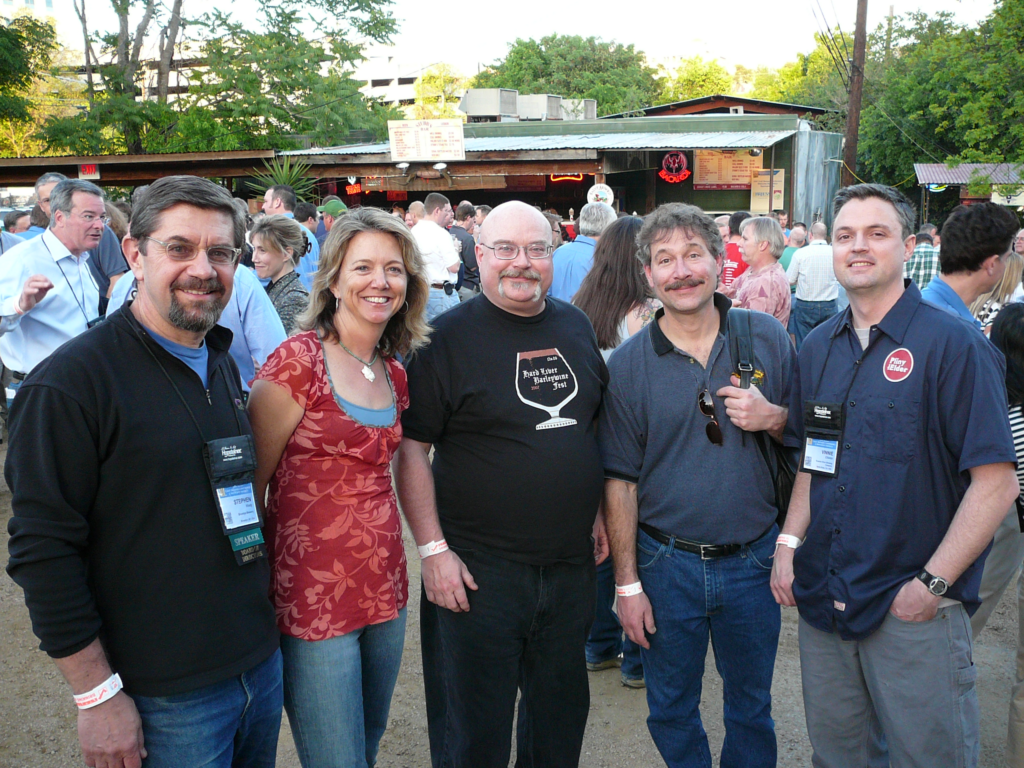
Stephen Beaumont, Steve and me at Barclay’s during SF Beer Week 2010.
Peace Or 2 Medals: Steve Altimari, from Valley Brewing
A very happy Steve at the Falling Rock Taphouse in Denver, after winning two medals at the 2009 Great American Beer Festival.
Steve-Donohue-2
The Three Steves: Steve Altimari, Steve Donohue and Steve Shapiro, from Beer by Bart, at the Breastfest. (Photo by Arie Litman.)
cbn-ann19-14
Craig Cauwels, from Schooner’s, with Steve at the Celebrator’s 18th anniversary party in 2007.
raley07-08
Peter Hoey, looking about twelve, with Steve, at the first Raley Field Beer Festival in 2007.

Filed Under: Birthdays Tagged With: California, Northern California

« Previous Page
Next Page »

Find Something

Northern California Breweries

Please consider purchasing my latest book, California Breweries North, available from Amazon, or ask for it at your local bookstore.

Recent Comments

  • Steve 'Pudgy' De Rose on Historic Beer Birthday: Jacob Schmidt
  • Jay Brooks on Beer Birthday: Bill Owens
  • Steve 'Pudgy' De Rose on Beer Birthday: Charles Finkel
  • Steve 'Pudgy' De Rose on Beer Birthday: Bill Owens
  • Steve "Pudgy" De Rose on Beer Birthday: Pete Slosberg

Recent Posts

  • Beer In Ads #5141: Eichler’s Holiday Bock Beer December 14, 2025
  • Historic Beer Birthday: Simon Fishel December 14, 2025
  • Beer Birthday: Vic Kralj December 14, 2025
  • Historic Beer Birthday: John Frederick Wiessner Sr.  December 14, 2025
  • Historic Beer Birthday: Jim Parker December 13, 2025

BBB Archives

Feedback

Head Quarter
This site is hosted and maintained by H25Q.dev. Any questions or comments for the webmaster can be directed here.