Brookston Beer Bulletin

Jay R. Brooks on Beer

  • Home
  • About
  • Editorial
  • Birthdays
  • Art & Beer

Socialize

  • Dribbble
  • Email
  • Facebook
  • Flickr
  • GitHub
  • Instagram
  • LinkedIn
  • Pinterest
  • RSS
  • Twitter
  • YouTube

Powered by Genesis

Marston’s Gobbles Up Old Thumper

July 12, 2007 By Jay Brooks

Marston’s, who brews Banks, Mansfield and Jennings as well as the eponymous beers, is buying out the regional Hampshire brewery, Ringwood, whose most well-known beer is undoubtedly “Old Thumper.” The pricetag is £19.2 million pounds (or just shy of $39 million dollars) and also includes Ringwood’s pubs in and around Hampshire. Six months ago, Marston’s also bought Eldridge Pope for £155m ($314.5 million U.S.).

According to a BBC article, “[t]he acquisition will boost Marston’s presence in the South of England and enhance its range of regional breweries which include Midlands-based Banks’s.” Alistair Darby, Marston’s managing director is quoted as saying. “We plan to develop its excellent brands as part of our strategy to meet consumer demand for premium ales with local provenance and heritage.” And here I thought they just wanted to make more money.

Ringwood Brewery has an interesting history. It’s situated in the relatively small town of Ringwood in Hampshire, which is in southern England, about 20 miles from the coast and 85 miles from London. The town is part of the rural district of Hampshire and is essentially a market town located along the River Avon and adjacent to “New Forest,” the largest remaining unenclosed pasture land, heathland and old-growth forest in England. By 1811, Ringwood was a bustling community and at one time boasted four breweries, but the last one — Carter’s — closed around 1923. Fifty-five years later, in 1978, Ringwood Brewery was opened by Peter Austin, who today is considered to be the “father of British micro-brewing.” Not only was he one of the first small breweries to open in modern times, but he also helped save cask beer from extinction.

The yeast Austin brought with him from the now-defunct Hull Brewery in northern England is today known as “Ringwood yeast” and is a popular ale strain used by countless small American craft breweries. Alan Pugsley, who learned brewing from Peter Austin, is the co-owner and master brewer of Shipyard Brewing in Portland, Maine. That’s also the reason that Ringwood’s “Old Thumper” beer is made under license by Shipyard for sales in North America. To learn more about how Ringwood Brewery greatly influenced the craft beer movement here in the United States, through Alan Pusgley, there are two illuminating interviews with him online by Lew Bryson and Andy Crouch.

Despite Marston’s claims that they’re only in it to “meet consumer demand for premium ales with local provenance and heritage,” I can’t help but be suspicious of yet another big brewery chain swallowing up a smaller one. These things rarely go well for the one being bought. There’s a lot of heritage in the Ringwood Brewery and it would be a crying shame if it was lost to another economic decision by a large company that only cared about its bottom line. And apparently I’m not the only one. CAMRA has also made its concerns known about the acquisition in a Publican article by Adam Withrington. CAMRA believes this buyout by Marston’s may have a “domino effect” for increasing the consolidations of pubs and breweries, a trend I personally thought was fairly well-established in England as already taking place.

From the Publican:

CAMRA chief executive Mike Benner said: “The practice among larger breweries of acquiring smaller competitors is a race where the only loser is the consumer who is often denied a locally brewed beer.

“As one of the larger breweries buys a brewery and expands their estate their competitors start hunting for their next purchase to keep up. CAMRA’s fear is that an increasing number of smaller breweries will be lost if this race continues and consumer choice will suffer as a result.”

CAMRA’s fears arise from a significant number of small local breweries being bought and closed down by bigger regionals over the last three years. Greene King has purchased both Ridley’s in Essex, Scottish brewer Belhaven and Nottinghamshire brewer Hardys & Hansons and closed all three breweries. In 2005 Fuller’s bought Hampshire regional brewer Gales and closed its brewery in Horndean.

The Ringwood Brewery in Hampshire, England.
 

Filed Under: Editorial, News Tagged With: Business, Europe, Great Britain

John White’s Final Trip

July 11, 2007 By Jay Brooks

I was at the Celebrator offices Monday night, doing a tasting of wheat beers for the next issue, when the sad news came in that John White, the tireless supporter of great beer passed away at 62. I never met the man, but know plenty of people who have and sang his praises. He ran the White Beer Travels website, a terrific resource for beer travelers and also beer-themed travel adventures known as “White Beer Travels Beer Hunts.” According to the website, White passed away on July 2 and a service celebrating his life was held on the 9th in his hometown of Grimsby, England.

Carolyn Smagalski has a moving tribute on her website, Bella Online, entitled “Tribute to a White Knight.”

John White with Michael Jackson in 2004.
 

Filed Under: News Tagged With: Europe, Great Britain, Travel, Websites

The Milwaukee Beer Party

July 10, 2007 By Jay Brooks

In a modern day version of the Boston Tea Party — but without the Indian costumes or a ship — Wisconsin beermakers staged a protest today by dumping out kegs of beer into the Milwaukee River. The Milwaukee Beer Party, which is what I’ll be calling it, was held to bring attention to Wisconsin SB 224, a state Senate bill that would make things more difficult for small local brewers.

From the AP article:

Basically, it divides small brewers into two licensed classes — those who want to serve food as brewpubs, and those who seek to bottle and distribute their product on a larger scale. The latter would face new restrictions on food service.

The brewers, who acknowledge they’re not savvy about the legislative process, say it’s not fair for new beer makers to have to decide their fate that early.

“Every business takes on a life of its own,” said Jim McCabe, proprietor of the Milwaukee Ale House. “For the guy that wants to start a brewery tomorrow, he’s got to make decisions early in his business life that aren’t possible.”

After countdowns in English and German, the kegs were opened with mallets that spewed suds across the deck and into the Milwaukee River.

The whole issue started when the Great Dane Pub opened a third location in the Madison area, but couldn’t sell its own brews because the law only allows two such operations per chain.

The brewers are also upset that the law was introduced on July 3 and is already scheduled for a vote Wednesday in the Senate’s Transportation, Tourism and Insurance Committee.

“This is just a run-of-the-night operation that’s being ram-roaded down our throats,” said Russ Klisch, owner of Lakefront Brewery Inc. in Milwaukee and president of the Wisconsin Brewers Guild. “There are so many questions out there that have been unanswered.”

It appears that lawmakers were unaware if the consequences of the actions and amendments are in the works, according to Terry Tuschen, a spokeperson for the bill’s sponsor, Senator Fred Risser (D-Madison). “Everybody’s working hard to fix what needs to be fixed,” Tuschen said. Still, if you live in Wisconsin, it probably can’t hurt to contact your local state senator’s office and ask them not to support the bill unless those provisions are amended or removed.


The Milwaukee Beer Party
From Channel 3 Wisconsin
 

Filed Under: News, Politics & Law Tagged With: Business, Law

The Official Beer of Planet Earth

July 10, 2007 By Jay Brooks

Now that’s a slogan: “The Official Beer of Planet Earth.” Butte Creek Brewing Co., the other little brewery in Chico, California, announced today that they will be revamping their entire packaging and introducing two new slogans, “Organic Pioneers” and “The Official Beer of Planet Earth.”

From the press release:

Golden West Brewing Announces Redesign of Butte Creek Organic Ales and Lagers

CHICO, Calif. — Golden West Brewing Company, Inc. announced today that it has completed the redesign of its core product line of Butte Creek Organic Ales and Lagers. The new labels, six-pack carriers, and case boxes released today in select markets eventually will be in all 25 states where Butte Creek is sold.

As part of the redesign of the brand, Butte Creek is using two new marks – “Organic Pioneers” and “The Official Beer of Planet Earth” – as cornerstones of its marketing campaign for the organic ales and lagers.

“We are very excited about the re-branding of Butte Creek Organic Ales and Lagers and believe our updated design is necessary to compete with recent entrants, such as Anheuser-Busch, into the organic beer category,” said John Power, President of Golden West Brewing.

Golden West Brewing has filed applications with the United States Trademark and Patent Office (“USPTO”) for both marks and hope the marks will be successfully registered with the USPTO. However, there is no guarantee the USPTO will publish the marks for opposition.

As part of the redesigning and marketing campaign, Golden West has secured new vendors for the glass and six-pack carriers that should reduce overall cost of these key raw materials.

“A limited price increase that went into effect July 1, combined with more effective purchasing of glass and cardboard, should improve our gross margins in the current third quarter of 2007,” Power said.

Golden West also announced the completion of a private placement of 282,000 shares at $0.33 per share to provide additional working capital. Details of the placement are contained in the Company’s Current Report on Form 8-K covering the financing.

About Golden West Brewing Company, Inc.

Golden West Brewing Company, Inc. was formed in 2003 and completed a small self-underwritten public offering in 2006. Golden West through its wholly owned subsidiary, Golden West Brewing Company, acquired the assets and certain liabilities of Butte Creek Brewing Company of Chico, California in August 2005. Founded in 1996, Butte Creek Brewing Company is one of the pioneer certified organic microbreweries in the United States


Filed Under: Uncategorized Tagged With: Business, California, Northern California, Packaging, Press Release

Beer Is Good For Your Lawn

July 10, 2007 By Jay Brooks

lawn-mower
According to lawn expert, Brad Fresenburg, beer can make your grass more green, thanks to the carbohydrates in it. Fresenburg is an extension and research associate at the University of Missouri at Columbia and he’s testing an internet lawn mix called “The Perfect Lawn Tonic” that uses five common household ingredients, one of which is beer. KSDK CBS Channel 5 in St. Louis, Missouri has asked Fresenburg to try out the tonic scientifically.

The five ingredients are beer, non-diet soda, mouthwash, household ammonia, and dish soap. “It’s really a home remedy that is simulating a lot of the bio-stimulants,” said Fresenburg. “There really isn’t anything in the ingredients that are going to be harmful to grasses.” Fresenburg believe the beer will benefit from carbohydrates in it to feed microbes that are in the soil.

When asked if the tonic will work, Fresenburg replied. “Yes and no, but it is going to do what they say it’s going to do as far as green color and maybe perhaps having a lawn look a little more green and lush,” said Fresenburg. “Especially at this time of year when grasses are struggling a little bit due to drought and perhaps turning a little bit brown … it will help with that effect.” At the end of the month, Fresenburg will be re-interviewed to gauge the results.

Here’s the tonic recipe:

The Perfect Lawn Tonic

1 beer (except light beer)
1 can of non-diet soda
1/2 cup mouthwash
1/2 cup household ammonia
1/2 cup dish soap (except anti-bacterial)

Mix all ingredients and pour into a 10-gallon hose end sprayer.

Spray on lawn after mowing — just enough to wet the grass.

Reapply every three weeks.

Filed Under: Just For Fun Tagged With: Midwest, Strange But True

Bravo for Bravo

July 10, 2007 By Jay Brooks

July 14, from Noon to 6:00 p.m., at Drake’s Brewing in San Leandro, California you’ll have another unique opportunity to taste at least twenty beers all made with the same hop, but with different malt, yeast and water. This year’s hop will be Bravo, a new variety that was “cultivated as a result of a cross in 2000 at Golden Gate Roza Hop Ranches in Prosser, Washington.” The new hop was only patented last year, and is distributed exclusively by S.S. Steiner, who donated the hops for the beers in the festival.

Drake’s Brewing Company 2nd Annual Beer Festival and Washoes Tournament will also feature music by The No Cover Band, The Shuffle Kings, and The Doormats. Your $35 admission price includes unlimited sampling, a commemorative glass, t-shirt and an entry into the Washoe tournament. This should be a lot of fun. Perhaps I’ll see you there.

From the press release:

Drake’s is about a 15-20 minute walk from the San Leandro BART station. Buses run up and down Davis Street. Cabs are available at the BART station. We are located at the loading dock area around the back of the Wal-Mart. Hope to see you here.


Some photos from last year’s inaugural festival:

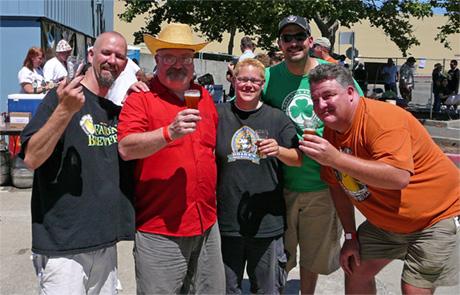
Drake’s brewer Rodger Davis, Dave Keene from the Toronado, Melissa Myers (also from Drake’s), James Costa from E. J. Phair, along with beer enthusiast Motor.

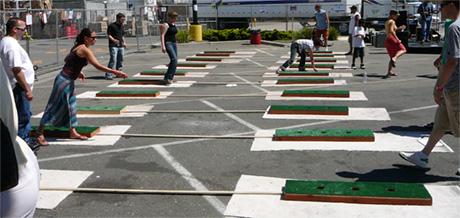
The Washoes Tournament underway.


Breweries Attending & Brewing the Same Hop IPA
 

  • The Beach Chalet
  • Bear Republic
  • Bison
  • Blue Frog and Grog
  • Devil’s Canyon
  • Drake’s
  • E.J. Phair
  • El Toro
  • Firehouse Grill
  • Half Moon Bay
  • Magnolia
  • Marin
  • Rubicon
  • Russian River
  • Sacramento
  • Seabright
  • Sonoma Chicken Coop
  • Stone Brewing
  • Thirsty Bear
  • Triple Rock
  • 21st Amendment
  • Valley Brewing


7.14

Single Hop Festival & Washoe Tournament (2nd annual)
Drake’s Brewing, 1933 Davis Street #177, San Leandro, California
510.562.0866 [ website ] [ directions ]
 

Filed Under: Events, News, Related Pleasures Tagged With: Announcements, Bay Area, California, Hops, Ingredients

Searching For the Holy Aroma

July 9, 2007 By Jay Brooks

According to Wired Science, scientists from Down Under (the Department of Food Science, University of Otago, in Dunedin, New Zealand, and the Australian Centre for Research on Separation Science, Department of Applied Chemistry, RMIT University, in Melbourne, Victoria, Australia more specifically) have published a paper identifying the chemicals creating the spicy aromas in noble hops using four different hop varieties: Target, Saaz, Hallertauer Hersbrucker, and Cascade. (That’s what’s being reported, target and cascade, of course are not noble hops.) They’ve now succeeded in finding the chemicals responsible for “spiciness,” using “two-dimensional gas chromatography mass spectrometry.” The equipment takes “individual chemical[s] from the hops in a two-step process, and then weighs the individual molecules to identify them.” There are nearly 1,000 separate chemical components that contribute to the aromas just from hops so this was definitely like looking for the proverbial needle in a haystack.

Dr. Lingshuang Cai and Jacek Koziel at Iowa State University

From the Wired article:

When the test results came in, five chemicals stood out from the others. All of them are terpenes. Geraniol, which is named after geranium flowers and obviously has a floral scent. Linalool, has a floral and spicy scent. It is also found in mint, cinnamon, and rosewood. Eugeneol has a spicy, clove-like aroma. Beta-ionone has a complex woody and fruity scent. Caryophyllene is found in black pepper.

Terpenes are a class of chemicals that are often responsible for the unique scent of food, perfume, and beverages. In 2002, other researchers showed that adding a tiny amount of a particular terpene to a very bland beer made it smell fantastic, but not quite as complex as a premium brew.

From the Abstract in the Journal of Agriculture and Food Chemistry:

The “spicy” character of hops is considered to be a desirable attribute in beer, associated with “noble hop aroma”. However, the compounds responsible have yet to be adequately identified. Odorants in four samples of the spicy fraction of hop essential oil were characterized using gas chromatography-olfactometry (GC-O) and CharmAnalysis. Four hop varieties were compared, namely, Target, Saaz, Hallertauer Hersbrucker, and Cascade. Odor-active compounds were tentatively identified using comprehensive two-dimensional gas chromatography (GC×GC) combined with time-of-flight mass spectrometry (TOFMS). An intense “woody, cedarwood” odor was determined to be the most potent odorant in three of the four spicy fraction samples. This odor coincided with a complex region where between 8 and 13 compounds were coeluting in each of the four spicy fractions. The peak responsible was determined by (i) correlating peak areas with Charm values in eight hop samples and (ii) heart-cut multidimensional gas chromatography-olfactometry (MDGC-O). The compound responsible was tentatively identified as 14-hydroxy-ß-caryophyllene. Other important odorants identified were geraniol, linalool, ß-ionone, and eugenol.

Filed Under: News Tagged With: Hops, Ingredients, Science of Brewing

Bottle Top Cake

July 7, 2007 By Jay Brooks

While I may not be a fan of the beer, this is a pretty impressive cake made to look like a Heineken crown! Perhaps more amazing is that this is easily one of the less impressive ones displayed at Hemmy’s Awesome Cake Art. It’s my daughter Alice’s third birthday today, but we went with a princess cake for her, which is what she’d been telling us she wanted for weeks now.


Filed Under: Food & Beer, Just For Fun Tagged With: Strange But True

Session #5: Atmosphere

July 6, 2007 By Jay Brooks

Today is our fifth Beer Blogging Friday “Session” and the topic is decidedly cerebral. Ron and Al, who run Hop Talk have chosen a topic near and dear to their hearts: atmosphere. Ron at Hop Talk wrote about atmosphere when they first started their blog almost a year ago. In that first atmospheric post, he wrote: “It might be a place, it might be a time, and it might be the company you are with; but, there’s no two ways about it, a beer will taste better if enjoyed in the right atmosphere.”

Fast forward to this June and the set-up for today’s session, which Ron and Al describe thusly:

Beer is about more than flavor, IBUs, and the debate over what is a craft beer and what isn’t. It’s about Life. It’s the proverbial icing on the cake.

So, we want to know about the “Atmosphere” in which you enjoy beer. Where is your favorite place to have a beer? When? With whom? Most importantly:

Why?

Because while life isn’t all about beer, beer is all about life.

I like this topic because it appeals to my philosophical nature and my tendency to over-analyze everything. I can’t really decide what is the right beer to have for such a discussion, though something atmospheric should do the trick. I suspect one isn’t really even necessary but I want to keep the tradition of including a beer as part of each Session. After all, what’s a Session without a beer?

After rummaging through the beer refrigerator I settle on a small 375 ml bottle of Russian River Temptation (batch 002) that’s been in there for several months, at least. As this is an out-of-this-world topic I give in to temptation and pick an out-of-this-world beer. So beer in hand, let’s tackle this sucker. High in the upper atmosphere — the exosphere — where the air is thinnest, is a good place to start. Metaphorically, I’d like to peel back the layers as we get closer and closer to the surface of things, where the air is thicker and richer. Will the heat shield hold? It’s been hotter than hades in the Bay Area this week. I hope I chose my beer wisely.

This far from home, your favorite place to have a beer is undoubtedly home. No matter how far you roam, no matter how many places you adopt as new homes, no matter how much time has passed, you only have one original home, the place you were born. I spent the first eighteen years of my life in one place and only three houses, two of which belonged to my grandmothers and the third one was purchased by my mother when she married my alcoholic stepfather when I was five. That one was in downtown Shillington. After high school, I left and came back more times than I care to remember, always drawn home like the proverbial moth to the flame, perhaps for the warmth of familiarity.

I was amazed to see Stan over at Appellation Beer chose the Northeast Taproom in Reading, Pennsylvania and included a piece he wrote ten years before when owner Pete Cammarano still had the place. What’s amazing about that is that Reading is my hometown — or near enough, I grew up just outside Reading in a little suburb called Shillington. So every visit home also included stopping in at the Northeast Taproom to spend time with friends who weren’t fortunate enough to escape the slow death of Reading from a mid-size industrial, manufacturing hub into the “Outlet Capital of the World” where busloads of shoppers from all over the east coast flock to buy cheap goods and take advantage of Pennsylvania having no sales tax on clothing.

After a stint in the Army Band, I was back living in the Commonwealth when I turned 21. I was also married (to my first wife) and putting myself through college and working full-time running a record store in the mall. So my best bar days were behind me, at least in Reading. I learned about most of the good ones while still underage as my stepfather had an uncanny knack of knowing all the best taverns, especially which ones had the best food. So by the time I was 21, I already knew the best ones to go to and so spent little time on experimentation. I already knew which ones felt comfortable to me, though it would take considerably longer to understand why that was so. Two teachers at Wilson High School — where by father-in-law was superintendent — wrote a book called “The Bars of Reading” and were invited to be on the Tonight Show. (My prick of a father-in-law told them they couldn’t go, but they managed it without his blessing, but that’s another story). I still have my copy and it’s still remarkable just how many corner bars there were in such a small town. At some of them, even today, you can still buy a 7 oz. glass of draft beer for under a buck. But the Northeast Taproom was by far the best in modern times. It was a great combination of good selection, quirky weirdness yet with that neighborhood bar feel to it. I haven’t been back since Pete sold the place and in a way I’m almost scared to go. I just don’t want to prove Tom Wolfe right, even though in this case he probably is correct.

So there is something about a drink at home in places dripping with nostalgia and memories. I often glance about such places furtively, forgetting for a second that I’m old enough to legally be drinking inside, not just stealing sips from my stepfather’s glass when no one is looking. But as comfortable as I feel in such places, having grown up in them, and despite such wonderful atmosphere they are more a piece of history and the past than my favorite places right now. For that, we have to descend farther into the atmosphere to the Thermosphere, where the Space Shuttle happily tests yeast and the Aurora Borealis straddles the Karman Line (at 100 km — the international definition of where space begins).

Below that is the Mesosphere, which is where most of the meters that shower the Earth burn up in the atmosphere. They’re just too hot to drink with, despite there being a French beer called Meteor. As we close in on Earth, we next descend into the Stratosphere, which is where what’s left of the ozone layer resides. It’s also where we send weather balloons to track the patterns in the atmosphere used by meteorologists to incorrectly predict the weather so maddeningly often. Just a little farther along we reach the final layer, known as the Troposphere. This where the airplanes fly, at its thickest a mere 23,000 feet (4 1/3 mi.) at the poles and 60,000 feet (10 1/2 mi.) at the equator. We sit at the very bottom of this airy fishbowl, on our barstools, talking about the weather and quenching out thirst with another beer. That’s our own atmosphere. Of course, it doesn’t answer the question of our favorite drinking atmosphere.

So let’s break the question down:

  1. Where
  2. When
  3. With Whom
  4. Why

1. Where

Where is probably the first aspect you think of when the question of atmosphere is posed. Location, location, location. The other W’s are merely window dressing to place and merely modify your experience of that place whether temporally, by its fellowship or the reason you’re there in the first place. So without question “where” is what atmosphere is all about. It’s the hokey pokey. Everything else that may or may not enhance it doesn’t stand a chance unless you’ve chosen the right place to begin with. So where are the best places? That’s undoubtedly a personal decision, but there is, I think, some universal criteria that we’d all more or less agree with.
 

  • Comfort: In my opinion, the best places are the ones where I feel the most comfortable, however you define that. I don’t necessarily mean safe, some of my favorite places are often described as dive bars. But you have to feel in place, not out of it. Often, that requires other people, but not always. There are plenty places of solitude that would qualify for me.
  •  

  • Beauty: It’s hard to admit, but looks do matter. Who wouldn’t prefer the stunning vista of mountains or a lake to a brick wall? There’s something universally calming about the idylls of nature. Why fight it?
  •  

  • The Source: It’s hard to imagine a better place than the source of something as the best place to enjoy it. I can’t imagine the unfiltered Radeberger Zwickel tastes sweeter outside of its native Dresden. Isn’t that why barrel tasting is so wonderful? You just can’t get closer to the source than that. I’m sure that’s why I like drinking in breweries so much.


2. The Rest

To me, when is less about time than season. Even here in California, where the seasons don’t make themselves individually known as forcefully as more temperate climates, there is a rhythm to the year. Some of it is imposed artificially by the calendar but much of it is still managed by nature herself. The time of year often makes the decision of a beer or range of beers for you. The blonde ale I’m enjoying right now is ideal for the warmth of this July day. If it were cooler, I’d be craving something heartier.

The people you drink with to my mind does more to change the experience than any other single factor, except for place. Simpatico drinking buddies are worth their weight in gold. They take a good situation — great place, great beer — and turn it into an experience worth remembering. Oftentimes, you can’t even remember what was discussed, just that it was an enjoyable experience. And in the end, that’s really all that matters.

And that brings us to why, which our hosts Ron and Al regard as being of the utmost importance. I’m not sure I place as much stock in the why as they do, though it’s undoubtedly important. I think, more often than not, the why of what makes a particular atmosphere comes out of the other factors, is in effect created by the place, the beer, the camaraderie, etcetera. It’s the synergy of all of the other factors coming together in such a way as makes them all fit together. I’m sure you can create those conditions artificially, but I’m willing to bet that it’s the ones that come together of their own accord that are the best. You can choose a great place. You can order a great beer. You can invite terrific friends to join you. But that’s still no guarantee of a great time. Oh, I’ll grant you it’s a good start and will probably work more often than not. Still, you could also go to the same place with the same people and drink the same beer night after night and not recreate a magical evening. It’s that indefinable synergy that provide the final ingredient and makes a pleasant evening into a truly memorable one.

Of course, like the best philosophy (not that I really have one), all of the preceding says quite a lot yet fails to answer the simple question of where is my favorite place to enjoy a beer. So here goes. During the day, my favorite location is where I spend most of my time — my house. In any comfy chair — comfort is king! — whether on the back deck, my office or the snuggle chair in the living room surrounded by my wife and friends is the ideal spot. At night, I fancy being out in the middle of nowhere with the bright stars twinkling overhead and a roaring campfire in front of me. Again, in a — what else? — comfy folding camp chair surrounded by my wife and friends.

Notice that regardless of the place, friends are an indispensable component of a favorite place to drink. Even though I continue to feel that location is of the utmost importance, it all falls apart if the experience can’t be enjoyed with the right people. Beer isn’t called a social lubricant for nothing. I haven’t read many other Session pieces yet, but I’m willing to bet sight unseen that for almost every single one, drinking with the right people is what it’s all about. I think that’s going to be near universal. Because while “place” makes the experience, “people” makes the experience worthwhile.

We started out, perhaps reluctantly, admitting “life isn’t all about beer” instead championing that “beer is all about life.” For those of us who think about beer so much more than the rest of the population — whatever we call ourselves — we do so because we’ve convinced ourselves that we’re in on a secret that enhances our very lives. It’s not necessarily a secret we want to keep, but instead is one we want to shout about to anybody willing to listen.

I imagine it’s like seeing color in a black and white world. How would you describe red or blue or yellow to someone who’s never seen color? And once you’ve seen the world in all it’s rich hues, the black and white world seems all gray and lifeless by comparison. It’s such a rich experience that you can’t help but want other people to see it, too. It’s too magnificent to keep it to yourself. It’s frankly a little frustrating when so many people seem to say, “nah, I like my world in black and white, thank you very much” because you know how much they’re missing. Sometimes I feel a little sorry for them, even though I know how patronizing and condescending that sounds. I see people I’ve known for years, still drinking industrial light lagers without a moment’s pause, and I just shake my head thinking of all of life’s pleasures they’re denying themselves. Because how could someone who thinks all beer is the same possibly even consider a question like atmosphere? It’s all the same, right? So what can it matter? I always imagine such people — trying to give them the benefit of the doubt — just feel they have more important things to think about. Truthfully, that never actually seems to be the case, and in fact many just seem to be sleepwalking through life not giving too much thought to any of the choices they make, beer or otherwise. If that really is the case, how many simple pleasures that you and I take for granted do they miss over and over again? If nothing else, loving beer is about enjoying life to the fullest, because it never stops with the beer. I guess beer is a gateway pleasure, because it leads to single malt scotch, cider, pairing with food, purposeful travel, fantastic cheese, port, cooking, and all manner of decadence that leads to a richer, fuller life. It also leads to an intuitive understanding that the very idea of “atmosphere” is important to the true enjoyment of life. That there is a healthy percentage of the world that can’t see that is very sad, indeed. Maybe that’s why there’s so much misery in the world today. Perhaps better beer really could save the world. Okay, I’ve changed my mind again. My favorite place to have a beer is that future world where everybody drinks good beer, war is an unknown concept and everybody understands that a life half-lived is a life wasted.

Hey, I can dream, can’t I? I’ll hold out until everybody understands the following poem, Lines on Ale (1848), by Edgar Allen Poe (1809-1849):

Fill with mingled cream and amber,
I will drain that glass again.
Such hilarious visions clamber
Through the chamber of my brain.
Quaintest thoughts, queerest fancies
Come to life and fade away.
What care I how time advances;
I am drinking ale today.

Amen, brother.


Filed Under: Editorial, The Session Tagged With: Websites

Alabama Loses One to Fire

July 5, 2007 By Jay Brooks

There are already painfully few craft brewers in Alabama and yesterday another one — Olde Towne Brewing — was lost, destroyed by fire. It had been Huntsville, Alabama’s only brewery since Prohibition ended, opening in 2004. According to the Huntsville Times, the fire began in the middle of the night — around 2:30 a.m. — and by morning was gone. Owner Don Alan Hankins had returned to his native Hunstville to open the brewery after having worked at and founded several more throughout the Southeast. So far, no one’s sure what started the fire.


Filed Under: News Tagged With: Southern States

« Previous Page
Next Page »

Find Something

Northern California Breweries

Please consider purchasing my latest book, California Breweries North, available from Amazon, or ask for it at your local bookstore.

Recent Comments

  • Bob Paolino on Beer Birthday: Grant Johnston
  • Gambrinus on Historic Beer Birthday: A.J. Houghton
  • Ernie Dewing on Historic Beer Birthday: Charles William Bergner 
  • Steve 'Pudgy' De Rose on Historic Beer Birthday: Jacob Schmidt
  • Jay Brooks on Beer Birthday: Bill Owens

Recent Posts

  • Beer In Ads #5228: All Together For Newark April 21, 2026
  • Beer Birthday: Steve Parkes April 21, 2026
  • Beer In Ads #5227: It’s Here! Bock Beer By Bosch April 20, 2026
  • Beer Birthday: Drew Beechum April 20, 2026
  • Beer Birthday: Des De Moor April 20, 2026

BBB Archives

Feedback

Head Quarter
This site is hosted and maintained by H25Q.dev. Any questions or comments for the webmaster can be directed here.