
There was an amusing little spoof on the Canadian humor site The Toque called “Plant Your Own Beer Garden.” They suggest simply planting the bottles in the ground, but caution against “over-planting. Too many beers in one garden will result in a watery, low-alcohol “lite” beer.”
Zatec Is Coming
In German, the famous hop used in those original Czech pilsners is called “saaz” hops, but in the Bohemian part of the Czech Republic, where they’re grown, the word is “zatec,” named for the town where they were first grown. According to the town’s history, “the name of Zatec was first mentioned in the Thietmar of Merseburg Chronicle in 1004.” Today the town of Zatec has its own hop museum.
There’s also a brewery in town, Zatecky Pivovar, and they’ve been brewing in the same location for a long, long time.
The history of Czech breweries contains only two breweries with proven a tradition of brewing beer in a single location for more than 700 years — Svitavy (1256) and Žatec (1261). The Society of Žatec Privileged Brewers was established in Žatec in 1261. The two beers called “Samec” and “Kozel” were in high demand in Bohemia and at court, requested by nobility and lords, at the table as well as for festive parties.
|
Merchant Du Vin, the Seattle importer who also brings Ayinger, Lindemans, Orval, Rochefort, Samuel Smith, Traquair House, and Westmalle, among others, into the U.S., will now be distributing Zatec in the States, as well. According to the press release, product should be in the states some time this June. From the press release:
|
The Zatecky Pivovar in Zatec, Czech Republic.
May is Mild Month

The British advocacy group CAMRA, the Campaign for Real Ale, promotes the month of May as “Mild Month” in an effort to educate people about a style that’s dying before their eyes throughout England. Since this Friday’s “Session” — a.k.a. Beer Blogging Friday — that I’ll be hosting will be about Milds, I thought I’d collect and provide some basic information about this relatively unknown and misunderstood style. In fact, the theme for Friday’s “Session” is “The Mysterious Misunderstood Mild” in an effort to make these delicious beers less so. Yesterday, CAMRA had a press release in anticipation of Mild Month beginning today that summarizes their efforts.
Mild was once Britain’s most popular style of real ale, but had fallen out of fashion in favour of other beers. However there are still many brewers who are enthusiastic about the future of Mild and CAMRA is dedicated to making sure their beers get the credit they deserve.
May has been designated as Mild Month by CAMRA and the consumer organisation is urging beer lovers to seek out milds in their local pubs and rediscover this wonderfully flavoursome beer.
CAMRA also suggests a few recipes for cooking with mild.
Mild’s popularity has been waning since at least 1960. In 1959 the style accounted for 42% of beer sold in Great Britain, but by 1980 its popularity had dropped to a mere 10% and today it’s far less than that. For a good overview of the history of the style and what led to its decline, read the December 1998 article that All About Beer magazine ran on the subject by Roger Protz, entitled “Vanishing Mild.”
Here’s how CAMRA describes milds:
Mild is one of the most traditional beer styles which is enjoying a revival in today’s real ale market. Usually dark brown in colour, due to the use of well-roasted malts or barley it is less hopped than bitters and often has a chocolatety character with nutty and burnt flavours.
Cask conditioned Mild is a rarity in a lot of parts of the country, which is a crying shame, because Mild is a distinctive and tasty beer. Mild is one of, if not the, oldest beer styles in the country. Until the 15th century, ale and mead were the major British brews, both made without hops. Hops were introduced from Holland, France and Germany after this time. This also started the trend on reducing the gravity of ale, as the Hop is also a preservative, and beers had to be brewed very strongly to try to help preserve them. The hop also started the rapid decline of mead, which is only made in a very few places today.
So what is Mild? It is a beer which has tastes and textures all it’s own. Basically it is a beer that is less hopped than bitter, etc. The darkness of Dark Milds, such as Greene King XX Mild, comes from the use of darker malts and/or roasted barley which are used to compensate for the loss of Hop character. “Chocolate “, “fruity”, “nutty” and “burnt” are all tastes to be found in the complexity of Milds. However, not all milds are dark. Yorkshire brewed Timothy Taylors Golden Best is one of the best examples of a light coloured mild, as is Bank’s Original, the name changed from Mild to try to give it a more modern image. In Scotland, 60/- ale is similar to mild (Belhaven’s being a good example).
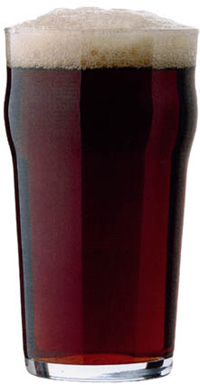
Milds today tend to have an ABV in the 3% to 3.5% range, with of course some notable exceptions. In fact, a lot of the Microbreweries who try their hand at mild are bringing the alcohol content back up somewhat! Mild wasn’t always weaker though. In the latter half of the 19th Century, milds were brewed to about the same strength as bitters as a response to the demand for a sweeter beer from the working classes and in those days most bitters were around 6 to 7% ABV.
During the First World War, malt rationing and pressure from the temperance movement led to brewers rapidly reduced the strength. Following the Second World War, as prosperity returned, mild`s popularity as a cheap ale began to fade, not being helped by being kept badly in run down pubs as the Big Brewers began to heavily promote their keg lager brands. Coupled to this was a gradual, but steady decline in heavy industry in the North and Midlands of Britain, mild`s great marketplace.
By the 1970s, the keg lager boom had seen mild’s share of the market fall to around 13% and it was a shame to see a bland gassy and overpriced product, which was generally weaker than the mild it was trying to oust, succeed in many cases.
On this side of the pond, there is a great deal of confusion about milds, though for me the most curious issue is that people don’t like the name. What on earth could be wrong with the word “mild,” which in terms of flavor is defined as “not sharp, pungent, or strong.” It’s the very opposite of extreme, but is still full-flavored and delicious. I can think of countless scenarios where a mild would be the ideal compliment to the situation, weather, food, etc.
Making things more confusing is the fact that oftentimes in England a mild when bottled is called a brown ale, but this is still not the same as a brown ale like Newcastle. And then there’s the fact that there are two recognized styles of milds, pale milds and dark milds, further clouding things.
The BJCP organizes milds under their Style #11, English Brown Ale, with 11A designated mild and two additional sub-styles, northern and southern English brown ale. They suggest IBUs of 10-25, SRM of 12-25, and ABV of 2.8-4.5%, with most falling between 3.1-3.8%. The only American example they list is Goose Island PMD Mild.
For the 2007 Great American Beer Festival, The Brewers Association will for the first time include milds as a separate category in the style guidelines. Two categories, actually, as they’re dividing them into two separate styles, English-Style Pale Mild Ale and English-Style Dark Mild Ale. These appear to be the same as Category 56 for the World Beer Cup. For the BA, Pale Mild has IBUs of 10-20, SRM of 8-17 and ABV of 3.2-4% and for Dark Mild, IBUs of 10-24, SRM of 17-34 and ABV of 3.2-4%.
The color distinctions between the two are described as “golden to amber” for pale mild and “deep copper to dark brown (often with a red tint)” for dark mild. Both are dominated by malt favors with very low bittering discernible and allow for some low levels of diacetyl (butterscotch). The dark mild may also include some licorice or “roast malt tones.”

On Friday, if you’re participating in “The Session,” be sure to post a comment to the mild hosting post that will appear here on the Bulletin shortly after midnight PDT. I’ll try to add links in near-realtime and write up the days’ entries as time permits.

So for Friday’s Mild Session Blogging Extravaganza, it might not be quite as simple to find a mild as going to your friendly neighborhood corner bar or liquor store. Hopefully, the information listed above may give you some help in finding a suitable beer to write about. The beer may not have the word “mild” written anywhere on the label, but if it’s close to the style parameters then go for it. The idea of Beer Blogging Friday is to be as inclusive as possible so we’re not going to get too hung up on strict style standards — whatever those might be. Find a “mild” beer and join us. To get you started, listed below are some American milds listed on the major beer forums:
The Top Rated American Milds From Beer Advocate*
English Pale Mild Ale:
Mild Ale, from Southern Tier Brewing, Lakewood, New York
Arcadia Special Reserve, from Arcadia Brewing, Battle Creek, Michigan
Cattail Ale, from Lakefront Brewery, Milwaukee, Wisconsin
English Dark Mild Ale:
Merrimack Mild, from The Tap (Haverhill Brewery), Haverhill, Massachusetts
Milltown Mild, from Victory Brewing, Downingtown, Pennsylvania
Harbor Lighthouse Ale, from Bar Harbor Brewing, Bar Harbor, Maine
Pride & Joy Mild Ale, from Three Floyds Brewing, Munster, Indiana
Motor City Brewing Ghettoblaster, from Motor City Brewing Works, Detroit, Michigan
The Top Rated American Milds From Rate Beer*
Merrimack Mild, from The Tap (Haverhill Brewery), Haverhill, Massachusetts
Dawn Patrol Dark Mild, from Pizza Port, Solana Beach, California
Titletown Brewing Whistling Chicken Mild Ale, from Titletown Brewing, Green Bay, Wisconsin
Flossmoor Station XXX Mild Ale, from Flossmoor Station, Flossmoor, Illinois
Brew It Up! Northern Mild Brown Ale, from Brew It Up!, Sacramento, California
And here are a few more American milds that I know about:*
Bells New World Ale, from Bells Brewery, Galesburg, Michigan
Iron Hill Mild Ale, Iron Hill Brewpubs, various locations in Delaware and Pennsylvania
Jeezum Jim, from Magic Hat Brewing, South Burlington, Vermont
John Harvards British Pale Mild, John Harvards Brewhouse, various locations
Lee’s Mild, Stone Brewing, Escondido, California
London Tavern Mild, from Valley Brewing, Stockton, California
Midlands Mild Ale, from Avery Brewing, Boulder, Colorado
Sara’s Ruby Mild, from Magnolia Pub & Brewery, San Francisco, California
Schlafly English Mild, from the Saint Louis Brewery, St. Louis, Missouri
Thunderhead Mild Ale, from Thunderhead Brewing, Kearney, Nebraska
Triumph Mild Ale, from Triumph Brewing, Princeton, New Jersey
Wynkoop Mayorale Mild, from Wynkoop Brewing, Denver, Colorado
* For both Beer Advocate and Rate Beer, most of the top-rated milds are, naturally, English beers. I removed those British beers from the list here because I figured it was we Americans (and Canadians) that will need the most help in finding a mild. And for all of the listed beers, I have no idea whether or not they are currently available.
Buckeye Victory
Again, vacation put me behind the curve on this one. I learned two weeks ago that there was trouble brewing in Ohio when KevBrews e-mailed me and a BA staff member told me about it at CBC. Even then, it looked like the language that would have been so detrimental to brewpubs wasn’t going to make it through, but I tend to be cynical about these things so I continued to worry.
It turns out the BA‘s new grassroots organization, Support Your Local Brewery, had things well in hand. Here’s their story:
Victory in Ohio Thanks to Support Your Local Brewery Members!
On April 19, Support Your Local Brewery was alerted to a potentially devastating piece of legislation on the fast track in the Ohio House of Representatives. A bill dealing with issues relating to the direct shipment of wine was amended to include language that would have essentially stripped self distribution and direct to consumer sales by breweries and brewpubs.
With a floor vote scheduled in less than 24 hours, Ohio members of the Support Your Local Brewery network were alerted and generated dozens of grassroots contacts to legislators’ offices. By April 20th, the offending provision had been pulled from the bill. Your efforts, coupled with the outreach carried on by many Ohio small brewers, turned this threat back, one which would have almost certainly hamstrung many breweries and potentially closed many brewpubs.
Thanks to all those who answered the call, acted in the best traditions of Support Your Local Brewery Beer Activists and helped to ensure the continued success of the Buckeye State’s small brewing community. Cheers!
KevBrews also received an e-mail response from Jon A. Husted, the Speaker of the Ohio House of Representatives, confirming that the anti-brewpub language had been removed from the budget bill. I’m certainly glad that so many people could be marshaled to the cause in such a timely manner, but the speed with which the entire episode arose left me feeling disconcerted about when this will happen again and whether we’ll be as successful or lucky. I’d like to be able to just say “relax, don’t worry, have a beer” but that little voice inside my head won’t let me, the bastard.
Sprecher Remakes Shakparo Gluten-Free
I’m still catching up from the last four days of my vacation, when I had very limited internet access (I could check my e-mails, that was all). I’m amazed how dependent on it I’ve become. I can do without a phone, television, radio and even a daily shower but I start twitching like a junkie at the prospect of even one day without access to the internet. I know it’s a little sad, but there it is. So it goes. Anyway, on to more important things.
|
Sprecher Brewing in Glendale, Wisconsin, announced they will be reformulating one of their limited release beers to be gluten-free, making them the latest established brewery to enter the fray. Last year Sprecher first brewed Shakparo Ale, a beer made with sorghum, and most likely barley and/or wheat, as well. It was based on a west African recipe. Due to demand from customers suffering from Celiac disease (who cannot have several common grains in their diet, such as barley and wheat) Sprecher decided to begin making it with millet, in addition to the sorghum, so it would be wheat and barley-free. Sprecher describes their original Shakparo Ale as follows:
It also had an original gravity of 14P, was aged for 5 weeks, had only 9 IBUs and was 5.7% a.b.v. OnMilwaukee‘s food writer Amy L. Carlson put it this way.
Sorghum is a traditional grain throughout parts of Africa, and even the Guinness brewed for the continent has sorghum in it. Shakparo is also apparently a time-honored type of local brew, though there is little documentation about it. |
One of the few I’ve been able to find online, is the introduction to an article on how to homebrew Shakparo in the brewery.org library entitled “Shakparo: a Traditional West African Sorghum Beer.”
One example of the use of of traditional microbial biotechnology to produce ennobled foods is Shakparo beer, which have an immense social, economic, ritual, nutritional, sanitary role in the Idashaland, Dassa-Zoume, in the Savannah region of Republic of Benin, West Africa. It is brewed mainly from malted guinea corn (Sorghum vulgare, S. bicolor) is an example of the use. Sorghum, also called gros mil in French, seems to be the best cereal for shakparo brewing. Shakparo is a green beer, “wild” fermented,but not so “wild” as Russell and I concluded after private e-mail correspondence; shakparo yeast is somewhat cultured or maintained on an immobilized form on the fermenting vessels(clay pot or vegetable gurd). The beverage has a full body, long aftertaste, a fruity, pleasantly sour taste ( I’m as objective as I can),with a complex estery and organic acid flavor and yoghur and sorghum aroma. It is very thirst-quenching, and it is cloudy and yeasty, with a brownish pink color. The alcohol content ranges from 1 to 8% by volume. A fresh beer bubbles, contains 3 to 4 % alc. / vol and 6 % solids. The enjoyer burp and the typical aroma come back. The traditional form of the product has a short shelf life and must be consumed within a few days after ~ 24 h fermentation.
Shakparo is a traditional sorghum beer brewed by Idasha women, the “grand cru corse” version being consume mainly by man. Long before the rise of western feminism, women of the generally matrilinear beer drinker’s tribes used beer to ensure their power in the society. An Idasha myth reports that a grateful heroic ancestor build the first market for his mother to sell the fruit of her work, most notably her beer. Before “modernization” it was easy to find good shakparo in Dassa-Zoume and the region around region. Every “normal” home has it’s brewery (a part of the kitchen). Mothers teach brewing art and science to their girls before marriage. An Ifa verse which sets the temperance rule report that Beer and his brothers Palm Wine and Raphia Wine consulted the oracle. These beverages are highly esteemed by the thirsty gods of the Voodoo / Orisha based civilizations.
Shakparo can be considered to be in the same family as bantu beer (called kaffir beer before the south African revolution), pombe (East Africa) dolo (Burkina Faso, Mali), burukutu (Nigeria), pito (Ghana and Nigeria), bouza (Egypt, Ethiopia), merisa ( Soudan), hemeket or zythum or zythos, last word of the dictionary (Ancient Egypt), shukutu (Benin and Togo), Tchakpalo (Benin, Burkina Faso, Cote d’Ivoire), bil-bil (Cameroon). Tourists and culturally alienated Africans often look upon those products as primitive dirty and harmful stuffs and prefer to drink Becks, Heineken and Kronenbourg.
Despite the cultural importance of traditional sorghum beer, scientific investigations are few and often contradictory and there aren’t any geared towards shakparo specifically.
Still, an interesting development as this small niche continues to grow, especially after the recent introduction of Anheuser-Busch’s Redbridge Sorghum Beer.
Math and Beer Bubbles
A new study published in the new issue of the journal Nature could have ramifications for your next pint of beer. Well, maybe not your next, but at some point in the future it may change the way brewers think about brewing their beer.
The article, by mathematician Robert D. MacPherson of Princeton’s Institute for Advanced Study and physicist David J. Srolovitz of Yeshiva University, is saddled with the indecipherable jargon-laden title, “The von Neumann relation generalized to coarsening of three-dimensional microstructures.” What that means essentially for the bubbles in your beer, is that they’ve found a mathematical formula that can be used to accurately predict and map out the dissipation of the head. It also describes the growth patterns of the beer bubbles, or any cell with boundaries. As co-author Srolovitz tells it. “What the theory does is it tells you how the size of every single bubble will evolve in time.”
Here’s the abstract:
Cellular structures or tessellations are ubiquitous in nature. Metals and ceramics commonly consist of space-filling arrays of single-crystal grains separated by a network of grain boundaries, and foams (froths) are networks of gas-filled bubbles separated by liquid walls. Cellular structures also occur in biological tissue, and in magnetic, ferroelectric and complex fluid contexts. In many situations, the cell/grain/bubble walls move under the influence of their surface tension (capillarity), with a velocity proportional to their mean curvature. As a result, the cells evolve and the structure coarsens. Over 50 years ago, von Neumann derived an exact formula for the growth rate of a cell in a two-dimensional cellular structure (using the relation between wall velocity and mean curvature, the fact that three domain walls meet at 120° and basic topology). This forms the basis of modern grain growth theory. Here we present an exact and much-sought extension of this result into three (and higher) dimensions. The present results may lead to the development of predictive models for capillarity-driven microstructure evolution in a wide range of industrial and commercial processing scenarios—such as the heat treatment of metals, or even controlling the ‘head’ on a pint of beer.
It’s pretty heady stuff — yes, pun intended — although it will likely be many years before it can be applied directly to brewing beer, if it ever really can be used in that way. It certainly seems plausible that it may be restricted to analysis after the fact, though even that may yield insights on what to tweak in the process for the next batch in the search for the ideal head.
Beer Chef Dinner: Valley Brewing at Cathedral Hill Hotel
4.27
Dinner with the Brewmaster: Steve Altamari of Valley Brewing
Cathedral Hill Hotel, 1101 Van Ness Avenue, San Francisco, California
415.674.3406 [ website ]
Harveys Home Again
By the time you read this, you can walk into the Lewes Arms in Sussex, England and once more order a pint of the local favorite, which is brewed down the road, Harveys Best Bitter. Since last December, when Greene King pub owner pulled Harvey’s tap because their own Greene King beer wasn’t selling nearly as well, the Friends of the Lewes Arms have been boycotting the pub asking for Harvey’s ale to be reinstated.
Throughout the boycott, the giant Greene King acted the part of bully with perfect arrogance and cluelessness. Their actions created something of a P.R. nightmare for them, and in the end doomed them to failure. Even when the writing was on the wall, they continued to act like bullies who could and would do whatever they wanted in the name of business. But eventually they capitulated, saying they would take another look at the issue. On April 20, they announced Harvey’s would be returned to the pub. Both the BBC and the Publican reported the news (as did fellow beer blogger Stonch), with Greene King making the following statement.
|
Today, Thursday April 26, Harveys Best Bitter will be on tap once more at the Lewes Arms, which is excellent news indeed. Congratulations to the Friends of the Lewes Arms.
Not Just Age and Taxes
Science Daily asks “When Are Minimum Legal Drinking-age And Beer-tax Policies The Most Effective?” in reporting on a new study about to be published in the May issue of “Alcoholism: Clinical & Experimental Research.” The study, “The Joint Impact of Minimum Legal Drinking Age and Beer Taxes on US Youth Traffic Fatalities, 1975-2001,” was funded by the National Institute on Alcohol Abuse and Alcoholism, a government agency and branch of the N.I.H. Their mission statement is to “provide leadership in the national effort to reduce alcohol-related problems.”
The study looked at the two most common ways in which government has tried to reduce alcohol-related societal problems: through the minimum drinking age and raising taxes on beer (notice how wine and spirits get yet another pass?). Most significant is the finding that “[w]hen it is illegal for youth to buy and consume beer — as it is now in all 50 US states — higher beer taxes are less effective.” Hear that Oregon legislators (and every other state official trying to extort money from small brewers)?
“Our findings suggest that some of the varying results across past research may simply indicate that a given public policy may not have the same effectiveness in all places and times,” said William R. Ponicki, one of the study’s authors. What that doublespeak means is essentially that for any given policy decision, many other factors determine whether the policy will work as intended or not. It’s not just a simple matter that raising the drinking age will cure underage drinking or that making beer more expensive will either. And that’s just looking at two very broad factors. Imagine all the others at work but not examined, such as peer pressure, alcohol’s perception in our culture, accessibility, and on and on.
What that suggests to me is that MADD and the other neo-prohibitionists were and are misguided in pushing for a higher minimum drinking age, tougher access for legal adults, higher taxes for alcoholic beverages and all the other harebrained ideas on their agenda without having any real notion of how they’ll effect society or even if they have a chance of working. There’s absolutely no reason that legal adults should have to pay more for legal products or have a harder time legally buying them, especially when such measures have not been shown to be effective in reducing any perceived problems. Frankly, I’m sick and tired of being in their petri dish of experimental legislation to mold society to their wishes. It’s my world, too. And yours, as well. We should try to remember that, I think, when fanatics try to remake it for their own benefit and worldview.
Good Beer Deserves the Right Glass
The Syracuse Post-Standard ran a nice article entitled “Good beer deserves the right glass” by staff writer Don Cazentre, who’s also a homebrewer. He provides a good rudimentary introduction to the importance of drinking beer not just from a glass, but from the proper glass. It’s another good example of better beer coverage by the media.