Brookston Beer Bulletin

Jay R. Brooks on Beer

  • Home
  • About
  • Editorial
  • Birthdays
  • Art & Beer

Socialize

  • Dribbble
  • Email
  • Facebook
  • Flickr
  • GitHub
  • Instagram
  • LinkedIn
  • Pinterest
  • RSS
  • Twitter
  • YouTube

Powered by Genesis

Bistro Double IPA Festival 2007

February 11, 2007 By Jay Brooks

The 7th annual Double IPA Festival was held yesterday at the Bistro in Hayward, California. There were 42 beers that we judged, narrowing it down to four. All four were terrific beers and any one of them could have ended up in first place, though ultimately Ballast Point Point Brewing‘s Dorado was the one we picked. Judging when pretty smoothly and we had a great group this time, including three Brits in town working on a CAMRA book on the west coast.
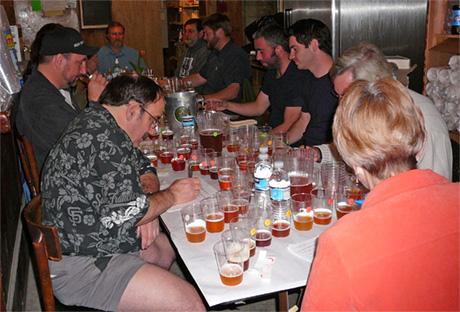
Judging in the cellar, trying to take the final ten beers and pick three winners.
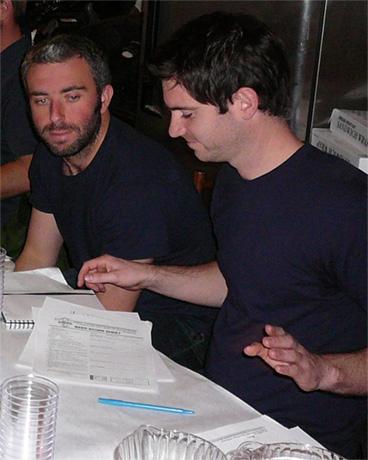
Ben McFarland, this year’s British Beer Writer of the Year, and Tom Sandham. The pair are in town along with my friend Glenn Payne (who helped start Meantime Brewing) to work on a CAMRA guidebook for British and European tourists coming to the west coast.
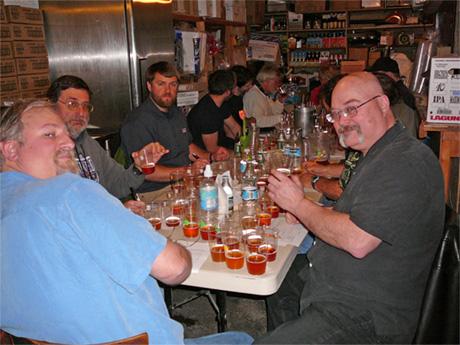
The other end of the judging table, with me flanked by Pete Slosberg and Dave Keene.
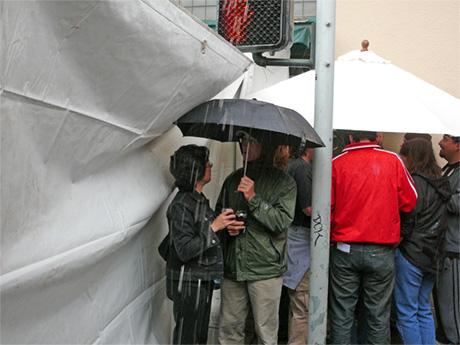
While upstairs it was raining something firece.
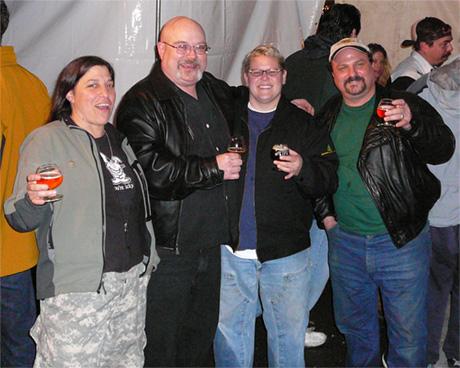
Darn, I forget the woman on the left’s name, but the rest are Dave Keene (owner of the Toronado), Melissa Myers (with Drake’s Brewing) and Ed Chainey (with Anderson Valley Brewing).
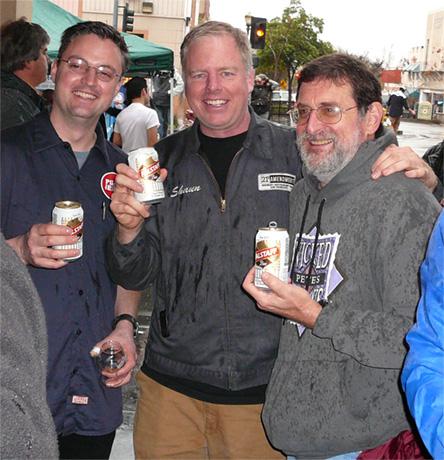
Vinnie Cilurzo (from Russian River Brewing), Shaun O’Sullivan (from 21st Amendment) and Pete Slosberg share a Falstaff.

Filed Under: Events Tagged With: Bay Area, California, Festivals, Photo Gallery

Nano Breweries

February 11, 2007 By Jay Brooks


Last week in the northwestern Washington Tri-City Herald there was a nice profile of a small Washington brewery, Laht Neppur Brewing, which is the last name backwards of the owners, Court and Katie Ruppenthal. The brewery is located in Waitsburg, Washington, which is in the southeastern part of the state, a little bit north of Walla Walla. The Ruppenthal’s brewery has been open a little over six months, having sold their first beer last June.

According to the article, they first thought most of their sales would be to local bars and restaurants but the brewery in their converted workshop has become a popular local hangout in its own right. Several of their popular beers sell out before they can be delivered outside the tiny brewery. But the Ruppenthal’s brewery is very laid back, with customers able to cook their own food on the grill. It’s become a community center of sorts.

Given the recent discussions about children at beer places, this passage lept out at me.

Children are welcome and even have their own toy boxes and a tiny broom to push around the broken peanut shells that litter the concrete floors. “We have a cement floor and metal furniture,” Katie said. “It’s not like, ‘Oh, they’re going to break something.”

But earlier in the article, co-owner and brewer Court Ruppenthal muses that his brewery is more like a “nano brewery” than a microbrewery, which started me thinking. A microbrewery is defined as a brewery that “produces less than 15,000 barrels of beer per year.” There are a few other bits to the definition, but that’s the main distinction. Above that are regional breweries (up to 2 million barrels) and then, simply, breweries (or big or national ones, with over 2 million barrels). There are only four breweries making more than 2 million barrels per year, and 53 that produce between 15,000 and 2 million (according to the 2006 figures from Modern Brewery Age). So out of roughly 1400 U.S. breweries, only 57 are large, leaving around 1,343 microbreweries (including brewpubs, whose definition has to do with their percentage of packaged beer sold).

So it seems to me on a practical basis, the term microbrewery doesn’t seem as useful anymore, or at least seems to need some modification. The various sizes of the remaining breweries and some patterns there seem to suggest some changes to the definitions. For example, below 15,000 annual barrels there are only five that brew more than 10,000 each year. Looking at the next 5,000 barrels down shows another big drop off, with only 19 breweries producing between 5,000 and 10,000 barrels per annum. So that means there are still a whopping 1,319 breweries that make less than 5,000 barrels per year.

If we keep going, only 10 make between 4,000 and 5,000 barrels annually, 16 between 3,000 and 4,000, and 17 between 2,000 and 3,000. This means 1,276 make less than 2,000 barrels of beer each year. Fully 67 breweries make more than 1,000 barrels so that’s still approximately 1,209 below a thousand barrels per year. The reason for doing all that math is to show that the overwhelming majority of breweries make a very small amount of beer each year. This is not to take anything away from their efforts, but in terms of what’s important to their interests, I have to believe they’re different from that of the larger concerns. There’s such a wide range of sizes within the definition of microbreweries that there must be a correspondingly varied set of issues they face, as well.

So I’m not quite sure where you’d draw the line, though at either 2,000 or 1,000 seems prudent. Those breweries, I think, we should define as nano breweries. Technically, the prefix “nano” means one billionth but more colloquially simply is used to denote the very small (as in nanotechnology). Fittingly, the Jargon File says the following about nano:

– pref. [SI: the next quantifier below micro-; meaning *10^(-9)] Smaller than micro-, and used in the same rather loose and connotative way. Thus, one has nanotechnology (coined by hacker K. Eric Drexler) by analogy with `microtechnology’; and a few machine architectures have a `nanocode’ level below `microcode’.

So in computer or math parlance, nano is directly below micro in terms of size. Next below nano is actually “pico,” technically meaning one-trillionth, but at some point it might also be useful to have microbreweries, nanobreweries and picobreweries.

But for now I’d argue for dividing the current definition of micros into two, with micros being breweries that produce between more than either 1,000 or 2,000 barrels per year and nanos being breweries that produce less than 1,000 or 2,000 each year, along with all of the other current parts of the definition. And since there are so few breweries between 10,000 and 15,000 barrles per year, perhaps the upper microbrewery/lower regional boundary should be changed to 10,000. The reason for doing this, I think, is in terms of not just size but the way in which these different size breweries function, are organized and approach the market, which I believe is radically different between all of the divisions. Thus it would make sense to start talking about them as separate parts of the beer industry, in much the same way we do now with the big breweries, regional breweries and microbreweries.

Anybody else have any thoughts or comments to add?

Filed Under: Editorial Tagged With: Business, Profiles, Washington

Shoo Fly Beer Pie

February 11, 2007 By Jay Brooks

I was surprised to come across a recipe for Shoo Fly Pie, especially in a Chicago area newspaper. I grew with Shoo Fly Pie, it was available at most restaurants and bakeries where I grew up. It’s essentially an Amish or Mennonite dessert, although there are versions of it in the deep south, too. It’s basically a pie made with molasses as the filling. Because it’s so sweet it was thought to attract flies which then have to be “shooed” away, and that’s supposedly how it got its name. When I was a little kid, I thought it was made with actual flies and refused to eat it. But now I love it, though it’s not the sort of thing you find here in California.

But the Northwest Herald has a recipe in their Saturday edition for Brown Ale Beer Shoofly Pie, courtesy of the NBWA. Authentic shoo fly pie, of course, doesn’t use beer and the Amish drink very little alcohol, and many drink none at all. But I can certainly see how adding some brown ale could work quite well, so I’m willing to give it a try. Here are a number of traditional recipes for Shoo Fly Pie at Berksweb, a tourist website for the county where I grew up in Pennsylvania.

Wet-Bottom Shoo Fly Pie.

Here’s the Brown Ale Beer Shoofly Pie recipe:

1 cup, plus 2 tablespoons all-purpose flour
3/4 cup light brown sugar (packed)
3/4 teaspoon ground cinnamon
1/4 teaspoon salt
1/4 cup cold butter, cut into small pieces
1 large egg
3/4 cup brown ale beer (porter beer may be substituted)
1 cup mild molasses
1 teaspoon baking soda
1/4 cup boiling water
1 (9-inch) ready-to-use refrigerated pie crust (or frozen 9-inch pie shell, thawed)

Preheat oven to 375 degrees F.

In bowl of a food processor, combine flour, brown sugar, cinnamon and salt. Pulse to mix. Add butter; pulse until mixture resembles fine crumbs. Remove 1/2 cup of the crumb mixture and set aside.

In large bowl, beat egg until well blended. Add beer and molasses; stir until just combined. In small cup, dissolve baking soda in boiling water. Stir into molasses mixture; add crumb mixture from food processor bowl. Stir mixture until well blended.

Pour mixture into pie shell. Top with reserved 1/2 cup crumb mixture. Bake in oven 35 minutes, or until filling is puffed and just set, and crumb mixture is lightly golden. Cool completely.

Filed Under: Food & Beer, Just For Fun

Double IPA Festival Winners

February 10, 2007 By Jay Brooks

Ballast Point Point Brewing‘s Dorado was chosen best in show at the 7th annual Double IPA Festival today at the Bistro in Hayward, California. The full winner list is below.


  • 1st Place: Dorado, Ballast Point Point Brewing
  • 2nd Place: Pliny the Elder, Russian River Brewing
  • 3rd Place: Hop Stoopid, Lagunitas Brewing
  • Honorable Mention: Hopsickle, Moylan’s Brewing


  • People’s Choice Award: Pliny the Younger, Russian River Brewing

Filed Under: Events, News Tagged With: Awards, Bay Area, California, Festivals

Bistro Double IPA Festival

February 10, 2007 By Jay Brooks

2.10

Bistro Double IPA Festival (7th annual)
The Bistro, 1001 B St, Hayward, California
510.886.8525 [ website ]

Filed Under: Uncategorized Tagged With: Uncategorized

Chilling Out

February 9, 2007 By Jay Brooks

I know marketing is necessary to sell things, to build awareness and demand. But I have this old-fashioned, almost quaint notion that the product should come first. I think brewers should come up with the best beer they can and from there the marketers step in and figure out the best way to sell it. There’s nothing wrong with looking around the marketplace and looking for a hole to fill, of course, that makes perfect sense to me. Or taking something people already like and tweaking it a bit, such as adding more hops to an IPA to create Imperial IPAs. But these days, increasingly the big company’s new products are being created by marketing and then the brewers create something to fit the marketing plan.

I realize that’s how the modern commerce-driven world works, but it’s not always the best way to create a beer. Committees aren’t the best way to do everything. Last year, Coors’ “frost brew lined” cans put a blue film inside the can, with the potential to effect the taste of the beer, but the marketing plan trumped those concerns. Anheuser-Busch has taken a scatter-shot approach in which they test literally dozens of new products each year in the hopes some will stick, but because there’s so may they can’t really get behind any of them. It’s also the reason that over the years we’ve been subjected to “dry” beers, “ice” beers, “light (low-calorie)” beers, “low-carb” beers, tequila-infused beer, and other fad beers.

As the late, great Bill Hicks was fond of saying. “If you’re in marketing in advertising … kill yourself. Seriously though, if you are, do. Aaah, no really, there’s no rationalization for what you do and you are the ruiner of all things good, seriously.” Perhaps an extreme view? There was also this great episode (the Competition) of the animated Dilbert series in which Dilbert goes to work for a rival company, Nirvana Co., that is a dream company to work for. It’s a company with bosses who listen, employees that treat one another with respect and best of all — no marketing department. After Dilbert suggests they might want a marketing department to sell a new product they’re launching, they add one … and all hell breaks loose. Within days (or is it hours) the headquarters is destroyed and the company is bankrupt. It’s a hilarious critique on what happens when marketing calls the shots and goes too far.

The newest example of a marketing-driven beer is Miller’s new Chill, a beer based on a Mexican drink — a chelada — and apparently aimed at Hispanic drinkers. For some reason that strikes me as odd, like making a malt liquor for African-Americans or a Sake-based beer for Asian-Americans. It’s one thing to create a product that you reasonably believe will appeal to a specific customer, but to so unabashedly go after an ethnic or cultural group just seems so, well, tacky. Most of the news reports about Miller’s new release used the AP opening. “Se habla Miller? Miller Brewing Co. is hoping Hispanics speak its name next month when the company introduces a beer flavored with lime and salt in Latino areas.” The initial test markets will be Arizona, southern California, Florida, New Mexico and Texas.

Miller is calling it an “American take on a Mexican classic,” which may be good propaganda but that’s about it. Anytime we — and by “we” I mean America as a whole — do “our” version of something we tend to ruin it. Americanization is not always a good thing, especially when it happens to the stuff we eat and drink. Think what Taco Bell did for Mexican food, or Olive Garden for Italian, or American-light lager for an authentic pilsner.

Chelada is essentially a drink you create at a bar, and one definition is a “cerveza that has been poured into a glass with a salted rim containing lime juice and ice.” So essentially that makes a chelada a drink that is prepared at the bar, like a black and tan or a shandy. And while there are pre-packaged versions of both of those, I’ve never liked the idea of pre-made cocktails. There’s just something about the process of them being create in front of you (or making one yourself) that can’t be duplicated by the pre-made variety. Maybe it’s the fresh ingredients. Maybe it’s something else — but whatever it is — they definitely taste different.

From the AP report:

The low-calorie beer will compete with mainstream light beers, such as top selling Bud Light and competitor Coors Light, Marino said. It’ll be priced slightly higher than Miller Lite to compete with premium beers such as Anheuser-Busch’s Budweiser, he said.

“It’s a different beer,” Marino said. “It’s a different take on light beer than what consumers are used to.”

The lime green bottles feature green and silver modular designs reminiscent of Aztec art, with the word “Chill” in bold black letters across the front and “Chelada style” below. A television advertising campaign with the slogan “Se habla Chill” will air in the test markets, Marino said.

And, of course, a light green bottle is a bad choice because it will allow beer photooxidation, meaning the beer can easily become lightstruck. This will make it taste skunky after even minimal exposure to light, especially direct sunlight. This is Heineken’s biggest problem. But again, marketing the green bottles is more important than what the beer tastes like because Heineken could obviously switch to brown glass any time they wanted to. It would throw off all their marketing and advertising and brand awareness, and that’s why they don’t and aren’t likely to change any time soon. It is interesting to note that in the Netherlands and indeed much of the rest of the world, Heineken does come in a brown bottle. (As an aside, actually brown isn’t the best, either, as it does allow some UV rays in. But brown bottles offer the best protection for the money. Dark red would be best, but red glass is prohibitively expensive. That’s the reason photographer’s dark rooms use red bulbs when working with photo paper and manually developing photographs.)

Miller has been putting several of their beers in clear glass for many years, but to a certain extent have solved the lightstruck problem by using pre-isomerized hop extracts, which don’t oxidize. The culprit is 3-methyl-2-butene thiol (from iso-alpha-acid hops) combined with another thiol radical (from compounds in malt) that form prenyl mercaptans. Lew Bryson, in his piece “How to Ruin a Beer,” explains it like this.

Miller Brewing takes a further step. They take the iso-alpha acids and hydrogenate them, much like is done at refineries, by forcing hydrogen through the oils at extremely high pressures. This produces rho-iso-alpha acids, also known as tetralones. These tetralones have intensified bitterness, increase foam stability and retention, and offer a better resistance to sunlight. They would be ideal, only they do not maintain the precise flavor of fresh hops. Hopping rates in mainstream American beers being what they are, this isn’t a serious problem as long as the bitterness is right.

There’s no word whether or not Chill is manufactured in this way or not, though I presume it must be. Unless, of course, Miller sees Chill’s main competition as Corona. Since Corona is another popular beer that comes in clear glass, it too is more often than not lightstruck. It may be the reason they market it with a lime in it in the first place, to mask the inherent skunkiness. But strange as it seems, it’s possible Chill could be marketed with the same defect customers have come to expect in their Corona, making switching to Miller Chill that much easier. After all, it’s the marketing that sells Corona, not it’s taste. For the big beer companies, it’s always about the marketing and rarely about the beer. Perhaps that’s why I have such a hard time chilling out.

Filed Under: Beers, Editorial, News Tagged With: National

EU Court Upholds Price Fixing Verdict

February 8, 2007 By Jay Brooks

The European Court of Justice upheld a 2005 price fixing verdict against the French company Danone. A fine of €42.4 million ($54.2 million U.S.) was imposed after being found guilty of participating in a Belgian beer cartel in which one of their subsidiaries — Alken-Maes — colluded with InBev (then still Interbrew) to control pricing in the Belgian beer market. According to the EU’s prosecution, the two companies “struck a general non-aggression pact to fix retail prices, to share information on sales volumes and to limit investments and advertising in hotels, restaurants and cafes from 1993 to 1998.”

This was Danone’s second such fine, the first being in 2004 when the EU fined them €1.5 million ($1.95 million U.S.) for a similar scheme in France with Heineken (who owned 30% of the French market). At that time, Danone also owned Kronenbourg, which had 40% of the French beer market.

In 2000, Danone sold off all of it’s breweries, French and Belgian, to the British Scottish & Newcastle.

Filed Under: News Tagged With: Belgium, Business, Europe, Law

Top 10 Beer Countries

February 8, 2007 By Jay Brooks

I stumbled on this map at Maps of the World’s Top Ten Countries, it’s a map highlighting the ten countries with the highest per capita consumption of beer. As several people have pointed out, the statistics are from 2001, which I didn’t see right away. I guess it’s time to get my eyes checked again.

Filed Under: Uncategorized Tagged With: Uncategorized

It’s the Hops, Stoopid

February 6, 2007 By Jay Brooks

Lagunitas is introducing a new line of beers in 22 oz. bottles under the name “Sonoma Farmhouse.” The idea according to Lagunitas owner Tony Magee is to be able to do different kinds of beers than the usual Lagunitas fare under the new label.

The Sonoma Farmhouse labels are a little more serious, less playful than the regular ones, too. They also lack Tony’s famous — or infamous — rambling label stories. But for what they’re missing on the outside, inside the bottle is another story. The first release is a Saison Style Ale, and it’s one of the best American versions of the style I’ve had. Like all good saisons, it’s very refreshing, clean and would be great with food. I’m told there are herbs and/or spices in the beer, but Tony’s not saying which one or ones. The beer has a certain zestiness so it’s possible grains of paradise are at least one of the ingredients and there are also herbal notes, but who knows. Since the yeast also imparts spicy elements, it’s always a challenge to identify the exact ingredients in these complex beers. And in the end, it’s pointless, since it’s the synergy of how all the elements work together that really matters. The Sonoma Farmhouse Saison flavors are quite delicate, a quality Lagunitas is not exactly known for, but there’s nothing I don’t like about this new beer.

Saisons were originally made by and for farmers to have in the fields. They were generally brewed late in the season so they’d stand a better of chance of making it through the summer. Saisons also walk a tightrope of strength (to last the summer) and drinkability (they need to quench a summer thirst). At 5.2% abv, this one is quite modest, but happily we have refrigerators, a luxury the French and Belgian farmers who pioneered this style did not.

Next up in the Sonoma Farmhouse line is Hop Stoopid, something on the order of a triple IPA, around 100 IBUs. Meant to be a gentle spoof of the increasingly hoppy west coast beers, bottling should begin on Wednesday and be in stores shortly thereafter. I’m told it’s a huge hop bomb brewed with hop oils and hop extracts to really ramp up the bitterness. I’m going to the brewery on Thursday to try some of the first bottles. Tony has done some hop bombs before over the years, and as someone who has definitely acquired a taste for bitter beers, I suspect this beer will seem like night and day to the delicate flavors of the Saison.

Lagunitas’ flagship is their IPA, itself an excellent example of a west coast IPA and quite hoppy, though still well-balanced.

The next Sonoma Farmhouse beer from Lagunitas, Hop Stoopid.

Filed Under: Beers, News Tagged With: Bay Area, California

It’s Raining Men … and Beer

February 6, 2007 By Jay Brooks

UPI has a funny story that happened Saturday night — where else but in Canada — in which a woman was saved from serious injury by beer. At an NHL match between the Calgary Flames and the Vancouver Canucks, Glennis Bradshaw felt beer splatter on her head, which understandably caused her to bolt upright in her seat and look up. As she did, a man fell from the balcony above, landing on her lap instead of her head as would have happened only a split second before. Apparently two men in the upper level both slipped while carrying beer back to their seats and fell over the railing. One landed on Bradshaw, breaking an ankle and knocking himself unconscious, while the other landed two rows ahead without injury. Glennis Bradshaw’s thigh was bruised but was otherwise okay, noting “it’s not often young men fall in my lap. Thing is, normally I’d like them conscious.”

Filed Under: Just For Fun, News Tagged With: Canada, Strange But True

« Previous Page
Next Page »

Find Something

Northern California Breweries

Please consider purchasing my latest book, California Breweries North, available from Amazon, or ask for it at your local bookstore.

Recent Comments

  • Bob Paolino on Beer Birthday: Grant Johnston
  • Gambrinus on Historic Beer Birthday: A.J. Houghton
  • Ernie Dewing on Historic Beer Birthday: Charles William Bergner 
  • Steve 'Pudgy' De Rose on Historic Beer Birthday: Jacob Schmidt
  • Jay Brooks on Beer Birthday: Bill Owens

Recent Posts

  • Beer In Ads #5228: All Together For Newark April 21, 2026
  • Beer Birthday: Steve Parkes April 21, 2026
  • Beer In Ads #5227: It’s Here! Bock Beer By Bosch April 20, 2026
  • Beer Birthday: Drew Beechum April 20, 2026
  • Beer Birthday: Des De Moor April 20, 2026

BBB Archives

Feedback

Head Quarter
This site is hosted and maintained by H25Q.dev. Any questions or comments for the webmaster can be directed here.