Brookston Beer Bulletin

Jay R. Brooks on Beer

  • Home
  • About
  • Editorial
  • Birthdays
  • Art & Beer

Socialize

  • Dribbble
  • Email
  • Facebook
  • Flickr
  • GitHub
  • Instagram
  • LinkedIn
  • Pinterest
  • RSS
  • Twitter
  • YouTube

Powered by Genesis

Trappist Beers & Chocolate Dinner

February 17, 2007 By Jay Brooks

Bruce Paton, the Beer Chef’s, 3rd annual Beer & Chocolate Dinner paired ten Trappist beers from six out of the seven monastery breweries authorized to call themselves Trappists by the International Trappist Association (ITA). In addition to hors d’oeuvres accented with chocolate (paired with Orval and Chimay Cinq Cents), there were four courses. The first course was a delicious lobster bisque infused with milk chocolate and crème fraiche and paired with Westmalle Dubbel and Chimay Premiere. When they started bringing the bowls of bisque into the dining room, the air was thick with the aroma of lobster, but when you tasted it the chocolate really came through as the dominant flavor.
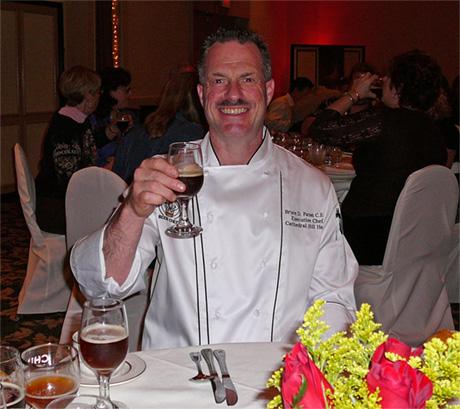
The table I sat at was Chef Bruce’s table, too, so we got some great insight on how he chose the pairings, found the ingredients and prepared the dishes. Next up was breast of squab with sweet potato chocolate flan and natural jus paired with Achel and Westmalle Tripel.

The third course was Angus beef short ribs braised in Chimay with parsnip puree dark chocolate port wine reduction served with Chimay Grand Reserve and Rochefort 8. The beef was so tender you didn’t need your knife. Also, the parsnips were all but completely overwhelmed by the chocolate flavors, which complemented the meat perfectly.

Guests at the dinner, from left. Cornelia Corey and Ray McCoy (Beer Drinkers of the Year 2001 and 2003, respectively), Bryan Harrell (the Celebrator’s man in Tokyo) and Portland beer writer Fred Eckhardt (who pioneered the beer and chocolate dinner way back in 1988)

The dessert course billed was an “Exploration of Chocolate Delights” which in this case meant three very different chocoholic desserts. There was a lemony chocolate cheesecake, a chocolate mousse with white chocolate pieces in it and a strawberry wearing a tasty white chocolate tuxedo. These were paired with Rochefort 10 and De Koningshoeven Quadrupel. The De Koningshoeven is only one of the seven Trappist breweries in the Netherlands (the rest are all in Belgium) though it is better known by its European name, La Trappe. The only Trappist beer not represented was, of course, Westvleteren, which no longer distributes its beer outside the monastery.
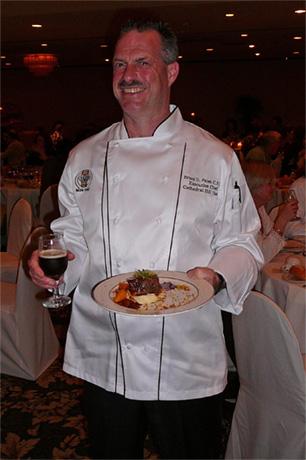
Beer Chef Bruce Paton with his two great passions, food and beer. Thanks Bruce for another terrific dinner. Look for a Valley Brewing dinner at the end of April and a Allagash beer dinner in late May.

Filed Under: Events, Food & Beer Tagged With: California, Photo Gallery, San Francisco

Beer Chef Dinner: Beer & Chocolate at Cathedral Hill Hotel

February 16, 2007 By Jay Brooks

2.16

Dinner with the Brewmaster: Beer & Chocolate

Cathedral Hill Hotel, 1101 Van Ness Avenue, San Francisco, California
415.674.3406 [ website ]

Filed Under: Uncategorized Tagged With: Uncategorized

Newsweek Discovers Vintage Beer

February 16, 2007 By Jay Brooks

Alright, it didn’t make the magazine, but it is a “web exclusive” on the Newsweek website. It is an article by Andrew Romano entitled Beer By the Year (thanks to Joe in Florida for sending me the link). The article is about vintage beers and the 25 of them Gramercy Tavern in New York City has added to their menu. It’s great to see Newsweek do a piece on aged beers, though the article suffers from the usual snide disbelief that beer could be worth spending money on and be something beyond a drink for the masses, or as Romano envisions it, an “equal-opportunity inebriator.”

Then there’s this dissmissive description:

This is beer we’re talking about. You know, the stuff shirtless football fans drink from a helmet. Sure, boosters might do well to take a page from wine’s playbook: according to the latest figures from the National Institutes of Health, alcohol consumption from beer (per capita) is down 6 percent since 1992, while “classier” vino is up 17 percent.

A little later in the article Romano grudgingly admits that some beers may benefit from aging but then claims that that’s true only “in theory.” He makes this claim because the final product may not necessarily turn out to be good after all. Why? One explanation is that the aging must be done properly: at the right temperature, in a dark place, etc. Here’s his other reasons.

Brewers, unlike vintners, release their beverages when they’re ready to drink, and aging is an inexact science. Given time, some bottles soar; others sour. With vintage beer, you always run the risk of liking the final draft less than the first.

This makes it sound as if he’s inferring that wine doesn’t have such issues, that aging wine is an exact science. But the exact same risks he brings up are true for wine, as well. First of all, plenty of wines are released too early but just as many are ready to drink, too. And then to age a wine properly, all the same steps involving light, temperature and so on must also be followed for the wine to have benefitted from the aging process.

Many — if not most — of the beers meant to be aged are not released when they’re green, but have in fact been aged for a period of time before being released to the public for further aging. I spoke to Vinnie Cilurzo of Russian River Brewing and he confirmed that he does age many of his beers either in the tank, barrel or bottle before releasing them to the public, some for a few weeks and some for many months. He wants the flavors to be right and the taste to have mellowed or changed in a positive way before they’re out of his hands.

I don’t quite understand why the author feels the need to qualify aging beer as having unique risks. “Given time,” not every bottle of wine will age well either, so why is he making it sound like aging is a different process for wine and beer?

Happily, Romano doesn’t stick with that tone and for the most part is convinced that vintage beers are worth their higher price tag. Romano and his dinner companion try six vintage beers and like all of them, and love a couple, especially the 1992 Thomas Hardy.

According to the article, Gramercy Tavern “gave beer-by-the-year its big-league, fine-dining debut with a select 25-bottle list of vintage suds from Europe, Japan and North America. The response, says assistant beverage director Kevin Garry, has been ‘amazing’—and it could mean more mainstream acceptance to come. ‘Based on how our guests have reacted, I can totally see vintage beer catching on at other places,’” says Garry, who pairs his bottles with cheeses and desserts. ‘I’d love to see it become the next cool thing in the fine-dining world.’”

As the article ends, Romano can’t resist bad-mouthing beer one more time in his last sentence, which concludes, “[w]e stumble home shortly thereafter.” Let’s see, two men share six bottles of beer. That’s three apiece. And not all were big 750 ml bottles. Thomas Hardy bottles are 11.2 ounces. Yes, some of the beers were strong, but overall not compared to the average wines. Would a wine writer having consumed an equal amount of wine ever claim to have “stumbled” home afterwards? Not in a million years.

Filed Under: Editorial, Food & Beer Tagged With: Eastern States, Mainstream Coverage, Websites

Two New Pelicans

February 16, 2007 By Jay Brooks

The award-winning Pelican Pub & Brewery, along Oregon’s coast in Pacific City, is releasing two new beers, a saison and a Grand Cru. Both are now on tap at the brewpub and also available bottle-conditioned.

The first, Saison du Pelican, is described as “a spicy, herbal aroma from the special Belgian yeast and Golding hops, and a snappy, refreshing finish, Saison du Pelican combines traditional flavors with excellent drinkability.”

The second is the Grand Cru de Pelican.

Grand Cru de Pelican is the result of inspiration, creativity, and imagination. With a nod to the great brewing traditions of Belgium, we have been inspired to create this dark, sensous brew. Grand Cru de Pelican entices with a rich, complex aroma, and satisfies with deep malty and caramel flavors. Spicy, aromatic flavors provide a harmonious counterpoint to the malty foundation of this robust beer. A snappy finish and medium-light body enhance the smooth drinkability of this beer.

From the press release:

“We’ve really had fun thinking out of the box in creating these beers. They are unlike anything we have brewed before,” said Headbrewer Darron Welch.

The brewers brought in a special Belgian yeast for the production of the beers. Each beer also utilizes unique ingredients. The Saison du Pelican includes spelt, an ancient grain, adding texture and dryness to the finish. The Grand Cru de Pélican includes 115 pounds of hand caramelized sugar. It took Brewery Manager Ben Love two days to carmelize the sugar, 15 pounds at a time. The complex caramel flavors in the beer prove that all the work was well worth it.

Once the initial fermentation finished, the brewers added more sugar and then hand-bottled and corked the beers. Inside the bottle, a second fermentation occurred, adding complexity and natural carbonation in the beers.

These bottle conditioned beers are available in limited edition 750 ml bottles. The bottles will be available at the Pelican Pub & Brewery and at selected bottle shops in Oregon. Beer fans outside Oregon can have the beer shipped to them through Belmont Station or Liquid Solutions.

Filed Under: Uncategorized Tagged With: Oregon, Press Release, Seasonal Release

This Here’s the Wattle …

February 16, 2007 By Jay Brooks

I confess I never really knew what exactly a wattle was, apart from some sort of Australian plant. But every time I hear the word — which admittedly doesn’t happen often — I think of the following declaration by the philosphy professors from the University of Woolamaloo in Australia. “This here’s the wattle — the emblem of our land. You can stick it in a bottle or you can hold it in yer hand.” All of their names are Bruce, of course, because the reference is from an episode of the brilliant British television show Monty Python’s Flying Circus.

But I saw recently that an Australian brewer, Barons Brewing, is using black wattle in their beer. So I figured it was time to figure out what the heck a wattle is, after all.

It turns out that a wattle is essentially the Australian word for an Acacia. Here’s what Wikipedia has to say about acacias:

Acacia is a genus of shrubs and trees of Gondwanian origin belonging to the Subfamily Mimosoideae of the family Fabaceae, first described from Africa by Linnaeus in 1773. Acacias are also known as thorntrees or wattles, including the yellow-fever acacia and umbrella acacias. There are roughly 1300 species of Acacia worldwide, about 950 of them native to Australia, with the remainder spread around the dry tropical to warm-temperate regions of both hemispheres, including Africa, southern Asia, and the Americas. The genus Acacia however is apparently not monophyletic. This discovery has led to the breaking up of Acacia into five new genera as discussed in list of Acacia species.

Black wattle, or Acacia mearnsii, is the variety being used by Barons Brewing.

Black wattle is a fast-growing leguminous nitrogen fixing tree. Native to Australia, A. mearnsii is often used as a commercial source of tannin or a source of fire wood for local communities. It threatens native habitats by competing with indigenous vegetation, replacing grass communities, reducing native biodiversity and increasing water loss from riparian zones. They are similar to Acacia dealbata. The species is named after E. A. Mearns who collected the type from a cultivated specimen in East Africa.

I’ve always been a fan of gruits and other beers made with herbs and spices. The complexity and range of flavors available by adding just a hint of one or more ingredients is astounding. And shrubs and trees, too, can work a similar magic on brewing. Beer made with spruce, for example, was quite common in colonial America where hops was in short supply. So I’m dying to try some of Baron’s new Black Wattle Superior, a Wattle Seed Ale.

Here’s what their website has to say about it:

In creating the Black Wattle range, we have used a combination of select malt and hops, brewed to traditional methods and standards. Black Wattle however, offers something special. All beers in the Black Wattle range feature a unique touch of Australia, incorporating native herbs and spices during the brewing process. The resulting beer delivers a wealth of flavours that have not been experienced in beer until today.

The first beer released is the Wattle Seed Ale, which starts with a blend of Australian and European malts, creating a rich flavour base of caramel with a hint of chocolate. The smooth malt flavours are lightly hopped and then infused with roasted Wattle Seed, bringing a unique and authentic Australian flavour to this fine red ale. The result is an outstanding ale that boasts a smooth taste profile balancing its robust character, an ultimately rewarding yet distinctive beer.

At 5.8% ABV and offering a long and lasting flavour, the Wattle Seed Ale is best enjoyed with or after a meal, complimenting a juicy steak, rack of lamb, or a prosciutto and rockmelon starter. Alternatively, this select ale will be enjoyed at almost any occasion by those who enjoy something special in a beer.

But I can’t bring up the Bruces from the Philosophy Department of the University of Woolamaloo without mentioning their “Philosophy Song.” I saw it performed live at the City Center in New York when my parents let me take my first unchaperoned trip to the Big Apple in 1976, when I was 17. It’s still one of my favorite Monty Python bits and I remain a huge fan of the show and much of the individual members’ later work, as well. The lyrics are reprinted below.

Bruces’ Philosophers Song

Immanuel Kant was a real pissant
Who was very rarely stable.

Heidegger, Heidegger was a boozy beggar
Who could think you under the table.

David Hume could out-consume
Wilhelm Friedrich Hegel, [later versions have ‘Schopenhauer and Hegel’]

And Wittgenstein was a beery swine
Who was just as schloshed as Schlegel.

There’s nothing Nietzsche couldn’t teach ya ’bout the raising of the wrist.
Socrates, himself, was permanently pissed.

John Stuart Mill, of his own free will,
On half a pint of shandy was particularly ill.

Plato, they say, could stick it away—
Half a crate of whisky every day.

Aristotle, Aristotle was a bugger for the bottle.
Hobbes was fond of his dram,

And René Descartes was a drunken fart.
‘I drink, therefore I am.’

Yes, Socrates, himself, is particularly missed,
A lovely little thinker, but a bugger when he’s pissed.

Filed Under: Beers, Just For Fun, News Tagged With: Australia, Humor

Glass Bottle Workshop for Brewers

February 15, 2007 By Jay Brooks

On March 1, the California Small Brewers Association, in conjunction ProBrewer.com, will be leading a half-day seminar focusing on the “resources, equipment and financial requirements of transitioning from pre-pack to bulk purchasing and the supply of glass to the beer industry. Suppliers of glass bottles and other vendors will be in attendance. This forum will be an opportunity for both brewers and suppliers to discuss needs and issues in a positive and constructive conversation.”

The Glass Bottle Workshop will be held at the Lagunitas Brewery located at 1280 N. McDowell Blvd. in Petaluma, California. The seminar is free to CSBA members and registered ProBrewer.com users. The course fee is $50.00 for all others. A beer social will follow. To attend, you must pre-register by calling 530.265.0422.

Filed Under: Uncategorized Tagged With: Announcements, Bay Area, Business, California, Other Event, Press Release

Why Can’t We All Just Get Along?

February 15, 2007 By Jay Brooks

A Seattle friend sent me a link to this (thanks Craig), and, unfortunately I think the piece is more indicative of many wine drinkers’ feelings toward beer than I wish were the case. This is perhaps the most annoying and personally sad feature of the wine vs. beer debate. In my experience, most beer people (defined by me loosely as people who claim beer as their primary drink of choice) also love wine and spirits, too. But many — perhaps even a majority? — of wine people seem to think, as Mike Myers might put it, “if it ain’t wine, it’s crap.” Now this isn’t true of winemakers, who generally love beer and spirits, at least all the ones I know. But wine snobs, many of whom are wine writers, definitely seem to project a worldview in which wine is the only beverage worthy of reverence and respect.

It feels a little like the democrats vs. republicans. Republicans are the minority with all the money and power and consequently get to decide what is sophisticated (meaning whatever they like), usually wine. They are “above” the people. Many with naked ambition want to be them and so act like them and, when polled, vote with them. Then pollsters declare wine is the preferred drink, while beer still outsells it four to one. Democrats, by contrast, are “of” the people, prefer the people’s drink, beer, but are too unfocused and like so many different things that their message — if indeed there even is one beyond “enjoy all of life’s pleasures” — never gets any traction. Now for those of you with opposite tastes, simmer down, I’m only making an analogy based on gross generalizations and very broad stereotypes.

But this leads us to today’s screed, “Climbing the Liquor Ladder: Going from Beer to Wine,” by wine and cigar writer Jennifer Jordan. The piece appears on BlogCritics, subtitled “a sinister cabal of superior writers.” Jordan also is the senior editor of a website about wine, Savor Each Glass, and about cigars, What’s Knot to Love.

She begins by detailing her early, not so pleasant, experiences with beer drinking from the time she was a child through college, after which time she then trades “up” to wine and … well I’ll let her tell it.

That is why, after college, where beer was just short of flowing from dorm room faucets, I decided to climb the corporate ladder of liquor consumption, with the next rung up being wine.

Initially I made this choice because of the health benefits of wine. Unlike beer, with each pint providing more belly fat in alcohol’s version of 8-minute abs, wine possesses several things beneficial to a person’s health, with particular concern to the heart. But, health benefits aside, I took this plunge because wine is so much more than alcohol.

However, taking the plunge from beer to wine wasn’t easy. While beer is junior varsity, wine is varsity. With wine, you’re playing with the big boys and there are several rules to keep in mind for a smooth transition.

Okay, there’s plenty not to like here and enough that’s simply wrong that I could go on and on about (especially about the health benefits angle), but hang on, there’s more. She then lists her five rules for “trading up” to drinking wine and how it differs from beer drinking, to help us members of the great-unwashed mass of beer drinkers — the hop polloi? — move up the corporate drinks ladder. That’s a hoot. Sit down and strap in, it’s going to be a bumpy ride.

1. “Don’t Play Drinking Games.” In this, she suggests “beer was made for drinking competitions” and that “[w]ine, simply put, is not a toy.” I agree that you shouldn’t play drinking games, but that advice holds across all alcohol, no alcohol is a toy. The problem isn’t that it’s beer, as she believes, but with the age and immaturity of the people playing the games. It’s like blaming the gun for a game of Russian roulette.

2. “Wine should be sipped, not chugged.” Here she claims chugging is ideal for beer because if you hate the stuff, as she claims to do, then you’ll taste less of it. She should do marketing for the big breweries, because that is the idea behind their “ice cold” propaganda. The colder and quicker you drink, the less you’ll taste of the mass-produced beers. But she also writes that “[e]ach sip of wine should provide a new experience for your taste buds, making your beer bottles boil with increasing jealousy in the process.” Well I don’t think a bottle Rochefort Grand Cru or Westmalle Tripel would be terribly jealous of a bottle of Blue Nun or any Gallo box wine. The fact is there is crap beer and there is crap wine. But good beer is meant to be sipped every bit as much as fine wine.

3. “Enjoy the Variety.” Apparently there are only “several different types of beer” and most taste “relatively the same.” But with wine any two bottles of wine “can taste dramatically unalike.” Cork dorks are — I love this phrase, like it’s a gift from the gods — “granted with the ability to pick from a variety of years, types, and flavors.” Oh, thank you great and terrible Oz for granting me this privilege. She then says you can pick “red wine or white wine” from all over the world. Wow, red and white. That takes me back to the Blues Brothers movie. “We’ve got both kinds of music, country and western.” As I probably don’t even need to say, there are far more varieties of beer than wine and they only taste the same to someone who has an undeveloped palate. And there are, of course, several beers that are vintage dated and can be aged.

4. “Embrace the History and the Culture.” Wine is apparently “packed with culture and history.” Does she think beer-making just sprang up last Tuesday? It’s at least as old — and possibly older — than wine with an equally rich heritage. How is it possible she doesn’t know that? She later comments that she was “merely saying that wine drinkers should embrace the history of wine” but given that it is one of her “rules” for transitioning from beer to wine it seems quite reasonable to infer that she feels beer’s history is not worthy, or at least is not as worthy as wine’s saga.

5. “Behave Yourself.” According to Jordan, “wine demands a certain sophistication that beer refutes: when drinking beer, the more barbaric the behavior the better.” This is the most pernicious propaganda in the beer hater’s arsenal. And again it comes back to context. Of course there are many people who abuse beer. But there are also homeless winos swilling wine out of a paper bag. That wine is inherently more sophisticated than beer is merely a product of our culture. It’s certainly not the case in much of the rest of the civilized world, Belgium being perhaps the best example.

In the end, she concludes that “beer and wine are on different sides of the alcohol spectrum” with beer being merely the “sippy-cup that prepares you for the real thing” — wine. I guess that makes all of us beer drinkers babies, but it’s hard to imagine a more childish, mis-informed opinion than that of Ms. Jordan.

There are a plethora of comments already over the last week (it first appeared on the 9th) and Jordan responds initially by saying her piece was meant to be “tongue in cheek” and that it’s just “opinion.” But so much of what she’s written is simply not true, that it’s hard to take the “I was just trying to funny” thing at face value. To me, it sounds more like the backpedaling of someone who suddenly realized they may have been wrong. In a later comment responding to her critics, Jordan replies. “That’s the great thing about an opinion piece: it’s an opinion. You don’t have to agree with me. I think wine is better than beer, you don’t. Who cares?” And that would be fine except that opinion should at least be based on fact, but her conclusions — which she calls opinions — flow directly from misinformation, whether deliberate or ignorant. We could prepare a laundry list of facts she’s gotten wrong from the variety of beer to the inherent lack of sophistication of beer. They are not merely opinions if they’re based on lies, in that case they’re stereotypes. It’s no different really from racial or ethnic stereotypes. And I know I’m on the fringes of opinion here, but I also believe that “opinions” like Jordan’s perpetuate the bad image that beer has today and certainly does nothing to change people’s perceptions and misconceptions about what beer is and has the potential to be. But Jordan just keeps telling all of the offended beer drinkers to relax, it’s just her opinion. It just feels like she’s still talking down to us, like she’s called us the “N” word but doesn’t think we should be upset because she’s just expressing her opinion.

She later writes that she was just being “cheeky” and that it was done “for humor.” She then expresses surprise that her piece “seemed to offend every Beer Drinker in the world (which again was not [her] intention).” How could she read what she wrote and not think beer drinkers would be offended? How is possible to re-read what she wrote and not think it would be reasonable to conclude that would be their response? It’s just baffling. But I’m still not ready to let her of the hook because it was “opinion,” was meant to be “humorous” and it wasn’t her “intention” to offend anyone. Those claims were all made after the article was published and so seem like justifications for what she wrote. But perhaps her true motives were revealed later responding to yet another critic. “Relax..this is an opinion piece with intended controversy (it’s controversy that gets traffic).” So like Ann Coulter and Rush Limbaugh, stirring up the pot with misinformation and “satire” is good for business. Facts don’t matter, but ratings do. Now that’s integrity. Whatever happened to journalistic ethics? I guess they don’t count if you call what you’re writing “opinion.”

Her persistent reliance on the “opinion” defense continues to rankle me. Perhaps our society does view it this way, but opinion shouldn’t be merely saying whatever comes into your head with no basis in reality. When you base an opinion on misinformation or ignorance, the opinion generated is likewise flawed and may properly be called wrong. I realize there are some people who can look at a photograph of our planet and still maintain that the Earth is flat, saying they’re free to hold such an opinion. And while technically they do have that freedom, who can blame the rest of us who see that opinion as misguided, ignorant or just plain wrong. As many have done in the comments to Jordan’s article, we are just as free to disagree and try to educate that person on why her “opinions” may be wrong because of the misinformation they’re based on. It almost goes without saying that Jordan is free to prefer wine to beer, but to justify her preference by arguing that wine is superior to beer is no longer mere opinion, but advocacy and a kind of unquestioning belief.

To her credit, Jordan got the approval of her boss to do a beer tasting this Friday with several beers suggested by her dissenters and there was a great deal of back and forth in the comments section coming up with the list. She supposedly will be writing up the results shortly thereafter. I don’t have high hopes for her conversion or seeing the light since she characterizes herself as “stubborn, but not unyielding.” I may be wrong — I too, am trying to keep an open mind — but she appears so strongly predisposed to her opinion that I doubt that one tasting of a sample of beer’s amazing diversity will be enough to change her mind. As we all know, prejudice is very hard to overcome. I have no problem with her preference for wine, but I — and every other beer lover — should have a problem with her prejudice against beer. Not only is it not justifiable, there’s really no reason to attack beer. I’m sure I could come up with just as many similar reasons why beer is more sophisticated than wine, but unlike a healthy percentage of wine drinkers, I believe you can lift up all available alcoholic choices without resorting to name-calling, vilification or worse. There’s simply no need to put one type down to raise the status of another. In the end, none are in fact better or worse than any other. There is just as much good and bad in all of them. It’s frustrating that wine and spirits tend to get much more positive coverage by the media than beer does, and articles like this one by Jennifer Jordan don’t help the situation, however unintentional she claims it to be. Every time I read one of these anti-beer diatribes, I continue to wonder. Why can’t we all just get along?

Filed Under: Editorial

Oregon Beer Up 16%

February 15, 2007 By Jay Brooks

An Oregonian Bulletin friend (thanks Jim) sent this in. Today’s Oregonian has a two-part piece by John Foyston, a veteran newspaperman and long-time advocate of good beer. The first part, Oregon beers grow by hops and bounds, details some great news about sales of Oregon beer in 2006, where again record growth ocurred for at least the third year in a row.

From the article:

Craft brewers in the state made 3.5 million gallons more beer last year than in 2005, a 16 percent increase and the third year in a row of double-digit gains. This at a time megabrewers such as Anheuser-Busch Cos. and Miller Brewing Co. have struggled to maintain their revenues and market share.

According to figures released this month by the Oregon Brewers Guild, the state’s 79 breweries produced about 792,000 barrels of beer in 2006, or 24.5 million gallons. That’s up from 21.1 million gallons a year earlier, and makes Oregon one of the leaders in a craft beer segment growing faster than any other part of the U.S. alcoholic beverage market.

The second part is a nice profile of Portland’s Amnesia Brewing.

Filed Under: News Tagged With: Business, Oregon

Sad News About The Beer King

February 13, 2007 By Jay Brooks

eames
Alan Eames, known to the beer world as “The Beer King” and “The Indiana Jones of Beer,” passed away Saturday, February 10. He was 59 years old. Eames was a cultural anthropologist, historian and writer by trade, and a tireless lecturer and advocate for beer. He will be deeply missed.

Here is a short biography of Alan Eames from Ohio Brew Week:

Dubbed the Indiana Jones of Beer and The Beer King by the world media, Vermont resident Alan Eames is an internationally recognized beer historian, author, consultant, and beer anthropologist.

Mr. Eames is author of A Beer Drinker’s Companion, Blood, Sweat and Beers, and The Oldenburg Beer Drinkers Bible. Eames has written about beer for a variety of publications, including All About Beer Magazine, Americas, Consumer Digest, Top Shelf; The Malt Advocate, Beer: The Magazine, Popular Science, and The New York Times Sunday Magazine. Eames provided entries spanning ancient times through the mid-19th century in his contributions to The Encyclopedia of Beer.

Mr. Eames was founding Director of the American Museum of Brewing History and Fine Arts in Ft. Mitchell, Kentucky. Speaking of the ancient and valuable role of beer in human societies, Mr. Eames has lectured throughout the United States at such institutions as The New England College of Medicine, The Culinary Institute of America, the Departments of Anthropology at Brown University, University of Georgia, and The United States Botanic Garden in Washington, D.C.

As a beer historian, Mr. Eames has appeared internationally before an audience of millions on radio, television, and in the press. A veteran of more than 14 appearances on National Public Radio throughout the United States, include All Things Considered, Weekend Edition, and the Splendid Table. Among mainstream television and talk shows, Eames’ work has been showcased in such primetime fare as NBC’s Today Show and Good Morning America. As a globetrotting beer anthropologist, Eames’ career was highlighted in Nippon Television’s documentary The World Beer Traveller, for Tokyo Television. Recently the Indiana Jones of Beer was the subject of a segment in Canada’s beery documentary FoodEssence. Mr. Eames may be currently seen on The History Channel’s MODERN MARVELS – BREWING. Mr. Eames has consulted on a variety of Hollywood feature films lending historical expertise to beer and barroom related scenes.

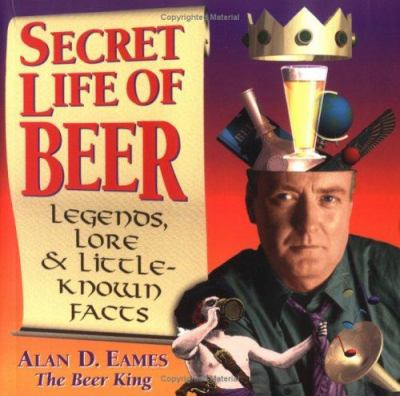
His most famous book was The Secret Life of Beer!: Exposed: Legends, Lore & Little-Known Facts

Secret-Life-of-Beer-Eames-Alan

The book’s description:

Beer has inspired, influenced, and excited human beings for thousands of years and Alan D. Eames, the certified “king of beer,” has traveled the world uncovering The Secret Life of Beer. In this book, he reveals untold stories, lore, and references to beer in poetry, song, literature, and history. Readers will be astonished to learn the esoteric facts Eames has discovered, such as that in most ancient cultures only women were allowed to brew, and for much of history beer was considered a nourishing alternative to drinking water!

From its origins among early civilizations to a hallowed place in the history of mankind, the art, the history, the culture, and the mystery of fermented beverages is the subject of historical fact, mythological speculation, and philosophical enquiry. The Secret Life of Beer! shares bits and pieces of this intriguing cultural history, along with quotes from such diverse beer drinkers as Nietzsche and Charles Darwin, in an inviting, highly browseable format.

Here is an interview of Eames by Robert Lauriston. And here’s an article from Yankee Brew News (1993) entitled Beer, Women, and History.
 

eames

Alan Eames — April 16, 1947 – February 10, 2007

Filed Under: News Tagged With: History, obituary

Celebrator Beer News Anniversary Party This Sunday

February 12, 2007 By Jay Brooks

This coming Sunday is the 19th anniversary party for the Celebrator Beer News, one of the magazines that I write for. It will be held at Trumer Brauerei in Berkeley, California from 4 to 8 pm. This year will also feature a Mardi Gras theme, with three bands, craft beer from fifteen breweries and BBQ and Cajun/Creole food. Tickets are $40, and are available on-line from the Celebrator website. To get a flavor of what the party will be like, check out my photos from last year. I’ll be there, most likely working the door, so say hello when you check-in at the entrance.


From the press release:

The Celebrator Beer News will celebrate its 19th anniversary on February 18, 2007, with a Mardi Gras-themed party from 4 to 8 pm at the Trumer Brauerei in Berkeley, Calif.

At least 15 other breweries will pour favorite brews. Meet Celebrator writers and beer industry luminaries, including pioneer figures in the craft beer movement. Cajun/Creole food, music from three bands and beer are included!

Breweries pouring include Anchor Brewery, Anderson Valley, Pacific Coast, Deschutes, Ommegang, BridgePort, Russian River, Sierra Nevada, Triple Rock, Trumer Pils, Valley Brewing, Widmer/Redhook and more.

Music includes a Dixieland Jazz Band and an industry Battle of the Bands with performances by the Hysters (Anchor Brewery) and the industry-staffed Rolling Boil Blues Band!

Tickets are on sale now: $40 per person, including BBQ and Cajun/Creole food, beer and music. Discount rooms will be available at the Cathedral Hill Hotel in San Francisco ($79 per night). Call 800-622-0855 and ask for the Celebrator rate. If you want to stay in Berkeley after the event, there is a deal at the Hotel Durant. Call 510-845-8981 and ask for the Manager’s rate. This event takes place one day after the start of the Barleywine Festival at the Toronado!

For more information, call 510-538-2739. Ticket sales by Visa/MC, phone 800-430-BEER or buy tickets here through PayPal.

Filed Under: Food & Beer, Just For Fun, News Tagged With: Announcements, Bay Area, California

« Previous Page
Next Page »

Find Something

Northern California Breweries

Please consider purchasing my latest book, California Breweries North, available from Amazon, or ask for it at your local bookstore.

Recent Comments

  • Bob Paolino on Beer Birthday: Grant Johnston
  • Gambrinus on Historic Beer Birthday: A.J. Houghton
  • Ernie Dewing on Historic Beer Birthday: Charles William Bergner 
  • Steve 'Pudgy' De Rose on Historic Beer Birthday: Jacob Schmidt
  • Jay Brooks on Beer Birthday: Bill Owens

Recent Posts

  • Beer In Ads #5228: All Together For Newark April 21, 2026
  • Beer Birthday: Steve Parkes April 21, 2026
  • Beer In Ads #5227: It’s Here! Bock Beer By Bosch April 20, 2026
  • Beer Birthday: Drew Beechum April 20, 2026
  • Beer Birthday: Des De Moor April 20, 2026

BBB Archives

Feedback

Head Quarter
This site is hosted and maintained by H25Q.dev. Any questions or comments for the webmaster can be directed here.