
Florence Fabricant, one of the members of the wheat beer tasting for the New York Times, had a little sidebar article about pizza, beer and other foods.
Beer of the Times: Wheat
Eric Asimov has a good article in today’s New York Times about wheat beers, well-research with lots of history. The Times also did a tasting of wheat beers, and here I think they made a few key gaffes. They stated from the outset that they were “looking for American versions of Bavarian-style brews” but tasting director Bernard Kirsch added “a few German sleepers.” That Bernie, what a cut-up. And they found that “as expected, the American wheat beers were all over the map, with brewers taking great liberties with the style.”
But here’s the thing. Not all of the beers they tasted were in fact Bavarian-style hefeweizens. Now is that the brewer’s fault or Bernie’s fault for the beers he chose? Either on purpose to confuse the panel or through ignorance of the style, he picked several non-German-style hefeweizens, inlcuding Widmer Hefeweizen. Widmer is in fact an American-style hefeweizen that is a completely separate style for GABF judging. Widmer defined that style, a fact panelist Garrett Oliver was well aware of. But when the panel dismissed Widmer, they said it “bore little relation to the style.” Of course it did, it was a different style.
So when Garrett’s own Brooklyner Weisse was chosen as the winner of their tasting, he “was unembarrassed by the panel’s unanimous approval.” Frankly, I think he should have been, at least a little bit. Generally speaking I think it’s a bad idea to sit in judgment on a panel in which one of your own beers is present. If you’re judging at the Great American Beer Festival you can’t even judge a category in which you’ve entered a beer, even if the flight you’d be judging doesn’t include your own beer. I’m sure he can be objective and personally I feel quite certain he was. Unfortunately, it’s all about the perception of impropriety. A few years ago, I judged at a beer festival sponsored by a brewery. When one of that brewery’s beers was chosen as the winner of a particular category, they disqualified themselves to remove that very perception.
Now I like Garrett Oliver and think he’s done as much to promote good beer as any living human could, especially in regard to advocating beer and food. In that area he’s been the leading expert. If he’s giving a seminar, talk or dinner I always try to attend. They’re invariably very worthwhile events, with much good beer education to boot. So this seems like a strange faux pas for him. He’s been involved with many of the Times’ tastings in the past and I suspect when they asked him, he felt he couldn’t say no. I honestly felt connflicted about posting anything negative about Garrett, because I do hold him in such high regard. Ultimately, I had to mention it because to not do so would have been to compromise my position on this issue even though I knew that Garrett is one of those rare people who could walk above such controversy and be objective under the circumstances. So I think he either should have removed his own beer from the tasting (which for business reasons I imagine might have been difficult) or excused himself for this tasting, even though very few people, and no one who knows Garrett, would have a problem with it.
Three of the beers they gave poor marks to were, according to the panel, “well past their prime” which I take to mean out of code, past their pull date, in other words no longer in a condition to drink. This is undoubtedly the fault of a distributor or retailer as beer should be pulled from the shelf once it’s past its code date. And Bernie should never have accepted samples of this type. Perhaps they weren’t clearly marked and I don’t know the method Bernie used in collecting his samples. But unless he got them from the brewery itself, in my opinion, the Times should not have penalized the brewers who made these beers with a bad review because they got an old sample.
They did at least like my favorite of the style, Franziskaner Hefe-Weissbier. It’s especially good on draft though the bottled beer is excellent, as well.
Square Beer Bottles
According to an item on Vestal Design’s blog, Alfred Heineken, who is credited with making Heineken beer an international brand, had a unique, if somewhat bizarre, idea to make square beer bottles that could be fitted together and stacked to build houses after people finished drinking them. It was mentioned briefly in his BBC News obituary, but with few details (Heineken passed away in 2002). According to Vestal Design’s account, Alfie was wandering the beach in Jamaica and was struck by the large number of beer bottles littering the beach. He was also apparently “concerned with the lack of cheap building materials, and at the resulting living conditions for the poor.” In one of those same leaping kind of moments that produced Reese’s Peanut Butter Cups (you’ve got chocolate in my peanut butter!) he put two and two together and got five. Voila, the square beer bottle was born. Or it would have been, except that Heineken’s board of directors didn’t share his vision. He thought square Heineken bottles would be imported around the world and then they’d stay there and be used to build houses. They thought he was nuts, or at least the idea was.
Vestal Design speculates that you would need one thousand bottles to build a house ten feet square. They also note glass is a good insulator and the bottle was designed in such a way that the bottle neck fit into a groove in the bottom of the bottle so they would essentially fit together. They would certainly stack in your refrigerator better, too, wouldn’t they?
Alfred Heineken’s World Beer bottles, which he envisioned using to build houses.
Oregon Trader Gets New Owners, New Name
According to an article in the Corvallis Gazette-Times, Orgeon Trader Brewing located in Albany, Oregon has been sold and re-named Calapooia Brewing Co. The new owners, Mark Martin and Laura Bryngelson, opened about three weeks ago. Their best-seller so far is Yankee Clipper IPA. They also apparently offer an amber, a chile beer, a pale ale, a stout and a wheat beer. Best of luck to them both.
AP Discovers Wild Hop Lager
Yesterday’s media ran a story by AP entitled “Organic beer sales grow, Anheuser-Busch enters market.” The article itself is fine, mostly comprehensive and well-written. But what struck me was the phrase A-B “enters market” (my emphasis) because I started writing about Wild Hop Lager on March 23. To my mind, almost four months later is not exactly a scoop by the mainstream press.
One statement in the article was quite interesting regarding sales of organic beer:
While organic beer sales are still minuscule in the overall beer industry, they are rising fast. North American sales of organic beers grew from $9 million in 2003 to $19 million in 2005, according to the Organic Trade Association.
That’s slightly better than doubling sales growth in two years’ time, which is pretty impressive.
Beer Ad: Rheingold Parade
I came across this old 1950s ad for Rheingold Beer done in stop motion on YouTube. Unfortunately, it cuts out just before the end but otherwise is great. They don’t make ’em like this anymore. Enjoy.
Photo Gallery: Drake’s Summit Hop Festival
Today was Drake’s 1st annual Beer Festival & Washoes Tournament in San Leandro. The festival involved 19 beers all made with the same hop — Summit — but with each brewery free to use whatever malt, yeast and water they wanted. Essentially, these were all single hop beers. I was fortunate enough to judge the beers and it’s certainly very interesting to see what different brewers will do with the same recipe and the same hop.

Rodger Davis, head brewer at Drake’s enjoys a pint of his own.

The judges. Clockwise from bottom left: Judy Ashworth, Bill Tarchala, me, Craig Cauwels of Schooner’s, David Hopgood of Stone, [I never did catch his name] and Paul Marshall, who ran the competition.
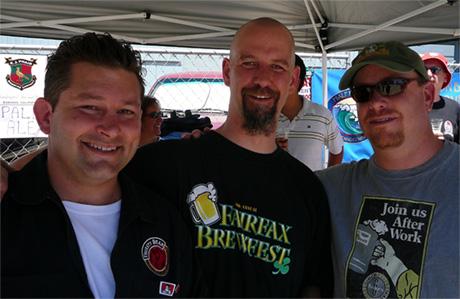
Brenden Dobel of Thirsty Bear, Rodger Davis from Drake’s and Arne Johnson from Marin Brewing.
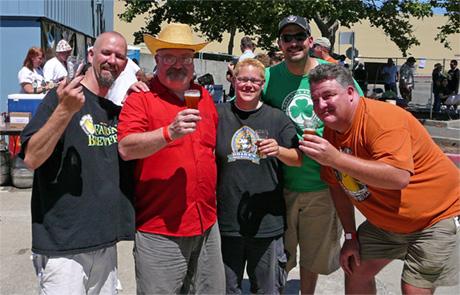
Rodger Davis again, Dave Keene from the Toronado, Melissa Myers (also from Drake’s), James Costa from Moylan’s and beer enthusiast Motor.
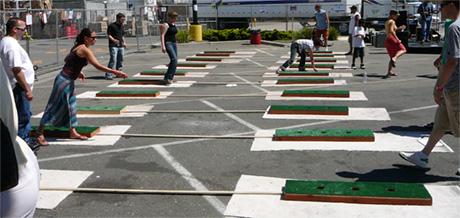
The Washoes Tournament gets underway.

Craig Cauwels from Schooner’s and James Costa from Moylan’s.

Vinnie Cilurzo from Russian River and Rich Norgrove from Bear Republic.

Alec Moss from Half Moon Bay Brewing with Vinnie Cilurzo and Dave Keene.

Christian Kazakoff and festival winner Daniel Del Grande from Bison Brewing.

Dave Keene and me.
Bison Takes the Summit
Here are the results from Drake’s 1st annual Beer Festival & Washoes Tournament in San Leandro. The competition involved 19 beers all made with the same hop — Summit — but with each brewery free to use whatever malt, yeast and water they wanted.
1st Place: Bison Brewing
2nd Place: Marin Brewing
3rd Place: Bear Republic Brewing
Congratulations to all the winners.
Pyramid CEO Resigns
Pyramid Brewing announced today that CEO John Lennon has resigned, effective immediately. The company is reporting that Lennon left to “pursue other business interests,” which is about a vague as you can get. He had been on the job only since last August, and before that he was with Beck’s. It will be interesting to see what finally comes out as the real reason for his departure, because in my mind these sort of things don’t play out like this unless there is a hidden agenda.
He will be replaced by board member Scott Barnum, who previously has worked for Pete’s Brewing and Miller. Barnum is a resident of the Bay Area and will apparently maintain offices both in Berkeley and Seattle.
More Good News for Healthy Beer Drinkers
HealthDay News had a short item today which touted another new study showing the health effects of drinking a pint or two beer each day.
From the article:
According to the Friedman School of Nutrition Science and Policy at Tufts University, beer contains high levels of an ingredient that helps deposit calcium and other minerals into bone tissue.
And a recent study found the antioxidants present in dark beer help prevent clogged arteries, which should reduce the risk of heart disease.
Most research showed the optimum benefits can be reaped with up to one drink a day for women and up to two a day for men.
This is another in a literal stream of health benefits now attributable to drinking beer. So why does the negative stereotpe continue to persist that beer is bad for you? Because too many people are making money off that assumption plus the demonization of alcohol is a favorite pastime of many with socially conservative leanings.