Brookston Beer Bulletin

Jay R. Brooks on Beer

  • Home
  • About
  • Editorial
  • Birthdays
  • Art & Beer

Socialize

  • Dribbble
  • Email
  • Facebook
  • Flickr
  • GitHub
  • Instagram
  • LinkedIn
  • Pinterest
  • RSS
  • Twitter
  • YouTube

Powered by Genesis

New Zealand Developing Hybrid Hops

June 21, 2006 By Jay Brooks

HortResearch of New Zealand is working to develop a hybrid hop that, according to hop breeder Ron Beatson, is not just another ‘High Alpha’ hop, which is where most global hop development has previously been focused. Instead Dr. Beatson is “taking the established New Zealand hybrids and crossing them with the traditional European aroma varieties, the latter of which have been used in brewing for well over 100 years. The result is a hybrid plant well adapted to New Zealand growing conditions that produces hops with unique flavour profiles perfectly suited to brewing ‘craft’ beers.” Many such aroma hybrids have now been produced.

“The idea was that fewer hops could be used to achieve the same bitter taste, making brewing more cost efficient. But consumers are now demanding more flavour in their beer and are prepared to pay a premium for that, so high aroma hops are back in vogue.”

Armed with funding from the grower-based industry body New Zealand Hops Ltd and the Foundation for Research Science and Technology, as well as support from New Zealand’s major brewing companies Lion Breweries Ltd and DB Breweries Ltd, HortResearch is now further developing its plant-breeding strategies.

An example of the novel flavours possible from such breeding is the HortResearch-bred Nelson Sauvin variety, which imparts distinct grape flavours to beer.

Most organic hops used today come from New Zealand because the country “is free from many of the pests and diseases which plague hop crops around the world, and this, combined with [their] clean, green image and innovative hop varieties make us an attractive option for brewing companies looking to source high-quality raw materials for brewing.”

Brewers are also seeking to explore further potential health benefits beer may offer consumers. Hops contain a number of unique polyphenols which have been associated with potential antioxidant benefits for humans. Clinical trials in the US and Europe are currently examining their effect on mitigating challenges to human health such as cancer, arteriosclerosis, bone deterioration, obesity, and diabetes to name a few.

At present many of these beneficial compounds are not harnessed in sufficient quantities by traditional brewing methods. Dr Beatson says the industry is now seeking ways to include greater levels of polyphenols in beer, and HortResearch is seeking to breed hops with increased polyphenol content.

Filed Under: News Tagged With: International

Bitburger M.I.A.

June 20, 2006 By Jay Brooks

After the public backlash in Germany over Anhesuer-Busch’s being named the beer sponsor for the World Cup games, A-B eventually bowed to public pressure and worked out a compromise that was supposed to insure that a German beer would also be available at all games. The brand chosen was Bitburger, whose Bit brandname had been deemed too close to Bud so that A-B was told they couldn’t use that name in their advertising. Instead they would have to use Anheuser-Busch Bud, which doesn’t exactly roll off the tongue. So a compromise was worked out. Bitburger could be sold at all World Cup games and A-B could advertise their product as simply “Bud.”

One little hitch, though, is that A-B appears to have reneged on its part of the deal. According to George Parker on AdHurl:

Interesting bit in this weeks Der Spiegel exposing the great Anheuser-Busch beer sham. Apparently in an attempt to placate the Germans, the company agreed to allow German beer to be sold alongside its Bud. But once the fans were inside the stadium… No Bitburger – The reporter was forced to drink Bud… With dreadful consequences. Seems like an incredibly bad piece of PR on the part of Anheuser-Busch. Unless some genius there thought “Oh, once they taste it, they’ll love it.” Listen Busch VI or VIII or whatever, I wouldn’t drink Bud in the US, and I certainly wouldn’t go to Germany to drink it. Dumb arrogant move!

He’s referring to a report in Der Spiegel by Marc Young:

I can now expose the great Anheuser-Busch beer sham. The US brewer bought the sole rights to sell beer in World Cup stadiums before Germany even knew it would host this summer’s tournament. But in an attempt to head off a nasty public backlash, the company cleverly agreed to allow German beer to be sold alongside its Budweiser. This was good PR, but I can report that there appeared to be no Bitburger — the German brewer Anheuser-Busch cut a deal with — to be had anywhere in the stadium. Maybe Bitburger got one stand outside near the security checks or something. But all I could find was Bud on tap.

That’s what you call a perfect strategic move to get what you want and screw everybody else. You placate everybody and difuse a potentially disasterous PR situation. Then you don’t deliver on your part of the bargain and by the time anyone figures out they’ve been had it’s too late to do anything about it. So the ads and signs all read “Bud” instead of “Anheuser-Busch Bud” but there’s still no German beer you can buy. Even if Marc Young missed it somehow, it still shows how difficult they made it even for someone making a particular point of trying to find Bitburger. And once you’re in the stadium there’s not really anything you can do except be pissed off. You can either drink Bud or nothing. A-B sure is showing the Germans — and every other nation represented at the World Cup — where the “ugly” in “ugly American” comes from. Nice job spreading goodwill. Because this isn’t just a black eye for an American corporation, it’s a black eye for America as a whole. Like it or not, America’s corporate image abroad is all most people see of us and so this skewed image of America as a whole is formed at least in part by those interactions with our corporations. When they act like … well, like corporations, they color people’s impressions of you and me, too.

Filed Under: Editorial, News Tagged With: Business, Europe, International

Beer Marketing in Your Underwear?

June 20, 2006 By Jay Brooks

world-cup06
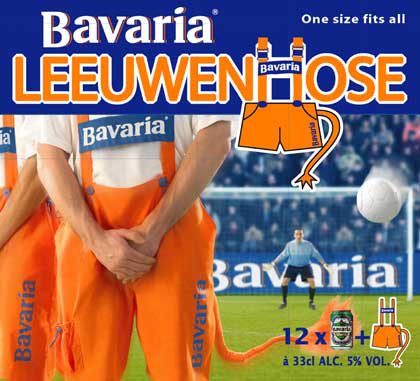
Yesterday’s World Cup match between the Netherlands and the Ivory Coast must have been quite a spectacle. As widely reported, over a thousand Dutch ticket holders arrived wearing orange lederhosen bearing the name of a Dutch brewery. Read that sentence again. Notice anything strange about it? Because it’s exactly the way this story has been reported by all but one or two news organizations. What’s missing is the name of the brewery, which was Bavaria NV. As revealed by IPKat, “For the record, most media – presumably because they benefit handsomely from Budweiser’s vast advertising budget – coyly refuse to tell us the identity of this Dutch upstart.”

bavaria

So anyway, over a thousand Dutch fans show up wearing orange lederhosen with the beer brand name Bavaria on them. Dutch soccer fans traditionally don all things orange before games of their beloved “Oranje,” which is the nickname of the Netherlands national team and the distinctive color of their uniforms. So there’s nothing necessarily odd in that, and this is, after all, the biggest soccer tournament on the planet. But officials at the stadium in Stuttgart ordered them to remove their lederhosen or they would not be allowed to enter the stadium to see the game, despite having paid for their tickets. The majority simply removed them and went into the match and watched it in their underwear.

lederhosen

You can buy your own pair of orange lederhosen at the Bavaria online shop. They only cost about eight bucks, plus shipping. Or you can buy a twelve-pack and get a free pair. “The idea is supposed to be a gentle mockery of the Germans’ penchant for real lederhosen during the World Cup period. The lederhosen also feature a tail and a lion motif — the national symbol of Holland. So far over 250,000 pairs of lederhosen have flown off the shelves and they have become a cult item among Dutch soccer fans.”

Given that the lederhosen have long been available from the brewery and they are perfect for the rabid soccer fan, I don’t really see the problem. Go to any football game in the U.S. and you’ll see countless fans wearing their team’s colors in all manner of available merchandising paraphenalia. Is it really that much of a stretch to imagine in a succesful marketing promotion many people wearing the same item to a game. In a stadium the size of Stuttgart’s (seating is 52,000) is a thousand people wearing the same team promotional item really that hard to believe?

Even if it is to hard for you to believe, so what if the brewery gave away the lederhosen or made it very easy to obtain them? Companies have been doing that since Adam Smith first used his invisible hand to avoid a “hand ball” foul. If more of them actually wore them to a game than anticipated, they should be pleased as punch, and FIFA and sponsor Anheuser-Busch should shut the hell up about it. That’s just the market for you.

But that’s not what they did, of course. Instead, they took a different tack.

“Anheuser Busch’s Budweiser is the official beer for the tournament and world soccer’s governing body fiercely protects its sponsors from brands which are not FIFA partners. Markus Siegler, FIFA’s director of communications, said at its daily media briefing yesterday that the governing body was alert to the kind of ‘ambush’ marketing Bavaria had attempted.

From the Yahoo UK article:

“Of course, FIFA has no right to tell an individual fan what to wear at a match, but if thousands of people all turn up wearing the same thing to market a product and to be seen on TV screens then of course we would stop it.

“I don’t know exactly about what happened in Stuttgart, but it seems like an organised attempt to conduct a mass ambush publicity campaign was taking place.”

Peer Swinkels of the Dutch brewery told Reuters by telephone it was “absolutely ridiculous” and “far too extreme” to order the fans to take off their lederhosen and said the brewery had complained to FIFA.

“I understand that FIFA has sponsors but you cannot tell people to strip off their lederhosen and force them to watch a game in their underpants. That is going too far.”

Also from IPKat:

Said FIFA: “Anyone can wear whatever they want, but if a company tries to carry out ambush marketing, FIFA must prevent that happening. In common with the IOC (International Olympic Committee) and UEFA, we do not tell individual supporters what to wear, but … FIFA has already won a court case against a beer manufacturer who tried this sort of thing”.

What this means is “Anyone can wear whatever they want, if FIFA says so”.

American beer Budweiser and Germany’s Bitburger are thus the only beers that can be sold, or even worn by spectators, in the 12 World Cup stadiums. The IPKat wonders what FIFA would have done, had the offending garments been t-shirts worn by thousands of young ladies.

PR Professional John Cass had this to say about how the incident will likely effect Anhesuer-Busch:

I think FIFA just created a public relations disaster for Anheuser-Busch by requiring 1,000 Dutch football supporters to remove their trousers when entering an international football match.

FIFA thought that the bright orange trousers represented a “marketing ambush” tactic. FIFA officials blocked entry to the stadium of any Dutch fans wearing the trousers, rather than miss the game 1,000 fans took off their trousers and watched the match in their underwear.

I think the FIFA officials have lost sight of the boundaries between business and common decency. As for Anheuser-Busch, I would not want to be the PR Manager today. This sort of protection of Anheuser-Busch’s sponsorship by FIFA surely cannot be endorsed by the company, otherwise Anheuser-Busch will be remembered this World Cup as company that took 1,000 Dutchmen’s pants away from them.

FIFA might be right that the Dutch company’s marketing tactic ambushed the World Cup stadium. But in the end what matters most in marketing terms is how a company’s brand it perceived through its marketing efforts. I’ve been searching through the web this evening, and it’s not looking good for Anheuser-Busch. Most comments are from Europe, and the majority of the posts are either incredulous or negative about the incident, for Anheuser-Busch:

I say “tough luck corporate sponsors”, money shouldn’t be able to buy the right to subject people to this kind of indignity. At the very least these people should have been offered alternative netherwear. In fact I think they should sue the sponsor who insisted on this and campaign to boycott their wares. So watch out Budweiser, I’m off Bud now (Nouslife Blog).

Where’s all this World Cup goodwill?

… and I always thought it wasn’t the winning that was important, but the taking part (No Offence Intended).

The PR disaster that is Budweiser’s sponsorship of the World Cup gets worse (CMM News).

The Netherlands beat Ivory Coast 2-1. I think I’ll be rooting for them in their next match, which of course I’ll be watching wearing nothing but my underwear with a nice cold Bavaria Beer by my side.

Filed Under: Editorial, Just For Fun, News Tagged With: Business, Europe, Germany, Marketing, Sports, The Netherlands

CAMRA Unhappy About Greene King Takeover

June 19, 2006 By Jay Brooks

On Friday, the UK’s Guardian Unlimited that CAMRA and other consumer advocacy groups are already angered by Greene King’s takeover big to buy Hardys & Hansons, after which they believe “Hardys & Hansons will be chewed up and spat out like so many before it,” according to Camra’s chief executive, Mike Benner. Hardys & Hansons also includes the pub Ye Olde Trip to Jerusalem in Nottingham, believed to be the oldest pub in Great Britain. The pub is literally carved into the sandstone under Nottingham castle, although Wikipedia indicates that perhaps nineteen other pubs have similar claims to the title “oldest in Britain.” Greene King’s bid has thus far included no information about the fate of the pub, the brewery or their employees.


From CAMRA’s press release:

The Campaign for Real Ale today called on shareholders of Hardys & Hansons to reject the takeover offer from Greene King and draw a line in the sand on behalf of beer consumers.

The offer to buy Nottingham based Hardys & Hansons is the latest in a series of acquisitions that has seen Greene King devour ten rivals in ten years.

CAMRA Chief Executive Mike Benner said: “If this deal goes through, history has shown us that Hardys & Hansons’ brewery and beers will not be in safe hands. Now is the time for the shareholders who truly care about this excellent brewery with more than 174 years of history to make a stand and reject this offer.

“Today’s announcement made scant reference to the future of the beers, the brewery or the staff. We believe if the shareholders don’t block this now, Hardys & Hansons will be chewed up and spat out like so many before it.”

CAMRA is concerned that the acquisition of Hardys & Hansons 268 strong pub estate would take the number of pubs owned by Greene King and selling its beers to around 2680 nationwide. Having such a massive presence can only be damaging to consumer choice.

Mike Benner continued: “In 2002 CAMRA warned the Government that the abolition of the Guest Beer Right would result in a series of mergers and takeovers that would undermine competition and consumer choice. Do we want to find ourselves in a situation where every other pub sells only Greene King IPA? The Guest Beer Right must be reintroduced before it is too late so that licensees can sell a beer of their choice to preserve the future for independent breweries.”

Here’s a history of buyouts undertaken by Greene King over the last ten years:

  1. 1996: Magic Pub Company (This pub group included the Hungry Horse concept which is now one of the Greene King’s pub brands)
  2. 1999: Morlands Brewery (closed the brewery and Ruddles beer brands acquired at the same time)
  3. 2001: Old English Inns (the pub estate integrated into the GK pub estate)
  4. 2002: Acquired the Morrells Pub company (pubs integrated with the GK pub estate)
  5. 2004: Laurel Pub Company (pubs integrated with the GK pub estate)
  6. 2005: Ridleys Brewery (brewery closed)
  7. 2005: Belhaven Brewery (brewery still open)

Filed Under: News Tagged With: Business, Europe, Great Britain, Press Release

Western Pennsylvania Beer Legacy

June 19, 2006 By Jay Brooks

In the wake of both the bankruptcy of Pittsburgh Brewing and the potential closing or sale of the Latrobe Brewery, AP had an interesting article today by Frank Garland of the Pittsburgh Tribune-Review that quite a few papers ran, including the San Jose Mercury News here in the Bay Area.

Filed Under: News Tagged With: Eastern States, History

Interview with Kona’s Rich Tucciarone

June 19, 2006 By Jay Brooks

Today’s Honolulu Star Bulletin has a nice profile and interview with Rich Tucciarone, Director of Brewery Operations for Kona Brewing. Rich is a great guy and it’s nice to see him — and the brewery — getting some much-deserved ink in the mainstream press.

Rich Tucciarone (at right) with fellow Kona brewer Britt Antrim (at left) at last year’s GABF.

Filed Under: News Tagged With: Interview, Profiles, Western States

Guinness Devolution

June 19, 2006 By Jay Brooks

Yesterday the other Cannes film festival began, the 53rd annual International Advertising Festival, a.k.a. Cannes Lions. A total of 24,862 commercials were entered in this year’s festival. According to Advertising Age’s Bob Garfield, the best of the almost 25,000 ads was one by Guinness known as NoitulovE. Happily, AdAge has the commercial posted on their site so you can watch NoitulovE. Just press play part way down Garfield’s article.

Here’s Bob Garfield’s description of the ad:

In the end, the best commercial of the year is simply much better — much better than Sony and even much better than the four-star “Big Ad.” It’s from Abbott Mead Vickers BBDO, London, for Guinness, and it is in every way a masterpiece.

Three young blokes sit at a bar sipping pints of creamy Guinness. Then the film starts going in reverse — out of the pub, onto the street, into prehistory, dinosaur life and all the way back to primordial slime. All this to Sammy Davis Jr.’s swinging rendition of “Rhythm of Life.”

“The Rhythm of Life is a powerful beat, puts a tingle in your fingers and a tingle in your feet. Rhythm in your bedroom, rhythm in the street. Yes, The Rhythm of Life is a powerful beat. …”

And so on. Eventually, the three guys are devolved all the way back to prehistoric mudskippers, just crawling out of the seas, and the familiar tagline: “Good things come to those who wait.” They sure do. Be patient long enough and you’ll find a flawless DGI production to an irresistible piece of music propelling a brilliant, astonishingly witty new iteration of a longstanding, unique positioning. This isn’t just great advertising; it is perfect advertising.

Click on the picture above to watch the commercial. It’s also available from Guinness and ‘boards.

Filed Under: Just For Fun, News

Irish Microbreweries

June 18, 2006 By Jay Brooks

There was an interesting article in Friday’s New York Times travel section about microbreweries in Ireland.

Filed Under: Uncategorized Tagged With: Europe

Foster’s Retreats from China

June 17, 2006 By Jay Brooks

Foster’s has sold its last remaining Chinese brewery, in Shanghai, to the Japanese Suntory for an estimated $15 million. Like Lion Nathan a few years earlier, also abandoned the Chinese market, which is the second larget beer market in the world.

According to the Sydney Morning Herald:

ABN Amro analyst David Cooke said Foster’s and Lion Nathan’s exit from China was largely a result of the two being out-muscled – and out-capitalised – in the race for Chinese beer drinkers by brewers such as Anheuser-Busch, SABMiller and Heineken.

“Foster’s and Lion Nathan didn’t have the deep pockets that the other players had,” Mr Cooke said.

The Shanghai sale came seven years after Foster’s signalled its first retreat from China with the sale of its Tianjin and Guangzhou brewing businesses. The sale also comes one month after Foster’s announced the sale of the Foster’s brand in Europe to Scottish & Newcastle for $750 million.

Foster’s said it would continue to market its flagship beer brands in China, pointing out that 90 per cent of the beer shipped from its Shanghai brewery were local Chinese brands. However, there is speculation Foster’s may even sell the licensing rights for its brands in Asia. The company ranks its flagship brand as the seventh highest selling “premium brand” in the world, with 100 slabs being consumed in 150 countries annually.

Additional information from the Foster’s Group press release:

Foster’s Group in China

Foster’s Group entered the Chinese market in 1993, acquiring majority stakes in the Shanghai, Guangdong and Tianjin breweries, Foster’s Group sold the Guangdong and Tianjin breweries in 1999.

The Foster’s Shanghai brewery was originally built in 1935 and has undergone two significant capacity and technology upgrades, the first in 1987 and the second in 1997. With production capacity of 1 million hectolitres, the brewery produces the Shanghai Lager, Guangming, Qing Yi, Yi Hao and has been brewing the Foster’s Lager brand since 1997.

The Foster’s Brand

First brewed in 1888 by the Foster brothers in Melbourne, Australia, Foster’s Lager is one of the world’s best beers. As one of only a handful of truly global beer brands, Foster’s in now available in over 150 countries. Foster’s is one of the fastest growing international premium beer brands in the world and has enjoyed international growth of 40% since 1997. Foster’s is brewed in 12 countries, at 17 locations with over 100 million cases of Foster’s sold annually.

Suntory in China

In 1984, Suntory established China Jiangsu Suntory Foods Co., Ltd. in Lianyungang, Jiangsu Province, as the first foreign company to become a joint venture brewer in China. The company entered the fast growing beer market in Shanghai in 1995 and achieved the number one position in Shanghai in 1999. Suntory Shanghai has maintained a steady growth and produced and sold the first draft beer in the region. In 2005, Suntory acquired the Shanghai Donghai Brewery, and now holds a 54% market share in Shanghai

Filed Under: News Tagged With: Asia

Top Ten Brewpubs

June 17, 2006 By Jay Brooks

The Brewers Association has released their list of the ten biggest brewpubs in the country.

  1. Oskar Blues Grill & Brewery; Lyons, CO
  2. Boundary Bay Brewery & Bistro; Bellingham, WA
  3. Sudwerk Privatbrauereii Hubsch; Davis, CA
  4. Elysian Brewing; Seattle, WA
  5. Eel River Brewing; Fortuna, CA
  6. Hofbrauhaus Newport; Newport, KY
  7. Wynkoop Brewing; Denver, CO
  8. BJ’s Brewery – Brea; Brea, CA
  9. Monte Carlo Pub & Brewery; Las Vegas, NV
  10. Great Dane Pub & Brewery; Madison, WI

Filed Under: News

« Previous Page
Next Page »

Find Something

Northern California Breweries

Please consider purchasing my latest book, California Breweries North, available from Amazon, or ask for it at your local bookstore.

Recent Comments

  • Bob Paolino on Beer Birthday: Grant Johnston
  • Gambrinus on Historic Beer Birthday: A.J. Houghton
  • Ernie Dewing on Historic Beer Birthday: Charles William Bergner 
  • Steve 'Pudgy' De Rose on Historic Beer Birthday: Jacob Schmidt
  • Jay Brooks on Beer Birthday: Bill Owens

Recent Posts

  • Historic Beer Birthday: Oliver Hughes May 20, 2026
  • Historic Beer Birthday: Benjamin, Lord Iveagh May 20, 2026
  • Historic Beer Birthday: Eduard Buchner May 20, 2026
  • Historic Beer Birthday: Louis de Luze Simonds May 20, 2026
  • Historic Beer Birthday: Johann Adam Lemp May 20, 2026

BBB Archives

Feedback

Head Quarter
This site is hosted and maintained by H25Q.dev. Any questions or comments for the webmaster can be directed here.