Brookston Beer Bulletin

Jay R. Brooks on Beer

  • Home
  • About
  • Editorial
  • Birthdays
  • Art & Beer

Socialize

  • Dribbble
  • Email
  • Facebook
  • Flickr
  • GitHub
  • Instagram
  • LinkedIn
  • Pinterest
  • RSS
  • Twitter
  • YouTube

Powered by Genesis

Sire, Sire Pants on Fire

May 1, 2006 By Jay Brooks

vs.

It was reported that “on Wednesday, Miller paid for an airplane to tow a banner over Anheuser-Busch’s St. Louis headquarters that read, ‘Sire, sire pants on fire.'” That was the same day a front page Wall Street Journal article appeared in which Anheuser-Busch finally admitted making changes to the formulas for their two most popular products, Budweiser and Bud Light. I just love the idea of this public fracas between the two big American brewing giants devolving to the level of a schoolyard fight. Obviously, Anheuser-Busch has long played the role of bully in this fight and bitter rival (pun intended) SABMiller wasted no time in all but using the “L” word in about as public a way as I can imagine. I presume “sire” is a reference to A-B’s vainglorious claim that they are the king of beers. But it’s still a little odd that Miller didn’t go the extra step to use the “L” word, though of course it was undeniably implied. My only regret is that I haven’t been able to find any photos of the plane flying over the brewery. Surely somebody must have taken a picture of so odd a sight as that.

Two days later Miller ran a full-page ad in USA Today claiming that A-B lied (this time apprently using the “L” word) when it had continually denied that its recipes had been altered over the years.

From the article:

The newspaper story also quoted Anheuser-Busch executives as denying that any changes were made in response to increased sales over the past three years by Miller Lite, Miller Brewing’s No. 1 brand.

The issue first surfaced in November, when Miller began running three TV ads that said Miller Lite has more taste than Bud Light despite changes in Bud Light.

Anheuser-Busch said then it had not changed the beer’s formula, and it complained to TV networks about the commercials.

Miller, however, said last fall it could substantiate its claims through documented increases in “bitterness units,” which measure the amount of hop bitterness in beer.

Advertising Age on Thursday, April 27, the day after the Wall Street Journal expose, ran an article entitled Miller Moves Quickly to Exploit Rival’s Revelation, in which they report that Miller’s ad agency has been challenged to begin using the information revealed in Wednesday’s Wall Street Journal article as soon as possible, and perhaps as soon as Friday. Apparently Miller’s ad agency, Crispin Porter & Bogusky, was up to the challenge given the full page ad in Friday’s USA Today.

From the Ad Age article:

The Journal’s report said that, in August 2003, A-B Chairman August Busch III told hops growers in the Pacific Northwest he intended to increase the proportion of hops used in A-B’s beers in order to give the beers more taste after decades of gradually lightening their flavor to adjust to changing consumer tastes. “I told the growers of our desire to use more hops in our brewing for the purpose of delivering more amplitude and hop flavor in Budweiser,” Mr. Busch told the paper.

While brewers tweak their beers all the time, that admission provides significant marketing ammunition for Miller, the No. 2 brewer behind A-B. Miller ran ads in November 2005 saying it detected a “changed” Bud Light, citing increases in bitterness and carbonation. That attack followed a 2004 campaign by Miller claiming its beers had “more taste” than A-B’s.

Funny stuff. I can’t wait to see what happens next.

UPDATE 5.5: I finally found a photo of the banner.

Photo by Bill Stover, Associated Press
Filed Under: Editorial, News Tagged With: Business, National

One Month Later: Wild Hop Lager Website Still Down

May 1, 2006 By Jay Brooks

At the end of March, someone posted a comment that the Wild Hop Lager website was down. This was a couple of days after I did a phone interview with Bob Scowcroft, Executive Director of the OFRF about the nature of the donation they were to receive “with every purchase of Wild Hop Lager,” as the website indicated.

Since that time I’ve been checking periodically and it’s remained down for at least a month now. Today, it still only says “This page is temporarily down. Please check back later.” Now I don’t know the official period of time something continues before it’s no longer considered “temporary” but in internet time, a month is an eternity. I certainly thought there would be something put up in its place by now. Perhaps the strategy for Wild Hop Lager is changing, but what’s taking so long? Who knows?


A screen capture of the original Wild Hop Lager website that has been down for a month. If you’re having trouble reading the text, click on the image to view the screen capture full size.

Filed Under: News Tagged With: Business, National, Organic, Websites

Lagunitas in Egg & Butter Parade

April 29, 2006 By Jay Brooks

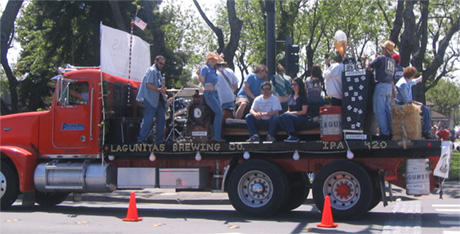
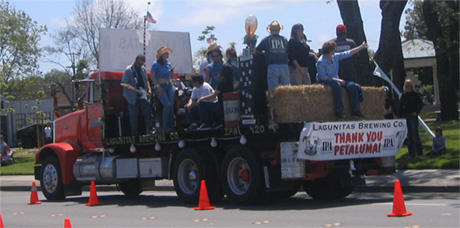
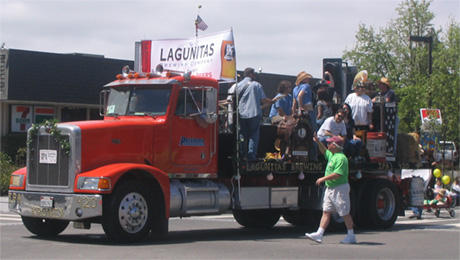
Today I took my kids, Porter and Alice, to the Butter & Eggs Day Parade in Petaluma, California. My son has been going through a farm animal phase and we though he would get to see a lot of horses and other animals in the parade. What we didn’t count on seeing was a float from Lagunitas Brewing Co. of Petaluma, though I suppose we should have. They had a flatbed truck with a band playing and all sorts of merriment going on. When the parade ended they kept on driving down the street, not stopping until they reached the Buckhorn Saloon, where I finally caught up with them for a drink.

The Lagunitas Float.

Pat Mace, a salesman for Lagunitas at the Buckhorn Saloon after the parade.

Filed Under: Just For Fun Tagged With: Bay Area, California

Great Divide Releases 4-Packs of Hercules & Yeti

April 28, 2006 By Jay Brooks

Great Divide Brewing of Denver, Colorado announced yesterday that they’re making two of their big beer series ales available in 12 oz. bottles in a four-pack package. Initially, these beers were only available on draft and in 22 oz. bottles. But the big beers have proven so popular and demand for the beers in 12 oz. bottles so great that the brewery responded. The Hercules Double IPA is fine imperial IPA but the Yeti Imperial Stout literally blew me away the first time I tried it. I was so impressed by it that I shot off an e-mail to owner Brian Dunn to congratulate him as soon as I got home from the tasting.

From the press release:

“Hercules Double IPA, Yeti Imperial Stout, Oak Aged Yeti Imperial Stout and Old Ruffian Barley Wine have become a very large part of our family of beers, and we’ve had a lot of fun brewing and selling them. We chose Hercules and Yeti to put in 4-packs, so these two behemoths could raise a little hell together on the cooler shelf” said Dunn.

Hercules Double IPA is a brash but creamy wonder, delivering a huge amount of piney, floral, and citrusy hop flavor and aroma from start to finish. A hefty backbone of nutty, toffee-like malt character balances Hercules’ aggressive, punchy hop profile. Hercules is 9.1% Alcohol by Volume (ABV), and 85 International Bittering Units (IBUs).

Yeti Imperial Stout, Silver Medal winner at the 2005 Great American Beer Festival, is an onslaught of the senses. An almost viscous, inky black brew, Yeti opens with a massive, roasty, chocolate, coffee malt flavor that eventually gives way to rich toffee and burnt caramel notes. Packed with an enormous quantity of American hops, Yeti’s hop profile reveals a wonderfully dry, hoppy finish. Yeti weighs in at 9.5% ABV and 75 IBUs.

Four-packs of the Yeti Imperial Stout and Hercules Double IPA will be released May 1.

Filed Under: Beers, News Tagged With: Colorado, Press Release

Budweiser Admits Flavor “Drifted” Over the Years

April 27, 2006 By Jay Brooks

bud-red
As I read the fascinating article in yesterday’s Wall Street Journal (subscription required to view the article) about how the flavor of Budweiser has drifted or “creeped” (as head brewmaster Doug Muhleman called it) over the years to become more bland, I was reminded of a conversation I had standing in line for food in the brewers’ lounge area at the Great American Beer Festival seven years ago. The GABF, when it was in the old building next to the new Convention Center where it’s now held, had a lounge where brewers, media and staff could go to relax and get away from the crowds. Standing in line for the free buffet lunch, in front of me, according to his badge was a brewer from Anheuser-Busch — I can no longer recall his name — and we began chatting amiably. Shortly before I’d left for Denver I’d received a gift at my office of a special 750 ml bottle of Budweiser that had been created to celebrate the millennium. My A-B chain rep. at that time explained to me that they were filled with everyday Budweiser, not a special brew to mark the occasion. So I mentioned this fact to my line buddy and asked why they didn’t do something special for the millennium bottle and I suggested they should have done a batch based on the original 1876 recipe. I’ll never forget the look on his face and what he said to me next. This brewer from Anhesuer-Busch looked me straight in the eye and said. “The Budweiser we make today is the same as it was then. We use the same recipe.” It was all I could do to not laugh in his face, because I really wasn’t trying to pick a fight. But it took a fair amount of restraint on my part not to call him on his statement.

And the reason for that is simple. No one in the beer industry believes that Budweiser today is the same as it was in 1876. Nobody. No one even thinks it’s the same now as it was at the end of World War Two. Nobody. And few people, if any, think it’s the same now as it was in the 1970s. But that’s been the party line at A-B for as long as I can remember. I recall Fred Eckhardt, a well-respected beer writer from Portland, talking about this fact in his various writings for many, many years. And I can’t recall a single conversation about this subject that came to a different conclusion over several decades. So for Anheuser-Busch to finally come clean and admit that the beer has changed feels like a vindication of the criticsms that have been leveled at them over the years.

The Wall Street Journal article states that “Anheuser[-Busch] concedes Budweiser has changed over the years. It quietly tinkered with its formula to make the beer less bitter and pungent, say several former brewmasters, a byproduct of the company’s desire to create a beer for the Everyman.” Apparently Triple Sticks, the affectionate nickname for August Busch III, in the 1980s ordered that sample bottles of A-B’s beers be cryogenically frozen, using the same method human tissue is frozen.

From the Wall Street Journal article:

Mr. Muhleman, who is officially Anheuser’s group vice president for brewing and technology, says the company didn’t set out to make the beers less bitter. He calls the change “creep,” the result of endlessly modifying the beer to allow for changes in ingredients, weather and consumer taste. “Through continuous feedback, listening to consumers, this is a change over 20, 30, 40 years,” says Mr. Muhleman, gesturing toward the row of Budweiser cans. “Over time, there is a drift.”

The five Budweiser cans in front of Mr. Busch, dating from 1982, 1988, 1993, 1998 and 2003, were pulled off the production line shortly after they were brewed. They were cooled to minus-321 degrees Fahrenheit over 16 hours and stored at that temperature in a secret laboratory in the company’s headquarters.

The sample cans demonstrate how “creep” works. The difference in taste between two beers brewed five years apart is indistinguishable. Yet, the difference between the 1982 beer and the 2003 beer is distinct. “The bones are the same. It is the same structure,” says Mr. Muhleman. Overall, however, “the beers have gotten a little less bitter.”

That may be part of it, but it sounds a bit disengenuous to me. They “listened to consumers?” How convenient that all these consumers wanted them to use less ingredients and make their beer more profitable. Because that’s the part of this “drift” that goes unmentioned. The WSJ article states that “[f]rom 1950 to 2004, the amount of malt used to brew a barrel of beer in the U.S. declined by nearly 27%, and the amount of hops in a barrel of beer declined by more than half, according to Brewers Almanac.” Well, guess what? They didn’t lower the price to reflect the use of less materials, did they? I certainly doubt it. According to the Siebel Institute: “Over the past twenty years the IBU’s of most American-style lagers has dramatically declined, from roughly 15-20 IBU’s to fewer than 10 today.”

Again, the article attributes this to outside influence, as the author writes. “Nonetheless, beer’s taste became steadily lighter.” (my emphasis.) This is driven home a second time by Graham Stewart, director of the International Centre for Brewing and Distilling at Heriot-Watt University in Edinburgh, Scotland when he states. “The North American palate has become lighter and lighter.” (my emphasis again.) They make it sound like it just happened as if it were accidental and beyond their control. But all of their advertising emphasized the “drinkability” of their beer as one of its greatest virtues. Through the slow manipulation of their formula to use less and less ingredients and careful advertising that de-emphasized that fact over time it was A-B (and the other big breweries) that changed their customers taste, not the other way around.

And this was done for one very sound reason, from their point of view — profit. Using less ingredients lowers your per item cost and increases profitability. Making the beer lighter has one other economic advantage and is explained rather straighforwardly by the article.

Again, from the WSJ article:

One key to Budweiser’s popularity is that it produces no “palate fatigue” after several drinks. The bitterness in stronger beers tends to build up, causing a drinker to tire of the taste. Bud’s appeal is what people in the industry call “drinkability.” (In the U.K., it is called “sessionability,” for how many beers one person will drink in a session.) Budweiser tests drinkability in “pub tests” in which the brewer rents a pub or a bar and invites people to drink free. Afterward, Anheuser drives the drinkers home.

For Mr. Busch, the definition of “drinkability” is simple: “I want the next beer!” he says. “You stop drinking because you know it’s time to stop but you don’t want to: That’s drinkability.” … “We’ve been tasting these beers for 50 years,” says Mr. Busch. “If we can’t sit down and drink three or four of them, then it’s not right.”

You’ve also heard this called “poundability,” and I think this admission runs quite contrary to the “responsible drinking” campaigns they’ve been using to keep the neo-prohibitionists off their back. A-B has their Responsibility Matters at beerresponsible.com, Miller has its Responsbile Drinking print campaign and Drink Aware in the UK. And you can download their Alcohol Manifesto at the Promoting Alcohol Responsibility section of the SABMiller website, and Coors‘ website has its own alcohol responsibility section. The point is that despite their hollow attempts at telling people to drink responsibly, a direct result of making their beer lighter is that people will drink more of it thus increasing sales. This is not so much a by-product as a carefully designed and predictable outcome of increasing “drinkability.” I love Busch’s own definition, which implies that if people stop drinking when they know they should stop then the Budweiser brewers haven’t done their job. How responsible is that?

According to the article, this strategy may finally be starting to backfire as craft beer has been showing consistent positive growth over the last few years. “As a result, rivals and some industry analysts blame Anheuser’s recent lackluster financial performance on the very foundation of Budweiser dominance: its light, bubbly formula, which has been mocked for years by beer snobs and beer drinkers outside the U.S.” So the economic indicators seem to be that people might actually be starting to demand that their beer have actual flavor. “I think you’re seeing an increased consumer acceptance that bitter is a positive characteristic in beer,” says Keith Lemke, vice president of the Siebel Institute. Another side benefit of craft beer, according to the big breweries’ logic (and one which should be embraced by the neo-prohibitionists), is that they claim craft beers’ strong flavors will create palate fatigue which lead to increased responsibility. This is because these full flavors will then cause people to drink less beer. That means that craft beer by its very nature is the better choice because it all but guarantees more responsible drinking. I realize it doesn’t actually really work that way, but it is a logical conclusion from A-B’s assertions. And I like the idea that from their own analysis craft beer is the best choice for drinking responsibly.

The article ends with a delightful coda from Abita Brewing’s president, David Blossom:

Many smaller brewers in the industry scoff at the idea there’s any difference between the two beers. “I sit back and chuckle at them going after each other,” says David Blossman, president of microbrewery Abita Brewing Co. in Abita Springs, La., which makes brands such as Purple Haze and Turbodog. “It’s like comparing Bunny Bread to Wonder Bread.”

And that’s an excellent observation, I think. We’re witnessing two giants duke it out over who has the better marketing claims. American-style lagers and American-style light lagers are all but indistinguishable from one another. So who wins the sales contest comes down to one thing: marketing. And how successful their marketing efforts have thus far been in misinforming their consumers about what beer is may be the saddest legacy of all.

Filed Under: Editorial, News Tagged With: Business, National

21st Amendment Preparing to Can Their Beer

April 25, 2006 By Jay Brooks

Shaun O’Sullivan, the brewmaster at 21st Amendment brewpub in San Francisco, has been extolling the virtues of canned beer for many months now, maybe longer. He’s been researching the improved technology for a while now, convinced that craft beer in cans is the wave of the future. But all that planning is going to begin paying off any time now. Shaun and his business partner Nico Freccia invited me to join them at the Ball Plant in Fairfield, California to watch the first cans of 21st Amendment beer manufactured. I’ve seen literally hundreds and hundreds of bottling lines, glass plants and even watched hand blown glass being made in Jamestown, Virginia but I’ve never seen beer cans being made. So I jumped at the chance to visit a can factory.

Left: The first Krueger can as shown in The Brewer’s News. Right: A digital recreation of the same can.

You know what they say. “Everything old is new again.” Beer cans debuted in 1935 when a now obscure New Jersey brewery, Gottfried Krueger, introduced their Krueger Cream Ale in cans in Richmond, Virginia. The advantage in those days was to protect the beer from becoming lightstruck. According to the BCCA account, “[b]ut the beer can really made its debut some 14 months earlier — just before the repeal of Prohibition. American Can Company had engineered a workable beer can. All that was needed was a brewer willing to take the pioneering plunge.” It tested very well and the rest is, as they say, history. Cans were very popular from the beginning but still did not outsell bottles until around 1969. That trend reversed itself again sometime in the 1980s or early 1990s when bottles again were the most popular package. While canned beer has been stigmatized as inferior to glass, the technology to make the cans, by coating each can with a protective internal coating so that the beer never comes in contact with the metal, has removed the issues that led to the tinny, metallic flavor that often leached into canned beer.

And slowly but surely, craft breweries have started canning their beer. Ed McNally’s Big Rock Brewery of Canada was probably the first craft beer I can recall in cans and Portland Brewing canned their McTarnhan’s Ale for sale on airplanes almost a decade ago. But Oskar Blues of Lyons, Colorado, with the help of Marty Jones, my friend and colleague — he also writes for the Celebrator — was the real pioneer of good beer in cans with their Dale’s Pale Ale leading the way. Since then several other craft breweries have begun canning their beers. Now 21st Amendment’s name can be added to the list. They’re going to put two of their beers in cans, the Watermelon Wheat and their IPA. And I believe they may be the first craft brewery in the Bay Area to can their beer. Ukiah Brewing was first in California when they came out with their Ukiah Pilsner last January. Today I watched the Watermelon Wheat cans being run and had an extensive tour, which was great fun.

Shaun O’Sullivan and Nico Freccia examine the first test cans to insure the colors and everything else are correct before commencing the full run.

Nico and the can’s designer sign off on the can proofs.

Large rolls of aluminum are used to create each can.

The rolls first run through a large machine that stamps out the initial shape of the can.

They look like small ashtrays and at this point the metal is still pretty thick.

It is then stretched in stages until it’s in the familiar can shape and much thinner.

And then receives an internal coating so that the beer never actually touches metal.

The cans are then washed and oven dried in preparation for printing.

Then the blank cans are printed using a a four-color process.

Here the plant was running some Pepsi cans through the line after being printed.

Here’s a Quicktime movie of the Pepsi cans moving swiftly on the line. You can either download the movie to your desktop or just click on the link to play it in your web browser (assuming your web browser has the quicktime plug-in installed).

The first 21st Amendment cans running on the can line.

Here’s two more Quicktime movies of the 21st Amendment cans on the line and then a closeup of them moving tha almost resembles an optical illusion. You can either download the movie to your desktop or just click on the link to play it in your web browser (assuming your web browser has the quicktime plug-in installed).

The cans on the conveyor belt before being palletized.

A full pallet, 21 rows high, of 21st Amendment beer cans.

A close up of the pallet of beer cans.

Nico and Shaun in front of the first pallets of 21st Amendment cans.

The full first run of 21st Amendment beer cans for Watermelon Wheat in the warehouse.

Shaun and Nico in front of the warehoused cans. Now the next step is to fill the cans, which should begin next week.

UPDATE: Part 2 of this story, how the cans are filled and sealed.

UPDATE: My review of the Watermelon Wheat in a can.

Filed Under: News Tagged With: California, Photo Gallery, San Francisco

More Thoughts on the Costco Decision

April 24, 2006 By Jay Brooks

I got the following sunny comment to my analysis of the Costco decision from SeattleBeerGuy:

Interesting analysis but I’m not sure I agree with the conclsuions. I think the change has the potential to earn wider distribution for many smaller breweries as they can now sell directly. The price issue does not seem terribly pressing as people who drink beer are generally willing to pay slightly more for a better beer anyway–ever plunk down $3 for 12oz? More than twice what you would pay for a macro-lager.

So yes, the big boxes will outcompete smaller stores on cases of Budweiser or Killian’s but that should only encourage smaller breweries to reach sweetheart deals with local, smaller stores. I see a rosy horizon over which small, local groceries sell beer from small, local breweries. Not a bad thing.

I was just going to post a comment responding to his thoughtful, if overly optimistic, take on the judge’s ruling but the more I thought about, the more I realized it required a more lengthy answer. This is necessary, I think, because it is the opinion that many people will likely hold. I want to be clear that I have no disrespect for this opinion but having been directly involved in the beer business at the retail level, I have a unique perspective on how things generally work from brewery to distributor to retailer. It is for this reason I hold a different opinion than SeattleBeerGuy and is why I can not be as sanguine and positive about the future.

So let’s look at SeattleBeerGuy’s assertions:

1. “The change has the potential to earn wider distribution for many smaller breweries as they can now sell directly.” That sounds good on paper but probably won’t work for a couple of reasons. First, that would require each small brewery to have a larger sales force to sell directly to retailers, including trucks to deliver to them, and merchandisers for support. Most small berweries simply won’t be able to afford to add the staff required. You could argue that one of the current brewery employees or the owner could do it, but given the number of locations that would now have to be sold to directly, that doesn’t seem remotely feasible. Second, buyers would be too busy to meet with a different salesman for each individual brewery. They simply don’t have that kind of time. That’s why having just a few distributors representing the majority of the brands makes sense, especially for the smaller players. Buyers only have to meet with a few people to meet all their needs. So that means distributors will still be the most efficient method for both small breweries and retailers. As it stands now, distributors sell to smaller retailers and larger chain stores are called on by what are called “chain reps.” or “chain salesmen” who give presentations to the larger chains. These more than likely already include “special deals” not made available to smaller retailers but now that it will be legal it will undoubtedly get worse. That’s not likely to change, except that the law will now give even more of an advantage to the big box stores. So buying direct will really only benefit these large stores who have trucks to pick up product and store it in their own warehouses. Those retailers will have an enormous advantage at every stage of the distribution path. Will wider distribution be possible for the smaller breweries? There may be a few medium or middle tier retailers looking for a way to distinguish themselves but I can’t see how that would create enough increased business to make much of a difference. At best, it seems like it might be something of a wash if that happens to balance the loss of business that I believe will eventually be caused by this decision.

2. “The price issue does not seem terribly pressing as people who drink beer are generally willing to pay slightly more for a better beer anyway–ever plunk down $3 for 12oz? More than twice what you would pay for a macro-lager.” This assertion ignores one inescapable fact, which is the people “willing to pay slightly more for a better beer” make up only 3.5% nationally of the total beer market. The other 96.5% are the ones buying crap for the most part. That number is probably higher in Seattle and it’s probably higher where I live in the Bay Area, as well. But even if it’s as high as 10% that still leaves 90% of consumers who aren’t willing to spend more. If you drink good beer you tend to live in a bubble — at least I know I do — where almost everyone you know also drinks decent beer. But the vast majority of consumers don’t drink craft beer. It’s weird to think about, but for every ten people you pass on the street, only one of them shares your love of good beer in a best case scenario. Depending where you live, it may be much, much worse. That’s why in a naming doublespeak that would make Orwell proud, Budwieser, Coors and Miller Genuine Draft are called “premium beers” and beers like Busch, Natural Light and Miller High Life are called “sub premium.” Imports like Heineken and Corona are called “premium imports.” Craft beer is called “specialty beer” which gives you some idea of how small a portion of total beer sales they represent. Most of the beer sales data is collected by two companies, Nielsen and IRI Scan Data, and both use these broad catagories to describe the beers they’re tracking. Both, as I understand it, only collect sales data from groceries, convenience stores, chain liquor stores and the like and so they’re not reflective of the overall market since they discount one-off liquor stores and other small retailers. But these are the figures used by most beer buyers and is does show some trends and has some value in that context since the sales data can be compared over time. And one of things they do show is how much price does matter to the 96.5% of consumers that buy beer not categorized as “specialty beer.” One of the reasons given for Anheuser-Busch’s recent drop in income is that they’ve been engaging in price wars, meaning they’ve lowered their price to increase sales at the expense of profitability. This has been going on in some fashion for at least five or six years, possibly more. And it’s kept domestic beer prices artificially low. So I think it is actually fairly pressing since the vast majority of beer drinkers do shop on price. What all this legal wrangling will result in, I believe is an even wider gap between domestic beer prices and craft beer. This gap makes it harder to convince the 90-96.5% to trade up to better beer. Forget all the arguments you can think of, some people are just stubbornly going to shop on price no matter what. At least that’s the way I see it.

3. “So yes, the big boxes will outcompete smaller stores on cases of Budweiser or Killian’s but that should only encourage smaller breweries to reach sweetheart deals with local, smaller stores. I see a rosy horizon over which small, local groceries sell beer from small, local breweries. Not a bad thing.” The problem with this, as I’ve said before, is that small breweries are not really in any position to make “sweetheart deals” with smaller retailers. I can’t tell you how many meetings I’ve had over the years when I was a beer buyer with small breweries telling me how they simply couldn’t match the big breweries on post-offs (posted discounts that are scheduled throughout the year), scans or scanbacks (another way to offer discounts that are tied to actual sales during a given period of time) or other incentives for hitting sales goals such as contests for stores, etc. And that’s because their business is tied to hitting some formula of volume of sales to the brewery’s capacity in order to be profitable. The amount of leeway they have for advertising or other sales incentives is miniscule compared to the larger breweries who have exponentially larger volume. Only the regional breweries, such as Anchor, Sierra Nevada or New Belgium have enough volume to do anything meaningful on a regular basis. And actually, Sierra Nevada did not discount their beer very often for many, many years. It really wasn’t until they’d built the new facility and introduced twelve-packs that they began doing a regular year-round schedule of discounts. The other problem is that many smaller retailers are also not going to be beating down their local brewery’s doors looking for them, either. There may be a few retailers who actually care about craft beer but in my experience each community only has a couple and usually only one or two that really specializes in having an outstanding beer selection. In Seattle I only know of Bottleworks. There may be another, but I don’t know of it. There’s probably a couple of stores where there’s an employee who’s really into good beer who’s made a difference at one store and who has a small following of customers. And that’s for a city of a little more than half a million people. In the nine counties that comprise the greater Bay Area there are just under seven million people and no dedicated beer store like Bottleworks, despite a vibrant beer culture. My point is that the number of places truly dedicated to the craft beer culture is fantastically small. And that fact makes it very difficult for me to see a “rosy horizon” when an enormous advantage is handed to a handful of big businesses whose sole goal — like all corporations — is domination of their market. I hope I’m wrong and it’s “not a bad thing” as SeattleBeerGuy believes, but my spidey sense is tingling and I can’t see any good coming from this long term, especially once this decision is used as a precedent and spread by Costco throughout the rest of the states.

Filed Under: Editorial, News Tagged With: Business, Law, Washington

A Beer for Menopausal Women

April 23, 2006 By Jay Brooks

While the FDA in the U.S. has been more than a little reluctant to endorse any health claims regarding beer, the EU has been at the vanguard of researching and standarizing such claims. Our governments’ stance on alcohol has been informed more by religious zealotry than any true health concerns. As a result we cannot bring ourselves to acknowledge that the demon alcohol might in fact not be all bad. That perhaps there are some health benefits from moderate drinking, despite study after study that shows just that, is anathema to the puritanical thinking of the neo-prohibitionists who make our country’s drug policy.

Meanwhile, the European Union has quietly created standards for organic beer, gluten-free beer and who knows what else. In most European countries drinking beer and wine in a family setting with meals, as a part of celebrations, and at family events and gatherings is so ubiquitous that they stare at us in wonder and bewilderment when we continually demonize alcohol. So it’s no surprise really that European doctors are studying ways to ease the suffering of women going through menopause by creating a special beer for them.

From the article in the South African iol:

Women struggling with the discomforts of menopause may soon find relief in a cold glass of beer.

Experts in the Czech Republic are working on a beer specifically brewed for women experiencing hot flashes, troubling sleeping and other woes during this phase.

The low-kilojoule, low-alcohol beer being developed by the Prague-based Research Institute of Brewing and Malting contains heightened levels of phytoestrogen, a plant form of the hormone estrogen often lacking in menopausal women, said the institute’s director Karel Kosar.

Phytoestrogen is found in the hops and barley malt used in many types of beer. Kosar said breweries could produce the special beer by increasing the levels of these ingredients.

A gynaecologist working with the institute reported good results from clinically tests with the beer on 20 women. The volunteers who drank three decilitres nightly for two months reported fewer menopausal symptoms.

I certainly hope they perfect it before my wife needs it. But that gives them twenty to twenty-five years which should be plenty of time.

Filed Under: Editorial, Just For Fun, News Tagged With: Europe, Health & Beer

Beginning of the End for Small Beer Businesses?

April 22, 2006 By Jay Brooks

In one of the most watched legal battles in recent years, the judge yesterday in the Costco case in Washington state may have signaled bad times ahead for small retailers and small breweries. Her short-sighted ruling followed most courts’ bias in recent years that favor big business over the consumer or small local businesses.

The specific state regulations dismantled by Judge Pechman are:

  1. Bans on volume discounts and credit sales of beer and wine.
  2. Minimum markup requirements, which force manufacturers to charge at least 10 percent over cost when they sell beer and wine to distributors. Distributors face the same rule when they resell the products to retailers.
  3. Mandates that manufacturers and distributors post product prices with the state, and keep prices the same for a month afterward. Distributors must charge that price to each retailer, and retailers can’t get discounts for paying for freight or picking up the product themselves.
  4. A ban on retailers storing or receiving beer or wine at a central warehouse.

So let’s look at each of these:

1. Volume sales. This, of course, benefits the huge box stores like Costco and Wal-Mart and will make it increasingly difficult for smaller retailers like family-owned mom and pop liquor stores to compete since they cannot buy in the large quantities of a Costco. This gives a huge, unbalanced advantage to the big retailers. Will these small stores go out of business as a result? It’s hard to say, but it certainly won’t make it any easier on them. It probably won’t happen right away, but it doesn’t seem a stretch to say a few years from now consumers will have less choice because there will be fewer places to buy beer. It would be easy to blame this all on the big stores but unfortunately consumers are at least partly to blame for this. The big stores merely exploit most people’s belief that low prices are the only criteria worth considering in purchase decisions. Stores like Wal-Mart could not destroy whole towns if their customers didn’t flock to them zombie-like in search of the latest bargain. As long as people shop on price alone without regard to the consequences of their choices, small businesses will continue to die out and our consumer landscape will become more and more homogenized with the same handful of national retailers dominating. Think I’m paranoid? Look at the state of music radio today now that Clear Channel owns most of the radio stations. The only way to combat this is to think about where you make your purchases and to be willing to pay a few cents more to support small, local businesses. The benefits to your community are huge even if they’re not immediately apparent. But if you don’t, you’d be naive to believe that the low prices that you were lured in by will continue once they’ve put your corner liquor store out of business. Not only will prices shoot up again dramatically but the number of available beers — and especially the non-national, local brands — will shrink precipitously. So if you value good beer, please think as much about where you buy your beer as what beer to buy.

2. Minimum mark-ups. At first blush, this appears to make no sense. Remove it and prices will drop, right? Maybe at first, but not for long, because this is very deceiving. You can see why Costco went after it, since they work on volume sales that allow them to have lower margins overall. Small businesses don’t have that luxury and most businesses don’t — and can’t — use that business model. Even so, 10% is nothing. Most businesses mark up their goods 40-50% and the beverage retailers I know about shoot for a markup of around 20-25%, less for sale and loss leader items. So on a per-item basis, the markup on alcoholic beverages is already lower than the market in general. So what will removing the 10% markup accomplish? It will allow the big box stores to get even deeper discounts which will assist them in their efforts to squash their competition. Will prices to consumers go down? Probably at first, but it will primarily be the big domestic and import brands that will have lower prices. It’s unlikely to have much effect on craft beers and smaller import beers. So the gap between the two will continue to widen, which is bad for everybody.

3. Price posting and freight discounts. Posting prices at a central location is to insure a level playing field. Removing it, of course, makes the playing field uneven. If there is no longer a requirement to post prices, then all manner of back room deals become possible … and legal. Again, this may lower some prices for some retailers for some period of time. But it will hurt the small retailers who won’t be offered any back room deals, and the small breweries who can’t afford to offer any back room deals to retailers. As to the frieight discounts — are you sensing a pattern yet? — this will only benefit the companies large enough to have their own fleet of trucks and you can probably figure out who they are.

4. Central warehouse ban. Again, the only businesses that have central warehouses are the very large, multi-location big box stores. The warehouse allows them to buy in extreme bulk. Not only does this give them yet another unfair advantage, but it also removes any incentive to sell fresh product to the consumer. Of course, since most of the brands that will be effected by this taste pretty bad already, maybe that’s not such a bad thing.


Both the national press such as AP and the local papers such as the Seattle Times and the Seattle Post-Intelligencer are reporting this as a victory not only for Costco but for consumers as well, saying that the decision will lower beer and wine prices in the state. But that’s just propaganda, it doesn’t really examine the long term ramifications of the decision. Short term, prices may indeed go down but that’s not always a good thing. But selling a bill of goods to the public by saying one thing when another is more likely true is what our media does best. Large city newspapers — who are big business themselves — generally always take the side of business in their reporting and are one of the many ways information consumers receive is managed. This is a terrific example of collective restraint by the media to not actually examine what this decision means for the average consumer preferring instead to spin it in a way that actually downplays its negative aspects.

What’s more troubling is that with this victory, Costco will be examining the remaining forty-nine states to decide if — or more likely when — they can screw consumers in those states, too. Our only hope is to spend a little more for better beer before it’s too late. Support your local businesses as much as possible. Don’t be pennywise and pound foolish.

Filed Under: Editorial, News Tagged With: Business, Law, Washington

Euphemistic Craft Brewers Alliance Swells Its Ranks?

April 19, 2006 By Jay Brooks

There’s been talk in the air for months regarding Anheuser-Busch approaching regional craft brewers about aligning themselves with them in some fashion — either by purchasing or other distribution arrangements — and many, many names have been dropped as being potential targets. Most have proved unfounded and because of this I’ve been careful not to name any rumored names. Even so, I’ve gotten several e-mails from friends in breweries letting me know they’re definitely not in negotiations with A-B, which has been appreciated. It’s nice to able to whittle down the list. But several names have persisted and even a few of them have been seen in print. So it was no surprise that more definite rumors abounded at the Craft Brewers Conference last week about which craft brewers might be joining Anheuser-Busch’s Craft Brewers Alliance.

Current members include Redhook and Widmer Brothers. The distribution deal, which is rumored to include a small percentage of ownership by A-B tied to performance standards, has worked wonders for Widmer and their business has grown quite dramatically. Redhook, on the hand, has not fared as well. As I understand it, they did not meet performance goals and as a result A-B exerts greater control over them now then before and owns a greater percentage of the Seattle-based company. I don’t know the actual specifics — does anybody? — but it’s something like that.

Three names kept coming up last week as having signed deals or being close to closing a deal with A-B to join the Craft Brewers Alliance. I want to stress that the exact nature of the deal, if any, is strictly rumor at this point. Though several people I spoke to seem to have it on good authority that this is what is happening. The three breweries consistently mentioned are Firestone Walker Fine Ales of Paso Robles, California, Goose Island Brewing of Chicago, Illinois and Kona Brewing of Hawaii. If true, that would make the CBA five fairly large and prominent breweries. For those breweries it would mean increased distribution nationally. For other craft brewers, especially those currently being distrubuted by A-B distributors, it could spell disaster. If your distributor has five reasonably popular craft brands with a variety of styles that they’re effectively bound by contract to focus on, then the amount of attention other brands will get will certainly be less, assuming they even keep those other brands. There will likely be additional pressure for the distributors to have “100% share of mind,” the name of A-B’s wholesaler exclusivity program, and that will likely result in many A-B houses dropping smaller, local brands in order to accomodate the new CBA brands.

Rich Tucciarone, Director of Brewery Operations for Kona, did confirm that they have had in place for some time now several distribution only agreements in a few states for Bud distributors to carry their products but that no new negotiations or deals have taken place in recent months. From what he told me, this is only new insofar as people are talking about it again and examining relationships between craft brewers and A-B houses involved in distrubting their product.

I wasn’t able to speak with Matt Brynildson, Firestone Walker’s brewmaster, because I only saw him accepting his awards at CBC. I did, however, talk with Mark Cabrera, an old friend and Northern California Sales Manager for Firestone Walker. He told me the rumors are patently untrue. Firestone Walker has, he mentioned, recently switched distributors in southern California to include exclusively A-B houses which may have fueled speculation. But, he assured me, Adam Firestone, though certainly approached, rebuffed A-B’s advances.

Goose Island, on the other hand, does appear to at least be in talks with A-B. As long ago as last December, the Chicago Tribune reported as much. As mentioned in Stan Hieronymus’ Beer Therapy “Goose Island president and founder John Hall confirmed as much, but said discussions have been limited to ‘distribution issues.’ He declined to comment further on the nature of the talks.” I saw Will Turner, who’s a Bay Area brewer who now brews for Goose Island, at CBC but I didn’t get a chance to ask him about this.

Every person I did talk to about this had a certain wearines in their voice, like they’d grown quite tired of talking about this and refuting the rumors. And that makes sense, there’s few things more damaging or harder to defend than an unfounded rumor. They’re a lot like viruses. No one can pinpoint where they started and they’re pretty hard to kill. So it seems that these recent round of rumors amount to virtually nothing, unfortunately, so we really still don’t know exactly what’s going on, who’s making deals, and what the deals are. Until that happens, all we can really do is wonder, speculate and worry.

Filed Under: Editorial, News Tagged With: Business, National

« Previous Page
Next Page »

Find Something

Northern California Breweries

Please consider purchasing my latest book, California Breweries North, available from Amazon, or ask for it at your local bookstore.

Recent Comments

  • Bob Paolino on Beer Birthday: Grant Johnston
  • Gambrinus on Historic Beer Birthday: A.J. Houghton
  • Ernie Dewing on Historic Beer Birthday: Charles William Bergner 
  • Steve 'Pudgy' De Rose on Historic Beer Birthday: Jacob Schmidt
  • Jay Brooks on Beer Birthday: Bill Owens

Recent Posts

  • Beer In Ads #5235: The Buck Is Loose! April 29, 2026
  • Historic Beer Birthday: Robert Cain April 29, 2026
  • Historic Beer Birthday: Philip Jacob Ebling Jr. April 29, 2026
  • Beer Birthday: Tom Riley April 29, 2026
  • Historic Beer Birthday: Matthew Vassar April 29, 2026

BBB Archives

Feedback

Head Quarter
This site is hosted and maintained by H25Q.dev. Any questions or comments for the webmaster can be directed here.