Brookston Beer Bulletin

Jay R. Brooks on Beer

  • Home
  • About
  • Editorial
  • Birthdays
  • Art & Beer

Socialize

  • Dribbble
  • Email
  • Facebook
  • Flickr
  • GitHub
  • Instagram
  • LinkedIn
  • Pinterest
  • RSS
  • Twitter
  • YouTube

Powered by Genesis

The London Beer Flood Of 1814

October 17, 2016 By Jay Brooks

flood
Today was a dark day in a certain part of London, known as the Parish of St. Giles. On October 17, 1814, an incident which became known as the London Beer Flood took place. Here’s the basic account, from Wikipedia:

At the Meux and Company Brewery on Tottenham Court Road, a huge vat containing over 135,000 imperial gallons (610,000 L) of beer ruptured, causing other vats in the same building to succumb in a domino effect. As a result, more than 323,000 imperial gallons (1,470,000 L) of beer burst out and gushed into the streets. The wave of beer destroyed two homes and crumbled the wall of the Tavistock Arms Pub, trapping teenage employee Eleanor Cooper under the rubble. Within minutes neighbouring George Street and New Street were swamped with alcohol, killing a mother and daughter who were taking tea, and surging through a room of people gathered for a wake.

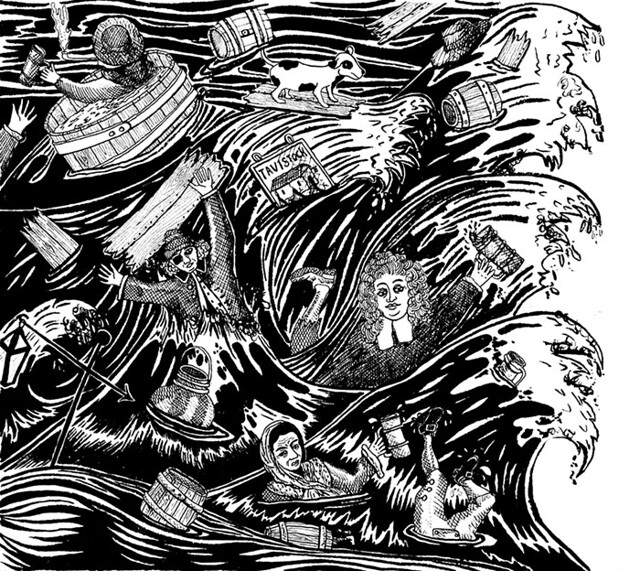
One source claimed this engraving appeared shortly after the incident, an artists rendition, so to speak, but I’ve since learned it very recent, created by a London artist, Chris Bianchi, for Completely London, and given the title “It’ll All End in Beer.”
londonbeerflood

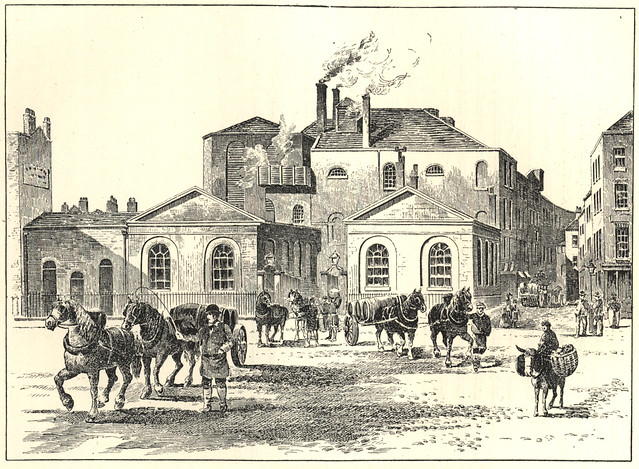
The flood occurred at Meux’s Brewery Co Ltd., which was established in 1764, It was a London brewery owned by Sir Henry Meux. Meux, like many modern brewers, bought out smaller breweries. One of the breweries it acquired was the Horse Shoe Brewery (founded by a Mr Blackburn, and famous for its ‘black beer’), located on the junction of Tottenham Court Road and Oxford Street, London. Atop the Horse Shoe stood several large vats of beer. The largest was the porter vat – a 22-foot-high monstrosity that held 511,920 litres of beer, in turn held together by a total of 29 large iron hoops. For some idea of its vastness, The Times report of 1 April, 1785 read:

There is a cask now building at Messrs. Meux & Co.’s brewery…the size of which exceeds all credibility, being designed to hold 20,000 barrels of porter; the whole expense attending the same will be upwards of £10,000.
meuxbwy-1830
Meux’s Horse Shoe Brewery, c. 1830.

The following account of the incident is from Historic UK:

On Monday 17th October 1814, a terrible disaster claimed the lives of at least 8 people in St Giles, London. A bizarre industrial accident resulted in the release of a beer tsunami onto the streets around Tottenham Court Road.

The Horse Shoe Brewery stood at the corner of Great Russell Street and Tottenham Court Road. In 1810 the brewery, Meux and Company, had had a 22 foot high wooden fermentation tank installed on the premises. Held together with massive iron rings, this huge vat held the equivalent of over 3,500 barrels of brown porter ale, a beer not unlike stout.

On the afternoon of October 17th 1814 one of the iron rings around the tank snapped. About an hour later the whole tank ruptured, releasing the hot fermenting ale with such force that the back wall of the brewery collapsed. The force also blasted open several more vats, adding their contents to the flood which now burst forth onto the street. More than 320,000 gallons of beer were released into the area. This was St Giles Rookery, a densely populated London slum of cheap housing and tenements inhabited by the poor, the destitute, prostitutes and criminals.

The flood reached George Street and New Street within minutes, swamping them with a tide of alcohol. The 15 foot high wave of beer and debris inundated the basements of two houses, causing them to collapse. In one of the houses, Mary Banfield and her daughter Hannah were taking tea when the flood hit; both were killed.
In the basement of the other house, an Irish wake was being held for a 2 year old boy who had died the previous day. The four mourners were all killed. The wave also took out the wall of the Tavistock Arms pub, trapping the teenage barmaid Eleanor Cooper in the rubble. In all, eight people were killed. Three brewery workers were rescued from the waist-high flood and another was pulled alive from the rubble.

All this ‘free’ beer led to hundreds of people scooping up the liquid in whatever containers they could. Some resorted to just drinking it, leading to reports of the death of a ninth victim some days later from alcoholic poisoning.

‘The bursting of the brew-house walls, and the fall of heavy timber, materially contributed to aggravate the mischief, by forcing the roofs and walls of the adjoining houses.’ The Times, 19th October 1814.
Some relatives exhibited the corpses of the victims for money. In one house, the macabre exhibition resulted in the collapse of the floor under the weight of all the visitors, plunging everyone waist-high into a beer-flooded cellar.

The stench of beer in the area persisted for months afterwards. The brewery was taken to court over the accident but the disaster was ruled to be an Act of God, leaving no one responsible.

The flood cost the brewery around £23000 (approx. £1.25 million today). However the company were able to reclaim the excise duty paid on the beer, which saved them from bankruptcy. They were also granted ₤7,250 (₤400,000 today) as compensation for the barrels of lost beer.

This unique disaster was responsible for the gradual phasing out of wooden fermentation casks to be replaced by lined concrete vats. The Horse Shoe Brewery was demolished in 1922; the Dominion Theatre now sits partly on its site.
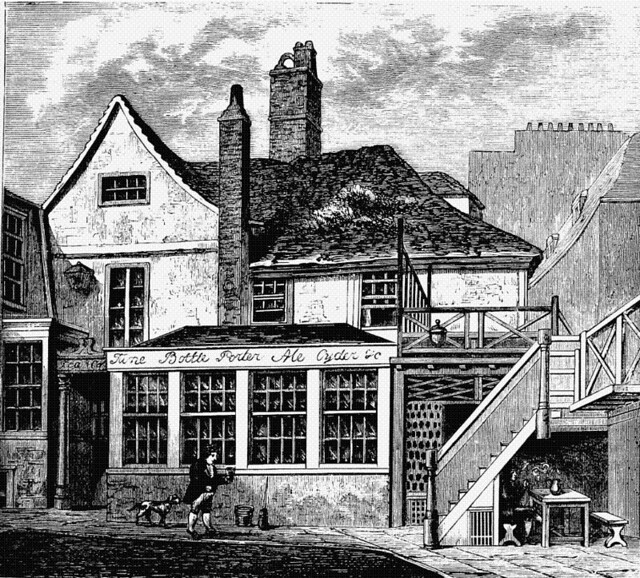
The_manor_house_of_Toten_Hall_-_1813
Toten Hall house in Tottenham Court Road, destroyed by the beer flood.

This is from h2g2 The Hitchhiker’s Guide to the Galaxy: Earth Edition.

Come October of 1814, the beer had been fermenting atop the brewery for months (as was the need with porter), and the metal and wood of this huge vat was, unbeknownst to the majority of the brewery workers3, beginning to show the strain of holding back the thousands of litres. Suddenly, at about 6.00pm, one of the heavy metal hoops snapped and the contents of the porter vat exploded out – quite literally – causing a chain reaction with the surrounding vats. The resulting noise was apparently heard as far away as five miles!

A total of 1,224,000 litres of beer under pressure smashed through the twenty-five foot high brick wall of the building, and gushed out into the surrounding area – the slum of St Giles. Many people lived in crowded conditions here, and some were caught by the waves of beer completely unaware. The torrent flooded through houses, demolishing two in its wake, and the nearby Tavistock Arms pub in Great Russell Street suffered too, its 14-year-old barmaid Eleanor Cooper buried under the rubble. The Times reported on 19 October of the flood:

The bursting of the brew-house walls, and the fall of heavy timber, materially contributed to aggravate the mischief, by forcing the roofs and walls of the adjoining houses.

Fearful that all the beer should go to waste, though, hundreds of people ran outside carrying pots, pans, and kettles to scoop it up – while some simply stooped low and lapped at the liquid washing through the streets. However, the tide was too strong for many, and as injured people began arriving at the nearby Middlesex Hospital there was almost a riot as other patients demanded to know why they weren’t being supplied with beer too – they could smell it on the flood survivors, and were insistent that they were missing out on a party! Calm was quickly restored at the hospital, but out in the streets was a different matter.

Back at the brewery, one man managed to save his brother from going under the vast wave, but as the tide receded the true damage could be discovered. The beer tsunami left nine people dead4; many had drowned (like Mary Mulvey and her 3-year-old son Thomas), others were swept away in the flood and died of the injuries they sustained (two young children: Hannah Banfield, 4, and Sarah Bates, 3), and the final victim actually succumbed some days later of alcohol poisoning – such was his heroic attempt to stem the tide by drinking as much beer as he humanly could.

Because of the poverty of the area, relatives of the drowned took to exhibiting their families’ corpses in their homes and charging a fee for viewing. In one house, though, too many people crowded in and the floor gave out, plunging them all into a cellar half full of beer. This morbid exhibition moved locations, attracting more custom – and eventually the police, who closed the doors on the horrible circus. Later, the funerals of the dead were paid for by the St Giles population, coins left on their coffins. The stench of the beer apparently lasted for months, and after the initial excitement, many found both their homes and livelihoods swept away with the flood. In amongst the misery of clearing away the dead and cleaning up the streets, though, there was compassion. The Times concluded:

The emotion and humanity with which the labourers proceeded in their distressing task excited a strong interest, and deserves warm approbation.

The Meux Brewery Company was taken to court over the accident, but the judge ruled that although devastating, the flood was an ‘Act of God’ and the deaths6 were simply by ‘casualty’. In other words, no party was to blame, and the company continued working despite the incident. Up until 1961 that is, when it was sold to Friary, Holroyd and Healy’s Brewery Ltd of Guildford. The firm became Friary Meux Ltd for only three years, before being bought outright by Ind Coope (& Allsop) of Burton-on-Trent.

Apparently the only eyewitness account to the flood was from an American tourist who chose the wrong shortcut:

All at once, I found myself borne onward with great velocity by a torrent which burst upon me so suddenly as almost to deprive me of breath. A roar as of falling buildings at a distance, and suffocating fumes, were in my ears and nostrils. I was rescued with great difficulty by the people who immediately collected around me, and from whom I learned the nature of the disaster which had befallen me. An immense vat belonging to a brew house situated in Banbury street [sic – now Bainbridge Street], Saint Giles, and containing four or five thousand barrels of strong beer, had suddenly burst and swept every thing before it. Whole dwellings were literally riddled by the flood; numbers were killed; and from among the crowds which filled the narrow passages in every direction came the groans of sufferers.
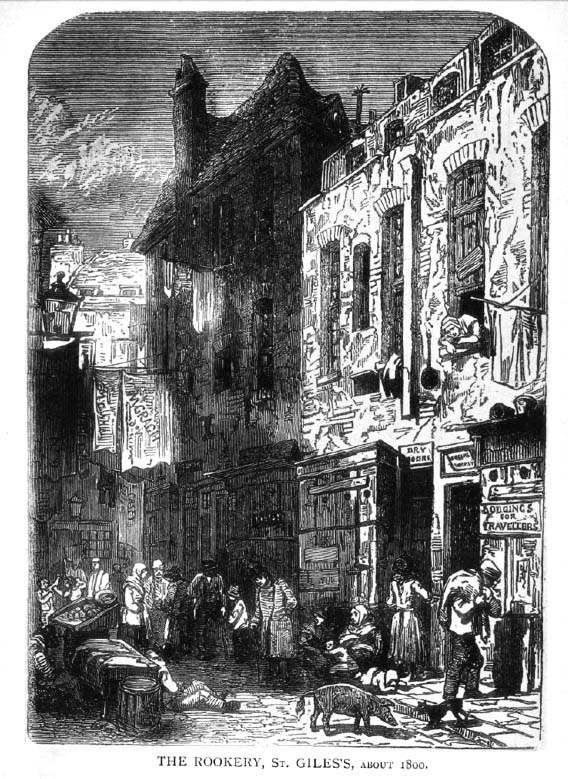
St-Giles-rookery

There are quite a few more accounts, such as History Nuggets, Damn Interesting, the History Channel, and The Independent. But naturally, the best account os from Martyn Cornell, the Zythophile, in So what REALLY happened on October 17 1814?
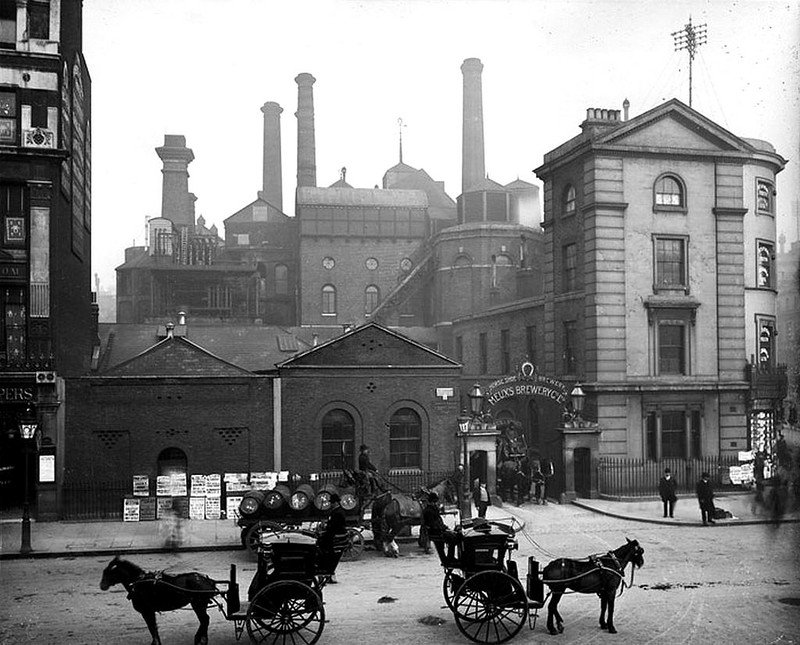
meux-brewery
Meux’s Horseshoe Brewery, around 1906.

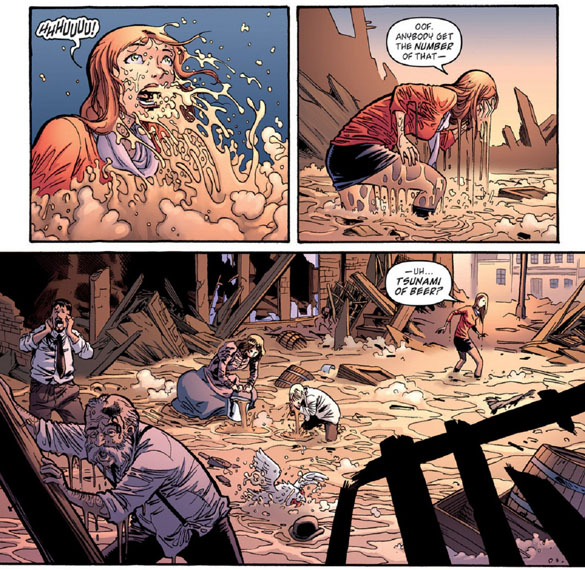
This version of the story, a bit altered from reality, appeared in the comic book “Doctor Who #4” (December 2012), with a script by Brandon Seifert, pencils by Philip Bond, inks by Ilias Kyriazis, colors by Charlie Kirchoff, and letters by Tom B. Long:
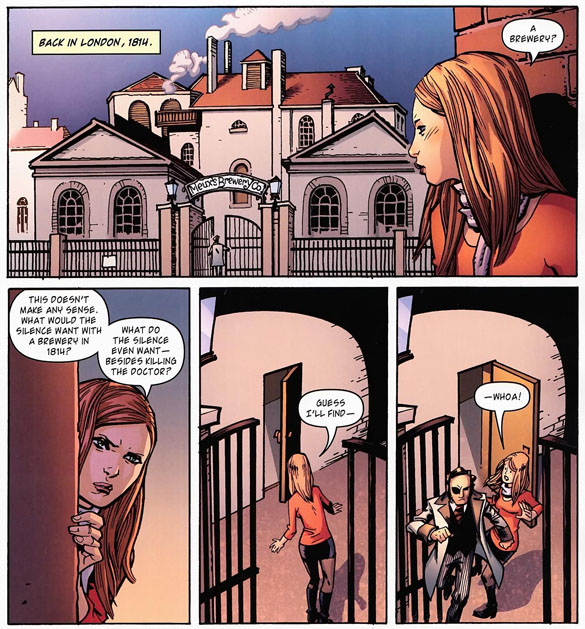

1017-dr-who-1

1017-dr-who-2

Layout 1

Layout 1

And here’s a short video on the flood, from American Adventure Survival Science (and please note, the host is wearing a Bagby Beer Co. shirt):

Filed Under: Beers, Breweries, Just For Fun, Related Pleasures Tagged With: England, History, London

Patent No. 266126A: Beer Pump

October 17, 2016 By Jay Brooks

patent-logo
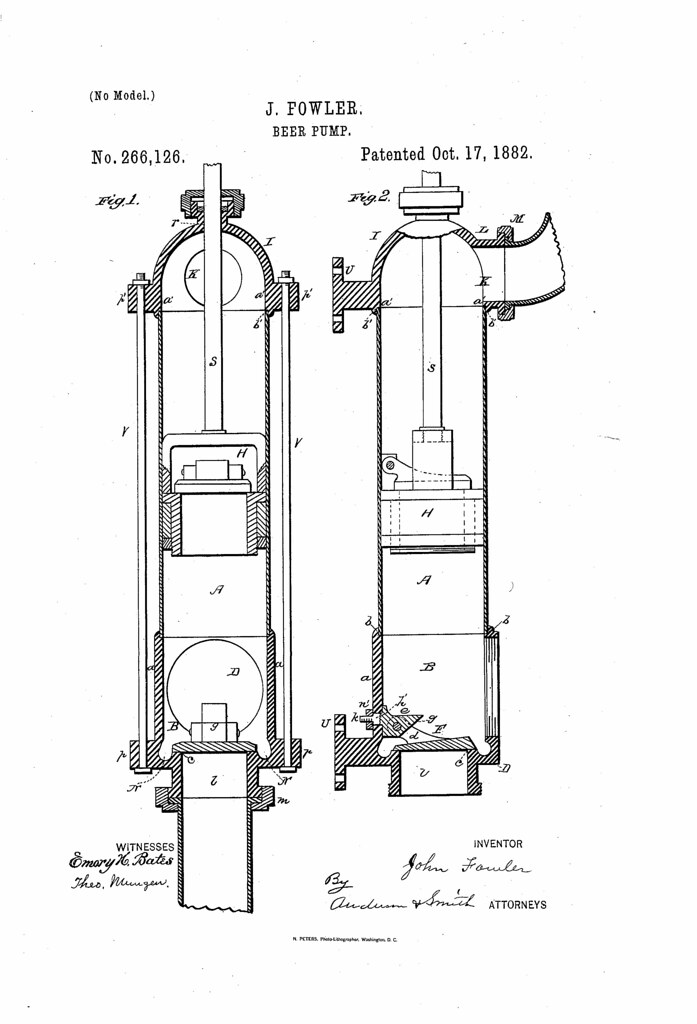
Today in 1882, US Patent 266126 A was issued, an invention of John Fowler, for his “Beer Pump.” There’s no Abstract, although in the description it includes these claims:

This invention has relation to beer-pumps used in distilleries for pumping beer and mash; and it consists in the novel construction and arrangement of parts, as will be hereinafter fully described, and particularly pointed out in the claims.

US266126-0

Filed Under: Beers, Breweries, Just For Fun, Politics & Law, Related Pleasures Tagged With: Brewing Equipment, History, Law, Patent, Science of Brewing

Beer In Ads #2065: Moments We’ll Never Forget

October 16, 2016 By Jay Brooks


Sunday’s ad is for Schlitz, from 1940. In this ad, entitled “Moments We’ll Never Forget …,” is features “Six great explorers recall exciting episodes around the world.” But then there’s one more story. And it’s the moment you first tasted Schlitz. There’s even a sidebar with how bad air is for your beer. Another dense double truck filled with text. These may some of the first advertorials.

Schlitz-1940-moments

Filed Under: Art & Beer, Beers Tagged With: Advertising, History, Schlitz

Patent No. 286637A: Beer Chip

October 16, 2016 By Jay Brooks

patent-logo
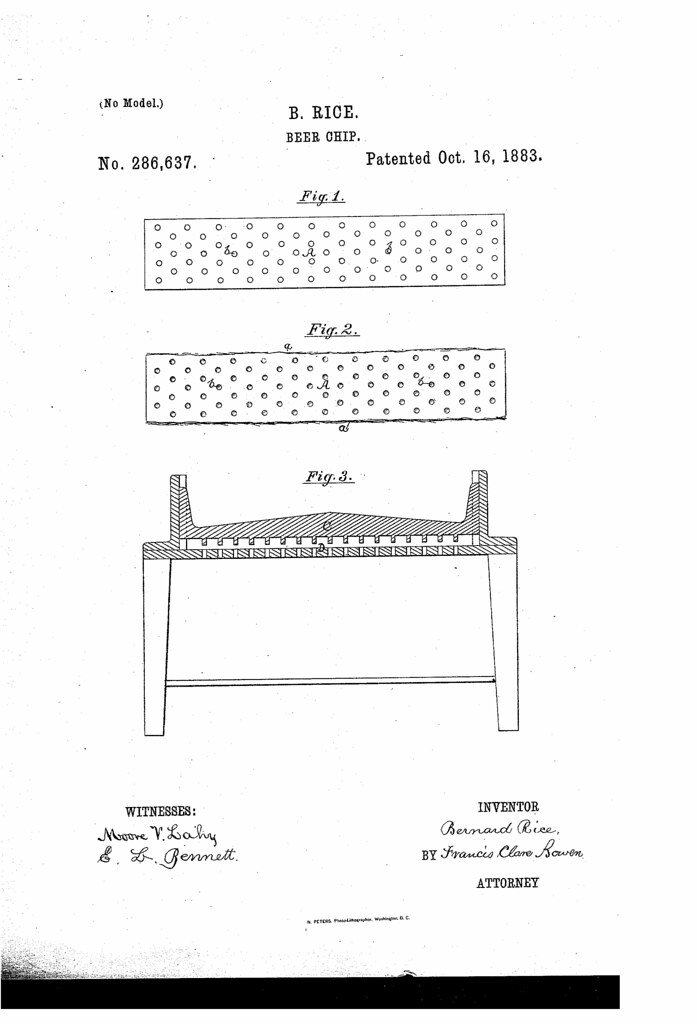
Today in 1883, US Patent 286637 A was issued, an invention of Edward Fitch, for his “Beer Chip.” There’s no Abstract, although in the description it includes these claims:

My invention consists in a “beer-chip,” so called, for clarifying the beer, which is perforated for the purpose of increasing its superficies and allowing a-circulation of liquid, the holes extending in parallel rows with those of the other, one row alternating with those of the other, so as to least weaken the article; also, in producing a roughened splintery edge on the veneer by breaking or splintering the same.

Heretofore beer-chips have been cut to a certain width by means of saws, knives, or shears, which gives the chip a comparatively smooth, edge,to which no particles in the beer will adhere, confining the clarifying functions to be performed solely through the surfaces of the chip. Should, as sometimes happens, two chips lie one upon the other, (which is never the case with the edges of a chip,) the surfaces of such chips, and consequently the chip itself, will be inoperative and useless as a clarifier in the vat. In order to meet this deficiency and increase the clarifying properties of the chip in general,l make the edges of the chip splintery. as shown in Fig. 2. Amore minute description of forming such splintery edges in the chip is given hereinafter. It will be seen and admitted that to the splintery edges of a chip impurities in the beer will readily ad here and be retained until cleansed and removed by the action of the water in the re= by subjecting the wood or veneer to the action of a pair of cutting-rolls. The wood or veneer is passed through the said-cutting-rolls, is wedged between the male and female cutters, which breaks or slits the veneer into chips, producing the desired splintery edges on the chips.

US286637-0

Filed Under: Beers, Breweries, Just For Fun, Politics & Law, Related Pleasures Tagged With: History, Law, Patent, Science of Brewing

Beer In Ads #2064: What’s In A Name?

October 15, 2016 By Jay Brooks


Saturday’s ad is for Schlitz, from 1940. In this ad, a trivia bonanza, all about how things got their names. “What’s in a Name? Everything!” There are sixteen little histories of how different things got their names, which is a lot for an ad, even a double truck. And then there’s just one more origin story:Schlitz.

Schlitz-1940-name

Filed Under: Art & Beer, Beers Tagged With: Advertising, History, Schlitz

Patent No. EP1979462A1: Use Of Cacao Polyphenols In Beer Production

October 15, 2016 By Jay Brooks

patent-logo
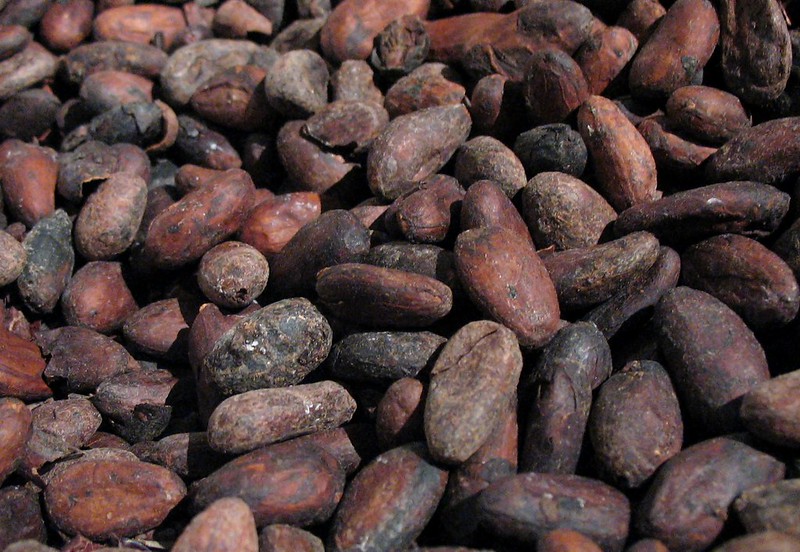
Today in 2008, US Patent EP 1979462 A1 was issued, an invention of Herwig Bernaert, for his “Use of Cacao Polyphenols in Beer Production.” Here’s the Abstract:

The present invention relates to a solvent-derived, cocoa extract comprising between 25 and 65% by weight of polyphenols, and uses thereof for improving a beer production process and the resulting beer product. The invention further relates to a method for improving a beer production process as well as the beer product resulting from it. The invention further relates to a beer product with improved quality such as enhanced colloidal, taste and flavor stability. The invention also provides a beer with exogenous polyphenols and a beer comprising at least one cocoa polyphenol. Furthermore, the present invention includes a use of exogenous polyphenols as process enhancer and a use of cocoa for enhancing filtration processes.

Cacao-roasted

Filed Under: Beers, Breweries, Just For Fun, Politics & Law, Related Pleasures Tagged With: adjuncts, Chocolate, History, Law, Patent, Science of Brewing

Beer In Ads #2063: Favorite Recipes That Go Well With Schlitz

October 14, 2016 By Jay Brooks


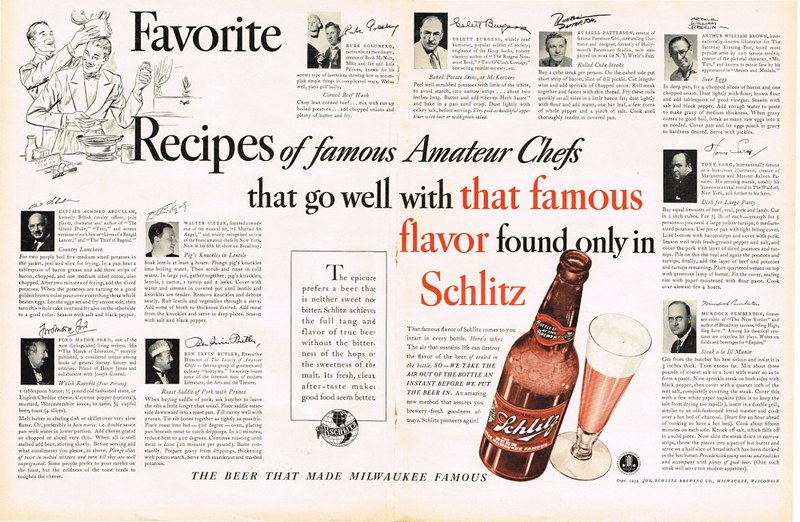
Friday’s ad is for Schlitz, from 1939. In this ad, with the ridiculously long title “Favorite Recipes of famous Amateur Chefs that go well with that famous flavor found only in Schlitz. The dense ad includes short bios and recipes from ten people (they’re hard to read) and this interesting blanket statement. “The epicure prefers a beer that is neither sweet nor bitter.” I think that depends on what he’s doing with it, how he’s using it or what food he’s pairing or cooking it with. Of course, this was 1939, and Sean Paxton and Bruce Paton hadn’t been born yet.

Schlitz-1939-recipes

Filed Under: Art & Beer, Beers Tagged With: Advertising, History, Schlitz

Patent No. 2855969A: Ladies’ Handbag (Shaped Like A Keg)

October 14, 2016 By Jay Brooks

patent-logo
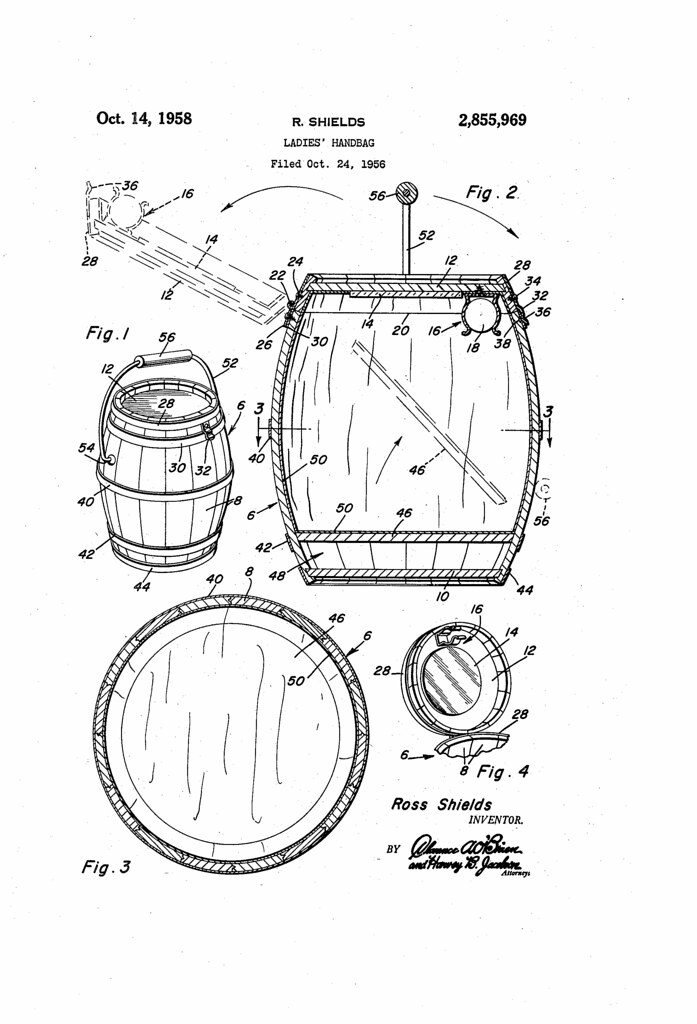
Today in 1958, US Patent 2855969A was issued, an invention of Edward Fitch, for his “Ladies’ Handbag” (Shaped Like A Keg). There’s no Abstract, although in the description it includes these claims:

This invention relates to a novel handbag for use by women and girls and has reference to a handbag which is original in that it is constructed to represent a miniature barrel.

Needless to say, handbags are designed and constructed in almost every conceivable shape and form. Current trends have, however, led to styles which are in representation of boxes, baskets, and all sorts of rigid type containers. With a view toward extending and enhancing the appearance of uniquely styled handbags, it is an object in the present matter to embark on a newer line of thought. To this end, the instant concept has to do with a handbag which is singularly distinct and different in that it takes the form of a miniature barrel and which lends itself to eye appeal by reason of the fact that it is a replica of a genuine keg or barrel and is, at the same time, practical and useful.

Briefly and somewhat broadly the improved handbag is characterized by a container having a given exterior shape. The container is characterized by a rigid, hollow body portion and rigid top and bottom wall. Thus constructed, the container serves to provide a fixed interior receptacle portion which may be appropriately lined using suitable material which lends itself to use in ones handbag. The upper or top portion of the container is separate from and hingedly mounted on the upper part of the body portion and constitutes a lid or cover. As a general rule, this is provided on its interior side with a face mirror and at least one article holding clip which may be employed to support a readily accessible lipstick. Handle means is also appropriately mounted on the body portion and is such in construction that it adds to the over-all distinctive appearance of the handbag.

More specifically, the container in its preferred embodiment is constructed to represent a miniature barrel, and to this end the body portion is constructed from longitudinally bowed staves with their abutting lengthwise edges connected by inter-fitting tongues and grooves. Ornamental hoop-like bands encircle and are fixedly mounted on the body portion as well as the end portions in somewhat customary fashion and these may be made of highly polished brass, copper or the like. Although not absolutely necessary, the handle takes the form of a bail and this is fashioned in representation of a carrying handle used, for example, on a pail or bucket.

The invention also features a removable partition mounted adjacent the bottom and cooperating with the main bottom wall and defining a false bottom as well as a so-called secret compartment between itself and the bottom wall.

This is easily one of the oddest patents I’ve come across in two years looking through the patent records. I can’t imagine this was a popular design for a ladies’ purse, especially in 1958. Maybe if it was today and/or if it was meant to be ironic. I wonder if it was ever sold commercially, and if so, if many women bought one.

US2855969-0

Filed Under: Just For Fun, Politics & Law, Related Pleasures Tagged With: History, Humor, Law, Patent

Patent No. 220595A: Improvement In Tapping And Venting Barrels

October 14, 2016 By Jay Brooks

patent-logo
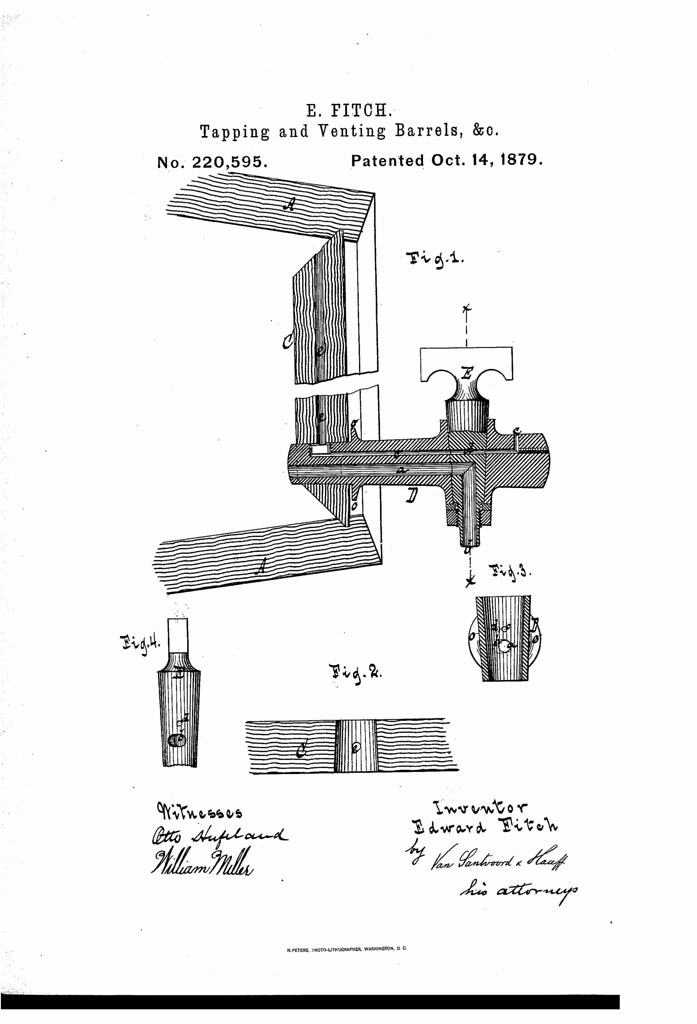
Today in 1879, US Patent 220595 A was issued, an invention of Edward Fitch, for his “Improvement in Tapping and Venting Barrels.” There’s no Abstract, although in the description it includes these claims:

This invention relates to an improved method or process of tapping and venting barrels, casks, or other vessels containing liquids, and consists- First. Of a faucet provided with an air-duct passing partly through the same lengthwise, preferably near the upper side thereof, and terminating near the inner end of the faucet in an opening upon the side of the faucet.

Second. This air-duct is controlled by the spigot of the faucet, and is opened or shut by turning the spigot. The spigot is provided with two openings, one above the other-the upper one for the admission of air to the airduct, and the lower one for the emission of the liquid contents of the barrel. The lower opening is made larger than the upper one, and in such position in the spigot that by partially turning the spigot the liquid will flow while the air-duct remains closed, and by further turning the spigot the air-duct will also be opened. The spigot can thus be made to open both passages at the same time, or to close both passages at the same time, or to open the lower passage for the flow of the liquid while the upper or air passage or duct remains closed.

Third. The head of the barrel,’cask, or other vessel to be tapped and vented is provided with an air duct or passage passing in a straight line through the substance of the head at right angles with the axis of the barrel, and opening at the lower end of the said air duct or passage in the upper side of the orifice in the said head through which the liquid is to be drawn, and at the other end thereof into the barrel at or near the junction of the head with the staves of the barrel, thus opening a duct or passage from the orifice in said head to the air-chamber in the upper side of the barrel when the same is placed upon its side in position for drawing the liquid.

US220595-0

Filed Under: Beers, Just For Fun, Politics & Law, Related Pleasures Tagged With: Barrels, History, Kegs, Law, Patent

Beer In Ads #2062: About A Brown Bottle

October 13, 2016 By Jay Brooks


Thursday’s ad is for Schlitz, from 1938. In this ad, it tells the tale of a man from Kansas in India for work, and amazed at the foreign land’s beauty and strangeness. But hen his “boy” brings him a brown bottle of Schlitz, cooled in a waterfall, and all is right with the world once more. In fact, he believes that beer saved his life. That’s a pretty impressive beer.

Schlitz-1938-brown-bottle

Filed Under: Art & Beer, Beers Tagged With: Advertising, History, Schlitz

« Previous Page
Next Page »

Find Something

Northern California Breweries

Please consider purchasing my latest book, California Breweries North, available from Amazon, or ask for it at your local bookstore.

Recent Comments

  • Bob Paolino on Beer Birthday: Grant Johnston
  • Gambrinus on Historic Beer Birthday: A.J. Houghton
  • Ernie Dewing on Historic Beer Birthday: Charles William Bergner 
  • Steve 'Pudgy' De Rose on Historic Beer Birthday: Jacob Schmidt
  • Jay Brooks on Beer Birthday: Bill Owens

Recent Posts

  • Beer Birthday: Dave Alexander May 8, 2026
  • Historic Beer Birthday: Emil Christian Hansen May 8, 2026
  • Beer In Ads #5244: Southern Brewing Bock Beer May 7, 2026
  • Historic Beer Birthday: Anton Dreher May 7, 2026
  • Beer In Ads #5243: Union Brewery Bock Beer! May 6, 2026

BBB Archives

Feedback

Head Quarter
This site is hosted and maintained by H25Q.dev. Any questions or comments for the webmaster can be directed here.