Brookston Beer Bulletin

Jay R. Brooks on Beer

  • Home
  • About
  • Editorial
  • Birthdays
  • Art & Beer

Socialize

  • Dribbble
  • Email
  • Facebook
  • Flickr
  • GitHub
  • Instagram
  • LinkedIn
  • Pinterest
  • RSS
  • Twitter
  • YouTube

Powered by Genesis

Marzen Madness 2016

March 13, 2016 By Jay Brooks

basketball
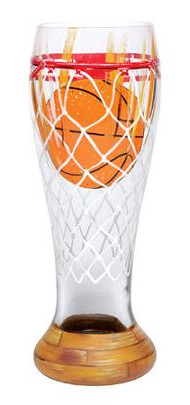
I may not be college basketball’s biggest fan, but I do still enjoy March Madness every year. The tournament is usually a fun diversion for a few weeks each year, so for the sixth straight year, I’ve set up a fantasy game, similar to fantasy football. It’s a bracket game through Yahoo which I call “Märzen Madness.” It doesn’t look like there’s a limit to the number of people who can play, so sign up and make your picks starting right now, and make sure you’re don choosing before March 17, which is when the first games take place.

marzen-madness-lg

To join Märzen Madness and play the Yahoo! Sports Tournament Pick’em game, just follow this instructions below. You’ll also need a Yahoo ID (which is free if you don’t already have one).

To accept the invitation, just follow this invitation link. For reference, here’s the group information.


Group ID#: 7455
Password: brookston
basketball-beer-glass
Good luck everybody.

Filed Under: Just For Fun, Related Pleasures Tagged With: Announcements, Games, Sports

Patent No. 20140072691A1: Method And Device For Adding Hops In Beer Manufacture, And Also Hop Product

March 13, 2016 By Jay Brooks

patent-logo
Today in 2014, US Patent 20140072691 A1 was issued, an invention of Ludwig Scheller, Rudolf Michel, and Patrick Bahns, for their “Method and Device for Adding Hops in Beer Manufacture, and Also Hop Product.” Here’s the Abstract:

The invention relates to a method for adding hops in beer manufacture, having the following process steps; a) separation of a sub-quantity (07 a) of water and/or wort (07) and/or beer as an aqueous fluid, b) addition of hop extract (10) in liquid or pasty form to the separated aqueous fluid (07 a), c) production of a macroemulsion (13) of the hop extract by emulsifying the hop extract (10) in the aqueous fluid (07 a), d) increasing the pressure in the macroemulsion (13) of the hop extract to a feed pressure of in particular higher than 100 bar, e) production of a microemulsion (17) of the hop extract by feeding the pressurized macroemulsion (13) through a gap or a valve (16) or by feeding the pressurized macroemulsion against a baffle plate, f) at least partial return of the microemulsion (17) of the hop extract to the beer manufacturing process.

US20140072691A1-20140313-D00000

Filed Under: Beers, Just For Fun, Politics & Law, Related Pleasures Tagged With: Brewing Equipment, History, Hops, Law, Patent, Science of Brewing

Patent No. 1950714A: Container And Cooler

March 13, 2016 By Jay Brooks

patent-logo
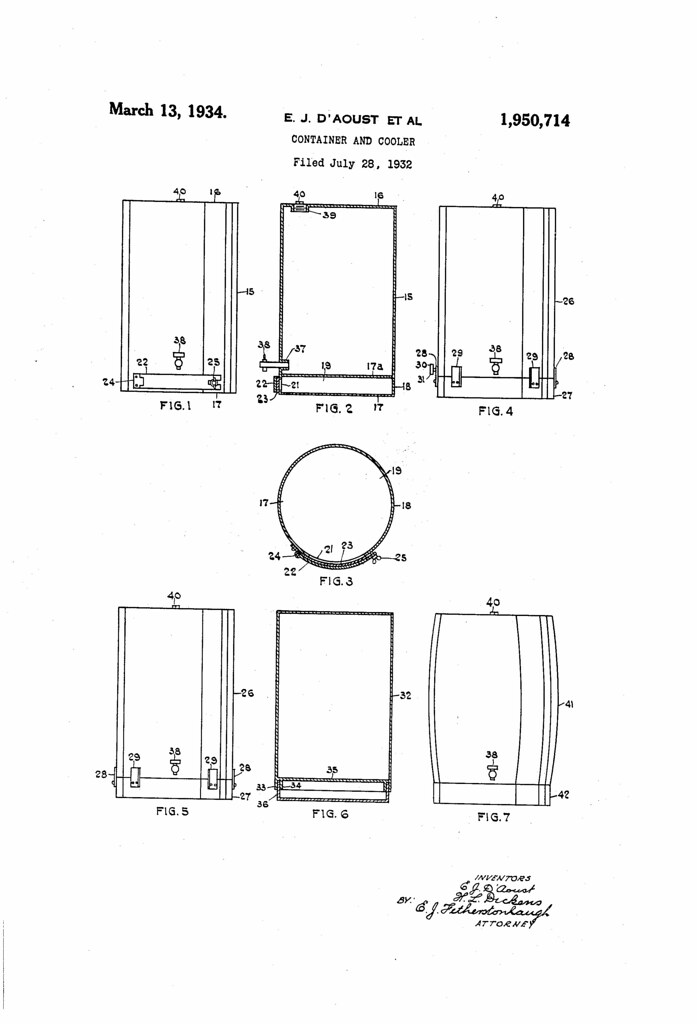
Today in 1934, US Patent 1950714 A was issued, an invention of Ernest Joseph D’Aoust and Herbert Lawrence Dickens, for their “Container and Cooler.” There’s no Abstract, although in the description it includes this summary:

The invention relates to a container and cooler, as described in the present specification and illustrated in the accompanying drawing that forms part of the same.

The invention consists essentially of the unit combining the means for refrigerating and the container as pointed out in the claim for novelty following a description in detail of the parts making up the unit.

The objects of the invention are to cool liquids such as beer, especially contents being continually drawn upon thereby making it possible to maintain the volume of liquid in constant use in a palatable condition while a considerable volume remains unchilled, which are ideal conditions for dispensing beer and many liquids, especially where they are sold by the glass; to facilitate the transport of beer and some other beverages, particularly those beverages liable to deterioration from changes of temperature and therefore deliver the container with its contents in as fit a state as when it left the brewery, factory or other production centre; to utilize dry ice, artificial ice, natural ice or chemical refrigerants to the best advantage for cooling containers and introduce the cooling medium with ease; and generally to provide for restaurants, hotels, merchants, dwellings and places of entertainment, a convenient form of container from which the beverage will be delivered in a wholesome condition and which will not materially add to the cost of the invention to the consumer.

US1950714-0

Filed Under: Beers, Just For Fun, Politics & Law, Related Pleasures Tagged With: History, Kegs, Law, Patent

Patent No. 1218724A: Beer Cooler

March 13, 2016 By Jay Brooks

patent-logo
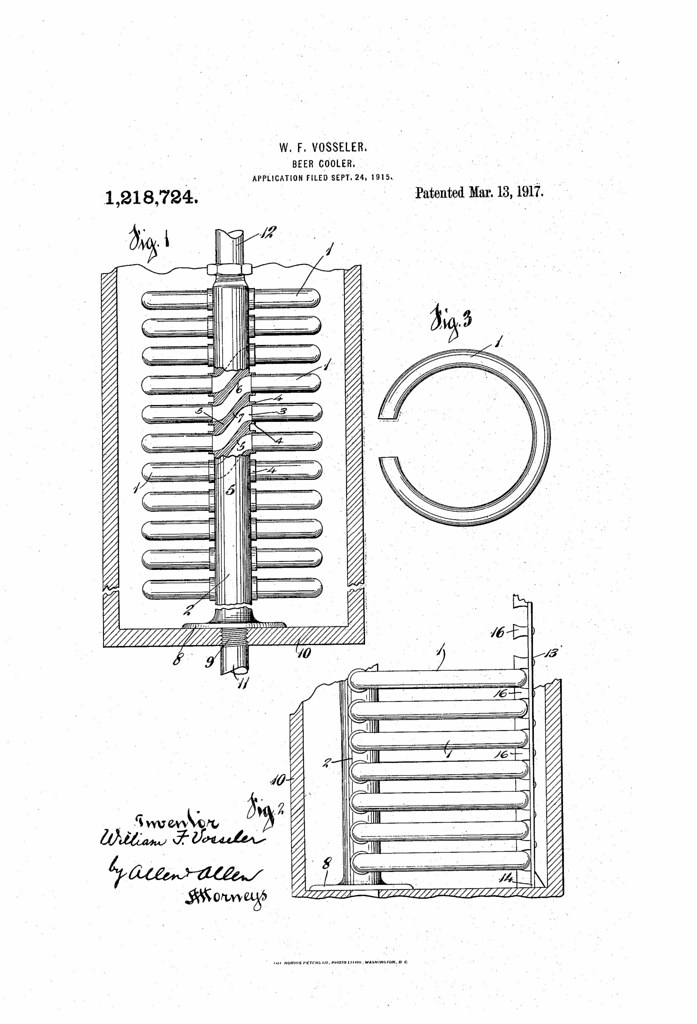
Today in 1917, US Patent 1218724 A was issued, an invention of William F. Vosseler, for his “Beer Cooler.” There’s no Abstract, although in the description it includes this summary:

My invention relates to beer coolers of the type in which a coil is provided through which the beer must pass in the presence of a cooling medium.

The simplest Way of cooling beer as it is pumped from a barrel to a faucet is to send it through a coil which is packed in ice. In coils for this purpose, there must be as little obstruction to the flow of beer as possible. There must be also as much of an exposure to the ice as possible.

Accordingly in the Patent No. 1,099,329, of June 9th, 1914, to William Vosseler, is described a device in which an open coil is mounted in an ice box so that ice can be packed down inside the coil as well vas around it. This is the best way of quickly and adequately cooling the beer as it passes through a cooler, but it opens the way to a number of difficulties. The first of these is that to make a strong coil which will Withstand the jamming down in it of ice, it is hard to provide against agitating the beer during its passage through the coil. In the next place, it is difficult to hold the coil in place in the box against these strains, and finally it is requisite to make the whole structure as inexpensive as possible.

It is the object of my invention herein to provide against these difficulties so as to have an open coil of great durability and cheapness, in which there is little or no obstruction to the flow of the beer to cause it to foam out of the faucet, which is very undesirable.

US1218724-0

Filed Under: Beers, Just For Fun, Politics & Law, Related Pleasures Tagged With: History, Kegs, Law, Patent

Beer In Ads #1848: Facts Versus Fallacies #89

March 12, 2016 By Jay Brooks


Saturday’s ad is another one for the Pennsylvania State Brewers Association, from 1916, No. 89 in series they did from 1915-17 called “Facts Versus Fallacies.” I have no idea how many were done but some of the them are numbered into low triple digits, suggesting there were a lot of them, all in an effort to stop Prohibition from happening and win over support for beer. This ad, marked “89,” is about hoping that the new year — 1916 — will be “a year of Temperance — of Moderation!” Sadly, it wasn’t, and prohibition happened a few years later anyway. As they see it. “Temperance does not mean Prohibition — for Temperance is a self-exercise virtue whose keynote is commonsense; and Prohibition is an imposed, obligatory condition that interferes with one’s personal liberty, and whose keynote is bigotry.”

Facts-v-Fallacies-89-1916

Filed Under: Art & Beer, Beers, Just For Fun Tagged With: Advertising, History, Pennsylvania, Philadelphia, Prohibition

Patent No. 2193445A: Beer Keg

March 12, 2016 By Jay Brooks

patent-logo
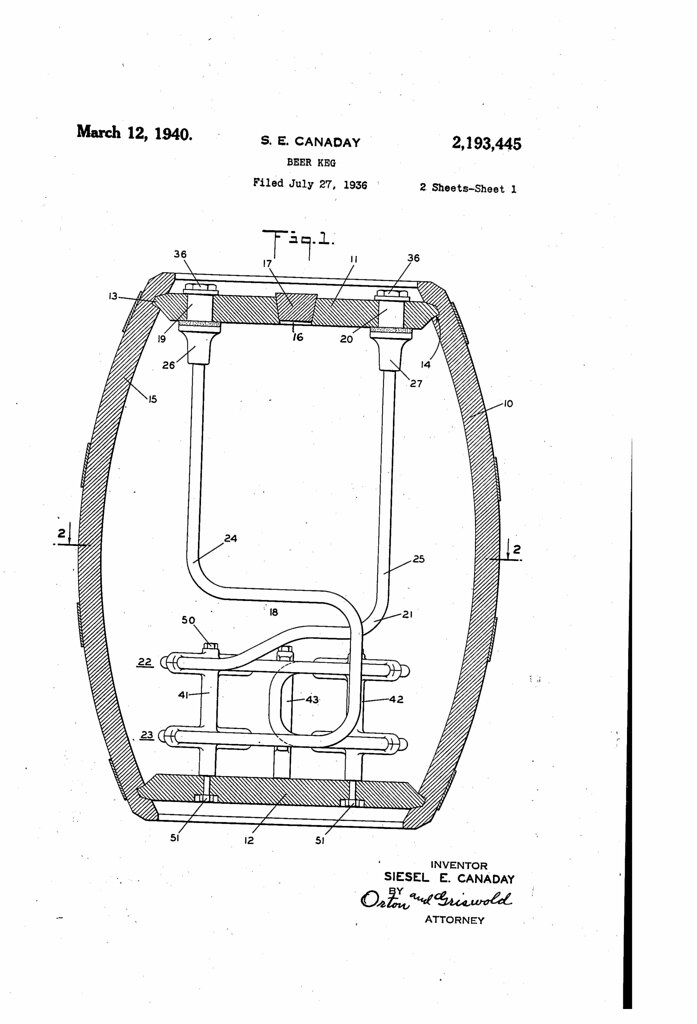
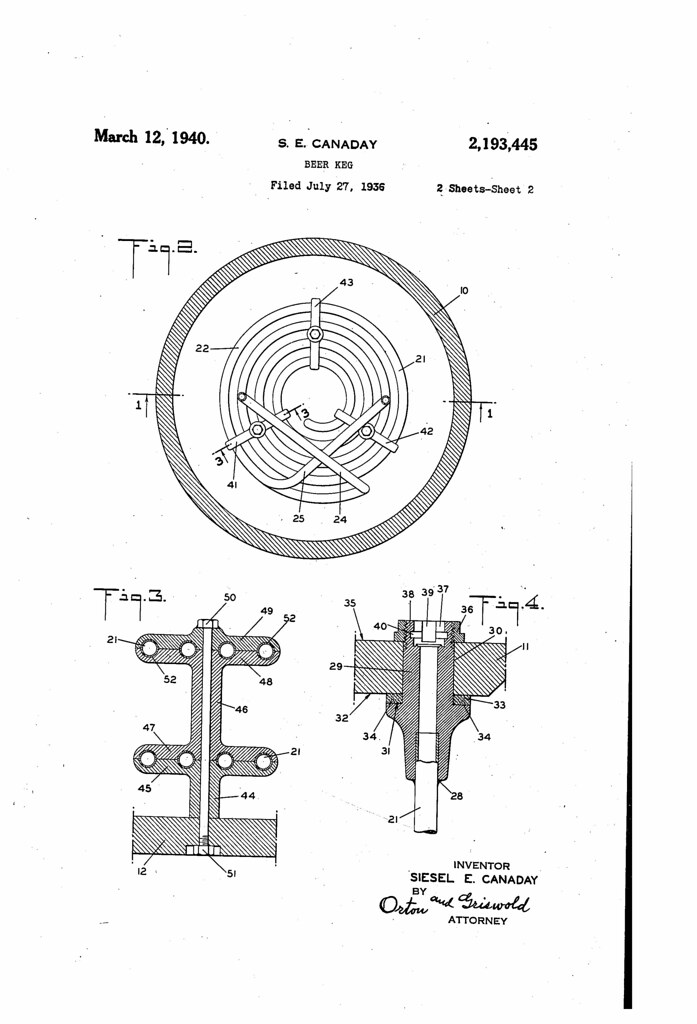
Today in 1940, US Patent 2193445 A was issued, an invention of Siesel E. Canaday, for his “Beer Keg.” There’s no Abstract, although in the description it includes this summary:

The invention relates to a beer keg of the type in which beer is transportedfrom the brewery to the user and which is designed to be cooled in the original container and from which container the cooled beer is vended from time to time.

In this type of beerkeg a cooling coil is dissition accessible from the outside of the keg for ready and quick attachment to a cooling system at the users place of business.

US2193445-0
US2193445-1

Filed Under: Beers, Just For Fun, Politics & Law, Related Pleasures Tagged With: History, Kegs, Law, Patent

Mesoamerican Corn Beer Discovered on Ancient Teeth

March 12, 2016 By Jay Brooks

corn-archeology
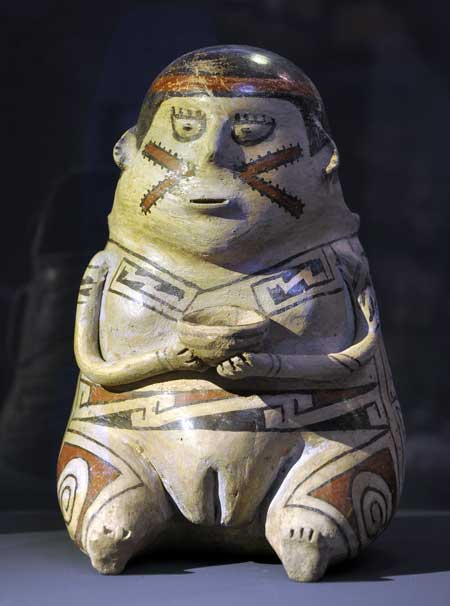
The ancient city of Casas Grandes (a.k.a. Paquimé) is “a prehistoric archaeological site in the northern Mexican state of Chihuahua. Construction of the site is attributed to the Mogollon culture. Casas Grandes has been designated a UNESCO World Heritage Site.” It once was home to at least 3,000 people in the 14th century, and was most likely a trade center in its heyday. It was first excavated in the 1950s, and initial finds included hundreds of human remains. It was inhabbited beginning around 1130 CE and hit its peak after 1350 CE, but was inexplicably abandoned a century later by 1450 CE. It’s “regarded as one of the most significant Mogollon archaeological zones in the northwestern Mexico region.”

Paquime1

So you’d think it was pretty well mined for what could be learned from the ancient city. But a team of archeologists from the University of Calgary led by Dr. Anne Katzenberg is using new technologies to examine the plaque on the teeth of hundred sets of human remains, specifically what they call “tooth calculus,” which she says is “fossilized tooth tartar.”

Western Digs, which “is a science news site that investigates the archaeology, anthropology, and paleontology of the American West,” continues the story in First Evidence of Corn Beer in Southwest Discovered on Teeth From Ancient Burials:

“If teeth aren’t cleaned regularly, then the tartar, which can trap pretty much anything in it, such as algae, plants, fungus, or fibers, will slowly mineralize with everything stuck in it and turn into calculus, while the microremains turn into microfossils.”

To get at this microscopic evidence, the team recovered tartar from the remains of 110 people found within the ancient city and from other sites in the Casas Grandes River valley, all buried between 700 and 1450 CE.

Of those 110 samples, 63 yielded some sort of microscopic remains.

But what they’ve concluded is that there was a lot of corn beer being consumed, but more importantly “what archaeologists say is the first conclusive evidence of corn beer in the Greater Southwest.”

Paquime-Casas-Grandes-Pottery-Ceramic-Figurine

Here’s more from First Evidence of Corn Beer in Southwest Discovered on Teeth From Ancient Burials:

Three of the samples revealed granules of maize that bore the unmistakable signs of fermentation, he said — including swelling and fragmentation caused by being heated at three distinct temperatures, and striations created by the fermenting process.

These bloated, broken grains seem to be the result of making chicha — a corn beer whose use has been recorded in Central and South America for as much as 5,000 years, King said.

In those cultures, brewing and consuming chicha is thought to have held ceremonial value, but it may have held other functions as well, he noted.

“We don’t have enough information to determine [chicha’s] use,” King said.

“Based on ethnographic accounts, we default to ‘ritual’, although I always think that’s a cop-out answer.

“We know modern groups used corn beer or similar drinks in religious ceremonies, so that’s all we can go off of.”

In addition, King noted, the burial contexts of the samples haven’t yet been analyzed, so archaeologists can’t yet draw conclusions about whether beer consumption was limited, for example, to a certain social class.

Moreover, he added, this is the first “substantial evidence” of corn beer in the Greater Southwest, so it’s possible that chicha may have served a different function in Casas Grandes than it did in Mesoamerica.

When it comes to beer in the southwestern archaeological record, he said, “almost nothing exists for northern Mexico or the American Southwest. The results we posted may be the first of their kind for this region.”

King’s new findings, then, raise the question of how the custom of brewing corn beer arrived at Casas Grandes, as well as when, and by whom.

“The best archaeological evidence we have for corn beer and other alcoholic drinks comes from Peru or Mesoamerica,” King said.

“So, if anything, the idea for corn fermentation came up from the south, but that is still conjecture at this point.”

As for when beer came to town, his findings do provide some insights.

His team studied teeth dating back as far as the year 700, but the fermented granules were only detected on remains dated to the so-called Medio Period of Casas Grandes — a cultural heyday that spanned from about 1200 CE to 1450 CE — suggesting that chicha might have been a relatively recent phenomenon.

“Our results show that maize was used throughout various time periods, but evidence for maize fermentation only comes from the Medio period,” he said.

“This is not to say such use did not exist in the [earlier] period, only that our results don’t currently support that idea.”

But whether it was brewed, chewed, or cooked, the corn of Casas Grandes may, in time, teach us volumes, not just about diet, but also about the social interactions that shaped one of the most important cultural crossroads in ancient North America.

“The continuity of maize use throughout the two time periods is important,” King said.

“It may suggest a continuity of people, thereby supporting an in situ development.

“Turning maize into beer during the Medio period, however, could suggest an influx of new ideas — or perhaps even people — during that time, which might indicate outside influence — either foreigners coming to Casas Grandes, or locals traveling and coming back with new ideas.”

Filed Under: Beers, Just For Fun, News, Related Pleasures Tagged With: Archeology, History, South America

Patent No. 62864A: Beer Faucet

March 12, 2016 By Jay Brooks

patent-logo
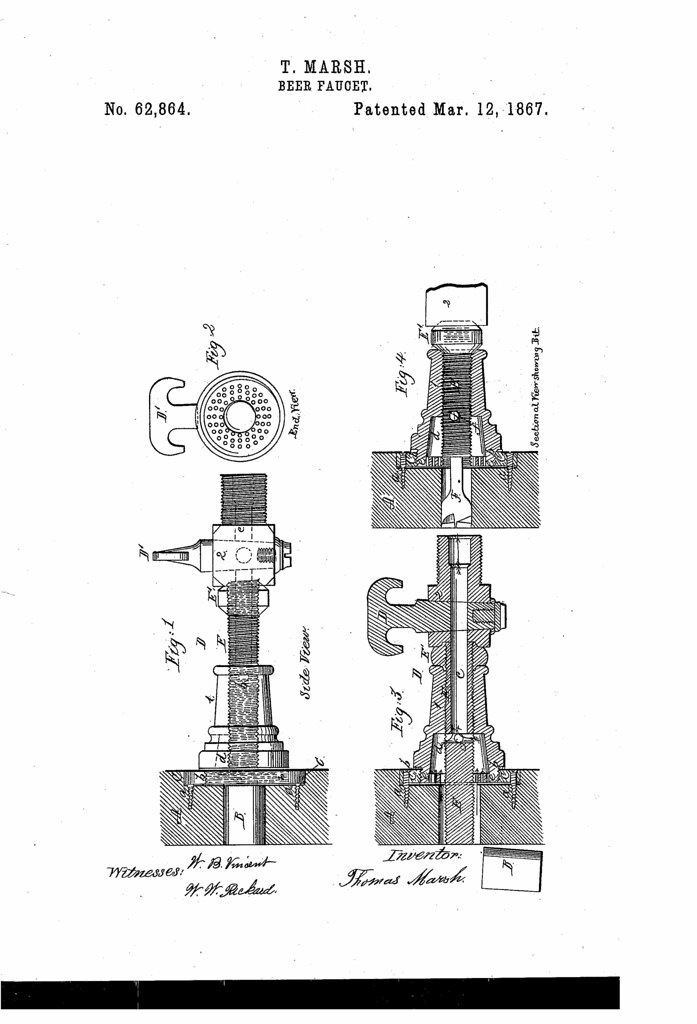
Today in 1867, US Patent 62864 A was issued, an invention of Thomas Marsh, for his “Beer Faucet.” There’s no Abstract, although in the description it includes this summary:

The invention herein described can be advantageously used for tapping a cask which .contains beer or other fluid confined under pressure. ‘The common method of tapping a beer cask, employed, is, first, to force inward, to the distance perhaps of half the thickness of the head of the cask, the plug which is always inserted in a hole made in one of the heads” for this purpose, and then placing the faucet or spigot upon its end against the plug so partially driven in, with a well-directed blow replug the hole with the end of the faucet. and at the same operation expel -into the interior of the Cask the former plug which filled the hole. It often happens that the pressure exerted by the beer is so great as to be able to resist the introduction of the faucet, especially if the latter is not exactly fitted to the hole, in which case the contents of the Cask will escape. The invention ‘described is intended to afford a convenient and certain means for tapping a cask in place of the means above described.

US62864-0

Filed Under: Beers, Just For Fun, Politics & Law, Related Pleasures Tagged With: History, Kegs, Law, Patent

Beer In Ads #1847: Facts Versus Fallacies #84

March 11, 2016 By Jay Brooks


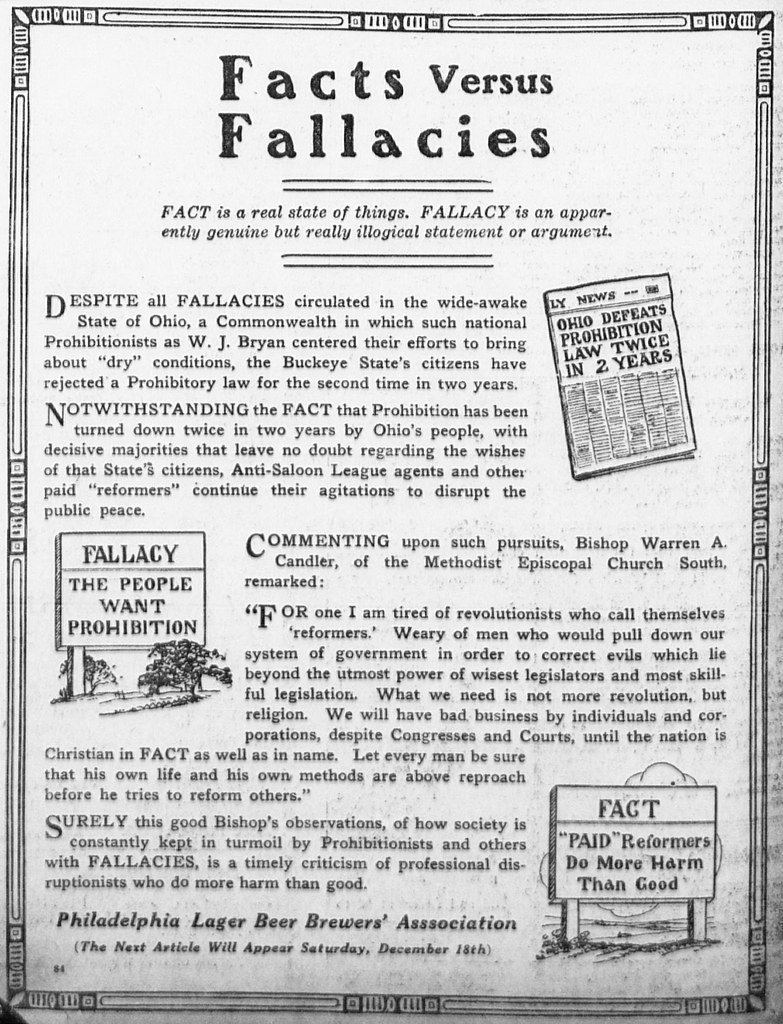
Friday’s ad is another one for the Pennsylvania State Brewers Association, from 1916, No. 84 in series they did from 1915-17 called “Facts Versus Fallacies.” I have no idea how many were done but some of the them are numbered into low triple digits, suggesting there were a lot of them, all in an effort to stop Prohibition from happening and win over support for beer. This ad, marked “84,” is interesting because it shows a problem that’s still with us with modern prohibitionists. As they point out, a majority of people were not originally in favor of removing alcohol from society. For example, the state of Ohio rejected a referendum to restrict it twice, and both times by wide margins. But that didn’t deter the fanatical prohibitionists from continuing to agitate for it and cajole people, even resorting to manipulating the system from behind the scenes. To say the will of the people carries any weight to such people is a joke. All that matters is what they want, as true today as it was in 1916.

Facts-v-Fallacies-84-1915

Filed Under: Art & Beer, Beers, Just For Fun Tagged With: Advertising, History, Pennsylvania, Philadelphia, Prohibition

Patent No. WO2004020570A1: Effervescent Hop Tablet

March 11, 2016 By Jay Brooks

patent-logo
Today in 2004, US Patent WO 2004020570 A1 was issued, an invention of James F. Boyd, assigned to Yakima Chief Inc., for his “Effervescent Hop Tablet.” Here’s the Abstract:

Effervescent formulations of hop adjuncts for use in the process of beer brewing, or more generally the manufacture or production of malt beverages are disclosed. These manufacturing processes can include primary fermentation, when added to the wort, secondary fermentation, when added to the green beer, and storage, when added to beer. The effervescent product includes an effervescent material, such as a carbonate compound, combined with brewing kettle hop adjuncts. The hop adjuncts may include any combination of conventionally derived hop materials or extracts, including alpha acids, beta acids, resins and oils. Preferably, the effervescent formulations are formed into the shape of a tablet, and serve to simplify and improve the efficiency and metering of the hop adjuncts into the brewing process.

hop_tablets

Filed Under: Just For Fun, Politics & Law, Related Pleasures Tagged With: History, Hops, Law, Patent

« Previous Page
Next Page »

Find Something

Northern California Breweries

Please consider purchasing my latest book, California Breweries North, available from Amazon, or ask for it at your local bookstore.

Recent Comments

  • Bob Paolino on Beer Birthday: Grant Johnston
  • Gambrinus on Historic Beer Birthday: A.J. Houghton
  • Ernie Dewing on Historic Beer Birthday: Charles William Bergner 
  • Steve 'Pudgy' De Rose on Historic Beer Birthday: Jacob Schmidt
  • Jay Brooks on Beer Birthday: Bill Owens

Recent Posts

  • Historic Beer Birthday: George F. Gund April 5, 2026
  • Historic Beer Birthday: John Friedrich Wiessner Jr. April 5, 2026
  • Beer Birthday: Steve Wagner April 5, 2026
  • Beer In Ads #5206: For The Feast Of Easter April 5, 2026
  • Historic Beer Birthday: Hew Ainslie April 5, 2026

BBB Archives

Feedback

Head Quarter
This site is hosted and maintained by H25Q.dev. Any questions or comments for the webmaster can be directed here.