Brookston Beer Bulletin

Jay R. Brooks on Beer

  • Home
  • About
  • Editorial
  • Birthdays
  • Art & Beer

Socialize

  • Dribbble
  • Email
  • Facebook
  • Flickr
  • GitHub
  • Instagram
  • LinkedIn
  • Pinterest
  • RSS
  • Twitter
  • YouTube

Powered by Genesis

Patent No. 206825A: Improvement In Beer-Pump Valves

August 6, 2015 By Jay Brooks

patent-logo
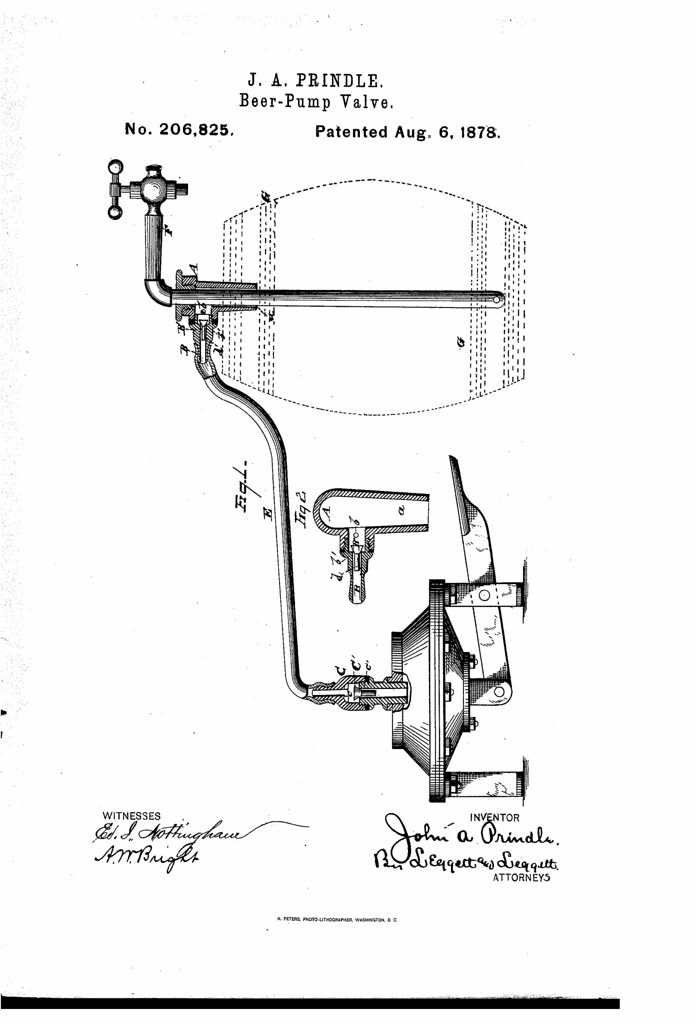
Today in 1878, US Patent 206825 A was issued, an invention of John A. Prindle, for his “Improvement in Beer-Pump Valves.” There’s no Abstract, although in the description it includes this summary:

My invention relates to an apparatus for pumping fluids from casks, and is intended as an improvement on the device shown and described in Letters Patent No. 191,656, dated February 6, 1877, granted to Wm. F. Glass.

My improvement consists, principally, in the peculiar construction of the bung, provided with valve or valves, which close the bunghole hermetically and automatically by the pressure of gas from within, while air or gases may be easily forced through it into the cask, barrel, or other vessel.

It also consists in constructing the air valve proper of rubber or equivalent elastic material, forming it conical or conoidal, and causing it to rest upon a sharp-edged seat, whereby slight pressure will be sufficient to insure good results, and heavy pressure the same results, without liability of damaging the valve.
Untitled

Filed Under: Beers, Just For Fun, Politics & Law, Related Pleasures Tagged With: History, Kegs, Law, Patent

Patent No. 3827595A: Beer Keg

August 6, 2015 By Jay Brooks

patent-logo
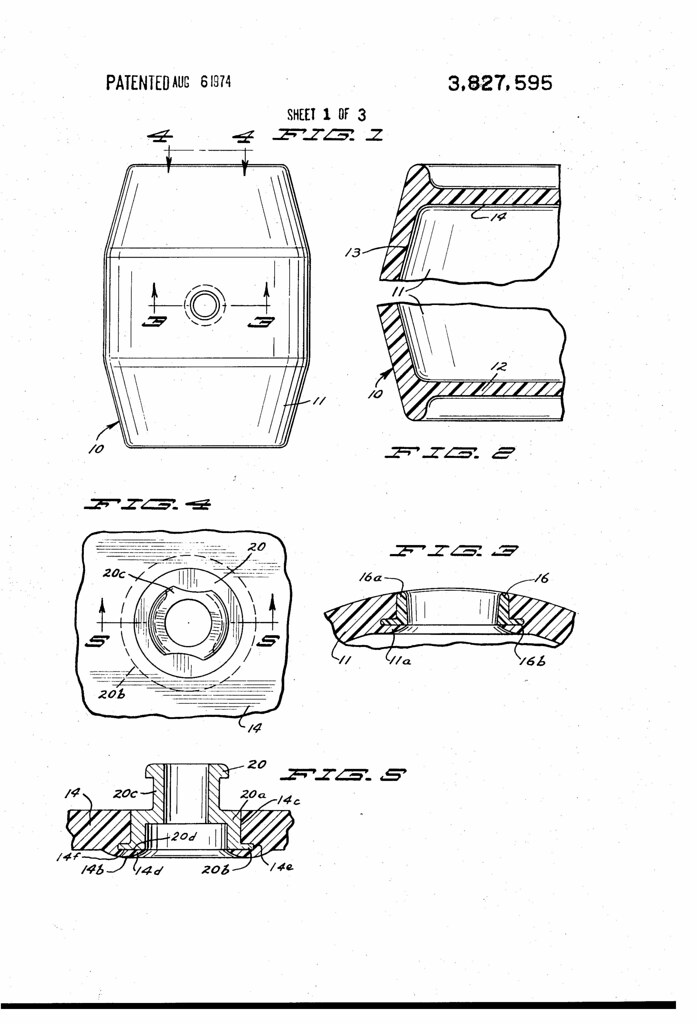
Today in 1974, US Patent 3827595 A was issued, an invention of Henry Clausen, for his “Beer Keg.” Here’s the Abstract:

A beer keg having the top, bottom and side walls made of plastic, and tapper and filler plug mounting members made of plastic or metal which in one embodiment are cast in position as the top and side walls are formed. In the second embodiment the filler plug is retained in the central part of the keg as the keg is molded and thereafter mounted in a filler opening formed in the barrel.

Untitled
Untitled
Untitled

Filed Under: Beers, Just For Fun, Politics & Law, Related Pleasures Tagged With: History, Kegs, Law, Patent

Beer In Ads #1639: Black & Tan Babies

August 5, 2015 By Jay Brooks


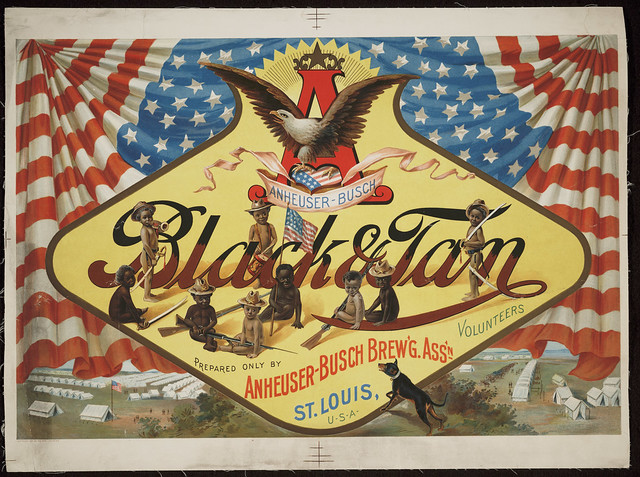
Wednesday’s ad is for Anheuser-Busch’s Black & Tan, from 1899. I’m sure this seemed like a cute idea at the turn of two centuries ago, around 116 years from now, but to our current sensibilities, it certainly looks odd. Back in 1995, A-B reintroduced their Black & Tan as part of their “American Originals” series, but this ad is from its original release, when it was “prepared only by Anheuser-Busch Brew’g Ass’n.” The patriotic ad shows a pair of American flags for most of the background behind the label, with a military camp showing beneath the flags at the bottom of the ad. The army “volunteers” referred to appear to be nine naked babies whose skin is either tan or black. And I’m not sure why there’s a dog — a black and tan doberman? — barking at them at the bottom of the label. I’m sure naked colored babies with rifles made sense in 1899, but I can’t imagine the ad being green-lit today.

black-and-tan-1899

Filed Under: Art & Beer, Beers Tagged With: Advertising, Anheuser-Busch, History

Patent No. 2605949A: Control Head For Devices For Filling Bottles Under Counterpressure

August 5, 2015 By Jay Brooks

patent-logo
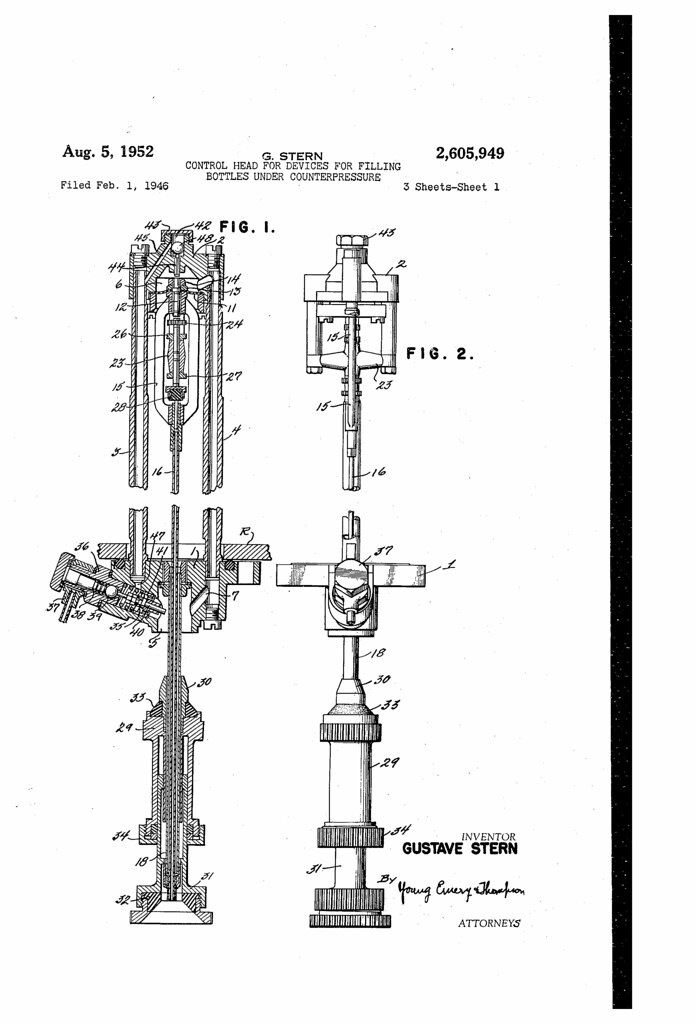
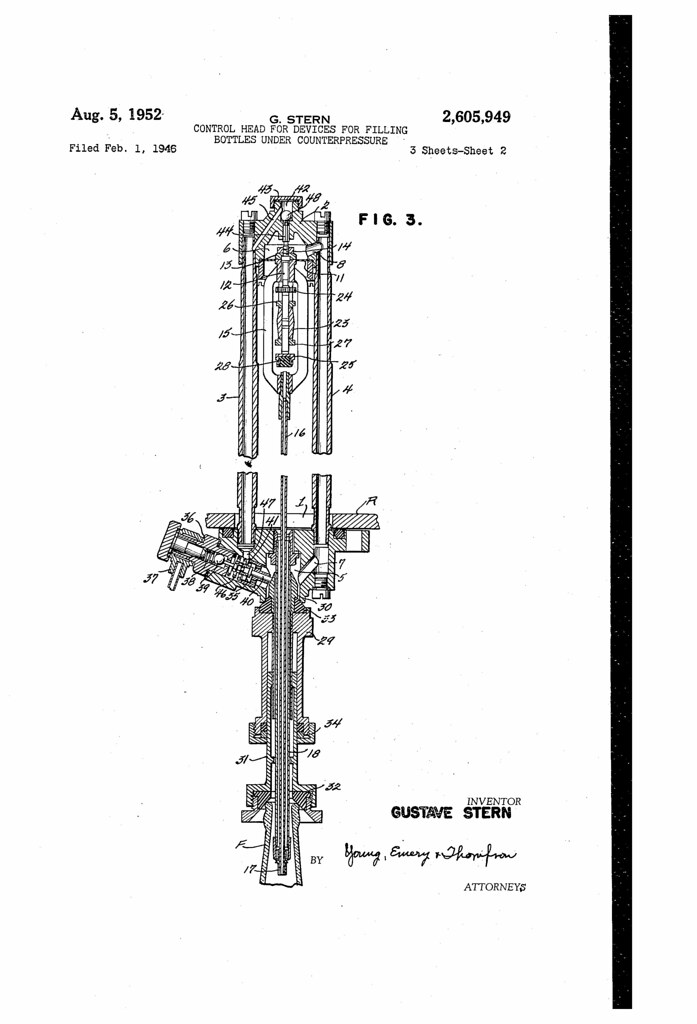
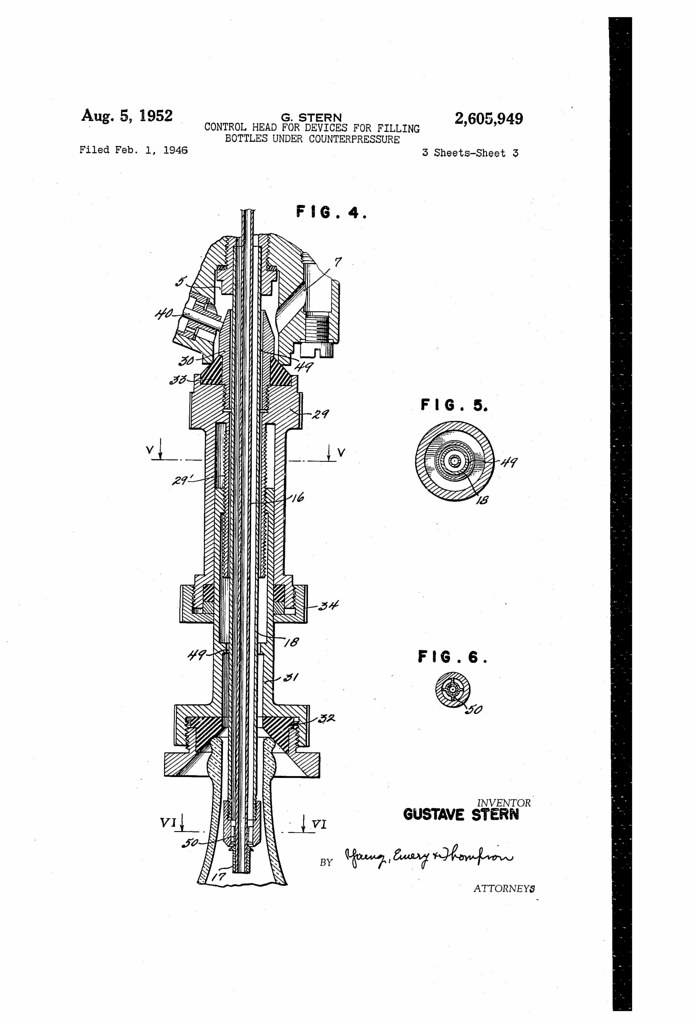
Today in 1952, US Patent 2605949 A was issued, an invention of Gustave Stern, for their “Control Head for Devices for Filling Bottles Under Counterpressure.” There’s no Abstract, although in the description it includes this summary:

The, object of the present invention is a control head for devices for filling bottles or other like (containers, with gaseous or nongaseous liquids, under counter-pressure), said head previously placing the bottles under compressed air.

The purpose of the invention is essentially to increase the automatic operation of the device, thereby enabling the rate of filling to be considerably accelerated, thus increasing the efficiency.

invention ensures the. satisfactory operation of the device when the pressure. of the supply of. compressedV air. is higher than the pressure in the filling tank which contains the liquid to be drawn out. Owing to this fact, it permits the elimination of the complicated and costly apparatus intended to ensure, the regularity of the air pressure.

Finally, tile invention relates to the provision of means of enabling the level of the liquid inside the bottles to be adjusted accurately.

Untitled
Untitled
Untitled

Filed Under: Beers, Breweries, Just For Fun, Related Pleasures Tagged With: Brewing Equipment, History, Law, Patent, Science of Brewing

Patent No. 218231A: Improvement In Processes And Apparatus For Treating Hops And Malt Extracts

August 5, 2015 By Jay Brooks

patent-logo
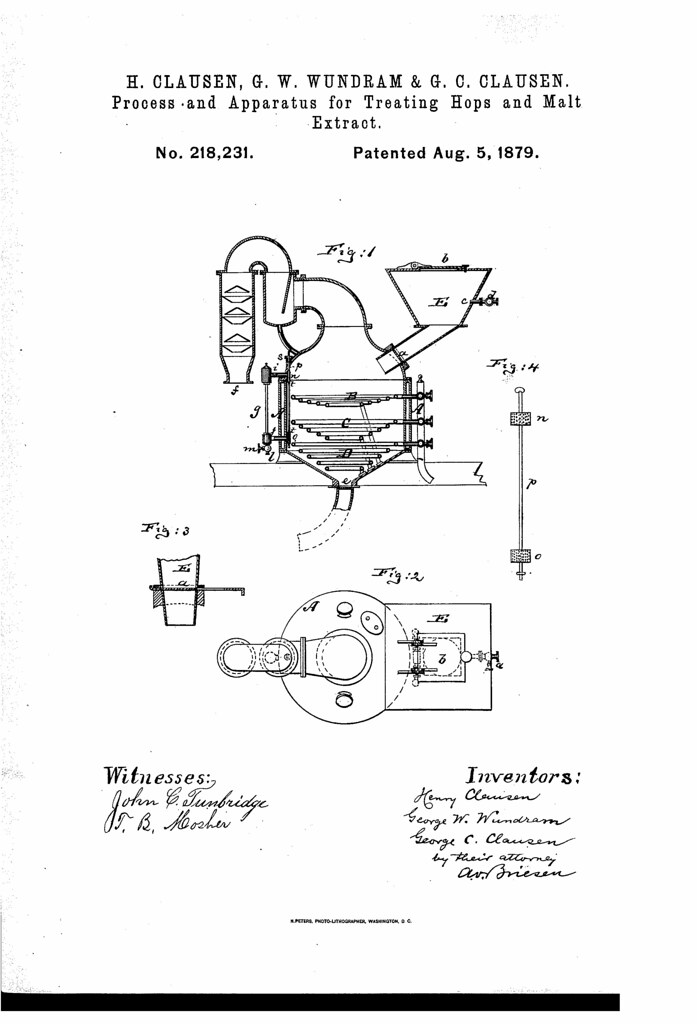
Today in 1879, US Patent 218231 A was issued, an invention of Henry Clausen, for his “Improvement in Processes and Apparatus For Treating Hops and Malt Extracts.” There’s no Abstract, although in the description it includes this summary:

This invention relates to a new method of treating malt extract and hops in the manufacture of beer, and to a new apparatus for carrying the same into effect; and consists, first, in treating the malt extract and the hops in a vacuum-pan which has separate channels for admitting the malt and the hops; also, in the new construction and arrangement of vacuum-pan hereinafter described.

Untitled

Filed Under: Beers, Breweries, Just For Fun, Politics & Law, Related Pleasures Tagged With: Brewing Equipment, History, Hops, Law, Malt, Patent, Science of Brewing

Beer In Ads #1638: In The Barremolen

August 4, 2015 By Jay Brooks


Tuesday’s ad is for Heineken, from 1976. The ad shows a woman in a traditional Dutch costume pouring a bottle of Heineken, apparently inside of a famous Dutch windmill known as the Barremolen. It’s located in Zoeterwoude-Rijndijk, Zuid-Holland, and according to the Dutch Windmill Database, it was built in 1661. The windmill, besides being a symbol of the Netherlands, is also located on the site of one of Heineken’s brewery, so it certainly made sense to feature it in their advertising.

Heineken-1976-barremolen

Filed Under: Art & Beer, Beers Tagged With: Advertising, Heineken, History

Patent No. 5788111A: Drinking Vessel

August 4, 2015 By Jay Brooks

patent-logo
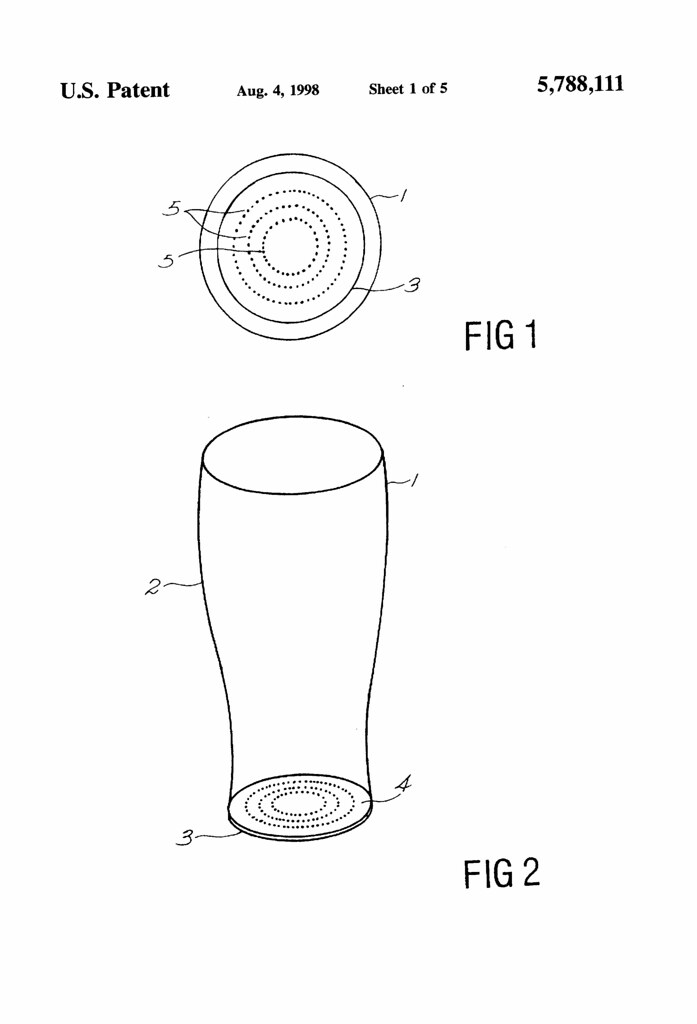
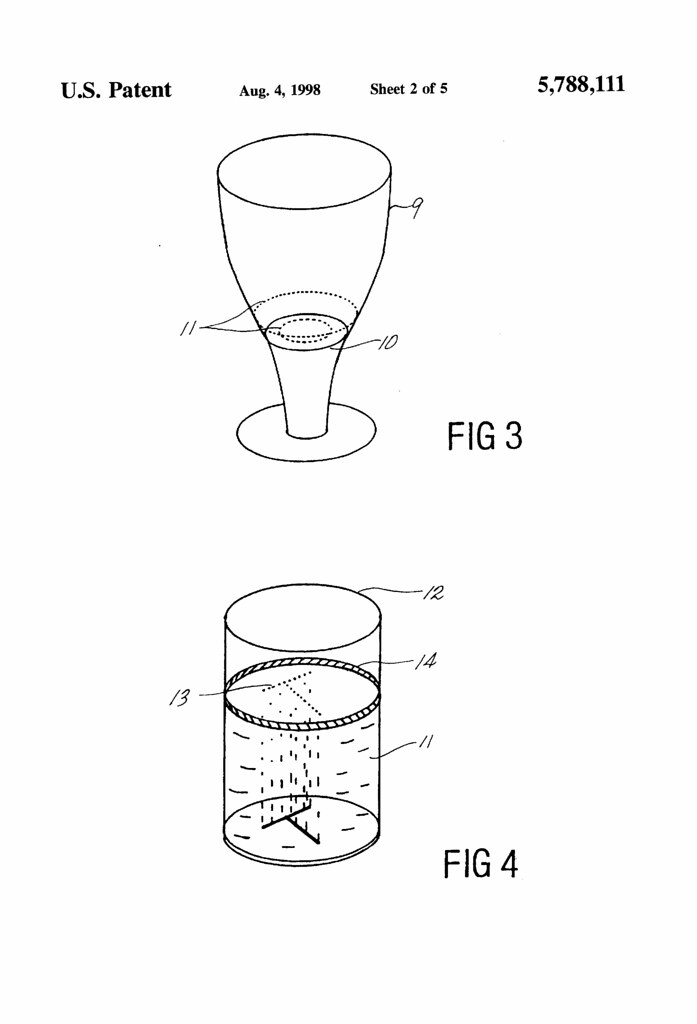
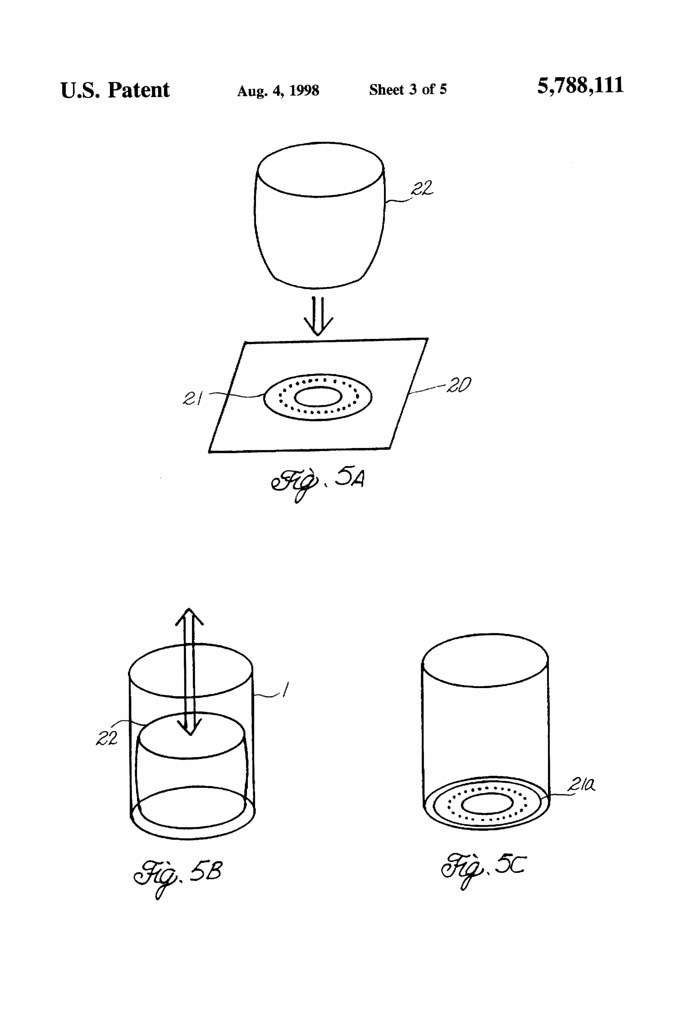
Today in 1998, US Patent 5788111 A was issued, an invention of Alan Grenville and Clive Waugh, for their “Drinking Vessel.” Here’s the Abstract:

An inside surface of a drinking vessel is treated with a material suitable for providing nucleation sites to encourage the formation of bubbles in a liquid containing a gas such as carbon dioxide or CO2 / nitrogen mixture. The material may be printed upon the internal surface.

Untitled
Untitled
Untitled

Filed Under: Beers, Just For Fun, Politics & Law, Related Pleasures Tagged With: Glassware, History, Law, Patent

Patent No. 2898209A: Method Of Extracting Hops

August 4, 2015 By Jay Brooks

patent-logo
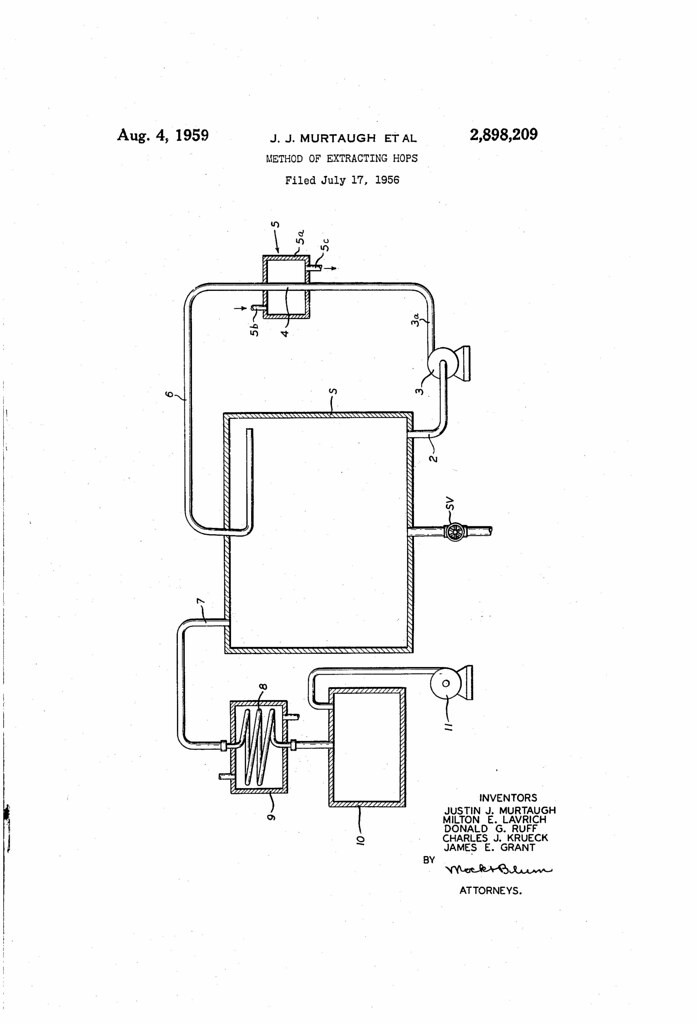
Today in 1959, US Patent 2898209 A was issued, an invention of James E. Grant, Charles J. Krueck, Milton E. Lavrich, Justin J. Murtaugh, and Donald G. Ruff, assigned to the Blatz Brewing Company, for their “Method of Extracting Hops.” There’s no Abstract, although in the description it includes this summary:

Our invention relates to a new and improved hop extract; to a new and improved method of making a hop extract; and to a new and improved hopped beverage, such as alcoholic malt beverages exemplified by beer and ale.

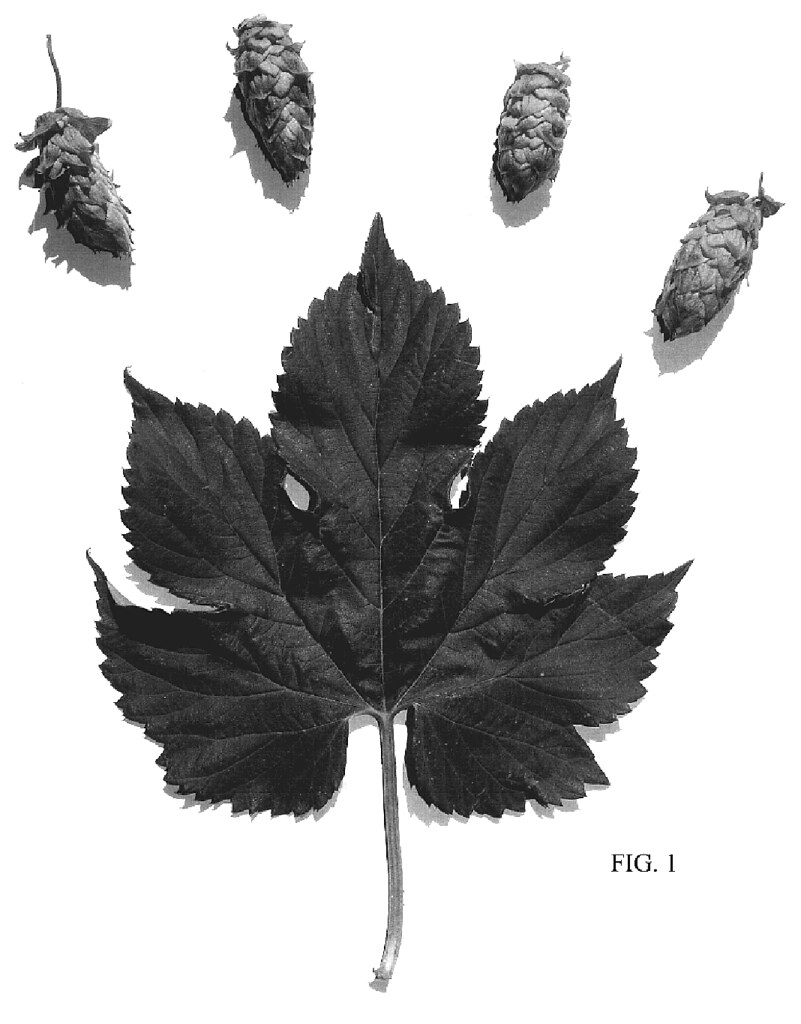
While the invention applies to the treatment of any part of the hop plant, it refers particularly to the treatment of the cones of the hop plant. These cones are preferably extracted in the whole state, but they may be cut, ground, or otherwise comminuted.

After a lengthy discussion, in the last page of the application, they set forth their claims, summarized:

1. A method of extracting solid starting material, said stafting material having substantially the composition of vine-fresh hops, which consists in extracting said material with methanol at a maximum temperature of 65 C. to produce an original liquid extract of said starting ina– terial, said original liquid extract including water which is extracted from said starting material, said water being mixed with said methanol in said original liquid extract, said original liquid extract including water-insoluble and methanol-soluble material which is extracted from said solid starting material and which is dissolved in the methanol of said original liquid extract, said original liquid extract including water-soluble and methanol-insoluble material which is extracted from said solid starting material and which is dissolved in the water of said original liquid extract, said methanol-soluble and waterinsoluble extracted material including alpha-resin and beta-resin, the weight of said alpha resin being at least 40% of the weight of the total soft resin; separating said original liquid extract from the undissolved, residual part of said starting material; flowing the separated, original liquid extract forwardly through an externally heated zone in the form of a thin, rapidly forwardly-flowing stream to heat said forwardly-flowing stream substantially uniformly within’ said heating Zone without substantially evaporating methanol or water from said forwardly-flowing stream within said heating zone, forwardly flowing said forwardlyflowing stream within said heating zone at a sufliciently high velocity to substantially prevent the solutes of said forwardly-flowing stream from coating the inner face of said heating zone; flowing said forwardly-flowing stream out of the outlet of said heating zone into an evaporation chamber; evaporating a part of the methanol and water in said evaporation chamber from the stream which is flowed into said evaporation chamber and thus providing a residue of said stream within said evaporation chamber, flowing the evaporated methanol and water out of said evaporation chamber; flowing the residue of said stream out of said evaporation chamber forwardly through said heating zone and back into said evaporation chamber in cyclic succession while evaporating a part of the methanol and water from the stream which is flowed into said evaporation chamber during each cycle and flowing the part of the methanol and water which is thus evaporated durmg each cycle out of said evaporating chamber, maintaining said evaporation chamber at a maximum temperature of substantially 65 C. and at a maximum pressure of substantially millimeters of mercury, and continuing said cyclic succession to produce a concentrate of said original extract in which the weight of said alpha-resin is at least 40% of the weight of the total soft resin.

2. A method according to claim 1 in which substantially all the methanol is evaporated in said cyclic succe’ssi’on within said evaporation chamber from said original extract.

3. A method according to claim 1, in which the cyclic succession is stopped when said concentrate includes an aqueous phase of residual water and a non aqueous methanol resin phase in which said resins are dissolved, and said aqueous phase is separated from said methanol resin phase. I

4. A method according to claim 3, in which said aqueous phase is separated from said methanol resin phase by dissolving a water-soluble salting-out agent in said aqueous phase.

5. A method according to claim 3, in which the weight of said aqueous phase is at least substantially 70% of the weight of said concentrate.

Untitled

Filed Under: Beers, Breweries, Just For Fun, Politics & Law, Related Pleasures Tagged With: History, Hops, Law, Patent, Science of Brewing

When Is A Brewhouse Not A Brewhouse?

August 4, 2015 By Jay Brooks

brewhouse
I know that title sounds like a riddle, but it’s not meant to be. It’s meant to start a discussion about something I’ve been noticing lately that’s starting to confound and annoy me, at least a little bit. I was on a family vacation last week, taking a road trip to the L.A. area to visit some beaches and some friends. As we began our holiday, we stopped for two days in Pismo Beach, and as we drove into town, I could see an intriguing sounding place from the highway called the Shell Beach Brewhouse. Since this was strictly a family holiday, I hadn’t done any reconnaissance on breweries but was secretly happy I’d spotted one. So after a quick dip in the pool (which are like strong magnets for my kids) we headed out for dinner and a few beers. It turned out that by “brewhouse,” they meant taphouse restaurant. Which was fine up to a point. The food was decent, the beer list almost passable, though the service was subpar. But it brings me to the larger point. When is a Brewhouse not a Brewhouse?

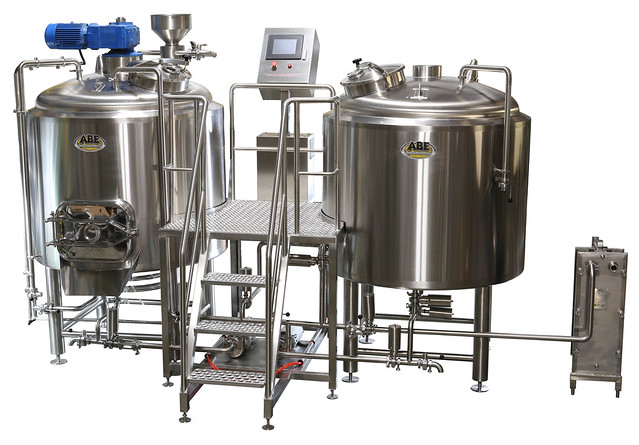
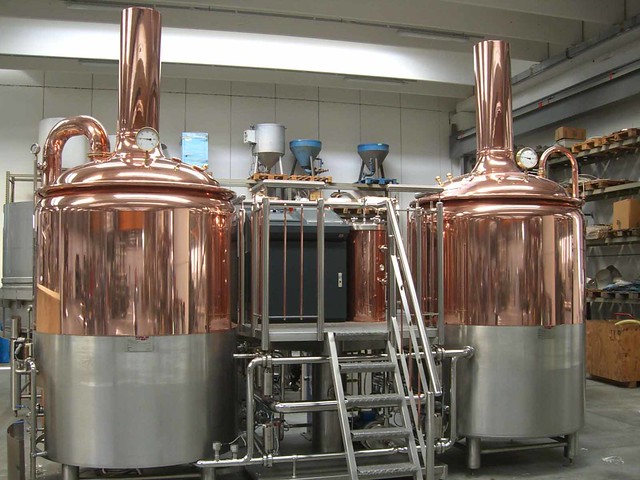
Earlier this year — or was it last year? — during a weekend trip to Monterey, I went to the Cannery Row Brewing Company while the rest of the family was shopping. At this point you probably won’t be surprised to learn that it was NOT a brewery, but a taphouse restaurant. Is this a growing trend, calling yourself something that suggests, implies or downright claims that you brew beer? Is it dishonest? I can see an argument that a brewhouse is a house with brews in it, but when I see the word brewhouse, I think of a place where people start to brew beer, with kettles, tuns and raw ingredients … oh, and hoses. Don’t forget the hoses.

ABE-brewhouse

Clearly, there’s no consensus on a naming convention. The Brewhouse in Santa Barbara does brew their own beer, as does the Barrel Head Brewhouse in San Francisco. Fitger’s Brewhouse in Duluth, Minnesota actually brews, as does Rupert’s Brew House in Kalamazoo, Michigan, the Audacity Brew House in Denton, Texas and the Covington Brewhouse in Covington, Lousiana. Also brewing their own beer is the Trinity Brewhouse in Providence, Rhode Island and the Crescent City Brewhouse in New Orleans. And so is the Northwinds Brewhouse & Eatery in Ontario, Canada, the Glacier Brewhouse in Anchorage, Alaska and all three McKenzie Brewhouse locations in Pennsylvania.

Skirting the naming, sort of, is the Temple Brew House in London, England, which serves its own beer, but the brewery itself is known as the Essex Street Brewing Company, which they explain as:

The Essex Street Brewing Company was founded in November 2014 to create great artisan beers, on site, and delicious to the good people of Temple. We’re really proud of our brewery, which is why it was built at the heart of the pub and the first thing you see as you walk down Essex Street.

But the BJs Restaurant and Brewhouse only used to, and today contracts their beer and trucks it to each location. I mean they … er to be fair, by they, I mean Michael Ferguson, brews the beer at a remote location, but the BJs themselves, which have “brewhouse” in their name, do not brew the beer onsite any longer even though it is exclusively brewed for them, by them.

There’s also the Flipside Brewhouse in Rohnert Part, the town right next to me [though they have apparently received brewing equipment months ago, it has yet to be installed or used despite claiming “Well Estd Brewhouse” on their logo], The BrewHouse in San Juan Capistrano [though I’m told they may have started gypsy brewing at other local breweries], and Scotty’s Brewhouse operates a dozen locations in Indiana. Then there’s the Brown Iron Brewhouse in Washington, Michigan and The Brew House in Maryland Heights, Missouri. What do all of these brewhouses have in common? They don’t brew their own beer onsite.

Also not brewing any beer is the Broadway Brewhouse of New Philadelphia, Ohio, Joe K’s Brewhouse in Harrisburg, Pennsylvania, the Upright Brew House in New York City, L.A.’s Blue Palms Brewhouse, and the 2nd Street Brewhouse in Philadelphia.

The Brew House & Bistro in Forest City, North Carolina, the Brewhouse Pub & Grille in Helena, Montana and The Brew House Bar and Restaurant in Pearl River, New York, along with many others, at least hint that they’re not actually brewing by including the word or words bar, pub, grille or restaurant in their names, too. That helps, at least a little bit, but still seems slightly misleading.

But what’s clear is that there’s no consensus. There’s plenty of examples of businesses with the word “brewhouse” featured prominently in their name that both brew beer onsite and do not. My list above is by no means complete or scientific, but the result of looking at the first few pages of a Google search for “brewhouse.” It does give a good indication that the use of the term “brewhouse” is all over the map. The actual definition, however, seems less open to debate.

The Dictionary.com definition of a brewhouse is quite simple:

brewhouse [broo-hous]
noun, plural brewhouses [broo-hou-ziz]
1. brewery.

Even the Oxford Dictionary definition is pretty succinct: “noun; A brewery.” And those definitions are not just a recent development indicative of a word in transition. The Webster’s Revised Unabridged Dictionary from 1828, as updated in 1913, defines a brewhouse as ” n. A house or building appropriated to brewing; a brewery.” So it’s fairly unambiguous, there’s little room for nuance in those definitions. Which is comforting, because that’s certainly the sense in which I’ve always understood the word.

new_10_hl_fully_automatic_operated_copper_brewhouse_25_10831

When a bar uses the word(s) brewing company or brew pub in their name that seems even more questionable since the words are less ambiguous even than brewhouse. While the Cannery Row Brewing Company is the only one I can remember by name, I’m pretty sure I’ve run into a couple of others over the years. If you know of a place that calls itself a “brewing company” but isn’t, let me know in the comments below, please. For obvious reasons, it’s much harder to search for businesses with brewing in their name but that don’t brew. Google doesn’t parse that information, sadly.

[Happily — or sadly — I was not wrong about there being additional “brewing company” businesses that do not brew, which readers were kind enough to alert me to. Here are a few more I’ve learned about. The Los Angeles Brewing Company, is a bar in downtown L.A. that at least claims they “do not currently brew beer on our premises, we have future plans to do so.” Also in L.A. was the Weiland Brewery Underground, but after 14 years of calling itself a brewery closed at the end of June this year. In Rochester, New York, the California Brew Haus has been not brewing their own beer for 45 years so far, and both the Visalia Brewing Company and Valley Brewing Company used to operate breweries but haven’t for long enough that they should probably stop calling themselves one. In the case of Valley Brew, it’s been a few years now since they removed the equipment but on their website they still refer to themselves as a “microbrewery” and the Google summary states “The Valley Brewing Company is Stockton’s oldest brewery.”]

Brewpub, or brew pub, however, seems even trickier. A much newer term, at least in common use, I would not have thought anyone would call themselves one without actually being a brewpub. But the Iron Horse Bar & Grill, in Montana, used to be called the Iron Horse Brew Pub, but changed their name, perhaps bowing to consumer pressure. I don’t know exactly when it changed its name, but the 2012 edition of the “Moon Spotlight Missoula & Northwestern Montana” travel guidebook still lists the brew pub name (and discloses their lack of brewing) so it must be pretty recently. Their website URL is still “ironhorsebrewpub.com.” Since they opened in 1991, that suggests that they were known incorrectly as a brew pub for at least 21+ years. Or is it technically a pub that serves brews, and that makes the name okay? That seems to be stretching things, but perhaps that’s the argument.

So it seems clear that a brewhouse in the ordinary meaning of the word is a brewery. And brew pub, brewpub or brewing company seem even more obviously misleading if brewing is not done onsite. Yet a number of bars, restaurants and the like are calling themselves a “brewhouse” without doing any actual brewing on premise, and there are at least a few instances of the other variety.

My question for the beer collective hive mind is this: Should an establishment not brewing beer be permitted to call itself a brewhouse, brewpub or brewing company, or is it misleading the public? Or does it simply not matter? I realize that there’s probably not any meaningful way to actually stop someone from calling their bar or restaurant whatever they want. But it seems like social pressure could be brought to bear. Or maybe I’m just being a pedantic grammar nutcase. What’s your take?

UPDATE 8.5: Thanks for everyone who’s commented. The list of places who brew and don’t brew with brewhouse and other potentially misleading names was meant to illustrate that there are a great number of both. As I stated, it was neither scientific nor in any way complete. However, several people have offered updated information about some of those places and also suggested new places, so I’ve decided to update those, where it makes sense, using [brackets], so you know that’s the updated information.

Filed Under: Breweries, Editorial, Just For Fun, Related Pleasures Tagged With: Philosophy, Words

Patent No. PP20200P3: Hop Plant Named ‘Apollo’

August 4, 2015 By Jay Brooks

patent-logo
Today in 2009, US Patent PP20200 P3 was issued, an invention of Roger D. Jeske and Joe Brulotte, assigned to S.S. Steiner, Inc., for their “Hop plant named ‘Apollo.'” Here’s the Abstract:

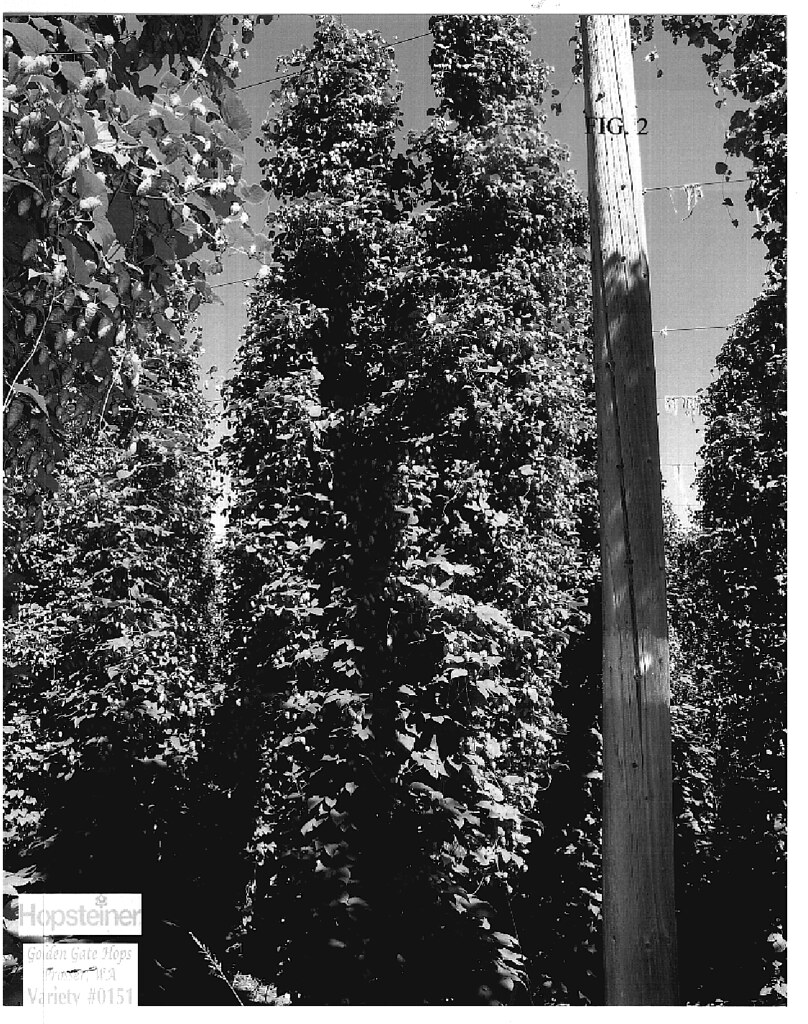
A new and distinct variety of hop, Humulus lupulus L., named “APOLLO” is characterized by its exceptional high percentage of alpha acids, excellent storage stability of alpha acids, low CoH value for an alpha variety, and resistance to hop powdery mildew strains found in Washington. The new variety was cultivated as a result of a cross in 2000 at Golden Gate Roza Hop Ranches in Prosser, Wash., United States and has been asexually reproduced in Prosser, Wash., United States.

Untitled
Untitled

Filed Under: Beers, Just For Fun, Politics & Law, Related Pleasures Tagged With: History, Hops, Law, Patent

« Previous Page
Next Page »

Find Something

Northern California Breweries

Please consider purchasing my latest book, California Breweries North, available from Amazon, or ask for it at your local bookstore.

Recent Comments

  • Bob Paolino on Beer Birthday: Grant Johnston
  • Gambrinus on Historic Beer Birthday: A.J. Houghton
  • Ernie Dewing on Historic Beer Birthday: Charles William Bergner 
  • Steve 'Pudgy' De Rose on Historic Beer Birthday: Jacob Schmidt
  • Jay Brooks on Beer Birthday: Bill Owens

Recent Posts

  • Historic Beer Birthday: Hew Ainslie April 5, 2026
  • Historic Beer Birthday: Robert Leo Hulseman April 5, 2026
  • Beer Birthday: Tom McCormick April 5, 2026
  • Beer In Ads #5205: Moerlein’s Celebrated Bock Beer, An Easy Winner April 5, 2026
  • Historic Beer Birthday: Fritz Funke April 4, 2026

BBB Archives

Feedback

Head Quarter
This site is hosted and maintained by H25Q.dev. Any questions or comments for the webmaster can be directed here.