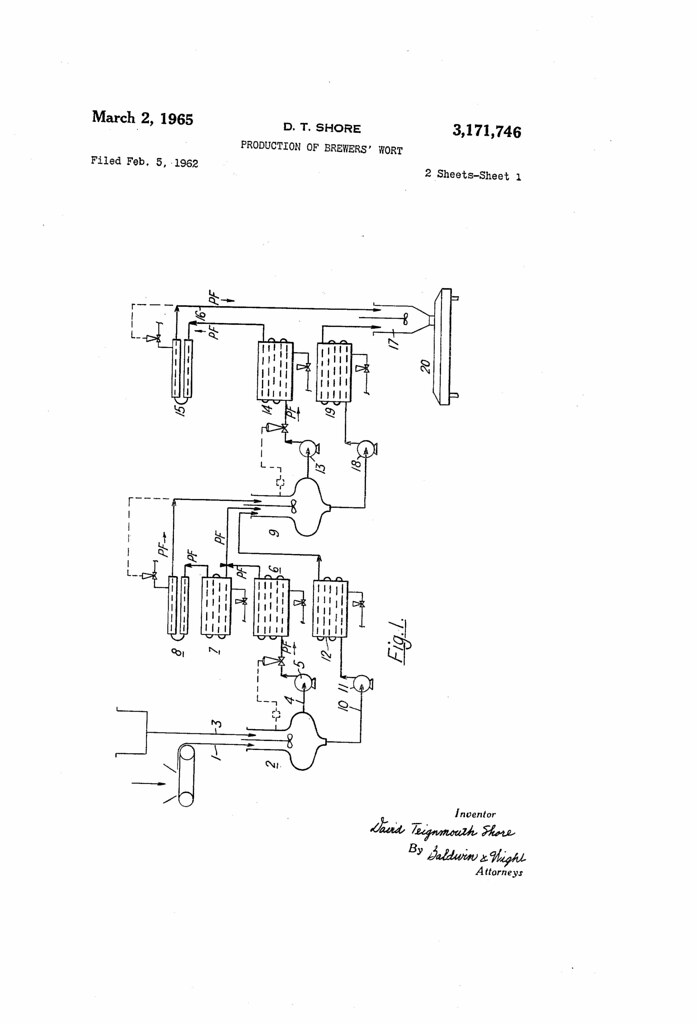
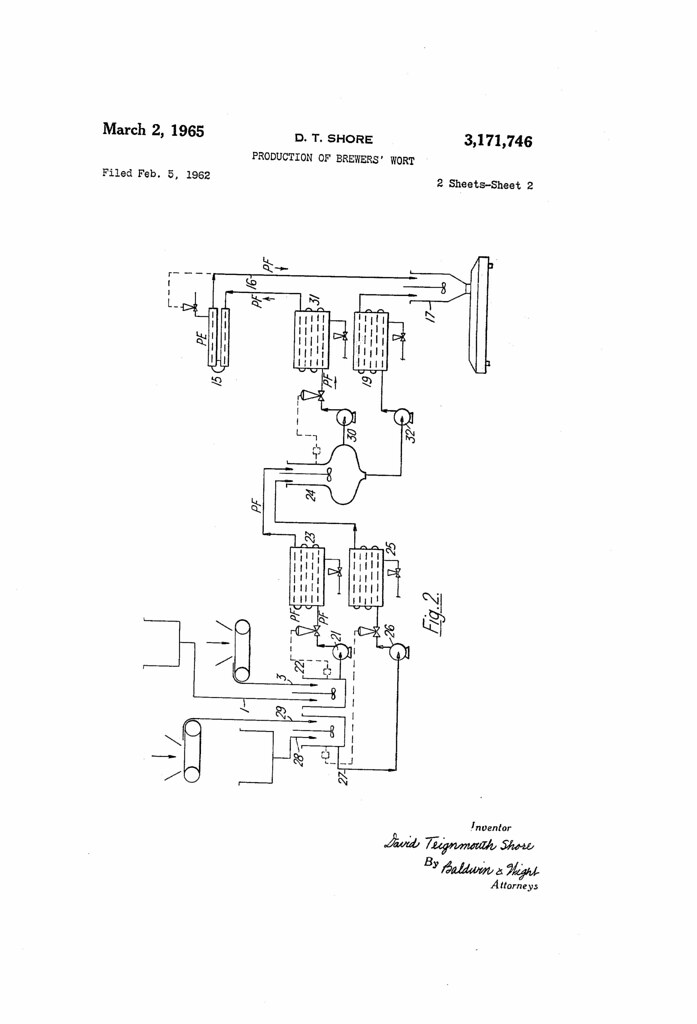
Today in 1965, US Patent 3171746 A was issued, an invention of David Teignmouth Shore, for his “Production of Brewers’ Wort.” There’s no Abstract, but in the description Shore explains that his “invention relates to the production of brewers wort at the mashing stage in which a reaction is created between water and goods, i.e., ground solids or grist to obtain as a product of the stage a wort which is known as sweet wort: the sweet Wort is passed on for further treatment including heating, hopping and fermentation treatment to produce beer of one grade or style or another.”
Beer In Ads #1481: March, The Month For Sowing Barley

Sunday’s ad is for the British ad campaign “Beer is Best,” from 1938. Part of “A Calendar of British Beer” from that year, March features a wonderful illustration of a farmer sowing his field with barley, and the text explains that this is the month for it, with some statistics of how much of the grain it takes each year to create all of England’s beer. “All the year round. Beer is Best.” Happy March.

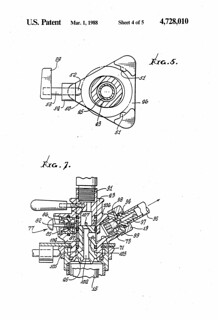
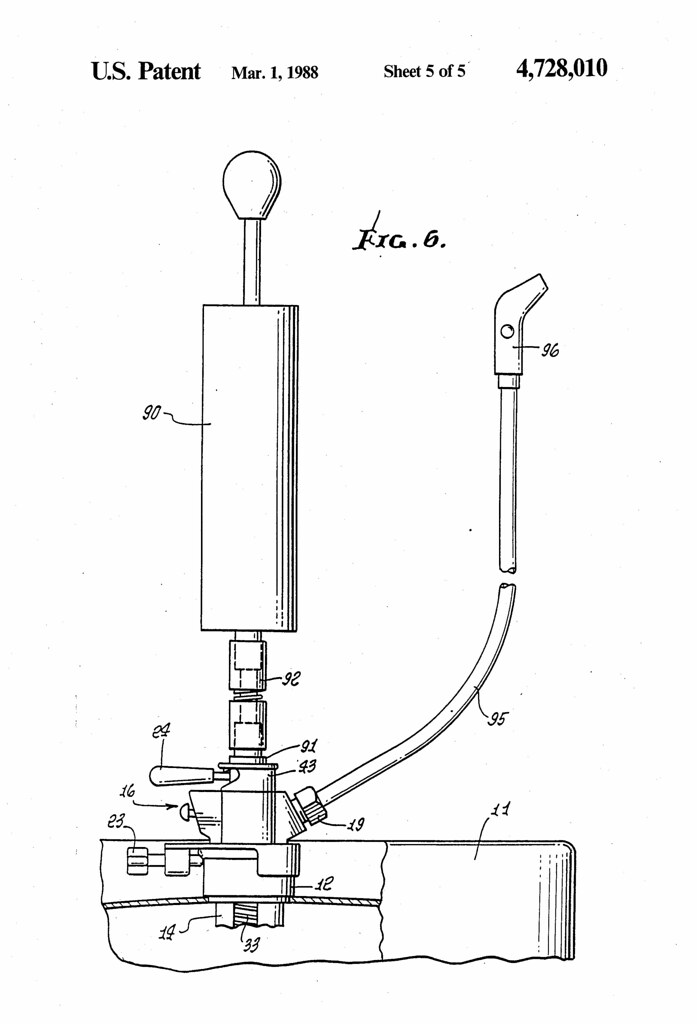
Patent No. 4728010A: Keg Tapper
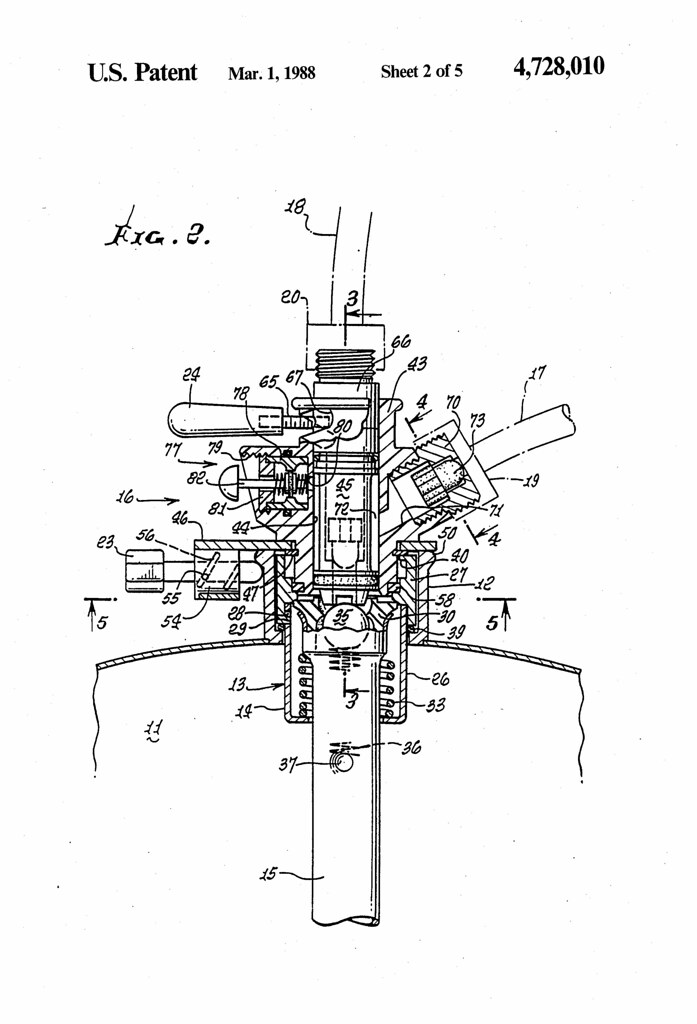
Today in 1988, US Patent 4728010 A was issued, an invention of Mack S. Johnston, for his “Keg Tapper.” Here’s the Abstract:
A keg tapper for use with a keg having a neck with a closure valve carried therein and a flange with a tapered edge on the neck. An arrangement for attaching the tapper at the flanged neck so that completion of the attachment opens the inner valve of the keg closure. A plunger carried in the keg tapper with an arrangement for moving the plunger axially within the tapper body to engage the keg closure and open the outer valve. A keg tapper which can be utilized in the tavern configuration and in the picnic configuration.


Patent No. 2462930A: Keg Closure
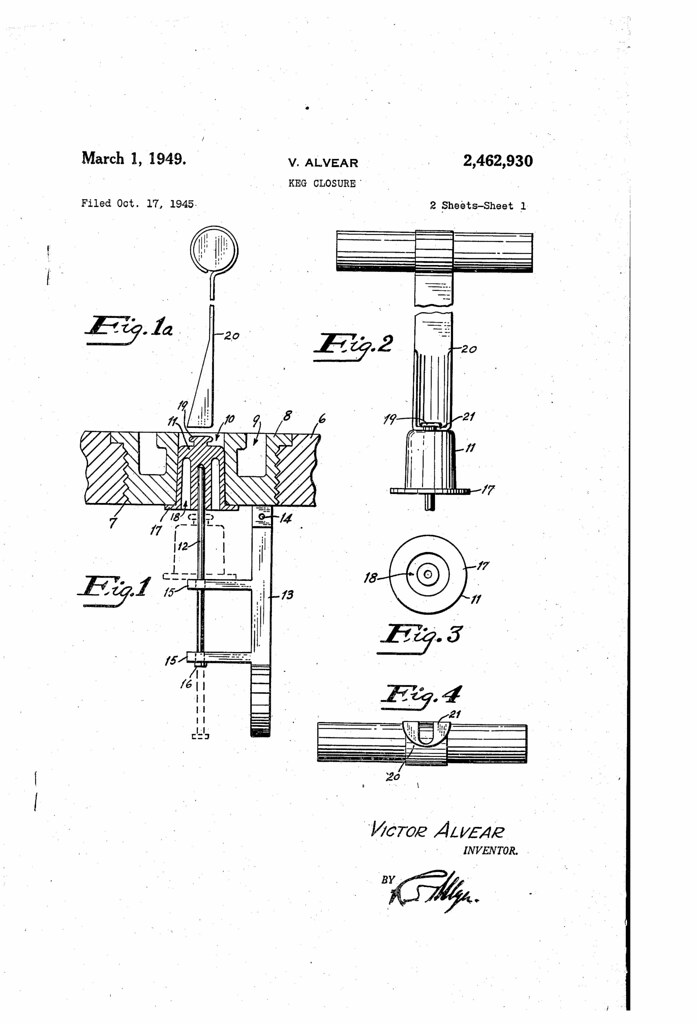
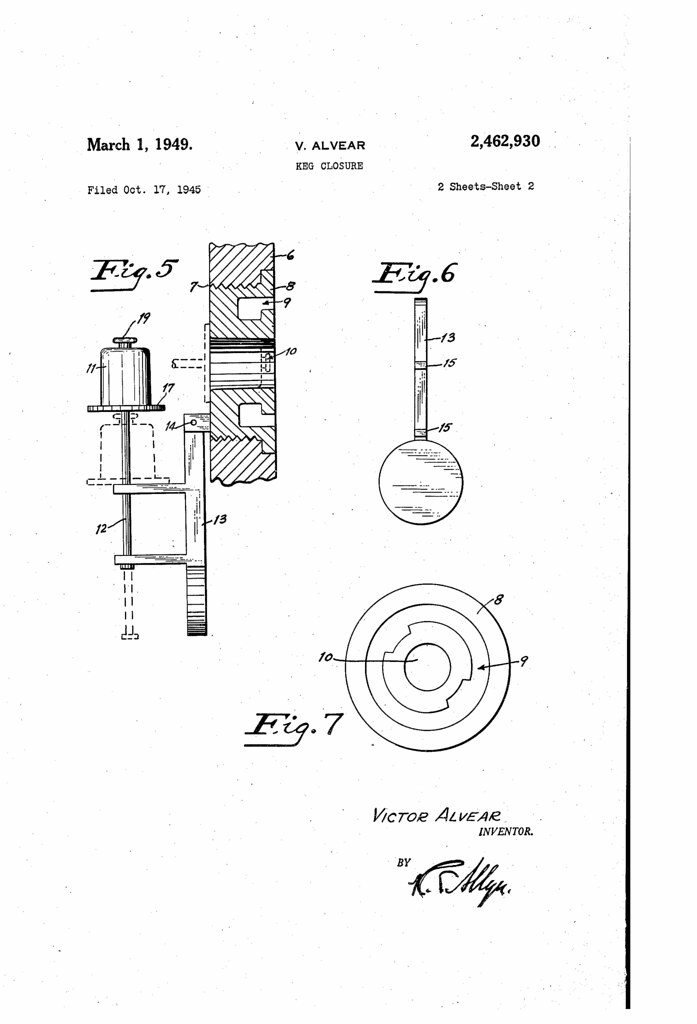
Today in 1949, US Patent 2462930 A was issued, an invention of Victor Alvear, for his “Keg Closure.” There’s no Abstract, but the description claims that the “object of the present invention to provide a bung for a keg in which the stopper is a fixture on the keg and cannot become lost and the chance of its becoming damaged is reduced to a minimum.” Alvear also writes that in addition, additional reasons for his patent include the “means for bringing the stopper or plug to alignment with the bung hole by gravity where it can easily be moved into closed position, the “means for readily grasping it with a tool and with means for sealing the opening in the bung,” “eliminate hammering and pounding on the barrel head and to eliminate spearing of corks,” to “facilitate tapping of the keg,” “provide a stopper that is sanitary, simple in construction and economical to manufacture,” “provide a stopper that cannot leak or blow out regardless of the pressure in the keg thereby providing an air-tight seal,” and “to provide a stopper that is self-sealing.” That is one impressive keg stopper.
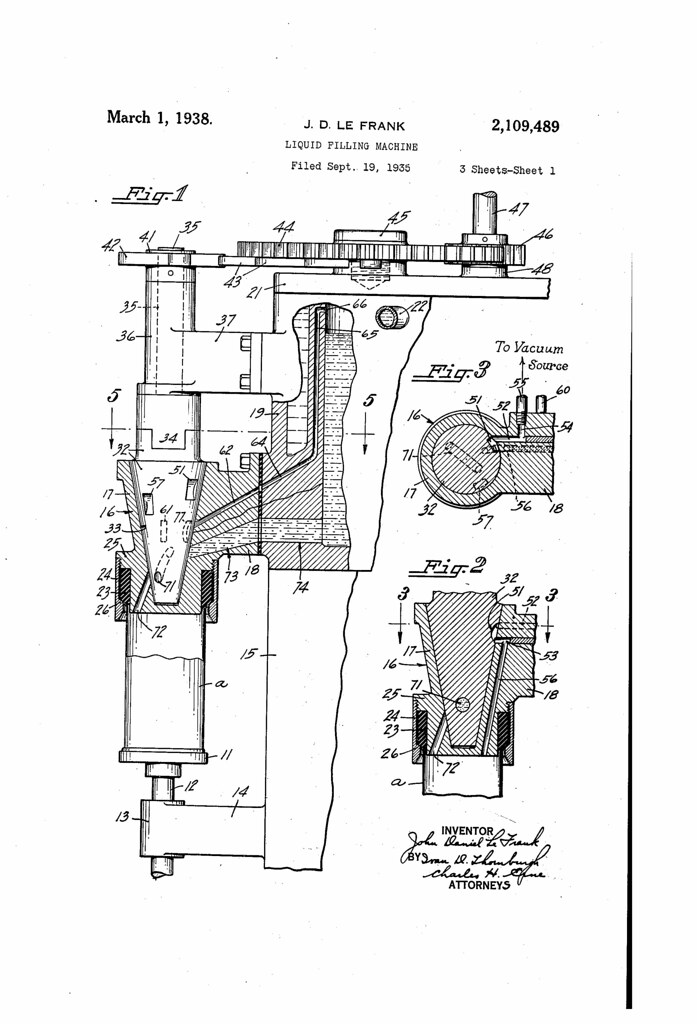
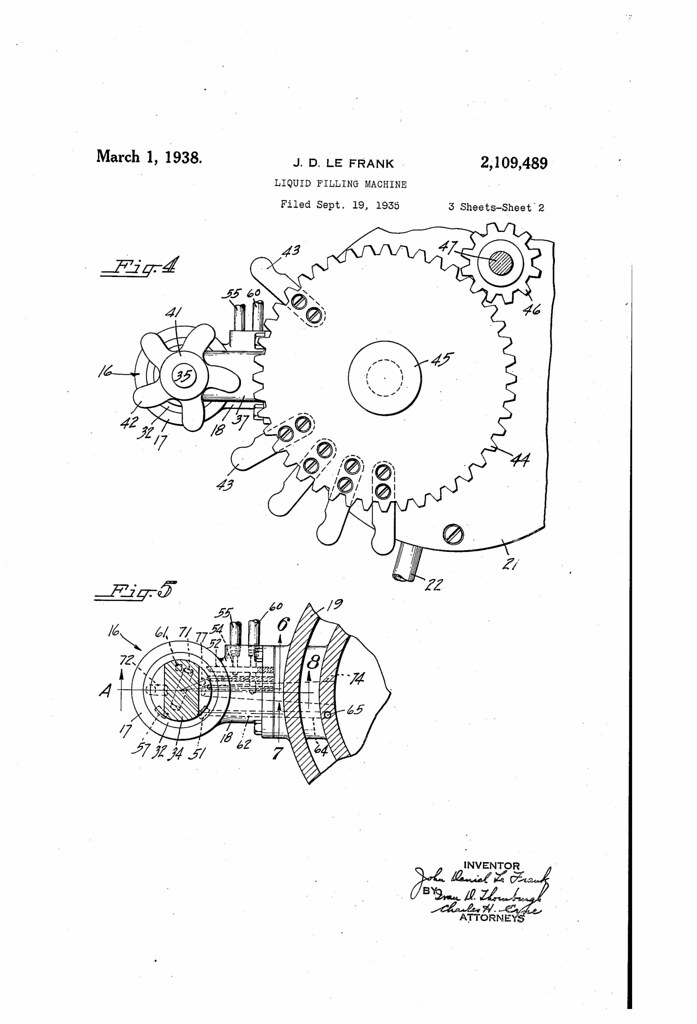
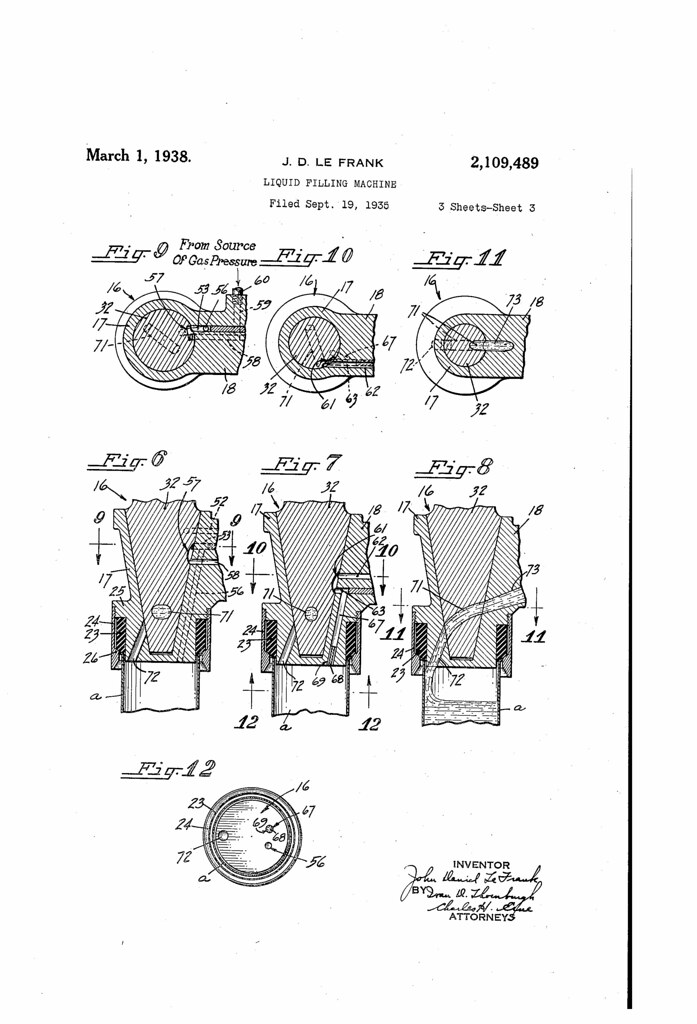
Patent No. 2109489A: Liquid Filling Machine
Today in 1938, US Patent 2109489 A was issued, an invention of John Daniel Le Frank, assigned to the American Can Co., for his “Liquid Filling Machine.” There’s no Abstract, but the description states that the “present invention relates to a machine for filling cans with liquids that have a tendency to foam and has particular reference to devices which minimize foaming of the liquid passing into a can, passages in the devices being automatically purged of any foam which may have accumulated during the filling of a preceding can.”
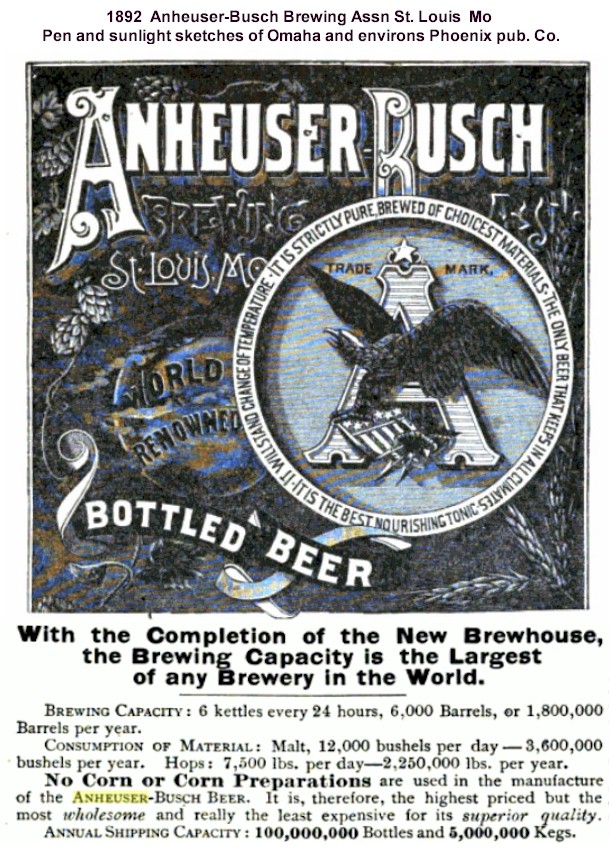
Beer In Ads #1480: No Corn Or Corn Preparations
Saturday’s ad is for Anheuser-Busch, from 1892. Apparently shortly after the competition of a new brewhouse in St. Louis, they celebrated by sponsoring “pen and sunlight sketches of Omaha and environs” with this ad. One curious feature of the otherwise simple image ad, is this line. “No Corn or Corn Preparations are used in the manufacture of Anheuser-Busch beer. It is, therefore, the highest-priced by the most wholesome and really the least expensive for its superior quality.” Funny they didn’t mention rice.
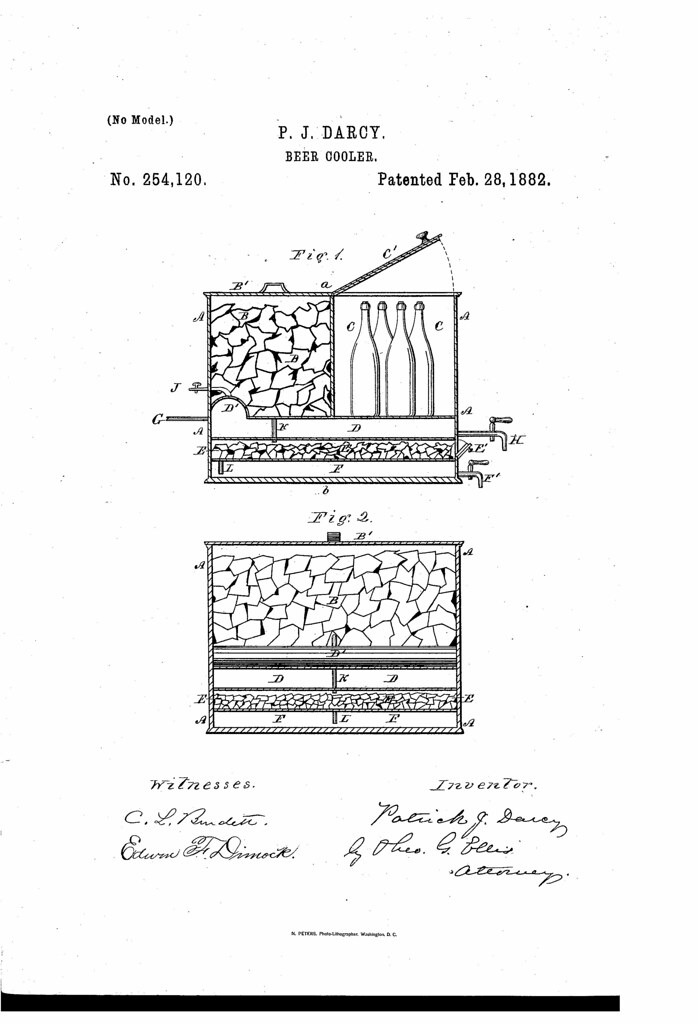
Patent No. 254120A: Beer-Cooler
Today in 1882, US Patent 254120 A was issued, an invention of Patrick J. Darcy, for his “Beer-Cooler.” There’s no Abstract, but the description states that his “improvement relates to a device for cooling beer as it is drawn from the cask, by which it is cooled as it is used, instead of being obliged to cool the cask, and thereby diminish the head or pressure, besides the waste of ice in cooling through the wood.”
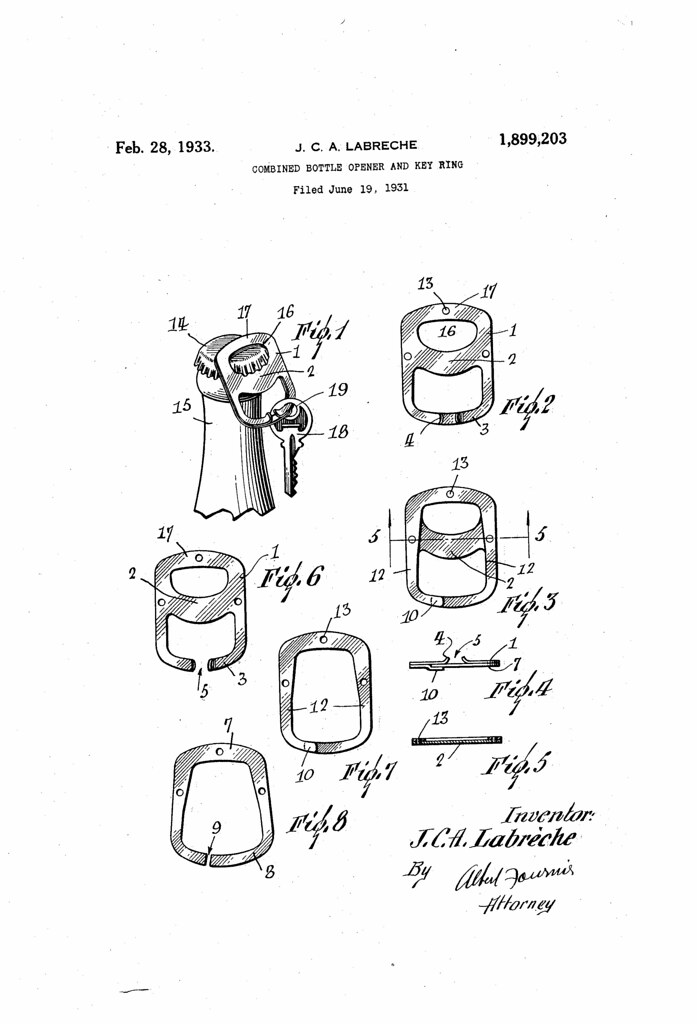
Patent No. 1899203A: Combined Bottle Opener And Key Ring
Today in 1933, US Patent 1899203 A was issued, an invention of Joseph Charle Auguste Labreche, for his “Combined Bottle Opener and Key Ring.” There’s no Abstract, but the simple description states that the “invention pertains to a novel combined bottle opener and key ring designed a to be carried conveniently-in the pocket.” Weird to think that this had to be patented, they seem so ubiquitous now.
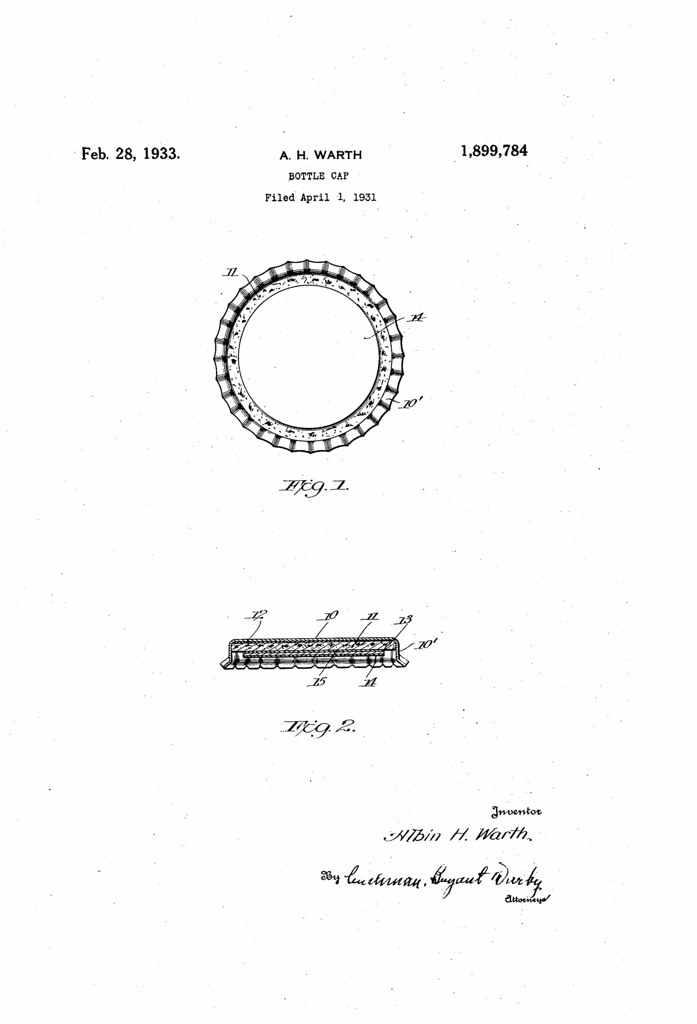
Patent No. 1899784A: Bottle Cap
Today in 1933, US Patent 1899784 A was issued, an invention of Albin H. Warth, assigned to the Crown Cork & Seal Co., for his “Bottle Cap.” This crown was patented shortly before the repeal of Prohibition, which took place several months later, in December, although by April some lower-strength beer became available. There’s no Abstract, but the description provides some insight in the why it was a more modern crown.
This invention relates to bottle caps and more particularly to a cap consisting of ametallic’shell containing a cushion disc having what is known as a protecting facing. In its preferred form, the invention relates to that type of cap having a protecting facing in the form of a center-disc or center-spot which is of smaller diameter than the cushion disc.
In closures of this character, the cushion or compressible disc is ordinarily formed of sheet cork or of a composition of granular cork, the particles of which are united by a binder which is resistant to gas and acids.
It is desirable to protect the cushion disc from the contents of the bottle, since the cork or other material of the disc becomes discolored and imparts an undesirable flavor or taint to the contents.
The facing discs have ordinarily been fornied either of metal foil, such as aluminum or tin, or of fibrous material, such as paper.
The present invention relates to the latter type in which the facing is of paper.
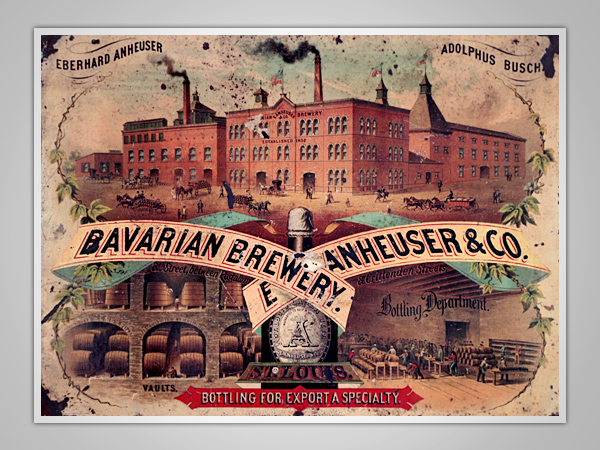
Beer In Ads #1479: Bavarian Brewery, E. Anheuser & Co.
Friday’s ad is for the Bavarian Brewery, a.k.a. E. Anheuser & Co., from 1860. This, of course, was the brewery that would later be called Anheuser-Busch, but sixteen years before they’d start making Budweiser. Even then, it was a fairly large enterprise, with “bottling for export a specialty.”