

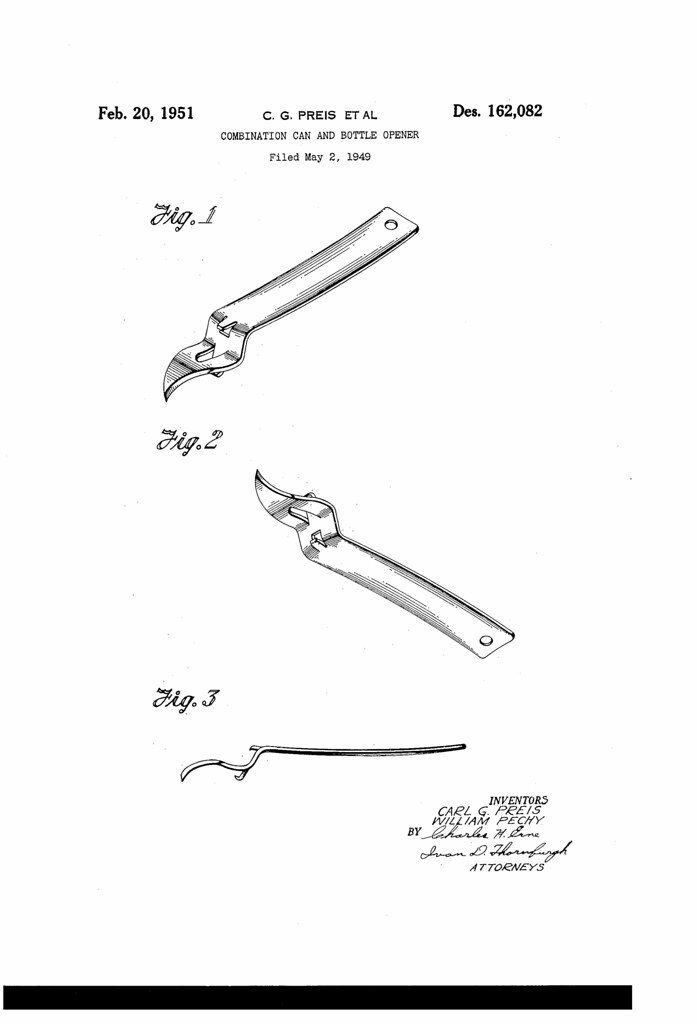
Today in 1951, US Patent D162082 S was issued, an invention of Carl G. Preis, for his “Combination Can and Bottle Opener.” There’s no Abstract, but the rather short application states simply that Preis has “invented a new, original, and ornamental Design for a Combination Can and Bottle Opener.”
Patent No. 2369721A: Beer Dispenser
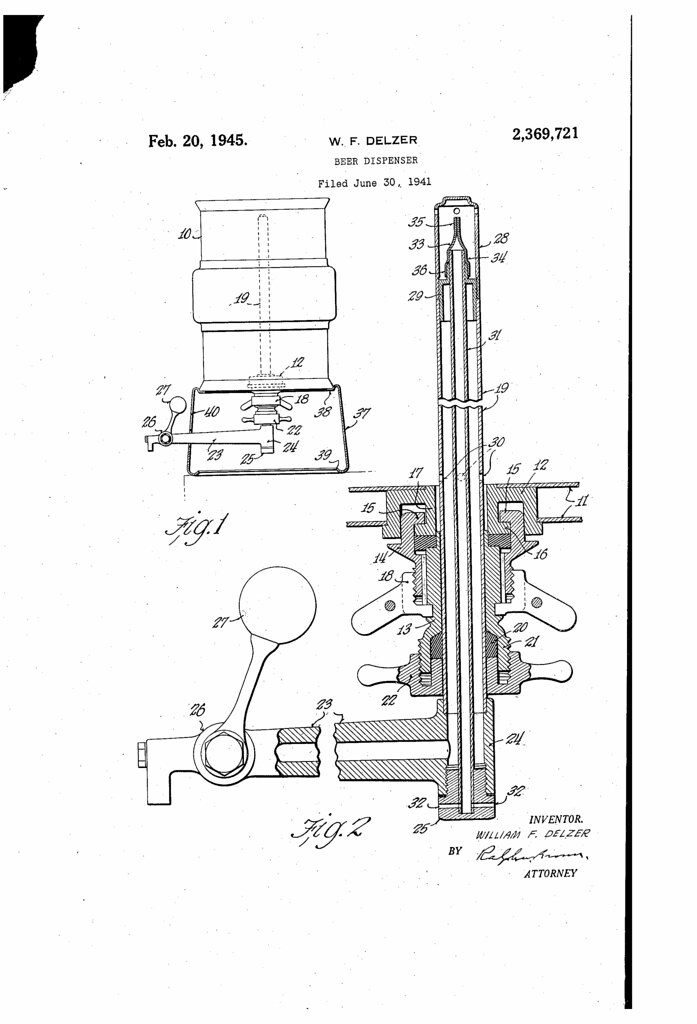
Today in 1945, US Patent 2369721 A was issued, an invention of William F. Delzer, for his “Beer Dispenser.” There’s no Abstract, but the introduction to the description gives something similar.
This invention relates to beer dispensers. The dispenser of the present invention is particularly adapted for home, club, picnic, or other uses where bar facilities are not available for the serving of draft beer. An object of the present invention is to provide a dispenser readily applicable to present commercial forms of kegs and the like and capable of discharging beer there from without the necessity of using hand pumps or other types of pressure devices heretofore required in dispensing.
Beer In Ads #1471: Drink The Famous Bock Beer

Thursday’s ad is for Pabst, from 1897. In honor of the Chinese New Year, and more specifically because it’s the year of the goat, this ad is for the Bock Beer made by the Pabst Zythepsary. Zythepsary, by the way, is an archaic word for brewery. Happy New Year.
Patent No. 3078166A: Continuous Brewing
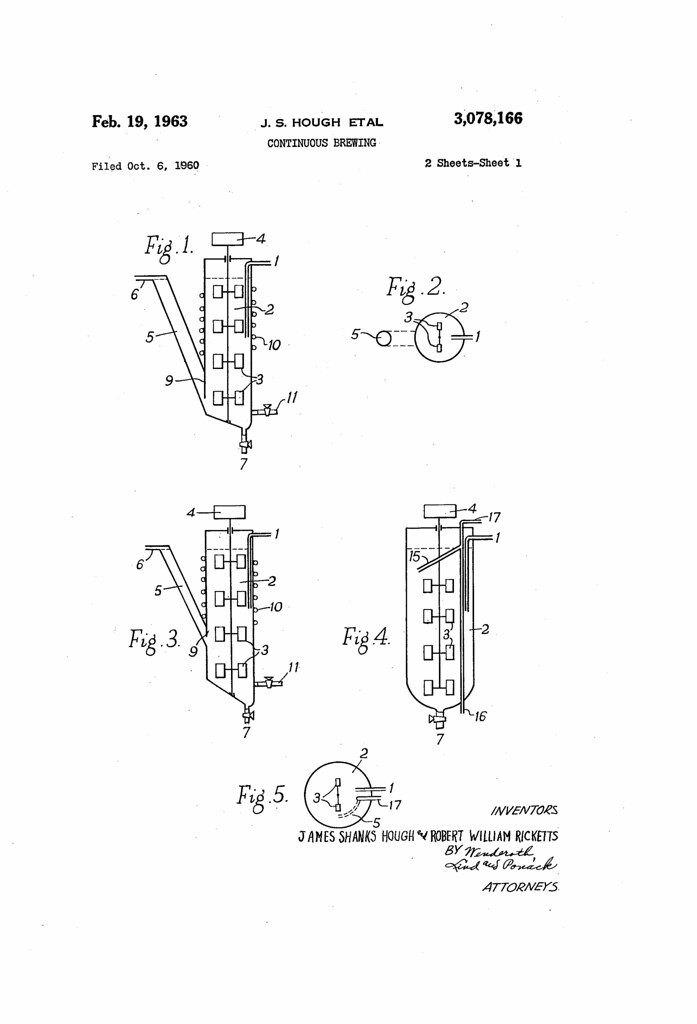
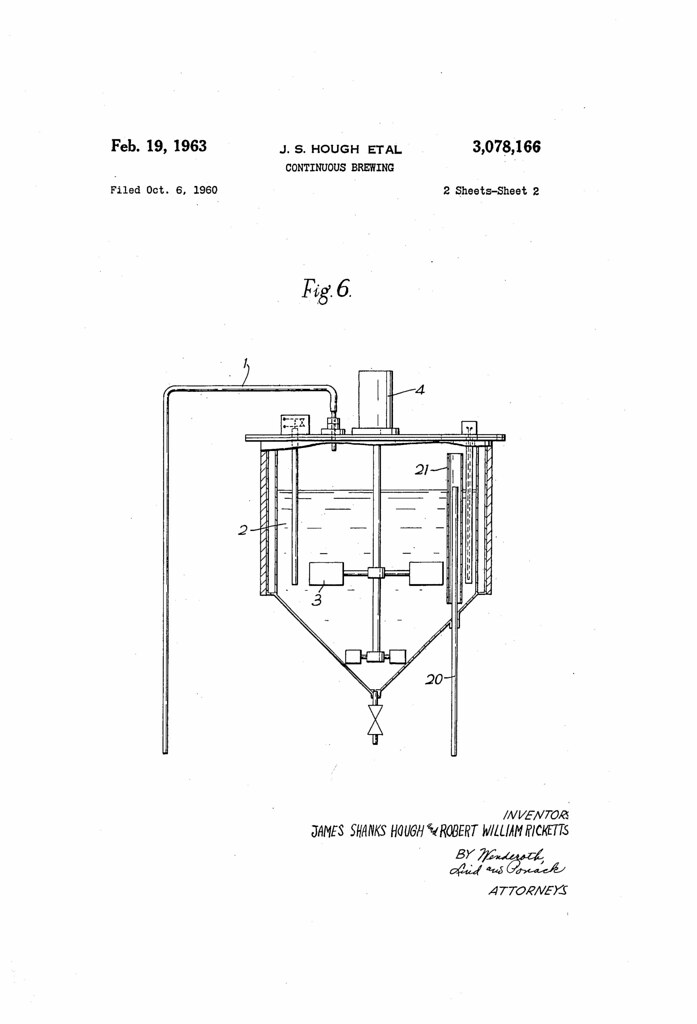
Today in 1963, US Patent 3078166 A was issued, an invention of James Shanks Hough and Robert William Ricketts, for their “Continuous Brewing.” There’s no Abstract, but the description states it’s for a “fermentation process in which means are secured for controlling the quantity of yeast present in the fermenting liquid and hence the rate of fermentation.” They continue in the application:
Still another object of the present invention is to provide a process whereby wort can be fermented with production of substantially smaller quantities of yeast than is possible in known processes.
Continuous processes for the fermentation of brewers wort are known and these are claimed to have a high rate of production in comparison with the conventional batch processes. In the known processes, however, a yeast separation stage is employed in which yeast is separated from the fermented wort and in most known processes the yeast separated from the fermented wort is recycled to the fermentation stage. The present invention permits a more compact apparatus to be used as no separate yeast separation stage is required unless it is specifically desired to produce yeast in conjunction with the production of beer. This is achieved by using a process which permits the separation of the yeast from the fermented wort to be effected in the actual fermentation vessel.
Patent No. 7332342B2: Barley Kernel Husk Evaluation
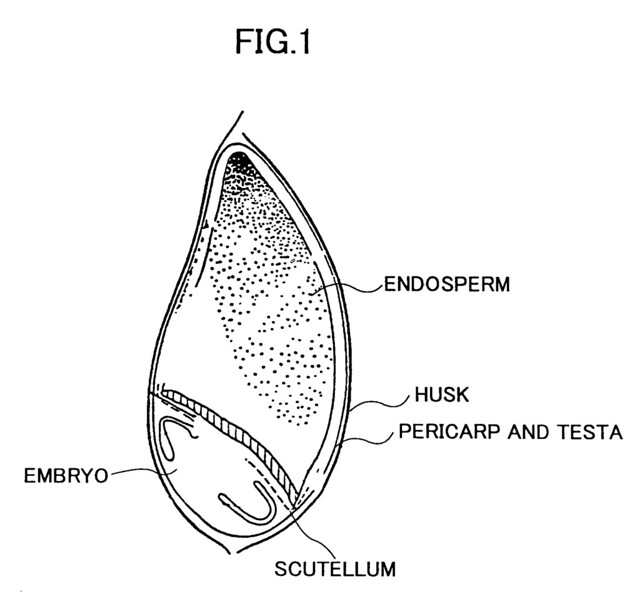
Today in 2008, US Patent 7332342 B2 was issued, an invention of Isao Kishinami, assigned to Sapporo Breweries Ltd., for his impossibly long patent name, “Disposing barley kernels with husks in a sulfuric acid solution having a 40% to 60% concentration, agitating the solution having the barley kernels disposed therein for a prescribed time, and observing the degree of husk remaining on the barley kernels subsequent to the agitation.” Here’s the Abstract, only slightly longer than the title:
An object of the present invention is to provide a method for evaluating the physical strength of husks of a barley ingredient for malt manufacture. Barley kernels with husks are disposed in a sulfuric acid solution with a concentration of approximately 40% to 60%, and are agitated for a prescribed time (e.g. approximately 1 hour) using a stirrer bar or the like. After agitation, the barley kernels are treated with a mixed liquid of Methylene Blue and Eosin, and the degree of peeled husk (remaining degree) is examined by referring to the degree of dyed barley kernels, to thereby evaluate the physical strength of the husks of the barley kernels.

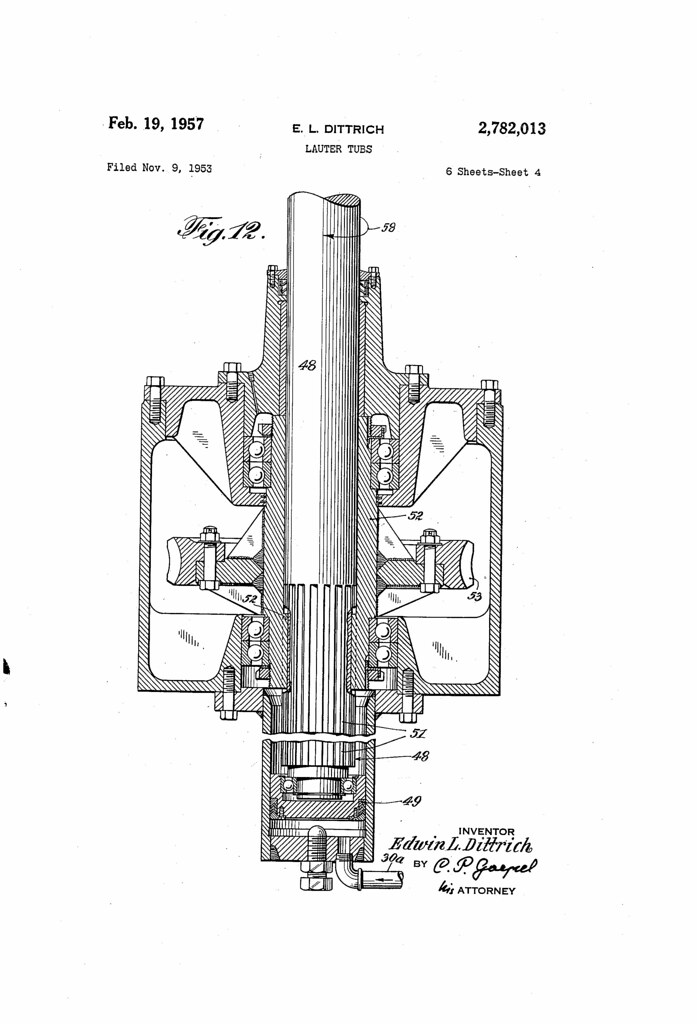
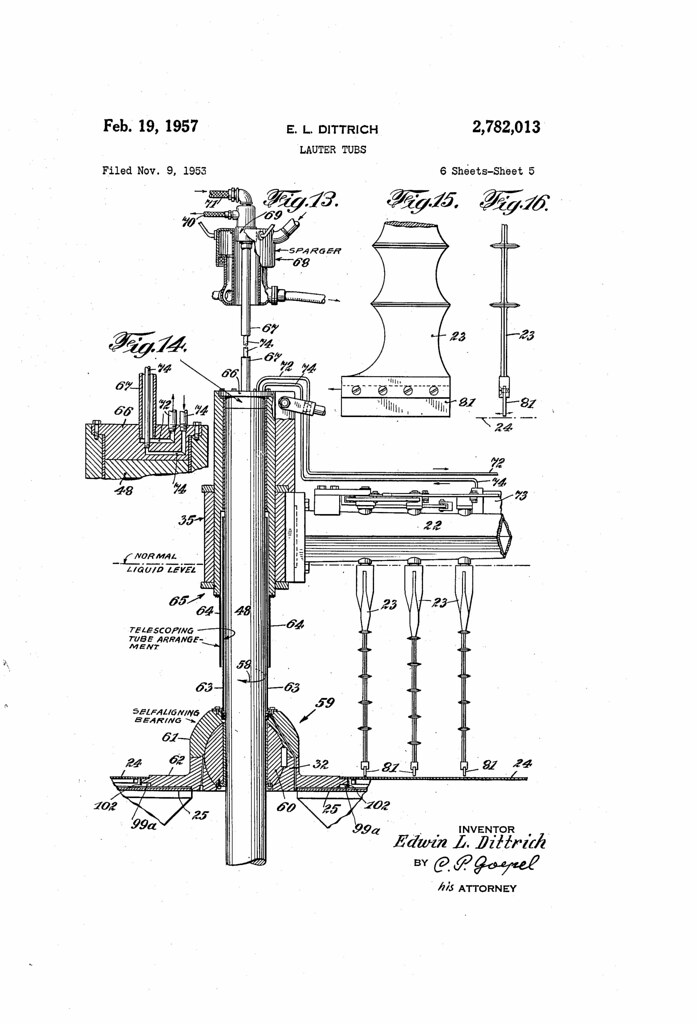
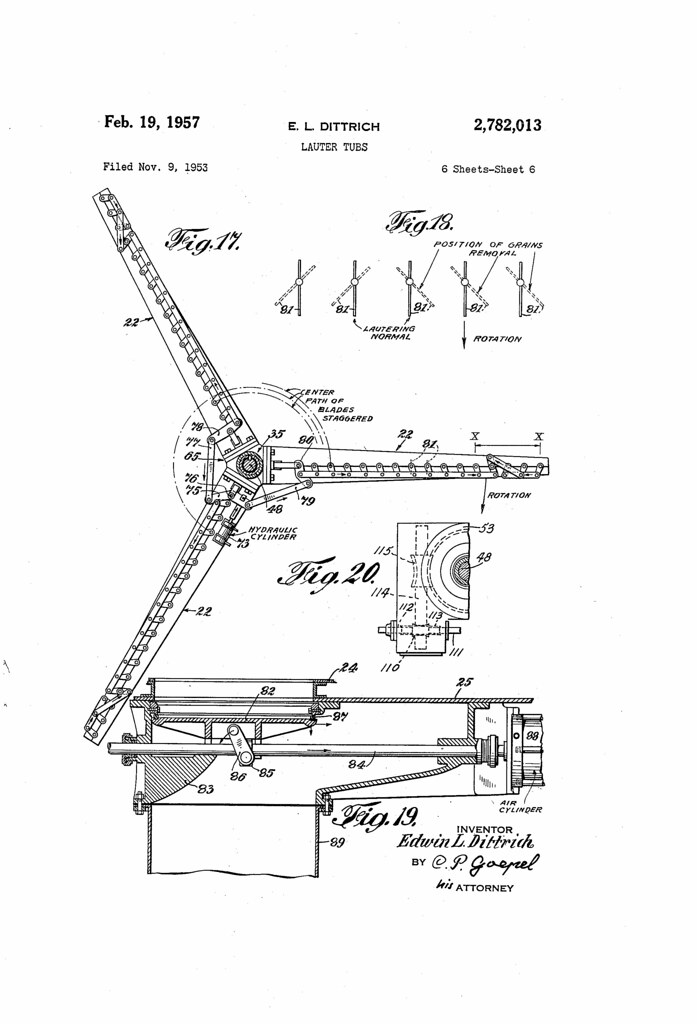
Patent No. 2782013A: Lauter Tubs
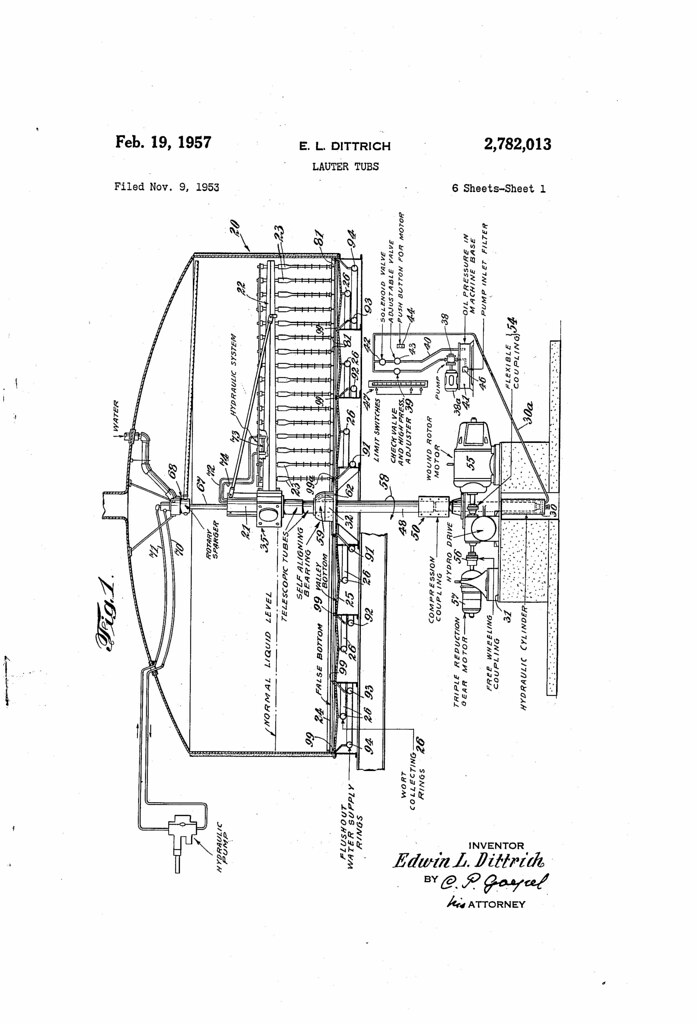
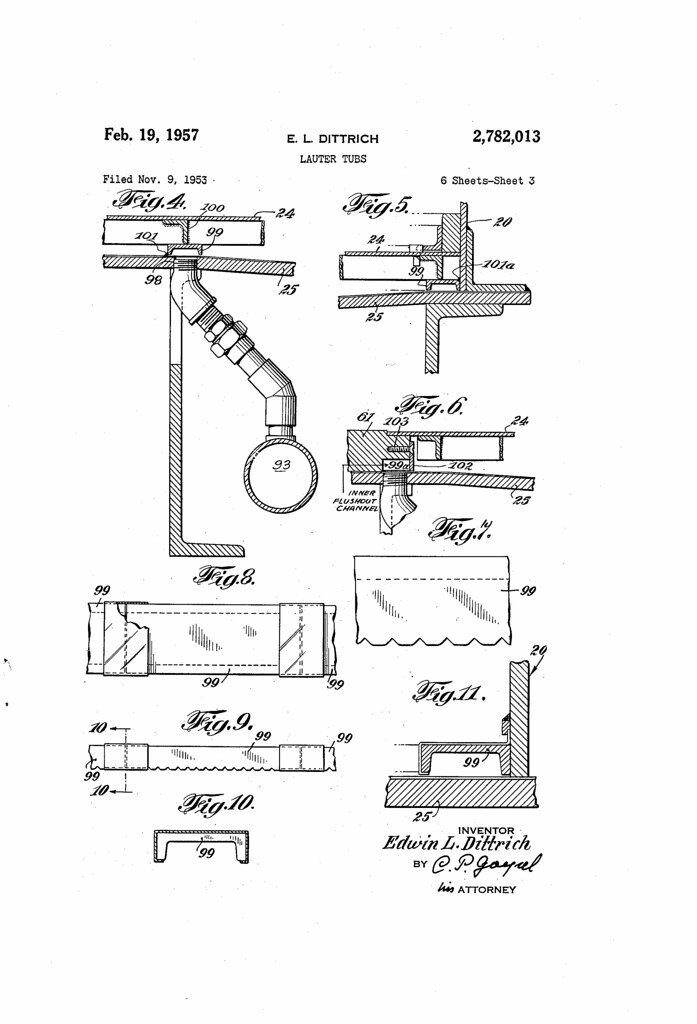
Today in 1957, US Patent 2782013 A was issued, an invention of Edwin L. Dittrich, assigned to Pfaudler Co. Inc., for his “Lauter Tubs.” There’s no Abstract, and the OCR didn’t work very well on this one, so it’s hard to read. What I can make out is that “this invention relates to lauter tubs and has for its object to provide several improvements thereto.
A lauter tub is essentially a device for straining wort liquid from the mash-grains; and comprises -a perforated false bottom resting on and separated from the tank bottom itself by spacer studs attached to the false bottom. The tank bottom is provided-with suitable drainage openings. The invention provides a combined gear drive and hydraulic system unit motivating the shaft which revolves in a universal bearing attached to the bottom of the tank, said shaft having vertical freedom of movement through out lifting the false bottom.”

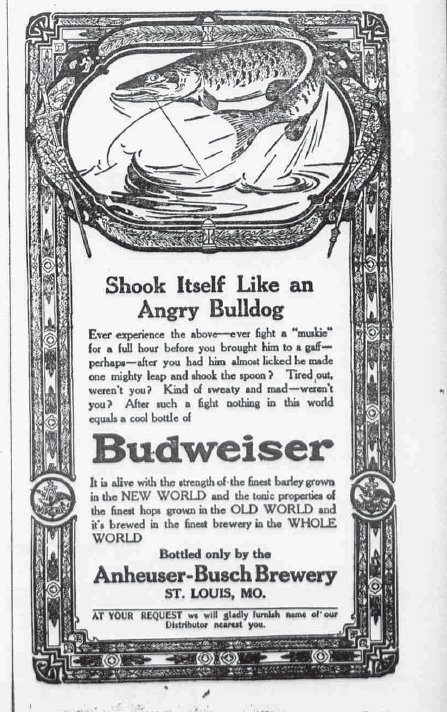
Beer In Ads #1470: Shook Itself Like An Angry Bulldog
Wednesday’s ad is for Budweiser, from 1910. After fighting a muskie fish you’re “mad and sweaty” you’ll want a beer. But I love their description of Budweiser. “It’s alive with the strength of the finest barley grown in the New World and the tonic properties of the finest hops grown in the Old World.” The “tonic properties” of hops?
Patent No. WO1999007820A2: Lipid Removal
Today in 1999, US Patent WO 1999007820 A2 was issued, an invention of Charles Bamforth, Dickie Kamini, and Robert Muller, for their “Lipid Removal.” Here’s the Abstract:
A method for removing lipids material from beer or other beverages. The beer is contacted with immobilized lipid binding protein which binds any lipid present in the beer or other beverage. After the lipid removal stage is complete there are no lipid binding additives remaining in the beverage.
This patent is particularly notable because one of the inventors is UC Davis brewing professor Charles Bamforth. And while he holds a few British patents, this is the only American one that turns up on Google’s patent search.
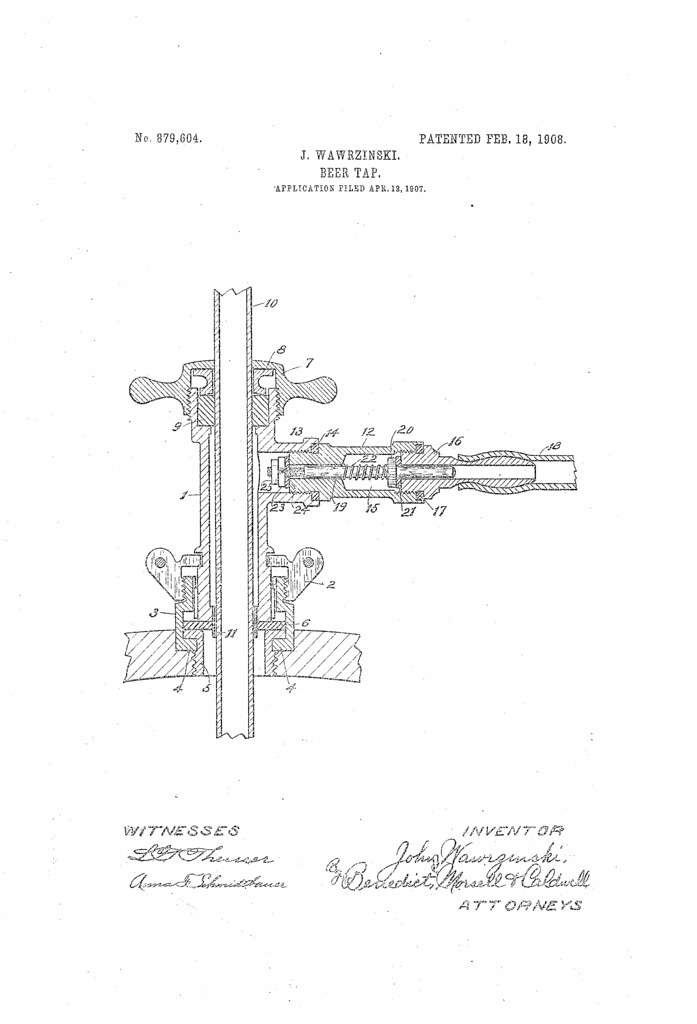
Patent No. 879604A: Beer-Tap
Today in 1908, US Patent 879604 A was issued, an invention of John Wawrzinski, for his “Beer-Tap.” There’s no Abstract, but it’s described as an “invention as for its object [is] to provide a beer tap with a back pressure valve of novel construction which Will effectively prevent the pressure from the beer keg entering `the communication leading to the beer-tap from the air pressure reservoir.”
A Compendium Of Alcohol Ingredients & Processes

Here’s an interesting infographic, The Compendium of Alcohol Ingredients and Processes, created by WineBags.com, a promotional items company catering primarily to the wine industry. It shows 48 different beverages containing alcohol, graphically showing the ingredients and how they’re combined. Beer, of course, is one of the drinks shown:
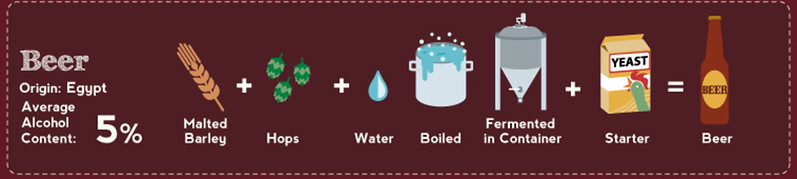
But it’s fascinating to see so many different drinks side by side, showing both the similarities and the differences, some of which are fairly small.

Click here to see the compendium full size.