Thursday’s holiday ad is a postcard from 1908 entitled simply “A Happy New Year.” The postcard shows a pair of young lads tapping a decorated wooden keg and filling their mugs to toast in the new year.
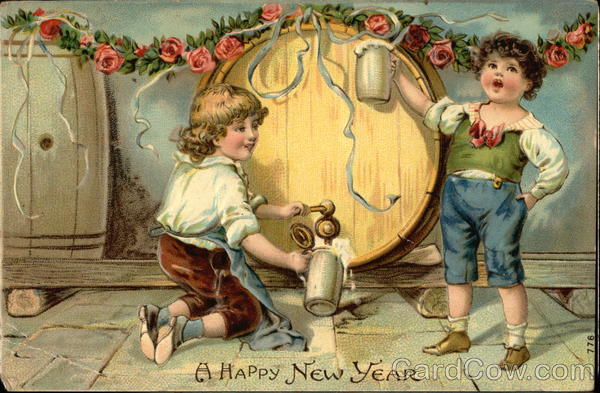

Thursday’s holiday ad is a postcard from 1908 entitled simply “A Happy New Year.” The postcard shows a pair of young lads tapping a decorated wooden keg and filling their mugs to toast in the new year.

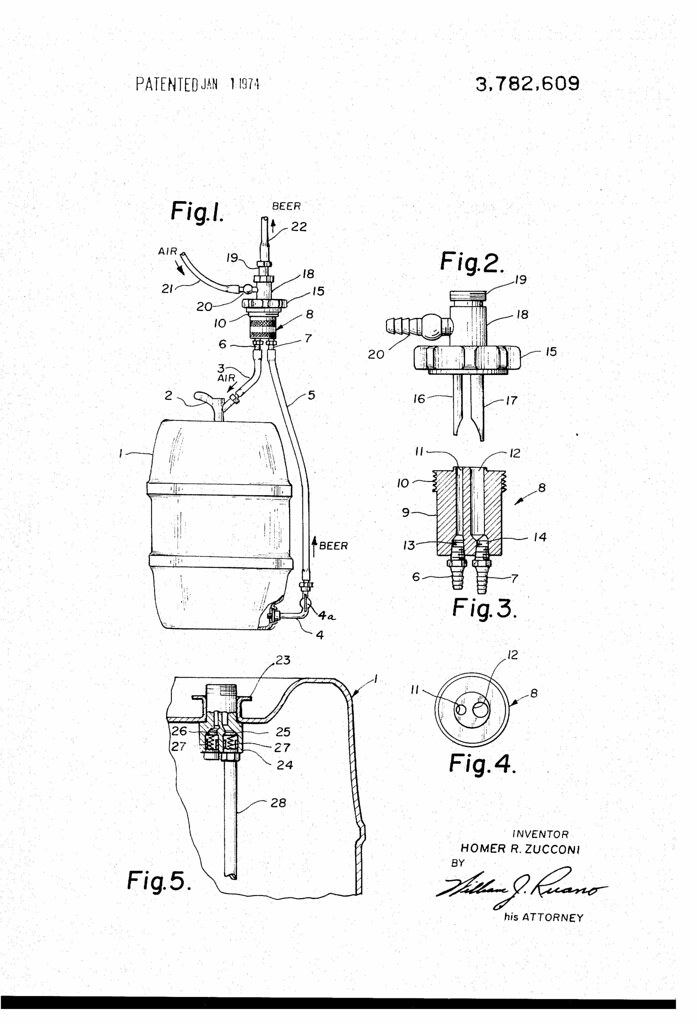
Today in 1974, US Patent 3782609 A was issued, an invention of Homer R. Zucconi, for a “Keg Tapping Assembly.” Here’s the Abstract:
A keg tapping assembly comprising a tavern unit having two prongs which are sleeve-like with tapered ends to unseat the two spring closed valves of a permanently attached keg unit detachably connected to the top central hole of a keg, upon insertion into the keg unit. The invention embodies an attachment having two bores through which said prongs are detachably fitted and having serrated terminal connections onto which hoses may be slip-fitted for attachment, respectively, to a tap rod insertable in the top center opening and to a valved outlet connection at the bottom of the keg. By simply unplugging the tavern unit from the keg unit and plugging it into said attachment it is selectively usable on either a conventional single connection tap or on the older double connection tap.
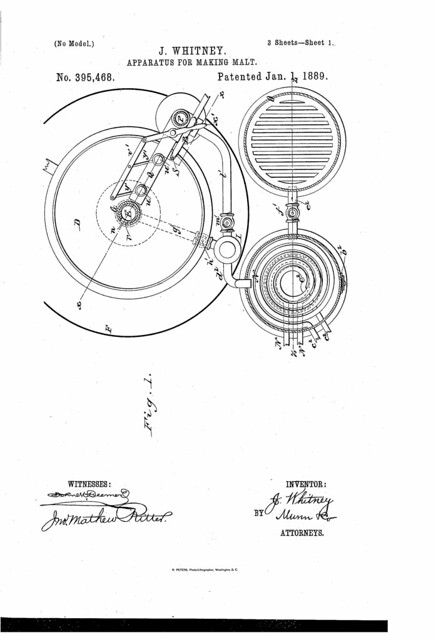
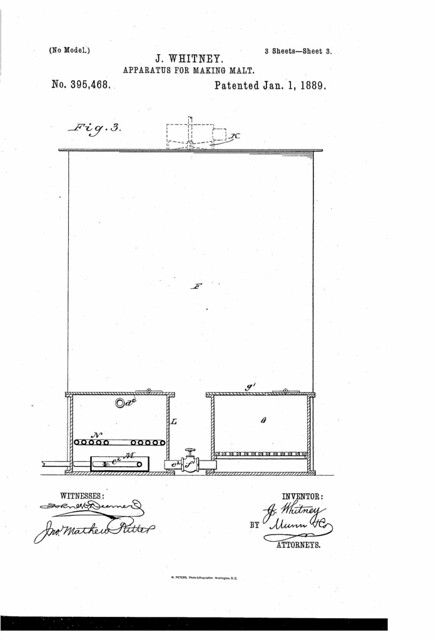
Today in 1889, US Patent 395468 A was issued, an invention of Justin Whitney, for an “Apparatus For Making Malt.” There’s no Abstract for this one, but you can read the full description about his “novel means and apparatus for making malt” at the patent page.

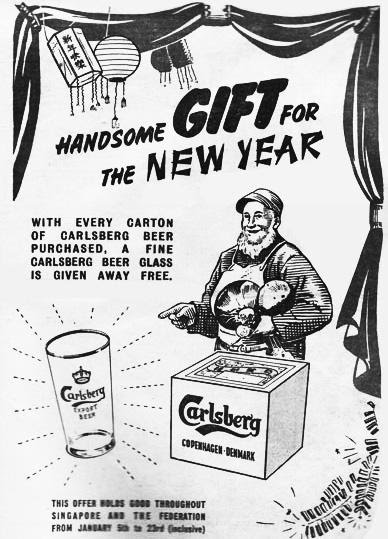
Wednesday’s holiday ad for Carlsberg, from who knows when. Admittedly it’s an ad for the Chinese New Year, but there’s a distinct lack of New Year’s Eve ads that I haven’t used before. This ad was for Singapore and “the Federation” which may help identify its age. Your “Handsome Gift for the New Year” is a free Carlsberg pint glass with every carton you buy.

Here’s an interesting piece of history. Today, New Year’s Eve, in 1938, police in Indianapolis, Indiana used the first commercial test to discover scientifically if a person had been drinking alcohol and if so, how much. December 31, 1938 saw the debut of the Drunkometer, designed by Rolla Neil Harger, a chemistry professor at Indiana University. He began working on the device in the 1930s, and patented it in 1936.
The drunkometer collected a motorist’s breath sample directly into a balloon inside the machine. The breath sample was then pumped through an acidified potassium permanganate solution. If there was alcohol in the breath sample, the solution changed color. The greater the color change, the more alcohol there was present in the breath. The drunkometer was manufactured and sold by Stephenson Corporation of Red Bank, New Jersey.
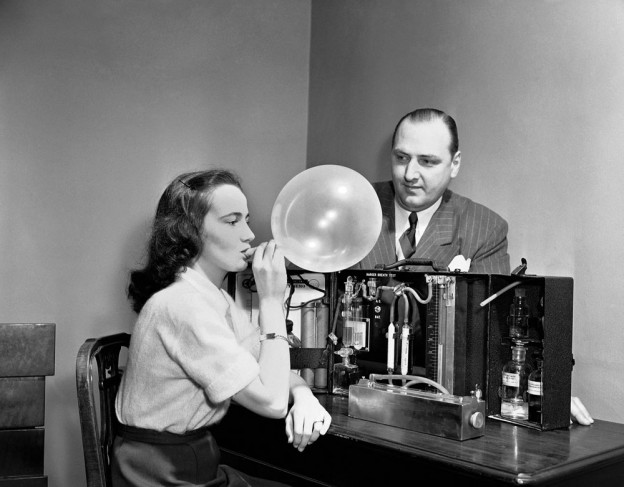
Dorothy Brengel helps W.D. Foden, Chairman of Statler Safety Committee, demonstrate the “Drunkometer”, a breath tests for alcohol, on display at the Greater New York Safety Council, Hotel Statler, March 28, 1950. For the preliminary test, the breath of the suspect is collected in a balloon and passed through a purple fluid (potassium permanganate and sulphuric acid) to see if it changes color. The breath of a non-drinking person will cause no change. If the purple color disappears, the amount of breath required to accomplish this indicates the approximate accumulation of alcohol in the blood. (AP/Carl Nesensohn)
In 1938, on New Year’s Eve, police in Indianapolis put a new piece of technology through its first practical test.
They used a breath analyzer to determine if someone had been drinking. What was then called the “Drunkometer” was based on the same idea as modern breathalyzers: a person blows into a bag, which contains chemicals that react according to how much alcohol is on a person’s breath.
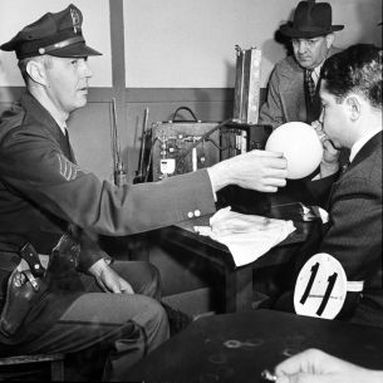
The Daily Dose gives a good account of its early use:
Thanks to the end of Prohibition and a boom in car sales, drunk driving had become a fast-growing problem in America in the 1930s. But on this New Year’s Eve, police in Indianapolis, Indiana went out armed with a new weapon to fight against people who had gotten behind the wheel after having too much to drink.
It’s a contraption called a “drunkometer” and it’s the invention of an Indiana University chemist named Rolla Harger. He had been working on the device since the early 1930s and had patented it two years earlier. The concept behind the drunkometer was pretty basic. Drivers suspected of being drunk were asked to breathe into a rubber balloon, which was attached to a tube of purple liquid—a weak solution of potassium permanganate in sulphuric acid.
If there was alcohol on their breath, the chemical solution changed color–the darker it got, the more alcohol they had in their system. From the shade of the liquid, the cops could use a simple equation to estimate the alcohol level in a person’s bloodstream. Previously, the only way police could check a driver’s alcohol level was to get a blood or urine sample; Neither was a very practical option on the roadside. While the drunkometer looked a bit like a mini chemistry set, it was portable, able to fit into a small suitcase.
Harger made the device as simple as possible so that judges and juries would understand how it worked and police officers could easily be trained to use it. He also made the drunkometer hard to beat. Experiments showed that no illness affected the result, and that nothing a person might eat – garlic, cloves, strong onions – would make any difference. Once police started using it, the drunkometer was found to have another advantage. A dramatic change in the color of the liquid could often make people admit how much they had drunk.
Sometimes Harger would ride along with the police to see how his invention was being used. What he discovered was that a lot more people were driving drunk than he ever imagined.
The drunkometer was used by police departments all over the country until the 1950s when it was replaced by the breathalyzer, invented by another Indiana University professor, Robert Borkenstein. The breathalyzer is a much smaller and more sophisticated device that uses infrared spectroscopy to measure blood alcohol levels.
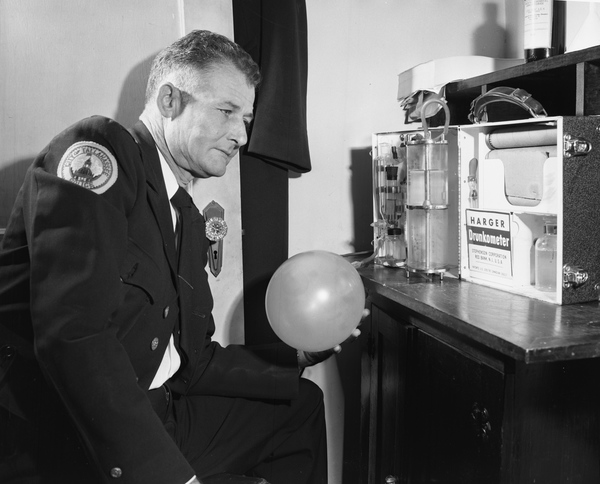
Tallahassee police officer with a Harger “Drunkometer” breathalyzer machine, photo taken in 1953.
The Drunkometer was replaced by the Breathalyzer in 1954, but for sixteen years was the way police nabbed drunk drivers. But who came up with that name? Happy New Year! Be careful out there.
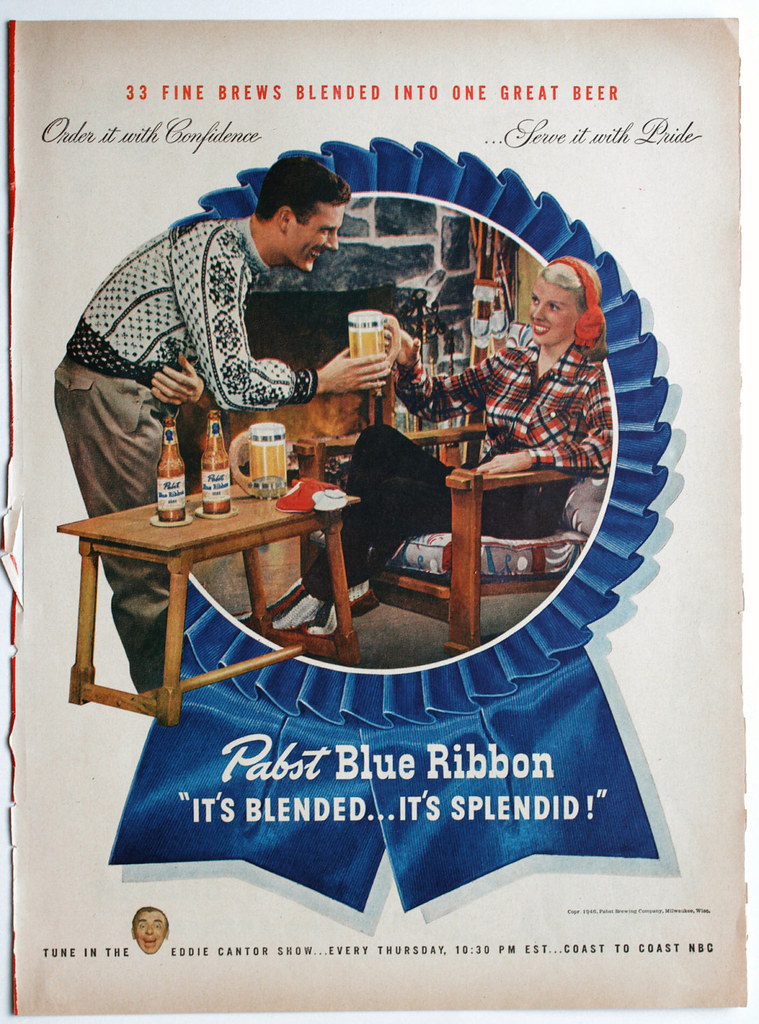
Tuesday’s holiday ad for Pabst Blue Ribbon, from 1946. IN a scene that looks like it’s after a long day skiing, a couple is relaxing back in the lodge, by the fireplace, as the man is serving mugs of Pabst. “Order it with Confidence … Serve it with Pride.” I’m not sure about the smile on him, it looks a little creepy to me. So maybe they’re not a couple after all, her smile seems a bit forced, so maybe this is a pickup attempt?

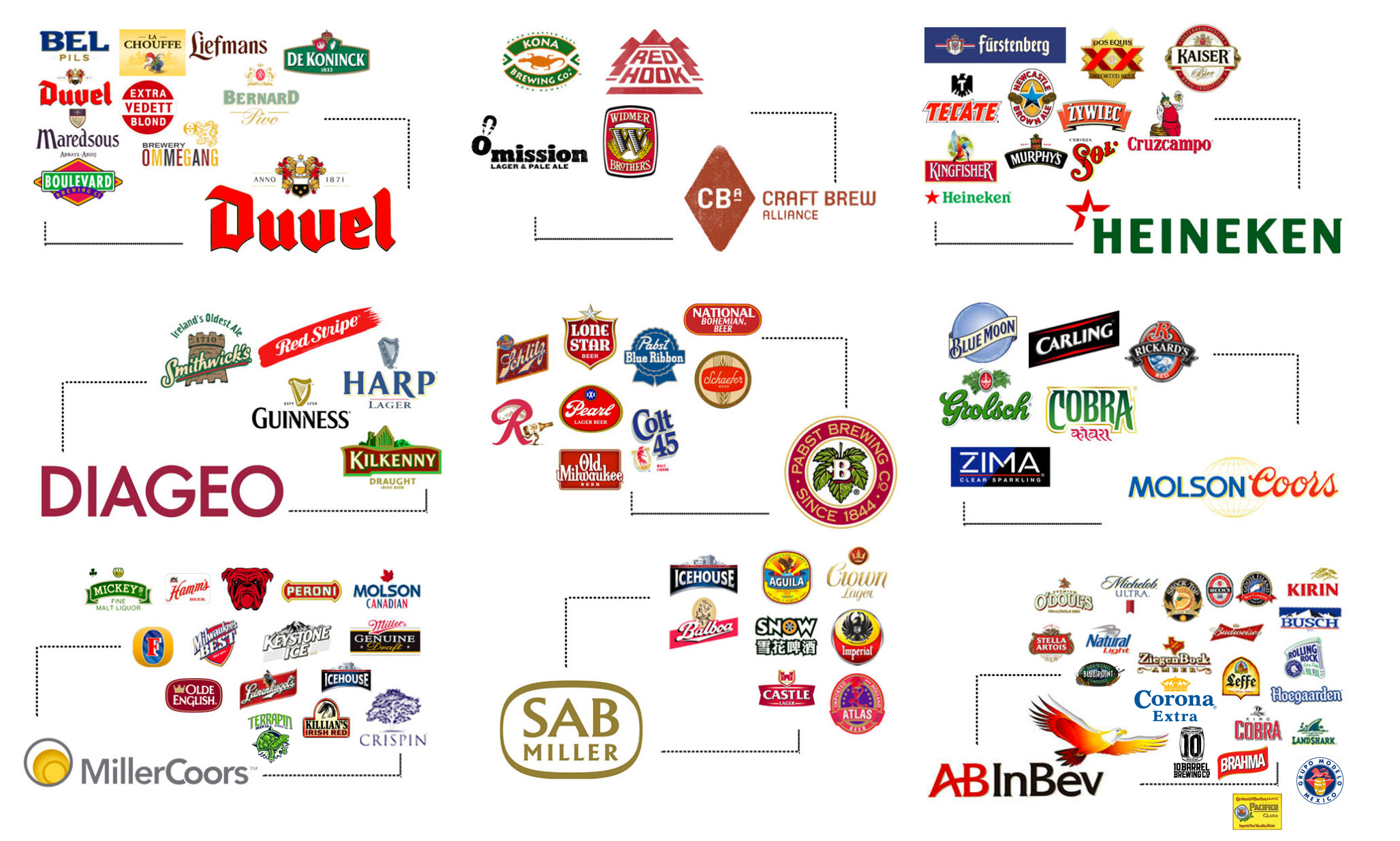
As the year’s winding down, I noticed this article from Booze News from last week entitled America’s Fastest Growing Beer Brands. While the article itself offered few insights, I noticed a graphic depicting which beer companies owned which brands. The graphic was taken from a Gizmodo article that ran a little over a year ago about Who Actually Owns Your Favorite Beers. I added one or two to ABI’s stable of brands, but otherwise a year on it’s still fairly accurate. If there’s any that need to be added, or changed, let me know in the comments and I’ll see what I can do.

I think you can see the chart full size here. If not, try here instead.
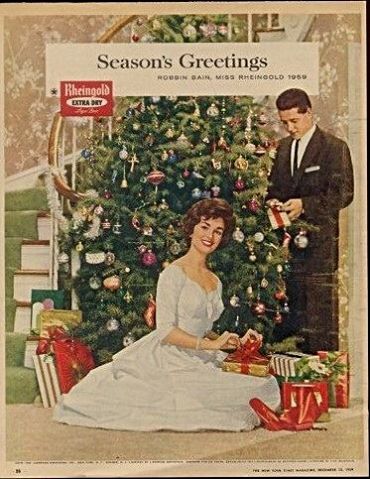
Monday’s holiday ad for Rheingold Beer, from 1959, and features Miss Rheingold from that year, Robbin Bain. Sitting in a beautiful white dress, wrapping the last presents, in front of a fully decorated Christmas tree — that’s got to be at least an eight-footer! — and it certainly looks like a holiday party should be taking place any minute.
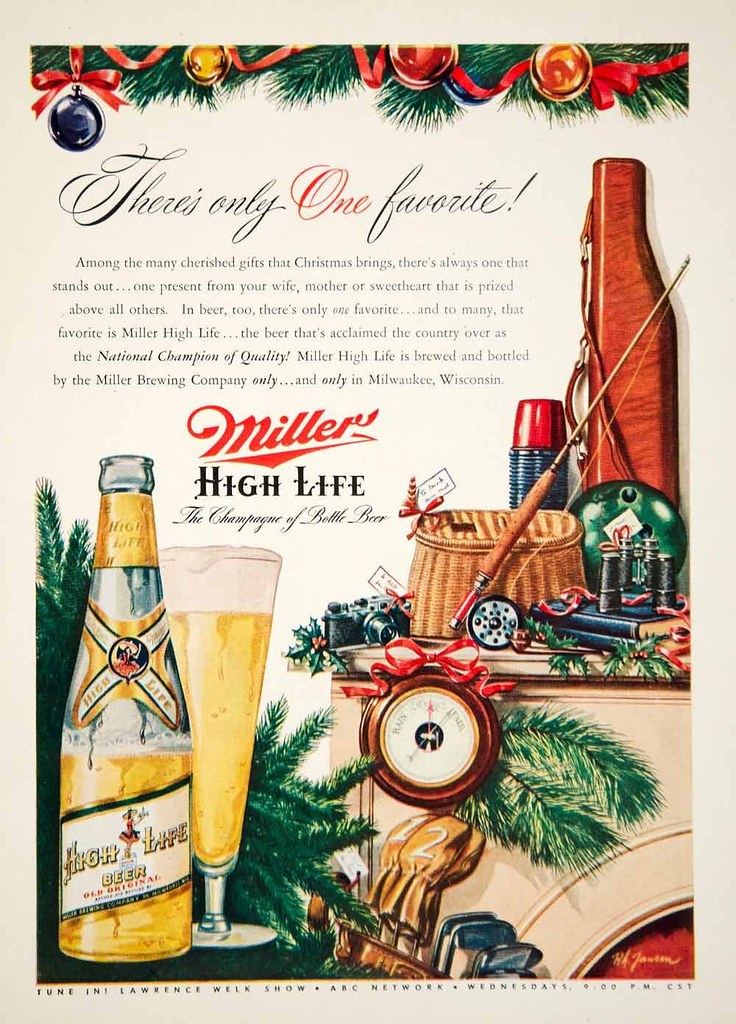
Sunday’s holiday ad is for Miller High Life, from 1950. In the days after Christmas, with all of your presents laid out, having been played with or used, one apparently emerges as the favorite. Just like “The Highlander,” I guess “there can be only one.” This guy (I’m presuming it was a guy) did pretty well. He appears to have received a rifle (or rifle case), a thermos, bowling ball, fishing basket, along with a rod and reel, binoculars, camera, books, a barometer and a set of golf clubs. But the ad would have us believe it was the Miller High Life that emerged as the favorite beer.
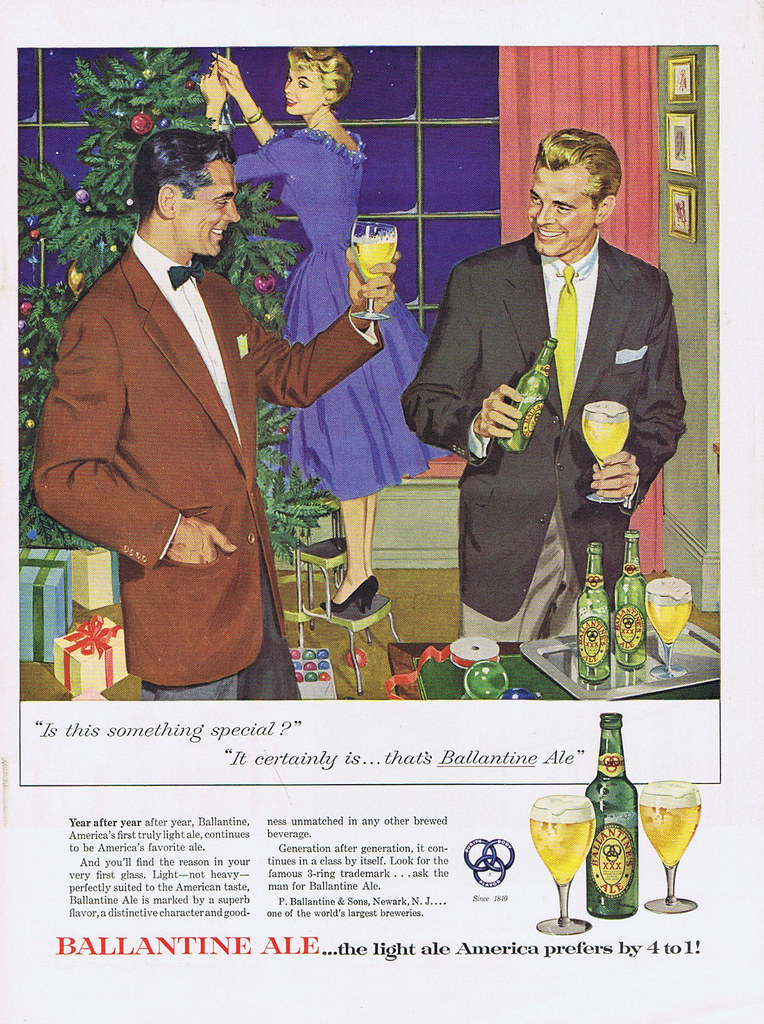
Saturday’s holiday ad is for Ballantine Ale, from 1954. “Is this something special? It certainly is … that’s Ballantine Ale.” There are three people at this tree-trimming party (note the three bottles of Ballantine) but only one person appears to be doing any work. The woman’s glass of beer sits unsipped on the silver tray, while the man on the left has started drinking his and the man on the right looks as if he’s just topped himself off. The woman is looking back at the the two dudes with an expression that says “you lazy chuckleheads.”