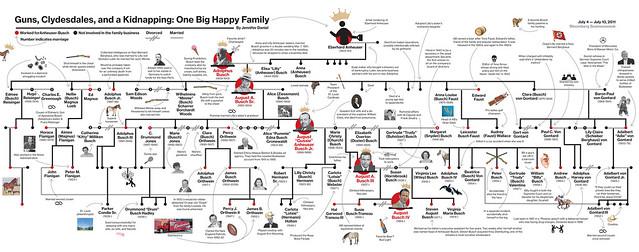
Today’s infographic is entitled “Guns, Clydesdales, and a Kidnapping: One Big Happy Family.” It was created by Jennifer Daniel, who’s currently a visual journalist at the New York Times, but did this one when she worked for Bloomberg BusinessWeek.
Beer Tapping Physics

The Division of Fluid Dynamics of the American Physical Society sent out a press release about a new study a couple of their members recently published on cavitation, which is a word you’ll understand better from the description.
An old, hilarious if somewhat juvenile party trick involves covertly tapping the top of someone’s newly opened beer bottle and standing back as the suds foam out onto the floor. Now researchers from Carlos III University and Universite Pierre et Marie Curie, Institut Jean le Rond d’Alembert, have produced new insight into the science behind the foaming, exploring the phenomenon of cavitation.
Take a look at the release, The Physics of Beer Tapping Fluid Dynamics Explains Why Bottled Beer Bubbles Over When Tapped, and thanks to regular reader Russ R. for sending me the link. I like this explanation a bit better, though.
“Buoyancy leads to the formation of plumes full of bubbles, whose shape resembles very much the mushrooms seen after powerful explosions,” Rodriguez-Rodriguez explained. “And here is what really makes the formation of foam so explosive: the larger the bubbles get, the faster they rise, and the other way around.” He adds that this is because fast-moving bubbles entrain more carbonic gas.
Honestly, I don’t think I’ve ever done that to a person’s bottle. Of course, I tend to be around people who pour their bottle of beer into a glass.

Photo: Javier Rodriguez-Rodriguez / Carlos III University of Madrid, SPAIN Almudena Casado-Chacon / Carlos III University of Madrid, SPAIN Daniel Fuster / CNRS (UMR 7190), Université Pierre et Marie Curie, Institut Jean le Rond d’Alembert, FRANCE
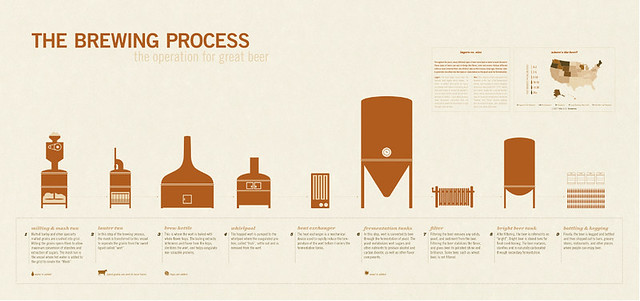
The Brewing Process: The Operation For Great Beer
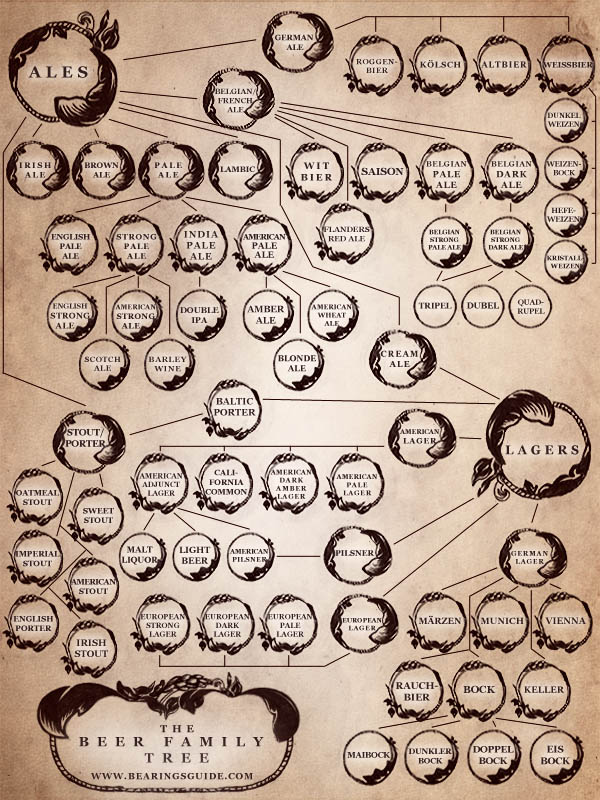
The Beer Family Tree

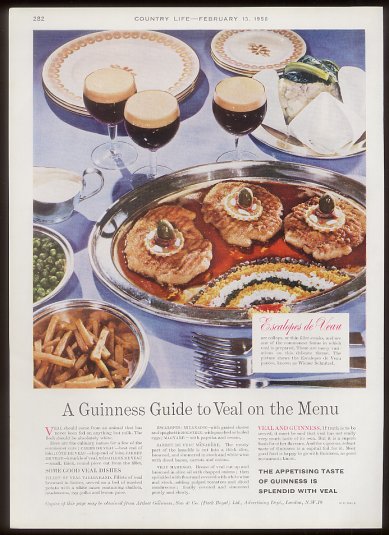
Beer In Ads #1026: A Guinness Guide To Veal

Friday’s ad is still another one for Guinness, this one from 1958, designed to look more like content than an ad. Instead, it’s “A Guinness Guide to Veal on the Menu,” with quite the impressive looking presentation. But again, at least there’s a dish of French Fries on the side, making it, once more, my kind of meal.
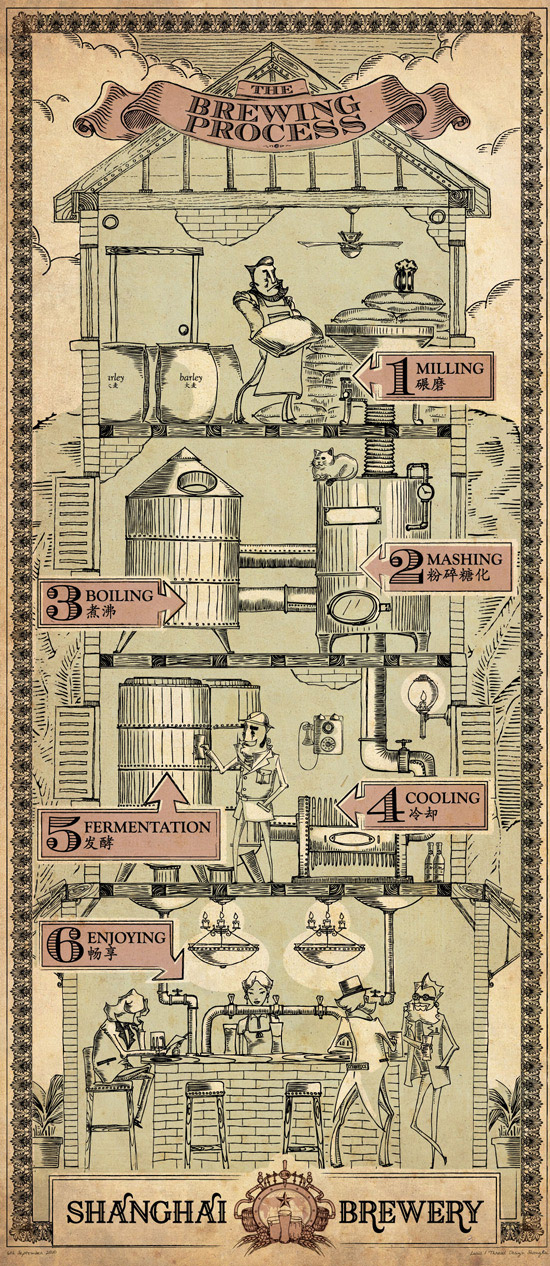
Beer Making Process Infographic

Today’s infographic is a cool, artistic poster of the beer making process from the Shanghai Brewery, which operates two breweries in China.
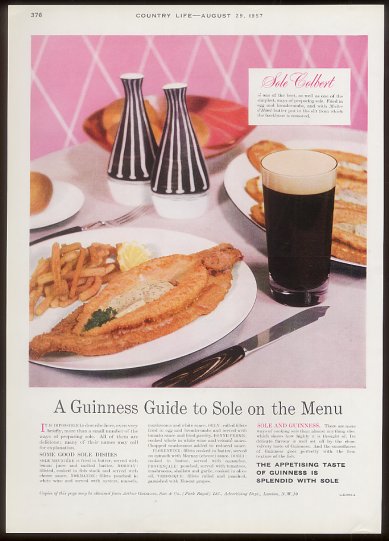
Beer In Ads #1025: A Guinness Guide To Sole
Thursday’s ad is another one for Guinness, also from 1957, and was designed to look more like content than an ad. Instead, it’s “A Guinness Guide to Sole on the Menu,” with the flatfish in the photo. Really, with the French Fries as a side dish, it’s really more of an upscale fish and chips. Again, my kind of meal, apart from the fish.
Why Are Doctors So Afraid Of Admitting Beer’s Health Benefits?

There was an article in the New York Daily News earlier this week, though actually it was a question answered by a physician who refers to himself as “The Running Doc™.” The fact that it’s trademarked is, I think, pretty funny, but I suppose there’s no reason why he can’t brand himself like anyone else.
A reader from upstate New York asks the doc if “beer is a cure for an upset stomach and kidney stones” and “[i]s drinking beer now a medical treatment?” But he begins his question with a request. “Please don’t laugh!” In this day and age, I suppose I should be happy enough with Dr. Maharam’s response. “I am really NOT laughing. Your friends are smart — beer actually does have some medicinal purposes. In moderation, obviously.” The Running Doc™ goes on to mention a handful of scientific studies that suggest drinking in moderation is good for what ales you, though considering how much there is now in the scientific literature, it’s a very small drop in the ocean of the body of ways in which responsible alcohol consumption can provide health benefits. And naturally he mentions the recent studies that suggest a beer after exercising — or running — but not the pièce de résistance, that total mortality is improved by moderate drinking.
Honestly, re-reading Lewis G. Maharam, MD’s response in The Running Doc says beer — especially ginger beer — has medicinal value but only in moderation, I think his answer is pretty good, and he at least treats the question seriously and also mentions that there is a body of scientific work that supports the idea of health benefits for drinking alcohol.
What bothers me, and was more of a camel’s back-breaking straw, was that he felt the need to mention, over and over again, moderation. It’s in the title, it’s the photo caption, and he mentions it twice more in the body of a very short article. Does it need mentioning? Maybe, but every time anyone from the medical or scientific community talks about any health benefits from drinking alcohol, they always qualify their statements with warnings like this. Really, they go out of their way to hit you over the head with them, as if we all need to hear it multiple times, or we might not understand. Is there really anyone alive today who’s missed the prohibitionist’s message that drinking too much is bad for you? It’s like the warning labels on packs of cigarettes; totally unnecessary, but covering their asses.
If the mounting evidence is showing, overwhelmingly, that alcohol can be good for you, then let’s just say so. We all know that a hamburger is a good source of protein but no one’s confused or has to be told that eating a ton of red meat might not be the best thing for your heart. Can they really be worried someone will go on a binge and blame the doctor for telling them it was okay to drink, saying they didn’t realize that they couldn’t just drink as much as they wanted? Honestly, this is, I think, the results of the bullying tactics of the prohibitionists, who’ve shouted down anyone who has a kind word to say about alcohol. They’ve made any health claims on beer labels verboten, tried their damnedest to limit where alcohol can be advertised, sold and even consumed, even by consenting adults. They’ve made it illegal in some states for parents to even educate their own children about it, while at the same time using only alarmist, fraudulent educational materials to lie to those same kids in public schools.
At this point, we all know that a beer or two a day can be good for us, both for physical and mental health, and over the past few decades, the scientific literature has caught up with what beer lovers have known all along. The only way to stop a bully is to stop giving him his power. Stand up to him, or her. If beer can be healthy, let’s say so. Sure, it’s best in moderation, but let’s not forget that numerous studies have shown that even drinking too much is, in the long run, better for you than not drinking at all. Overall mortality is improved most by moderate drinking, more so than by people who completely abstain, and yet even people who overindulge tend to live longer than the teetotalers, so all this qualifying of the results by medical science is not really helping anyone, it’s just continuing to pander to the prohibitionists, keeping the bullies mollified.
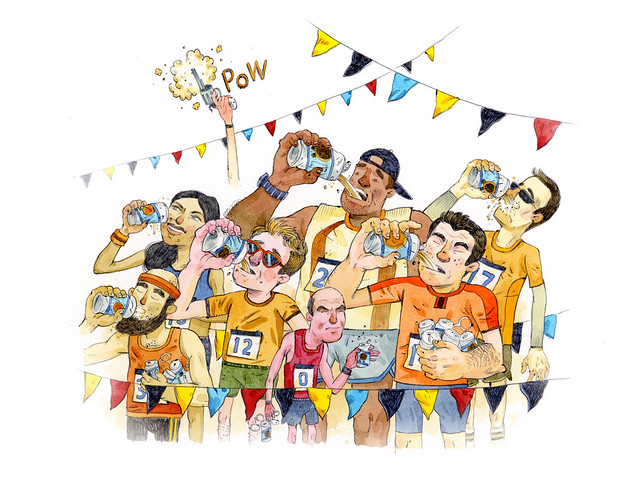
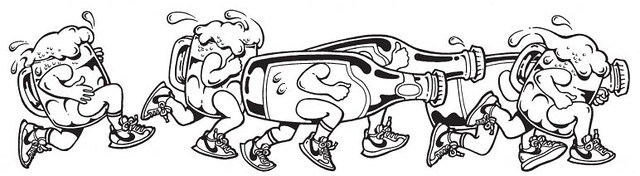
[Illustration by artist John Hendrix in the September 2012 issue of Runner’s World.]
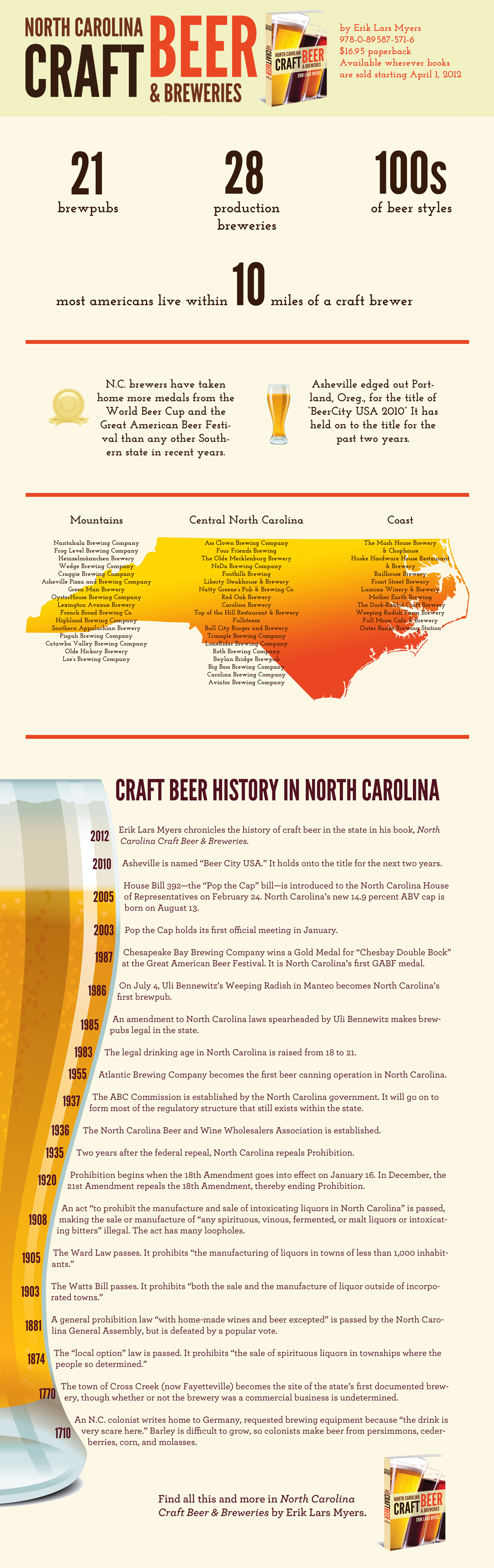
North Carolina Craft Beer & Breweries

Today’s infographic is about North Carolina Craft Beer & Breweries, based on information from Erik Lars Myers book of the same name. Today is statehood day for North Carolina, which became the 12th state on this day in 1789.


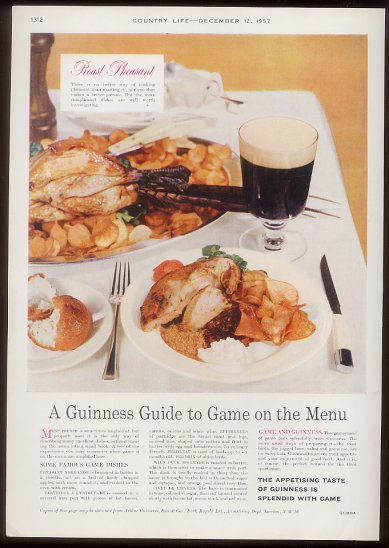
Beer In Ads #1024: A Guinness Guide To Game
Wednesday’s ad is for Guinness, from 1957, and was designed to look more like content than an ad. Instead, it’s “A Guinness Guide to Game on the Menu,” with roast pheasant in the photo. I’m pretty sure the pheasant is being served with potato chips as a side dish. Now that’s my kind of meal.