Thursday’s ad is for Pabst Blue Ribbon, from 1963. The ad apparently is meant to look older, from the century before the Sixties. But the notion that “old-time flavor likes you best” strikes me as hilariously odd.
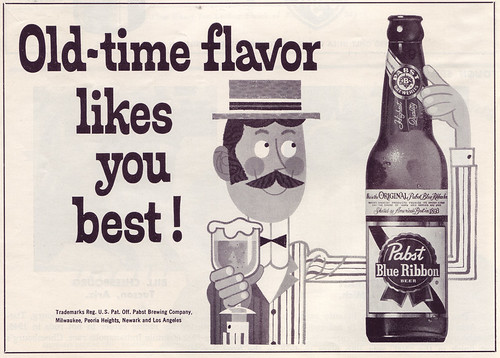

Thursday’s ad is for Pabst Blue Ribbon, from 1963. The ad apparently is meant to look older, from the century before the Sixties. But the notion that “old-time flavor likes you best” strikes me as hilariously odd.
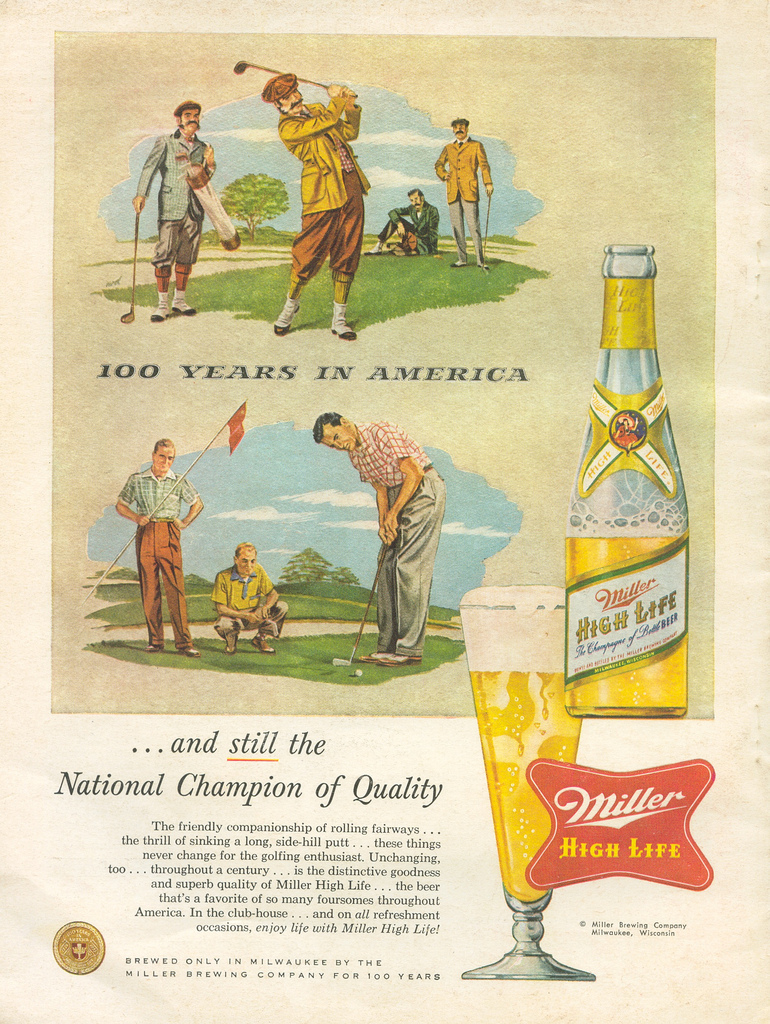
Wednesday’s ad is for Miller High Life, from 1955. Showing scenes of two groups playing golf, 100 years apart, the 100 Years In America they’re referring to vaguely tied to being “still the National Champion of Quality.” They also make the connection that golf courses are unchanged, and the beer is unchanged, over that same century. And that must be one really tiny pilsner glass, as it’s been filled to the top, but the bottle is still half full.

This is great news, Alabama may soon become the last state to legalize homebrewing since Prohibition, thanks in large part to the grassroots efforts of Right to Brew. According to the American Homebrewers Association:
The Alabama legislature has passed a bill that, once signed by Governor Robert J. Bentley, will effectively legalize homebrewing throughout the state. Alabama will be the last state in the nation to legalize homebrewing.
“Homebrewing has been an integral part of the history of America, so it’s thrilling to know that soon all 50 states will support this growing hobby and long-standing tradition,” said Gary Glass, director, American Homebrewers Association. “We appreciate the backing of all of the homebrewers, the dedicated grassroots efforts of Right to Brew and the legislators who have worked so diligently to make homebrewing a reality in Alabama. We are especially grateful to Representative Mac McCutcheon who introduced this bill and has fought long and hard for its passage, along with Senator Bill Holtzclaw.”
Alabama is the last state holding out against legalizing homebrewing. In March 2013, Mississippi became the 49th state to pass homebrew legislation. The AHA has been working with Right to Brew for five years in order to get the Alabama bill passed.
Homebrewing became federally legal in 1979, though the 21st Amendment predominantly leaves regulation of alcohol to the states. Therefore, even though homebrewing is federally legal, it is up to individual states to legalize homebrewing in state codes. Once the Alabama bill is signed by Gov. Bentley, it will be the first time since pre-Prohibition days that homebrewers in all the states can legally brew at home.
The next step is for the Alabama governor to sign the bill into law. If you’re in Alabama, please urge the governer to do so. You can find out how to help at the Craft Beer website.
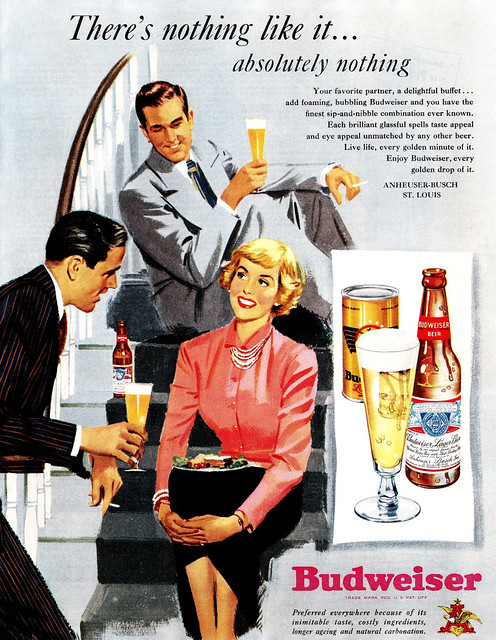
Tuesday’s ad is for Budweiser, from 1949. It’s from their “There’s nothing like it …” series that ran for quite a long while. The ad copy, which begins “Your favorite partner, a delightful buffet …” seems quite odd, and possibly revealing. It continues. “Add foaming, babbling Budweiser and you have the finest sip-and-nibble combination ever known.” I don’t think they’re talking about the beer and food. I think they mean the predatory males hunting that poor woman just trying to have a bite to eat. Presumably they’re at a cocktail party at someone’s home. The person who gets a plate of food and retreats to the stairs is trying to be alone. But then these two circle her, blocking her escape route either up or down the stairs, each with a fresh beer in hand. The strained smile on her face and her posture — clasping her hands protectively around her skirt, unable to eat — seems to say ‘how long do I have to be polite before I can get away from these yahoos?’

Today’s infographic is entitled What’s Your Favorite Beer Style?, and is a flowchart created by Beer Advocate. Follow the lines of what you’re looking for in a beer and it will lead you to what you want to drink.
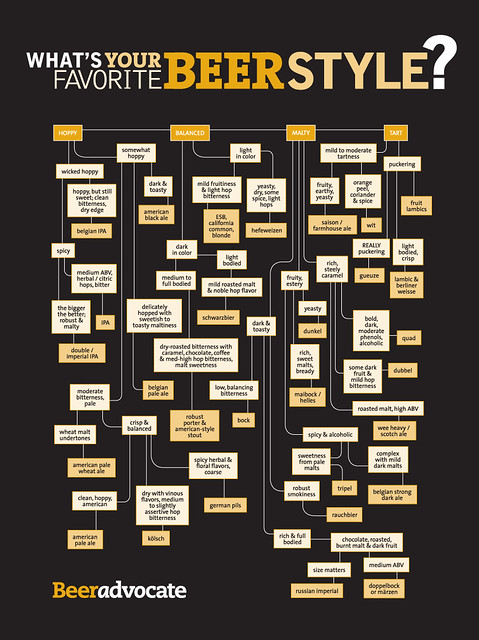
Click here to see the chart full size.
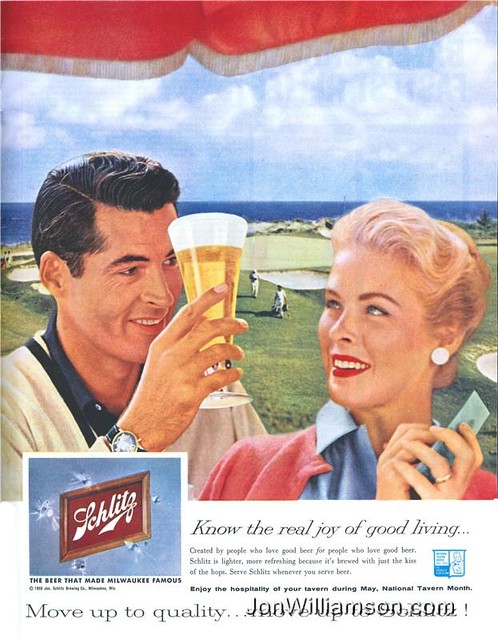
Monday’s ad is for Schlitz, from 1959. It’s from their “Know the real joy of good living …” series, and shows a couple at a golf course. The woman is trying to write down her score on the scorecard , but she looks distracted by the shiny beer that the man is holding up. He almost looks like he’s trying to hypnotize her with beer. “You’re getting sleepy ….”

Back in February, during SF Beer Week, it hit me that we needed a Session Beer Festival in the Bay Area. California is already known for big, hoppy beers but I was convinced that not everybody wants an extreme beer all the time. Don’t get me wrong, I love a hop bomb IPA or an Imperial Stout as much as the next beer geek, but not every day of the week. So I started talking it up, mentioning the idea here and there. I spoke to the San Francisco Brewers Guild, called Joe Tucker from RateBeer, and brought it up with several brewers. Everybody liked the concept.
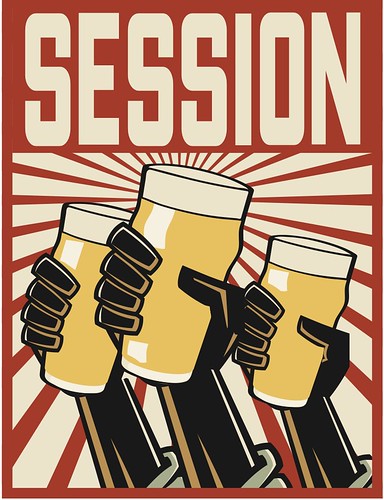
Somehow word reached John Martin and Drake’s/Triple Rock. Their wonderful marketing director, Kelsey Williams, picked up the ball and has been running with it ever since. After discussions with all of us, she’s set a juggernaut in motion. First, at least in the Bay Area, we’ve declared that May is “Session Beer Month,” and we’re calling on all breweries, bars, restaurants and beer stores to create some sort of event to create awareness of session beers. This is the first year, obviously, so we’re not expecting too much this time around, but are looking at the long haul, hoping to create momentum so that next year Session Beer Month will be huge, or at least will grow bigger each year.
To facilitate that, she’s also created a Facebook Page and Twitter account for SessionBeerMay. Check them out; “like us” and “follow us,” and most importantly, if you’re in a position to help, please consider creating a session beer event this month. If you’re not, please consider supporting the effort by drinking session beers throughout the month. If your favorite place doesn’t have any, ask them to carry at least one session beer. Although it may spark an unwinnable debate, we’re defining “session beers” as 4.5% a.b.v. or below. We accept that sometimes a 5% beer can be considered sessionable, but for our purposes — with tongue firmly in cheek — those we’ll consider “imperial session beer” or “extreme session beers.”

On the Facebook page, Kelsey’s drafted our mission statement.
A Manifesto:
Beer lovers, we are in the midst of a revolution. We have thrown off the fetters of the fizzy yellows and clamored for change. To supplant the sameness, we sought and found the EXTREME. We now have Triple IPAs and World Wide Stouts, Bourbon Barrel Aged Imperials, Belgian Quads, and all manner of High Gravity beers stuffed with fruits, spices, malts, hops. We’ve reached for the outermost precipices of beer, and succeeded.
Yet, in our noble quest for more innovation and more experimentation we have flown past many classic, well-loved, craft beer styles that may have seemed, due to their modest alcohol contents, a little too close to the weak, yellow, fizz water we’d escaped.
We have left behind these beers of import, beers perfectly suited to a long conversation at the pub, a picnic at the park, a post-hike refreshment, or a mid-summer beach trip, and beers that one can happily imbibe over the course of a few hours and leave satisfied and still standing.
We call to you beer lovers. Do not disregard a well-made, flavorful Bitter, Mild, Scottish Ale, Dry Stout, or any other Session beer because you perceive a lower alcohol content as a sign of the weak and bland. Allow us to prove that these beers are worthy of consideration. They, just like the extreme beers, have their place in our fridges and on our local taps.
We declare the month of May for Session beers. Beers that need not be analyzed, dissected, sipped, or sniffed in abundance. Delicious beers that not only enhance a good conversation but can extend it through multiple rounds.
Raise a Pint. Raise a Few. Spread the word in May; Less is most certainly more.
Amen. That’s the idea, nailed up to the electronic doors of the church of extreme beer, in the hopes of sparking a session reformation.
The next step? That’s easy: A Session Beer Festival. This year the NorCal Session Fest, will be held modestly at Drake’s Brewing in San Leandro on Saturday, May 25, 2013 from 12-4 PM. As befits session beers, the festival will benefit the East Bay Bike Coalition. Tickets to the event are $30 in advance and $35 at the door. You can buy tickets online at Brown Paper Tickets. In addition to the beer, local food trucks will be on-site with tasty food for sale. Please join us for the first beer festival celebrating session beers in the Bay Area. Let’s make this an annual event. I’ll see you there.