Friday’s ad is the 420th beer ad I’ve posted so in honor of that number, today’s ad is for a beer festival, the 420 Fest put on by SweetWater of Atlanta, Georgia. It was done by artist R. Marx for the 2008 festival. Happy 420!
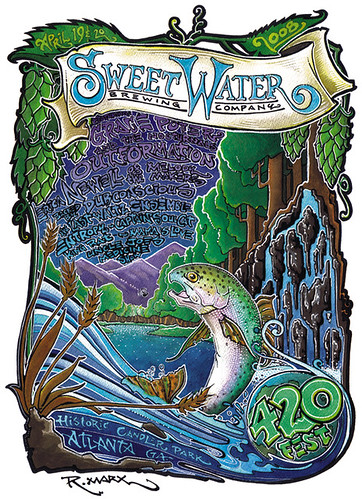

Friday’s ad is the 420th beer ad I’ve posted so in honor of that number, today’s ad is for a beer festival, the 420 Fest put on by SweetWater of Atlanta, Georgia. It was done by artist R. Marx for the 2008 festival. Happy 420!
Thursday’s ad is another one for Schlitz, this time much later, from 1968. Using their popular “When you’re out of Schlitz, you’re out of beer” slogan. The image, though, is a less-than-flattering angle.


Charlie Papazian had an interesting series of posts (See Part 1, Part 2 and Part 3) a few years back that I thought was worth revisiting about what he refers to as “heritage breweries,” a term that he used to describe the few small breweries that not only survived prohibition but are still in business today, over 75 year later. According to his research, when prohibition summarily closed down thriving businesses in 1919, at a stroke 1,179 breweries were out of business, or at least no longer allowed to make their primary product: beer.
Of the ones that reopened thirteen years later, when prohibition was repealed only a handful managed to make it into the present, braving untold challenges, merger-manias, fickle consumers and ever more oppressive attacks by neo-prohibitionists unconvinced of prohibition’s massive failure. Papazian divides the heritage brewers into four types:
Of the first type, those still owned by the original family, only four remain.
For the second type, breweries still considered independent but no longer owned by their original founders or their family, there are a mere seven left.
Of the third type, breweries “no longer owned by the original family, nor independent of a large brewing company,” only one remains, and I’m not sure if it really does fit in the third group.
I say that because it seems to me that while MillerCoors does own the brewery outright, the family, led today by Jake Leinenkugel, does maintain a certain amount of autonomy and makes a lot of their own decisions about the business. I interviewed Jake a number of years ago for an article I wrote for American Brewer magazine, and that was certainly the impression I was left with. It may not be “owned” by the family any longer, but they do seem to control their own destiny, and that has to count for something.
The fourth, and final category, as outlined by Papazian, is one in which the “original family ownership and location is far removed from the current operation.” Of this type, there are only two remaining.
Totaled up, there are only thirteen breweries still in existence that were in business 92 years ago, when prohibition began. Twelve, if you discount brands that are contract brewed, such as Dixie is now post-Katrina. Now that’s just small breweries, but the picture’s not much rosier even if you include everybody, big and small.
Even pulling everybody, big or small, contract beer company or actual brewery, that’s still only 18 remaining from the original 1,179 left. That’s only 1.5% still in business after 82 years. Back out the big guys, and it’s 1.2%. I’m an inveterate pessimist, so I find that sad. I know that’s business in general, and many of the brewery mergers are the result of the cannibalistic nature of many of the big brewers (and corporate business more generally), but I’m a romantic pessimist, the worst kind. As much as I don’t really like the beers so many of the fallen breweries (and many of the remaining big ones, too) make, I still think we lose some part of our history every time yet another one closes or is bought out.
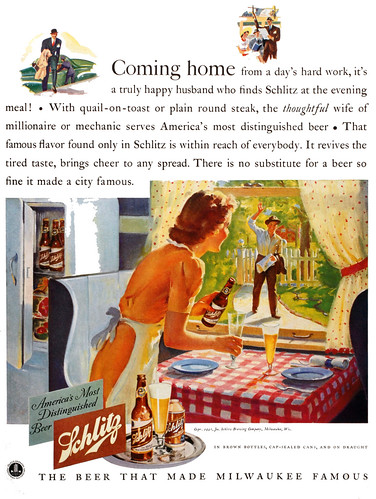
Wednesday’s ad is from 1941 for Schlitz, and is certainly a product of its time. Showing a housewife pouring glasses of Schlitz as her work-weary husband waves through the window as he walks home from work. The ad copy is great. “Coming home from a day’s hard work, it’s a truly happy husband who finds Schlitz at the evening meal!”
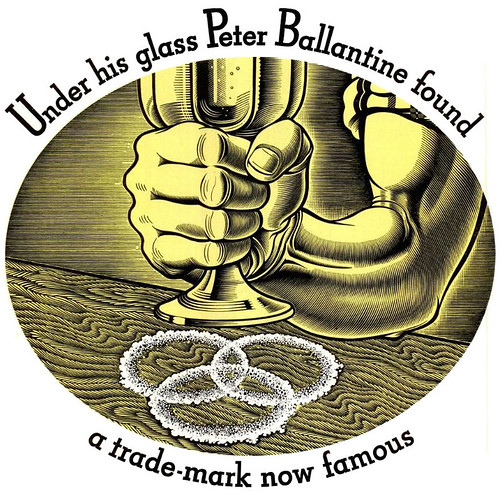
Tuesday’s ad is an old woodcut piece of art used to promote Ballantine Ale. Whether it was used in an advertisement or for some other promotional purpose is unclear. It’s visually telling the presumably mythical story of how the Ballantine three-ring logo was born, when its founder, Peter Ballantine, had set down his glass a few times, accidentally creating a perfect geometric shape known as Borromean rings. As the first woodcut suggests “Under his glass Peter Ballantine found a trade-mark now famous.” The Borromean rings became Ballantine’s logo, which did make the brand very recognizable.
In the second woodcut, the incredibly buff Peter Ballantine is pointing to the rings, presumably showing them to someone else, unless he’s in the habit of pointing and talking to himself, of course. And just look at the grip he keeps on his beer. No one is taking that glass away from him.
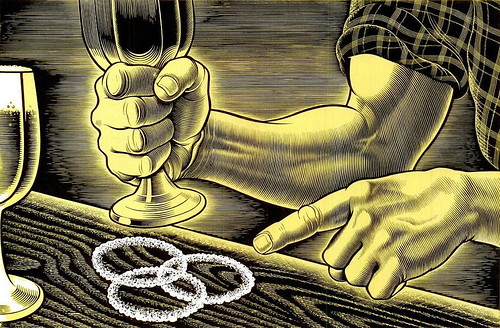
Still, pretty awesome art.
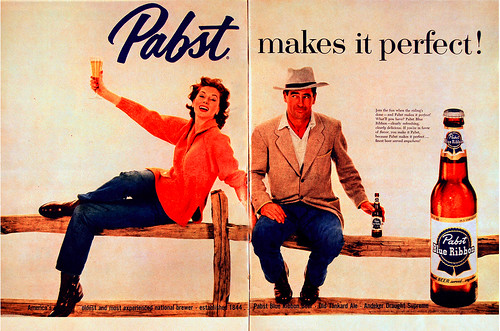
Monday’s ad is for Pabst from, it appears, sometime in the 1950s. It’s a double truck ad with a free wheeling high-spirited woman on one side of the fence and her conservative beau on the other. In his cowboy hat and tweed jacket, he’s looking askance at her unfettered emotions, barely moving as he holds on to his bottle of beer.
Today is the 4th annual holiday celebrating brewers around the world, International Brewers Day, which I created in 2008. While I haven’t been able to put as much effort into it as I might have liked, someday I will. In the meantime, some parts of the international brewing community are carrying on with celebrations, most notably in Australia. For now, a quiet celebration involving beer and any brewer you happen to encounter today is in order.

You could see the original idea, the plan and why I chose July 18 at the old International Brewers Day website, but unfortunately it’s currently down. I’ll have to get that moved and back up again one of these days.
Here was my original driving thought:
Brewers have given so many of us the pleasure of their artistry and enriched our lives with their beer since civilization began. So I think it’s time we recognized their efforts by celebrating their lives, their commitment and their craft. We’re all beer people, but without the brewers what would we be drinking?
Did I mention that hugging brewers is a big part of the holiday?
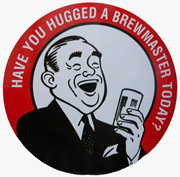
As the old Czech saying goes:
“Blessed is the mother who gives birth to a brewer.“

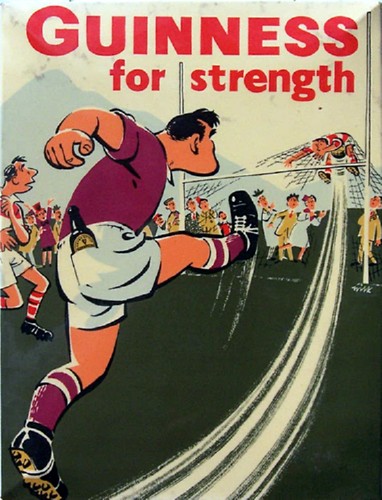
Our 77th Guinness ad features a free kick in a soccer … er, football match that the goalie is unable to stop because it was kicked hard enough to propel both the ball and the goalie into the net for a score. The source of that force can be found sticking out of his back pocket: a bottle of Guinness.
Friday’s ad is for Hamm’s, from 1965, and that is one seriously large bubble perched on top of the open bottle. And although in front of the person is just a white wall or sheet, behind him — at least in reflection — is quite the outdoor setting.

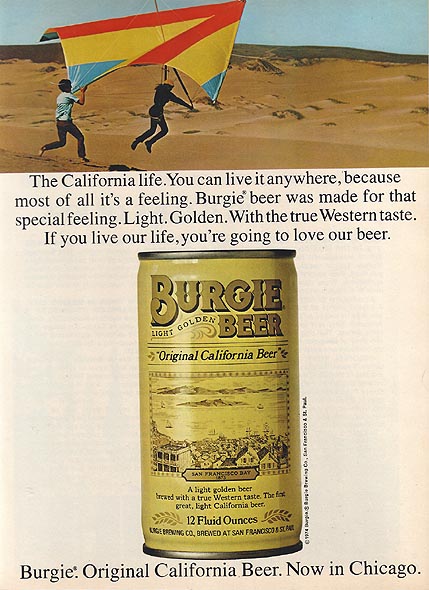
Thursday’s ad is for Burgie, from 1974, and makes a big deal about its California origins. “The California life. You can live it anywhere, because most of all it’s a feeling. Burgie beer was made for that special feeling. Light. Golden. With the true Western taste. If you live our life, you’re going to love our beer.” The can shows an old-time San Francisco scene and that’s where the can says it was brewed, too. So he kicker is that after lavishing all that attention on California, the tagline veers eastward. “Burgie: Original California Beer. Now in Chicago.”