Brookston Beer Bulletin

Jay R. Brooks on Beer

  • Home
  • About
  • Editorial
  • Birthdays
  • Art & Beer

Socialize

  • Dribbble
  • Email
  • Facebook
  • Flickr
  • GitHub
  • Instagram
  • LinkedIn
  • Pinterest
  • RSS
  • Twitter
  • YouTube

Powered by Genesis

Sacramento’s Pyramid Alehouse Closes

March 4, 2013 By Jay Brooks

pyramid-breweries
I just heard from a reliable source that the Pyramid Alehouse in Sacramento has closed. The Sacramento website has the following information posted:

WE REGRET TO INFORM YOU THAT THE SACRAMENTO PYRAMID ALEHOUSE HAS PERMANENTLY CLOSED ITS DOORS AS OF TODAY, MARCH 4, 2013. WE WANT TO THANK THE SACRAMENTO COMMUNITY FOR THEIR PATRONAGE AND OUR EMPLOYEES FOR THEIR YEARS OF SERVICE.
pyramid-sacto

Filed Under: Breweries, News Tagged With: Business, California, Sacramento

NBA Beer Prices

March 2, 2013 By Jay Brooks

basketball
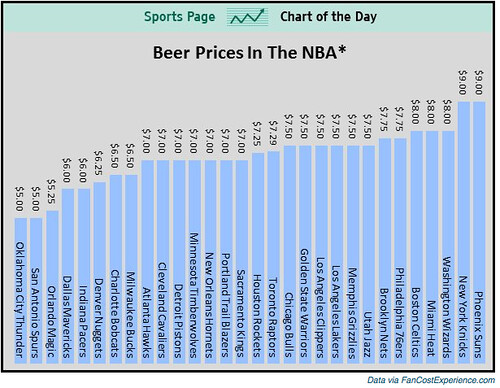
Last year, I posted about how high beer prices were at NFL Football stadiums, and, not surprisingly, the same is true for NBA Basketball games, as well. According to the Bleacher Report’s NBA Beer Prices Are Absurd, the price for a beer at an NBA game starts at $5 and can go for as much as $9, depending on the arena. The other interesting finding is that there doesn’t seem to be any logical reason for the price disparity and, naturally, team owners can charge whatever they want. Why people will actually pay that much … well, that’s a larger discussion. Below is a chart of NBA pricing across the league. It appears that between $7 and $7.50 is the average, which is, as the title of the piece suggests, a pretty absurd price for a small beer.

While the NBA story doesn’t break it down by ounces, as the NFL one did, is does say that the pricing is for “a small beer.” And while that’s not defined, the NFL average was $7.28 for 17 oz., I have to assume a “small” is less than that, probably closer to 12 or possibly 14 ounces. And if that’s true, that would make NBA beer even pricier than at an NFL game, which is pretty hard to swallow.

NBA-beer-prices

Filed Under: Beers, Editorial, News Tagged With: Business, Sports

Class Action Suit Alleges ABI Watering Down Bud & Michelob

February 26, 2013 By Jay Brooks

ABI
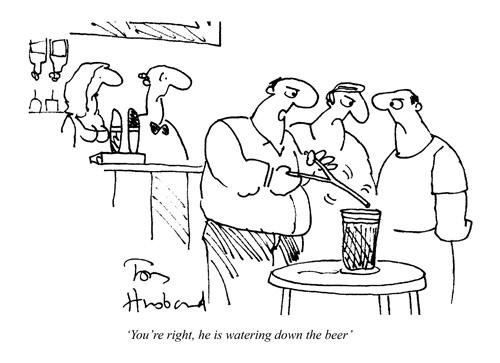
Just when you think things can’t get any stranger, beer drinkers in three states — California, Pennsylvania and New Jersey — have filed a class action suit against Anheuser-Busch InBev. The L.A. Times is reporting in Beer drinkers accuse Anheuser-Busch of watering down brews, that the lawsuit alleges the following:

Ten Anheuser-Busch products were named in the lawsuits: Budweiser, Michelob, Michelob Ultra, Bud Ice, Bud Light Platinum, Hurricane High Gravity Lager, King Cobra, Busch Ice, Natural Ice and Bud Light Lime.

Former employees at the company’s 13 breweries — including some in high-level positions — are cooperating with the plaintiffs, said San Rafael, Calif., lawyer Josh Boxer, the lead attorney in the case.

“Our information comes from former employees at Anheuser-Busch, who have informed us that as a matter of corporate practice, all of their products [mentioned in the lawsuit] are watered down,” Boxer said, according to the Associated Press. “It’s a simple cost-saving measure, and it’s very significant.”

The excess water is added just before bottling and cuts the stated alcohol content by 3% to 8%, he said.

ABI, naturally, is calling the lawsuit “groundless,” but it will be interesting to see how it all plays out.

You_re_right__he_is_watering_down_the_beer
Cartoon by Tony Husband.

UPDATE: NBC News is also now reporting this story, in Budweiser waters down its beer, lawsuit alleges. Apparently, Bloomberg broke the story earlier today, and also the AP, the BBC and Business Day have all weighed in.

UPDATE 2: I’ve seen a lot of commentary on this story in the interwebs suggesting that since there appears to be no test results from the Plaintiffs in this case that perhaps they are simply confusing high-gravity brewing with actively lowering the final alcohol percentage, which is a reasonable assumption. But there may be another possibility. Thanks to Stan at Appellation Beer for pointing out a post from last October by Gary Spedding at his Alcohol Beverage Testing News. I’ve known Gary for a number of years. He runs a lab in Kentucky called Brewing and Distilling Analytical Services, LLC and also most years presents an orientation exercise for GABF judges the day before we start each year. It’s sort of a continuing education component of the judging experience. His presentations are always interesting and informative and, needless to say, Spedding’s expertise is unassailable.

Last October, he posted Gaining its airs and losing its graces — a Tale of Two Buds, which he wrote in response to a popular article last fall from Bloomberg Business Week entitled The Plot to Destroy America’s Beer. In addressing the suggestion in the article that Budweiser beer had changed after InBev took control of Anheuser-Busch, noted the following experiences he’d had with the beer in recent months.

Bud has been our control beer in our laboratory … for calibrating our alcohol instruments Bud goes in after calibration to see hopefully 5.00% abv. pretty much on the nose. Not so recently. Now as low as 4.94% after slipping from 4.98% earlier in the year. Losing it graces by higher airs it may be toppling from its top spot and is no longer our control beer of choice. But it is changing. A tale of two Buds (early and late) would reveal much more. Over the years the international bitterness content has declined from about 12 in the late 90’s to 7-8 today — another parameter to watch.

That original post also included a discussion of increasing oxygen levels, but Spedding had a lengthy discussion with Paul Cobet, who’s the Director of the Technical Center for ABI in St. Louis. The oxygen question is apparently now less of a concern and appears to be instrument-driven, and Gary updated that with a newer post, Regaining its Graces — Driving Oxygen Down — Good for Budweiser. So while the plaintiffs may not have tested the beer — still odd, admittedly — there is apparently some reason to think their case may hold water after all.

Filed Under: Breweries, News, Politics & Law Tagged With: Anheuser-Busch InBev, Business, California, Law, New Jersey, Pennsylvania

Ignoring Economies of Scale

February 26, 2013 By Jay Brooks

economics
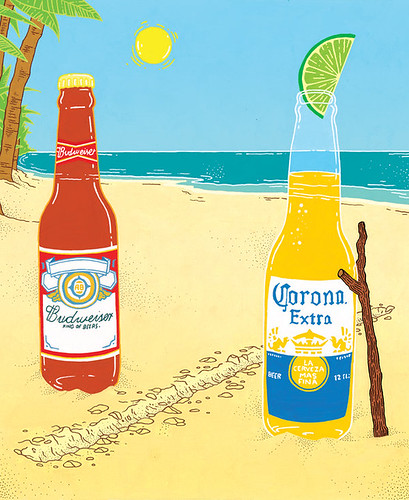
As the news keeps swirling around the possible — I say inevitable — buyout of Grupo Modelo by Anheuser Busch-InBev in a breathless “will they, won’t they” kind of coverage, I’m utterly fascinated by the theater of it all. It’s especially interesting to see the many “business experts” weighing in with no real understanding of the history of the brewing industry or how it all works. These “instant experts” all seem to assume that general economics or business principles apply equally well to every scenario, yet fail to grasp that alcohol has always navigated a different path through the economic world, with extra layers of taxation, legislation and law, its moral or anti-alcohol critics, and has to abide by at least 51 sets of laws (federal laws plus one for each state). I brought this up last month in The Beer Monopoly, but this morning an economics reporter from the New York Times, Adam Davidson, weighed in with his own take on the shenanigans.

In his It’s the Economy column published today, Are We in Danger of a Beer Monopoly?, he gives his own version of reality. In his world, where there are nearly 2,400 American breweries, he at least admits many of them are “tiny,” but goes on to claim that a few “have become large national brands.” National, yes, but “large” is a somewhat relative term. They’re large compared to a tiny nanobrewery or even an average sized brewpub, but the volumes of beer manufactured by ABI and SABMIller are in another class altogether. All 2,398 of the other breweries represent much less than 10% of the total beer produced in the U.S., meaning there’s a fairly wide chasm between the two groups, even if “a handful” of them have been successful. Measured against the domination of the biggest two, even the most successful seem modest by comparison.

But this is an argument that many economists seem to make, and indeed it’s the same argument that ABI always makes when they’re trying to buy another global company. How can there be a monopoly with so much competition? Just walk down the beer set in an average grocery store and, if you know who owns or controls what, you’ll easily see who’s winning the beer wars. The power wielded by ABI and SABMiller is so far above that of any smaller brewer, or even the total of all of the smaller ones, that it really is a true David and Goliath relationship. Sure, the big guys throw a few crumbs to the little guys nipping at their heels, but they don’t feel seriously threatened by them. Lately, they’ve been paying closer attention because they’re losing incremental marketshare, but they’ll respond to any such loss, because it hurts the share price. But saying they’re on equal footing is the economic equivalent of pretending that employees and employers have equal bargaining power, as most economic textbooks continue to insist.

But here’s Davidson’s takeaway from recent events as ABI tries to win approval for buying Grupo Modelo. “So I was surprised to learn that the Justice Department is worried that Anheuser-Busch InBev, the conglomerate that owns Bud, is on the cusp of becoming an abusive monopoly.” That’s almost spit take worthy. “On the cusp?” ABI has been a de facto monopoly with one or two others for decades, all but controlling the marketplace, not that anybody has been particularly concerned in the business world.

Anyone who hasn’t had their head buried deep in the sand for last few decades has to have noticed that we live in a society utterly dominated by business interests. Business power is the only power that matters. Political power takes a back seat to it and the will of the people is something politicians invoke only when they’re trying to get elected. How else can you explain that corporations have all the benefits of being a person, with none of the responsibilities or consequences? How else can money be considered free speech to influence politics? How else can you explain the many businesses deemed too big to fail while the same individuals those corporations ruined are left swinging in the wind, with no life raft for the ordinary flesh and blood person.

Davidson goes on to give a flawed history of the brewery business, and seems to think that mergers are a relatively new phenomenon. Of course, brewery mergers and acquisitions have been going on in brewing since the late 19th century, and stopped only briefly for about thirteen years, during Prohibition. Then he says we’re “still in the very early stages of what appears to be a global version of the scale-based consolidation we’ve seen in the United States over the past century.” I can’t tell if that’s a joke? The global beer world has been dominated by an ever-shrinking group of very large conglomerates for at least the last three or four decades. It’s hardly a new thing. In 2010, the four largest beer companies accounted for over half of all beer worldwide, and according to another source the Top 5 were about half. Heineken, Carlsberg, and a few others are very large companies, indeed, and they, too, have been gobbling up breweries around the world for many, many years.

It’s probably not a coincidence that Davidson has his own S.H.A.M.E. profile. Why the New York Times continues to let him shill for big business, well’s that’s a whole other discussion, but it’s obvious he’s defending the pro-business position. It’s also clear that he’s part of the theater that will ultimately end in the DOJ’s approval of the deal between ABI and Grupo Modelo. Here’s my prediction of what will happen next. As always happens, the two parties will hammer out a compromise that was probably the deal everybody wanted in the first place, but this way both parties look good in the public eye. The DOJ will look like they’re being tough on big business and are protecting the public while ABI will look good because they were able to get the deal done, and their share price will shoot up. Everybody wins. As Shakespeare observed, “all the world’s a stage.” And we’re the audience. I just wish they’d stop pretending we’re all idiots.

bud-corona

Filed Under: Breweries, Editorial, News, Politics & Law Tagged With: Big Brewers, Business, Economics, Mainstream Coverage

Two Beer Companies, 210 Beer Brands

February 22, 2013 By Jay Brooks

ABI sabmiller
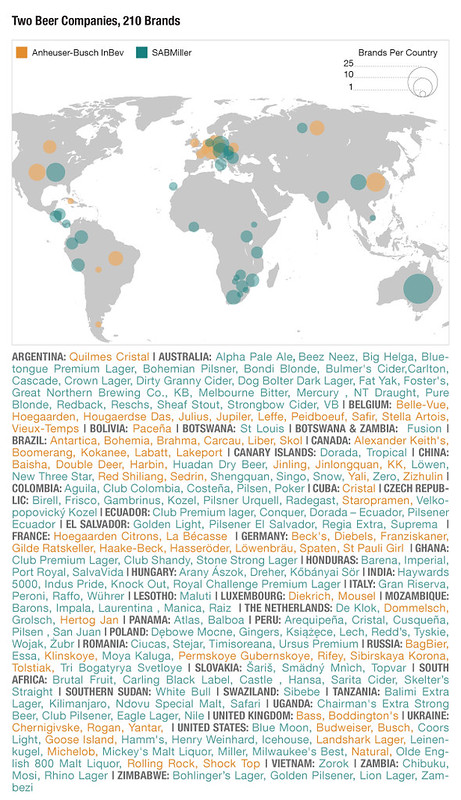
Today’s infographic is an interesting one, created by NPR. Entitled Two Beer Companies, 210 Brands, it shows all of the beer brands owned by Anheuser-Busch InBev and SABMiller across the globe. Below the map, there’s also a list of brands by country, color-coded by which beer giant owns or controls them. How accurate is it? Hard to say. It doesn’t appear to include line extensions, which would balloon the chart to many times its current size, but glancing at the list for the United states, it looks like it may be missing some, though to be fair I didn’t do a line by line comparison.

two-beer-companies
Click here to see the chart full size.

Filed Under: Breweries, Just For Fun Tagged With: Anheuser-Busch InBev, Big Brewers, Business, Infographics, International, SABMiller

A Bud Is A Bud Is A Bud

February 21, 2013 By Jay Brooks

budvar
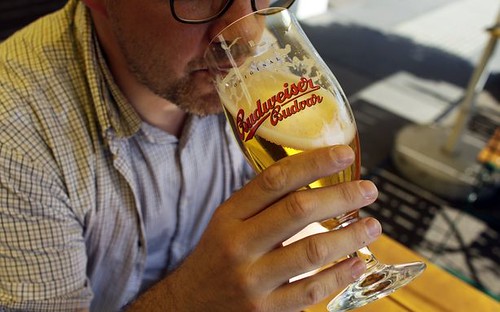
Oh, I hate to pick on the mainstream media as they cover the world of beer, but this is too delicious not to point out. In a story about the proposed buyout of Grupo Modelo by Anheuser-Busch InBev, entitled The Great Beer Monopoly Deal May Be Back On, the Atlantic features the following photo, which I downloaded in case somebody gets wise and replaces it. And a hat tip to Tom Dalldorf for sending me the link. I guess one Bud’s as good as another. Can I assume I don’t have to draw a diagram?

budvar-ab

Filed Under: Beers, Breweries, Editorial, Just For Fun, News Tagged With: Anheuser-Busch InBev, Business, Mainstream Coverage

CCBA ABC Workshop At UCSD Next Week

February 4, 2013 By Jay Brooks

CCBA-logo
Next week, on Tuesday, February 12, at the International House Great Hall, on the campus of UCSD in San Diego, the California Craft Brewers Association will host an ABC Workshop. The workshop is only open to California craft brewers, out of state craft breweries doing business in California and CCBA Allied Trade Associate Members, and pre-registration is required. You can pre-pay through PayPal or send an e-mail to the CCBA, with details on how to do so here.

Registration for the workshop will begin on February 12 at 12:15 PM and will begin at 1:00 PM and will last until 5:00 PM. There will also be a Beer Social afterwards. If you’re not involved in SF Beer Week, this is your chance to get answers to puzzling questions straight from ABC.

CSBA high res7

Filed Under: Breweries, News Tagged With: Announcements, Business, California, CCBA

The Beer Monopoly

January 2, 2013 By Jay Brooks

apm
This just drives me crazy for some unknown reason. It happens with alarming frequency that seems to belie a willful ignorance and an amazing ability to act as if the media just woke from a Rip Van Winkle-like nap. The latest culprit is American Public Media, a company that produces public radio programming, including Marketplace, a show that specializes in the world of business. Marketplace is the one that just filed a report on the proposed merger between ABI and Grupo Modelo, the latest in a seemingly unending series of consolidation in the beer commodities market. Entitled Proposed Beer Merger Could Hurt Competition in U.S., here’s part of what the very short report has to say.

Barry Lynn, a fellow at the New America Foundation, argues that over the years, Anheuser Busch-InBev and the world’s second largest beer company, MillerCoors, have created a monopoly.

Really, he “argues?” And it seems like he’s implying that it’s just happened lately, slowly over the years and nobody noticed until now? Maybe I”m reading into that, but that’s how it strikes me. First of all, the “Big Two” — f.k.a. the “Big Three” — have had a monopoly over the beer world for decades, at least since the 1980s, some thirty years. And prior to that, big breweries dominated the beer industry because, well … because that’s all there was: big breweries and regional breweries. I don’t think anyone needs to “argue” that point. I’d say it’s pretty well-settled. I’m not aware of any contrary flat-Earth-like group arguing that there’s no monopoly in the beer industry. But every time there’s a high profile merger, you hear this as if nobody was paying attention until now.

It’s doubly odd because Lynn is apparently an “expert” on monopolies, author of the book Cornered: The New Monopoly Capitalism and the Economics of Destruction, and he also wrote Big Beer, A Moral Market, and Innovation in the Harvard Business Review.

In the latter piece, he expands this theme and claims that “this began to change in the early 1980s, as radical revisions to antitrust law unleashed extreme consolidation in two of the industry’s three tiers. … In brewing, a long series of mergers has reduced the field from more than 48 major brewers in 1981 to two.” But that’s not exactly correct. There weren’t “48 major brewers in 1981.” According to the Beer Institute, who’s kept the number of breweries tally since 1887, there were 38 “traditional breweries” in 1981, along with 10 “specialty brewers.” It’s not the numbers I’m quibbling with, but the characterization that these 48 breweries were somehow equal, or nearly so, by calling them all “major brewers.” I don’t know exactly who the ten were, but it’s a safe bet they included Anchor, New Albion, Sierra Nevada, Boulder, RedHook, none of whom even today, much less in 1981, would be considered “major,” especially when compared to the largest brewers. There was, and is, an enormous difference in the size of these breweries. While there were, of course, a few larger regional breweries still around in 1981, the chasm between the largest and smallest was still dramatic. It sets up a false perception to say that they were all major in 1981 but now only two remain thirty years later. That’s just not what happened.
monopoly-beer
While I don’t recall this term being used, in the 1970s and the very early 80s, there was essentially the “Big 5,” which was the Big 3 plus Pabst and Schlitz. Five companies dominating the industry is hardly much different than three, and still a big difference from the fictional 48. Consolidation of breweries actually began right after Prohibition ended, when many that existed before 1919 never reopened and those that did often struggled mightily. A lot of them were swallowed up quickly by those breweries that enjoyed early post-prohibition success, a pattern that continued from roughly 1934 through the 1980s.

A 1994 study estimated U.S. beer market share by decade of the top 10 beer companies. In 1939, the biggest 10 owned 24% of the market. By 1964, it had more than doubled to 58%. In 1966, worried about what further consolidation would do to the market, the U.S. government intervened to try to keep more consolidation by M&A from happening. They obviously failed. Commenting in 1991, A. M. McGahan, remarked in his piece, “The Emergence of the National Brewing Oligopoly,” that “policy implementation was too late to prevent an oligopoly in the market. The nationwide recognition and brand loyalty earned by the ‘big five’ breweries created momentum, and these firms demonstrated that consolidation was no longer necessary to gain market share. By 1980, the combined production of the ‘big five’ breweries accounted for 75 percent of all domestic beer produced. The top ten largest breweries produced 93 percent of the nation’s beer.”

That 1994 survey largely agrees, estimating that in 1974, the top 10 accounted for 81% of the market and by 1980, their share had risen to 94%, hitting a peak of 98% in 1990. So much for this being a recent phenomenon. The domination of the beer industry by just a few companies is, quite frankly, old hat. Yet this old saw about it having just happened is trotted out every time a new merger occurs. I admit it’s gotten worse, from a sheer numbers point of view now that we’re down to two, but the fact is a near monopoly of the beer market has been with us longer than most of us have been alive.

Later this year, ABI will again go before federal regulators to ask that their purchase of Grupo Modelo be approved. ABI has owned a 50% non-controlling stake in the Mexican beer company for many years, so this would give them control, and the other half of the company. I assume it will sail through. The last time ABI came before the feds was when InBev wanted to buy A-B, and all the government required was that they divest themselves domestically of Labatt’s. Big whoop.

The meteoric rise of — let’s just call it the specialty beer market for now — has created an industry with more breweries than we’ve had in over a century, but even after 35 years only accounts for about 6% of the total market. That percentage has changed only incrementally in all those decades. That there’s a beer monopoly should quite frankly be seen as a given. It’s been with us for a long, long time. So let’s stop pretending with every new merger that this is the one to push us over the edge of decreased competition. As any smaller brewer will tell you, the market has been difficult since the very beginning for every single brewery, especially early on.

The one thing I do agree with Lynn about is this statement about the large beer companies. “They have this remarkable ability to make it seem as if this is the most competitive of marketplaces.” That’s certainly true, as a knowing walk down the average grocery store beer set will prove. So while I’m sure the argument before government regulators will undoubtedly be that competition will not materially be effected by this merger, I agree that it’s hard to see how this latest acquisition will change much. As they say, it’s a little late to close the stable door now that the horse has bolted. But he bolted so long ago that he’s nowhere in sight anymore.

In his Harvard Business Review piece, Lynn suggests that “the threat we face is not only to the variety and quality we all enjoy.” “[C]onsolidation can also threaten the primary outcome of this market — the ability of communities and individuals to manage for themselves this ever so extraordinary commodity.” Again, the fallacy here, IMHO, is that this represents a new threat. The damage has already been done, in fact done so long ago that the wound has healed. Most specialty breweries understand the world they’re trying to do business in, they get that it’s inherently unfair and is unequally balanced, but they’ve figured out how to work within a system that’s been broken almost since it began when the three-tier system was imposed after the repeal of prohibition. [Note: before the heated commentary begins, I admit the three-tier system does work in many ways, and I’m not arguing against it per se, but it has favored larger beer companies and has made life difficult for many smaller ones over the years. There’s no doubt that’s been changing but has more to do with the hard work of countless small brewery employees than any magnanimous sea change by wholesalers.]

Retail and the distribution networks favor consolidation because having to deal with fewer companies is more efficient. That’s why all of the big companies offer a myriad of brand names to give the illusion of choice. When people want choice, it’s easier to pretend to offer just that by creating different packages with very similar stuff inside them, and let advertisers and marketers create preferences. That’s a model that’s worked well in the modern era.

So will this latest merger “hurt competition” in the U.S. beer market? No more than the last one, or the one before that one, or the one prior to the last one, or the one before then, ad infinitum. Is it getting worse? Perhaps, but we’ve had a beer market dominated by just a few big players for such a long, long time that at the very least we should stop pretending this is a new problem that needs addressing with each merger. The beer monopoly has been with us for decades. Whatever solutions there might be to the problems of a consolidating industry — not that I can think of any that have a chance in hell — we should at least be honest about the situation we find ourselves in. Just say know.

You can listen to the entire Marketplace report below.
monopoly-beer

Filed Under: Breweries, News Tagged With: Big Brewers, Business

Nine Beers Experiencing Titanic Sales Drops

December 9, 2012 By Jay Brooks

sales-chart-down
24/7 Wall St. had an interesting look at some beers that have fallen on hard times over the last five years. Entitled Nine Beers Americans No Longer Drink, it lists some mainstream beers that have experienced some amazing drops in sales from 2006 through last year. The data is from Beer Marketer’s Insights and the list includes nine beers that have experienced more than a one-third drop in sales — and in two cases two-thirds — over that five-year time period. Here’s the list:

  1. Michelob: 72% drop in sales, 2006-2011 (ABI)
  2. Michelob Light: 66.3% drop in sales, 2006-2011 (ABI)
  3. Budweiser Select: 60.8% drop in sales, 2006-2011 (ABI)
  4. Milwaukee’s Best: 57.1% drop in sales, 2006-2011 (MillerCoors)
  5. Old Milwaukee: 52.8% drop in sales, 2006-2011 (Pabst)
  6. Miller Genuine Draft: 52.3% drop in sales, 2006-2011 (MillerCoors)
  7. Amstel Light: 47.7% drop in sales, 2006-2011 (Heineken)
  8. Miller High Life Light: 37.6% drop in sales, 2006-2011 (MillerCoors)
  9. Milwaukee’s Best Light: 35.5% drop in sales, 2006-2011 (MillerCoors)

That’s a pretty remarkable list. A few of those used to be truly successful brands. The article also details how “to combat the growing popularity of craft brews, major breweries such as Anheuser-Busch Inbev and MillerCoors have aggressively marketed their own specialty beer.” Those include such stealth beers as Blue Moon, Shock Top, et al. That’s in addition to buying up craft brands such as Goose Island or creating separate marketing arms, like Tenth and Blake.

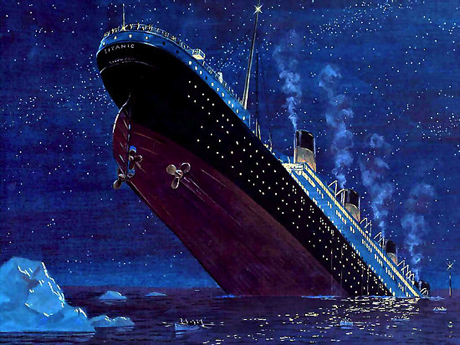
It will be interesting to see what these companies will do next as these brands drag down the ship with such titanic sinking sales. Will they take steps to reinvigorate these brands or jettison them from their portfolios and instead concentrate on craftier brands?

titanic

Filed Under: Beers, Breweries, Editorial, News Tagged With: Anheuser-Busch InBev, Big Brewers, Business

Beer Bouncing Back

October 29, 2012 By Jay Brooks

bouncingball
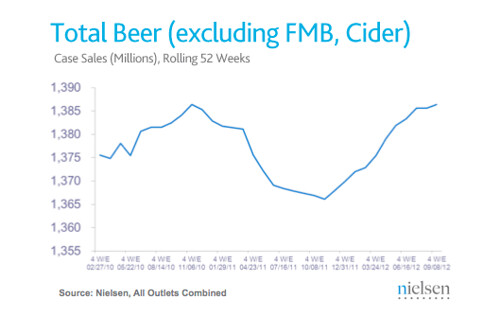
Nielsen, the company that tracks all things trackable, is speculating on their NelsonWire that beer is bouncing back and that this may signal the “beginning of a beer boom.” According to their data, “Beer sales are seeing a surge in growth, up 5 million cases (1.4 percent) in the last 12 weeks through September 1, 2012, in Nielsen-measured retail outlets. The same period last year saw a decline of 1.7 million cases.”

Total-Beer1k-2012

The main reason they cite for this is choice.

With more options on shelves and innovative product offerings, new consumers were attracted to the beer category. Nearly half of the households who were new to malt, or cider-based beverages (beer, flavored malt beverages and cider) in the past six months had bridged over from solely buying wine or spirits last year.

But as they’re focused to a greater extent on the bigger players in the category, they mean choice in a different way than you and I normally understand it. When Nielsen refers to choice, they mean “flavors, formats and packaging,” though in my experience it’s always “packaging options” that seem to get the most attention. But even with the term as common as flavor, it’s used here as more jargon instead of what you’d ordinarily think it means. By “new flavors,” they don’t mean more different styles or kinds of beer on the average beer set shelf. No, they mean line extensions like the two they give as examples: “Bacon Maple and Blue Raspberry Lemonade,” as a part of other already-established brands.

So while this is good news, and we should all welcome a coming “beer boom,” I can’t help but wonder if this “boom” of which they speak — which quite frankly the craft beer side has been seeing for a decade — is not going to favor them as much as the regional breweries and even the smaller craft breweries. That’s what it’s been doing for several years now, and I can’t see any reason to suspect that will change in the coming months or years, no matter how “bright the last quarter of 2012 may be for beer.” Still, a coming “beer boom” sure has a nice ring to it.

Filed Under: Beers, Editorial, News Tagged With: Big Brewers, Business, Mainstream Coverage, Statistics

« Previous Page
Next Page »

Find Something

Northern California Breweries

Please consider purchasing my latest book, California Breweries North, available from Amazon, or ask for it at your local bookstore.

Recent Comments

  • Bob Paolino on Beer Birthday: Grant Johnston
  • Gambrinus on Historic Beer Birthday: A.J. Houghton
  • Ernie Dewing on Historic Beer Birthday: Charles William Bergner 
  • Steve 'Pudgy' De Rose on Historic Beer Birthday: Jacob Schmidt
  • Jay Brooks on Beer Birthday: Bill Owens

Recent Posts

  • Beer In Ads #5148: Ach Himmel Mr. Goat March 6, 2026
  • Historic Beer Birthday: Conrad Windisch March 6, 2026
  • Historic Beer Birthday: Samuel Wainwright March 6, 2026
  • Beer In Ads #5147: Frankenmuth Is Michigan’s Largest Selling Bock March 6, 2026
  • Historic Beer Birthday: John Bird Fuller March 6, 2026

BBB Archives

Feedback

Head Quarter
This site is hosted and maintained by H25Q.dev. Any questions or comments for the webmaster can be directed here.