Brookston Beer Bulletin

Jay R. Brooks on Beer

  • Home
  • About
  • Editorial
  • Birthdays
  • Art & Beer

Socialize

  • Dribbble
  • Email
  • Facebook
  • Flickr
  • GitHub
  • Instagram
  • LinkedIn
  • Pinterest
  • RSS
  • Twitter
  • YouTube

Powered by Genesis

The Death Of The Coaster?

June 29, 2009 By Jay Brooks

coaster-square

Most of us take the humble beer coaster for granted. I know I do, even though I have a casual collection of them that probably numbers in the thousands. I say casual because they’re in some boxex in the garage and I’ve never tried to organize them at all. Their formal name is the beermat, and “the first beermats made of cardboard were introduced in 1880 by the German printing company, Friedrich Horn.” Today, there are believed to be something on the order of 5.5 billion coasters worldwide. One company, The Katz Group, absolutely dominates the industry, with an estimated 75% market share.

But the economic crisis has reached the beer coaster now, too, as The Katz Group recently filed for bankruptcy relief in their native Germany. Spiegel reported that no one is sure what will happen to the market if the
Katz Group cannot successfully reorganize through the courts. Though they don’t say so, this has to be one of the worst potential side effects of consolidations and mergers that has been taking place worldwide for decades, with many, if not most, industries becoming increasing concentrated in just a few large corporations.

The BBC also has their take on the story and the ramifications, especially for collectors. The sheer ubiquity of them seems to all but guarantee their survival, but as priorities go, I also can’t see them rising to the top of anybody’s key businesses needing saving, like Wall Street or the auto industry. So if you have a lot of coasters lying around, best hang onto them for now.
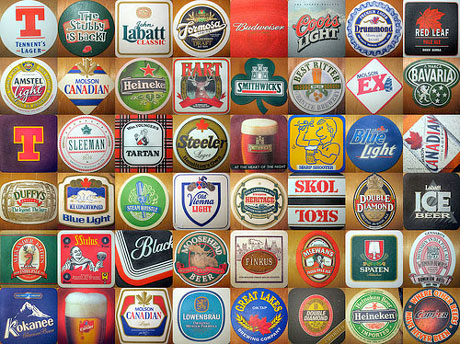

coasters

Filed Under: News, Related Pleasures Tagged With: Business, Coasters, Packaging

Agreement Reached For InBev Takeover Of Anheuser-Busch

July 13, 2008 By Jay Brooks

Well, folks, it’s all over. The deed is done, indeed. The deal for InBev to acquire Anheuser-Busch has been agreed upon in principle, for nearly $50 billion. It’s not really over, of course, because it still has to wind its way through the federal approval process. But for all intents and purposes, it’s probably just a matter of time now that the two parties have reached an accord.

The Wall Street Journal, Reuters, and the Financial Times are all now reporting that the parties have agreed to a deal. The new entity’s board will contain two A-B people, most likely including August A. Busch IV. Sadly, they decided to ignore my suggestion of calling the new company InBusch and went instead with the relatively boring and far too long name, Anheuser-Busch InBev.


Filed Under: Editorial, Politics & Law Tagged With: Business, Ingredients, International, Malt, National

Bud Woos Modelo

June 12, 2008 By Jay Brooks

The Wall Street Journal is today reporting that Anheuser-Busch has entered into talks with Grupo Modelo about some sort of merger or acquisition in an effort to keep InBev’s takeover bid from becoming a reality. This is at least one of the strategies that had been floated in recent weeks and months for strengthening A-B. If you’re unfamiliar with Grupo Modelo, they are the largest brewer in Mexico, with nearly a two-thirds share of the Mexican market, and I’m sure you know at least one of their dozen brands: Corona. A-B already has a 50% stake in the Mexican beer company, but it’s non-voting stock and thus they have no control over the business. Today’s AP story regarding the InBev deal mentioned that InBev’s weak performance last quarter makes getting enough equity to complete the takeover possibly problematic, meaning that an A-B that also included control of Corona would be more expensive, which might be enough to kill the deal. Strap in folks, this is getting interesting.


Filed Under: Breweries, News Tagged With: Anheuser-Busch, Business, Modelo

Losing Their Share of Mind

February 9, 2008 By Jay Brooks

trkanim
Anheuser-Busch’s “100% share of mind” program is legendary. It started ten years ago, when A-B began offering incentives to their distributors so they’d care only about A-B products. Though I assume they never said so — wink, wink — they encouraged distributors to drop non-A-B brands and concentrate on only the important brands. And at that time, such was A-B’s market strength that many distributors did in fact tow the line. But lately as domestic sales have been static or slipping, distributors are adding non-Bud brands to their portfolios to stay at the same level of profitability. The Associated Press had an article last week about this recent phenomenon called Beer Distributors Want More Than One Best Bud.

As the article points out:

For consumers, it means greater choice at their local bars and liquor stores. Wall Street analysts say the movement signals a weakening of the St. Louis brewer’s clout in the marketplace, as small-batch “craft” beers and imports, as well as wine and spirits, wrest market share from mass-market brews like Budweiser.

Many of the 560 nationwide A-B distributors realized that as craft beer is increasingly in demand, that their competitors were having the last laugh, because they were free to pick up whatever brands they wanted and believed they could be successful selling.

While IRI general manager Bump Williams described the program as a “great business model,” not everybody was convinced that it was fair. The DOJ launched an investigation into anti-trust violations, but later abandoned it. Naturally, A-B continues to push the program with such statements as “[w]e want their efforts and focus aligned with ours.” Well, who wouldn’t? But that isn’t how the world works nor is it how it should work. It’s schemes like this one that gave A-B its reputation as a bully. And it appears that they still have that mindset. Again, from the AP article.

Still, Anheuser wasn’t happy with the way it learned of the Tennessee distributors’ decision. “We found out later (in their decision-making process) than we would have liked,” says Mr. Peacock. “When we don’t get early communication, it rubs us wrong.”

Now why would one business be rubbed the wrong way if another, supposedly separate and independent company, didn’t consult with them before making a business decision? The best illustration of this mindset comes from more than a decade ago, with the former head of A-B, August Busch III, sitting around a conference table at their Hawaiian distributor petulantly throwing bottles of craft beer against the wall, smashing them to bits, to show his displeasure with a separate business having the unmitigated gall to sell something he can’t profit from. It’s that arrogance, borne of being the market leader for such a long time, that leads a company to believe that whatever is in their best interest is in everyone else’s best interests, too.

But as the market changes, that’s becoming less and less tenable. Distributors are realizing that to remain successful, they have to stock brands that their customers want, regardless of who makes them. That only makes good business sense. Some industry analysts, like my friend Harry Schuhmacher who runs Beer Business Daily, are surprised that it has taken so long for this to begin happening. As he puts it. “It really hasn’t been a widespread national jailbreak.” But that’s the hold that A-B has traditionally had over its distributors. Now that it’s finally beginning to erode, it will be interesting to see what percentage share of mind Bud is left with.

Filed Under: Breweries, Editorial, News, Politics & Law Tagged With: Anheuser-Busch, Beer Distributors, Big Brewers, Business

Appeals Court Reverses Washington Costco Decision

January 29, 2008 By Jay Brooks

According to a breaking news press release I received from the National Beer Wholesalers Association (NBWA), the Ninth Circuit Court of Appeals has reached a verdict in the lower court’s earlier decision in Costco v. Hoen (Washington State Liquor Control Board), reversing a majority of it, which, according to the NBWA, “thereby affirm[s] the right of the states to regulate alcohol under the 21st Amendment – a system that works to protect the citizens of each state. While NBWA is still reviewing the totality of the Court’s opinion, it appears that state regulation has been validated.”

Disappointingly, the Seattle Post-Intelligencer’s report on this begins with the following loaded sentence. “A federal appeals court Tuesday dealt Costco Wholesale Corp. a setback on whether the giant warehouse club operator could lower prices of beer and wine for its customers.” I realize that was in the business section, but so much for impartiality. Swallowing Costco’s propaganda entirely, to say they sued the state so they could lower prices to consumers is at best not telling the whole story and at worst and out and out fabrication.

Of the nine laws and regulations Costco claimed restricted competitive practices, U.S. District Court Judge Marsha Pechman agreed and ruled over a year ago in their favor. Today’s appeals ruling reversed eight of those, with the exception of the post-and-hold requirement. It appears likely that it may now be appealed to the Supreme Court. According to the PI, “The 9th Circuit Court of Appeals said the state Liquor Control Board could prohibit discounts, ban central warehousing of beer and wine by retailers, require wholesale distributors to charge uniform prices to all retailers and require a 10 percent markup. The state had said if Costco won it could put into question the systems other states use to control alcohol consumption and safeguard the collection of taxes. At least 30 other states or jurisdictions had filed briefs in support of Washington.”

Reuters, on the other hand, more even-handedly stated that Costco “lost a bid on Tuesday to overturn Washington state liquor rules that control pricing and discounts.”

The Seattle Times and the Wall Street Journal have also now weighed in with stories of their own.

From the Wall Street Journal:

Costco’s 2006 triumph attracted a lot of attention because it suggested that major changes might be in store for the nation’s complex system of regulating alcohol sales. Changes in Washington state could have a ripple effect, because most states have similar laws.

Costco is challenging a regulatory architecture that dates to the repeal of Prohibition and was designed partly to discourage overconsumption of alcohol. Makers of alcoholic beverages sell to a distributor, which marks up the price and trucks it to a bar, restaurant or store, which then sells it to a consumer.

Costco is deciding whether to appeal the ruling. “We are pleased that the central part of the anticompetitive restraints provisions was struck down,” said David Burman, a Seattle-based lawyer handling the case for Costco, referring to the “post and hold” provisions. “It will be good for Costco members and other consumers.”

Seventeen other states have post-and-hold laws, Mr. Burman said. He added that he thinks Washington lawmakers “will likely” consider overturning other provisions.

Washington alcohol regulators may appeal the part of the ruling favoring Costco. “The state got a pretty good deal. It has to decide whether it can live with a regulatory scheme that sort of has one component plucked out and thrown away,” said Richard Blau, a lawyer who specializes in alcohol law with GrayRobinson, a Florida law firm. Regulators could leave it up to state lawmakers to address that aspect of the court’s decision.

The other reason that this so-called “regulatory architecture” was partly created, in addition to discouraging overconsumption, is to level the playing field among different sizes of businesses so that advantages were not given to larger businesses by virtue of their superior bargaining position and resources to make larger buys. That was the real reason Costco went after these laws, not because they were concerned that their customers might be paying too much for the beer and wine they sold. You’d have to be pretty blind to reality to swallow that one as their motivation, yet in mainstream media story after story that continues to be the reason stated.


Filed Under: Beers Tagged With: Bay Area, Business, California, National, Washington

Cognitive Branding

January 29, 2008 By Jay Brooks

This is slightly off topic — it’s more about advertising — but since Anheuser-Busch’s Super Bowl ads are singled out, and also because it’s quite interesting, I thought I’d pass it along just the same. An article in yesterday’s Advertising Age by a Lisa Haverty, titled Don’t Flush Your Ad Down the Super Bowl: Unless Your Spot Has Fundamental Cognitive Elements, No One Will Recall Your Brand, begins with this ominous warning. “If you’re not Bud, don’t bother.” Ouch, if I were spending $2.7 million on an ad promoting the Bulletin during the Super Bowl I wouldn’t be very happy to read that. But apparently unless I’m careful to incorporate “some very fundamental cognitive elements” in my ad, people will end up remembering it as another Bud ad. The Cognitive Science Conference — doesn’t that have fun time written all over it? — held last August in Tennessee (and sponsored by the Cognitive Science Society) revealed in a study that “[a]ds with poor ‘cognitive scores’ were misattributed by consumers, and beer ads were attributed to the huge Super Bowl presence that is Budweiser.” There are ways to avoid this from happening. As Haverty suggests, you have to follow the basic principles of cognitive science to make people remember who you are, or in the jargon, reliable brand recall.

Here’s an interesting example:

Take, for example, the concept of “working memory.” Information has to go through working memory to get into long-term memory, where brand awareness and loyalty reside. One of the principles of cognitive science is that a person can hold and process only about seven items in working memory at any given moment. This actually varies from about five to nine in the general population. If your ad has so much information that it exceeds working-memory capacity, you’ll lose control over what consumers are able to remember. Cog-sci lesson: Respect working memory.

There are a few other examples, read them if you find this sort of thing as fascinating as I do. What I really take away from all this, apart from the simple fact that one must be careful in how to spend $2.7 million, is something I always suspected about any large company’s approach to blitzkrieg advertising. By year after year being the biggest advertiser during the Super Bowl, A-B has set themselves up in a very enviable position. Any other beer or related commercial runs the risk of having their own ad remembered by consumers as being for the competition. Talk about a gamble. They’ve effectively made it almost impossible for any other beer company to reach their audience during one of the most-watched television events of the year. In essence, they now own the event, ad-wise. The cynic in me thinks that if they paid for it, they should reap the rewards, but my idealistic side hates that any big company with vastly more resources than all of his competition can just use a bludgeon to maintain his market position. But that’s what’s happening in virtually any industry you can name. Once upon a time, hundreds and thousands of small local and regional businesses competed more or less on a level playing field, at least more fair than today’s environment. Go anywhere in America today, and the number of national chain stores and other businesses dominating and squashing local competitors is astonishingly near completion. And that’s not good on so many levels. As the science of advertising gets better and better, we’ve truly been manipulated into thinking what’s good for GM is good for America. If that idea is allowed to run its course there will be two or three brands, at most, for literally every type of good you can name, and even at that each will be remarkably similar to one another. Only the cognitive branding, advertising and marketing will be able to identify any difference, and they’ll do so by the most dishonest of methods possible. Geez, I need a beer.

As an aside, there’s a very funny critique of this AdAge article by AdHurl, which as far as I can tell is by a thirty-year veteran of the ad game, George Parker. He calls out Haverty for her overuse of the word “cognitive” throughout her piece. It’s snarky and hilarious. A kindred soul.


Filed Under: News Tagged With: Business, Law, Press Release, Washington

Here Comes the Stagecoach

January 28, 2008 By Jay Brooks

It seems like there’s been a number of brewers taking the next bog step into packaging, and the latest one comes from Mantorville, Minnesota, a small town southeast of Minneapolis and not to far from the border of Iowa. Mantorville Brewing was founded in 1995 and, according to a story in their local Post-Bulletin, has had a difficult road to production. But now the Stagecoach Amber Ale, named for stagecoach stop that is a part of the small town’s history, has started to be delivered to local retailers throughout the area.


Filed Under: Editorial Tagged With: Business, Statistics

Stout & Cheddar Soup

January 28, 2008 By Jay Brooks

This tasty looking recipe was featured on Chicago’s ABC Channel 7, created by Michael Pivoney, Executive Chef at Marion Street Cheese Market.


Stout & Cheddar Soup (makes 6 servings)


  • 2 Tbsp. canola oil
  • 1 stick unsalted butter
  • 3 stalks celery, diced
  • 2 jumbo carrots, diced
  • 1 medium white onion, diced
  • 1 stalk of leek, diced
  • 4 cloves garlic, minced
  • ½ cup all-purpose flour
  • ½ cup rye flour
  • 2 bottles of stout beer (premium quality such as Guinness)
  • 1 quart chicken stock (vegetable stock may be substituted)
  • 1 tsp. thyme
  • dash of Worcestershire sauce
  • dash of tabasco
  • 2 cups finely-shredded cheddar cheese (premium quality)
  • Kosher salt and fresh cracked pepper


Method:

In a large soup pot, heat the oil and butter then saute the celery, carrots, onion, leeks and garlic over medium-high heat for approximately 10 minutes – until the onions are translucent Add the flour and saute over medium-low heat for approximately 8 minutes until flour is slightly brown and has a nutty scent. Whisk-in the stout beer and simmer for five minutes, then add chicken stock and thyme and dashes of Worcestershire sauce and tabasco. Continue to simmer and when mixture begins to thicken, slowly add the cheese, whisking constantly until well-combined. Season to taste with salt and pepper, then allow the soup to simmer over low heat an additional 30 minutes.

Puree the soup in a blender and serve hot.


Filed Under: Beers, Editorial, News Tagged With: Business, Europe

Random Beer Names

January 27, 2008 By Jay Brooks

I’m not entirely sure why this exists, but I did have fun with it — so perhaps that’s enough of a reason — but Strange Brew, a Canadian software company that makes programs for homebrewers, also has an online Random Beer Name Generator. My first beer name:

Flying Squirrel-Mash Oud Bruin

Being a huge fan of Rocky & Bullwinkle, I thought this one was a great name for a beer. But some others were equally intriguing, such as Craptacular Loch Ness Monster Tripel, Barney and Spiderman’s Transgendered Bière de Garde and even The Squid Formerly Known As Winston Churchill’s Unbefreakinglievable Pilsner. I don’t know how many names are in there. I tried quite a few and never got a duplicate. Give it a try. Let me know your best ones.


Filed Under: Just For Fun Tagged With: Business, Europe, History, International, Strange But True

A Sad Commentary

January 25, 2008 By Jay Brooks

We’ve had the Big Three — Bud, Miller and Coors — for so long now that it would probably take me a few years to stop using the term. In the UK, once upon a time it was the Big Six; and they included Allied Breweries, Bass Charrington, Courage Imperial, Scottish & Newcastle, Watneys, and Whitbread. Until yesterday, only S&N remained. With the announcement earlier today of Carlsberg and Heineken’s buyout of Scottish & Newcastle, the last vestige of a bygone era will soon disappear, as well. England’s esteemed Financial Times today has a somewhat sad commentary on this entitled Few Crying into Beers at Decline of Big Six Breweries. As they observe, the change in the beer market and the mergers that began around 1989 have now come to a final solution, and with no one left to mourn them.

Here’s a few statistics. Since the turn of the century, imported beer to the UK has increased by 50%. During that same time, the number of large breweries fell by two-thirds. Today, a mere six remain, with 34 more considered regional breweries. Since the 1980s, the number of breweries has actually tripled, but that’s because of the UK’s own microbrewery revolution, which today includes over 500 small breweries whose total production accounts for only 2% of the nation’s beer market. Before today’s buyout, Heineken enjoyed only 1% of the total British market, but after the deal is approved they will have something in the neighborhood of 30%, making them Great Britain’s biggest beer company.

Maybe none of this matters. After all, as the FT’s editorial makes clear, British pub-goers, publicans and pub operators, and even CAMRA’s real ale aficionados will all be dishearteningly unmoved by today’s news. I can’t help but think that’s a mistake. So much of our early microbreweries owe such a great debt to the heritage and history of English ales that it seems a shame to let this dismal milestone pass so cavalierly. Perhaps I’ve romanticized these old breweries too much, but I don’t feel the same loathing for their products or their business practices that I usually do for our Big Three. That may simply be the 1,000-mile expanse of ocean separating me from everyday contact, who knows? But even though the British beer industry is nowhere near deceased, this is just one more wound that will again forever alter its landscape. I, for one, in the words of the immortal Edgar Allen Poe, “am drinking ale today.”


Filed Under: Editorial Tagged With: Business, Europe, Great Britain, History, Mainstream Coverage

« Previous Page
Next Page »

Find Something

Northern California Breweries

Please consider purchasing my latest book, California Breweries North, available from Amazon, or ask for it at your local bookstore.

Recent Comments

  • Bob Paolino on Beer Birthday: Grant Johnston
  • Gambrinus on Historic Beer Birthday: A.J. Houghton
  • Ernie Dewing on Historic Beer Birthday: Charles William Bergner 
  • Steve 'Pudgy' De Rose on Historic Beer Birthday: Jacob Schmidt
  • Jay Brooks on Beer Birthday: Bill Owens

Recent Posts

  • Beer In Ads #5152: A Message From Over The Sea About Genuine Bock Beer March 8, 2026
  • Beer In Ads #5151: March Is Bock Beer Time March 8, 2026
  • Beer In Ads #5150: The Best Of Bocks Comes To Town! March 7, 2026
  • Historic Beer Birthday: John J. Saltzmann March 7, 2026
  • Beer In Ads #5149: Winter Brewed For Summer Flavor! March 7, 2026

BBB Archives

Feedback

Head Quarter
This site is hosted and maintained by H25Q.dev. Any questions or comments for the webmaster can be directed here.