Brookston Beer Bulletin

Jay R. Brooks on Beer

  • Home
  • About
  • Editorial
  • Birthdays
  • Art & Beer

Socialize

  • Dribbble
  • Email
  • Facebook
  • Flickr
  • GitHub
  • Instagram
  • LinkedIn
  • Pinterest
  • RSS
  • Twitter
  • YouTube

Powered by Genesis

The Primo Return of Primo

January 9, 2008 By Jay Brooks

primo-new
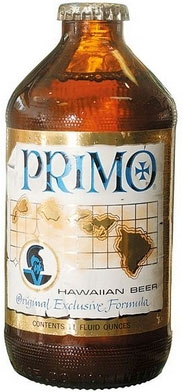
This was first reported back in late November during what I’ll continue to call “The Great Ennui of Late ’07” when the Bulletin was looking pretty sparse. I’m returning to the new year reinvigorated, or at least willing myself to try, and so I’m trying to catch up on old news people have sent in, and this comes to me by way of my island connection, a regular Bulletin reader living in Hawaii. Thanks Doug. It seems the old iconic Primo Beer brand has returned as of December, so far in kegs only. Bottles will be back sometime in April.
primo-shirt

First, a little history. Primo Beer was originally made by the Honolulu Brewing & Malting Co., which was founded in 1898. After Prohibition ended, it was renamed the Hawaii Brewing Co. and by the 1950s became the best-selling beer on the islands. In 1963, Schlitz Brewing bought the brand, building a new brewery in ‘Aiea, and they continued making Primo until closing it in 1979. At its height, the Hawaiian brewery produced over 400,00 barrels per year. A few years later, in 1982, Stroh Brewing bought the brand and changed the label as well as the formula, trying to sell the brand outside Hawaii in several states. With mixed success, sales grew and then fell again, and eventually Stroh stopped making Primo in either 1997 or 98 (accounts differ on this point). A year or two later, Pabst acquired the brand, along with several others brands from Stroh’s and they are the current owners of the brand.

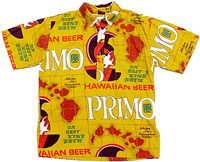
So last year, Pabst made the decision to bring back the label. And that makes sense, Primo was one of those iconic brands that people couldn’t help but associate with Hawaii. Using a silhouetted image of King Kamehameha, who in 1810 united the Hawaii Islands under his leadership of the Kingdom of Hawaii, was a genius marking move and the bold Hawaiian shirts made in the 1960s-70s with the Primo label continue to be collector’s items right up to the present.

The new Primo is being launched by the Primo Brewing Co., a division of Pabst Brewing. A new recipe was created by brewmaster Phil Markowski, who justly won fame and fortune for his beers at the Southampton Publick House on Long Island, New York.

The beer itself is being brewed by a craft brewery on the island of Kauai, Keoki Brewing, who initially will brew around 200 kegs each month. Once bottled production starts up, that will be handled stateside by Pabst in Irwindale, California. But since Pabst doesn’t own any breweries, that means Miller Brewing — who does own a brewery in Irwindale — will be contract brewing the beer for Pabst. According to a press release, “the draft and bottled versions will be distributed by Paradise Beverage Co.”

It will be interesting to see if they can successfully revive the brand. I imagine it will be great as a tourist beer and for locals looking to support a well-known local brand, at least as far as the draft beer is concerned. The bottles stateside may prove trickier, especially after the initial novelty wears off, as it inevitably will.
primo-btl

Filed Under: Beers, News Tagged With: Business, History, Western States

Anheuser-Busch Up 2% in 2007

January 7, 2008 By Jay Brooks

Anheuser-Busch announced today that shipments were up 2% in 2007 over the previous year. While the news is presumably good for shareholders, it’s not exactly all that different from recent years when increases have been meager at best.

From the press release:

“Anheuser-Busch achieved increased shipments in 2007 due to the success of our initiatives to broaden the company’s beer portfolio, including the addition of InBev European brands,” said Busch. Wholesaler sales-to-retailers grew 1.3 percent for the full year. Acquired and import brands contributed 170 basis points of growth to shipments and 160 points to wholesaler sales-to-retailers for the full year.

For the fourth quarter 2007 wholesaler sales-to-retailers were up 1.3 percent, on a selling day adjusted basis. The fourth quarter of 2007 had one more selling day than the fourth quarter of 2006. U.S. beer shipments to wholesalers increased 3.4 percent in the same timeframe. Shipments to wholesalers are not selling day adjusted. Import brands contributed 230 basis points of growth to shipments and 180 points of growth to wholesaler sales-to-retailers for the quarter. Wholesaler inventories at year-end were approximately the same as year-end 2006.

“Our expanded beer portfolio along with our enhanced marketing and sales strategies to accelerate core beer sales position Anheuser-Busch for growth in volume and earnings in 2008,” concluded Busch.

Anheuser-Busch Cos., Inc. will announce worldwide beer volume and consolidated earnings results for the fourth quarter and full year 2007 on Jan. 31, 2008.

I’m no economist, but I confess I read economics as a hobby, and the fact that the press release keeps switching between percentages and basis points (which are 100ths of a percentage, e.g. 150 basis points = 1.5%) seems to me like they’re engaging in a bit of prestidigitation. Maybe that is standard practice, I don’t know. But just in case, let’s look at the first paragraph. “Wholesaler sales-to-retailers grew 1.3 percent” and “import brands contributed … 160 points to wholesaler sales-to-retailers.” So unless I’m mis-reading it, doesn’t that mean if imports made up 1.6%, then other products — which would have to be domestic beer, the core brands — fell by 0.3% or 30 basis points? Because if imports “contributed” more than the total, wouldn’t that have to mean the rest of the percentage came from somewhere else?

Similarly, in the next paragraph it is stated that “beer shipments to wholesalers increased 3.4 percent” and “[i]mport brands contributed 230 basis points of growth to shipments.” That would also seem to suggest that domestic beer only increased 1.1%, wouldn’t it? That would seem to contradict Busch’s statement that these numbers would cause one to “conclude” core brands will likely grow “in volume and earnings in 2008.”

Maybe I’m nitpicking, but there is a fishy looking codicil below the press release that begins:

This release contains forward-looking statements regarding the company’s expectations concerning its future operations, earnings and prospects. On the date the forward-looking statements are made, the statements represent the company’s expectations, but the company’s expectations concerning its future operations, earnings and prospects may change. The company’s expectations involve risks and uncertainties (both favorable and unfavorable) and are based on many assumptions that the company believes to be reasonable, but such assumptions may ultimately prove to be inaccurate or incomplete, in whole or in part. Accordingly, there can be no assurances that the company’s expectations and the forward-looking statements will be correct.

And that’s only about 20% (or 200 basis points) worth of the qualifying fine print. It goes on and on in soporific legalese that no one will bother to read, except perhaps the most anal-retentive among us — yes, that means me, dear readers. But what that whole exercise boils down to is this. We think we’re going to do great in 2008 … unless we don’t. Please buy or hold on to your A-B stock because 2008’s going to be great year … unless it isn’t. The political punditry calls it spin, but there are unkinder words for what it really is.

 
UPDATE 1.8: As if you needed more proof that framing, spin and propaganda works, the next day’s St. Louis Post-Dispatch reported that “[i]nvestors reacted happily to Anheuser-Busch Cos.’ announcement Monday that its beer shipments increased last year and in the most-recent quarter. Shares of the country’s biggest brewer soared nearly 5 percent, their steepest climb in more than 20 months, despite slow growth among the company’s trademark beers.” See, nobody, especially the business press, bothers to check the math or read the fine print.
 

Filed Under: Editorial, News Tagged With: Business, National, Press Release

Iron City’s Solvency Plan

January 6, 2008 By Jay Brooks

Last fall the bankrupt Pittsburgh Brewing got a new Plan of Reorganization confirmed which included new investors, a settlement with creditors, a new CEO and a new name: Iron City Brewing. The new boss, Tim Hickman, today outlines his four-prong plan to increase revenues this year by a staggering 35%, certainly an audacious goal. Perhaps their biggest hurdle is that the perception of the brewery, as a direct result of the bankruptcy, has diminished and many locals assume the quality of the beer has likewise decreased. This despite the fact that the brewery was founded in 1861, making it one of the oldest breweries in America still operating today (#1 is another Pennsylvania favorite, Yuengling, which was founded in 1829).

To combat these problems, Here’s the four things Hickman hopes to accomplish:

  1. Upgrade the facility on Liberty Avenue to assure consistent production.
  2. Stop competing with beer-producing giants.
  3. Saturate the bar scene.
  4. Redesign packaging and labels.

With a modernized brewery, “Iron City expects to produce more than 233,000 barrels of beer in 2008. Last year, the brewery turned out about 172,000 barrels. The 2008 projection would be the most beer brewed at Iron City since 2004.” Sales VP Tony Ferraro has made the sensible observation that they can’t really complete on price with the bigger breweries and will be looking at themselves as a regional brewery. As a result, they’ll raise their prices slightly in line with a reasonable mark-up and will promote the beer as local, tying themselves to Pittsburgh’s 250th birthday celebration, which takes place this year. They’re also finally replacing their Hoff-Stevens kegs with new Sankey’s in an effort to get more tap handles in local bars and restaurants.

They’ll also be redesigning their packaging and labels, although apparently the iron city logo is off-limits. A new slogan will also be introduced. “The official beer of the Pittsburgh Nation.” And apparently some locals agree. A pair of Pittsburgh natives have set up Drink Iron City, “a blog about supporting the Iron City [Brewing] Company.”

Currently, Iron City Beer has a 6% market share in the greater Pittsburgh area and the plan is to shoot for 10% over the next few years. As Hickman puts it. “We’ll get there,” he said. “We have a quality product here, and we have consumer loyalty behind our brands.”

My friend and colleague, Julie Bradford, who is the editor of All About Beer magazine, agreed and is quoted in a Pittsburgh Tribune-Review article.

She said she approved of every step Iron City is taking, and even praised Hickman for raising prices.

“In fact, it’s a smart idea to raise prices,” she said. “That raises perceived value.”

Bradford also agreed that Iron City should concentrate on local loyalty, “because that’s what Iron City has going for them.”


The old Pittsburgh Brewery during better times.
 

Filed Under: Editorial, News Tagged With: Business, Eastern States

Fine Food, Fine Wine, Bad Beer

January 5, 2008 By Jay Brooks

Roger A. Baylor, better know to the online world as the Potable Curmudgeon, is the owner of New Albanian Brewing and Rich O’s Public House, both in New Albany, Indiana. On an online forum, Louisville Hot Bytes, dedicated to Food in nearby Louisville, Kentucky (just over the Ohio River from New Albany), Baylor asked an innocent — and I think altogether reasonable — question while discussing positive and negative factors that go into a restaurant’s rating. He posited whether a fine restaurant should be dinged a half-point for carrying only industrial light lagers from the big three mega-breweries. He goes on to assert that if you’d lower a restaurant’s score for using Velveeta, Wonder Bread or putting Blue Nun on their wine list, then why not if they had only pedestrian beer, too? He suggested that it’s hypocritical to be so fastidious about using only fine ingredients or carrying upscale items but then to not apply that same logic to beer. The forum discussion ran to thirteen pages and at times turned ugly and even mean, but it’s a fascinating glimpse into the mind of ignorance, backwards thinking and the status quo. Most of the defenders of bad beer use the excuse that they are simply giving the customer what he or she asked for, despite the fact that they wouldn’t carry Blue Nun or Velveeta even if the customer wanted those, too. But they also claim no customer would ask for inferior food or wine at a fine restaurant and thus it’s not the same. But the nature and understanding of wine and food are not the same today as they were when I was a child. My parents might conceivably have asked for Blue Nun or some pedestrian food (my stepfather loved to drown his eggs in pepper and ketchup, for example) but new kinds of chefs and restaurants changed the food world and they didn’t do so by catering to the status quo, they did so by changing it, by challenging it. What the customer really wants is a fine dining experience and most people can’t or won’t see how that includes beer, too.

In what I find truly bewildering, especially in my neck of the woods, Chez Panisse, whose famous owner Alice Waters has written books about using high quality and local ingredients, carried crap beer, and imported at that, until only very recently. And even that wasn’t Waters’ doing. My understanding is that one of her bartenders finally persuaded her to carry local beer and they now offer beer from Magnolia and Moonlight breweries. Her restaurant opened in 1971 and it took 35 years for her to apply the same logic that made her a food guru to beer? That she had to be convinced says quite a lot about how even devotees of fine, local food and wine can’t easily manage to extend their thinking to beer. I find that quite sad, and don’t really understand why so many people defend big beer when there’s so much diversity and pleasure waiting for them if they’d merely look beyond the barrage of marketing and advertising. Baylor himself gives his own answer to that question by posting a rant he wrote ten years ago on another one of his blogs, NA Confidential. It’s very well written and in it he makes several excellent points, including several I hadn’t even thought of — but will undoubtedly steal to use in the future.


Filed Under: Editorial, Food & Beer Tagged With: Business, National

Moylan’s To Squeeze Kilt Lifter Into Six-Packs

January 3, 2008 By Jay Brooks

Moylan’s Brewing of Novato, California has always had many, if not all, of their beers available in 22 oz. bottles. For the first time they’re debuting one of their beers, Kilt Lifter Scotch Ale, in six-packs of 12-oz. bottles.

From the press release:

Moylan’s Brewing Company will be sending six-pack bottles to the shelves come late January of 2008, just in time for the Superbowl in February. Moylan’s world-wide award winning Kilt Lifter Scotch Ale will be available in selected retail locations with suggested prices from $8.99-9.99. Denise Jones, Moylan’s Brewmaster, journeyed up to Sudwerk Brewing Company, in Davis CA, to work on expanding and perfecting the brewing of the ever popular Scotch Ale in a larger capacity; an agreement created partly out of owner Brendan Moylan’s respect for Sudwerk, it’s Brewmaster, and the quality of beer brewed onsite, and partly due to the desire to reach more customers with different packaging options. Moylan’s Brewing Company is excited about the reception of the new packaging and, if all goes well, plan on increasing the selection to include other award winning ales in smaller options. Curtis Cassidy, sales manager at Moylan’s Brewing Company states, “Starting off, we will be offering the new bottle size exclusively to California customers. After testing the waters with the Kilt Lifter six-packs, we plan on moving other Moylan’s beers into six-packs as well. We hope to be taking steps towards these goals by the end of 2008.”

The new Kilt Lifter in a 12 oz. bottle.

And the new Kilt Lifter six-pack carrier.


Filed Under: Beers, News Tagged With: Bay Area, Business, California, Packaging, Press Release

Strange Brew: My Beer Predictions for 2008

January 2, 2008 By Jay Brooks

To Beer or Not to Beer. As Strange Brew was a loose parody of Hamlet, I thought I’d again peer crazily into the skull of poor Yorick, and try to divine the future. Let’s see if anything that happened last year can be used to predict what might happen in the beer industry in 2007. Here are five things I think will happen this year. Let’s see how I do a year from now. What are your predictions?

 
The hops and malt shortages will continue to plague the industry throughout 2008 and may even grow worse. It seems to me that the malt problem can be solved more easily than the hops problem, not that either are particularly simple. But the hop one seems as resistant as a mutated spider mite. A Hop field or yard takes three years to produce a full yield and nobody is planting new vines so once most breweries’ current hop contacts run out, then what? I’ve been joking that we’ll see more gruits in 2008, but it is going to get harder and harder for big hoppy beers to remain economically viable as hop prices triple and quadruple, especially on the spot market. Will 2008 be the year of the session beer? Perhaps not, but it may not be a good idea for brewers to make fresh hop beers for a couple of years while hops are in such short supply.

 
Beer prices will go up, that’s a fact not a prediction. The real question is whether or not beer consumers will be willing to pay more and, if so, how much more? The big beer companies can more easily afford to absorb some margin losses to keep volume up, and so I don’t think they’ll raise their prices as much as the smaller breweries will be forced to. Whether or not, or to what extent, that will effect the continued growth of craft beer remains to be seen but I believe it will slow the growth of craft beer at least until hop prices come down and availability is up. I think craft beer will continue its upward movement, but it may be closer to 8-10% this year.

 
Distributor consolidation will increase and will continue to make things difficult for small brewers trying to bring their beer to market or increase their distribution to new areas.

 
Mergers among big multi-national beer companies will continue and at least one or two big such announcements will be made in 2008.

 
Neo-Prohibitionists will continue to step up attacks on alcohol generally and to specifically and inexplicably target beer.


Filed Under: Editorial, News Tagged With: Business, National

Top 10 Beer Stories of 2007

December 31, 2007 By Jay Brooks

As the year winds down yet again — didn’t we just do this a year ago? — everybody and his brother has a top ten list for the year and I’m still no different. It helps, I think, to stop and reflect on what happened over the previous year which puts the whole year in perspective and makes it easier to prepare for the coming one. So here are my choices for the top ten beer stories of 2007.
 

Irish Brewing in the Bronze Age: While seemingly a historical side note story, I think this has the potential to change how we view beer’s history in civilization, especially in Europe, where most our modern brewing heritage has its origins. If bronze age Ireland was brewing it means the impact of beer on mankind began far earlier than originally believed.

Lewes Arms Boycott Successful: I’m a sucker for the underdog and the small fry. The citizens of a small pub in the middle of nowhere took on pub giant Greene King to save their local beer being served in its home town. Greene King foolishly let it go on far longer than was prudent but eventually saw the light and relented.

Sam Adams vs. Sam Adams: The Boston Beer Company, owner of the trademarked Samuel Adams eponymous beers, went head to head in late October with a flesh and blood Sam Adams running for mayor of Portland. In a battle between a corporation’s fictional, but oddly legal, personhood and the real life variety, my money’s always on the real Sam Adams. For Boston Beer it was a public relations disaster and even their half-hearted apology seemed flat. On the plus side, Boston Beer did announce they’d be brewing at the old Rolling Rock brewery in Latrobe, Pennsylvania, which is good for that town. The one they were planning in Freetown, Massachusetts, on the other hand, after months of rumors, was finally canceled.

The Loss of Steve Harrison: Steve Harrison was Sierra Nevada Brewing‘s first employee and was as much responsible for its success, especially early on, as owner Ken Grossman and the rest of the crew from Chico. When he went missing under mysterious circumstances in August, it took a week of searching the area before his body turned up in the river. His passing was a huge and terrible loss to the brewing industry.

It’s Official! Double-Digit Craft Beer Growth Again!: It was another terrific year for craft beer and although there are problems in the horizon, three years of double-digit growth suggests that craft beer is on the right track. Barring some foreseen shortages, things are likely to continue to be rosy for the foreseeable future.

Widmer & Redhook Merger: Rumored since at least January, Widmer and Redhook agreed to merge in November.

Michael Jackson Passes Away: This was a huge and somewhat unexpected blow to the cause of better beer. Many of us who’d known Michael for a time had speculated about his health and last year he had finally publicly announced that he’d been battling Parkinson’s for at least ten years. I know I breathed a sigh of relief because I knew Parkinson’s could be treated and wasn’t the immediate threat it had once been. So when I got the news I was taken aback, as were most of us in the industry. It was news of the worst kind, especially coming on the heels of the losses of several other beer industry personalities throughout 2007: Alan Eames, Steve Harrison and John White. As I’ve said many times before, Michael’s impact on the craft beer industry here in the U.S. and better beer throughout the world cannot be overestimated. He was a singular talent that I can’t imagine being replaced. And beyond the loss to the industry, for me personally I think Michael Jackson’s death should be nearer the top because it’s doubly difficult and surprisingly emotional to lose a friend so unexpectedly.

Assaults on Beer by Neo-Prohibitionists & Wine Writers: Perhaps because of craft beers’ recent gains and renewed attention, the number of attacks on beer by both anti-alcohol groups and misguided and ignorant beverage and food journalists seemed to be on the rise with hardly a week passing without yet another egregious example. Neo-prohibitionists accused beer of all sorts of evil and wine writers blasted beer with all manner of misinformation and twisted statistics. Here’s a sample of some of the worst:

  • Beer Drinkers More Irreligious
  • License Plates as Free Speech
  • Neo-Prohibitionist Math
  • Beer Is Dead
  • Against the Ropes
  • Criminal Parenting
  • Real Hop-Sicles
  • Researchers Target Beer As Binge Drink of Choice
  • California Redefines Distilled Spirits
  • Putting On Airs
  • Today Alcopops, Tomorrow Beer
  • MADD Takes On Gladys Kravitz Role
  • Target: Alcohol
  • Got … A Sense of Humor?
  • Spot the Drunk
  • Prohibition Returns
  • Mothers For Social Drinking
  • Not Just Age and Taxes

Coors & Miller to Merge U.S. Operations: In an unexpected, if not altogether surprising move, the second and third largest American beer companies decided to pool their efforts in competing against number one. What the impact will be on the rest of the industry still remains to be seen, but I, for one, am not convinced it will be all for the better or that there’s nothing to fret about.

The Hop and Malt Shortages: The shortages of hops got most of the attention but shortages of malt is just as serious. This could not have happened at a worse time for the industry as shortages quite possibly could have disastrous consequences for continuing the roll that craft beer has been on for a half-decade.

And what will next year bring? See tomorrow’s post with my predictions for the beer industry in 2008.


Filed Under: Editorial, News Tagged With: Business, International, National

My Report Card From 2007

December 31, 2007 By Jay Brooks

Last year at this time, I made five predictions for the 2007 beer year. Let’s see how I did.

 
Craft beer growth will hit double digits for 2006 and also will continue to rise through 2007.

My Score: A+ This one wasn’t a stretch, of course, though things will likely be trickier next year.

 
Price wars among the large domestic producers and the popular import brands will heat up again beginning in spring or early summer.

My Score: B Price wars by the major players did indeed start up again after a short ceasefire, but didn’t begin until late summer, which I continue to believe is bad for the industry and the image of beer as a whole.

 
Mainstream media attention will increase and will actually begin to improve.

My Score: B While there was certainly some shoddy reporting, overall things did improve for beers’ coverage by the mainstream media, and I’m not just saying that because I started doing some writing for one of the mainstream news outlets. There weren’t nearly as many of the really horrific articles that were so common in 2006. As craft beer regained its cache, good beer again became the story and happily one that’s being told with a bit more accuracy and attention to detail.

 
A-B’s Here’s to Beer PR campaign will either quietly disappear or if the website remains up will not have any new content added now that Bob Lachky is no longer in charge of the effort.

My Score: C+ While Here’s to Beer has not disappeared, after Bob Lachky was promoted, the website did indeed lie dormant for many months but last March a new version was launched to much fanfare. But when I look now the current edition is only Vol. 3, meaning since March it has only been updated with new content twice in nine months rather than the promised monthly changing content.

 
Gluten-Free beer made for the growing number of people with Celiac disease will surprise most predictions and become a bigger niche than expected.

My Score: C This wasn’t quite as big as I anticipated, but I understand Red Bridge and the others are holding their own. It’s probably going to remain small but steady.


Filed Under: Editorial, News Tagged With: Business, National

Bell’s in the Wall Street Journal

December 23, 2007 By Jay Brooks

I’m trying to catch up a little with interesting items sent in by Bulletin readers. Last week my cable modem went down and it took a few days for the cable company to come out and replace it, so I missed a few days. It continues to amaze me how dependent I am on internet access, far more than the telephone or cable television or even my car. Despite the fact that I was born when Eisenhower was President, it’s hard to remember what it was like before the internet was such a ubiquitous feature of our modern world. I feel naked without my laptop. Anyway, this comes from Doug in Hawaii (thanks Doug) and is the Wall Street Journal article about Larry Bell’s brewery and his distributor fight in Illinois. I saw the original Journal article when it came out, but I don’t have online access to the WSJ. Happily, it was reprinted on the free site Small Biz.

Beyond Bell’s specific travails, the larger issue of franchise laws is discussed. Franchise laws are one of those things that people in the industry are familiar with but which get very little public attention. They should, because by and large franchise laws are not good for small breweries. There, of course, exceptions — good distributors who care and do a god job with smaller breweries. But in my experience I’ve heard far more horror stories about distributor mistreatment of craft brewers than the other way around.

Distributors love franchise laws, of course, because for them, in many cases, they are a legal stranglehold and something of a disincentive for distributors to actually do a good job promoting a particular brand. In some states, Nevada for example, once a brewer signs up with a distributor, no matter how bad a job they do by law they cannot switch distributors without the distributor’s consent (something which is almost never given). My understanding is that franchise laws were originally enacted to protect distributor’s from spending years building a brand in a particular market only to have the brand go to a competitor. But in most states, distributors — which despite their rhetoric are large businesses — have deep pockets to lobby politicians and get favorable legislation to protect their business at the expense of smaller, weaker microbreweries. As the Wall Street Journal touches on, that balance of power is just beginning to shift slightly, but entrenched power tends to hang on far longer than anybody ever expects, so I’m not persuaded things will change for the better anytime soon.


Filed Under: News Tagged With: Business, Law, Mainstream Coverage, Midwest

Winning Friends Resolution

December 22, 2007 By Jay Brooks

For regular Bulletin readers who recall How To Win Friends and Influence People from the beginning of the month, where a South Dakota A-B distributor’s “Contemporary Marketing Coordinator” responded to harsh criticism of one of their products — Rolling Rock — with a textbook example of poor customer relations, has apparently come to a resolution. I received word, not from E-Rokk (the original poster), but from one of his bandmates, Nick Fitt, that the issue had been resolved and he has written up the story of how and why at their Hey Stupid blog. It’s rambling and incoherent at times — Nick’s writing style is reminiscent of someone suffering from Tourette’s Syndrome and an obsessive preoccupation with pornographic imagery — yet pieces of an actual story do peek out from time to time. As far as I can tell, he called the distributor and spoke to Cassie Kimball’s boss, eventually having a conference call with both her boss and that person’s boss, too. Her fate remains vague, though he hints that they told him she “was now hauling skids in the mail room, suffering from many splinters of wood that had been treated with PCP,” whatever that means. In the end, the distributors apparently coughed up some free cases of beer to mollify the situation — Budweiser, not Rolling Rock — and the final paragraphs are spent slobberingly praising “Anheiser Bush” [sic] and their new favorite beer. I’m not sure why, but it all feels a little unsatisfying to me. Considering one of the original complaints was that A-B had sold out by altering E-Rokk’s beloved Rolling Rock, it sure feels like the hey stupid gang do likewise for a few measly cases of free Bud. C’est la vie.


Filed Under: Editorial Tagged With: Business, Midwest, Strange But True, Websites

« Previous Page
Next Page »

Find Something

Northern California Breweries

Please consider purchasing my latest book, California Breweries North, available from Amazon, or ask for it at your local bookstore.

Recent Comments

  • Bob Paolino on Beer Birthday: Grant Johnston
  • Gambrinus on Historic Beer Birthday: A.J. Houghton
  • Ernie Dewing on Historic Beer Birthday: Charles William Bergner 
  • Steve 'Pudgy' De Rose on Historic Beer Birthday: Jacob Schmidt
  • Jay Brooks on Beer Birthday: Bill Owens

Recent Posts

  • Beer In Ads #5152: A Message From Over The Sea About Genuine Bock Beer March 8, 2026
  • Beer In Ads #5151: March Is Bock Beer Time March 8, 2026
  • Beer In Ads #5150: The Best Of Bocks Comes To Town! March 7, 2026
  • Historic Beer Birthday: John J. Saltzmann March 7, 2026
  • Beer In Ads #5149: Winter Brewed For Summer Flavor! March 7, 2026

BBB Archives

Feedback

Head Quarter
This site is hosted and maintained by H25Q.dev. Any questions or comments for the webmaster can be directed here.