Brookston Beer Bulletin

Jay R. Brooks on Beer

  • Home
  • About
  • Editorial
  • Birthdays
  • Art & Beer

Socialize

  • Dribbble
  • Email
  • Facebook
  • Flickr
  • GitHub
  • Instagram
  • LinkedIn
  • Pinterest
  • RSS
  • Twitter
  • YouTube

Powered by Genesis

Beer Can Dads

June 9, 2011 By Jay Brooks

fathers
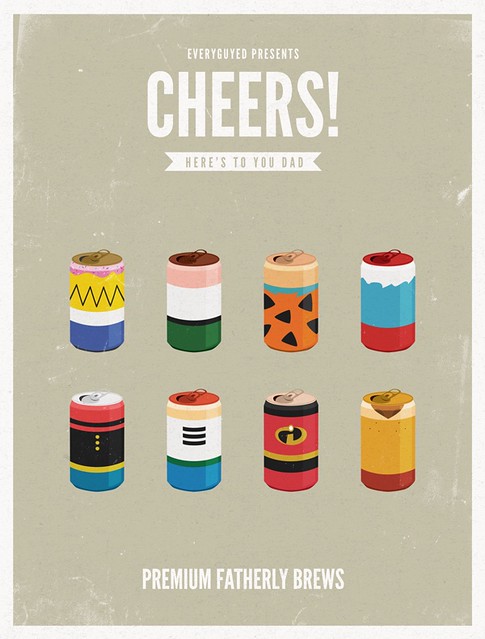
With Father’s day less than two weeks away, I thought I’d share this fun project done by the folks at Every Guyed, where they designed eight beer can dads.
fathersday-cartoondads

Here’s the idea:

To celebrate Father’s Day, EveryGuyed and Moxy Creative House have teamed up once again to deliver the second installment of the ‘Cheers!’. This time we had creative director Glenn Michael raise a glass — and his brush — to 8 iconic animated dads, re-envisioning them as beer cans.

When you were a kid, Father’s Day was a pretty boring affair. Now you’re of age, and all of a sudden you have the chance to do something with your dad that he’ll actually enjoy: share a cold one together.

See if you can guess all of the cartoon dads. The answers are below, just under the slideshow, where you can see the eight individuals posters for each beer can dad.

Now I want my own dad can. What would yours look like?

  1. Homer Simpson
  2. Peter Griffin (Family Guy)
  3. Fred Flintstone
  4. Papa Smurf
  5. Popeye
  6. George Jetson
  7. Mr. Incredible
  8. Mufasa (The Lion King)

You can even buy any of the prints as a poster at Moxy Creative House.

Filed Under: Beers, Just For Fun Tagged With: Cans, Cartoons, Holidays, Humor

Beer In Ads #353: Miss Rheingold Out On The Boat

April 21, 2011 By Jay Brooks

ad-billboard
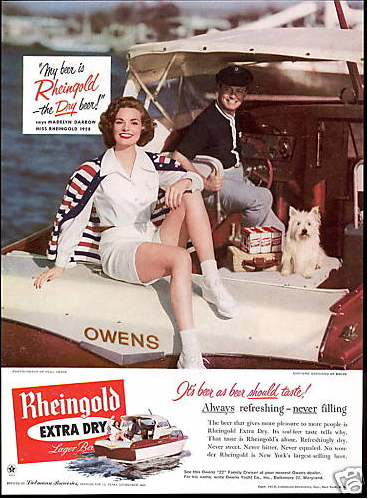
Thursday’s ad is another one for Rheingold beer, this one from 1958, featuring Miss Rheingold for that year, Madelyn Darrow, out on a motor boat — the Owens — along with a driver, her dog and at least a six-pack of Rheingold beer, in cans naturally since they’re on the water.

Rheingold-1958-7

Filed Under: Art & Beer, Beers Tagged With: Advertising, Cans, History

Amish Beer For Rumspringa

March 9, 2011 By Jay Brooks

amish-fightin
I love contradictions, especially when they have to do with the Amish. I grew up right around the Pennsylvania Amish, and in fact on my mother’s side, I am partly Amish, so to speak. From my grandfather’s generation and before, my family was Mennonite and operated a farm, having come to America from Bern, Switzerland in 1745 as Anabaptists. The Amish and the Mennonites both share an Anabaptist heritage. The Amish are the more well-known of the two, and eschew many modern conveniences such as electricity and cars. Mennonites on the other hand, at least the ones I observed growing up, drove cars but painted all the chrome black so as to avoid anything flashy or showy. Whenever you visit Amish tourist areas, the ones operating the gift shops and tourist attractions who look Amish, are more likely to be Mennonites.

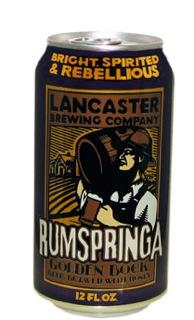
As a result of that childhood, I love all things Amish and we even have a large hex sign on our house in California, if for no better reason than to confuse people — plus, I just think they’re cool. When I play fantasy sports, I often use as a team name: the “Fightin’ Amish,” again because I love the contradiction. The Amish are conscientious objectors and don’t fight, and even have an exemption for military service. Likewise, there’s a great band I like called The Electric Amish that nicely plays on the contradictions between the Amish and modern life. I bring this up because Lancaster Brewing, in the heart of Pennsylvania’s Amish country, has announced their latest seasonal beer, in a can, to be called Rumspringa Golden Bock.
lancaster-rumspringa
Rumspringa is essentially adolescence, from around age 16 until 18, when an Amish teen has to decide to be baptized and join the church or be “shunned” (ostracized by their community for the rest of the lives — no pressure there). Not surprisingly, most join the church. During the Rumspringa, teens have more freedom then before or after, and though it varies by sect, it’s often thought of as the time when they can “sow their wild oats,” find a spouse, get a little crazy. While I’ve seen documentaries where drinking and other taboos do take place, for most it’s simply a time to decide what to do with their lives, at least as I understand it. The Amish, of course, don’t drink alcohol so I love the apparent contradiction of naming a beer for this time in the Amish life cycle. Plus it’s just a good name for a spring beer. And I’m doubly glad they’re canning it so I may even have a shot at trying some.

Filed Under: Beers, Breweries, Editorial, Just For Fun Tagged With: Cans, new release, Pennsylvania, Religion & Beer

Session #48: Bottle, Can, Keg or Cask?

February 4, 2011 By Jay Brooks

beer-bottle-brown beer-can-beer keg cask-firkin
Our 48th Session is hosted by Simon Johnson of the Reluctant Scooper. He’s chosen as his topic the age-old question about which package is best: “Cask, Keg, Can, Bottle?.”

The method of beer dispense often raises the hackles of even the most seasoned beer drinker. Some evangilise about living, breathing cask as being the one true way. Others heartily support the pressurised keg. The humble tinny has its fans. Lovers of bottled beer, either conditioned or pasturised, can be equally voiciferous.

Perhaps you think that one method magnifiies a beer’s impact. Perhaps you won’t try a beer if it’s dispensed in a way you don’t agree with. Perhaps you’ve tried one beer that’s been dispensed every which way.

The question is simple but your answer may not be: Cask, Keg, Can, Bottle: Does dispense matter

session_logo_all_text_200

I’m not necessarily a champion of any one beer delivery system over the rest. It seems to me that each contributes something to the final product, the beer. And while I applaud CAMRA’s efforts, especially early on, they seem to be stuck in the past these days continuing to promote the idea that cask beer is the only beer, whereas many forward-thinking British brewers are making great beer that’s kegged and bottled. I personally feel they should embrace any beer that tastes good and lose their preoccupation with one delivery system. (I have been a member of CAMRA, but my membership is currently lapsed.) I should also say that’s only how CAMRA seems to me from 5,000 miles away, it’s just my perception. I could be totally off base on that.

keg-wooden That being said, I must confess a weakness for cask beer, and generally order a beer on cask or in a firkin if a bar offers one. But that has more to do with wanting to encourage every bar, or at least all the good ones, to keep at least some cask or firkin beer on their menu. That, and cask beer in the U.S. is still uncommon enough that I still get excited when I discover that a new place has some. I suspect if I lived in England where it is far more common, that my choices might be different. Certainly whenever I visit the UK I rarely order beer that’s not on cask, unless it’s something special that’s not available on cask, as is increasingly the case from small artisanal British and Scottish brewers.

I really do love cask beer, especially when comparing the same beer on cask and on keg or bottled. While many people complain about cask beer seeming flat, I think the lack of carbonation allows you to taste more of the flavors of the beer that are often masked by the CO2 in non-cask beer.

keg Which brings us to kegs, which for many, many beers work just fine, as far as I’m confirmed. Certainly nitrogen kegs have a smooth taste as a generality and many regular CO2 kegs have that bubbly carbonation that for some beers works quite well, many lager styles for example seem to me to be improved by the carbonation, which give them a cleanliness of sorts — scrubbing bubbles is how I often think of them.

beer-bottle-brown Bottles, of course, allow us to be able to drink many more beers from around the country and the world because they make it possible for the beer to travel farther and last longer. Of course, clear bottles and green bottles pervert those advantages with new problems, but brown seems to do a pretty good job. I once read that red bottles would actually offer the most UV light protection, but apparently they’re prohibitively expensive for some reason (or perhaps it’s just a matter of little or no demand?). I’ve actually only seen one red bottle, which was a specialty beer I picked up at the Trumer Brauerei in Salzburg, Austria. I’ve also seen white and blue bottles, too, but have no idea how they compare.

Then, of course, there’s bottle-conditioned beers, with live yeast in them that continue to ferment in the bottle. For me, they’re the preferred bottle for many, if not, most styles of beer. Interestingly, the Sierra Nevada Pale Ale in bottles — which is bottle-conditioned — uses a slightly different recipe for their kegged pale ale, and have been experimenting with essentially a keg-conditioned version that they’re hoping will more closely approximate the bottled version.

growler-2 Of course, the question also leaves out the hybrid package: growlers. Growlers are essentially a hand-bottled keg or cask beer that you can take home with you, but you have only a day or two in which to drink it. So it’s not exactly the best of both worlds, but it is a great way to try a draft-only beer in another setting.
beer-can-beer Cans are the wild card, I think. For so long, they were dismissed as a package. Back in the early days, brewers and other beer folk (myself included) hailed the brown beer bottle as the package for craft beer. So convincing was the argument at the time that I think it’s actually slowed the acceptance of craft beer in cans. Because the issues of beer in cans — specifically metal turbidity, which is metal leeching into the beer — have been largely solved. And beyond that, cans have many advantages over bottles. I’ve been involved in several side-by-side tastings of canned vs. kegged beer and the consensus in every case has been that no discernible difference can be detected. Is anyone yet doing a can-conditioned beer?

In the end, yes, I think the package does matter, but not to the point where I’d ever pass on a beer on that basis alone. Ultimately, it’s what the beer tastes like that’s most important. The package may determine that to some extent, and some do a better job with certain beers, but enough certainly seem suited to their primary package for it not to matter. As long as it ends up in my glass, I’m going to drink it, and I’ll probably enjoy it, too.

Filed Under: Beers, Editorial, The Session Tagged With: Bottles, Cans, Cask, Kegs

Walgreens Debuts Private Label Beer

January 27, 2011 By Jay Brooks

walgreens
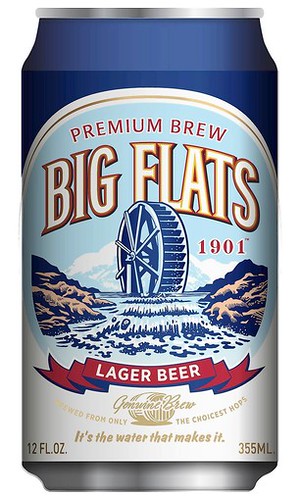
The Chicago Tribune is reporting that the drug store chain Walgreens has rolled out their own private label beer in cans, called Big Flats 1901. Walgreens is carrying the new beers in 60% of its nearly 8,000 locations and the average price is about $2.99 per six-pack or 50 cents a can. Around 15 years ago, Walgreens stopped selling alcohol in all (most?) of its stores, but recently starting stocking it again in less than half of the locations.

It would appear that Genesee Brewing in New York, part of North American Breweries, is the contract brewer making the lager beer. The label refers to the it as “Premium Brew” and includes a generic “Genuine Brew” logo and the tagline “It’s the water that makes it.” Supposedly the name comes from the “flat boats that traveled the” rivers in upstate New York “delivering goods to early settlers.” Curiously, the trademark for the name “Big Flats 1901” is owned by the Winery Exchange, which styles itself as a “full-service, value-added, corporate brand beverage alcohol company that sources beer, wine and spirits from the finest regions worldwide.” They’re also located in the same small Marin County town where I live, Novato, California.

walgreens-beer

Filed Under: Beers, News Tagged With: Business, Cans

Beer In Ads #295: Krueger’s Cream Ale

January 24, 2011 By Jay Brooks

ad-billboard
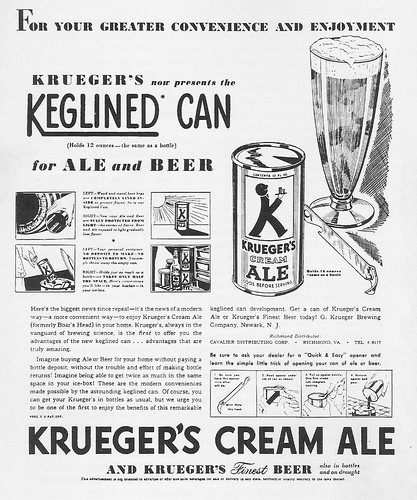
Monday’s ad is one of the first advertising canned beers, in honor of the anniversary of the first beer can being sold today in 1935. It’s for Krueger’s Cream Ale, the first beer to be sold in a can. They tested the package in Richmond, Virginia, far from their native New Jersey in case the test went poorly to avoid any damage to the brand in their home market.

krueger-cream-ale

Filed Under: Art & Beer, Beers Tagged With: Advertising, Cans, History

Next Session Opens A Can, Bottle, Cask Or Keg

January 18, 2011 By Jay Brooks

session-the
Our 48th Session will be hosted by Simon Johnson of the Reluctant Scooper. His topic is “Cask, Keg, Can, Bottle?,” or as he describes the question:

The method of beer dispense often raises the hackles of even the most seasoned beer drinker. Some evangilise about living, breathing cask as being the one true way. Others heartily support the pressurised keg. The humble tinny has its fans. Lovers of bottled beer, either conditioned or pasturised, can be equally voiciferous.

Perhaps you think that one method magnifiies a beer’s impact. Perhaps you won’t try a beer if it’s dispensed in a way you don’t agree with. Perhaps you’ve tried one beer that’s been dispensed every which way.

The question is simple but your answer may not be: Cask, Keg, Can, Bottle: Does dispense matter?

So tap a keg, pull a pint, pop a cap or open a can of whoop-ass on the next Session on Friday, February 4.

Filed Under: Beers, The Session Tagged With: Announcements, Bottles, Cans, Kegs, Packaging

Beer In Ads #284: A Bud Can Sandwich

January 7, 2011 By Jay Brooks

ad-billboard
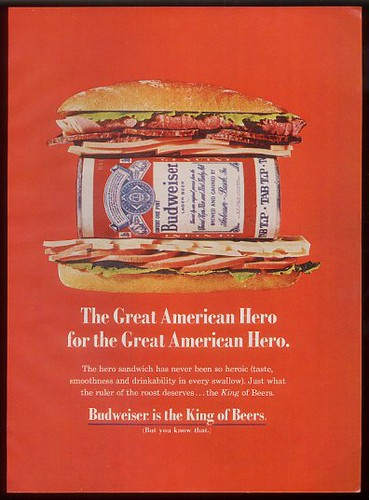
Friday’s ad is a 1969 Budweiser ad showing a can of their beer in between a hero sandwich, with the slogan “The Great American Hero for the Great American Hero.” I’m not sure I’d want to bite into that sandwich, I’d be afraid I’d lose a tooth. Or it might taste metallic.

Bud-1969-sandwich

Filed Under: Art & Beer, Beers Tagged With: Advertising, Budweiser, Cans, History

Heineken Redesigns Bottles, Reduces Number Of Sizes

December 7, 2010 By Jay Brooks

heineken
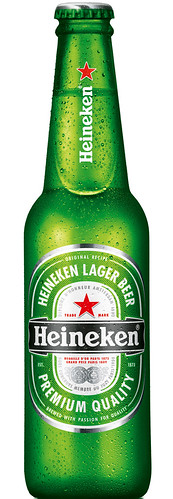
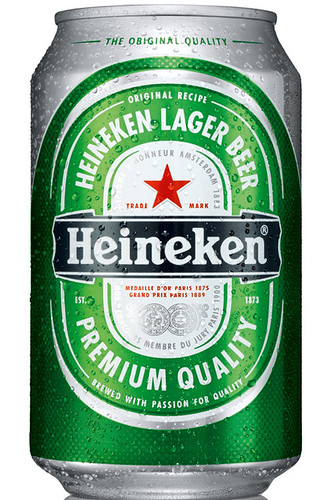
Heineken announced at the beginning of December that next year they’ll be launching redesigned bottles and cans along with a big reduction in the number of sizes they’ll be selling worldwide. The packaging redesign is cosmetic, but the package size reduction is more worrying.

According to the press release, “[t]he restyling aims to streamline the visual identity and make the brand even more consistent and recognizable in all 170 markets worldwide where Heineken can be enjoyed. The new bottle will come in five different volume sizes and will be available in Western Europe at the beginning of 2011 and across the rest of the world by 2012.”

While I realize that packaging, brand identity, etc. are very important, I still can’t help but laugh at some of the language and the way in which the new packaging design is framed. For example, check out this description:

The new bottle, replacing the XLN (extra long neck) and Heineken shortneck packaging, is introduced in two versions: embossed and standard. The new design features a unique curved embossment on the neck and back, which not only looks good, but also adds a pleasing to-the-touch feel, whilst a distinctive embossed mark acts as a stamp of quality and authenticity. Additionally, the new shape makes it look proud while enhancing the premium positioning of the bottle.

Yes, nothing says quality like a “pleasing to-the-touch feel” except perhaps the actual taste of the beer. How “proud” the new bottle looks. Huh? The “embossments,” made by using “strategically placed indents and tactile ink” somehow add “to the overall drinking experience.” Hilarious. Nothing makes me enjoy my beer more than having little raised spots on my bottle to hold on to. Of course, I always pour my beer into a glass, but I’m weird that way. No worries, a newly redesigned glass “features an embossed curve on the side, adding a pleasant feeling when held.” So they got us glass-drinkers covered, too. Whew.

But all this attention paid to their “revolutionary tactile ink” just cracks me up, and is indicative of why the big brewers are stagnating. They continue to focus on marketing and ignore what’s really important: how their beer tastes. Undoubtedly, marketing is going to keep them huge for a long time to come, but slowly it is having an effect. So this “revolutionary ink, created by a series of small raised dots on the surface of the can, gives the consumer a better feeling in the hand, enhanced grip and allows the brand to appear more refreshing and recognizable.” Nothing like an “enhanced grip” to make the beer “appear more refreshing.” I’m certainly interested in how that process works. How exactly does my grip on the beer bottle give the beer inside “the power to restore freshness, vitality, energy, etc.,” which is the definition of refreshing. That’s some pretty impressive osmosis.

Heineken_K2_Bottle_Embossed
The new “magic” embossed Heineken bottle.

But snarkiness aside, the real news is that Heineken will be reducing the number of package sizes they offer worldwide “from fifteen to five bottles sizes.” I understand any company’s reasons for reducing the number of items they sell, to a point at least. As they concede, it’s being done to achieve “greater efficiencies in the supply chain.” And it may not mean anything, but then again I can see at least one possible scenario that could play out. If Heineken cuts two-thirds of its package sizes, it’s not too hard to imagine the other international beer companies doing likewise. With the vast majority of glass manufacturer sales going to just a few companies, most likely they’d simply discontinue making the package sizes that Heineken and the others abandon. That would make those other ten bottles sizes unavailable for smaller breweries, too, or at least prohibitively expensive. Maybe that’s a stretch, but at a minimum I think it at least bears watching.

The changes will start early next year, first in Western Europe, and then the rest of the world over the balance of the year.

Heineken_Can_Tactile
The new can with “tactile ink.”

Filed Under: Breweries, News Tagged With: Big Brewers, Bottles, Business, Cans, Heineken, International, Packaging

BrewDog To Can Punk IPA

November 23, 2010 By Jay Brooks

brew-dog
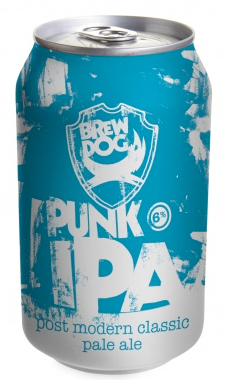
Scotland’s BrewDog announced earlier today that they’ll be releasing their popular Punk IPA in cans.

brewdog-punk-ipa-can-2

According to the BrewDog blog, the cans will be available for sale beginning in March of 2011.

brewdog-punk-ipa-can-1

Filed Under: Beers Tagged With: Announcements, Cans, Scotland

« Previous Page
Next Page »

Find Something

Northern California Breweries

Please consider purchasing my latest book, California Breweries North, available from Amazon, or ask for it at your local bookstore.

Recent Comments

  • Bob Paolino on Beer Birthday: Grant Johnston
  • Gambrinus on Historic Beer Birthday: A.J. Houghton
  • Ernie Dewing on Historic Beer Birthday: Charles William Bergner 
  • Steve 'Pudgy' De Rose on Historic Beer Birthday: Jacob Schmidt
  • Jay Brooks on Beer Birthday: Bill Owens

Recent Posts

  • Historic Beer Birthday: Anthony J. McGowan March 14, 2026
  • Beer In Ads #5163: It’s Here Genuine New Jersey Bock Beer March 14, 2026
  • Beer In Ads #5162: Bock Beer Time Is Here gain March 13-18 March 13, 2026
  • Beer Birthday: Joe Tucker March 13, 2026
  • Historic Beer Birthday: John Taylor March 13, 2026

BBB Archives

Feedback

Head Quarter
This site is hosted and maintained by H25Q.dev. Any questions or comments for the webmaster can be directed here.