Brookston Beer Bulletin

Jay R. Brooks on Beer

  • Home
  • About
  • Editorial
  • Birthdays
  • Art & Beer

Socialize

  • Dribbble
  • Email
  • Facebook
  • Flickr
  • GitHub
  • Instagram
  • LinkedIn
  • Pinterest
  • RSS
  • Twitter
  • YouTube

Powered by Genesis

Historic Beer Birthday: Charles Stegmaier

October 7, 2025 By Jay Brooks

stegmaier-crest
Today is the birthday of Charles Stegmaier (October 6, 1821-August 11, 1906). Stegmaier was born in Germany and worked there as a brewer until the age of 27. He moved to Pennsylvania and worked at breweries in Philadelphia, before he founded the Baer & Stegmaier Brewery with his father-in-law, in Wilkes-Barre, in 1857. It eventually became known as the Stegmaier Brewing Co., and Charles ran it with his sons, Christian, Fred and George.

charles_stegmaier_1821_1906

Here’s a short biography from Find-a-Grave:

Charles Stegmaier was born in Gmund, Wurtemberg, Germany, on October 7, 1821, where he learned the art of brewing. At the age of 27, having been brewmaster at several large local breweries, he sailed for America, arriving in New York in 1849. He quickly found employment with Engle & Wolf brewery in Philadelphia, and then with the Louis Bergdoll brewery. Charles formed a short-lived partnership with John Reichard of the Reichard & Weaver brewery, and came to Wilkes-Barre in 1851. This business association produced the first lager beer brewed in the Wyoming Valley.

A longer partnership was formed in 1851 when Charles met Catharine Baer, daughter of George C. Baer. Charles and Catharine were married on January 4, 1852. The couple had six children – Charles Jr., Christian, Anna, George, Louise, and Fred.

In 1857 he formed a partnership with his father-in-law to build a small brewery. The new Baer & Stegmaier Brewery was opened in 1863 and lasted until the Panic of 1873.

Charles entered the hotel business for two years before buying another brewery. Forming a partnership with his son, Christian, he successfully increased business and repurchased the Baer & Stegmaier Brewery in 1880. They built a new brewhouse and storage facility in 1894, increasing annual capacity to 300,000 barrels. By the standards of the time, this was an extremely large brewery, and they incorporated the firm in 1897 as the Stegmaier Brewing Co. Charles, who continued active management of Company affairs until 1902, operated the firm with his sons, Christian, Fred and George.

Like other philanthropically minded entrepreneurs, Charles invested in the Wilkes-Barre community. A public-spirited citizen, he contributed a significant portion of his income to the organized charities of the Wyoming Valley.

Charles died of general debility at his daughter’s home in Los Angeles, California, on August 11, 1906. He left an estate valued at $4 million.

stegmaier_brewery_1870
The Stegmaier brewery in 1870.

Here’s a history of the brewery by Ruddy Hechler, published in the Fall 1987 NABA Breweriana Collector:

Charles Stegmaier, born October 7, 1821, learned his trade in his home area of Wurtenberg, Germany. At the age of 27, having been brewmaster at several large local breweries, he set sail for America. He quickly found employment at the small Corporation Brewery in Philadelphia. Shortly thereafter, he gained employment with the Louis Bergdoll brewery, where he met John Reichard of the Reichard & Weaver brewery in Wilkes-Barre. This friendship of 1851 sent Charles packing on a 120-mile trip upstate, where he and John formed a short-lived partnership. This business association produced the first lager beer in their section of Pennsylvania. A longer partnership was also formed in 1851 when Charles married Catharine Baer, daughter of George C. Baer.

Several years later, Charles accepted a position in Pottsville with the George Laurer brewery, but he returned to Wilkes-Barre in 1857 to establish a bottling business. He quickly formed a partnership with his father-in-law, George Baer, to build a small brewery on South Canal Street. They brewed with a wooden kettle and stored their beer in an abandoned coal mine tunnel while a new brewery with underground vaults was built on East Market Street. The new Baer & Stegmaier Brewery was opened in 1863 and lasted until the Panic of 1873.

Out of a job, Charles entered the hotel business for two years before buying the Joel Bowkley Brewery on North River Street at the Canal. Forming a partnership with his son, Christian E. Stegmaier, he successfully increased business to the extent that they could repurchase the Bear & Stegmaier Brewery in 1880. Output continued to grow under the name of C. Stegmaier & Son; a new brewhouse and storage facility were built in 1894, increasing annual capacity to 300,000 barrels. By the standards of the time, this was an extremely large brewery. Charles and Christian incorporated the firm in 1897 as the Stegmaier Brewing Co. Charles, who continued active management of Company affairs until 1902, operated the firm with Christian and his other sons, Fred and George. The Stegmaier family were highly esteemed as citizens of the city; they were extremely charitable and contributed greatly toward the growth and development of Wilkes-Barre. Success this time was not short-lived; the company enjoyed many productive years before closing during long years of slow decline of the local brewers in October, 1974.

Between 1910 and 1913 Stegmaier won eight gold medals at expositions in Paris, Brussels and Rome. After prohibition it became one of the largest independent breweries in North America, reaching an output of a half million barrels in 1940. Using a 60-truck fleet and rail services, the distribution areas eventually covered the East Coast from Maine to Florida – a considerable evolution from the days of 1857 when Charles Stegmaier personally delivered each barrel of beer with an express wagon drawn by a husky goat.

The sudden announcement in 1974 by Edward R. Maier, great grandson of Charles Stegmaier, that the Stegmaier label was sold to Lion, Inc. of Wilkes-Barre sent shock waves through the brewery’s work force. The Company’s financial situation was known to be deteriorating, but the notice of sale still came as a surprise to most.

The Company was a family-run business covering four generations, always respected as a “class act” by its loyal employees, many of whom were from families whose parents and grandparents had worked with Charles Stegmaier. About 50 employees, along with Maier as Executive Vice President, were employed by Lion, Inc., but some 150 workers lost their jobs. The vacated Stegmaier brewery, purchased for back taxes in 1978, is currently owned by the City of Wilkes-Barre. The City has hopes of selling it to a developer who will pursue historic restoration of the buildings.

Stegmaier’s many years of brewing brought us not only award winning beer, but a myriad of advertising memorabilia. A room of considerable size could be filled with historic breweriana with the “Stegmaier Brewing Co.” name appearing.

Stegmaier beer is still produced by Lion, Inc., of Wilkes-Barre, and remains one of the firms best selling products. Enjoy a cold, frosty “Steg” and appreciate the history that the Stegmaier Brewing Co. has left behind.

Stegmaier-brewers
Stegmaier Brewery workers c. 1894.

From Pennsylvania Heritage; Stegmaier Brewed Beer and a Regional History, by William C. Kashatus:

“Ring-A-Ding-Ding! Do the Stegmaier Thing, In the Summertime. It’s Cold and It’s Gold like a Pocono Spring, In the Summertime. So, Ring-A-Ding-Ding, Do the Stegmaier Thing, Any Time At All!”

Pennsylvanians may recall the infectious jingle advertising Stegmaier beer on WFIL radio and television in Philadelphia and shouted across billboards in the Pocono Mountains and the northeastern counties of the Keystone State in the 1960s. It was part of an aggressive advertising campaign launched by the Wilkes-Barre-based brewing company to retain its dominant position in the regional beer-making industry over emerging consolidated national brewers.

Stegmaier’s not only prevailed in the competition, but strengthened its relationship with its fiercely loyal consumer base struggling to survive the economic dislocation created by the demise of the region’s anthracite industry. The Stegmaier Brewing Company was an inextricable part of northeastern Pennsylvania’s cultural identity for more than a century. Founded in 1857 by German immigrant Charles E. Stegmaier (1821-1906), the business began as a modest brewery and bottling operation but, by the turn of the century, was producing 800,000 barrels of beer annually, making it one of the largest breweries in the United States. Stegmaier is the story of a German immigrant’s quest for the American Dream.

Pennsylvania’s beer-making industry dates to the earliest communities established by English and Dutch settlers in the early to mid-seventeenth century. The colonists quickly recognized that the climate and soil of the Mid-Atlantic region were particularly well suited to brewing beer and growing malt and hops, two of beer’s essential ingredients. William Penn, the Quaker founder of the colony, brewed beer at his Bucks County estate, Pennsbury Manor. His capital city of Philadelphia boasted at least four brew houses as the city’s earliest settlers were hearty drinkers. Beer was an essential staple in the seventeenth-century diet of Pennsylvanians and continued to be the drink of choice throughout the eighteenth century when brewing expanded to other communities such as Reading, Allentown, and Pittsburgh. For many years the production of beer remained a local enterprise. Bottling was expensive and beer did not stay fresh for long periods of time. Nearly all beer was stored in, and served from, wooden kegs. While there were many small breweries it was not uncommon for households to brew their own beer, particularly ales, porters, and stouts, in the English tradition.

Factory-Scene-Post-Cards-Stegmaier-Brewing-Co

During the nineteenth century Pennsylvania witnessed the emergence of brewing as a significant industry. Industrial growth attracted considerable immigration from strong beer-drinking countries such as England, Ireland, and Germany. German immigrants, in particular, were skilled craftsmen who found work in the building and beer-making trades. Breweries were established in every major city and many towns associated with the steel and coal industries. One of these immigrants was Charles E. Stegmaier.

Born on October 7, 1821, in Gmund, Wüttemberg, Germany, Stegmaier at the age of fifteen became an apprentice to a local brewer. He spent thirteen years learning the art of brewing. Intent on parlaying his knowledge into a lucrative business the twenty-seven-year-old German set sail for the United States in 1849. He settled in Philadelphia where he found employment at the small Corporation Brewery, also known as the Philadelphia Joint Stock Brewery, at 209 North Third St. In 1851 Stegmaier joined the Louis Bergdoll and Sons Brewing Company, also in Philadelphia, where he met Wilkes-Barre brewer John Reichard who had been producing British-style ales. Reichard brewed his beer with top fermenting yeasts which ranged from light pale ales to hearty chocolate-colored stouts and porters. The American market at the time was yielding to an increasing demand for German-style lager beers. Lager beers require a great deal of care and attention; not only do they need a longer maturation period than ales, but they use a bottom fermenting yeast and are much more sensitive to temperatures. Capitalizing on the shifting market Stegmaier and Reichard formed a partnership at Wilkes-Barre to produce the first lager beer in northeastern Pennsylvania.

On January 4, 1852, Stegmaier married Katherine Baer (1820-1885) and they became the parents of six children, five of whom survived into adulthood: Charles Jr., Christian E., George J., Frederick J., and Louise, who married Philip Forve. Newly married and with a child on the way, Stegmaier had greater ambitions. He accepted a position as a brewer with George Lauer of Pottsville, Schuylkill County, operator of the Orchard Brewery from 1845 to 1860 and one of the most prominent brewers in Pennsylvania. During the next five years, Stegmaier learned the intricacies of managing a brewery and lived frugally, intending to find a suitable place to establish a brewery of his own.

Confident that Wilkes-Barre, with its growing anthracite mining industry and its rapidly increasing population, would eventually provide a lucrative market for his products, Stegmaier returned to the Wyoming Valley in 1857 and entered into a partnership with his father-in-law, George C. Baer. They established their business on Hunt Street. It was a provincial operation in which beer was brewed in a wooden kettle and stored in an abandoned mine tunnel to keep it cool. Stegmaier delivered the beer to local bars and taverns in a goat-drawn cart. He devoted himself to every detail of the business, made friends, and extended his trade. Within a few years, they erected a small brewery on South Canal Street, formally adopted the name of Baer and Stegmaier Brewing Company, and hired five employees.

stegmaier-coaster-seethru

Baer and Stegmaier prospered, enabling the partners to build a new brewery with underground vaults on East Market Street. The new operation, opened in 1863, enabled the firm to enlarge its brewing and storing capacity and to steadily increase its trade. It was one of 1,269 breweries in the United States. Collectively, the breweries produced more than one million barrels of beer yearly for the nation’s population of thirty-one million. New York and Pennsylvania accounted for 85 percent of the production. But the boom and bust economy of the late nineteenth century ended success for many breweries.

During the Panic of 1873, which triggered a severe economic depression that lasted until 1879, values depreciated to such an extent that many breweries failed. Forced to sell his brewery, Stegmaier briefly entered the hotel business before declaring bankruptcy. Despite the financial setback he managed to regroup by 1875. He formed a partnership with son Christian and leased the old Joel Bowkley Brewery on North River Street. Within two years C. Stegmaier and Son increased production to 4,362 barrels of beer. With the profits Charles was able to repurchase the Baer and Stegmaier Brewery in 1880. Output continued to grow and the brewery expanded to a sprawling 4.6-acre complex.

In 1890 Stegmaier commissioned Adam C. Wagner (1858-1935), a Philadelphia architect who designed fifty brewing plants during his career, to draw plans for a new cupola-topped brew house, administration building, and storage facility. Construction of the handsome complex was completed in 1894. The elaborately crafted, wood-paneled office building was centered among the brew, wash, bottle, and barrel houses, where more than three hundred employees worked. Workers kept the brewery in immaculate shape and it awed visitors with its gleaming brass railings, brightly shining kettles, and enormous vats.

The new facilities also allowed the company to increase annual capacity to 400,000 barrels, making C. Stegmaier and Son an extremely large brewery by the standards of the time. The company specialized in Lietbotschaner lager, marketed as “the people’s popular beverage,” and porter. It employed forty-seven men at the brewery, as well as drivers for thirty-six delivery horses. The enterprise was so prosperous that Stegmaier returned to the hotel business, operating the Brewery Hotel at the corner of East Market and Baltimore Streets, where the company’s offices were also located. It was also during this decade that Stegmaier’s other sons, Charles Jr., George, and Frederick, began working for the company.
Charles Stegmaier was literally in the right place at the right time. Beer was a mass-produced, mass-consumed beverage at the close of the nineteenth century. At a time when America was becoming an industrialized society most workers in the manufacturing and mining trades drank beer during and after working hours. The beverage also benefited from a growing temperance movement that advocated beer instead of spirits such as rum or whiskey with considerably higher alcoholic content. Stegmaier capitalized on these trends. He launched an ambitious billboard campaign advertising his company’s brews as “Recommended by Prominent Physicians for Purity, Strength, and Flavor.” Other advertisements emphasized his hotel’s proximity to the Lehigh and Susquehanna Railroad Company’s train depot, noting that the “bar is always open and stocked with the choicest of wines, ales, liquors, and cigars.” The brewery enjoyed an enormous regional market supported by thousands of coal miners, as well as a growing national market. Stegmaier was one of several companies that increased its scale of production and scope of distribution by utilizing the growing railroad system to distribute beer in more distant markets. Situated across from the New Jersey Central Railroad line, the Stegmaier Brewery was easily able to transport its beer to consumers along the East Coast.

Although not considered a powerful national-oriented brewery such as Pabst in Milwaukee and Anheuser-Busch in St. Louis, Stegmaier was able to compete with these larger firms in the eastern United States. Its regional success was due to such innovations as pasteurizing, bottling, and transporting beer, compared to the locally-oriented breweries that mainly supplied draught beer in wooden kegs to their immediate markets.

In 1897 the Stegmaiers incorporated their enterprise as the Stegmaier Brewing Company, an acknowledgement that the firm was a family business operated by father and his four sons. The company’s value was estimated at $600,000. Charles, who served as president, received 5,400 shares, and his sons 150 shares each. With a labor force of several hundred and cold storage plants and depots throughout northeastern Pennsylvania, Stegmaier was producing 110,000 barrels per year by 1903, doubling the output of any other brewery in Luzerne County and making it the largest brewery business outside of Philadelphia and Pittsburgh.

Charles Stegmaier enjoyed the wealth he had worked so hard to achieve. He lived in luxury at the new Hotel Sterling. His suite on the top floor overlooked the Susquehanna River, Public Square, and the River Common. He was also an exceptional individual. Stegmaier was shrewd in business but scrupulously honest; frugal in his personal lifestyle but lavish in his hospitality. A modest man, he disliked praise or notoriety but was always willing to help a deserving cause. Like other philanthropically-minded entrepreneurs Stegmaier invested liberally in the Wilkes-Barre community and contributed significantly to the organized charities of the Wyoming Valley. He served on the boards of the city’s largest commercial enterprises and financial institutions. He made every effort to employ the “deserving” and “industrious” poor rather than those who were “idle” and simply looking for a handout. As a result, employees and their families were extremely loyal, as sons and grandsons eventually went to work for the brewery. When he died on August 11, 1906, Charles Stegmaier left an estate valued at $4 million, the equivalent of nearly one hundred million dollars in today’s currency. His sons continued the brewery with mixed success.

stegmeier_boiler_room_c1930s
Stegmaier’s boiler room, c. 1930.

By 1910 brewing had become one of the leading manufacturing industries in the United States with 1,568 active breweries. Stegmaier reaped the rewards of that success winning eight gold medals at expositions in Paris, Brussels, and Rome between 1910 and 1913. In 1916 Stegmaier was producing more than 200,000 barrels annually, cementing its status as the largest brewery in northeastern Pennsylvania. As the brewery continued to grow, however, so too did the body of temperance reformers who sought to entirely eliminate alcoholic beverages from American life. The “dry forces” prevailed with the ratification of the Eighteenth Amendment on January 29, 1919, and once again the Stegmaier Brewing Company would struggle to survive. Prohibition made the production and distribution of beverages with more than one-half of 1 percent alcohol illegal and resulted in the closing of many small breweries that had been profitable.

The larger shipping breweries with much greater investments were not as inclined to walk away from brewing. Schlitz, Blatz, Pabst, and Anheuser-Busch, the leading pre-Prohibition shippers, began producing “near beer,” a malt beverage containing less than one-half of 1 percent alcohol. While it was not a commercial success, its production allowed the firms to keep current their beer-making skills and generate modest revenues. Anheuser-Busch called its near beer Budweiser which was simply the old Budweiser lager beer brewed according to the traditional method and then de-alcoholized.

The federal government granted special licenses to leading breweries which allowed them to brew beverages with an alcohol content greater than one-half of 1 percent for medicinal purposes. The licenses gave them a competitive advantage since they were able to keep their brewing staff working. Stegmaier’s was caught in the middle. While it was larger than the other local breweries, it did not command the market of the bigger ones, which enjoyed a much greater national distribution. Stegmaier weathered the storm of Prohibition by producing near beer and malt syrup. While the company advertised malt syrup as an ingredient for baking cookies it was really intended for homemade beer.

In April 1933 Congress amended the Volstead Act to allow for 3.2 percent beer. Eight months later, in December, after more than thirteen dry years, Congress and the states ratified the Twenty-First Amendment, officially repealing Prohibition. After Prohibition ended Stegmaier’s became one of the largest independent breweries in North America, reaching an output of a half million barrels in 1940. During World War II the brewing industry boomed as consumers, both soldiers and civilians, used some of their wages for beer. Per capita consumption grew by 50 percent between 1940 and 1945. Stegmaier seized the opportunity to expand its market. Using a fleet of sixty trucks and rail services, the brewery’s distribution areas eventually covered the entire East Coast from Maine to Florida.

The company, proud of its magnificent complex completed in 1894, used images of it on stationery, including billheads which also advertised export and select beer, stock lager, porter, malt extract, and ales.

While total production of beer continued to grow in the decades after the war, per capita consumption fell in the 1960s before rebounding to levels of more than twenty-one gallons per capita in the 1970s, the highest rates in the nation’s history. It also became evident that Stegmaier could no longer compete with the nation’s leading breweries Anheuser-Busch, Pabst, Schlitz, and Blatz. With the company’s financial situation deteriorating, Edward R. Maier, the great-grandson of Charles Stegmaier, announced in October 1974 that the Stegmaier label had been sold to The Lion Inc. of Wilkes-Barre. The announcement sent shock waves through the brewery’s work force. Maier, as executive vice president, along with fifty employees were added to The Lion’s operation. Another 150 workers lost their jobs. “It was very sad to sell the business,” admitted Maier in a 1992 interview. “Ours was a gorgeous complex, like a dollhouse. It was shining, all brass and copper. Curved moldings, brass railings. But it was an impossible business. We closed for the same reason Rheingold, Schaefer, and Ballantine closed – a tough competitive environment. The brewery business is like the auto-making business. Either you’re very, very big or you get eaten up.”

Stegmaier beer is still produced by The Lion Inc. at its North End brewery and remains one of the firm’s best-selling products. The Stegmaier brewery complex, purchased by the City of Wilkes-Barre for back taxes in 1978, was restored by the awardwinning architectural firm of Bohlin Cywinski Jackson and now serves as a federal office building. The Victorian era red brick brew house remains from the brewery’s glory days, an impressive reminder of the days when beer was the workingman’s champagne, and the robust aroma of hops, barley, and malt filled the air of downtown Wilkes-Barre.

Stegmaier_Brewin_53a40cc7956bf

Gold-Medal--Beer-Labels-Stegmaier-Brewing-Company

Filed Under: Birthdays, Just For Fun Tagged With: Germany, History, Pennsylvania

Historic Beer Birthday: John Wieland

October 6, 2025 By Jay Brooks

john-wieland
Today is the birthday of John Wieland (October 6, 1829-January 3, 1885). He was born in Baden-Württemberg, Germany, and emigrated to the U.S. when he was twenty, in 1849, eventually settling in the San Francisco area of California. In 1855, he founded (or bought into) the Philadelphia Brewery in San Francisco. After his death in 1885, the name was changed in 1887 to the John Wieland Brewery. In 1890, it became part of a ten-brewery British syndicate, and remained open until prohibition. It reopened in 1934, but closed for good the same year.

John-Wieland-portrait

This obituary is from the Daily Alta California, January 3, 1885:

Founder of Philadelpha Brewery, Descended from one of oldest families in Wurtemberg, Germany. His father, John David Wieland was born in Wurtemberg in 1751 and married to Regina Hahn.
John Wieland went to school to age 13 and then worked in the vineyards. On 3/26/1849 he set sail to the United States, landing in New York and going directly to Philadelphia where he was apprenticed as a baker. In 1850, after hearing tales of gold in California, he sailed around Cape Horn on a 165-day voyage and arrived in San Francisco in early 1851. He mined on the South Fork of the Yuba river and Canon creek with great success and purchased a claim on Twist Flat, sold it and then returned to San Francisco as a baker at Union Bakery- later owning it. He married Sophia Fredrica Dorthea Schulthiess (native of Wurtemburg) in November 1853 and had eleven children. (Nine of them were surviving as of 1892). Tragically, on January 3, 1895, he and his 17-year-old daughter, Bertha, were killed in an accident when he brought a candle too close to oil stored in the basement and it exploded. His son Albert was also badly burnt and his son Hermann had severe burns on his right hand.

Wieland
This obituary is from “The Bay of San Francisco,” published in 1892:

JOHN WIELAND, deceased, whose name was so well and favorably known as one of San Francisco’s most progressive business men, was the founder and proprietor of the Philadelphia Brewery, which grew from a small beginning to be one of the leading industries of the city. Mr. Wieland was descended from one of the oldest families of Wurtemberg, Germany. His father, John David Wieland, was born in the home of his ancestors in 1791, and followed the business of a wine grower and also did some farming. During his life he was a gallant soldier, and in recognition of his bravery he was decorated. He married Regina Hahn. Their son, John Wieland, was born October 6, 1829 in Wurtemberg, and attended school until he was thirteen years of age, when he went to Constadt and worked on farms and in vineyards. After seven pears [years] spent in this way he determined to go to American, and March 26, 1849, he bade farewell to his native land and set sail for the New World. After landing in New York he went direct to Philadelphia and apprenticed himself as a baker. In 1850 the stories of the gold discoveries of California reached the East, and he determined to see all that the United States could offer. He sailed from the port of New York on board the ship Botner, went around the Horn, and arrived in San Francisco early in 1851, after a voyage of 165 days. He at once went to work at his trade, but attracted by the gold mining reports he went to the south fork of the Yuba river and mined on Canon creek, meeting with great success. Later he purchased a claim on Twist Flat and continued there until the close of 1851, when the sold out and returned to San Francisco. For two months he was employed at the Union Bakery, and then bought an interest in the business, and in six months was the owner of the whole establishment. The following year he formed a partnership, the firm being known as John Wieland & Co., and this existed until 1855. When this relationship ceased he determined to embark in the business in which he was successful up to the time of his death. He first purchased an interest in the business of August Hoelscher; they were very prosperous, and in 1867 he purchased the interest of his partner, paying therefor the sum of $100,000. He continued to make improvements and to extend his patronage until the establishment became one of the great enterprises in the commerce of the city.

philadelphia-brewery-ad

Mr. Wieland was married in November 1853, to Miss Sophia Frederica Dorothea Schulthiess, a native of Wurtemberg, and the union was blessed with eleven children; nine of whom still survive; three of the sons were associated with the father in business and rendered him valuable assistance. Mr. Wieland was a member of the Turn Verein, having joined in 1854; for a short time he was Treasurer of the society; he was a member of the San Francisco Schuetzen Verein. He was frequently urged to allow his name to be used as a candidate for public office, but he steadily declined the honor. Soon after his arrival in Philadelphia he made application for citizenship, and in 1853, in San Francisco, he accepted the obligations imposed upon an adopted citizen of the United States, and has ever been true to his vows.

Wieland-ad-1888

On January 3, 1885, he met with a sad and painful accident, which resulted in his death on the following day. The cause of the disaster was a kerosene explosion, in which his son and daughter were badly burned, and in his efforts to save them he lost his own life. This affliction caused a deep gloom to settle over the city, and many sympathizing friends did all in human power for the bereaved and suffering family. Mr. Wieland was a kind and indulgent father and husband, and a stanch and trusted friend. Mrs. Wieland survived her husband until the year 1891, when she, too, passed to the other life. She was a women of unlimited generosity and of most gracious hospitality. The children are all natives of San Francisco, and are among her most worthy sons and daughters.

wielands_brewery
This account is from Bill Yenne’s “San Francisco Beer: A History of Brewing by the Bay:”

Wieland-yenne

wieland-employees

wielands-extra-pale-lager-indian-girl-beer-tray

Crown-Special-Lager-Beer-Labels-John-Wieland-Brewery--San-Francisco-Breweries

Filed Under: Birthdays, Breweries, Just For Fun Tagged With: California, Germany, History

Historic Beer Birthday: Anthony Yoerg

October 5, 2025 By Jay Brooks

yoerg
Today is the birthday of Anthony Yoerg (October 5, 1816-July 5, 1896). He was born in Bavaria, was trained there as a brewer, and came to America when he was 29, settling first in Pittsburgh, then Illinois, before settling in St. Paul, Minnesota in 1848. In 1869, Anthony and his son built Minnesota’s first brewery, and began selling beer the following year, in 1870.

anthony-yoerg

Here’s a short biography of Anthony Yoerg:

Anthony Yoerg, born in Bavaria in 1816, arrived in St. Paul in 1848. After a failed attempt at running a butcher shop, he and his son, Anthony Yoerg, Jr., began construction of Minnesota’s first brewery that winter near where Washington and Eagle once met (just bellow the current civic center parking lot). Their first beer was sold the following spring. In 1870 the Yoergs moved their operation across the river to Commercial (Ethel) & Ohio St. This new location was equipped with the latest in steam-powered equipment as well as five cellars excavated into the sandstone bluffs to serve as fermentation and storage holds for the popular lager beer.

Anthony Yoerg died July 5, 1896, leaving his family to operate the brewery as the Yoerg Brewing Co., which they did successfully even through Prohibition, when they produced soft drinks. Beer began flowing again after Repeal and the Yoerg Brewing Co. continued operation up until 1952.

The brewery buildings were eventually occupied by the Harris Plumbing Company. On September 26, 1958, the main building caught fire and was eventually razed.

Anthony_Yoerg_Painting_WEB

This account is by Dave C. of the Minnesota Beer Activists:

Anthony Yoerg was “Minnesota’s first commercial brewer. Born in 1816, Yoerg was born in real beer country, Bavaria Germany. He was trained as a brewer in Bavaria and moved to the United States when he was 29. He jumped around the country a little before landing in St Paul in 1848.

By the following year, Yoerg was already up and brewing in the area behind the Eagle Street Grille where he could use the bluffs to store his beer in which it was famously referred to as “Cave-Aged”. By the time 1871 came around his beer was in such demand that the brewery was getting too cramped and he needed to relocate. Finding a new location was as simple as looking across the river.

The new brewery was built on the corner of St. Paul’s Ohio and Ethel streets. Here Yoerg had the perfect 47-degree climate for the storage and aging of the beer and more than enough room if needed for any future expansion of the brewery. Soon his new brewery was producing up to 50 barrels of beer a day and things were looking up for Yoerg and his crew.

By 1880 the brewery had entered “the modern age” and installed steam power. The work crew consisted of around 20 workers including the brewmaster Joseph Slappi… (I could make a joke here but I won’t). In the next decade the styles were expanded by offering Pilsner (of course), Lager and Culmbacher, (not exactly sure what style that is but Kulmbacher is currently a beer in Germany which is made in…Kulmbach). On a side note Yoerg had a slogan for their Royal Export beer and that was “The Queen of beers”…yeah I’m not sure what was going on in those caves but those guys spent way too much time together haha. Also, is this where Budweiser got the inspiration for their slogan?

Sadly, in July of 1896 Anthony Yoerg died. After which Yoerg’s five sons took over the business and continued on.

yoerg-brewery-illustration

By far, the most and best information about Anthony Yoerg, the Yoerg Brewing Co., and the entire family, can be found at Yoerg’s Beer, a contemporary effort to bring back the Yoerg beer brand to Saint Paul. They also have a lot of history and images of all things Yoerg Beer.

Saint Paul has a rich and storied brewing history, and it all started with the opening of Minnesota’s first brewery in 1848; The Anthony Yoerg Brewing Company. Minnesota, and in particular Saint Paul, had one of the largest German populations in the country back then, and these immigrants brought with them the great art of brewing. The German technology was much more advanced than the British influences that were prevalent at the time, and Minnesota had all the required ingredients to brew great beer; terrific water sources and lots of farmland to grow barley and hops.

Yoergs-Beer-Labels-Yoerg-Brewing-Company

Anthony Yoerg was born into a brewing family on October 5th, 1816 in the Bavarian village of Gundelfingen. At 19 years of age, he immigrated to the United States and first settled in Pittsburgh Pennsylvania. Soon after he relocated to Galena Illinois and finally moved to a new Minnesota settlement on the Mississippi River called Saint Paul. For a very short time Anthony ran a butcher shop in a German neighborhood on the West Side but he quickly decided to change careers and opened a small brewery in the German ‘Uppertown’ neighborhood not far from today’s seven corners.

For 21 years Yoerg ran this little brewery with great success and Saint Paul was a becoming quite popular in the Midwest with up to 12 breweries operation at one time. But the Yoerg Brewery was the most revered of them all, and produced hearty, Bavarian styled beers that were the standard bearers of the state and the benchmark that every new Minnesota brewery would try to recreate. In 1871, Anthony built a great stone brewery across the river on Ohio Street on the West Side, just two blocks from Water Street. A mile of underground cooling caves were created and this new operation was a true, fully automated brewery that was the envy of breweries nationwide. Production was now up to 50 barrels of beer a day, and by 1881, they were producing over 20,000 barrels of beer a year. Ten years later and production has almost doubled with the brewery now producing over 35,000 barrels a year and they were one of the biggest breweries in the state (With Theodore Hamms and Jacob Schmidt far behind him).

Yoergs-Beer-Labels-Yoerg-Brewing-Co

Yoerg’s ‘Cave Aged’ beers were produced exclusively from Minnesota grown Barley and 100% Washington State Hops. The water source was a deep well dug on the Brewery property and the Yoerg’s had their own Bavarian cooper on staff that made and designed all their own oak cooperage. The bottling line was the finest available and the family was constantly upgrading their equipment. The Yoerg Lagers were produced utilizing the steam process, this meant that the beers were brewed at warm temperatures using lager yeasts, and the finished products were the richest and most lavish beers on the market. The family was also famous for hiring other German immigrants back then to work at the brewery (the entire staff were almost all Bavarian born).

Yoerg_Staff_-_1880s_WEB
Yoerg Brewery employees in the 1880s.

And here’s Yoerg’s obituary:

Yoerg_obituary

yoerg_ad_111

yoerg_-_elves_ad_-_coooool_350

Filed Under: Birthdays, Just For Fun Tagged With: Germany, History, Minnesota

Historic Beer Birthday: Karl Strauss

October 5, 2025 By Jay Brooks

Today is the birthday of Karl Strauss (October 5, 1912-December 21, 2006). He “was a German-American brewer. He fled Nazi Germany in 1939, and went on to become a brewer, executive, and consultant in the American brewing industry. He received numerous awards during his career, which spanned both the large national brewery and the microbrew segments of the industry. Karl Strauss Brewing Company, which he helped found in 1989, continues to bear his name.”

I only met Karl one time (I think) in the latter half of the 1990s during my BevMo days. In 2006, my Karl Strauss rep. from that time sent me an e-mail letting me know that Karl has passed, and I wrote the following in the blog ten years ago. “Yesterday, Karl Strauss passed away in Milwaukee at age 94. Born in Germany, and a graduate of Weihenstephan, Strauss worked for Pabst for decades before retiring as a vice-president. In 1989, along with cousin Chris Cramer and Matt Rattner, Strauss founded the San Diego microbrewery that bears his name. It was San Diego’s first one and today the company operates a brewery and six brewpubs.”

Here’s the more thorough story from the brewery website:

Karl Strauss was destined to brew beer. Born in 1912 on the premises of his father’s brewery in Minden, Germany, he spent his childhood playing amid beer barrels and sacks of fresh hops and barley. At age 19, he left home for Bavaria, the brewing capital of Germany, to attend the Technical University of Munich-Weihenstephan. There he earned a degree in the science and practice of malting and brewing, as well as a Master Brewer certification. Given the political situation in 1930s Germany, Karl had to look abroad for work. In February of 1939, he boarded the SS Manhatten and set sail for America, in pursuit of opportunity. His job search led him to Milwaukee, Wisconsin, home to one of the most famous breweries in the United States.

Karl began his career at Pabst Brewing Company on the bottling line in May, 1939. But with his strong work ethic and educational background, he quickly worked his way up the brewing ranks. In the 1950s, he was part of the team that reformulated the recipe for Pabst’s Blue Ribbon beer. The improved version catapulted sales for the company, and PBR remains an American brewing icon to this day. In 1960, Karl became Vice President of Production, overseeing all brewing operations across the country. He held the position until he retired in 1983, after 44 years with the company.
Not content to rest after his retirement, Karl launched a new career as a brewery consultant, providing expert advice to breweries all over the world. In 1986, he was approached by his cousin Chris in San Diego about starting a microbrewery. Karl thought it was a great idea. He helped design the brewery, train the brewers, and create recipes for the first beers. He was so passionate about the project that he even lent his name, face and voice to the enterprise. Karl served as Master Brewer from 1989 to 2006, remaining involved in brewery operations until his passing.

Karl was very active in the brewing community throughout his life. He was president of the Master Brewers Association of the Americas (1961-1963) and founder and director of the Museum of Beer and Brewing in Milwaukee. He is the only person to have received the MBAA Award of Merit (1981), Award of Honor (1992), and the Distinguished Life Service Award (2003). Karl also believed it was important to pass on the techniques and traditions of his craft to young brewers. We created the Karl M. Strauss Brewers Education Fund in honor of his work.

Karl had a contagious enthusiasm that inspired everyone around him. He was driven by a belief that everyone should enjoy life, preferably with good friends and good beer. Over the course of his 70 plus years as a brewer, he brewed more than seven billion servings of beer, enough for everyone on the planet to have a Karl Strauss Beer.

Karl_Strauss_1960

Here’s much more, from Wikipedia:

Early Life

He was born October 5, 1912, on the second floor of the administration building of the Feldschlösschen Bräu, a brewery in Minden, Germany, of which his father was president. The second born of two boys and a girl to Albrecht and Mathilde Strauss, he attended the Oberrealschule in Minden where he received his Abitur. During his young life he assisted his father as a brewer and intern while living in the family quarters at the brewery. At age 19, he went to the Technical University of Munich at Weihenstephan, where he received a degree in the science and practice of malting and brewing. In addition, he received Master Brewer certification, allowing him to teach apprentice brewers. With his diploma in hand, he began working at breweries including the Falkenkreuz Brauerei Lippert in Detmold, Westphalia; the Bauer Brauerei in Lübeck, Holstein; and the Altstädter Malzfabrik in Altstadt, Thuringia.

With the rise of the Nazis, Germany was not a safe place for the Jewish Strauss family, and work became scarce. “I graduated from college while Hitler was in power and as a Jew could not find employment in the brewing industry,” he wrote in 1943. Thanks to family living in the United States, he was able to secure sponsorship to emigrate. But other members of his family were not so lucky. The last time he saw his mother was the night he left Germany. She later was killed in a concentration camp. His brother was killed in a Nazi raid on the Polish underground.

Career in America

In 1939, Strauss left Germany for the United States, followed soon by his first wife, Irene Vollweiler. He had planned to join family members in San Francisco, California, but stopped in Milwaukee, Wisconsin, at the urging of an uncle to visit family friends. While there he applied for a job with the Pabst Brewing Company, which he intended to be temporary. “I arrived in Milwaukee on St. Patrick’s Day, 1939,” he later recalled. “I started to work at Pabst on May 11, 1939, and I worked for Pabst for 44 years.”

He began his work at Pabst feeding bottles to the bottle soaker. However, “once Pabst realized that it had a Bavarian brew master in its employ, Strauss quickly advanced.” Within a few months he was promoted to foreman of filtration. He continued to quickly move up the corporate ladder, becoming an assistant superintendent and later malt house superintendent. In 1942, he was transferred to Pabst’s brewery in Peoria, Illinois, as the plant production manager. Within a few years he was made head maltster in Milwaukee and was assistant superintendent of the malt house and brewhouse. In 1948, he was promoted to superintendent of Pabst’s newly purchased plant in Los Angeles, and remained there until 1956. He was named technical director of Pabst in 1958, and promoted to vice-president of production in 1960. He helped Pabst reformulate its beer, as well as create a new Pabst Blue Ribbon. He continued as vice-president until retiring from Pabst in 1983.

His first wife died in 1978. He married his second wife, Marjean Schaefer, in 1980.

Post-retirement

In the 1980s, Strauss began a new career as a brewery consultant, providing services for both large breweries and microbreweries throughout the world. He had clients in Europe, Asia, and North America, including Molson, Tsingtao, The Boston Beer Company, and Goose Island Beer Company. He helped design more than 50 brewpubs and microbreweries.

In 1987, a cousin, Chris Cramer, and Cramer’s college roommate, Matt Rattner, asked Strauss to help them develop a brewpub in San Diego, California. Strauss not only designed the brewery and trained the brewers; he also formulated the original beer recipes and lent his name to the endeavor. Opening on February 2, 1989, Karl Strauss Brewing Company became the first brewery in San Diego in more than fifty years and is credited with having launched the craft brewing industry in San Diego. Strauss served as the brewmaster and corporate image of Karl Strauss Brewing Company. As corporate spokesman he made radio commercials in his thick German accent, always concluding “…or my name isn’t Karrrrl Strrrrrauss!”; on the technical side he was heavily involved in the design of the company’s new properties and brewing of new beers. He remained actively involved with the company until his death in Milwaukee on December 21, 2006, at the age of 94. He is buried at Mount Sinai Memorial Park in Los Angeles.

Strauss co-authored a book, The Practical Brewer, published by the Master Brewers Association of the Americas.

strauss-amber-label

Legacy

Strauss was president of the Master Brewers Association of the Americas from 1961–63. He is the only person to receive all three of the highest awards given by the association: the Award of Merit (1981), given to an individual or individuals who made an outstanding contribution to the brewing industry; the Award of Honor (1992), given to a member who has rendered outstanding service to the association; and the Distinguished Life Service Award (2003), which recognizes MBAA members who have given exceptional service to the association.

Karl was a founder and director of the Museum of Beer and Brewing in Milwaukee. The museum now presents an annual Karl Strauss Award to individuals for lifetime contributions to the industry.

In 2006, Karl Strauss Brewing Company set up the Karl Strauss Brewers Education Fund with the Jewish Community Foundation of San Diego. The fund provides financial educational support to aspiring southern California brewers pursuing a career in the field of brewing.

karl-strauss-coaster

And finally, here’s a video celebrating what would have been Karl’s 100th birthday in 2012.

Filed Under: Birthdays, Just For Fun Tagged With: California, Germany, History, San Diego

Historic Beer Birthday: Jacob Gimlich

October 4, 2025 By Jay Brooks

Today is the birthday of Jacob Gimlich (October 4, 1845-January 21, 1912). He was born in Weisenheim, Bavaria, but came to Massachusetts and bought the M. Benson Brewery of Pittsfield, with business partner John White, in 1868, only one year after it opened. They renamed it the unimaginative Jacob Gimlich & John White Brewery. In 1891, they changed its name to the Berkshire Brewing Association, and that remained its name until it closed due to prohibition in 1918 or 1919. “The brewery produced beers such as Greylock Ale, Mannheimer Lager, Lenox Half Stock Ale, Berkshire Lager, Berkshire Ale, and Superior Old Porter. In addition to beer, Mineral Water, Soda, and Malt Extracts were also produced. The brewery was a great success producing 75,000 barrels a year and distributed all over the northeast and as far south as the Carolinas.”

Here’s a history of Gimlich, from “Historic homes and institutions and genealogical and personal memoirs of Berkshire County, Massachusetts,” published in 1906:

Here’s a story of the brewery iBerkshires.com:

One can only wonder what John White and Jacob Gimlich would have thought as federal officers poured 15,000 gallons of locally crafted beer into the sewer on an early May morning in 1922.

Gimlich and his brother-in-law White had first purchased a small brewery on Columbus Street in 1868 from Michael Benson. First called simply “Jacob Gimlich & John White,” the business began at an output of just six barrels a day, but would grow to be a major manufacturer in the West Side Pittsfield neighborhood.

Both men had immigrated to the country from Germany in their youth, and both served tours in the Civil War. Gimlich worked briefly for the Taconic Woolen Mills before going into the beer business with his sister Rachel’s husband.

By 1880, operating as Gimlich, White & Co., the brewers erected a much larger facility in a five-story brick building measuring 40 by 80 feet. The expanded plant employed from 15 to 20 men and was shipping about 16,000 barrels a year.

Gimlich and White built houses directly across the road from their plant on John Street, and as their fortunes grew became increasingly prominent members of the community. Gimlich in particular became enmeshed in a variety of financial and civic affairs. From 1884-1885, he served as the city’s representative in the Legislature, and was one of the organizers and directors of City Savings Bank. Gimlich likewise served on the board of the Berkshire Loan and Trust Co. and of the Co-Operative Bank, was a past chancellor of the local lodge, Knights of Pythias, and member of the Grand Lodge of Massachusetts and of the local Sons of Veterans.

“Pittsfield has been pleased with the success of Gimlich & White and they are counted among the town’s leading, liberal, and most public spirited citizens,” states one Pittsfield Sun editorial of the time.

By the early 1890s the torch was being passed to the next generation, with sons David Gimlich along with Fred and George White taking on more leadership of the company when it reincorporated as Berkshire Brewing Association in 1892. An additional four-story building was added, with the brewing complex now taking up the full block along Columbus Avenue between Onota and John Street to Gilbert Avenue.

Among Berkshire Brewing’s most popular products were Mannheimer Lager Beer, Berkshire Pure Malt Extract, Lenox Half Stock Ale, and Berkshire Pale Ale, considered to be one of the finest India pale ales then on the market. The plant also churned out bottled mineral waters, ginger ale and other soft drinks.

The elder Gimlich and White passed away in 1912 and 1916, respectively, but the enterprise they founded continued to see steady growth. The only brewery of the kind within 50 miles of Pittsfield, Berkshire Brewing Association had something of a monopoly in the region, along with a thriving distribution throughout the east coast as far south as the Carolinas. At its peak, it employed 150 workers and put out 75,000 to 100,000 barrels worth of beer annually. Records indicate between 1910 and 1920, Berkshire Brewing Association paid $1 million in federal taxes, in addition to state and local taxes and fees, including $1,200 a year for a brewer’s license and $800 for an annual bottling license.

The company was not without its occasional hiccups, such as a lengthy strike in the fall of 1911 by the Pittsfield Brewers Union, culminating in the reinstatement of a dismissed employee.

Real crisis came at the end of the decade, as increasing restrictions on alcohol grew into total national prohibition. They first ceased brewing beer temporarily in December 1918, after a directive from the National Food Administration following the passage of the the Wartime Prohibition Act. Even after the passage of the Volstead Act the following fall, BBA voted to remain in business, focusing on bottled soft drinks while hoping the ban to be a brief legislative phase.

They also continued to brew beer, as did several major brewers throughout the country at first, seeing the government’s lack of resources tasked to enforce the rule. Finally in spring 1922, federal officers arrived to turn off the taps, disposing of 15,000 gallons worth and estimated $15,000 to $20,000 at the time.

Ironically, the company waited it out until nearly the end of the failed domestic policy, the board of directors voting to close down in January 1929.

The brewery building was dismantled soon after; for a time, the Siegel Furniture Co. operated out of the former bottling building, which later became the Warehouse Furniture Co. In 1975, this, too, was cleared as the land passed to the Pittsfield Housing Authority, which developed the Christopher Arms housing project that occupies the former site of the brewery today.

berkshire-beer-truck


A brewery delivery truck around 1905.

And here’s Gimlich’s obituary:

berkshire-brewing-sign

Filed Under: Birthdays, Just For Fun Tagged With: Germany, History, Massachusetts

Historic Beer Birthday: Fred Horix

October 3, 2025 By Jay Brooks

akron
Today is the birthday of Fred Horix (October 3, 1843-1929+?). Horix was born in Hesse-Darmstadt, Germany, but came to America in 1868, eventually settling in Akron, Ohio. In 870, he and John Kirn formed the Fred Horix & John Kirn Brewery, and three years later he bought out Kirn, renaming it the Fred Horix Brewery. Unfortunately, the brewery closed in 1879. Horix then bought another brewery which he named the Frederick Horix Brewery, but a decade later he sold it to George J. Renner. He later became part-owner of the Akron Brewing Co., along with over 50 local saloonkeepers, and spent the remainder of his career as its Vice-President. Unfortunately, there’s not much biographical information I could find on Horix, not even his date of death or a photo.

Akron-Brewing-Company-lg

After his first brewery closed, he bought another, as detailed in “Brewing Beer In The Buckeye State, Volume I” by Dr. Robert A. Musson:

At this point, [brewery owner Frederick] Oberholtz found himself $30,000 in debt to several parties, and he subsequently lost ownership of the plant. The brewery changed hands twice more while sitting idle, until September 1876, when it was purchased by John A. Kolp. He operated it briefly before defaulting on several loans himself. It was then sold at a sheriff’s auction in January 1879 to Fred Horix, for $8,334, or two-thirds of its appraised value. Oberholtz later moved to Kansas City for a time before returning to Akron, where he died of consumption in 1888.

Horix had successfully operated a small brewery on East Exchange St. for several years. When he took ownership of this plant, it consisted only of an icehouse, a small storage building, and the main brewhouse with a potential annual capacity of 20,000 barrels. Horix was immediately able to invest a significant amount of money into the plant, and brewing operations began again by mid-1879.

Souvenir-Bock-Beer-Labels-Geo-J-Renner-Brewing-Company

Just one year later, in August 1880, a second fire struck the plant. Beginning late at night in the boiler room, it quickly spread through the plant. Horix, who lived in a house next door to the plant, saw the fire and ran up the Forge Street hill in his nightclothes to the nearest firebox a half mile away. Despite a rapid response by the fire department, the top two floors of the plant were gutted, with a loss of nearly $12,000. This time, however, the plant was fully insured, and was quickly rebuilt.

Within several years, the plant had increased in size to seven buildings, and annual production had increased to nearly 7,000 barrels; the brewery was finally operating at a profit. In 1888, however, Horix chose to sell the plant for $45,000 to George J. Renner. The deed of transfer mentioned that while Renner would take ownership of the entire plant and house, Horix would retain his personal records, family furniture, and “a spotted horse called Dick”. Horix then spent a year in Germany before returning to Akron, where he was involved in several different business ventures before opening a delicatessen on South High St. After the turn of the century, he would return to the brewing business, becoming involved with the newly formed Akron Brewing Company.

Souvenir-Premium-Beer-Labels-Geo-J-Renner-Brewing-Company
And his final job was with the Akron Brewing Co., again told in “Brewing Beer In The Buckeye State, Volume I” by Dr. Robert A. Musson:

At the outset of the twentieth century, the predominant trend in the brewing industry was toward the formation of stock companies, many of which were operated by local saloon owners. The Akron Brewing Company began as one of these, when in October 1902, approximately fifty saloonkeepers from the Akron area banded together to create a new brewery in the city. Many of them had argued for years that the prices they had to pay for beer from the existing breweries were too high, which made it more difficult to realize a profit. Therefore, with the creation of their own company, they would have a guaranteed supply of beer at a reasonable cost. It was also assumed that many of the 250 saloons in Summit County would also patronize this new establishment.

The new company was incorporated in April 1903, with a capital stock of $200,000. The initial president was John Koerber, the owner of the Bank CafÈ in downtown Akron, and who had previously been involved with the formation of other brewery stock companies elsewhere before coming to Akron. Vice-president was Fred Horix, who had previously operated a small brewery on East Exchange Street, as well as what was now known as the Renner brewery on North Forge Street. A native Prussian, he had more experience with the brewing of beer than anyone else in the group, and was currently the operator of a small delicatessen and saloon on South High Street.

The company’s treasurer was John Lamparter, a local real estate dealer and owner of the Palace Drug Store. Secretary and general manager was F. Wm. Fuchs, the proprietor of the Buckeye Supply House, who had previously been an Akron agent for the L. Schlather Brewery of Cleveland. Other initial directors included John Backe, Ed Kearn, Christian Koch, Jacob Gayer, Adolph Kull, George Good, William Evans, Frank Selzer, William Carter, Sam Woodring, Ed Curran, and brothers Jacob, John, and Louis Dettling, all of whom were local businessmen or saloon owners.

Construction of a new modern brewery building, costing $150,000, began in September. The site was at 841-869 South High St., at the corner of Voris St., although High St. was renamed South Broadway in later years. This new plant, made primarily of steel, was considered to be fireproof and it contained storage cellars that were made of enameled steel. Eliminating wood from the storage vats meant no need for frequent varnishing, and the beer would never taste like wood. The plant’s five-story brewhouse initially had an annual capacity of 30,000 barrels, but it could be enlarged to 100,000 barrels if necessary.

The plant’s brewmaster was John Hau, and his first brew took place on February 24, 1904. Three months later, White Rock Export Beer made its debut in the Akron market. In addition to sales in many local saloons, the beer was also bottled and marketed heavily for home consumption, the latter being an emerging trend in the industry at the time. A decade later, Wurzburger Beer would make its appearance as an alternative to White Rock.

Old-German-Lager-Beer-Labels-Akron-Brewing
In 1906, Koerber sold his share in the company and was subsequently replaced by John Backe, another saloon owner. Koerber then moved to Ionia, Michigan, where he purchased and rebuilt a small local brewery that had recently burned. The rebuilding was successful, but when the county voted itself “dry” by local option in 1909, the business collapsed, and Koerber was ruined. He died of kidney disease just two years later. His family remained in the business, however, later operating the Koerber Brewing Co. in Toledo and two breweries in Michigan after Prohibition ended.

By 1911, Louis Dettling had become president of the brewery. With his brothers Jacob and John, Dettling was the proprietor of The Rathskeller, a prominent restaurant and tavern in downtown Akron. When Louis died in 1917, he was replaced as president by his brother Jacob. Also joining the company during this period was new master brewer Ernst Hafenbrack. He was replaced shortly thereafter by Walter Gruner, who would eventually become the company’s president in 1921 upon the death of Jacob Dettling.

In 1913 came the appearance of the Diamond Land and Improvement Co., a real estate development company owned by the brewery’s stockholders. It began as a management office for the 82 saloons in Akron that were owned by the brewery, although other non-saloon properties were later acquired by the company.
Despite indications that Prohibition was inevitable, the company undertook a major ex-pansion in late 1916, building a large new four-story brewhouse and expanding the cellars into the original brewhouse. This radically changed the appearance of the plant, as it lost a great deal of the original ornate architecture. Soon after this, the company’s capital stock was increased to $400,000.

When statewide Prohibition took effect in May 1919, the company reincorporated as the Akron Beverage and Cold Storage Co., with capital stock of $500,000. This would continue to produce White Rock Cereal Beverage, with less than 0.5% alcohol, as well as a new cereal beverage known as Tiro, which apparently met with disappointing sales, as it did not last for long. In addition, the original bottling house was converted into the new White Rock Dairy, producing a wide range of dairy products. Walter Gruner remained president of the company until 1923, when he was replaced by Fred W. Fuchs, son of F. Wm. Fuchs, one of the company’s original officers. Fred had begun working for the brewery in 1914 upon graduating from nearby Buchtel College, later known as the University of Akron.

White-Crown-Lager-Beer-Labels-Akron-Brewing-Company

Filed Under: Birthdays, Breweries, Just For Fun Tagged With: Germany, History, Ohio

Historic Beer Birthday: F.D. Radeke

October 3, 2025 By Jay Brooks

Today is the birthday of Frederick D. Radeke (October 3, 1843-September 24, 1901). He was born in Oyle, Hanover, Germany, but came to America when he was 24, in 1867, settling in Kankakee, Illinois. He initially became a grocer, but when it burned down, he joined his brother-in-law in the brewery business he’d bought, and by 1873 it had been reorganized as the F. D. Radeke Brewing Co. It was closed by prohibition, reopened under a series of names after repeal, but closed for good in 1937.

Frederick-D-Radeke-portrait

This obituary is from “The Kankakee Daily-Journal,” dated November 29, 2016.

Frederick Radeke moved to Kankakee in 1867. The previous year his sister, Margaret Radeke Beckman and her husband, Fredrick, bought the Riverside Brewery. Radeke quickly became involved in the local business community.

Within a year, he had purchased a grocery store on Court Street, opened a billiards parlor and set up a bottling works to produce ginger ale and carbonated water. Shortly after fire destroyed both his store and billiards parlor in 1870, Radeke joined Beckman in the brewery operation. In 1873, the Riverside Brewery was reorganized and renamed as the F.D. Radeke Brewing Company.
During the first two decades of the 20th century, the brewery was highly successful. In the year 1913, for example, a workforce of 125 people produced 40,000 barrels of beer, and the bottling department filled and capped 30,000 bottles per day. Radeke brewed bottles of beer with names such as Wiener Export and Royal Pale. F.D. Radeke Brewing Company advertised itself as “Brewers and Bottlers of High Grades of Beer.”
On Jan. 1, 1920, brewing of Radeke beer came to a halt because of the Volstead Act. After Prohibition the brewery reverted from root beer back to regular beer, but never recovered from the years of Prohibition and eventually closed in 1936.

Radeke-postcard

And here’s another obituary, this one from the American Brewers’ Review:

Radeke-brewery-workers
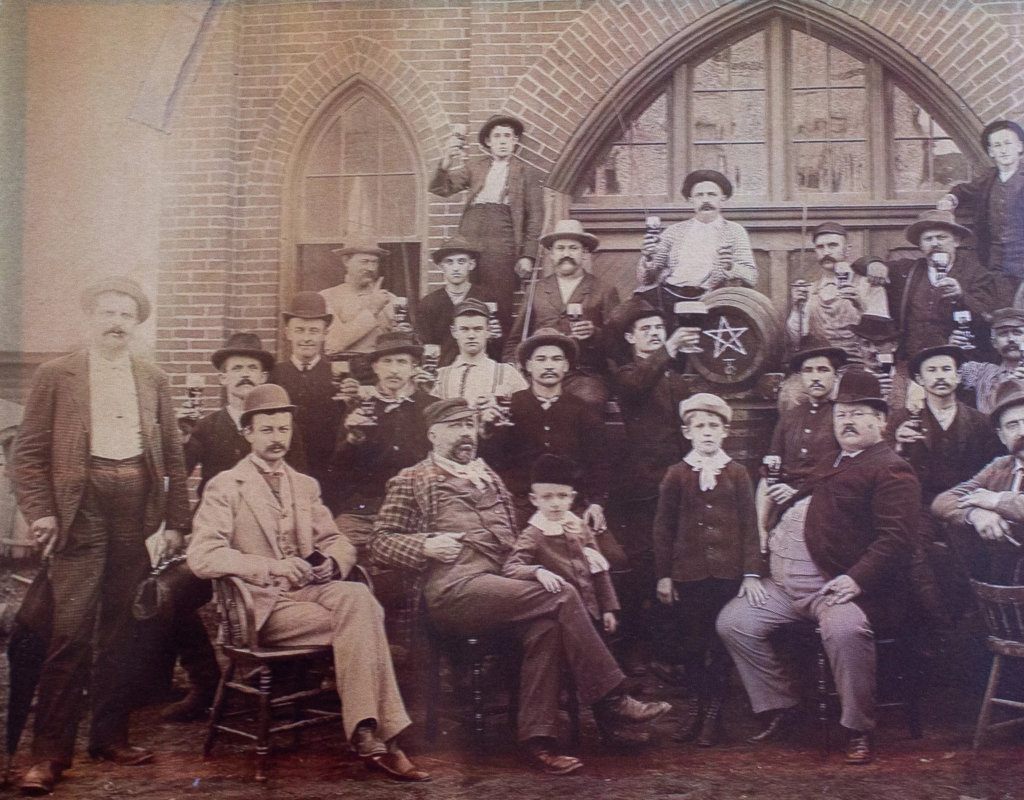
F.D. Radeke Brewing Co. workers.

This history of the brewery is from “100 Years of Brewing.”

Radeke-beer-label

FD-Radeke-Brewery-1883

Filed Under: Birthdays, Breweries, Just For Fun Tagged With: Germany, History, Illinois

Historic Beer Birthday: Valentin Blatz

October 1, 2025 By Jay Brooks

blatz
Today is the birthday of Valentin Blatz (October 1, 1826-May 26, 1894). Blatz was a German-American brewer and banker. He was born in Miltenberg, Bavaria and worked at his father’s brewery in his youth. In August 1848 Blatz immigrated to America and by 1849 had moved to Milwaukee, Wisconsin. Blatz established a brewery next to Johann Braun’s City Brewery in 1850 and merged both breweries upon Braun’s death in 1852. He also married Braun’s widow. The brewery produced Milwaukee’s first individually bottled beer in 1874. It incorporated as the Valentin Blatz Brewing Company in 1889 and by the 1900s was the city’s third largest brewer.

Here’s a biography of Blatz from Find-a-Grave:

Businessman, Beer Magnate. Valentin Blatz, born to Casper Blatz, a brewer, in Miltenberg am Main, Bavaria, Germany, attended municipal schools until age 14 when he began an apprenticeship in his father’s brewery. He began in 1844, to acquire additional experience at breweries in Augusburg, Wurzburg and Munich until 1848 when he emigrated from Bavaria to Buffalo, New York, where he worked for a year at Philip Born’s brewery. Arriving in Milwaukee, Wisconsin in 1849, he became brewmaster at John Braun’s Cedar Brewery producing 150 barrels annually. He boarded at Braun’s home until 1851 when, after having saved $500, he established his own brewery. Shortly thereafter, Braun was fatally thrown from his horse-drawn beer wagon and Blatz eventually married Braun’s widow. Subsequently he combined Braun’s small brewery and his own into a new company, City Brewery; with output of 500 barrels annually it would eventually become one of the largest breweries in Milwaukee. Blatz was widely acknowledged to be the first of the great Milwaukee brewers to establish a reputation outside of Wisconsin, the first to begin developing a national distribution network, and the first to establish a bottling plant in connection with his brewery. During its early years of development, he operated the brewery as a sole proprietorship and reportedly out-paced both the Pabst and Schlitz operations. With production exceeding 200,000 barrels in 1889, he incorporated it as the Val. Blatz Brewing Company with capital stock of $2,000,000 and sold it in 1891 to a group of British and American investors, United States Brewing Company, reportedly netting himself (also a member of the syndicate) and his family $3,000,000 and full control of the Milwaukee operation. Blatz was the only beer available on tap in German restaurants at the 1893 Chicago World’s Fair.

A year later he died unexpectedly at the Hotel Ryan in St. Paul, Minnesota, returning from a trip to California, where he had vacationed and attended a midwinter exposition. Ironically, he had postponed the trip several times because of a premonition he would not return to Milwaukee alive, but made the trip because of his wife’s deteriorating health so they could spend part of the winter in California’s milder climate. At his death, he was one of Milwaukee’s wealthiest men, with an estate estimated at between $6,000,000 and $8,000,000. Throughout his life he had been active in community affairs and belonged to the Milwuakee Old Settlers Society and a host of other organizations. In 1866 he became the first president of the Merchants National Bank, and in 1868 he was elected President of the Second Ward Savings Bank, a position held until his death. A member of the Milwaukee Brewers Association and the Chamber of Commerce, he belonged to an influential group of local businessmen who organized the Milwaukee Industrial Exposition in 1879. Also served a single term as a Milwaukee city alderman in 1882. His company survived prohibition with “near beer” and other non-alcoholic products until 1933, when it resumed producing beer, until 1958 when it was purchased by Pabst. The Blatz label was sold to G. Heileman brewing in 1959, which was acquired by Stroh Brewery in 1996, which was sold to Pabst in 1999 who now owns it.

And here’s a biography of both Valentin and his Blatz Brewery, from the Blatz Brewing Company Records, 1862-1944, housed in the University of Wisconsin Library:

Valentin Blatz was born on October 1, 1826, in Miltenberg am Main, Bavaria. The son of a local brewer, Caspar Blatz and his wife Barbara, he attended school until age fourteen at which time he began an apprenticeship in his father’s business. In 1844 Blatz began an extended tour of some of Europe’s greatest breweries where he spent his time learning new techniques and the latest in brewing technology until, at age twenty-one, he was forced to return home in order to fulfill his military obligation in the army. However, his father, a prominent community leader, obtained a substitute to serve in his place and shortly thereafter, like thousands of his countrymen, Valentin Blatz left Bavaria for the United States. Landing in New York City in August 1848, Blatz found work almost immediately at the Born Brewery in Buffalo, New York.

Blatz remained in Buffalo for approximately one year after which time he journeyed west to Milwaukee. Arriving in 1849, he found work as the foreman (some sources say brewmaster) at John Braun’s Cedar Brewery that had been established in 1846. It was a small operation, employing only a few workmen and capable of producing approximately 150 barrels of beer annually. The brewery’s storage capacity was said to be only 80 barrels. Blatz worked for Braun and boarded at his home until 1851, when, after having saved $500, he purchased half of a city lot and began his own brewing business.

Around the time that Blatz was establishing his own brewery, John Braun was killed suddenly after being thrown from his horse-drawn wagon while on a trip selling beer. He left a son, John, and a wife, Louise, who was pregnant with the couple’s second child. In December of 1851 Blatz married Braun’s widow and adopted her infant child (also named Louise) who was born after Braun’s death. Blatz also raised his late employer’s son John as his own. Although he was never formally adopted, John Braun became known generally around Milwaukee as “John Blatz.” Valentin and Louise (Braun) Blatz also had five children of their own: four sons; Albert, Emil, Valentin Jr., and Louis (who died at a young age); and one daughter, Alma.

The marriage allowed Blatz to acquire Braun’s small brewery and combine it with his own operation, which he named City Brewery. This formed the basis of what would eventually become one of the largest and most prominent breweries in Milwaukee. Blatz was widely acknowledged to be the first of the great Milwaukee brewers to establish a reputation outside Wisconsin, the first to begin developing a national distribution network, and the first to establish a bottling plant in connection with his brewery. During its early years of development, the Blatz brewery reportedly out-paced both the Pabst and Schlitz operations.

Blatz operated his business as a single proprietorship until 1889 when it was incorporated as the Val. Blatz Brewing Company with a capital stock of 21 $2,000,000. Officers of the new corporation were Valentin Blatz, president; Albert C. Blatz, vice president; John Kremer (a son-in-law), secretary; and Val. Blatz, Jr., superintendent. The company was quietly sold in 1891 to a group of British and American investors incorporated as the United States Brewing Company and known variously as the “English Syndicate” or the “Chicago Syndicate.” The sale reportedly netted Blatz (who was himself a member of the syndicate) and his family $3,000,000 and left them in full control of the local operation.

Three years later, on May 26, 1894, Valentin Blatz died suddenly while staying at the Hotel Ryan in St. Paul, Minnesota, on his return from a trip to California, where he vacationed and attended a midwinter exposition. Ironically, it was a journey that he had reportedly postponed several times because of a premonition that he would not return to Milwaukee alive. A newspaper reported at the time that it was only because of his wife’s deteriorating health that he agreed to go to California where they could spend part of the winter in a milder climate. At the time of his death at age sixty-eight, Blatz was regarded as one of Milwaukee’s wealthiest men, with an estate estimated at between $6,000,000 and $8,000,000. Throughout his life Blatz was a generous man. In his will he not only left thousands of dollars to more than a dozen local charities, hospitals, orphanages, and homes for the aged, but also provided for the four children (Cora, Selma, Elsie, and John) of his late step-son “John Blatz.” He was survived by his wife, Louise, who was with him in St. Paul; three sons, Albert, Emil, and Valentin, Jr.; and two daughters, Louise (Mrs. John) Kremer and Alma (Mrs. Gustav) Kletzsch. He was interred in Milwaukee’s Forest Home Cemetery.

Throughout his life, Blatz had been active in community affairs. He was a lifelong member of the Milwaukee Musical Society and belonged to a host of other groups, including the Milwaukee Old Settlers Society, the Independent Order of Odd Fellows (I.O.O.F.), the Aurora Lodge of Freemasons, The Arion Club, the Frei Gemeinde, the Liederkranz Society, the Germania Maennerchor of Chicago, the Eichenkranz Maennerchor of New York, several local Turnverein Societies, and–reportedly one of his favorite haunts–the West Side Old Settlers Bowling Club. In 1866 he became the first president of the Merchants National Bank, and in 1868 he was elected President of the Second Ward Savings Bank, a position he held until his death. Blatz was a member of the Milwaukee Brewers Association and the Chamber of Commerce, and also belonged to an influential committee of local businessmen who organized the Milwaukee Industrial Exposition in 1879. Blatz, who became an American citizen in 1855, was elected for a single term as a Milwaukee city alderman in 1882

After Blatz’s death, the brewery was operated by two of his sons, Albert C. and Val. Blatz, Jr., and John Kremer, a son-in-law. The United States Brewing Company, which purchased the brewery in 1891, owned and operated it until the onset of national prohibition in 1920.

This lengthy article is from the Industrial History of Milwaukee, published in 1886.

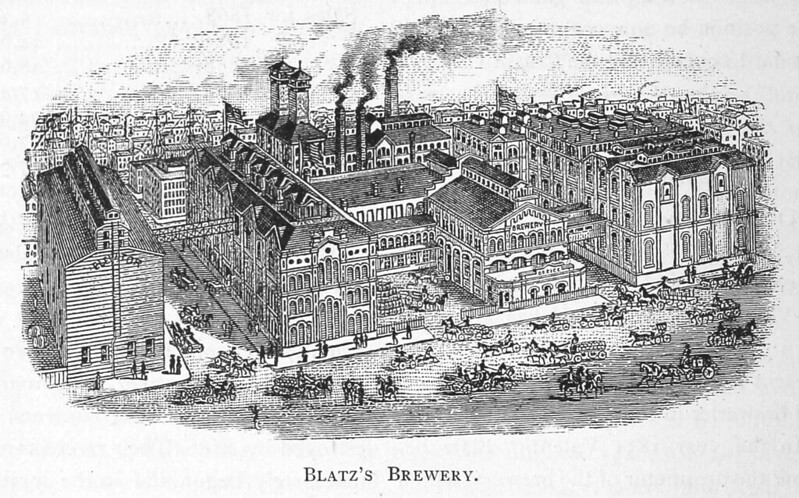
Blatz Brewery in 1886,
The Valetin Blatz home c. 1886

This 1946 ad features a plate with founder Valentin Blatz.

Here’s a history of Blatz, from the current Blatz beer website, which is currently owned by Pabst Brewing.

Blatz was one of the premier Milwaukee breweries. It was founded by John Braun in 1846, shortly before Wisconsin achieved statehood, and was originally called the City Brewery. Braun’s fledgling business produced about 150 barrels of beer annually – until 1851 when Valentine Blatz, a former employee, established a brewery of his own next door to the City Brewery. Braun died later that year and Blatz soon married his widow, thereby uniting the City Brewery and his own operation.

At the time of the marriage, the combined breweries produced only 350 barrels per year. However, by 1880 total annual production reached 125,000 barrels. The brewery’s growth continued, and in 1884 Blatz ranked as the third-largest beer producer in Milwaukee.

Blatz was the first Milwaukee brewer to market beer nationally. He set up distribution centers in Chicago, New York, Boston, New Orleans, Memphis, Charleston, and Savannah. He was also the first of the Milwaukee brewers to include a bottling plant within his brewery. In addition, Blatz operated his own carpenter shop, railroad cars, cooper shop, machine shop and coal yard.

In 1890 Blatz sold his brewery to a group of London investors, who continued to operate the plant until Prohibition. Following the repeal of the eighteenth amendment, the Blatz brewery again flourished, producing over a million barrels annually during the 1940s and 1950s. Its labels included Blatz, Pilsener, Old Heidelberg, Private Stock, Milwaukee Dark, Culmbacher, Continental Special, Tempo, and English Style Ale.

By 1955 only six Milwaukee breweries remained open. Of these six, Miller, Pabst and Schlitz were the biggest and most successful. Blatz was big, too, but stiff competition and skyrocketing production costs prevented it from growing further. In 1958 the brewery was finally sold to Pabst; however a federal court order at the time prevented Pabst from Brewing at the Blatz facilities. In 1959 this giant, Blatz, ceased all operations. Shortly there after, Pabst purchased the Blatz brands, and relaunched the brand as a craft-style beer, true to the high-quality style that Valetine Blatz espoused.

Today, Blatz continues to be recognized for it’s quality and tradition. While the Blatz Brewery is now home to some of Milwaukee’s Finest Citizens, Blatz Beer will always be Milwaukee’s Finest Beer.

Blatz-Beer-Paper-Ads-Blatz-Brewing-Company

Filed Under: Birthdays, Breweries, Just For Fun Tagged With: Bavaria, Blatz, Germany, History, Milwaukee, Wisconsin

Historic Beer Birthday: Ludwig Narziß, a.k.a. Beer Pope

September 30, 2025 By Jay Brooks

Today is the birthday of Ludwig Narziß (or Narziss), who was also known as the “Beer Pope” (September 30, 1925-November 29, 2022). He was born in Munich, and was “one of the world’s most renowned brewing scientists and educators of the 20th century. For almost thirty years, “was a leading authority in his field at the Weihenstephan Center of Life and Food Science in Freising, outside Munich. Often called the Harvard of beer, the school, part of the Technical University of Munich, is closely tied to the Bavarian state-owned brewery with which it shares its name. Following an apprenticeship at the Tucher Brewery in Nuremberg, Narziss arrived at Weihenstephan as a student in 1948. There, he received degrees in brewing science and engineering and later completed a doctorate, writing a thesis on the influence of different yeast strains on beer quality. In 1958, he became the brewmaster at Munich’s Löwenbräu Brewery. But Weihenstephan didn’t let Narziss stray for long. Only 6 years later he joined the faculty at Weihenstephan, taking over the chair of Brewing Technology I. While instructing students in the science of beer making and conducting research on methods in Weihenstephan’s test brewery, Professor Narziss at times also served as the school’s dean, once from 1968 to 1970 and again in 1990. He also made time available to be a council member of the European Brewery Convention, as well as the organization’s president from 1979 to 1983. Narziss has authored and co-authored literally hundreds of papers as well as three seminal text books, Abriss der Bierbrauerei (An Outline of Beer Brewing) in 1972, Die Technologie der Malzbereitung (Technology of Malt Preparation) in 1976, and Die Technologie der Würzebereitung (Technology of Wort Preparation) in 1985. These books have gone through many revisions and editions and are still used as standard student textbooks today. Professor Narziss retired from Weihenstephan in 1992. He still lives in Freising and serves as Professor Emeritus at his venerable alma mater.”

This was his obituary, from Brauwelt, written by Lydia Junkersfeld:

Prof. Ludwig Narziß was born in Munich on September 30, 1925 and grew up in Nuremberg. As a young adult he personally experienced the Second World War. His father was an authorized signatory at the Lederer Brewery and had planned a commercial apprenticeship at the Tucher Brewery for his son, who had returned home from captivity. Of his own accord, Ludwig Narziß soon switched to an apprenticeship as a brewer, which appealed to him more – the right decision, as it turned out. Despite the difficult conditions in the brewery after the war, he successfully completed his apprenticeship after two years in October 1947 and in 1948 switched to the Faculty of Brewing in Weihenstephan to study, where a long career began.

From 1951 he initially worked for two years as a research assistant and management consultant in the field service of the research institute for brewing at the Bavarian State Trade Institute in Nuremberg, where he also met his wife Dorle. In 1953, Prof. Weinfurtner recruited him to the State Brewery Testing and Research Institute (today the Weihenstephan Research Centre for Brewing and Food Quality) in Weihenstephan and offered him the opportunity to study for a doctorate (topic: “The influence of the yeast variety on beer quality“) which he completed in 1956.

After completing his doctorate, Prof. Narziß first went back into business: he worked at the Löwenbrauerei in Munich as first brewmaster and authorized signatory until 1964, before he returned to Weihenstephan. Between 1964 and 1992 he held the Chair for Technology at Brewery 1 of the Technical University of Munich in Weihenstephan, where he trained and shaped generations of students. Many ground-breaking innovations in brewery technology and technology occurred during this time, which Prof. Narziß initiated and managed. There was hardly an area in the brewery that could not be further developed through research from his chair: raw material issues, developments in malting, in the brewhouse, in fermentation and storage or in filtration. It was a basic need of Prof. Narziß to solve practical problems through scientific research; whilst often about optimizing production, it was of course also about improving the quality of the product. One of the most important research topics from his time was the avoidance of spoilage from oxygen in beer.

Hundreds of graduate students and over 50 doctoral students have worked on various topics under his expert guidance. He was a “doctor father” to them, with whom some of the former doctoral students have remained in close contact to this day. What distinguished Prof. Ludwig Narziß was his closeness to people. Despite the great international recognition, he maintained his humble and lovable manner towards everyone. He challenged his employees – he was strict in this matter – but he also promoted them to the best of his ability.

Hundreds of Publications

Many books, including classics of brewery technology, and hundreds of publications and lectures have emerged from his scientific work. All of this has made him a world-renowned brewing scientist whose expertise was valued by authorities, associations and breweries around the world. Prof. Narziß has not only significantly shaped the faculty for brewing in Weihenstephan, but also the reputation of German brewing science in general at home and abroad. It was always important to him to ensure dialogue between the brewing industry and brewing science, between research and brewing practice. It is only logical that a research prize, the Ludwig Narziß Award for Brewing Science from BrewingScience, bears his name.

Charlie Bamfort, Graham Stewart and Ludwig.

International Recognition

Prof. Ludwig Narziß joined the Institute of Brewing in 1965, after being nominated by the late Norman Curtis. He was elected President of the EBC Council in 1981, with the 19th EBC Congress being held in 1983 on the South Bank in London where, in collaboration with his EBC/IOB colleagues, he played a major role in the organisation of this event and 1600 delegates attended it. During the course of this Congress he had the opportunity to co-author a poster presentation (they were still very much in their infancy at that time) entitled “Composition of Worts and Beers of High Temperature Wort Boiling Systems“.

Prof. Narziß also participated in one of the Institute‘s London Section Cambridge meetings, also with Norman Curtis who was the London Section‘s Chairman at the time. In addition, he was a participant in the Master Brewer Association of the Americas Ontario District One-Day Conferences that were held in Toronto each January and he also was a participant in a number of the Association‘s National Conferences.

Prof. Narziß was awarded the IBD’s Horace Brown Medal in 1990 and the accompanying lecture, 125 Years Research At Weihenstephan, was delivered at the Royal Society in London and published in the Journal of the Institute of Brewing in 1992.

Many Awards and Honours

Commitment to voluntary work at home and abroad was also a matter of course for him, for example his 1979 election as President of the European Brewery Convention (EBC) in Brussels. To this day he is the only honorary president of the EBC. Prof. Narziß was the bearer of the Cross of Merit of the Order of Merit of the Federal Republic of Germany as well as receiving many other honours and awards.

In 1992, Prof. Narziß handed over the management of the chair to Prof. Werner Back, but retained his research spirit, which kept him very active to the end. At the age of over 90, he was still traveling the world to attend brewing industry events and give lectures.

In spring 2021 he moved from Freising and Weihenstephan, the centre of his life for many years, to his family, who live near Reutlingen. Even if things got a little quieter around him, he still worked on his books every day, kept himself up to date with telephone calls.

The contribution given by Prof. Ludwig Narziß to the brewing industry internationally has been unique and we have lost a truly remarkable icon!

And this obituary is from Weinheistephaner:

Prof. Ludwig Narziß was a true “Weihenstephaner“: he passed his degree here after his brewery apprenticeship and also completed his doctorate in 1956. After his time as brewmaster at Löwenbräu, he was appointed to the Chair of Brewery Technology I and took over management of the teaching and research brewery. Until 1992, Prof. Narziß was the man at the helm, researching the further development of brewing – teaching the craft of brewing to thousands and thousands of students. Even today, many young people benefit from his works, which are held as standard works in brewing and beverage technology. 

His professional expertise was more than appreciated by the Bavarian State Brewery Weihenstephan. Not only was great value placed here on his opinion on new beers – he was also a very welcome conversation partner at the table in the Bräustüberl. In every exchange, Prof. Narziß provided a different perspective, a further idea, a new approach: the fire for brewing was still burning in him until the very last moment. A characteristic that everyone appreciates to this day and that proved infectious to all his students.

Alongside all his professional expertise, it must never go unmentioned that with Prof. Narziß we lost a fine person. Never at a loss for a joke, always a smile on his lips – and above all he always had an open ear for every generation. Regardless of whether you were a young student or an experienced brewer: no question was left unanswered, Prof. Narziß always made time for you. He usually finished his meals in the Bräustüberl with a sip from his favorite beer, the Pils – and in the next days, people will be raising a toast to his memory and legacy everywhere in the brewing world. 

Prof. Dr. Josef Schrädler, Director of the Bavarian State Brewery Weihenstephan explained on Wednesday: ”For me, Prof. Narziß was always an important dialog partner and advisor in strategic questions.“ But not only that: “I looked forward to every beer tasting with him – he was just an extremely likeable person.“ 

And Tobias Zollo, Technical Director and First Brewmaster can only confirm this: “Prof. Narziß treated everyone with respect, he was a true brewer.“ For Zollo and the brewmaster team, the many discussions they had with him on the last product developments about three years ago were especially valuable. Passing on knowledge – that was Prof. Narziß‘ mission in life. And he fulfilled this mission brilliantly.

Filed Under: Beers, Birthdays, Breweries, Related Pleasures Tagged With: Germany, Science of Brewing

Historic Beer Birthday: Frederick Wacker

September 30, 2025 By Jay Brooks

wacker-and-birk
Today is the birthday of Frederick Wacker (September 30, 1830-July 8, 1884). Wacker was born in Württemberg Germany (though some sources claim he was from Switzerland) and founded the Chicago brewery Wacker & Birk in 1857 with business partner Jacob Birk. Shortly thereafter, Birk left to start a different brewery, and the name was changed to the Frederick Wacker Brewing Co. 1865. But Birk appears to have returned to the business, because the name became the Frederick Wacker & Jacob Birk Brewing & Malting Co., and it remained some form of the two men’s names until it was closed for good by prohibition. Frederick Wacker is also remembered as the father of his more famous son, Charles Wacker, for whom Wacker Drive in Chicago was named.

Here’s a biography of Frederick Wacker, from the History of Chicago, Volume 3, by Alfred Theodore Andreas, published in 1886.

wacker-and-birk

The Chicago brewery Frederick started was originally called Seidenschwanz & Wacker, and was located on Hinsdale, between Pine and Rush streets. It was founded in 1857, but the following year it became known as Wacker & Seidenschwanz, and was on N. Franklin Street. That version lasted until 1865. Beginning that same year, its name changed once again to the Frederick Wacker Brewery, and its address was listed as 848 N. Franklin Street, presumably in the same location as its predecessor. Sixteen years later, in 1882, it relocated to 171 N. Desplaines (now Indiana Street) and it became known as the Wacker & Birk Brewing & Malting Co. This is also when Charles joined his father’s business, when he would have been 26 years old. Just before prohibition the name was shortened to the Wacker & Birk Co., although it appears to have closed by 1920.

wacker-poster

wackerbirklabels

Filed Under: Birthdays, Breweries Tagged With: Chicago, Germany, History, Illinois, Switzerland

« Previous Page
Next Page »

Find Something

Northern California Breweries

Please consider purchasing my latest book, California Breweries North, available from Amazon, or ask for it at your local bookstore.

Recent Comments

  • Bob Paolino on Beer Birthday: Grant Johnston
  • Gambrinus on Historic Beer Birthday: A.J. Houghton
  • Ernie Dewing on Historic Beer Birthday: Charles William Bergner 
  • Steve 'Pudgy' De Rose on Historic Beer Birthday: Jacob Schmidt
  • Jay Brooks on Beer Birthday: Bill Owens

Recent Posts

  • Beer Birthday: Brian Stechschulte May 14, 2026
  • Beer Birthday: Dan Carey May 14, 2026
  • Beer Birthday: John Martin May 14, 2026
  • Beer In Ads #5250: Pacific Bock Beer May 13, 2026
  • Historic Beer Birthday: Jacob Adams May 13, 2026

BBB Archives

Feedback

Head Quarter
This site is hosted and maintained by H25Q.dev. Any questions or comments for the webmaster can be directed here.