Brookston Beer Bulletin

Jay R. Brooks on Beer

  • Home
  • About
  • Editorial
  • Birthdays
  • Art & Beer

Socialize

  • Dribbble
  • Email
  • Facebook
  • Flickr
  • GitHub
  • Instagram
  • LinkedIn
  • Pinterest
  • RSS
  • Twitter
  • YouTube

Powered by Genesis

You Just Know This Is Going To End Badly

August 8, 2012 By Jay Brooks

beer-mug
You just know this is going to end badly … or is it? There’s only one way to find out.

Filed Under: Beers, Just For Fun, Related Pleasures Tagged With: Germany, Humor, Video

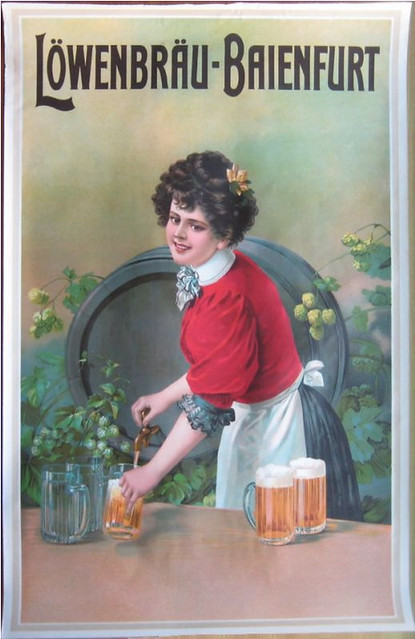
Beer In Ads #603: Lowenbrau-Baienfurt

May 9, 2012 By Jay Brooks


Wednesday’s ad is for Lowenbrau, from 1900, when everybody used artwork of a pretty gal to sell beer. I think it worked, Lowenbrau is still making beer.

Lowenbrau-1900

Filed Under: Art & Beer, Beers Tagged With: Advertising, Germany, History

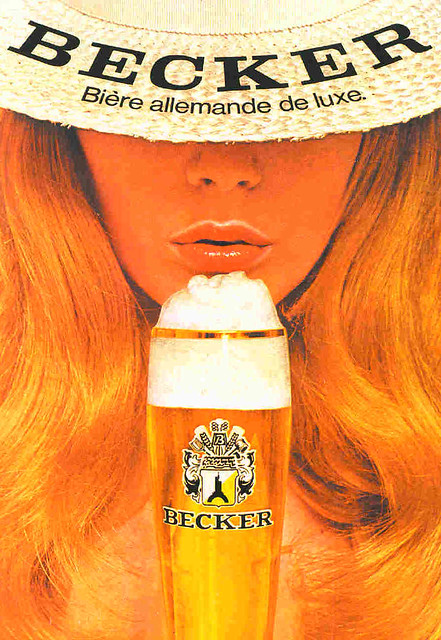
Beer In Ads #583: German Luxury Beer Becker

April 11, 2012 By Jay Brooks


Wednesday’s ad is for a German pilsner, Becker, advertising in France. I have no idea when the ad is from, though 1970s is my guess based on the hat, the hair and the overt sexual overtones. It’s not exactly subtle. The ad copy, “Bière allemande de luxe,” translates as “German Luxury Beer.”

Becker-sexy_pils_poster

Filed Under: Art & Beer, Beers Tagged With: Advertising, Germany, History

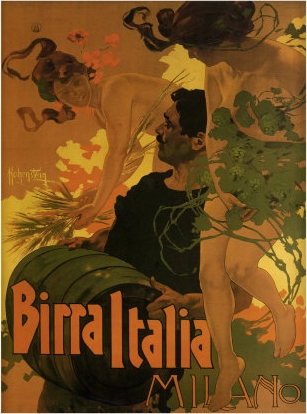
Beer In Ads #533: Birra Italia Milano

February 1, 2012 By Jay Brooks


Wednesday’s ad is also for an Italian beer, though it’s by renowned German illustrator Adolfo Hohenstein, who made a name for himself painting in Italy, where he helped to found Italian Art Nouveau. Hohenstein is also considered the “father of Italian poster art,” and this poster was completed in 1906, the year he left Milan and returned home to Germany. I think it’s one of the most beautiful of the time period.

birra-italia-milano

Filed Under: Art & Beer, Beers Tagged With: Advertising, Germany, History, Italy

Beer In Art #159: George Grosz’s Political Conversation, The Cafe

January 29, 2012 By Jay Brooks

art-beer
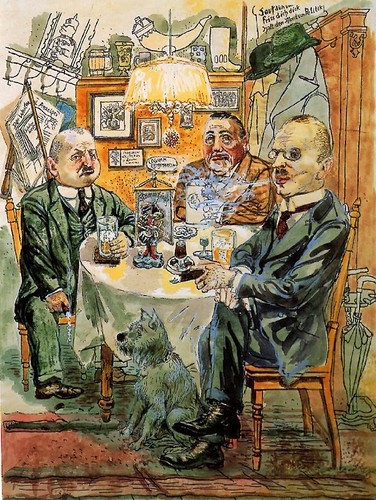
Today’s work of art is by the German Dadaist George Grosz. He was born in Germany, but after 1938 he painted primarily in the United States, though he returned to Berlin late in life. He was perhaps best known for his caricatures. This week’s work, completed around 1928, is known as Political Conversation, The Café. It’s done in watercolor and ink on paper and today hangs in the Museo Thyssen-Bornemisza, in Madrid, Spain.

Grosz-political-conversation

Here’s one analysis of the painting:

George Grosz has painted a typical Bierstube scene. Three Germans have gathered in a café to smoke and drink beer. Following his Dadaist period, Grosz — an excellent draftsman and keen social observer — returned to figurative art. He was one of the leading members of the movement known as New Objectivity (Neue Sachlichkeit). But he was also skilled at genre painting, a gift he used to push the art of caricature to new levels of expression.

To learn more about George Grosz, you can start with Wikipedia and MoMA has a biography from the Oxford University Press. MoMA also has a gallery of his work, as does Olga’s Gallery and ArtCyclopedia has numerous links to other galleries showing his art.

Filed Under: Art & Beer, Beers Tagged With: Germany

Beer In Art #153: John Lewis Krimmel’s Village Tavern

December 18, 2011 By Jay Brooks

art-beer
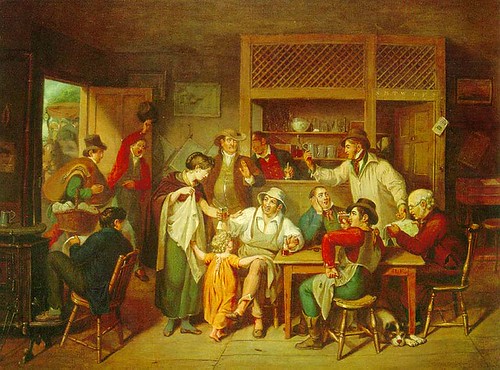
This week’s work of art is by John Lewis Krimmel. He was born in Germany, but emigrated to the U.S. in 1809 to join his brother in Philadelphia. Instead of joining the family business, he took up painting and became well-known for his genre paintings depicting everyday life in the city of brotherly love. One of his most well-known paintings was “The Village Tavern,” painted between 1813-14.

Kimmel-village-tavern

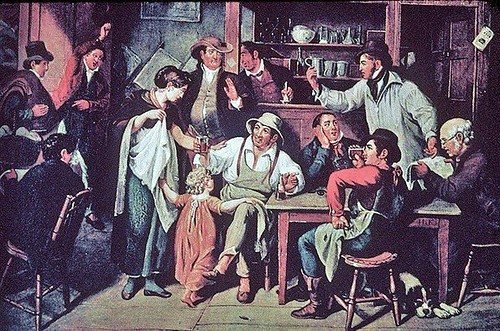
The painting is also sometimes called “In An American Inn,” and just from searching around, it appears their may be more than one of them, as there seem to be various references to both that are very, very similar, but not quite exactly the same, with slightly different colors and with the size of what’s depicted more or less, as if Krimmel painted the exact same scene more than once.

Kimmel-village-tavern-2

Perhaps most curiously, apparently the painting was used by prohibitionists as propaganda. “The depiction of a mother and daughter trying to persuade the drunken father to come home has caused historians of the temperance movement to praise In an American Inn as the first work of an American artist to illustrate this issue.” But that interpretation does not seem obvious to me. Nothing in the woman or the child’s demeanor suggests to me that they’re trying to persuade the man of anything. And the man is raising his glass to her with a smile on his face. And nobody else around them seems particularly alarmed by them being there. In fact, many people in the tavern don’t seem to be paying them any mind whatsoever, as if their presence is not so unusual. It just looks an old-fashioned scene from the TV show Cheers, with several groups in the inn.

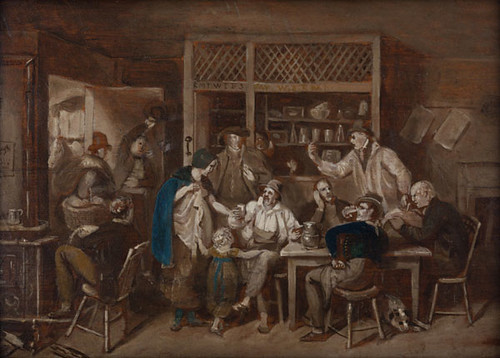
The Woodmere Art Museum has in its collection the “Study for ‘Village Tavern,'” oil on wood panel, also done in 1814.

Kimmel-village-tavern-sketch

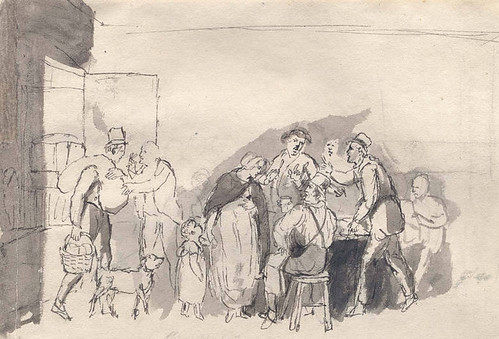
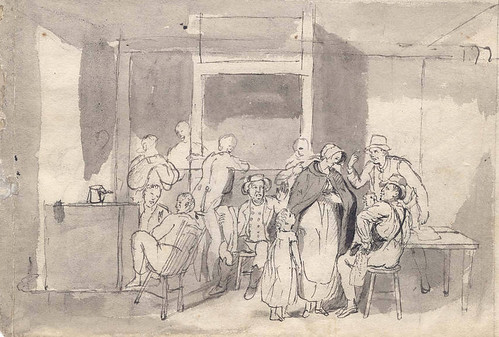
And the Winterthur Library has two early drawings that would eventually become the painting, done in ink and ink wash over pencil.

Kimmel-village-tavern-sketch-3

They contain all the elements of the finished work, but you can see the artist trying out different placements for the characters in the painting.

Kimmel-village-tavern-sketch-2

You can read Krimmel’s biography at Wikipedia or at Terra. There are links to more Krimmel resources at the ArtCyclopedia. You can also see more of his work at the Art Renewal Center, Scholar’s Resource, the Philadelphia Academy and the American Gallery.

Filed Under: Art & Beer Tagged With: Germany, History, Pennsylvania, Philadelphia, Pubs

Did Lager Yeast Come From Patagonia?

August 25, 2011 By Jay Brooks

yeast-cell
You probably saw this little item, it’s been all over the interwebs over the last few days, about a group of eight scientists positing that a newly discovered yeast strain, dubbed Saccharomyces eubayanus, may have hitched a ride from Patagonia, in South America, to Europe where it got busy with local yeasts there — notably Saccharomyces cerevisiae — to form the yeast we know today as lager yeast, or Saccharomyces pastorianus (a.k.a. Saccharomyces carlsbergensis).

The academic paper, to be published in the August edition of the journal Proceedings of the National Academy of Sciences of the United States of America (or PNAS), goes by the rather dry title, Microbe domestication and the identification of the wild genetic stock of lager-brewing yeast. The Abstract summarizes the paper:

Domestication of plants and animals promoted humanity’s transition from nomadic to sedentary lifestyles, demographic expansion, and the emergence of civilizations. In contrast to the well-documented successes of crop and livestock breeding, processes of microbe domestication remain obscure, despite the importance of microbes to the production of food, beverages, and biofuels. Lager-beer, first brewed in the 15th century, employs an allotetraploid hybrid yeast, Saccharomyces pastorianus (syn. Saccharomyces carlsbergensis), a domesticated species created by the fusion of a Saccharomyces cerevisiae ale-yeast with an unknown cryotolerant Saccharomyces species. We report the isolation of that species and designate it Saccharomyces eubayanus sp. nov. because of its resemblance to Saccharomyces bayanus (a complex hybrid of S. eubayanus, Saccharomyces uvarum, and S. cerevisiae found only in the brewing environment). Individuals from populations of S. eubayanus and its sister species, S. uvarum, exist in apparent sympatry in Nothofagus (Southern beech) forests in Patagonia, but are isolated genetically through intrinsic postzygotic barriers, and ecologically through host-preference. The draft genome sequence of S. eubayanus is 99.5% identical to the non-S. cerevisiae portion of the S. pastorianus genome sequence and suggests specific changes in sugar and sulfite metabolism that were crucial for domestication in the lager-brewing environment. This study shows that combining microbial ecology with comparative genomics facilitates the discovery and preservation of wild genetic stocks of domesticated microbes to trace their history, identify genetic changes, and suggest paths to further industrial improvement.

Mainstream media, picking up the story, has sensationalized it, looking for the human angle. For example the L.A. Times compared the discovery to finding the evolutionary missing link, titling their piece Scientists find lager beer’s missing link — in Patagonia. Essentially, they detail the scientists’ five-year quest to answer the question of where lager yeast originated, and how it came to be. The answer, according to the new paper, is a newly found strain of yeast discovered in the forests of Argentina’s Patagonia region. The wild yeast was named Saccharomyces eubayanus, and it was found living on beech trees.

According to the Times’ report:

Their best bet is that centuries ago, S. eubayanus somehow found its way to Europe and hybridized with the domestic yeast used to brew ale, creating an organism that can ferment at the lower temperatures used to make lager.

Geneticists have known since the 1980s that the yeast brewers use to make lager, S. pastorianus, was a hybrid of two yeast species: S. cerevisiae — used to make ales, wine and bread — and some other, unidentified organism.

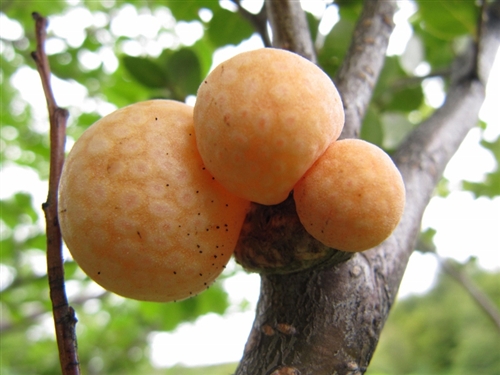
Then one of the eight, Diego Libkind, a professor at the Institute for Biodiversity and Environment Research in Bariloche, Argentina, discovered sugar-rich galls on southern beech trees in Patagonia. Yeast were drawn to the galls like a moth to a flame, and had been used by native populations to make a fermented beverage. The yeast in the galls was sent to the University of Colorado, who analyzed the genome, finding that it was 99.5% identical to lager yeast. They named the new yeast Saccharomyces eubayanus, presumably because of its similarity to Saccharomyces bayanus, a yeast commonly used to make cider and wine. Said Stanford geneticist Gavin Sherlock, quoted in the L.A. Times: “The DNA evidence is strong.”

yeast-gall-2

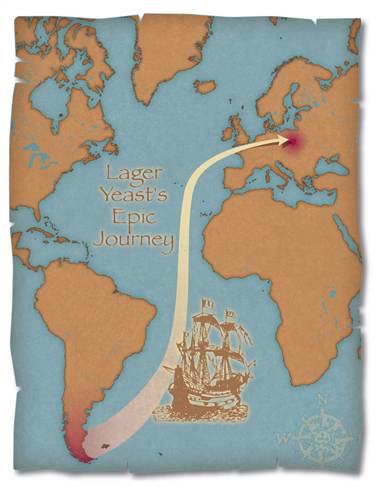
Naturally, Sherlock, and many others have been wondering how Saccharomyces eubayanus hitched a ride to Bavaria at a time when there was no known contact between the two parts of the world, separated by an ocean and some 8,000 miles. The article also states that “Lager was invented in the 1400s,” though my memory is that European brewers were using lager yeast well before that, and it was the lagering process was developed in the 1400s, but perhaps I’m not remembering that correctly.

lager-yeast-maps

In an interesting development surrounding this debate, U. Penn biomolecular archeologist, Patrick McGovern (author of Uncorking the Past), weighed in with his thoughts at the MSNBC article about this story, Beer mystery solved! Yeast ID’d. Here’s what McGovern had to say, as summarized by author John Roach:

Assuming the genetics work is correct, he said he is “troubled by how this newly discovered wild yeast strain made it into Bavaria in the 1500s.”

For one, he noted, Germans, and especially Bavarians, were not involved in the European exploration of Patagonia at the time. So, if the yeast somehow hitched a ride back to Europe via trade with the English, Spanish, and Portuguese, how did it get to Bavaria?

“Perhaps, some Patagonian beech was used to make a wine barrel that was then transported to Bavaria and subsequently inoculated a batch of beer there?” he asked. “Seems unlikely.”

He said a more likely scenario is that galls in the oak forests of southern Germany also harbored S. eubayanus, at least until it was out competed by the more ubiquitous S. cerevisiae.

“If true, then the use of European oak in making beer barrels and especially processing vats, which could harbor the yeast, might better explain the Bavarian ‘discovery’ of lager in the 1500s,” he said.

Nevertheless, he added, history and archaeology are full of surprises.

“Nowhere is this more true than of the seemingly miraculous process of fermentation and the key role of alcohol in human culture and life itself on this planet,” he said.

“This article has begun to unravel the complicated heritage and life history of the fermentation yeasts, and will hopefully stimulate more research to see whether the Patagonian hypothesis proves correct.”

Diplomatically put, because as everyone admits, the find in South America may not be the exclusive area where Saccharomyces eubayanus lives, just the first place it’s been found. The human history portion of this story doesn’t seem to quite fit at this point, but it’s certainly a compelling story and it will be interesting to see how it continues to develop.

yeast-gall-1

Filed Under: Beers, Editorial, News Tagged With: Archeology, Argentina, Europe, Germany, History, South America, Yeast

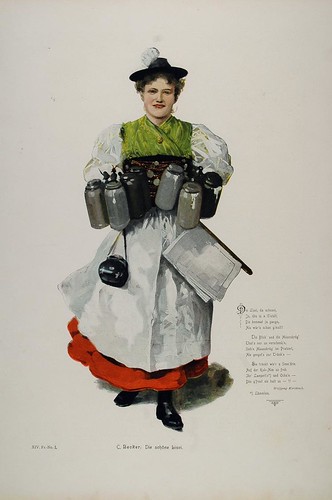
Beer In Ads #401: Becker Serving Woman

June 27, 2011 By Jay Brooks


Monday’s ad is from 1900 and is for a German beer, C. Becker. The bottom of the ad says simply: “C. Becker: Die schone bisei, which is “the beautiful ____” something, I’m not sure what the word “besei” means. Anyone know? The ad also features a poem, in German, that’s likely about the beer but it’s a little hard to decipher. But at the heart of it is a great illustration of a beer server from the old days in Germany.

Becker-1900-serving-girl

Filed Under: Art & Beer, Beers Tagged With: Advertising, Germany, History

Beer In Art #122: Johann Georg Hinz Still Lifes

April 10, 2011 By Jay Brooks

art-beer
This week’s works of art are by Johann Georg Hinz, a German painter from Hamburg. His last name was also sometime spelled Hintz, Hainz or Heintz. He was born in 1630, in Altona, but spent most of his life painting in Hamburg, where he’s best known for his still life paintings. Many of them had beer in the painting — it was Germany after all — like the first one below: Still Life with Beer Glass.

Hinz_still-life-with-beer-glass

And the second is simply Still Life.

Hinz_Still-life-4

And here’s a third, also titled simply Still Life.

Hinz_still-life

There’s no dates for any of them, though Hinz is believed to have spent some time in Amsterdam and came to Hamburg in the 1660s. I was in Amsterdam he picked up the idea for still life painting and was the first to paint them in Hamburg, and possibly in Germany, too. You can see a few more of paintings at WikiGallery.

Filed Under: Art & Beer, Beers Tagged With: Germany

Celtic Beer: 500 B.C.

January 19, 2011 By Jay Brooks

celtic-blue
Science News last week had a fascinating tale from 2,500 years ago, about ancient Celtic breweries in present-day Germany. It was revealed in a new paper by Hans-Peter Stika, entitled Early Iron Age and Late Mediaeval malt finds from Germany—attempts at reconstruction of early Celtic brewing and the taste of Celtic beer, that early Celts built breweries “capable of turning out large quantities of a beer with a dark, smoky, slightly sour taste.”

Published earlier this month in the journal, Archaeological and Anthropological Sciences, here’s the abstract:

In this paper, we discuss specialised ditch structure from the early Iron Age settlement of Eberdingen–Hochdorf (early La Tène Period, fifth–fourth century BC), that contained large numbers of evenly germinated hulled barley grains. This malt appears to be the result of deliberate germination, given the purity of the finds and the associated unusual archaeological structure, which may have been used for germination and/or as a drying kiln for roasting the malt. The Hochdorf malt most probably was produced for the purpose of beer brewing. To learn more about the morphology of malt and the effects of carbonisation on it, experiments on modern barley grains were undertaken. Their results are compared to the ancient Hochdorf malt. Based on the excavated findings and finds as well as theoretical reflections on the early Iron Age brewing process, attempts at reconstructing the possible taste of early Celtic beer are presented. Additionally, a malt find from late mediaeval Berlin in northeast Germany is presented. A mixture of deliberately sprouted hulled barley as well as rye and oat grains, which were not germinated, was found. The three different cereals could have been used for brewing a typical mediaeval/early modern beer since the use of mixed crops for producing beer has been quite common. Because of a lack of further evidence, it remains unclear whether or not the half-timbered house in the late mediaeval town was a trading place and storehouse for malt or the brewery itself, where the malt was processed to make beer.

A large store of charred grains of barley were discovered at a site in northeast Germany, near Berlin. The barley was found in ditches, suggesting a “large malt-making enterprise.”
barley-iron-age
He then reconstructed the steps he believes the early Celts would have used to brew their beer.

  1. Dig a ditch, in an oblong shape.
  2. Soak barley in the specially constructed ditches until it sprouts.
  3. Grains were then dried by lighting fires at the ends of the ditches (providing dark color & a smoky taste).
  4. Lactic acid bacteria stimulated by slow drying of soaked grains, a well-known phenomenon, adding sourness to the brew.
  5. Mash up the barley to maximize the sugar content.
  6. Flavor it with henbane — a.k.a. stinking nightshade — which was found at the site. Henbane would also have made the beer more intoxicating. It could possibly have contained other spices such as mugwort or carrot seeds.
  7. Boil the ingredients with the mashed grains, towards the beginning to flavor the beer.
  8. Heated stones may have been placed in liquefied malt during the brewing process (though so far none have been found at the site). Otherwise, it would probably have been heated over a low fire.
  9. Separate out the lumpiest bits of grain.
  10. Fermentation then my have been triggered by using yeast-coated brewing equipment or by adding honey or fruit, both of which would have contained wild yeast.
  11. Let the yeast settle to the bottom.
  12. Cool the beer and drink.

Not all of the steps have been confirmed by the evidence yet, but the search goes on.

Filed Under: Breweries, News Tagged With: Germany, History, Science of Brewing

« Previous Page
Next Page »

Find Something

Northern California Breweries

Please consider purchasing my latest book, California Breweries North, available from Amazon, or ask for it at your local bookstore.

Recent Comments

  • Ernie Dewing on Historic Beer Birthday: Charles William Bergner 
  • Steve 'Pudgy' De Rose on Historic Beer Birthday: Jacob Schmidt
  • Jay Brooks on Beer Birthday: Bill Owens
  • Steve 'Pudgy' De Rose on Beer Birthday: Charles Finkel
  • Steve 'Pudgy' De Rose on Beer Birthday: Bill Owens

Recent Posts

  • Historic Beer Birthday: Ernest Davis February 17, 2026
  • Beer In Ads #5205: Bock Time Is Schmidt’s Time February 16, 2026
  • Historic Beer Birthday: Samuel C. Whitbread February 16, 2026
  • Historic Beer Birthday: Wilhelm Bierbauer February 16, 2026
  • Beer Birthday: Brendan Moylan February 16, 2026

BBB Archives

Feedback

Head Quarter
This site is hosted and maintained by H25Q.dev. Any questions or comments for the webmaster can be directed here.