

Reuters is reporting that the impending sale of Beck’s by Anheuser-Busch InBev has been scuttled, by ABIB. According to the weekly German magazine WirtschaftsWoche, the 1.7 billion Euro ($2.54 billion) contract was ready to be sign by purchaser U.S. buyout firm Bain Capital when ABIB walked away from the deal. WirtschaftsWoche is speculating that the earlier “sale of 13 eastern European breweries for 2.2 billion euros in October eased Anheuser-Busch InBev’s debt burden enough for the brewing giant to call off the Beck’s deal.” That’s all that’s known so far, but I’m, sure we’ll learn more on Monday.
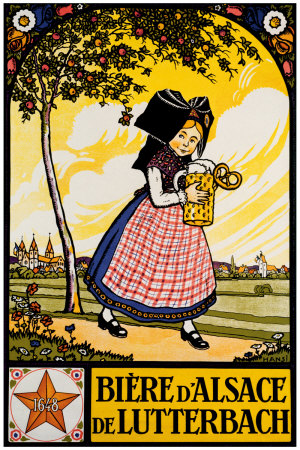
Beer In Ads #6: Biere d’Alsace

The artist for today’s ad was born in the Alsace, in 1873, in what is today part of France. But two years before he was born, it belonged to the German Empire, who had annexed it after the Franco-Prussian War that began in 1870. Why is that relevant? Because Jean-Jacques Waltz, better known as “Hansi,” grew up hating the Germans and early in his career drew editorial cartoons poking fun at them. This won him few friends in Germany and in fact he even spent time in jail, “imprisoned several times by German authorities for making fun of the German military and professors.” In addition to putting down his captors, he wrote and drew scenes extolling Alsace’s virtues. One of his most famous works was a history of Alsace for kids by “Uncle Hansi,” L’Historie d’Alssace. The ad today features a girl in the traditional costume of the Alsace, and in fact it shows up in a number of Hansi’s works. I’m not sure if the illustration is advertising for a specific brewery of just beer from the Alsace generally. There is a brewery in Luttenbach (near the border between France in Germany in the Alsace) today known as Les Caves de la Brasserie. The date in the star, 1648, seems to suggest an older brewery, one that perhaps is no longer with us.
Beer In Art #52: Ernst Henseler’s Beer Evening

Today’s work of art is straight out of Germany’s history pages, and in fact I found it at the German History in Documents and Images website. It was by a relatively obscure German artist named Ernst Henseler. About all I could find out about him is that he was born in 1852 and died in 1940. Though I called it “Beer Evening” above, today’s painting is really titled Bismarck in Conversation with Reichstag Deputies at a Parliamentary Soirée and is believed to have been painted in 1894.
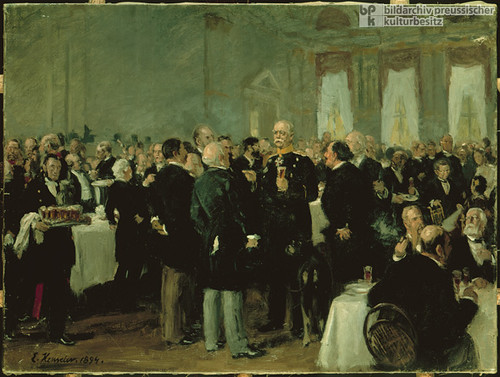
The painting is an illustration for the section of the GHDI entitled “Forging an Empire: Bismarckian Germany (1866-1890)” and under the sub-heading “Parties and Political Mobilization.” This also included the following description of the events in the painting:
This painting by Ernst Henseler (b. 1852) shows a parliamentary “beer evening” in the Imperial chancellery. These soirées provided Bismarck with an opportunity to convince parliamentary friends and foes alike that his policies deserved support. Sometimes consensus-building flowed in the opposite direction. Note that beer was more plentiful than food on such occasions, perhaps to the disappointment of one of Bismarck’s dogs, who was also on the invitation list.
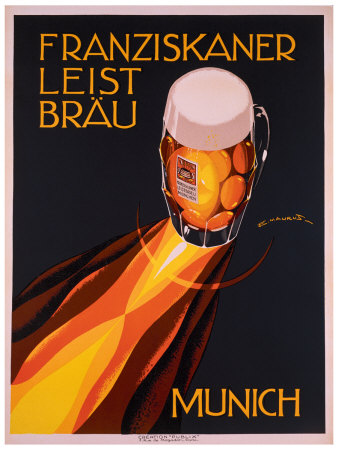
Beer In Ads #5: Franziskaner Leist Brau
The name Franziskaner today is most often associated with the Bavarian weiss beer brewed by Spaten, but originally it was a separate company known as Franziskaner-Leist-Bräu. The word “Franziskaner” means Franciscan, which is why there’s a monk on the labels nowadays. They merged with Spaten in 1922, so today’s ad is undoubtedly before then. Poster companies selling a reproduction of today’s ad all say it’s circa 1930, but given the earlier merger I’m not sure that can be right, unless of course it continued as a separate brand in their advertising. The artist’s name is either Maurus or Maueus, but that’s a close as I can pin it down.
Hindenbeer To Be Auctioned
My son Porter, being a somewhat typical 8-year old, loves all things that have to do with destruction. But unlike most kids his age, he has a fascination with historical disasters, especially the Titanic and the Hindenburg. He has at least two dozen books about the Titanic and other sea disasters and three about Zeppelins and the Hindenburg, along with several more general aviation books that include airships. So it was with great joy that I told him today that a bottle of beer that was salvaged from the Hindenburg disaster was going to be auctioned this Saturday.
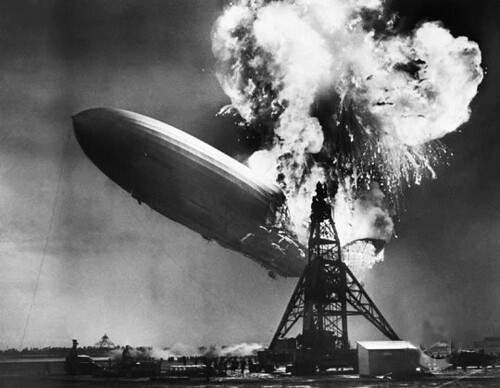
Apparently, on the morning of May 6, 1937, firefighter Leroy Smith fortuitously came upon six bottles of Lowenbrau beer and a silver-plated pitcher. Thinking quickly, he buried them, returning later to dig up his booty. He gave five of the bottles to colleagues and kept one, along with the pitcher, for himself. Most of the rest have been lost, though one ended up in the Spaten museum in Munich (and I saw that one a few years ago when I visited Spaten). In 1966, Smith’s niece inherited the two Hindenburg souvenirs, and will now be auctioned by Henry Aldridge and Son of London. Coincidentally, they also specialize in items from the Titanic.
According to the BBC, the burnt Lowenbrau bottle is expected to fetch around £5,000 (or $8,337). The auction catalog for the bottle has the following information:
Hindenburg memorabilia: An extremely rare bottle of Lowenbrau Beer recovered from the wreck site of the Z129 Hindenburg, May 6th 1937 when it crashed at Lakehurst Naval Air Station. It was recovered by local Fire Chief Leroy Smith of the Matawan Fire Department New Jersey, along with 5 others which he handed out to each of his colleagues. The whereabouts of all of these bottles with the exception of one is unknown. He presented one to the Lowenbrau brewery in 1977 where it remains to the present day. The example being offered for auction is sealed, with some of its original label and shows evidence of heat damage. This lot is sold with a provenance package which include correspondence from the Lowenbrau brewery regarding the bottle of beer donated to their Museum, press cuttings and signed copy of a letter of provenance and an account of how Fire Chief Smith came to acquire the bottle.
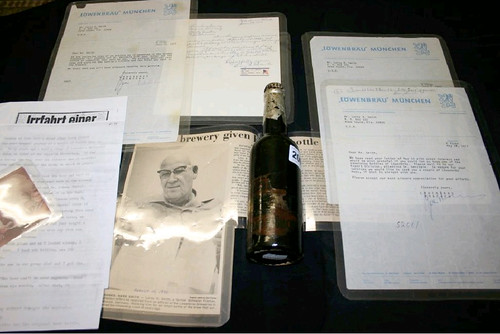
All of the accounts of this story, such as by the BBC, the New York Post and ABC News each claim this will be the highest price paid for a bottle of beer, but in August of 2007, a bottle Allsopp’s Arctic Ale that sold on eBay for $503,300.
Here’s a better view of the Lowenbrau bottle.
Beer In Ads #4: Thirst Is Only Through Good Beer
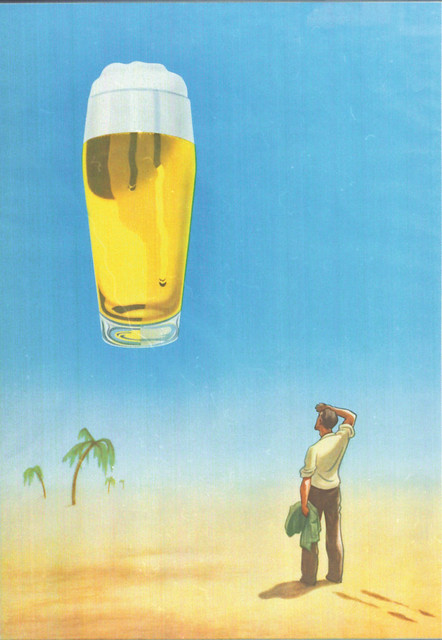
Today’s beer ad is from Germany. I saw an original of it framed at the Franconian Brewery Museum in Bamberg when I was there a couple of years ago. It was originally an advertisement for Gaffel Kolsch. The text reads “Durst wird durch Bier erst schon,” which Google translates as Thirst Is Only Through Good Beer. That’s the best-sounding one I came across, though I suspect it’s closer to something like “Thirst Is Only Quenched Through Good Beer.” Other translators came up with “thirst becomes through beer first already,” “thirst becomes by beer only already” and “thirst with beer is just been.” If you’re fluent in German, let me know what a better translation is. Still, I love the idea of being out in the desert and the mirage you see is a giant glass of beer. What better sight could there be under such circumstances?
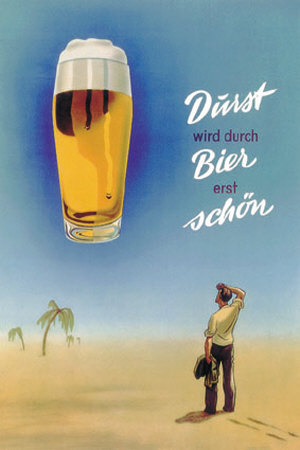
It was also sold as a poster without the text.
Martin Luther’s Beer

I stumbled upon this interesting write-up of the Beers of Martin Luther on a Lutheran website, Cyberbrethern. The post is based on notes from a talk given at a Men’s Breakfast at Good Shepherd Lutheran Church, Fayetteville, New York in April of 1997. Keith Villa of Blue Moon Brewing is thanked for “describing how the beers of Martin Luther’s era would have looked and tasted.”
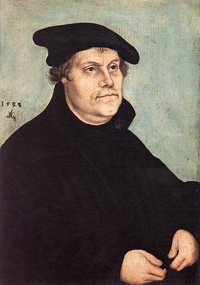
The article discusses German beer in the middle ages, both homebrewed beer and brews made at Abbeys, and then speculates which beer of the time would have been Martin Luther’s favorite. This proved easier than you might imagine.
Frederick Salem, in his Beer, Its History and Its Economic Value as a National Beverage (1880) notes, “Luther’s fondness for beer is well known, and on the evening of that eventful day at Worms, April 18, 1521, the Duke Erich von Braunschweig sent him a pot of Eimbecker (Einbecker) beer, to which he was specially addicted.”
Michael Jackson also mentioned this connection in his New World Guide to Beer, saying “Luther received a gift of Einbeck beer on the occasion of his wedding.”
The article goes on to suggest that Luther preferred homebrew over beer from commercial breweries, finding the latter to be “a curse for Germany.” But in an apparent contradiction, Luther “drank at home.”
One biographer notes, “The German prophet became a patriarch, and the living room was dominated by his presence. He enjoyed his beer and had a great mug with three rings on it, one ‘the Ten Commandments’, the next ‘the Creed’ and third ‘the Lord’s Prayer’. He boasted that he could encompass all three with ease.”
But he was also a champion for moderation, and in sermon he gave in 1539, preached the following:
“It is possible to tolerate a little elevation, when a man takes a drink or two too much after working hard and when he is feeling low. This must be called a frolic. But to sit day and night, pouring it in and pouring it out again, is piggish… all food is a matter of freedom, even a modest drink for one’s pleasure. If you do not wish to conduct yourself this way, if you are going to go beyond this and be a born pig and guzzle beer and wine, then, if this cannot be stopped by the rulers, you must know that you cannot be saved. For God will not admit such piggish drinkers into the kingdom of heaven [cf. Gal. 5:19-21]… If you are tired and downhearted, take a drink; but this does not mean being a pig and doing nothing but gorging and swilling… You should be moderate and sober; this means that we should not be drunken, though we may be exhilarated.”
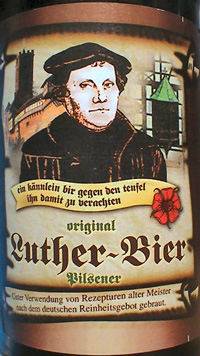
There is at least one Luther-Bier, a German-style pilsner brewed by Einsiedler Brauhaus. I’m not sure what that adds to the story, but I found in interesting all the same. As far as I can tell, it was a special release and there’s even a separate website for Luther-Bier, but there’s almost no additional information there. But you can see the special box it comes in an etched mug at a Wittenberg website.
And I found this great quote on another church’s website:
“We old folks have to find our cushions and pillows in our tankards. Strong beer is the milk of the old.”
— Martin Luther
Session #11: Doppelbocks
It’s time once again for our eleventh Session, and this time around we’re highlighting Doppelbocks courtesy of this month’s host, Wilson at Brewvana. I recently spent two weeks in the home of Doppelbocks — Germany — when many breweries I visited were just debuting their winter seasonal, which more often than not was a doppelbock.
| Their history is, of course, reasonably well settled, with the Pauline Monks of Munich making the first example of the style around 1780. By the Napoleonic Era, the brewery had become secular and brewmaster Franz-Xaver Zacherl began selling his strongest beer around Easter-time each year, calling it “savior,” which in German is “Salvator.” Other breweries began adopting the name and it was in danger of becoming generic when, in 1894, trademark law made Paulaner the only brewer legally allowed use the name. As a result, countless other doppelbocks renamed their beers but continued using the suffix “-ator,” possibly to denote strength, but more likely to continue associating themselves with Salvator. The traditional reason for brewing this beer at this time of the year was for the forty days — not counting Sundays — of fasting just prior to Easter, known as Lent. The monks wanted something heartier to drink while they weren’t able to eat. This period also became known as “strong beer season.” This year, strong beer season will begin February 6. |
As fate would have it, last night was the bimonthly blind panel tasting at the Celebrator Beer News and one of the two styles we tasted was doppelbocks. Of the seven we sampled, I decided to write about three common German examples, the original Paulaner Salvator, Spaten’s Optimator and Aying’s Celebrator.
So let’s drink some doppelbock, shall we?
| Paulaner’s Salvator bright amber in color with a tan head. It has sweet, toffee aromas with alcohol quite evident in the nose. The alcohol — at 7.9% abv — carries over into the taste profile and bites tartly against the malt backbone, which has a hint of candied sweetness. The finish lingers and continues to bite back long after it’s left. |
| Ayinger’s Celebrator Doppelbock was a very dark brown, almost black, with a rich tan head. The nose was predominantly sweet malt with touches of earthy, herbal aromas. Creamy and chewy, with a gritty effervescence that dances on the tongue, the flavor is a big wallop of malt with a restrained smokiness hiding underneath. The finish is clean with a touch of tartness. |
| Spaten’s Optimator was dark brown with a thick ivory head. The nose was dry with aromas of lightly sweet malt with just a touch of smoke or roasted toffee. The flavors were likewise sweetly malty. At only 7.2% abv, the alcohol was somewhat less evident in the taste and there was a little astringency, possibly from the hops. Overall it was full-bodied and rich and the finish clean. |
Bavaria in Pictures: Updated
Roughly the first two weeks of November, I was fortunate enough to be invited along on a press junket to the Bavarian part of Germany along with a dozen colleagues. I took around 2,000 photos and it’s been taking me forever to go through them all. Day one of our trip went up in early December and today I’ve finally gotten up the next day’s photos. I’ll keep updating this post as I get more of the photos up and in the photo gallery.

The gang of twelve plus three at the Faust Brauerei in Miltenberg, Germany. From left: Cornelius Faust, me, Lisa Morrison, Johannes Faust, Julie Bradford, Andy Crouch, Peter Reid, Horst Dornbusch, Jeannine Marois, Harry Schumacher, Tony Forder, Candace Alstron, Don Russell, Jason Alstrom and Todd Alstrom.
For more photos from my trip Germany, visit Miltenberg Sunday, Miltenberg Monday: Faust Brewery Tour, the Wurzburger Hofbrau, Weyermann Malting and Schlenkerla Tavern in the photo gallery.
Busch Model Train Accesories
After the official part of my recent German beer trip ended, I had a few days to myself before heading back across the pond. So one day, Peter Reid (who publishes Modern Brewery Age) and I took a Deutsche Bahn train to nearby Salzburg, Austria to visit the original Trumer Brauerei (more about that trip soon). On the train, I was idly paging through the train’s on-board magazine Mobil (sort of like an in-flight magazine) when I came across a multi-page ad for a toy store chain, Idee+Spiel. Based on the number of pages and locations listed, I imagine it’s something like the Toys R Us of Germany. On the page with toy trains, there were pictured accessories by a German company called, with no irony, Busch (or more properly Busch Gmbh and Co.). Two of the products shown were a Beer Garden and a Hopyard. I imagine neither of these HO-scale train accessories will ever see the light of day here in neo-prohibitionist America, but I love the idea that these scenes are so common that nobody in civilized Europe has a problem with them.
The Busch model HO-Biergarten.
The Busch model HO-Hopfen.
Visiting their website, I also discovered that Busch has a few more beer-related accessories for train layouts, and the hop field is featured on the cover of their catalog.
Busch’s 2007 catalog.
The other accessories included this barley field.
Notice the hops in the field across the road? If you look back the hopyard picture, you can now see the barley field there, too.
I love way the person on the bench is sitting. The catalog refers to him as a “happy ‘carouser.'”