Brookston Beer Bulletin

Jay R. Brooks on Beer

  • Home
  • About
  • Editorial
  • Birthdays
  • Art & Beer

Socialize

  • Dribbble
  • Email
  • Facebook
  • Flickr
  • GitHub
  • Instagram
  • LinkedIn
  • Pinterest
  • RSS
  • Twitter
  • YouTube

Powered by Genesis

Patent No. 2057347A: Beer Barrel

October 13, 2016 By Jay Brooks

patent-logo
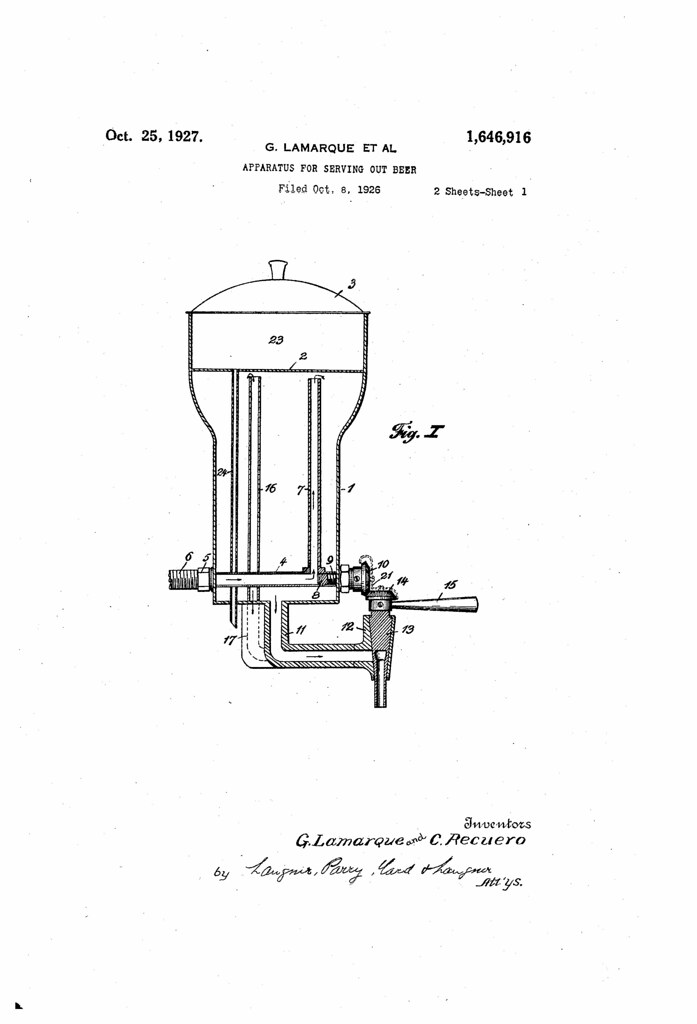
Today in 1936, US Patent 2057347 A was issued, an invention of Daniel J. Reed, for his “Beer Barrel.” There’s no Abstract, although in the description it includes these claims:

This invention relates to a metal beer barrel.

The principal object of the invention is to provide means for absorbing blows and sudden shocks delivered longitudinally of the barrel on 5 the end edge, thereby preventing injury to the body of the barrel and to the lining material therein.

US2057347-0

Filed Under: Beers, Just For Fun, Politics & Law, Related Pleasures Tagged With: Barrels, History, Kegs, Law, Patent

Beer In Ads #2061: A Geographic Hall Of Fame

October 12, 2016 By Jay Brooks


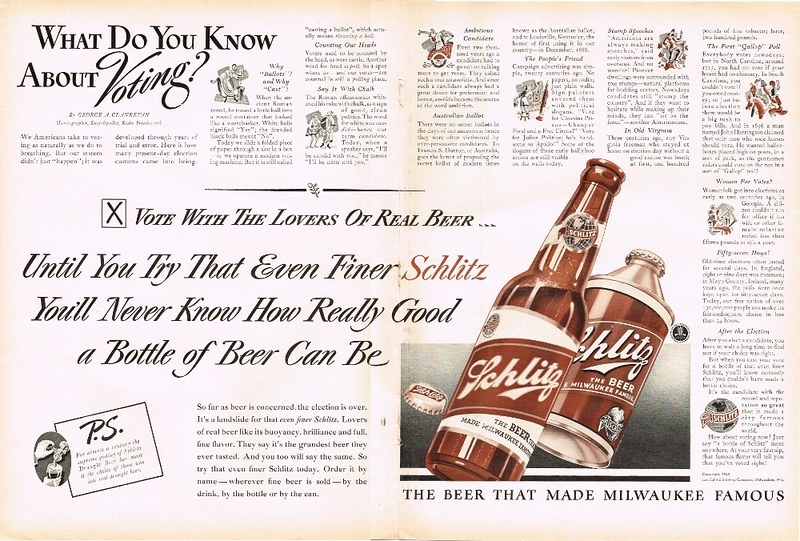
Wednesday’s ad is for Schlitz, from 1939. In this ad, it’s an early form of listicle creating “A Geographic Hall of Fame,” meaning what certain places are famous for. Some are obvious, like cigars from Havana or Concord grapes. Others seem less well known, at least to me, like sausage from Bolgna or china from Dresden. (I certainly didn’t see a lot of plates and cups when I was there, though to be fair I wasn’t really looking for china, either.) Naturally, the ad is making the case that what Milwaukee should be in the Hall of Fame for is beer, and not just any beer, but Schlitz.

Schlitz-1939-geographic-fame

Filed Under: Art & Beer, Beers Tagged With: Advertising, History, Schlitz

Patent No. 2451156A: Process And Apparatus For Producing Alcohol By Fermentation

October 12, 2016 By Jay Brooks

patent-logo
Today in 1984, US Patent 2451156 A was issued, an invention of Annibal Ramos De Mattos, for his “Process and Apparatus for Producing Alcohol by Fermentation.” There’s no Abstract, although in the description it includes these claims:

This invention relates to a process and apparatus for yeast fermentation and, more particularly, for producing alcohol by fermentation.

Commercially, alcohol is customarily produced by a batch or a modified batch process. In such processes the yeast necessary to convert the nutrient medium or wort into alcohol must be grown on the wort or on an outside nutrient medium. Yet as the conversion of the wort to alcohol takes place and the concentration of alcohol increases, the medium becomes toxic to the yeast. As a result, the alcohol ultimately present in high concentration kills a certain portion of the yeast, and the wort consumed in the production of this yeast is lost. Additionally, in such processes the concentration of yeast and its contact with the nutrient medium is seldom best adapted for optimum rate of alcohol conversion.

In the production of alcohol by conventional fermentation processes, it is usually necessary to kill or prevent the growth of bacteria which are deleterious to the propagation of the yeast or impede the conversion of the nutrient medium to alcohol. These deleterious bacteria are controlled either by subjecting the wort to heating at sterilization temperatures or by the introduction of chemical bactericides such as sulfuric acid, hydrochloric acid, fluorides, copper sulfate, and the like. It is also known that nutrients suitable for conversion to alcohol by fermentation, particularly cheaper nutrients such as low grade sugar, seldom contain all the elements necessary for the nutrition and propagation of the yeast which convert the nutrient into alcohol. As a result, the conventional nutrient medium must be complemented by the addition of so called stimulants such as the various mineral salts including, for instance, sulfates and nitrates of ammonia, calcium super-phosphates, and the like, or organic substances such as urea, malt, peptone, and the like.

The known commercial processes of producing alcohol by yeast fermentation may be divided roughly into four types; namely, progressive filling, division, continuous feeding, and a fourth process in which the yeast is recovered and reused in subsequent fermentation vats.

In the first-mentioned process a group of vats is placed in series and fermentation initiated in one of the vats. When the fermentation has reached a desired point, a portion of the fermenting wort in the first vat is transferred to a second vat to initiate the fermentation therein and so on for any desired number of vats.

In the second-mentioned process the contents of one vat is used for the purpose of inoculating other vats. For instance, after a group of vats has been used for fermenting wort to alcohol, one of the group is not discharged but is retained for the purpose of distribution to the vats which have been discharged for the purpose of initiating the fermentation of fresh wort.

The third-mentioned continuous feeding process is a very old process introduced by Guillaume, involving inoculating a multiplicity of fermentation vats from a culturing vat.

The fourth process is of more recent origin and was patented by Melle and Bolnot. In this last-mentioned process the pH of the fermenting wort is carefully controlled to approximate a pH of 3. When the fermentation is nearly complete, the partially spent wort and yeast are passed into a centrifuge where the yeast is recovered in the form of a liquid containing a high concentration of yeast. This liquid is used for the purpose of initiating the fermentation of a new charge of wort. This latter process has a number of disadvantages involving, as it does, the necessity for controlling pH of the fermentation mass and requiring the addition of conventional stimulants and the like used in other fermentation processes. The centrifuging device involves added equipment costs. The process makes possible some saving in fermentation equipment but not nearly so much as is possible in accordance with my continuous process described in detail hereinafter.

US2451156-0

Filed Under: Beers, Breweries, Just For Fun, Politics & Law, Related Pleasures Tagged With: Brewing Equipment, History, Law, Patent, Science of Brewing

Patent No. EP0091322A2: A Brewing Unit

October 12, 2016 By Jay Brooks

patent-logo
Today in 1983, US Patent EP 0091322 A2 was issued, an invention of Noel Roy Wilkinson, for “A Brewing Unit.” Here’s the Abstract:

An improved brewing unit in which energy is saved by providing a mash tun (14), hot water tank (10) and kettle (8) in a single unit (1), by partially enclosing the mash tun with the tank and if necessary pre-heating the water supply to the tank by using the heat from wort coolers provided between the unit (1) and fermentation tank (83, 85); further improvements are provided by constructing the kettle as a combined kettle and whirlpool in a single chamber having a circular wall (2) and a tangential inlet (92) to the wall, a pump (53) and wort boiler (6) being in circuit with the kettle so that wort is continuously circulated through the boiler and tangential inlet to the kettle whilst the worts are boiled. The combined kettle and whirlpool saves space and enables the process of brewing to be shortened with resultant savings in both energy and brewing time.

0091322-imgf0001

0091322-imgf0002

Filed Under: Beers, Breweries, Just For Fun, Politics & Law, Related Pleasures Tagged With: Brewing Equipment, History, Law, Patent, Science of Brewing

Beer In Ads #2060: Head Of The Table

October 11, 2016 By Jay Brooks


Tuesday’s ad is for Schlitz, from 1941. In this ad, oddly about class, it’s really about how we call beer an “affordable luxury,” although the way they say it as a little different. “Not everyone can own the finest pearl, or drive the costliest car. But America’s most distinguished beer is within the reach of everybody. Here, indeed, is democracy in a bottle!”

Schlitz-1941-head-of-the-table

Filed Under: Art & Beer, Beers Tagged With: Advertising, History, Schlitz

Patent No. 4409246A: Yeast Strain For Fermenting High Plato Value Worts

October 11, 2016 By Jay Brooks

patent-logo
Today in 1983, US Patent 4409246 A was issued, an invention of Graham G. Stewart, Thomas E. Goring, and Ingeborg Russell, assigned to the Labatt Brewing Company, for their “Yeast Strain For Fermenting High Plato Value Worts.” Here’s the Abstract:

The specification discloses a novel brewers’ yeast strain and a method of manufacturing the same. The yeast is a strain of Saccharomyces cerevisiae and has been deposited at the National Collection of Yeast Cultures, Norwich, England under the number 962. Morphologically the giant colony of the novel strain can be described as a circular colony having a slightly serrated periphery, a convex surface topography with a central, globular dome and exhibiting primary concentric convolutions and secondary radial convolutions which, in combination, impart a rough appearance to the surface. The novel ale strain has the advantages that it is effective in worts having high plato values and is a bottom-cropping strain.

US4409246-1

Filed Under: Beers, Breweries, Just For Fun, Politics & Law, Related Pleasures Tagged With: History, Law, Patent, Science of Brewing, Wort, Yeast

Beer In Ads #2059: Long Before The Chicago Fire

October 10, 2016 By Jay Brooks


Monday’s ad is for Schlitz, from 1935. In this ad, which shows a blazing fire engulfing Chicago — the Great Chicago Fire of 1871 — along with the tagline “Long Before The Chicago Fire, Schlitz was making Milwaukee famous.” Which is technically true, since Schlitz was founded in 1849, or 22 years before the fire destroyed Chicago. Still, it seems like an odd way to sell beer.

Schlitz-1935-chicago-fire

Filed Under: Beers Tagged With: Advertising, History, Schlitz

Beer In Ads #2058: Hitting The Ceiling For Pictures

October 9, 2016 By Jay Brooks


Sunday’s ad is for Schlitz, from 1939. In this ad, all about aerial photography, in addition to American landmarks shot from the air, there’s also a photo of the Schlitz brewery in Milwaukee.

Schlitz-1939-from-above

Filed Under: Art & Beer, Beers, Breweries Tagged With: Advertising, History, Schlitz

Patent No. 527123A: Means For Transporting Beer

October 9, 2016 By Jay Brooks

patent-logo
Today in 1894, US Patent 527123 A was issued, an invention of Valentin Oppl, for his “Means For Transporting Beer.” There’s no Abstract, although in the description it includes these claims:

My invention relates to means for transporting beer, and the invention consists in a four-wheeled vehicle having a tank permanently thereon, pumps connected with the tank and power mechanism to operate the pumps.

US527123-0
US527123-1
US527123-2

Filed Under: Beers, Breweries, Just For Fun, Politics & Law, Related Pleasures Tagged With: History, Law, Patent

Beer In Ads #2057: The Whole Nation Enjoys

October 8, 2016 By Jay Brooks


Friday’s ad is for Schlitz, from 1888. In this ad, a very patriotic server, in the shadow of the U.S. Capitol, is setting down a third glass of beer, as her two customers try to clink their glasses together while staring off into space. And are those the smallest beer glasses you’ve ever seen? And lastly, what about that goat table leg?

Schlitz-Beer-1888-Historic-Advertising-Print

Filed Under: Art & Beer, Beers Tagged With: Advertising, History, Schlitz

« Previous Page
Next Page »

Find Something

Northern California Breweries

Please consider purchasing my latest book, California Breweries North, available from Amazon, or ask for it at your local bookstore.

Recent Comments

  • Bob Paolino on Beer Birthday: Grant Johnston
  • Gambrinus on Historic Beer Birthday: A.J. Houghton
  • Ernie Dewing on Historic Beer Birthday: Charles William Bergner 
  • Steve 'Pudgy' De Rose on Historic Beer Birthday: Jacob Schmidt
  • Jay Brooks on Beer Birthday: Bill Owens

Recent Posts

  • Beer Birthday: Zambo August 21, 2026
  • Beer Birthday: Julian Shrago August 21, 2026
  • Historic Beer Birthday: Josef Groll August 21, 2026
  • Beer In Ads #5326: Bock Is The Best Medicine! August 20, 2026
  • Beer Birthday: Julie Radcliffe Atallah August 20, 2026

BBB Archives

Feedback

Head Quarter
This site is hosted and maintained by H25Q.dev. Any questions or comments for the webmaster can be directed here.