Brookston Beer Bulletin

Jay R. Brooks on Beer

  • Home
  • About
  • Editorial
  • Birthdays
  • Art & Beer

Socialize

  • Dribbble
  • Email
  • Facebook
  • Flickr
  • GitHub
  • Instagram
  • LinkedIn
  • Pinterest
  • RSS
  • Twitter
  • YouTube

Powered by Genesis

Historic Beer Birthday: George F. Klotter Jr.

August 25, 2025 By Jay Brooks

bellevue-ohio
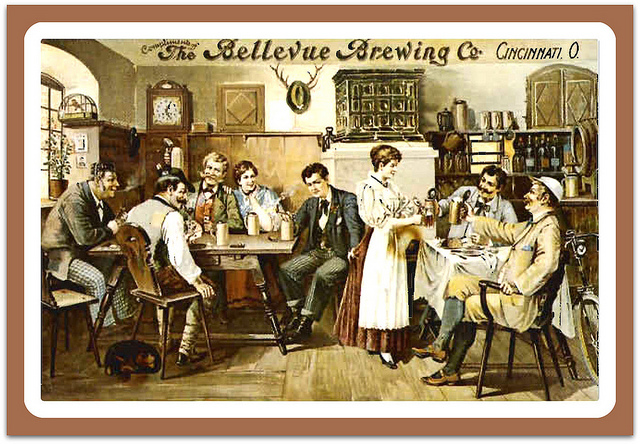
Today is the birthday of George F. Klotter Jr. (August 25, 1835-1900?) His father, along with partner Johann G. Sohn, established the Hamilton Brewery in Cincinnati, Ohio in 1846. Klotter Sr. left that brewery, while Sohn continued alone, and Klotter started another brewery, the George Klotter Brewery in 1866 The following year George Jr., and his brother Louis, joined the brewery, and it was renamed the George Klotter and Sons Brewery, which it remained until 1888.
Bellevue-postcard

It 1888, it was renamed the Bellevue Brewery until finally closing in 1919.

Filed Under: Birthdays Tagged With: History, Ohio

Historic Beer Birthday: John Taylor, The Bard of Beer

August 24, 2025 By Jay Brooks

poetry
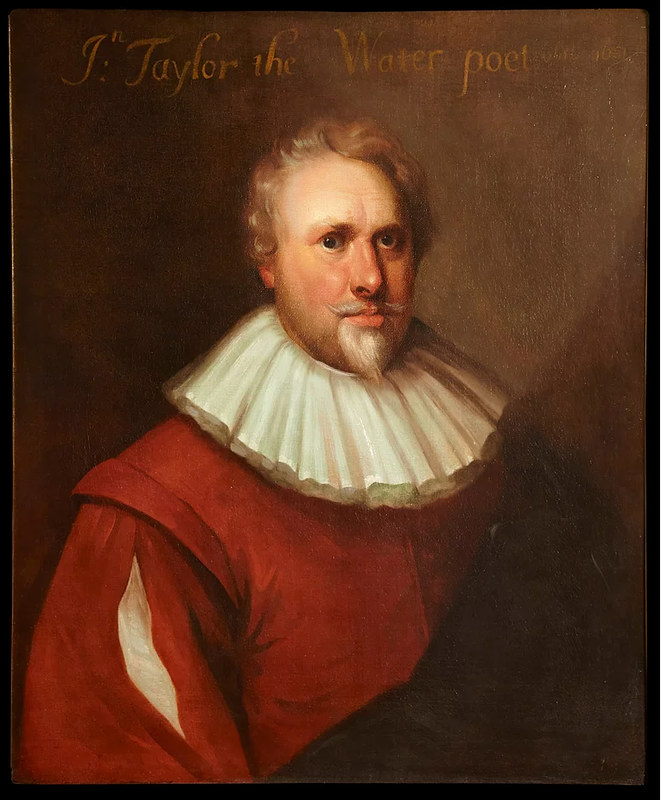
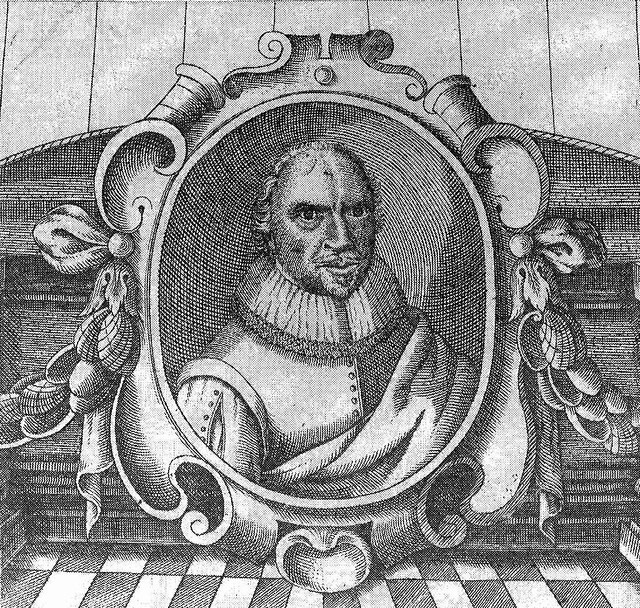
Today is the birthday of John Taylor, who was nicknamed “The Bard of Beer,” although he apparently referred to himself as “The Water Poet.” (August 24, 1578-1653). He was born in Gloucester, and “after his waterman apprenticeship he served (1596) in Essex’s fleet, and was present at Flores in 1597 and at a siege of Cadiz.”

john-taylor-water-poet

Here’s part of his biography from his Wikipedia page:

He spent much of his life as a Thames waterman, a member of the guild of boatmen that ferried passengers across the River Thames in London, in the days when the London Bridge was the only passage between the banks. He became a member of the ruling oligarchy of the guild, serving as its clerk; it is mainly through his writings that history is familiar with the watermen’s disputes of 1641–42, in which an attempt was made to democratize the leadership of the Company. He details the uprisings in the pamphlets Iohn Taylors Manifestation … and To the Right Honorable Assembly … (Commons Petition), and in John Taylors Last Voyage and Adventure of 1641.

He was a prolific, if rough-hewn writer (a wit rather than a poet), with over one hundred and fifty publications in his lifetime. Many were gathered into the compilation All the Workes of John Taylor the Water Poet (London, 1630; facsimile reprint Scholar Press, Menston, Yorkshire, 1973); augmented by the Spenser Society’s edition of the Works of John Taylor … not included in the Folio edition of 1630 (5 volumes, 1870–78). Although his work was not sophisticated, he was a keen observer of people and styles in the seventeenth century, and his work is often studied by social historians. An example is his 1621 work Taylor’s Motto, which included a list of then-current card games and diversions.

He achieved notoriety by a series of eccentric journeys: for example, he travelled from London to Queenborough in a paper boat with two stockfish tied to canes for oars, described in “The Praise of Hemp-Seed”,[2] which was re-enacted in 2006. From his journey to Scotland in 1618, on which he took no money, Taylor published his Pennyless Pilgrimage. (Ben Jonson walked to Scotland in the same year.)

Taylor is one of the few credited early authors of a palindrome: in 1614, he wrote “Lewd did I live, & evil I did dwel.” He wrote a poem about Thomas Parr, a man who supposedly lived to the age of 152. He was also the author of a constructed language called Barmoodan.

Many of Taylor’s works were published by subscription; i.e., he would propose a book, ask for contributors, and write it when he had enough subscribers to undertake the printing costs. He had more than sixteen hundred subscribers to The Pennylesse Pilgrimage; or, the Moneylesse Perambulation of John Taylor, alias the Kings Magesties Water-Poet; How He TRAVAILED on Foot from London to Edenborough in Scotland, Not Carrying any Money To or Fro, Neither Begging, Borrowing, or Asking Meate, Drinke, or Lodging., published in 1618.

talyor-john
And this is his entry from the Encyclopedia Britannica:

John Taylor, (born Aug. 24, 1580, Gloucester, Gloucestershire, Eng.—died December 1653, London), minor English poet, pamphleteer, and journalist who called himself “the Water Poet.”

The son of a surgeon, Taylor was sent to a grammar school but became, as he said, “mired in Latin accidence” and was apprenticed to a Thames boatman. He served in the navy and saw action at Cádiz (1596) and Flores (1597). Returning to London, he worked as a waterman transporting passengers up and down the River Thames and also held a semiofficial post at the Tower of London for several years. Taylor won fame by making a series of whimsical journeys that he described in lively, rollicking verse and prose. For example, he journeyed from London to Queenborough, Kent, in a paper boat with two stockfish tied to canes for oars and nearly drowned in the attempt. He made other water journeys between London, York, and Salisbury, and The Pennyles Pilgrimage. . . (1618) describes a trip he made on foot from London to Edinburgh without money. In 1620 he journeyed to Prague, where he was received by the queen of Bohemia. His humorous accounts of his journeys won the patronage of Ben Jonson, among others. Taylor also amused the court and the public in his paper war with another eccentric traveler, Thomas Coryate. In 1630 he published 63 pieces in All the Works of John Taylor the Water Poet, although he continued to publish prolifically afterward.

When the English Civil Wars began Taylor moved to Oxford, where he wrote royalist pamphlets. After the city surrendered (1645), he returned to London and kept a public house, “The Crown” (later “The Poet’s Head”), until his death.

ex-ale-tation-cover
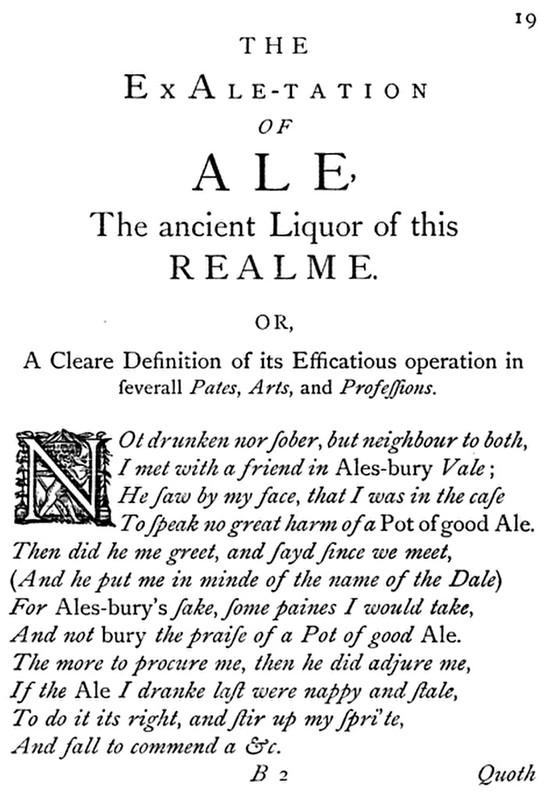
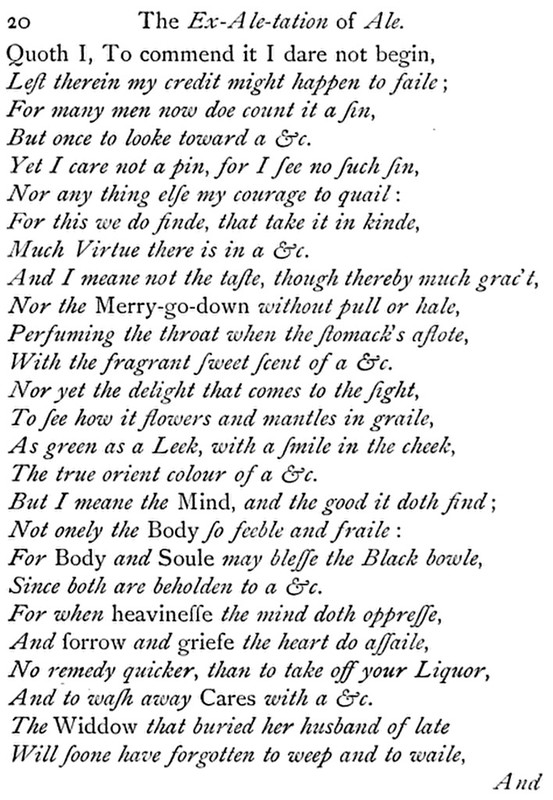
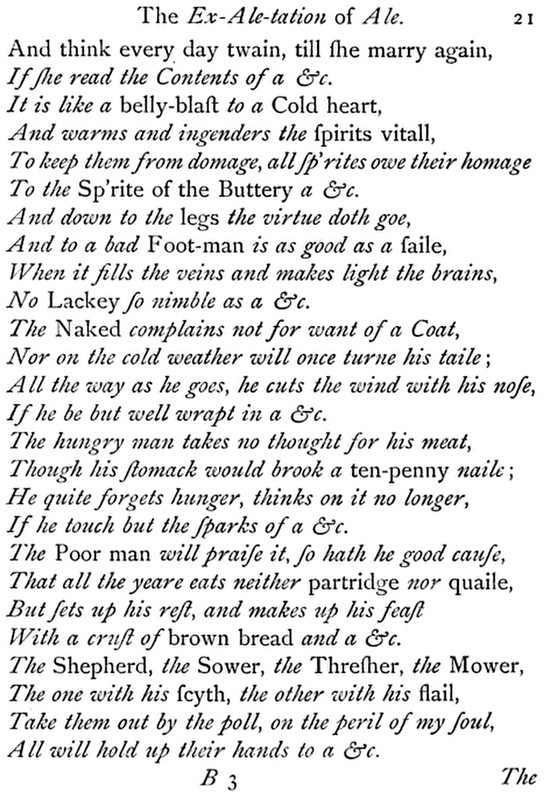
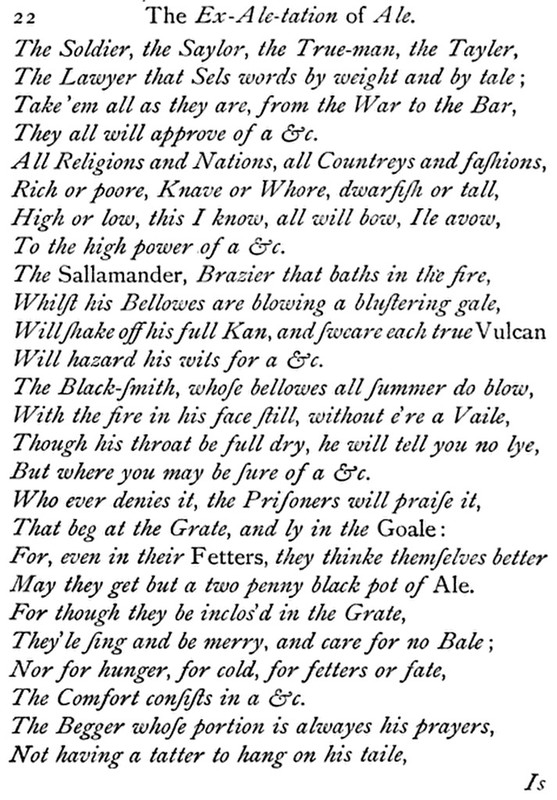
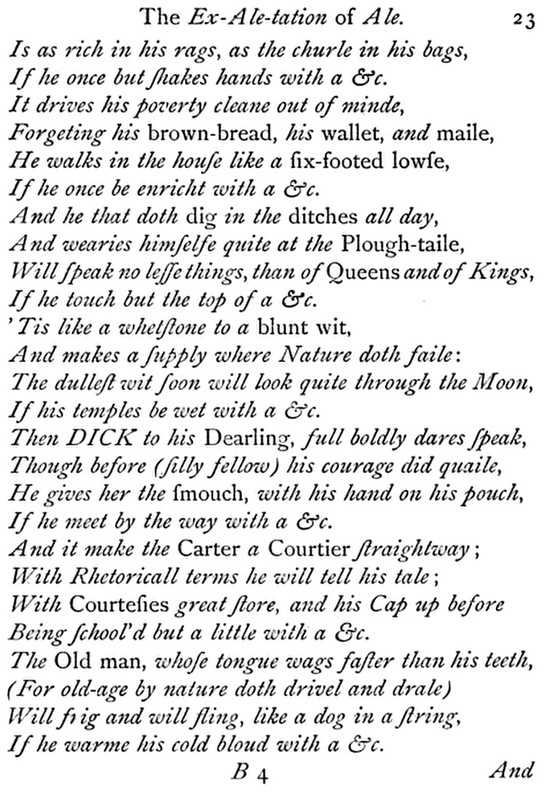
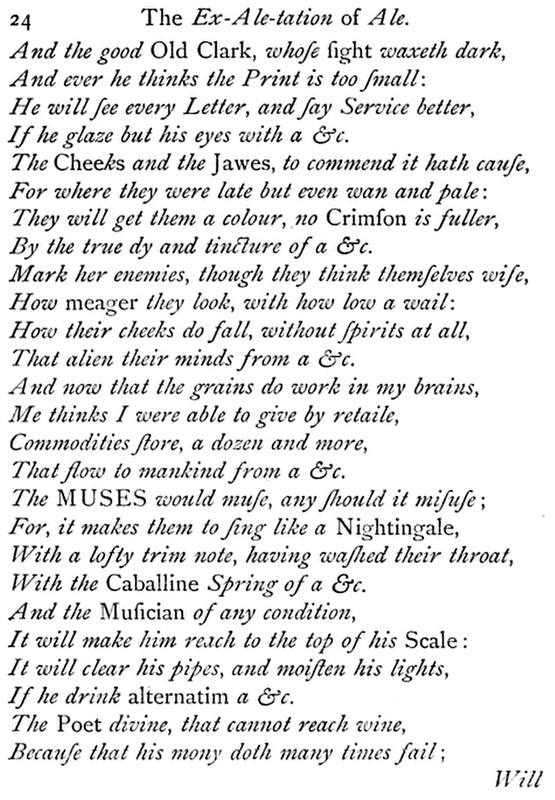
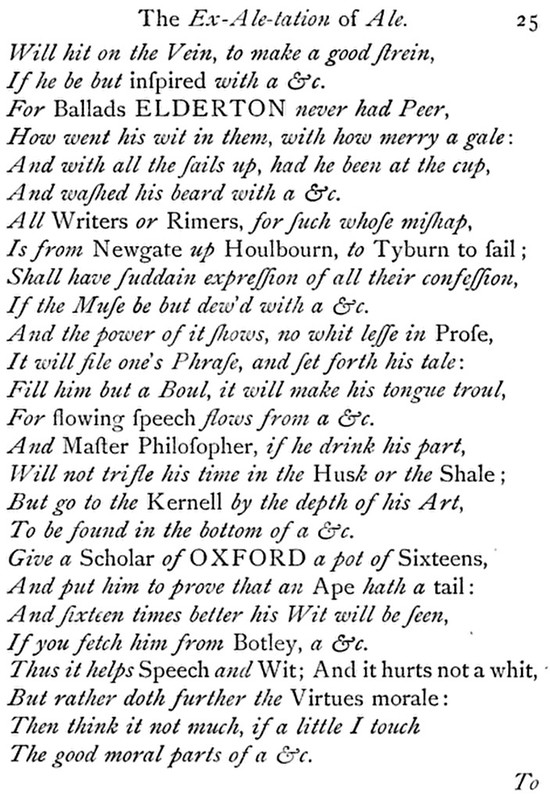
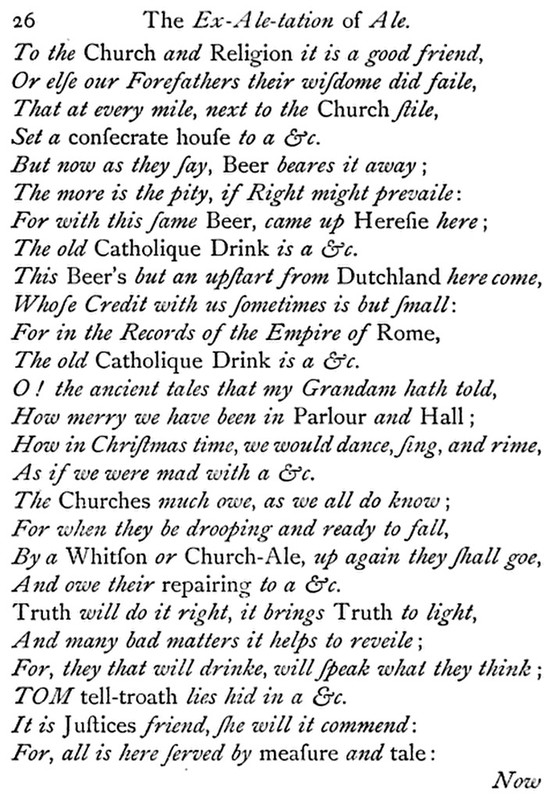
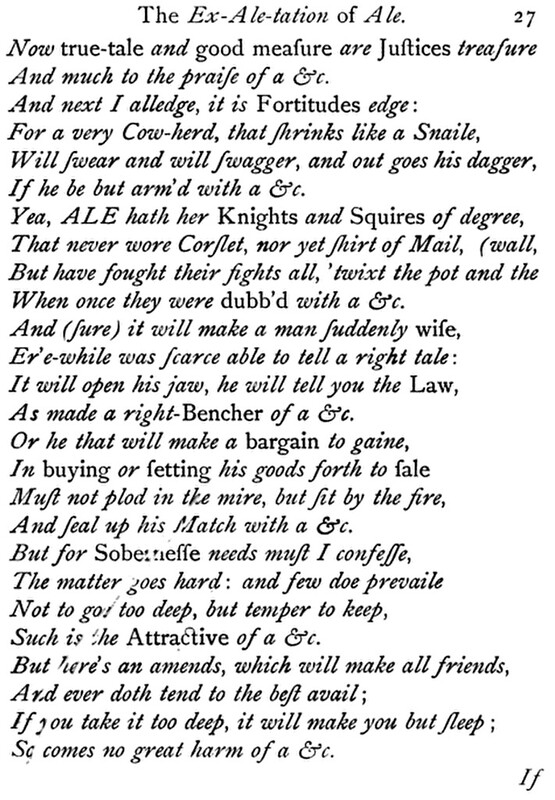
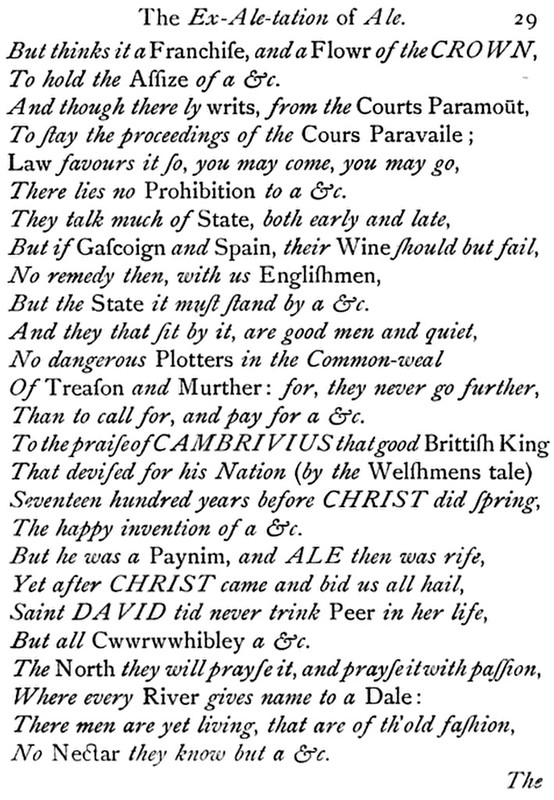
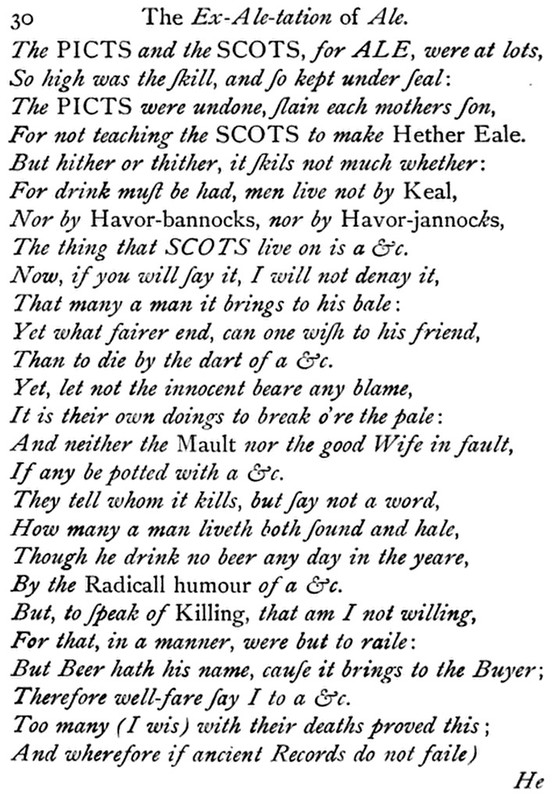
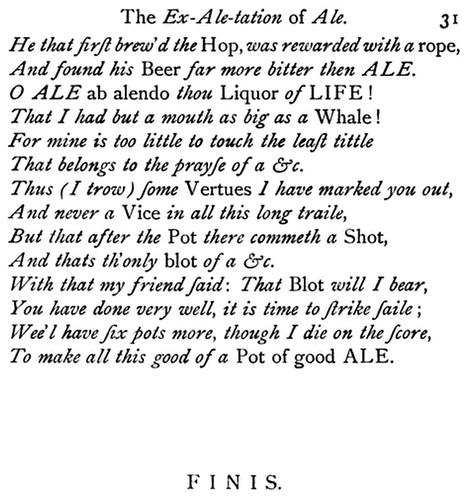
Here is one of his most beer-centric poems:

The Ex-Ale-Tation of Ale

ExAle-Tation-01
ExAle-Tation-02
ExAle-Tation-03
ExAle-Tation-04
ExAle-Tation-05
ExAle-Tation-06
ExAle-Tation-07
ExAle-Tation-08
ExAle-Tation-09
ExAle-Tation-10
ExAle-Tation-11
ExAle-Tation-12
ExAle-Tation-13
John_Taylor_poet

Filed Under: Birthdays, Just For Fun, Related Pleasures Tagged With: England, Great Britain, History, Literature, Poetry, Words

Historic Beer Birthday: Louis Wiegand

August 24, 2025 By Jay Brooks

new_york
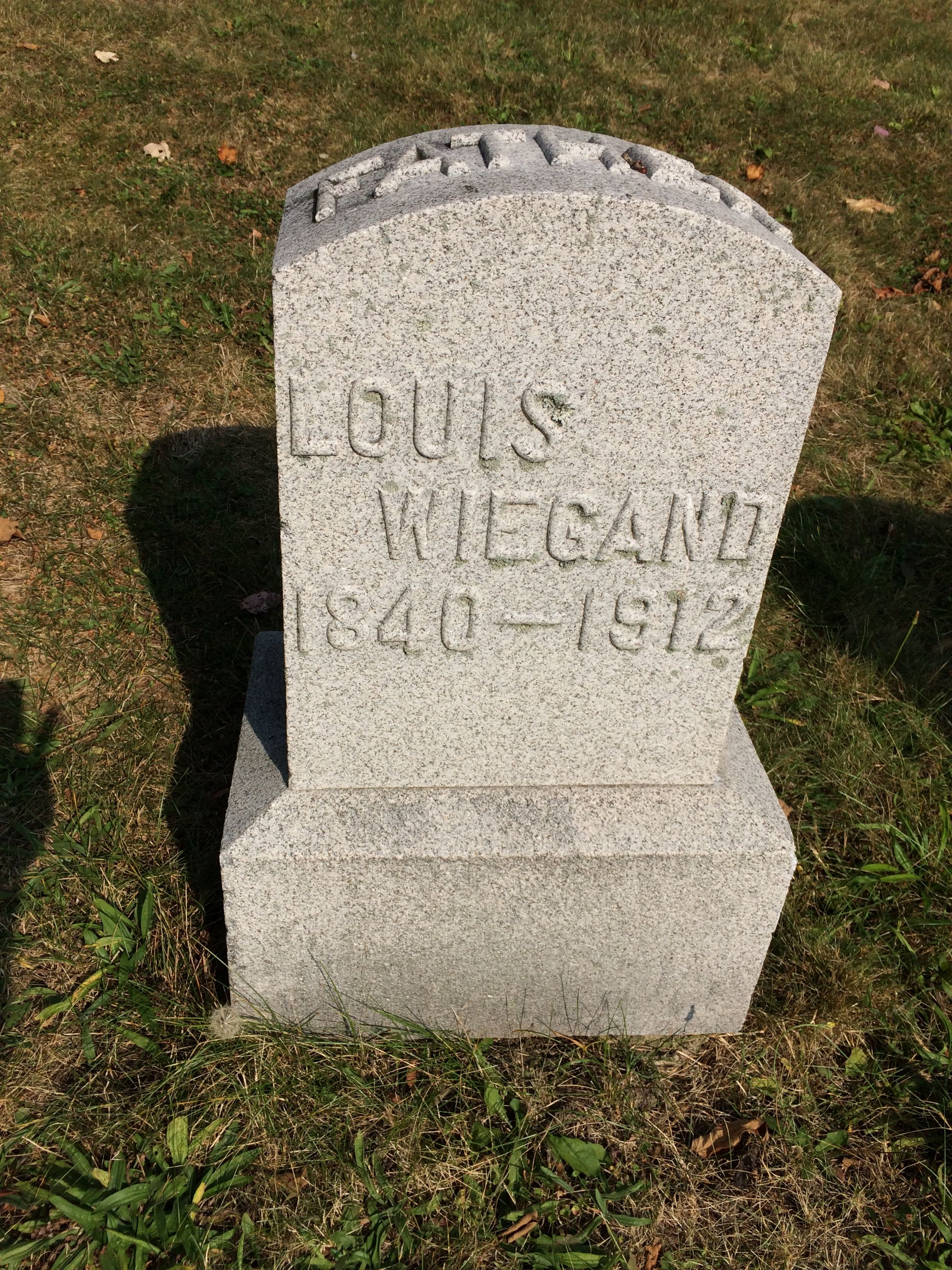
Today is the birthday of Louis Wiegand (August 24, 1840-March 2, 1912). He was born in Frankfort, Germany, he emigrated to America when he was 27, in 1867. He was initially in the meat business but in 1878, along with partners Carl Durr and William Wagner, he founded the Oswego German Brewing Co. in Oswego, New York. A few years later, in 1882, he bought out his partners, and renamed if the Wiegand Brewing Co. and then the Louis Wiegand Brewing Co. When his sons joined him in the business in 1896 it became known as Louis Wiegand & Son. It was closed by prohibition in 1916 and never reopened.

This is his obituary, from the Oswego Daily Times, for Monday, March 4, 1912:

The death of Louis Wiegand senior member of L Wiegand & son brewers, which occurred at his home, No 166 East Second street, Saturday evening at 4:45 o’clock, will be received with sorrow by citizens generally. Mr. Wiegand had been in failing health since last May and for several months had been confined to his home. Born in Wirthheina, near Frankfort, Germany, in 1840, Mr. Wiegand came to Oswego in 1867, He engaged successfully in the meat business in East Bridge street for several years. In 1882, Mr. Wiegand organized the Germania Brewing Company and shortly thereafter took over the business, which he has successfully conducted ever since. Deeply interested in the St. Peter’s Cemetery association and one of its organizers, Mr. Wiegand was zealous in promoting it. He had been president of the society for several years. When It was desired to acquire more property for the extension of the cemetery, the funds on hand were not sufficient. Mr. Wiegand purchased the property and sold it to the association without profit to himself. He was a constant visitor to the cemetery and gave much of his time to plans for beautifying it.

Mr. Wiegand’s first wife died several years ago. He is survived by his second wife, formerly Miss Catherine Stoke; one son, Louis X, and a sister, Mrs. Margaret Cook, all of Oswego. The funeral will be held tomorrow morning from his home and at St Peter’s church.

Unfortunately, apart from his obituary, there was almost nothing else I could find about him, his sons or his brewery, not even any photos or breweriana.

Filed Under: Birthdays, Breweries, Just For Fun Tagged With: Germany, History, New York

Beer In Ads #5061: Schaffhauser Giant Bock

August 23, 2025 By Jay Brooks

Last year I decided to concentrate on Bock ads. Bock, of course, may have originated in Germany, in the town of Einbeck. Because many 19th century American breweries were founded by German immigrants, they offered a bock at certain times of the year, be it Spring, Easter, Lent, Christmas, or what have you. In a sense they were some of the first seasonal beers. “The style was later adopted in Bavaria by Munich brewers in the 17th century. Due to their Bavarian accent, citizens of Munich pronounced ‘Einbeck’ as ‘ein Bock’ (a billy goat), and thus the beer became known as ‘Bock.’ A goat often appears on bottle labels.” And presumably because they were special releases, many breweries went all out promoting them with beautiful artwork on posters and other advertising.

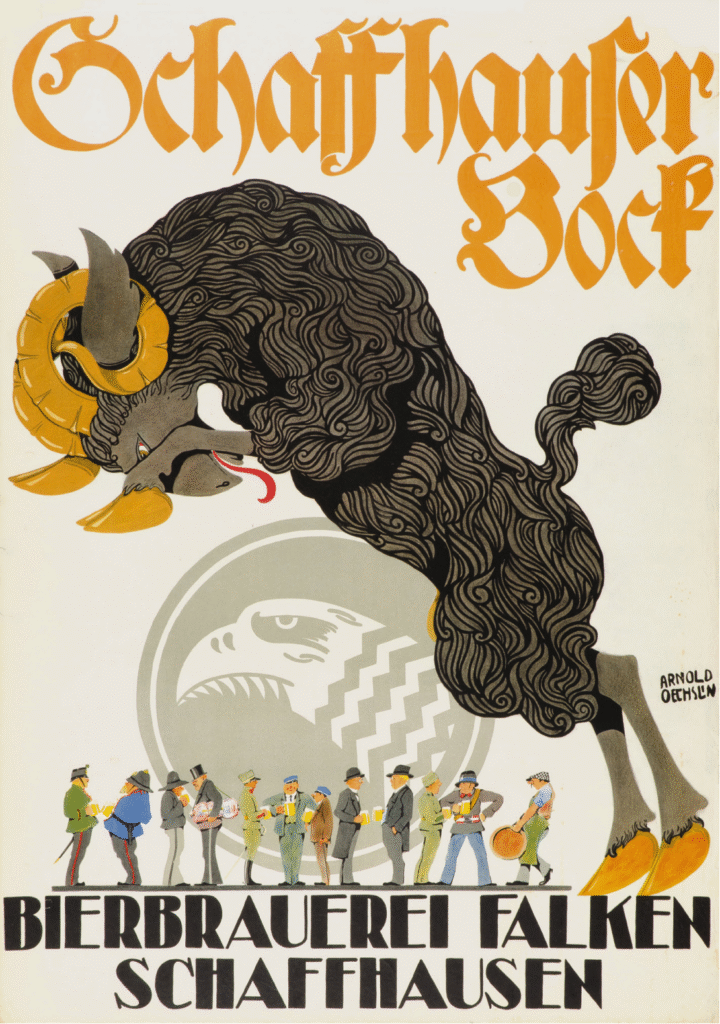
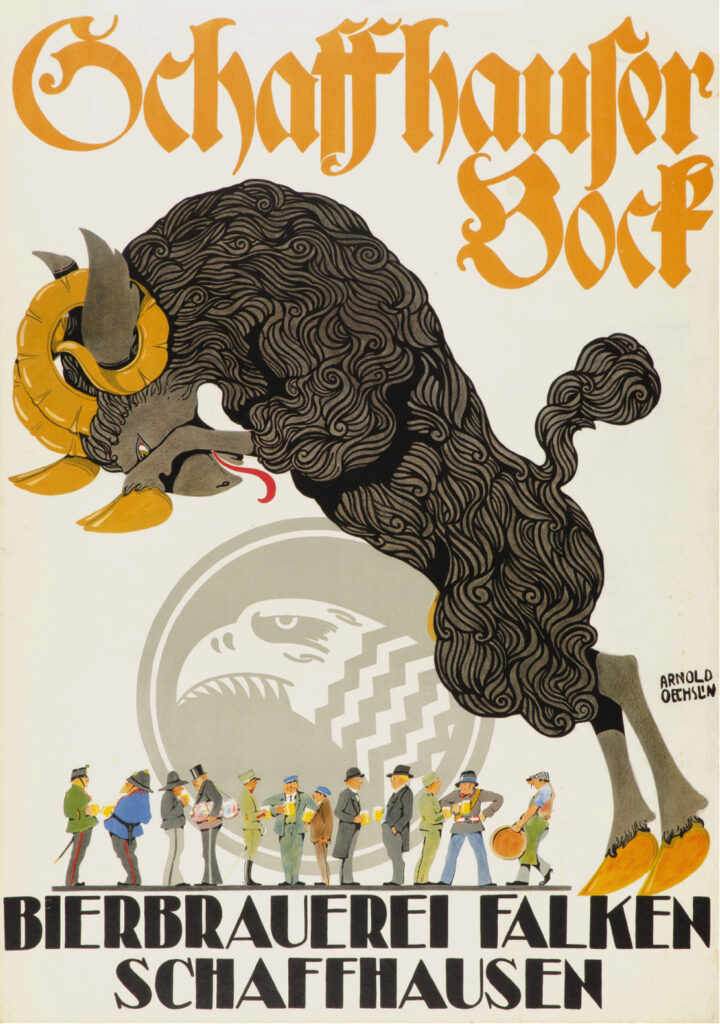
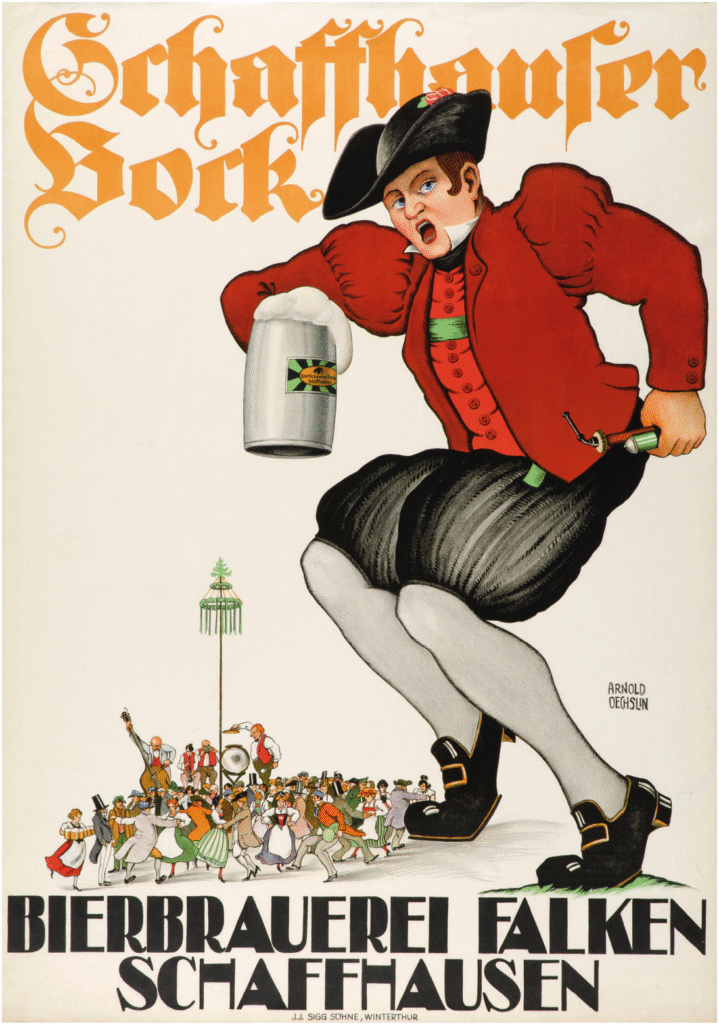
Saturday’s poster is for Falken Schaffhauser’s Bock, and was published in 1934. This one was made for the Bierbrauerei Falken Schaffhausen, or Falcon Brewery, of Schaffhausen, Switzerland. The brewery was founded in 1799, and is still in business today, and is “considered the only independent brewery in the Schaffhausen region,” and is Switzerland’s 5th largest brewery. This one is for their Schaffhauser Bock and shows a giant goat (though honestly it looks more like a bighorn sheep) towering over a dozen men all drinking beer. It was created by Swiss artist Arnold Oechslin.

Filed Under: Art & Beer, Beers, Breweries, Just For Fun Tagged With: Advertising, Bock, History, Switzerland

Historic Beer Birthday: George W.C. Oland

August 23, 2025 By Jay Brooks

Today is the birthday of George W.C. Oland (August 23, 1855-January 25, 1933). He was born in Hampshire, England but emigrated to Canada, settling in Halifax, Nova Scotia. He was the son of Susannah Oland, who founded Moosehead Breweries. After his mother died in 1885, he took over control of Moosehead, but “sold the brewery to an English syndicate and used the proceeds to acquire the Highland Spring Brewery of Halifax and another brewery in Saint John.

George W.C. Oland seated in the front, with his sons, Sidney, George Bauld, and Geoffrey behind him.

The Halifax brewery was destroyed in the explosion of 1917 and, as a consequence, George W. C. Oland transferred all his energies to the Saint John Brewery, which was run by his son George Bauld (see Halifax Explosion). His second son, Sidney, joined him in the business at the end of the First World War and with the aid of government compensation for victims of the Halifax explosion, the Olands rebuilt the old Highland Spring Brewery.”

The Oland Brewery after the Halifax explosion in 1917.

During Prohibition, when the sale of intoxicating beverages was illegal, the Olands supplemented the little money they made from soft drinks and 2 per cent beer, which was legal to produce, with profits from selling illegal “strong” beer in pubs and shops. In 1927, George Bauld admitted to selling illegal beer to various pubs and shops, which cost his business some $24,000 in fines over the course of Prohibition. This dodgy practice helped keep the business afloat. In 1928, Oland & Sons purchased the Alexander Keith’s Brewery when it came up for sale. Keith’s was the oldest brewery in the Maritimes and its acquisition gave Oland & Sons a monopoly on brewing in Nova Scotia.

The Moosehead Brewery in the 1930s or 40s.

Soon after the Oland family acquired the Keith’s brewery, Sidney Oland’s older brother, George Bauld Oland, acquired the James Ready Brewery in Saint John, which was renamed New Brunswick Breweries (and again renamed Moosehead Breweries Limited in 1947). In 1933, George Bauld introduced Moosehead Pale Ale to the public. Ever since they were boys, Sidney and George had been in competition with one another. While their father was alive, the intense rivalry was never allowed to descend into a family feud. But when George Sr. died in 1933, the brothers went their separate ways. By the end of the Second World War, there were two distinct branches of the Oland family: the Nova Scotia Olands, who owned and operated the Alexander Keith’s Brewery, and the New Brunswick Olands, who controlled Moosehead. Eventually, control of the Moosehead brewery in Saint John was given to George Bauld’s son, Philip, while Oland & Sons of Halifax was taken over by Sidney’s three sons Victor, Bruce, and Don.

Filed Under: Birthdays, Breweries, Just For Fun Tagged With: Canada, History, Nova Scotia

Beer In Ads #5060: Hospitality Demands Our Pale Bock Beer

August 22, 2025 By Jay Brooks

Last year I decided to concentrate on Bock ads. Bock, of course, may have originated in Germany, in the town of Einbeck. Because many 19th century American breweries were founded by German immigrants, they offered a bock at certain times of the year, be it Spring, Easter, Lent, Christmas, or what have you. In a sense they were some of the first seasonal beers. “The style was later adopted in Bavaria by Munich brewers in the 17th century. Due to their Bavarian accent, citizens of Munich pronounced ‘Einbeck’ as ‘ein Bock’ (a billy goat), and thus the beer became known as ‘Bock.’ A goat often appears on bottle labels.” And presumably because they were special releases, many breweries went all out promoting them with beautiful artwork on posters and other advertising.

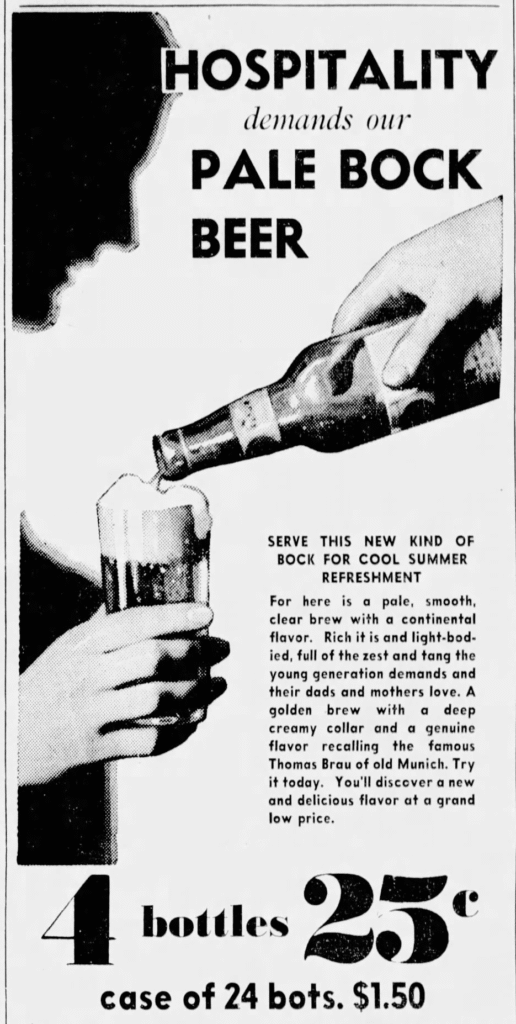
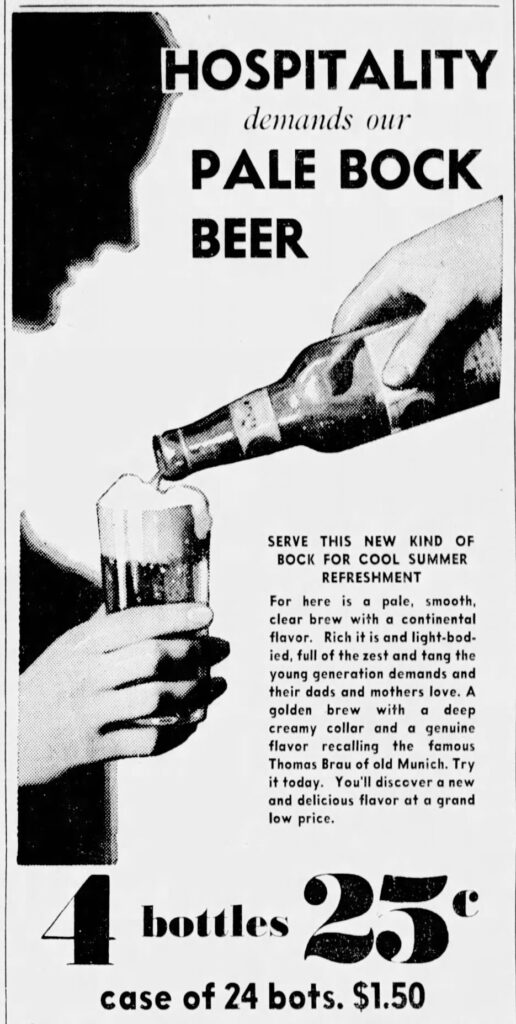
Friday’s ad is for Thomas Brau Bock Beer, which was published on August 22, 1935. This one was for the Gebrüder Thomas Bierbrauerei of Munich, Germany, which was originally founded in the Middle Ages, but merged with Paulaner in 1928. To be fair, it’s really a small part of a full-page ad for a market chain called “George W. Loft Markets,” in upstate New York, with locations in New Rochelle, White Plains, and the Bronx. This ad ran in The Standard-Star, of New Rochelle, New York, and the exact same ad also ran in the Daily Reporter of White Plains.

Filed Under: Art & Beer, Beers, Breweries, Just For Fun Tagged With: Advertising, Bock, Germany, History, New York

Beer In Ads #5059: Schaffhauser Leaping Bock

August 21, 2025 By Jay Brooks

Last year I decided to concentrate on Bock ads. Bock, of course, may have originated in Germany, in the town of Einbeck. Because many 19th century American breweries were founded by German immigrants, they offered a bock at certain times of the year, be it Spring, Easter, Lent, Christmas, or what have you. In a sense they were some of the first seasonal beers. “The style was later adopted in Bavaria by Munich brewers in the 17th century. Due to their Bavarian accent, citizens of Munich pronounced ‘Einbeck’ as ‘ein Bock’ (a billy goat), and thus the beer became known as ‘Bock.’ A goat often appears on bottle labels.” And presumably because they were special releases, many breweries went all out promoting them with beautiful artwork on posters and other advertising.

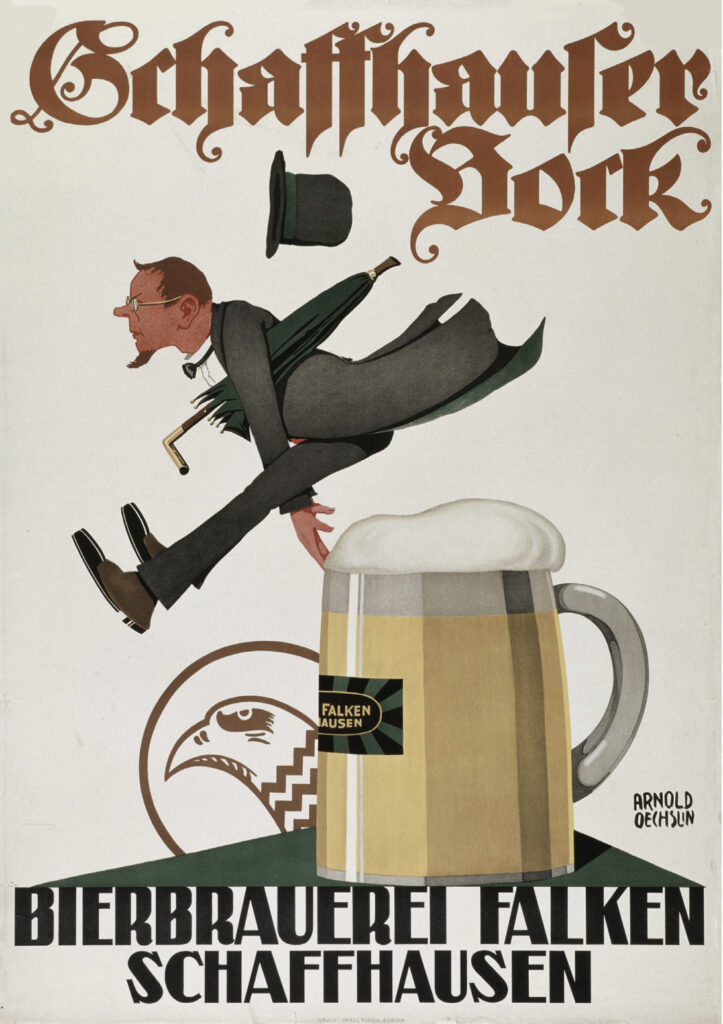
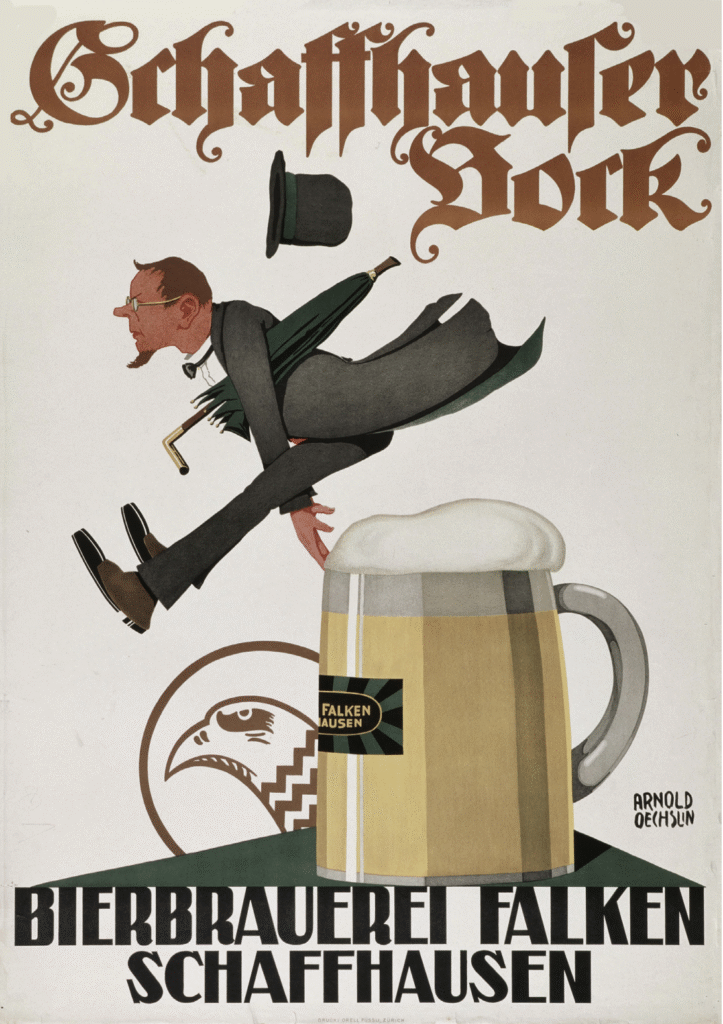
Wednesday’s poster is for Falken Schaffhauser’s Bock, and was published in 1933. This one was made for the Bierbrauerei Falken Schaffhausen, or Falcon Brewery, of Schaffhausen, Switzerland. The brewery was founded in 1799, and is still in business today, and is “considered the only independent brewery in the Schaffhausen region,” and is Switzerland’s 5th largest brewery. This one is for their Schaffhauser Bock and shows a man leaping over a giant mug of beer. It was created by Swiss artist Arnold Oechslin.

Filed Under: Art & Beer, Breweries, Just For Fun Tagged With: Advertising, Bock, History, Switzerland

Historic Beer Birthday: Christian Diehl

August 21, 2025 By Jay Brooks

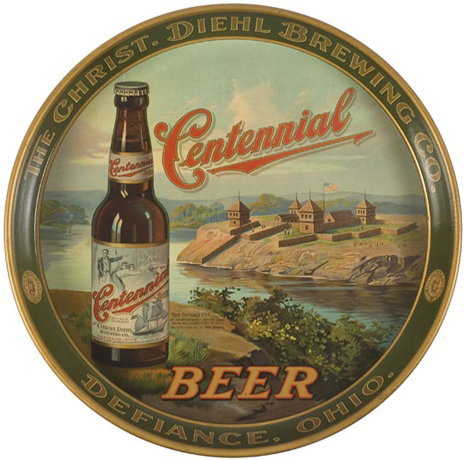
diehl-round
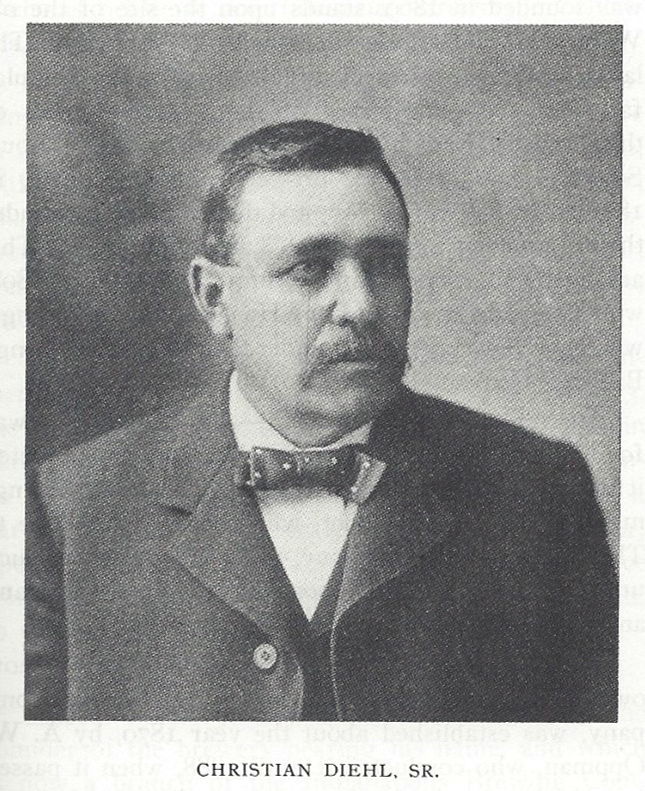
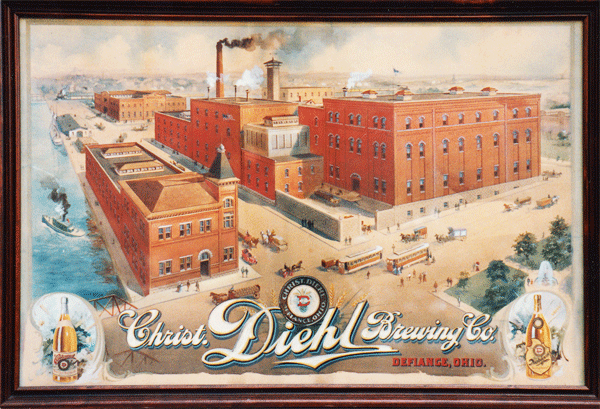
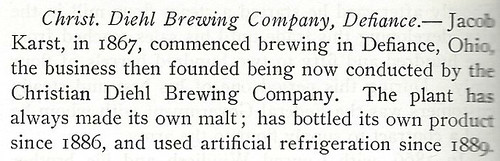
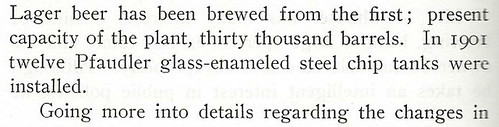
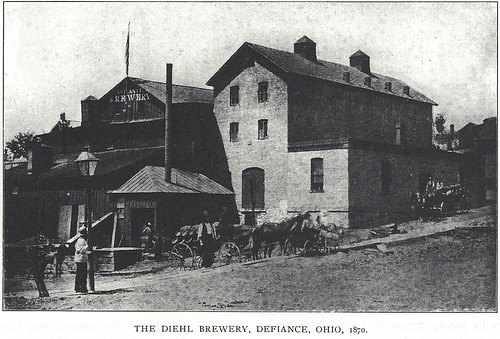
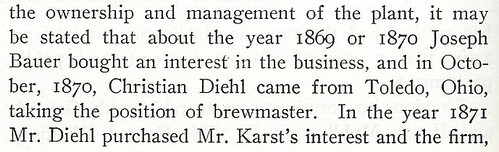
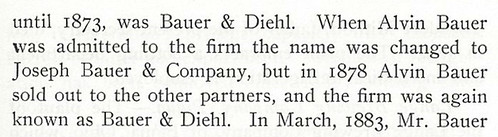
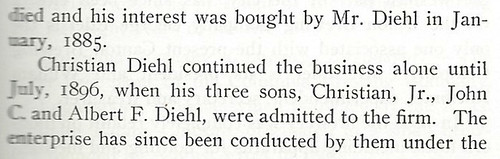
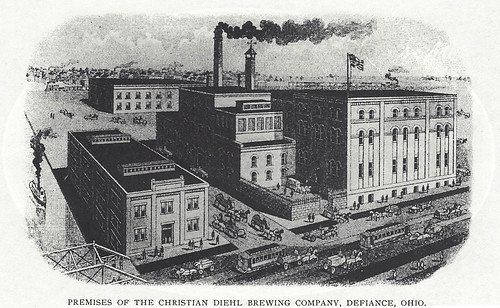
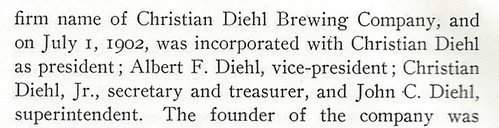
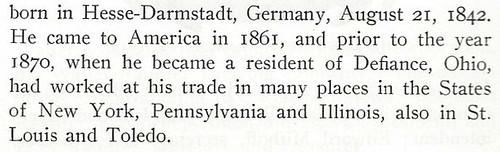
Today is the birthday of Christian Diehl (August 21, 1842-1928). He was born in Hessen-Darmstadt, Germany and moved to the U.S. when he was 28, in 1870, settling in Defiance, Ohio. There, Jacob Karst and Joseph Bauer hired Diehl to be the brewmaster for their Defiance Brewery, which Karst had founded in 1867. The next year, Diehl bought out Karst and the brewery became known as the Bauer & Christian Diehl Brewery. Shortly after Bauer died, and in 1885 it became the Christian Diehl Brewery and later the Christ. Diehl Brewing Co., with Diehl as sole owner. The brewery reopened after prohibition and remained in business for another twenty years, closing for good in 1955.

christian-diehl-portrait

Here’s a portion of an article about Diehl, by Carl Miller, entitled What A Diehl! from the Defiance Crescent News.

The Legacy Begins

On October 21, 1870, a twenty-eight-year-old Christian Diehl arrived in Defiance to take a position as brewmaster at the local brewery. He had learned the art of brewing beer in his hometown of Hessen-Darmstadt, Germany before emigrating to America in 1861. European-trained brewers like Christian found employment easily in mid-nineteenth century America due to the hundreds of small breweries operating throughout the east and midwest.

The young Christian Diehl took full advantage of the demand enjoyed by his profession, traveling from state to state exploring his newly adopted country. Before coming to Ohio, he worked in breweries in New York, Pennsylvania, Illinois and Missouri. Just prior to his arrival in Defiance, he had been employed by a Toledo brewer.

The brewery which lured Christian Diehl to Defiance was established in 1867 by German immigrant Jacob Karst. Known simply as the “Defiance Brewery,” the works was situated on North Clinton street just near the Maumee River. In 1869, local saloonkeeper Joseph Bauer purchased an interest in the brewery, and it was the firm of Karst and Bauer which hired Christian as brewmaster in 1870. By the following year, Christian had accumulated resources enough to buy Karst’s share in the brewery, and the partnership of Bauer and Diehl was established. Aside from a brief participation in the business by Bauer’s son, the brewery operated basically unchanged until the passing away of Joseph Bauer in 1883. Christian, who had apparently achieved a certain degree of financial success with the brewery by this time, purchased Bauer’s interest from his family in 1885.

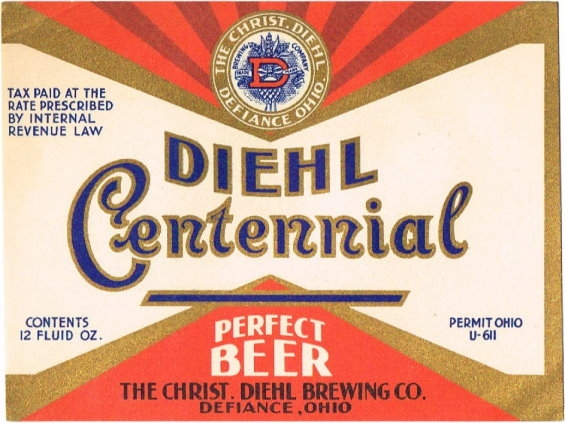
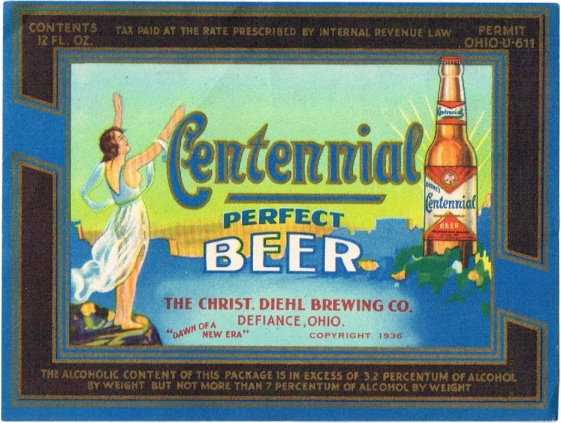
Centennial-Beer-Labels-The-Christ-Diehl-Brewing-Co--Post-Prohibition-1909

The Next Generation

In 1896, three of Christian’s sons — Christian Jr., John C., and Albert F. Diehl — were initiated into the brewery’s management. The young men had virtually grown up inside the brewery and each was already well acquainted with the business. Christian Jr., in fact, had shown such an early “adaptability for business” that he was put in charge of the firm’s books at age thirteen. John C. Diehl, having graduated from the American Brewing Academy in Chicago, took over his father’s post as Diehl brewmaster.

Although the elder Christian Diehl officially continued to fill the office of brewery president, he gradually relinquished control of the family business to his sons. After the turn of the century, Christian spent much of his time tending to the family farm just outside Defiance, where he died in 1928.

The young Diehls lead the brewery into what was perhaps the most prosperous period in its history. By 1899, the Diehl brewery employed 21 men and produced annually about 12,000 barrels of beer (32 gallons per barrel), a nearly five-fold increase over the brewery’s early days. And production continued to climb well into the new century.

The great majority of Diehl beer was consumed within Defiance County in the years before Prohibition. However, a small portion of the brewery’s product was shipped to outside markets. Proximity to the Maumee River provided easy transportation to, among other locations, Ft. Wayne and Toledo. The latter city was quite possibly the brewery’s largest market outside of Defiance. By 1911, sales of Diehl beer in Toledo had justified the construction of a brewery-owned distribution depot in that city. The brewery was said to have sent beer as far north as Grand Rapids before the onset of Prohibition.

Nevertheless, the Diehl brewery’s lifeblood was its local market. In fact, the brewery’s long-time feature brand of beer was named in honor of the city itself: Centennial Beer was introduced in 1894 to commemorate the 100th anniversary of Fort Defiance. Early bottle labels for Centennial Beer depicted General Anthony Wayne engaged in the Battle of Fallen Timbers. Other early Diehl brands included Hofbrau and Diehlgold. All were advertised as being “Diehlicious.”

The Big Drought

By about 1910, it had become apparent that prohibitionist groups such as the Anti-Saloon League and the Women’s Christian Temperance Union were rapidly gaining ground in their quest to abolish the manufacture of alcoholic beverages. The Diehl brothers, having fostered significant growth and expansion of the brewery throughout the early years of the century, were now charged with guiding the family business through what promised to be uncertain times ahead.

The Diehls felt it prudent to begin investigating alternative fields of business in the event that the brewing industry suffered a fatal blow. The milk condensing business emerged as a promising option due to the surrounding farmland, the lack of local competition, and the compatibility of the brewing equipment. Christian Jr. traveled to Wisconsin to observe state-of-the-art condensories in operation and returned with a glowing account of the condition of the industry.

The Prohibition crusade, in the meantime, had reached its peak. A 1918 statewide referendum left Ohio completely dry beginning in May of 1919. And, shortly thereafter, ratification of the 18th Amendment marked the beginning of National Prohibition. Brewers nationwide scrambled to find new areas of business in hopes of being among the lucky few who survived.
Although the Diehls’ plans to enter the milk condensing business had not fully materialized by the time Prohibition came, the proposed venture had attracted a significant amount of local interest. By 1922, several investors with experience in milk condensing had been recruited, and the Defiance Dairy Products Company was soon in full operation in a portion of the old brewery. The Crescent News called the opening of the condensory “a milestone in the commercial life of Defiance.” Indeed, the milk condensory — still owned and operated by the Diehl family — is today one of the city’s largest enterprises.

Incidentally, the brewery was kept in operation well into Prohibition, making “near beer,” a de-alcoholized version of real beer. The bottling works remained active as well, packaging a wide variety of soft drinks.

And this history of the brewery is from “100 Years of Brewing:”

Centennial-Beer-Tip-Trays-3-6-inches-The-Christ-Diehl-Brewing-Co--Post-Prohibition

Filed Under: Birthdays, Breweries, Just For Fun Tagged With: Germany, History, Ohio

Historic Beer Birthday: Josef Groll

August 21, 2025 By Jay Brooks

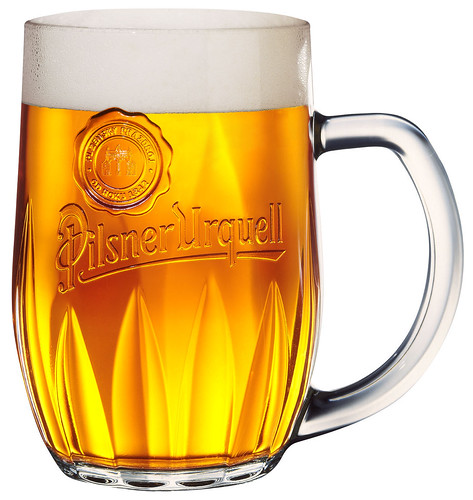
pilsner-urquell
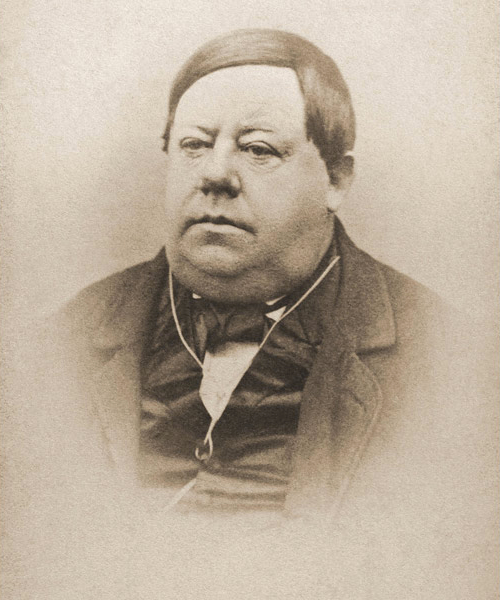
Today is the birthday of Josef Groll (August 21, 1813-November 22, 1887). He was born in Vilshofen an der Donau, Germany. Many consider the Bavarian brewer to be the inventor of pilsener beer.

Josef Groll’s portrait.

According to the Wikipedia:

The citizens of Pilsen were no longer satisfied with their top-fermented Oberhefenbier. They publicly emptied several casks of beer in order to draw attention to its low quality and short storage life. It was decided to build a new brewery capable of producing a bottom-fermented beer with a longer storage life. At the time, this was termed a Bavarian beer, since bottom-fermentation first became popular in Bavaria and spread from there. The climate in Bohemia is similar to that in Bavaria and made it possible to store ice in winter and cool the fermentation tanks down to 4 to 9 degrees Celsius year-round, which is necessary for bottom-fermentation.

Bavarian beer had an excellent reputation, and Bavarian brewers were considered the masters of their trade. Thus, the citizens of Pilsen not only built a new brewery, but also hired Josef Groll, a Bavarian brewer. Josef Groll’s father owned a brewery in Vilshofen in Lower Bavaria and had long experimented with new recipes for bottom-fermented beer. On October 5, 1842, Groll produced the first batch of Urquell beer, which was characterized by the use of soft Bohemian water, very pale malt, and Saaz hops It was first served in the public houses Zum Goldenen Anker, Zur weißen Rose and Hanes on 11 November 1842, and was very well received by the populace.

Josef Groll’s contract with the Bürgerliches Brauhaus (citizens’ brewery) in Pilsen expired on April 30, 1845 and was not renewed. Groll returned to Vilshofen and later inherited his father’s brewery. The Pilsen brewery was directed by Bavarian brewers for nearly sixty years until 1900.

Groll around age 60.

Here’s a description of Groll and his development of pilsner from the German Beer Institute:

The modern Pils may be a northern German brew, but it was a Bavarian brewmaster, Josef Groll, who started it all a scant 160 years ago, when he accepted a new job. Groll, who was born in 1813 in the Bavarian village of Vilshofen (some 100 miles northeast of Munich), prepared a new mash on October 5, 1842, at his new place of employment, the Burgher Brewery in the Bohemian city of Pilsen. As it turned out, the brew that Josef was mixing in the mash tun that day was truly revolutionary…it was the very first blond lager. It was a brew that was to set the style for an entirely new line of beers. The beer that resulted from that first brew was first served on November 11, 1842…and it has conquered the entire world ever since.

Until Groll made his new beer, the standard drink in Pilsen was a top-fermented brew, an ale. But not all was well with the Pilsen ale, because on one occasion, the city council ordered that 36 casks of it be dumped in public. It had become all too frequent that the beers available to the good burghers of Pilsen had been unfit to drink. This caused them to stick their heads together and to hatch a drastic plan: They would invest in a new, state-of-the art brewery and contract a competent brewer to come up with a better beer. In the 1840s, that meant a brewery capable of making Bavarian-style bottom-fermented brews, that is, lagers. Because of the reputation of Bavarian beer, Bavarian brewmasters, too, were held in high regard. So the citizens of Pilsen not only built a Bavarian brewhouse for Bavarian beer, they even engaged a Bavarian brewer to rescue the Pilsner beer from oblivion.

The fellow they engaged for the job was the above-mentioned Josef Groll of Vilshofen. He was an intrepid brewer who clearly rose to the challenge. Instead of using the standard dark malts of his day, he kilned his malt to a very pale color — a technique that had only recently been perfected in Britain. Groll then made use of only the finest of local raw materials. He flavored the brew with plenty of hops from the Saaz region of Bohemia (today, Czech Saaz hops is considered one of the finest aroma hops money can buy) and, of course, brewed with the city’s extremely soft water. From these ingredients he made an extract, which he fermented with good Bavarian lager yeast — and a new beer was born. Nobody before Groll had ever made such an aromatic golden-blond, full-bodied lager.

When Joseph’s contract was up, on April 30, 1845, he went back home to his native Bavaria, but his new beer’s reputation spread quickly beyond the limits of Pilsen. If imitation is the sincerest form of flattery, Joseph Groll sure had cause to feel flattered. Initially, the designation Pilsner beer was just an appellation of origin — a beer made in the city of Pilsen. But soon the new brew was copied everywhere. The first imitators were in adjacent towns with similarly soft water and equal access to Saaz hops. This was the beginning of the Bohemian Pilsner style. But breweries across the border, in Germany, began also to be interested in the Bohemian phenomenon … they had to, because it started to eat into their own sales. This was the time in Europe, when the emerging railway network made the transportation of beer possible to just about any major city.

By the turn of the 19th century, it had become chic from Paris to Vienna and from Hamburg to Rome to drink the beer from Pilsen. The beer’s name had become a household word, usually in its abridged form of Pils. The term Pils had evolved from an appellation of origin to a designation for a new beer style, the very model of a modern lager beer. When Groll died in the village of his birth, in little Vilshofen, on October 22, 1887, he probably had no idea how profound a revolution he had brought about in the world of beer!

Groll’s beer was taking the continent by storm and was even making inroads in Munich, where brewers were starting to make their own variation on the Groll brew. The Burgher Brewery of Pilsen, however, where it had all started, was far from flattered by the imitations its beer had spawned. This brewery was far more interested in supplying the demand for Pilsner beer itself than having other breweries usurp what it considered its proprietary brand name. In 1898, therefore, the Burgher Brewery of Pilsen went to court in Munich. It sought an injunction against the Thomass Brewery, which had come out with a blonde lager, named “Thomass-Pilsner-Bier.” The verdict that the court handed down in April 1899, however, went against the plaintiff. The court argued that “Pilsner” was no longer an appellation, but had become a universal style designation.

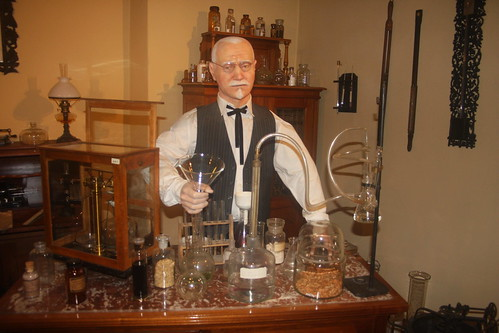
A diorama of Groll in his lab at the Pilsner Urquell Museum.

And this account is from Food Reference, but appears to have been written by Pilsner Urquell:

Most importantly, Martin Stelzer also discovered a brewmaster who would change the way that beer was brewed forever: a young Bavarian called Josef Groll.

The first brewmaster, a visionary, young Bavarian Josef Groll, revolutionized how beer was brewed, looked and tasted.

Beer as we know it has always been produced using the same basic ingredients, hops, barley and water, and for thousands of years was brewed in open vats with fermentation occurring at the top of the brew.

Groll was able to look beyond what was possible and combine his knowledge of an innovative new bottom fermenting process, known as ‘lagering’, with his access to the finest local ingredients at Plzen: a special type of two-row fine-husk barley, the locally grown Saaz hops and of course the uniquely soft local water.

In 1842 Josef Groll’s vision became reality. He succeeded in making a beer the best it could be.

Josef Groll was an unlikely hero, so rude and bad-tempered he was described as the ‘coarsest man in the whole of Bavaria’ by his father.

But it is the fate of every genius to challenge those around him. Throughout history those who have made a step change in their fields, those who have had an idea of true originality, have had one thing in common, the ability to see beyond the ordinary, and create something extraordinary.

Sir Issac Newton observed an apple, and it changed how we see the world. A certain Mr Columbus discovered the New World by rejecting how everyone had seen the old one. And in 1842 Josef Groll created a beer that changed the way the world would see beer.

From the dawn of civilization, beer had been a dark, murky liquid. Then a protest by the citizens of Plzen, Bohemia, inspired the change that would influence the entire beer industry and set the standard for all lagers.

After furious citizens had dumped no less than 36 barrels of undrinkable sludge into the city’s gutters in 1838, it sparked off a remarkable chain of events – a new brewery building, an innovative new brewmaster and finally the world’s first golden beer.

On 4 October 1842 in St Martin’s market, Plzen, Josef Groll unveiled his new creation to widespread sensation, after all a golden beer had never been seen before.

News of this remarkable Plzen beer spread throughout Bohemia. The arrival of the railway and the beer’s popularity amongst German and French tourists soon meant that Plzen’s famous brew gained international appeal.

But with success inevitably came competition. Josef Groll’s original golden beer soon spawned many imitators, many of which also claimed to be Plzen or Pilsner beer, whether they came from Plzen or not. In fact, today Pilsner has become a generic term around the world for any bottom-fermented golden beer sold as ‘pils’ or ‘pilsner’.

In 1898, the brewery acted to protect itself against inferior competitors and the beer’s name was changed to Pilsner Urquell- a German phrase meaning literally “from the original source, Plzen”.

Some say the name was changed to satisfy consumer demand for the original golden beer. But as those who know their beer will tell you: you can tell the original Pilsner by its slightly darker shade of gold, and of course by its taste which is a world apart.

Beer Sweden also has a nice two-part account, as does Brewing Techniques and Food Reference. Pilsner Urquell’s Czech website also has a brief history and a timeline. Brewer K. Florian Klemp wrote Presenting Pilsners for All ABout Beer, which includes Groll’s story.

Filed Under: Birthdays, Just For Fun Tagged With: Czech Republic, History

Beer In Ads #5058: Schaffhauser Bock

August 20, 2025 By Jay Brooks

Last year I decided to concentrate on Bock ads. Bock, of course, may have originated in Germany, in the town of Einbeck. Because many 19th century American breweries were founded by German immigrants, they offered a bock at certain times of the year, be it Spring, Easter, Lent, Christmas, or what have you. In a sense they were some of the first seasonal beers. “The style was later adopted in Bavaria by Munich brewers in the 17th century. Due to their Bavarian accent, citizens of Munich pronounced ‘Einbeck’ as ‘ein Bock’ (a billy goat), and thus the beer became known as ‘Bock.’ A goat often appears on bottle labels.” And presumably because they were special releases, many breweries went all out promoting them with beautiful artwork on posters and other advertising.

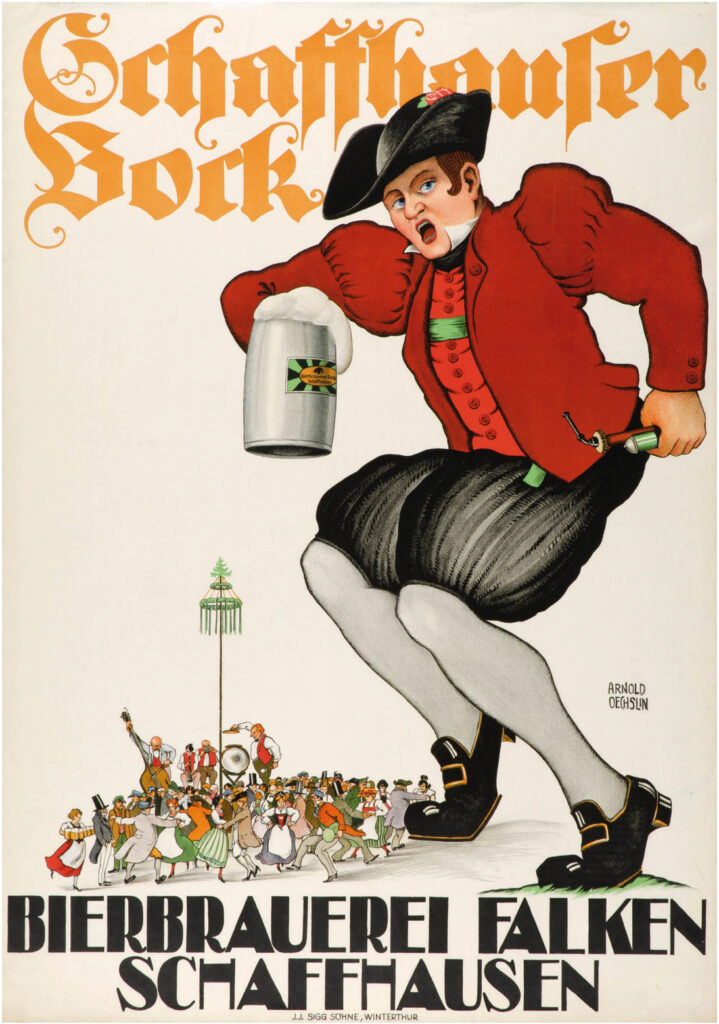
Wednesday’s poster is for Falken Schaffhauser’s Bock, and was published in 1932. This one was made for the Bierbrauerei Falken Schaffhausen, or Falcon Brewery, of Schaffhausen, Switzerland. The brewery was founded in 1799, and is still in business today, and is “considered the only independent brewery in the Schaffhausen region,” and is Switzerland’s 5th largest brewery. This one is for their Schaffhauser Bock and shows a giant man with a mug of beer. Below him is a village Maypole with a band playing while numerous couples dance. It was created by Swiss artist Arnold Oechslin.

Filed Under: Art & Beer, Beers, Breweries, Just For Fun Tagged With: Advertising, Bock, History, Switzerland

« Previous Page
Next Page »

Find Something

Northern California Breweries

Please consider purchasing my latest book, California Breweries North, available from Amazon, or ask for it at your local bookstore.

Recent Comments

  • Bob Paolino on Beer Birthday: Grant Johnston
  • Gambrinus on Historic Beer Birthday: A.J. Houghton
  • Ernie Dewing on Historic Beer Birthday: Charles William Bergner 
  • Steve 'Pudgy' De Rose on Historic Beer Birthday: Jacob Schmidt
  • Jay Brooks on Beer Birthday: Bill Owens

Recent Posts

  • Beer In Ads #5137: Bock Is Back… Look For It March 1st February 28, 2026
  • Historic Beer Birthday: John Holme Ballantine February 28, 2026
  • American Craft Beer Hall of Fame: 2nd Year Inductees February 28, 2026
  • Beer Birthday: Jeff Bell February 28, 2026
  • Beer In Ads #5136: American Bock Beer Is Being Served Today! February 28, 2026

BBB Archives

Feedback

Head Quarter
This site is hosted and maintained by H25Q.dev. Any questions or comments for the webmaster can be directed here.