Brookston Beer Bulletin

Jay R. Brooks on Beer

  • Home
  • About
  • Editorial
  • Birthdays
  • Art & Beer

Socialize

  • Dribbble
  • Email
  • Facebook
  • Flickr
  • GitHub
  • Instagram
  • LinkedIn
  • Pinterest
  • RSS
  • Twitter
  • YouTube

Powered by Genesis

Beer In Ads #954: Brewed With Corn Means Quality Beer

August 14, 2013 By Jay Brooks


Wednesday’s ad is for the American Corn Millers’ Federation, from 1933, just as Prohibition ended. The ad is singing the praises of brewing with “dry milled corn grits,” which they explain is “the public preference.” And then there’s this great tagline: “Brewed with Corn Means Quality Beer.”

brewed-with-corn-means-quality-beer

Filed Under: Art & Beer, Beers Tagged With: adjuncts, Advertising, Big Brewers, History

Beer In Ads #953: La Meuse

August 13, 2013 By Jay Brooks


Tuesday’s ad is for La Meuse, this one I’m guessing is from the late 19th century. There are several other, more artistic, ads from the same period advertising bieres de “La Meuse.” This one shows two snooty gentlemen, with one beer between them. It doesn’t make me want to join them; how about you?

bierre-la-meuse

Filed Under: Art & Beer, Beers Tagged With: Advertising, France, History

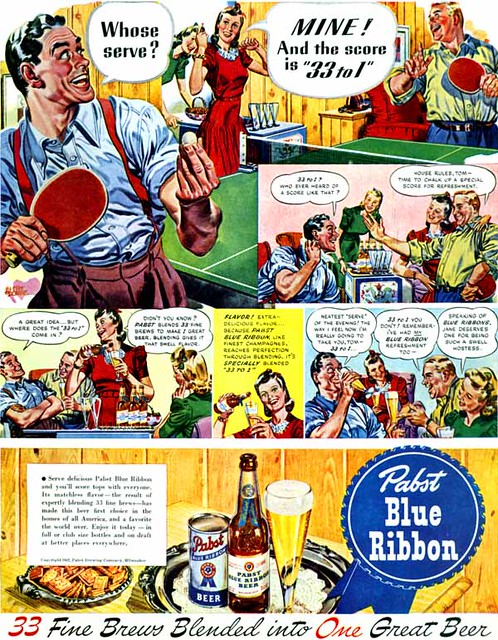
Beer In Ads #952: They All Come Back To Pabst

August 12, 2013 By Jay Brooks


Monday’s ad is for Pabst Blue Ribbon, this one from 1913. It’s a fairly simple ad, with two men (possibly famous? – the one on the left looks a little familiar) clinking some pretty small glasses of beer. They look a lot like modern 4 oz. sample glasses. One thing I am curious about; what was it they were doing that they had to “come back to Pabst?”

pabst-1913

Filed Under: Art & Beer, Beers Tagged With: Advertising, History, Pabst

Beer In Ads #951: Tommy Henrich, Athlete-of-the-Year

August 9, 2013 By Jay Brooks


Friday’s ad is again for Pabst Blue Ribbon, also from 1950. This one features New York Yankee Tommy Henrich, who apparently was named Athlete-of-the-Year that year. He’s showing off his World Series home run ball, from what series I have no idea. Given the look on his face, it’s probably a good thing he’s sharing a PBR so his guest can endure his tall tales.

pabst-1950-tommy-heinrich

Filed Under: Art & Beer, Beers Tagged With: Advertising, History, Pabst

Beer In Ads #950: Hit The Ball

August 8, 2013 By Jay Brooks


Thursday’s ad is again for Pabst Blue Ribbon, this one from 1950. Showing an old-fashioned tennis player — is that Pancho Gonzalez again? — using a racket with just one string, the analogy they’re using is that playing that way is the equivalent of not blending your beer. Blending is great, but it’s not the only way to brew a beer, and it may not even be the best way to make a pilsner. But how about that outfit?

pabst-1950-tennis

Filed Under: Art & Beer, Beers Tagged With: Advertising, History, Pabst

Beer In Ads #949: Served In The Hollywood Home Of Bob Hope

August 7, 2013 By Jay Brooks


Wednesday’s ad is also for Pabst Blue Ribbon, this one from 1948. Showing famed comedian and actor Bob Hope in what’s purported to be his home in Hollywood — golf club in hand — he appears to be lecturing the crowd, perhaps on pain of getting hit with his driver. That, or he’s boring them to death with another golf story.

pabst-1948-bob-hope

Filed Under: Art & Beer, Beers Tagged With: Advertising, History, Pabst

Beer In Ads #948: Always In The Picture … Always In Good Taste!

August 6, 2013 By Jay Brooks


Tuesday’s ad is still another one for Pabst Blue Ribbon, this one from 1963. Showing a pretty spiffy rec room, or hobby den, and an impressive DIY toy yacht in the process of being built. But he’s taking a break from his “leisure-time activities” to enjoy a beer with his wife.

pabst-1963

Filed Under: Art & Beer, Beers Tagged With: Advertising, History, Pabst

Beer In Ads #947: Pabst Makes It Perfect!

August 5, 2013 By Jay Brooks


Monday’s ad is yet another one for Pabst Blue Ribbon, this one from 1958. Featuring an artist painting what looks like something abstract, or possibly a terrible landscape, though curiously there’s a woman on the grass under his easel with a tray of food and a glass of beer. He’s apparently taking a break with his own beer and a smoke … or maybe that’s the way he paints. Maybe it’s just me, but his posture makes him look like quite the schlub.

pabst-1958-makes-perfect

Filed Under: Art & Beer, Beers Tagged With: Advertising, History, Pabst

Wheatland Hop Riot Legacy

August 3, 2013 By Jay Brooks

high-water
Today marks the 100th anniversary of the Wheatland Hop Riot, a seminal event in labor relations, the second major labor dispute in U.S. history, and the first event to shine a light on the plight of agricultural workers and their conditions. It was for this event that High Water Brewing named their Hop Riot IPA, as its name pays homage to the legacy of hops in California, which before prohibition was the largest hop-growing state in the U.S.

wheatland-hop-riots-04

Here’s one account on the riot, this one from True West:

In the region northeast of Sacramento, field temperatures had hit the 120s—tough working conditions for the migrants harvesting hops, the green plant (related to hemp) used in brewing beer.

The work was hard, and the season short (by the end of August, the migrants would be moving on). The Durst Ranch, the largest agricultural employer in California, needed about 1,500 workers; nearly double showed up. Most workers made less than $1.50 a day—big pay in a time of national recession.

Conditions were hellish. Workers had to buy water (contaminated by acetic acid) for five cents, plus food and other supplies from a price-gouging company store. Dysentery was rampant, with less than a dozen toilets available for workers. Garbage and refuse cluttered the area. (In all fairness, the situation at the Durst Ranch was not unusual for California operations that hired migrants.)

Richard “Blackie” Ford, a former organizer for the radical Industrial Workers of the World, decided to mobilize the Durst Ranch workers to get higher pay and better conditions. He presented a list of demands to Durst on August 3. The rancher agreed to all of them—regular ice-water breaks (at no charge), more toilets and so forth. But he wouldn’t boost the pay.

Ford said that wasn’t good enough; some accounts state Durst responded by slapping Ford in the mouth. The labor man then went to a nearby platform to harangue the workers. Durst went into town to get the authorities.

The rancher returned with a couple carloads of men, including Yuba County Sheriff George Voss, Deputy Eugene Reardon and District Attorney Ed Manwell. They arrived shortly after five p.m., and Ford had the crowd worked up.

Just what happened next depends on which side you believe. The authorities and Durst claimed that some workers had attacked them. Ford and the migrants said the lawmen had opened fire on them. Either way, a melee ensued.

When it was done, Manwell, Reardon and two workers were dead. Sheriff Voss was severely injured, as were an untold number of folks on both sides. Ford was on the run, and most of the workers had scattered to the four winds. The day became known as “Bloody Sunday.”

Ford and organizer Herman Suhr were arrested. Neither participated in the attacks, but officials accused them of inciting the violence and charged them with murder.

The trial took place in January 1914 in nearby Marysville. Most locals (including jury members) weren’t sympathetic to the union or the migrants. Both defendants were found guilty of second-degree murder and given life sentences. The proceedings received international press coverage.

After the incident, the Durst Ranch gave in to all the demands, including the higher pay. The hop crop was brought in without any further trouble.

Ford was pardoned in 1924, and Suhr paroled two years later.

wheatland-hop-riots-05

Another account, suggests that Durst was hardly blameless, and at least shared responsibility by the way he tricked and treated his workers, a not uncommon occurrence at that time.

An important and highly-publicized event in California labor history, it was the second major labor dispute in the United States supposedly initiated by the Industrial Workers of the World. The bloody clash, which occurred at the Durst Ranch in Wheatland, California, was the climax of growing tensions brought about by the difficult conditions farm laborers at the ranch endured. The riot resulted in four deaths and many injuries. It focused public opinion for the first time on the plight of California’s agricultural laborers, and resulted in new state legislation to regulate labor camp conditions. A new State Commission on Immigration and Housing was created to help improve working conditions. The Wheatland Hop Riot was also the first major farm labor confrontation in California and a harbinger of decades of attempts to organize or control agricultural labor.

Durst advertised for 3000 hop pickers and other seasonal agricultural workers, though he only needed half that number — in order to drive wages down. Of a $1.50/ day wage, $0.78 – $1.00 was withheld from the workers’ pay. If a worker didn’t stay till the end of the season, Durst kept that withheld money. Durst then had the workers harassed, cheated, and abused to try to make them leave before the end of the season. The strikers demanded water twice a day, separate bathrooms for men and women, and higher pay. During a speech by Richard “Blackie” Ford, the Yuba County sheriff and a group of over 100 vigilantes fired into the crowd of workers, causing the riot. Two workers, a deputy, and the district attorney were killed. The National Guard was ordered into the area and 100 workers arrested.

wheatland-hop-riots-01

In addition, libcom.org has an account of the hop riot and the Sacramento Bee has their version to commemorate the 100th anniversary this year that was posted a few days ago. You can also read more about the Wheatland Hop Riot at Wikipedia, too.

David A. Kulczyk also wrote an interesting, more labor-friendly, account, published in 2007, entitled “Hops of Wrath, 1913’s bloody Wheatland Hop Riot eventually led to better conditions for workers. Too bad it was only temporary” and LaborNet has the Legacy of Wheatland.

wheatland-hop-riots-02

So tonight, drink a toast to the men and women of the Wheatland Hop Rio, and make it a High Water Hop Riot IPA.

high-water-hop-riot

Filed Under: Politics & Law Tagged With: California, History, Hops

Beer In Ads #946: Finest Beer Served … Anywhere!

August 2, 2013 By Jay Brooks


Friday’s ad is another one for Pabst Blue Ribbon, from 1950. Showing famous tennis player Pancho Gonzales relaxing with a PBR — and wearing the quintessential tennis getup — that he’s sharing with someone courtside in a suit and tie. It looks like Pancho’s pointing at the blurred player serving on the court, perhaps a new prospect?

Pabst-1950-pancho-gonzales

Filed Under: Art & Beer, Beers Tagged With: Advertising, History, Pabst

« Previous Page
Next Page »

Find Something

Northern California Breweries

Please consider purchasing my latest book, California Breweries North, available from Amazon, or ask for it at your local bookstore.

Recent Comments

  • Bob Paolino on Beer Birthday: Grant Johnston
  • Gambrinus on Historic Beer Birthday: A.J. Houghton
  • Ernie Dewing on Historic Beer Birthday: Charles William Bergner 
  • Steve 'Pudgy' De Rose on Historic Beer Birthday: Jacob Schmidt
  • Jay Brooks on Beer Birthday: Bill Owens

Recent Posts

  • Beer Birthday: Mike “Tasty” McDole August 28, 2026
  • Beer In Ads #5331: Bock Beer, Hopfen Und Malz Gott Erhalts! August 27, 2026
  • Beer Birthday: Fred Bowman August 27, 2026
  • Beer In Ads #5330: Bock Beer Trade Card August 26, 2026
  • Beer Birthday: Pete Reid August 26, 2026

BBB Archives

Feedback

Head Quarter
This site is hosted and maintained by H25Q.dev. Any questions or comments for the webmaster can be directed here.