Monday’s Christmas Eve ad is for Arrow Beer, from 1946. It’s a simple ad, showing a glass of Arrow Beer along with a bottle in front of a wreath of holly and a candle. The ad copy couldn’t be simpler. “Seasons Cheer … from Arrow Beer.”
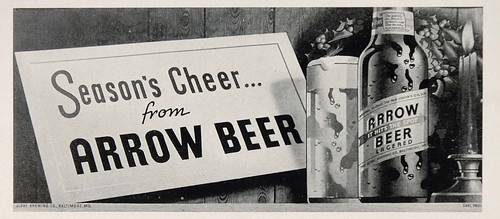

Monday’s Christmas Eve ad is for Arrow Beer, from 1946. It’s a simple ad, showing a glass of Arrow Beer along with a bottle in front of a wreath of holly and a candle. The ad copy couldn’t be simpler. “Seasons Cheer … from Arrow Beer.”
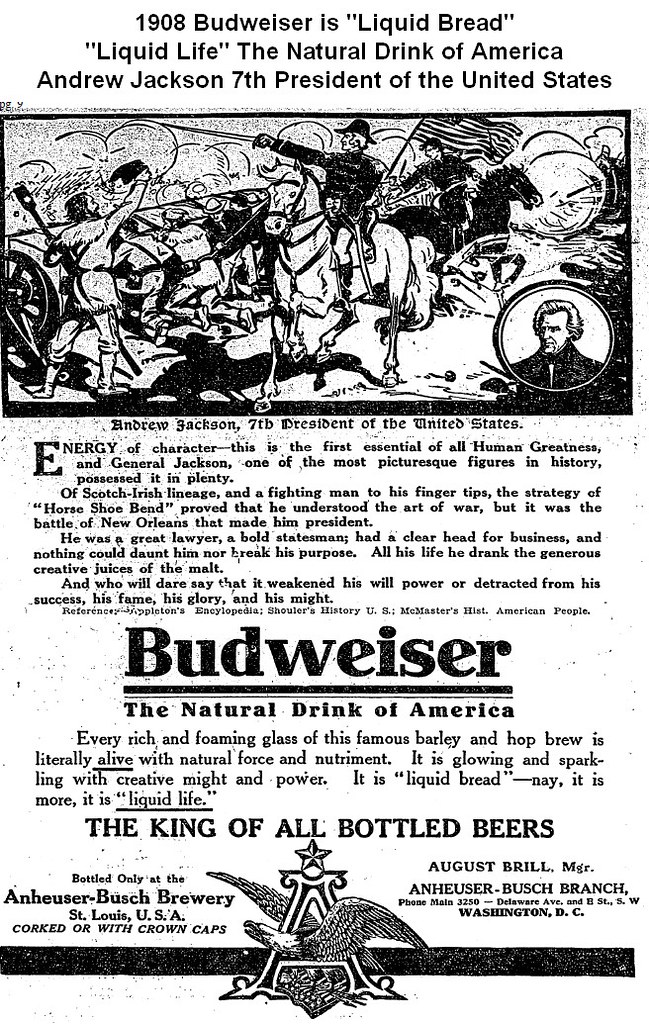
Thursday’s ad is for Budweiser, from 1908, when it appears they launched a number of historically themed ads. This one features our 7th president, Andrew Jackson, and equates him with “Liquid Life,” “The National Drink of America.”
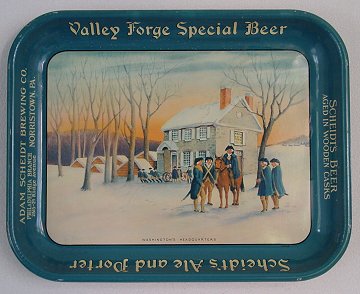
Wednesday’s ad is for Valley Forge Beer, because it was on this day, December 19, 1777 that George Washington set up camp for the winter in the small Pennsylvania town of Valley Forge. I went to the historical site a few times as a kid, including once as a Boy Scout where we followed some orienteering with maps and compass to earn some sort of ribbon, or something. I don’t usually do breweriana other than actual print advertising, but it made sense to break out the tray because of the date.
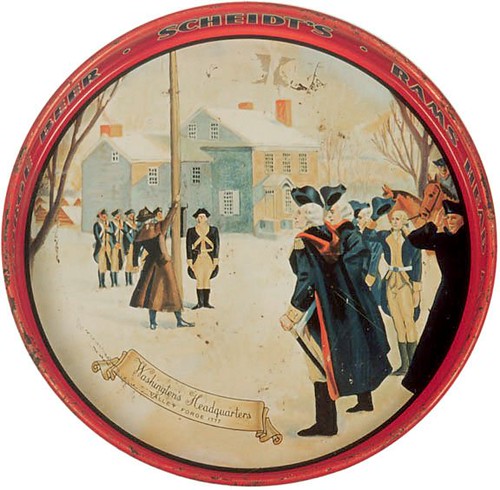
Valley Forge Beer was brewed by the Adam Scheidt Brewery in Norristown, Pennsylvania, which is just a few miles from Valley Forge. Here’s a short history of the brewery, from a breweriana collectors website.
The Adam Scheidt Brewing Company was founded in the late 1870s and was incorporated in 1884. After Prohibition, the brewery thrived, brewing Valley Forge Beer, Ram’s Head Ale, and Prior Beer. The brewery’s name was changed to the Valley Forge Brewing Company in 1963 and, five years later, it was sold to Philadelphia’s largest brewer at the time, C. Schmidt & Sons. It continued to operate as a branch of Schmidt’s until 1975, when the facility was closed. Schmidt’s continued to brew the Valley Forge and Ram’s Head brands until the early 1980s, when Schmidt’s itself finally ceased operations.
And here’s another one of the same tray, this one showing better color.
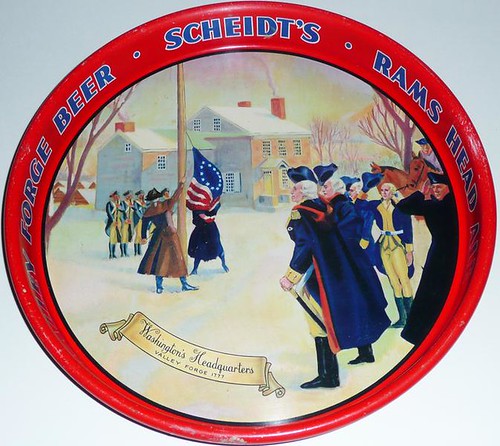
Frankly, I remember seeing these trays around when I was a kid, and cans of the beer, but it was never something I ever drank. I don’t ever remember even seeing it for sale where we lived. Below is a less common tray showing the same event, but by a different artist, obviously.
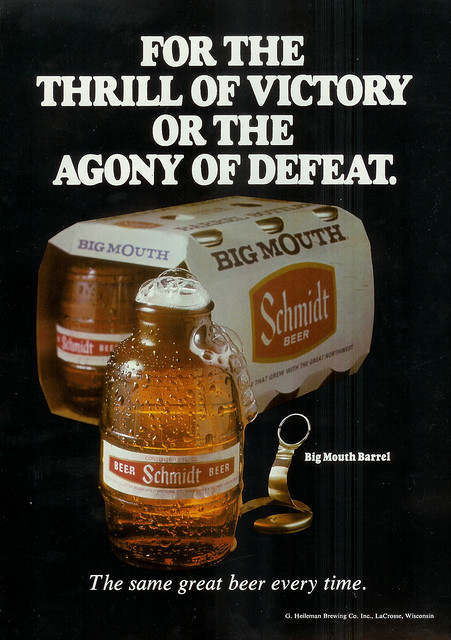
Tuesday’s ad is for the G. Heilman brand Schmidt, not to be confused with Schmidt’s. I’m not sure when the ad is from, but I imagine the most telling clue is the pull-top crown and the big mouth bottle. Is anybody still using those bottles? The last one I remember was Mickey’s Big Mouth. I haven’t seen them in California for a few years now. Also, with that tagline, For the Thrill of Victory or the Agony of Defeat, I’m not sure how invoking ABC’s Wide World of Sports ties into the beer, although it may offer a clue as the ad’s age. The show debuted in 1961, so it’s likely the ad was sometime after that, though it seems reasonable that it would have been long enough after it began that their catchphrase was already popular. But perhaps it’s the text at the bottom, “the same great beer every time,” that the tagline is referring to; insofar as you don’t want some beers to be winners and others to be losers, it’s consistency that’s king. Anybody have a better theory?
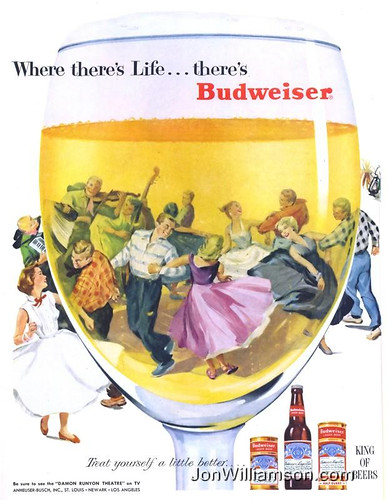
Monday’s ad is from the long-running “Where there’s Life …” series for Budweiser, this one from the mid-1950s, I believe. They did few ads of this type, with scene shown through a full glass of beer, and in this one it’s square dancing. Yee haw.
Saturday’s ad is the last (that I know of) in the Budweiser historical series from 1908. The black and white ad is text-heavy and includes a history lesson on James Monroe, our fifth president and the architect of the Monroe Doctrine. After the requisite historical bit, it launches into this priceless series of claims:
WHEN old Mother Earth grows better malting barley than northern soil produces —
WHEN the fertile valleys and verdant mountain slopes of Old Bohemia grow better hops —
WHEN natures produces better and purer waters —
WHEN brew-science has been developed to a higher art —
THEN, and not till then, will it be possible to produce a better beer than Budweiser.
Good luck with that.

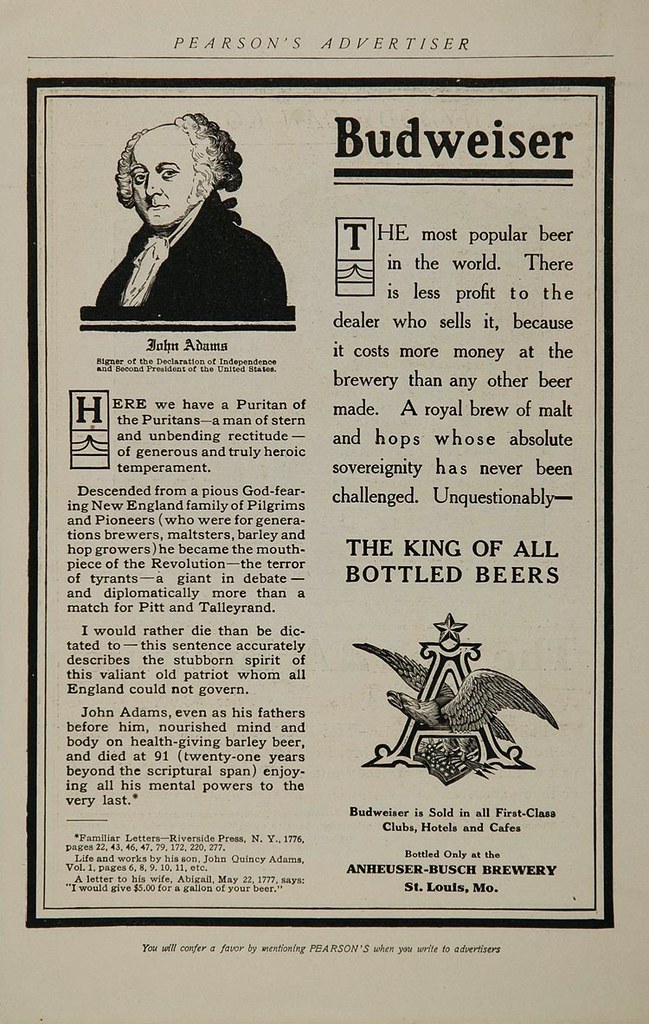
Friday’s ad is another in the Budweiser historical series from 1908. The black and white ad is text-heavy and includes a history lesson on John Adams, our second president and one of the signers of the Declaration of Independence. The ad makes the curious appeal that any dealer who carries Budweiser will realize less profits than selling other beers. Why? “Because it costs more money at the brewery than any other beer made. A royal brew of malt and hops whose absolute sovereignty has never been challenged.” Interesting strategy. One other anachronistic feature of advertising a century ago. The advert ran in a publication called Pearson’s Advertiser. At the very bottom of the page it includes this gem. “You will confer a favor by mentioning PEARSON’S when you write to advertisers.”

Here’s an interesting list of the The Brewer’s 10 Commandments, or Die 10 Gebote des Bierbrauers, that I found on the website for the Museum of Beer & Brewing in Milwaukee, Wisconsin. It’s origin is apparently from “the Brewers 1887 Convention.”
Thursday’s ad is another in the Budweiser historical series from 1908. The black and white ad is text-heavy and includes a history lesson on William Penn, who founded the Commonwealth of Pennsylvania. After discussing Penn, the ad copy switches to hops. “Lupulin has created a stir in the medical world because of its great Tonic properties for stomach disorders. It is found in the highest and most effective form in Saazer Hops, grown in the province of Saaz, Bohemia. The Anheuser Busch Brewing Ass’n, St. Louis, U.S.A. import more of these hops than all other breweries in the United States, and use them exclusively in their famous Budweiser.” Anybody know if ABI still uses an Saaz — er, Saazer — hops? I know they own hopfields in the Hallertau (I’ve been to those) and also in Idaho (ditto), but in the Czech Republic?


Here are some obsolete words that need to be brought back. We all know zymurgy is “the branch of applied chemistry dealing with fermentation, as in winemaking, brewing, the preparation of yeast, etc.” not to mention a magazine, and zymology “is the study of zymurgy, the area of applied science related to fermentation. It deals with the biochemical processes involved in fermentation, with yeast selection and physiology, and with the practical issues of brewing.” So far so good, but have you ever heard of these?
Those are some pretty cool words. Come on people, let’s starting using those again. Who doesn’t want to go for a Zythum, made by a Zumologist at your local Zythepsary?
Here’s a passage by Charles Dickens in the weekly Journal “All the Year Round” using the word zythepsary. It’s from 1861, when the word was already uncommon, apparently.
“But the oddest things of all are to be found in the dictionaries. Why they are all kept there no one knows; but what man in his senses would use such words as zythepsary for a brewhouse, and zumologist for a brewer; would talk of a stormy day as procellous and himself as madefied; of his long-legged son as increasing in procerity but sadly inarcid, of having met wilh much procacity from such a one; of a bore as a macrologist; of an aged horse as macrobiolic; of important business as moliminous,and his daughter’s necklace as moniliform; of some one’s talk as meracious, and lament, his last night’s nimiety of wine at that dapatical feast, whence he was taken by ereption?”
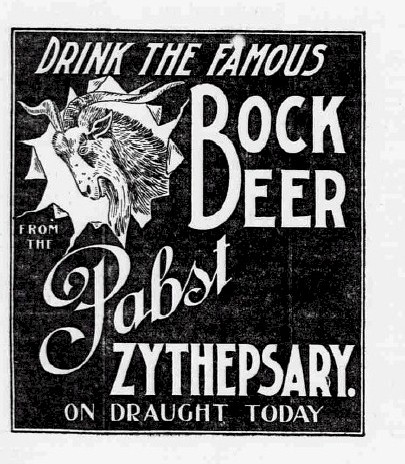
And this Pabst ad from 1897 refers to the Pabst Zythepsary.
And here’s science fiction writer Isaac Asimov using zymologist in 1962’s “The Caves of Steel.”
“‘I’m a zymologist, if you don’t mind.’
‘What’s the difference?’
Clousarr looked lofty. ‘A chemist is a soup-pusher, a stink-operator. A zymologist is a man who helps keep a few billion people alive. I’m a yeast-culture specialist.'”
I’ve heard Yeast-wrangler before, but not that one. That’s also pretty awesome. I’d love to start seeing that on brewers’ business cards: “Yeast-Culture Specialist.”