Brookston Beer Bulletin

Jay R. Brooks on Beer

  • Home
  • About
  • Editorial
  • Birthdays
  • Art & Beer

Socialize

  • Dribbble
  • Email
  • Facebook
  • Flickr
  • GitHub
  • Instagram
  • LinkedIn
  • Pinterest
  • RSS
  • Twitter
  • YouTube

Powered by Genesis

Bravo for the Winners

July 15, 2007 By Jay Brooks

Okay, I promise that was the last bad Bravo pun, but yesterday at Drake’s Brewing in San Leandro the 2nd annual Single Hop Festival & Washoe Tournament took place. This year, 21 breweries made an IPA using only Bravo hops, following roughly the same recipe. The recipe called for mostly 2-row malt, along with Munich and Crystal 45, though the exact malts was left to each brewery. The 21 breweries used seven different ale yeast strains and nine of them filtered the beer. Hop additions were specified in the directions, though mash and fermentation temperatures were left to each brewery.

I was asked to coordinate and lead the judging, and I took a hedonistic approach, meaning we used a standard of which beer would you buy for yourself and a friend. Since they were all IPAs, we didn’t dwell on style considerations. I divided the judges into teams of three each, and gave each group seven random beers, from which they each chose two to push forward to the final round. We were then joined by Mike Sutton, who works for S.S. Steiner (the company that developed the Bravo hop variety) and chose our three favorites from the six. Sometimes when I judge deadlocks are broken by a simple vote with the beers getting the majority of votes being declared the winner. While I understand the rationale for this method, I do not personally like to use it because it’s my feeling that all of the judges should be satisfied with the results, not just a majority. For this reason, I prefer to use more of a jury-like approach where ten angry men talk it out until all can agree with the results. This approach does tend to take longer, but I think the result is a more well-thought out decision that each judge can feel good about. This year, the winners we chose were:

  1. Bison Brewing
  2. Russian River Brewing
  3. Sonoma Coop’s

The three other beers that made it to the finals were, in no particular order, from Firehouse Brewing, Seabright and 21st Amendment. The Bravo hop proved to be far milder than last year’s Summit hop and overall made for a better-tasting beer. There did seem to be less variation, too, but also Bravo did not have bold signature aromas the way Summit did. That’s not better or worse, just different. It seems like Bravo should blend well with many other hops and should end up being a successful hop over time. Now that’s my idea of a fun afternoon. The only thing that would have made it better is if I could have played washoes.

Washoes,

Beer and Barbecue.

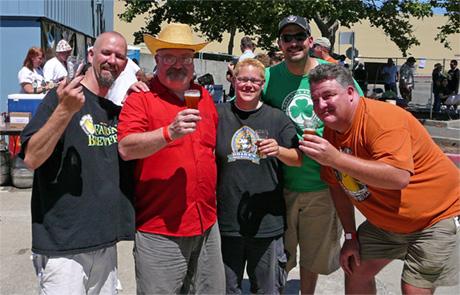
Shaun O’Sullivan, from 21st Amendment Brewery, James Costa, from E.J. Phair Brewing, and Vinnie Cilurzo from Russian River Brewing.
 

For more photos from the Single Hop Festival, visit the photo gallery.
 

Filed Under: Events, News Tagged With: Bay Area, California, Festivals, Hops

Bravo For the New Hop

July 13, 2007 By Jay Brooks

Countless new hop varieties are created every year, so many in fact that they are given only a number. A hop has to really prove itself worthy before it actually gets a name. For example, Hop #01046 began its life in Prosser, Washington at the Golden Gate Roza Hop Ranches. During the summer of 2000, a female hop known as Zeus was cross-pollinated with a male known simply as #98004 (whose mother is in effect Nugget hops). Its lineage, therefore, is “50% Zeus, 18.75% Nugget, 25% USDA 19058m, and 6.25% unknown.”

The following year, seeds were collected and the plant was grown in a greenhouse for the next two years, and screened for powdery mildew resistance, along with gender, vigor, and cone type. By 2002, #01046 was exhibiting higher than usual alpha-acid percentages with good resistance and several other very positive attributes. The next year, 2003, #01046 was asexually propagated and rhizomes from the original plant “were dug, divided and planted into multiple greenhouse grown containers.” Eventually, 4,000 softwood-cutting plants were created and then grown at two different locations, the original Roza ranch and also at Golden Gate Emerald Hop Ranches in Sunnyside, Washington. These plants represented the second-generation of the hop plant.


Over the subsequent three years the hops were grown, sampled, tested and analyzed on a variety of factors. These tests confirmed that the new hop had good resistance to disease, along with exceptionally high yield and high alpha-acids percentages. The hops were harvested and processed into 200 lb. bales, which were tested using the ASBC (American Society of Brewing Chemists) spectrophotometric method and showed “average alpha-acids level of 17.5% and beta-acids level of 3.5%.” The alphas were almost exactly the same as Mom (Zeus) but with much less loss of alpha-acids in storage, a good sign.


In 2005, third-generation plants were created and a large-scale field test was conducted at the Emerald Ranch. Declared a success, #01046 was re-christened “Bravo” and S.S. Steiner, who operated the hop fields in Washington, filed a patent application. 2006 yielded the first commercially available Bravo hops.


For every one of these success stories, there are hundreds that never make it. But even getting this far doesn’t guarantee a hop’s success. How it works in the beer is the final and arguably the most important test. So what will it taste like in your beer? Nobody’s certain, though there is a great way to find out. Tomorrow you have an opportunity to sample at least 21 single hop IPAs, using only Bravo hops, made by breweries from around northern California. Drake’s Brewing in San Leandro is hosting their 2nd annual Drake’s Brewing Beer Festival and Washoes Tournament. Each brewery will also be serving some of their other available beers so you’ll have plenty of other beers to sample, as well. But it’s a great educational experience on several fronts. First, you get to try a new hop in its debut in a commercial beer. Second, you can see firsthand how different brewers using different equipment but the same hop and the same IPA recipe can craft 21 beers that all taste distinctively different (at least that was the experience from last year when Summit hop was used at the festival). It should be a fun time. Come join us at Drake’s for a memorable afternoon of beer, food, music and games. See you there.


Bravo Hop Characteristics:

Alplha Acids: 14.-17.%
Cohumulone: 29-34% of alpha acids
Beta-Acids: 3-5% w/w
Total Hop Oils: 1.6-2.4% v/w


7.14

Single Hop Festival & Washoe Tournament (2nd annual)
Drake’s Brewing, 1933 Davis Street #177, San Leandro, California
510.562.0866 [ website ] [ directions ]

NOTE: The patent filing lists Bravo as #01046 but the photo shows #1046. So far, I’ve been unable to confirm which is correct.


Filed Under: Uncategorized Tagged With: Hops, Ingredients, Washington

Bravo for Bravo

July 10, 2007 By Jay Brooks

July 14, from Noon to 6:00 p.m., at Drake’s Brewing in San Leandro, California you’ll have another unique opportunity to taste at least twenty beers all made with the same hop, but with different malt, yeast and water. This year’s hop will be Bravo, a new variety that was “cultivated as a result of a cross in 2000 at Golden Gate Roza Hop Ranches in Prosser, Washington.” The new hop was only patented last year, and is distributed exclusively by S.S. Steiner, who donated the hops for the beers in the festival.

Drake’s Brewing Company 2nd Annual Beer Festival and Washoes Tournament will also feature music by The No Cover Band, The Shuffle Kings, and The Doormats. Your $35 admission price includes unlimited sampling, a commemorative glass, t-shirt and an entry into the Washoe tournament. This should be a lot of fun. Perhaps I’ll see you there.

From the press release:

Drake’s is about a 15-20 minute walk from the San Leandro BART station. Buses run up and down Davis Street. Cabs are available at the BART station. We are located at the loading dock area around the back of the Wal-Mart. Hope to see you here.


Some photos from last year’s inaugural festival:

Drake’s brewer Rodger Davis, Dave Keene from the Toronado, Melissa Myers (also from Drake’s), James Costa from E. J. Phair, along with beer enthusiast Motor.

The Washoes Tournament underway.


Breweries Attending & Brewing the Same Hop IPA
 

  • The Beach Chalet
  • Bear Republic
  • Bison
  • Blue Frog and Grog
  • Devil’s Canyon
  • Drake’s
  • E.J. Phair
  • El Toro
  • Firehouse Grill
  • Half Moon Bay
  • Magnolia
  • Marin
  • Rubicon
  • Russian River
  • Sacramento
  • Seabright
  • Sonoma Chicken Coop
  • Stone Brewing
  • Thirsty Bear
  • Triple Rock
  • 21st Amendment
  • Valley Brewing


7.14

Single Hop Festival & Washoe Tournament (2nd annual)
Drake’s Brewing, 1933 Davis Street #177, San Leandro, California
510.562.0866 [ website ] [ directions ]
 

Filed Under: Events, News, Related Pleasures Tagged With: Announcements, Bay Area, California, Hops, Ingredients

Searching For the Holy Aroma

July 9, 2007 By Jay Brooks

According to Wired Science, scientists from Down Under (the Department of Food Science, University of Otago, in Dunedin, New Zealand, and the Australian Centre for Research on Separation Science, Department of Applied Chemistry, RMIT University, in Melbourne, Victoria, Australia more specifically) have published a paper identifying the chemicals creating the spicy aromas in noble hops using four different hop varieties: Target, Saaz, Hallertauer Hersbrucker, and Cascade. (That’s what’s being reported, target and cascade, of course are not noble hops.) They’ve now succeeded in finding the chemicals responsible for “spiciness,” using “two-dimensional gas chromatography mass spectrometry.” The equipment takes “individual chemical[s] from the hops in a two-step process, and then weighs the individual molecules to identify them.” There are nearly 1,000 separate chemical components that contribute to the aromas just from hops so this was definitely like looking for the proverbial needle in a haystack.

Dr. Lingshuang Cai and Jacek Koziel at Iowa State University

From the Wired article:

When the test results came in, five chemicals stood out from the others. All of them are terpenes. Geraniol, which is named after geranium flowers and obviously has a floral scent. Linalool, has a floral and spicy scent. It is also found in mint, cinnamon, and rosewood. Eugeneol has a spicy, clove-like aroma. Beta-ionone has a complex woody and fruity scent. Caryophyllene is found in black pepper.

Terpenes are a class of chemicals that are often responsible for the unique scent of food, perfume, and beverages. In 2002, other researchers showed that adding a tiny amount of a particular terpene to a very bland beer made it smell fantastic, but not quite as complex as a premium brew.

From the Abstract in the Journal of Agriculture and Food Chemistry:

The “spicy” character of hops is considered to be a desirable attribute in beer, associated with “noble hop aroma”. However, the compounds responsible have yet to be adequately identified. Odorants in four samples of the spicy fraction of hop essential oil were characterized using gas chromatography-olfactometry (GC-O) and CharmAnalysis. Four hop varieties were compared, namely, Target, Saaz, Hallertauer Hersbrucker, and Cascade. Odor-active compounds were tentatively identified using comprehensive two-dimensional gas chromatography (GC×GC) combined with time-of-flight mass spectrometry (TOFMS). An intense “woody, cedarwood” odor was determined to be the most potent odorant in three of the four spicy fraction samples. This odor coincided with a complex region where between 8 and 13 compounds were coeluting in each of the four spicy fractions. The peak responsible was determined by (i) correlating peak areas with Charm values in eight hop samples and (ii) heart-cut multidimensional gas chromatography-olfactometry (MDGC-O). The compound responsible was tentatively identified as 14-hydroxy-ß-caryophyllene. Other important odorants identified were geraniol, linalool, ß-ionone, and eugenol.

Filed Under: News Tagged With: Hops, Ingredients, Science of Brewing

Yakima Hop Warehouse Catches Fire

October 3, 2006 By Jay Brooks

On Monday, fire broke out in a warehouse storing baled hops owned by the S.S. Steiner company of Germany. The entire 40,000 square foot warehouse was engulfed in flames and its cause is not yet known. The impact of the fire, if any, on the global hop market is already being discussed among industry leaders.

According to the AP Story:

The United States produces 24 percent of the world’s hops, which are used to brew beer. The vast majority are grown in the Pacific Northwest, in particular central Washington’s Yakima Valley.

Steiner is one of the larger growers in the valley, said Ann George, administrator of the Washington Hops Commission, an industry marketing group funded by member fees.

“They handle a large volume of the crop, but they have multiple warehouses,” George said. “Depending on what variety or varieties were involved in this incident, if it was a variety that was already in short supply, that could have an impact on price and availability.”

UPDATE: CNN has done a follow-up to this story and it seems the hops destroyed in the Yakima fire represent 4% of the total U.S. supply, or about 2 million pounds of hops. The Yakima Herald-Republic has a more in-depth article, along with additional photos, too. According to the Yakima article, “[t]he 10,000 bales weighing about 200 pounds each, were probably worth between $1.75 and $2 per pound, based on average prices this year. That puts the fire’s monetary damage between $3.5 million and $4 million.”

GORDON KING/Yakima Herald-Republic

Filed Under: News Tagged With: Hops, Washington

Tastes Great, Less Gesundheit

September 12, 2006 By Jay Brooks

Add hay fever to the growing list of maladies that can be helped by the moderate drinking of beer. A new preliminary study released today by Tadao Enomoto at the Japanese Red Cross Society’s medical center in Japan’s Wakayama Prefecture appears to show marked relief in alleviating sneezing and running noses for hay fever sufferers from a flavonol compound in hops. They study’s full findings will be presented next month to the Palynological Society of Japan.

Japanese brewer Sapporo, who co-sponsored the research, has filed for a patent on the process of extracting the hay fever-fighting flavonol, which involves pulverizing the hops and then soaking them in water. By next spring — before the next hay fever season — Sapporo plans to release a new beer containing the isolated hop flavonol that combats hay fever.

Filed Under: Beers, News Tagged With: Asia, Health & Beer, Hops, International

Time for Fresh Hop Beers

August 29, 2006 By Jay Brooks

Autumn brings many changes, even here in California where the change of seasons is not as dramatic as in more temperate areas. But regardless of specific climate, throughout the country, it’s harvest time. Only the exact date to begin picking changes. For Moonlight Brewing and Russian River’s combined hop harvest, that date was Monday.

A little more then ten years ago, small breweries began making “fresh hop beers,” which are usually ales made with freshly picked hops thrown into the boil as soon as possible after they were picked from the vine, often within a few hours of being harvested. Usually, many times more fresh hops are used than in ordinary brews and aficionados claim that fresh hopping enhances aromas. It may be merely a perceptional advantage, but to my mind — and senses — they definitely do have great aromas and flavors.

These beers are also known by other names, including “wet hop beers” and “harvest ales.” Sierra Nevada Brewing’s Harvest Ale was undoubtedly one of the first and today is sold in every state. But most remain small batches, generally limited by the fresh hops themselves, as well as other factors. Over the years, an increasing number of breweries are now making fresh hop beers, including Alpine Brewing of San Diego (WHAle, Wet Hopped Ale), Deschutes Brewery of Bend, Oregon (Hop Trip Harvest Ale), Dogfish Head of Delaware (Fed-Extra Mid), East End Brewing of Pittsburgh (Big Hop Harvest Ale), Great Divide Brewing of Denver (Maverick Fresh Hop Pale Ale), Left Hand Brewing of Longmont, Colorado (Warrior IPA), Rogue Ales of Newport, Oregon (Hop Heaven), and Victory Brewing of Downingtown, Pennsylvania (Harvest Pilsner) to name only a few.

On Monday, I helped out with the hop harvest of cascade, chinook and red vine hops grown on the property at Moonlight Brewing and shared with Russian River Brewing for the two breweries’ fresh hop beers. Moonlight’s is called Homegrown (in some places) and Russian River’s is know as HopTime. It was a lot fun — though today I’m still a little sore and scratched up — and took about five or six hours to complete the harvest. Then both brewers retired to their respective breweries to begin the process of making their fresh hop ales. The rest of us enjoyed a yummy lunch at Russian River provided by Natalie Cilurzo, the hop queen of Russian River Brewing.

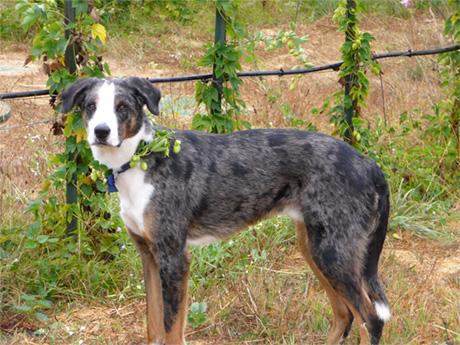
Barley, the dog, adorned with fresh hops plays in the hopyard.

The Moonlight/Russian River hopyard.

Brewers Brian Hunt, assistant brewer Travis, and Vinnie Cilurzo in their hopyard.

Brian Hunt on a ladder cutting down hopvines from ten-foot wires strung across the yard.

Then the bottoms are cut so the vines can be moved for picking.

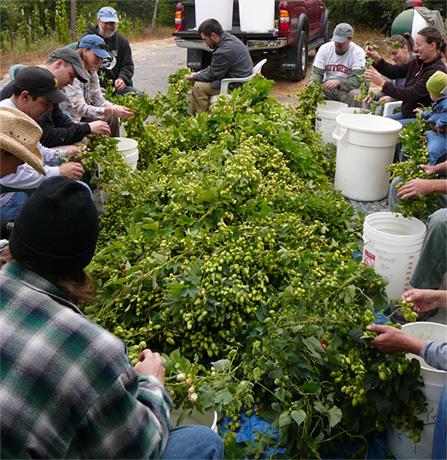
The volunteer hop pickers in front of Moonlight’s brewery.

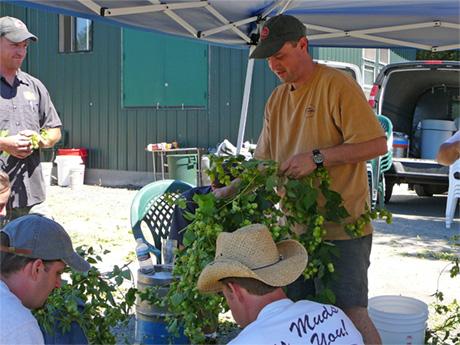
Everybody works in a circle picking the hop cones from the vine and collecting them in buckets.

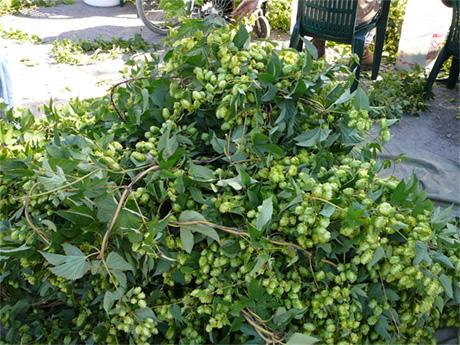
A mound of hopvines ready to be picked. Cascade and Chinook hops are mixed in the pile.

Hops on the vine.

Stored in a bucket after picking.

A third hop is kept separate. This is Red Vine, a type of cluster hop.

Vinnie Cilurzo picking Red Vine hops.
 

Last Friday, the Wall Street Journal did a feature article about Fresh Hop Beers. If you don’t have a subscription, the Pittsburgh Post-Gazette syndicated the story and “To toast a new crop, brewers roll out ‘wet hop’ beer” is available online. I’ve been complaining lately that only smaller and regional traditional media is covering beer so it’s nice to see a big player step up. Though according to insiders, the story took many weeks to get approval and the author had to advocate persistently to finally get it published.

Filed Under: Events, News Tagged With: California, Hops, Mainstream Coverage, National, Northern California, Other Events, Photo Gallery

Hopping in Maine

July 23, 2006 By Jay Brooks

When Rick Courcy retired, he wanted to get out of the city and so moved his family from Masschusetts to Oxford County, Maine, known as the “Gemstone Capital of Maine.” He settled on a 90-acre farm in Paris, with a view of Mount Washington.

Mount Washington (along with Mount Madison) seen from the Appalachian Trail.

Courcy was whiling away his time watching television while still trying to figure out what unique crop to grow when he saw a beer ad and was hit by inspiration. So he hopped up and planted organic hops, built the requisite trellises and has spoken to area brewers who are interested in using locally grown hops. He’s called his hop farm Paris View Farm. According to John Harker from Maine’s Department of Agriculture, Courcy is now the only commercial hop grower in the state.

Now that’s great news. I don’t think I realized hops would grow in Maine’s climate but according to Harker, “hops used to be grown in nearly every farmer’s backyard.” I always thought the reason spruce and other plants were common as a hop substitute throughout New England was because hops wouldn’t easily grow there. Oh well, maybe it’s global warming.

UPDATE 7/25: Brendan from Beerdata.org did a really nice more in-depth piece on this story last week.

Filed Under: News Tagged With: Eastern States, Hops

HopUnion Merges with Yakima Chief Craft Division

June 21, 2006 By Jay Brooks

hopunion-globe yakima-chief
HopUnion LLC announced today that they will be merging, effective August 1, with Yakima Chief’s craft division. Yakima Chief will continue to independently run their other divisions. But the craft beer side of their hop business will be folded into HopUnion’s and almost nothing will change there apart from having more hops to offer and the addition of longtime Yakima Chief east coast salesman Jim Boyd.

From the press release:

“We believe this merger will help provide more selection of hop varieties as well as better stability in the supply and demand chain,” said Ralph Olson, general manager and one of the owners of Hopunion Craft Brewing Sales, LLC. “Our ability to take care of the needs and desires of the customer will be greatly enhanced.”

Olson said that by combining the two companies there will be improved efficiencies in pellet plant production with the ability to produce larger volumes of consistent product.

Prior to the merger, Hopunion Craft Brewing Sales, LLC and Yakima Chief, Inc. were providing specialty hop varieties to the craft brewing industry.

Joining Olson in the new company will be Ralph Woodall, Jim Boyd and David Edgar, who together have over 60 years of experience in the hop industry. Support staffs from Hopunion Craft Brewing Sales, LLC and Yakima Chief, Inc. will be located at the Hopunion Craft Brewing Sales, LLC office in Yakima.

Ownership of the new company includes several Northwest growers who specialize in producing premier aroma hops. With these grower partners, the new company will be able to continue to provide the consistency in quality of hops that customers have come to expect from both companies.

“We will now be able to provide greater coverage in North America for the craft brewing industry,” Olson said of the merger. “And, it will allow us to help nurture craft and specialty brewing internationally, a growing segment of the industry.”

I spoke to Ralph Woodall this morning and it sounds like the merger is all positive. According to Ralph, the two can now stop competing in this area and start working together which should be a boon to craft brewers. Both have, as I understand it, great reputations in the industry though HopUnion certainly has the more public face (and puts on the best industry parties — especially when they work alongside Joanne Carilli from White Labs). Gerard Lemmens had been the public persona of Yakima Chief but he left the company last year for Brewers Supply Group and has all but retired to London now. So this merger makes a great deal of sense for both parties.

HopUnion, even before the merger, was the biggest supplier of hops to the craft beer industry with Yakima Chief solidly at number two. Post-merger they will own a sizable share of the market, though the craft beer market represents a fairly small percentage of total U.S. hop production. Best of luck to the Ralphs, David, Jim, Jennifer, Dave and Becky, the Johns and the rest of the wonderful folks at HopUnion.

ralph-olson-1
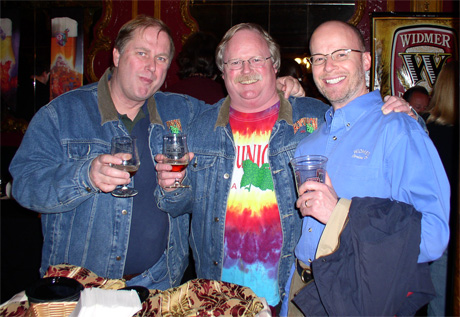
The infamous Ralph’s from HopUnion. From left: Ralph Olson and Ralph Woodall, with Rob Widmer, of Widmer Brothers Brewing. I took this at the 15th Anniversary Party for the Celebrator Beer News.

Filed Under: News, Related Pleasures Tagged With: Business, Hops, National, Press Release, Washington

« Previous Page

Find Something

Northern California Breweries

Please consider purchasing my latest book, California Breweries North, available from Amazon, or ask for it at your local bookstore.

Recent Comments

  • Ernie Dewing on Historic Beer Birthday: Charles William Bergner 
  • Steve 'Pudgy' De Rose on Historic Beer Birthday: Jacob Schmidt
  • Jay Brooks on Beer Birthday: Bill Owens
  • Steve 'Pudgy' De Rose on Beer Birthday: Charles Finkel
  • Steve 'Pudgy' De Rose on Beer Birthday: Bill Owens

Recent Posts

  • Beer Birthday: Teri Fahrendorf February 18, 2026
  • Beer In Ads #5207: Good News! Good Cheer! Dawson’s Bock Beer Is Here! February 17, 2026
  • Historic Beer Birthday: George Younger February 17, 2026
  • Historic Beer Birthday: Anton Geiger February 17, 2026
  • Beer Birthday: Marty Jones February 17, 2026

BBB Archives

Feedback

Head Quarter
This site is hosted and maintained by H25Q.dev. Any questions or comments for the webmaster can be directed here.