ABC News has a mildly amusing photo gallery up, one each from the top ten beer drinking countries.
From the number one country, China, a beer drinking contest during the Qingdao International Beer Festival in Qingdao.

ABC News has a mildly amusing photo gallery up, one each from the top ten beer drinking countries.
From the number one country, China, a beer drinking contest during the Qingdao International Beer Festival in Qingdao.
Eric Asimov had another great beer piece yesterday at The Pour, this one was an overview on cask-conditioned beers. Personally, if I have a choice I always go with the cask version. In fact last night while out with some old high school buddies, I enjoyed Sara’s Ruby Mild on cask at Magnolia and later Moonlight’s Sublimmminal at the Toronado. Yum.
And here’s some general information on casks.
The parts of a beer barrel.
Cask Sizes:
I happened upon this cool bit of history while searching for some images the other day. It’s the Museum of Anti-Alcohol Posters, a collection of old Soviet propaganda posters on the evils of drinking. There are more then thirty of them here, with translations. What struck me most in looking through them is that they’re really not all that different from the propaganda used by neo-prohibitionists working today in the United States. It’s the same sort of sensationalist nonsense with little basis in facts. But it’s somewhat comforting to know that propaganda is propaganda, no matter where it came from, and they are sort of fun to see. Enjoy.
Translation: “Rich inner substance.”
Translation: “Profiteer is a worst enemy.”

I happened upon this item from across the pond at Zythophile, who appears to be a soul mate when it comes to disliking neo-prohibitionists and their attendant propaganda. The UK’s Times Online made a rather startling, if not altogether surprising, revelation that the Department of Health in Great Britain, in defining what it means to be a “hazardous drinker” in 1987 did so by essentially just making it up and pulling the numbers out of thin air. I’ll let that sink in. As the Times’ article puts it, the “guidelines have no basis in science. Rather, in the words of a member of the committee that drew them up, they were simply ‘plucked out of the air’.” The twenty year-old standards by the Royal College of Physicians set “safe limits” at 21 units of alcohol a week for a man and 14 for a woman, apparently without regard to weight so far as I can tell. Britain defines one unit of alcohol as “8 grams of pure ethanol.”
In the article, a doctor involved in creating the standard, reminisces:
Richard Smith, the former editor of the British Medical Journal and a member of the college’s working party on alcohol, told The Times yesterday that the figures were not based on any clear evidence. He remembers “rather vividly” what happened when the discussion came round to whether the group should recommend safe limits for men and women.
“David Barker was the epidemiologist on the committee and his line was that ‘We don’t really have any decent data whatsoever. It’s impossible to say what’s safe and what isn’t’.
“And other people said, ‘Well, that’s not much use. If somebody comes to see you and says ‘What can I safely drink?’, you can’t say ‘Well, we’ve no evidence. Come back in 20 years and we’ll let you know’. So the feeling was that we ought to come up with something. So those limits were really plucked out of the air. They weren’t really based on any firm evidence at all. It was a sort of intelligent guess by a committee.”
Well how scientific. And I’d think all well and good if it were just a guideline, some advice to tell a patient. But, of course, that’s not how the government used these numbers. They instead not only endorsed the numbers — and indeed why shouldn’t they having come from a supposedly reputable health organization — they essentially set them in stone, terrorizing citizens with them the same way America’s health bureaucracy does likewise by defining binge drinking at a ridiculous “five or more drinks in a row.”
Not only that, but they continued to cling to the numbers as gospel, despite numerous subsequent studies that contradicted those numbers. For example, here are the results of a 2000 study by the World Health Organization:
The WHO’s International Guide for Monitoring Alcohol Consumption and Related Harm set out drinking ranges that qualified people as being at low, medium or high-risk of chronic alcohol-related harm. For men, less than 35 weekly units was low-risk, 36-52.5 was medium-risk and above 53 was high-risk. Women were low-risk below 17.5 units, medium between 18 and 35 and high above 36.
Government bureaucracy has a habit of becoming entrenched even in the face of contrary evidence. At least one blogger I respect sees this as no big deal, that everyone simply knew the numbers were made up. Perhaps I wouldn’t be so bothered by that if I didn’t strongly believe my own government, in collusion with Big Pharma and much of the guilt-ridden medical community, has been lying — and continues to lie — to my face about my own son Porter’s autism. I think it’s a mistake to take lying so cavalierly, especially when it comes from an area of society that we’re conditioned to place great trust in: the medical community. The Hippocratic Oath was undoubtedly a good start, but the more I learn about the way doctors, their protectionist professional groups, along with medical insurers, pharmaceutical companies, hospital administrators and the like manipulate patients and society at large for their own purposes, the more that oath seems hypocritical and largely an anachronism in our modern world that medical science seems quick to ignore whenever it doesn’t suit them.
I think it’s precisely because people tend to trust doctors and so-called medical science that they often can’t conceive of it being used as propaganda or to support an extreme agenda. And that’s why I find this sort of lying so dangerous. We may take for granted that our government will lie to us or that people trying to persuade us of something might do likewise, but I don’t see how that makes it acceptable or something we shouldn’t get worked up about. Have we really all been lied to so much that we no longer recognize it? That it becomes acceptable if it’s for our own good? I can see how telling a fib to a child to keep him or her safe as a temporary solution has some merit, but if we don’t fess up when they get older, that’s an entirely different matter. Though personally, I think nowadays we overprotect children and go too far in trying to keep them from experiencing any adversity. As a result, they are incapable of dealing with even the smallest slight as young adults. This also makes it easier for our own government to continue becoming more and more paternalistic as each successive generation becomes increasingly comfortable with being told what to think and within what narrow range is acceptable. We’re all adults and yet more and more governments treat their citizens like children to be taken care of instead of allowing everyone to have a real say in decisions made on our behalf. That’s a classic example of a slippery slope. If you accept one lie because you believe it’s for your own good, then it becomes easier for you to accept the next one, and the next one after that, etcetera. I find this whole subject fascinating, and if you want to read more about it, I recommend Lying: Moral Choice in Public and Private Life, by Sissela Bok, and The Liar’s Tale, A History of Falsehood, by Jeremy Campbell.
As usual, I’ve veered off on a tangent, so let’s hear from another British doctor who also conveniently believes that the specific limits are superfluous.
Christopher Record, a liver-disease specialist at Newcastle University, suggested that “it doesn’t really matter what the limits are”. “What we do know is, the more you drink, the greater the risk. The trouble is that we all have different genes. Some people can drink considerably more than [the limits] and they won’t get into any trouble.”
Well that doesn’t mean it doesn’t matter. That means using a standard that doesn’t work is useless and counter-productive for predicting how a person will react to a given amount of alcohol. And if government continually uses false statistics to manage its population, it does them great harm, both psychologically and possibly physically. It would be one thing if for the last twenty years health officials told people that drinking too much had dire consequences and advocated that people take care in that regard. That would be quite sensible and without question in the public interest. But that’s not what the health agencies did. Instead, they made up a number and told people not to drink more than this amount or there would be dire health consequences, knowing full well that the the levels they set had no basis in science whatsoever.
I’m confident that our own definition of binge drinking had a similarly unscientific genesis and I know how that definition has been used to skew statistics toward a specific agenda by neo-prohibitionists. I would be shocked to learn that our British cousins never did likewise. When you officially and purposely set what it means to be a heavy drinker at a level you know to be too low, you can claim with a straight face that there are many more alcoholics plaguing society than there really are. Armed with these false statistics, committed anti-alcohol organizations can do a lot of harm to society.
I’m not entirely sure why governments tend to embrace neo-prohibitionist agendas, but Zythophile’s hypothesis bears examining.
My personal guess is that too many politicians — and members of public health committees — are in the game because they want to control others, and they associate drinking with loss of control, and therefore want to stop it: except they know, after the failure of prohibition in the United States, that stopping people drinking is impossible, and so they try to make us feel as guilty as possible about one of life’s best pleasures.
But whether they meant well or were being maliciously manipulative, this sort of lying by those entrusted with the public health is pretty hard to swallow.

Greenpeace today released the results of an independent analysis of rice at an Arkansas mill which supplies rice to Anheuser-Busch for use in their beer. The lab found genetically engineered rice in 75% of the samples. From the press release:
An independent laboratory, commissioned by Greenpeace, detected the presence of GE rice (Bayer LL601) in three out of four samples taken at the mill. The experimental GE rice is one of three rice varieties that were first found in 2006 to have contaminated rice stocks in the US. Since then, GE contamination has been found in approximately 30 per cent of US rice stocks. This has had a massive negative impact on the US rice industry as foreign markets, where GE rice has not been approved, have been closed to US rice.
“Anheuser-Busch must make a clear statement about the level of GE contamination of the rice used to brew Budweiser in the US and spell out what measures are in place to ensure this beer does not reach the company’s export markets,” said Doreen Stabinsky, Greenpeace International GE Campaigner.
“US beer drinkers need Anheuser-Busch to explain why it is not preventing use of this genetically-engineered rice in the US. If, as the company has informed Greenpeace, all of the Budweiser exported from the US or manufactured outside of the US is guaranteed GE free then Anheuser-Busch needs to state this publicly, and explain the double standard,” said Stabinsky.
Greenpeace informed Anheuser-Busch of the test results prior to their release and sought clear information from the company on the extent of contamination and its global policy on the use of GE ingredients. Anheuser-Busch responded that the rice is approved in the US and is not used in brewing Budweiser destined for export. The full extent of the contamination remains unclear, however.
LL601 GE rice was retroactively granted approval by the US Dept of Agriculture in an effort to reduce public concern and company liability despite 15,000 public objections. The European Food Safety Authority stated that there was insufficient data to make a finding of safety. Greenpeace says that US consumers have a right to know if this GE rice is used to make Budweiser. This GE rice is not approved outside the US so the Budweiser brewed with it could not be sold abroad.
Anheuser-Busch is the largest single rice buyer in the US, buying 6-10 per cent of the annual US rice crop. Budweiser is one of only a few beers having rice as an ingredient. The brand is found in around 60 countries through a mix of exports and local brewing arrangements.
I recently did an article on green breweries and interviewed the Senior Group Director of Environmental, Health and Safety for A-B. I was pleasantly surprised at just how many things they were doing to be “green” so it seems surprising that they’d overlook genetically engineered rice being used in the beer itself. One thing you can say about Anheuser-Busch is that they do care about their public perception, so it will be interesting to see their reaction to this revelation.
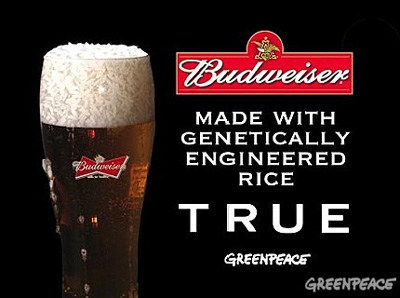
Doug Muhleman, Anheuser-Busch’s Group Vice President of Brewing, Operations and Technology, released a statement yesterday which I think suggests that Greenpeace is not the virtuous one in this story. On closer examination, this may be more about international politics than beer. Here’s Muhleman’s statement:
Greenpeace’s statements regarding our beer brands are false and defamatory. All of our products are made according to the highest quality standards and in complete compliance with the laws in each country where we sell our beers.
We stand in support of U.S. farmers, who are partners with us in the quality of our products. Greenpeace recently asked us to join their advocacy campaign on genetically modified crops. We refused their calls to boycott U.S. farmers, and they are now retaliating.
The use of genetically modified crops in the United States is not new. The vast majority of the commercial corn and soybean supply in the United States contains genetically modified versions that are certified to be safe for human consumption by the U.S. Government.
We use U.S. rice for brewing our products for U.S. consumption. U.S.-grown long-grained rice that may have micro levels of Liberty Link proteins present is fully approved by the U.S. Government, having determined that it is perfectly safe for human consumption. Moreover, the Liberty Link protein, like all proteins, is substantially removed or destroyed by the brewing process. Liberty Link has not been found in any of our tests of our beers brewed in the United States.
We fully comply with all international regulatory standards on the use or presence of genetically modified ingredients wherever our beers are sold internationally, as well. Neither Anheuser-Busch, nor our international licensed brewing partners use genetically modified ingredients, including genetically modified rice, in brewing products sold in any country with legal restrictions.
We talked with Greenpeace, hoping to help them understand the facts. We are disappointed that they instead chose to pursue pressure tactics.
Now I’m no fan of GMO’s, but they have been used here for many years and, like it or not, they’re a part of our massive food system. Short of pulling out every crop in the country and starting over, I’m not exactly sure what would satisfy Greenpeace. Certainly the way Greenpeace is seeking to sensationalize this seems more bullying than anything. I confess I was alarmed when I first read the story but having looked at it more closely in the interim I’m not sure their tactics are entirely warranted.

Me with Doug Muhleman at an A-B reception at GABF last year.
My friend Melissa, who brews at Drake’s, sent me a link to the BBC’s Day in Pictures, commenting simply. “That’s a sad sad sight.”
And I see what she means. Although there aren’t too many details about the photos apart from the caption, it’s the sort of thing you hate to see no matter what the circumstances.
Indonesian officials destroy alcohol confiscated from unlicensed stores in Jakarta.
The Prague Daily Monitor reported today that the Czech Republic government has changed its mind for the time being about privatizing Budejovicky Budvar brewery. Prime Minister Mirek Topolanek was quoted as saying there’s “no privatization,” adding that it would take at least 12-18 more months before Budvar would become a joint-stock company. He also laid to rest rumors that Marek Dalik, Topolanek’s advisor, was in negotiations with Anheuser-Busch to purchase the Czech brewery, as had been widely reported in the business press.
WARNING: This whole post is not really about beer at all, but instead is about blogging about beer and the ethics surrounding what beer bloggers write about. If that sounds dead boring, you can safely ignore reading this one. This is a very, very long post so I wanted to give everyone fair warning before investing a lot of time in reading it only to find out there was no light (beer) at the end of the tunnel.
At the beginning of the month I got an e-mail from Jack of the Stella Artois Blog inviting me to an “exclusive online premiere of the new Stella Artois cinematic website on 15th September, 3 days before it screens to the rest of the world.” The e-mail was personal enough to suggest he’d actually visited the Bulletin but otherwise seemed somewhat canned. I didn’t give it much thought as I was on some deadlines and didn’t reply. Less than a week later I got another e-mail that sounded much less personal and gave me a gentle nudging for having not RSVP’d despite the fact that the original e-mail made no such mention. It did, however, hold out the proverbial carrot that the promotional packets were “dwindling.” A few days later I got a similar introductory e-mail from a Matt, also from Stella Artois, asking me again if I’d watch and write about the new website. All told, I received six e-mails about this promotion. At any rate I did get the promo packet which included a poster, some coasters and the password. In the end I never did get a chance to actually go to the new web launch and watch the movie because I was just too busy with assignments.
In the meantime, every other beer blogger got a similar invitation. Some probably went to the new website and watched the movie, some didn’t. While I was working, Stonch, across the pond, was thinking about this and what it means for bloggers and the beer blogging community. Last week, he wrote a message to all of us. Here’s a part of that message:
The object, of course, is to start a “viral campaign” on the internet. Having recognised that between us we have many thousands of readers, they’re expecting beer bloggers to give free promotion to their product. The Stella Artois Blog lists and thanks those who have so far fallen into the trap. I’d ask those of my peers who have provided a link to or posted about the Stella site to reconsider. If this latest campaign to grab further market share for Stella Artois succeeds – at the expense of products we do like — let’s at least be able to say we weren’t part of it.
Remember what makes blogs unique, and what makes them popular. I’m not implacably against InBev or any other company (although sometimes I think I should be). Just remember that people don’t visit our websites to read press releases from macrobrewers — the trade press covers that nicely. I didn’t start a blog to provide a free service to InBev, and I suspect you didn’t either. Don’t get taken for a ride.
In deference to Stonch’s opinion and my own unsettled mind, I will not provide a link in this post, as I might normally have otherwise done.
What’s really interesting has been the response to Stonch’s post. He’s really sparked an interesting debate about ethics and beer blogging. Alan over at A Good Beer Blog added his take, which he titled Stonch’s New Campaign: Don’t Sell Out Beer Bloggers. Between the two posts, there have been at least 44 comments made, many of them running to several paragraphs, with a back and forth vibe and Stonch at the center defending and clarifying his opinion, as necessary. There were people who agreed wholeheartedly and some who did not. Clearly this issue is on our collective minds.
I started to add my own comments to Stonch’s post and Alan’s follow-up, but my typical verbosity started to run longer than usual so I gave up and started over here instead. If you want to read the originals instead of my cliff notes version, go ahead. I’ll wait right here until you get back. Otherwise, what follows here are the relevant bits of the discussion, at least for my purposes, along with my own take, following each comment, in italics.
Alan at A Good Beer Blog responded first:
How masterful of you and quite right. It is odd when these things come by in the emails — people expecting that their product and your hard won bandwidth/readership have a relationship. A while ago the makers of a movie with beer in the title which likely had a multi-million dollar ad campaign fund, wanted to trade the reputation of beer bloggers for free word of mouth. Backfired.
Bob Woodshed at [BW] Beer Blog disagreed, saying:
While I agree with you that their campaign is obviously viral marketing, the reason I accepted their invitation is because their idea of a cinematic website intrigued me. Stella Artois decided to take a chance by spending every cent on their obviously very expensive site, so why not give them a hand?
Bob’s notion that we should “give them a hand” because they spent a lot of money seems odd, at the very least, to me. Of all the reasons I’ve personally ever reviewed something, cost has never been a factor. Stella Artois is not, of course, much of an underdog with limited resources needing championing. Between their affiliation with Anheuser-Busch and their previous master, InBev, they haven’t exactly been hurting for marketing dollars such that they would have to reach out to the beer blogging community guerrilla-style as their only option to reach potential consumers. So that suggests to me it was a conscious decision to launch a grassroots-like campaign by contacting beer bloggers.
But let me suggest a different way of thinking about this. I don’t see anything inherently wrong with Stella Artois sending us invitations or press releases. I rely on press releases quite a bit to know what’s happening in the industry. I probably get at least a dozen each day. Some I discard immediately and some I write about immediately, with most falling somewhere in between. The only thing different about Stella Artois’ communication with us was that they tried to personalize the messages, which I assume must have taken considerably longer than a gang e-mail exactly the same to everyone on their list. They also perhaps tried to make us feel special by personalizing the e-mails and being invited in to take a peek at the new website early. I hope this doesn’t sound patronizing — it’s not intended to — but most beer bloggers who don’t also work for more traditional media perhaps aren’t used to getting freebies or something early before it’s available to the general public. But really, that’s exactly how regular marketing works. Book reviewers get books before they’re published. Movie reviewers see films before they’re released. That’s how the movie review is in the paper the same day the movie comes out and the book review is a magazine the same week or month it’s published.
Press releases are exactly what Stonch is complaining about, an attempt to get the media to write about whatever is the subject of the press release, no more, no less. Ideally, Stella Artois gave us three days to visit the new website in the hopes that many of us would write about it on the day they launched it thus creating a buzz over its launch. The same thing is happening a million times every day for every product you can imagine and even some you can’t. Check out any of the PR websites where businesses post their press releases. The sheer volume of them is quite amazing. There isn’t a company doing business today that doesn’t use press releases. Some even call them news releases so they don’t sound quite so commercial. But the fact is news organizations do rely on them to some extent for news they write about. It’s one of the ways they gather the news that ends up in their paper, on their television station, or wherever each and every day. So yes, Stella Artois was trying to get something for nothing, but no more so than every other single business in the world. We’re all on the same ride, and we can’t really be taken on one we don’t want to get on.
Mike from the Stella Artois Blog also chimed in, insisting Stella was not trying to seed a viral campaign.
I am part of the team undertaking the Stella Artois campaign and I would just like to correct a couple of things. Nobody is asking you to use a press release. We invited bloggers who we believed were interested in Stella Artois, having read their blogs, to see a preview of the new website. If you don’t like it say so. If you want to say nothing, say nothing. This is not about a ‘viral’ campaign however you define it, this is about respecting your opinion if you wish to give it.
Mike is, I think, partly correct. It was simply an invitation with no real way Stella Artois could or would expect that everyone would write about their new website. With press releases, if you get a 10% return you’re probably doing pretty good. He is, however, I think a little disingenuous when he asserts it wasn’t “about a ‘viral’ campaign however you define it.” Whether he’ll admit it or not, they did want people to write about it. One of the e-mails I received specifically asked me to write about them and said so in no uncertain terms, asking if I’d “be interested in checking out and writing about this new campaign for Stella Artois.” They certainly wouldn’t have spent all that time and resources sending all the beer bloggers an individual e-mail and the packets if they weren’t at least hoping that they’d get a good response and people would write favorably about them. They wanted buzz, to say otherwise seems like spin.
A little later on, Dumbledore remarked:
Alan, what I am trying to say is that it is not the responsibility of the Stella marketing department to maintain the purity of beer blogs. It’s their job to sell Stella. And I think, given that most beer bloggers are open to contact and approaches from sponsors, they have every right to send the emails they have.
It is the responsibility of the beer bloggers to maintain their standards.Which I think is what Stonch is saying when he says “I think it’s clear that I didn’t mean you’re literally asking people to reproduce a press release. However, I’d argue that bloggers uncritically publicising a campaign for InBev amounts to the same thing.” Who’s to blame if bloggers uncritically publicise a campaign? The bloggers, of course.
If you don’t like the product, ignore these emails like we all ignore all the other spam we get daily in our inboxes.
Exactly. We should all critically look at every communique we get and decide if we want to use it or not.
Shawn, the Beer Philosopher, added:
This may be a fundamental philosophical difference between you and I [Stonch], but I don’t tend to, de facto, reject commenting on happenings in the worldwide beer industry because they’re from a macro beer maker. In my opinion, if they do something that’s interesting enough to comment on, I’ll post it … all the while making sure I note to my readers that I in no way endorse or recommend their product.
I agree with Shawn. One should never make a policy decision absolute. Never (pun intended). If nothing else, keeping tabs on macro brewers is a way to keep them honest, too. If they know bloggers might be critical of something they do, it’s possible they won’t do it. Doubtful, perhaps, but possible. But really, most macros have the knowledge, sophisticated equipment and expertise to make fantastic beers, but for business reasons choose to make beers with very broad appeal, inoffensive to almost everyone except us beer geeks. Why do you think they have 95% market share? They have shareholders to appease and are so large that to keep the share price up they must keep up growth. That’s the corporate system. I personally hate that system and believe it’s done and is doing our society great harm, but I understand it. The way to sell more beer is not to suddenly double your costs to go all-malt with three times the hops and then have to spend millions of advertising and marketing dollars to re-train the majority of your consumers that what you’ve been selling up until this point is not really what beer is after all. I love that fantasy, but it will, of course, never ever come to pass. Any big company that tries it would be bankrupt within a year.
Alan, again from A Good Beer Blog:
What Stonch (and I) might be suggesting is that beer bloggers should have a confidence that is not always seen, the confidence to have if not “higher standards” then at least some respect for themselves as media outlets many people now read. Obviously the InBev PR people thought enough about the power of beer blogging to reach out as they did. That they chose this route rather than advertising bloggers or webtech bloggers speaks to the intention of the happening. In significant part, it was to get the product mentioned on beer blogs. In response, beer bloggers should be considering seriously what that means as that, for me, is the real event.
Lew Bryson, at his Seen From a Glass, liking what Alan wrote, added with his usual aplomb:
Very well put. I was feeling nervous about my livelihood a couple years ago; why should people buy my stuff when they could get beer writing for free on the Web? Then some brewer yelled at me for what I said about his beer, and I said it was nothing more than what was being said on the rating sites. Am I to be held to a higher standard, I asked. Well, yeah, he replied, as if I were stupid. You’re an established beer writer. You have a responsibility to your readers and to the brewers. I guess I’d always known that, I was just getting nervous and a bit sloppy. I shaped up, and my work’s actually gotten better and I’ve got more of it.
Bloggers who are consistent, who write good stuff, who take this seriously, whether they are paid for it or not, fall into that same category. You become “serious” and “responsible” by virtue of being there every day, or week, or whatever, and not just writing willy-nilly, but thinking, and asking, and backing up your opinions. And just like with political bloggers getting “real” press credentials, beer bloggers get invites to press trips, samples, press releases, and…invites to website launches. Stonch obviously already has assimilated the flipside of that: the responsibility to write about that with full objective perspective. You have that responsibility to your readers, and as I just exercised, to the brewers — got a press release from a major brewer’s PR firm, and sent it back, noting a somewhat glaring error. Part of the business.
Stonch is quite correct, however, when he says that “what makes blogs unique, and what makes them popular” is their honesty, their voice, along with Alan and Lew’s confidence. It’s that consistency of voice and opinion that I think is at the heart of any good beer bloggers can do. We have to be true to ourselves first. If we can do that, our own voice will emerge. People will know when we’re not being true, especially if they’re following what we’re writing on a regular basis. So personally I don’t want to write about things I don’t believe in or want to support for some reason, because not only will people feel I’ve compromised myself but, more importantly, I’d feel the same way. Maybe that’s overly pretentious, but it is right I think. The only people I read regularly are the ones that I also respect because I know I’m getting their unadulterated true selves in their opinions. I may not always agree with them — and frankly I’d hate it if I did — but an honest exchange of differing viewpoints is what makes change possible. How many times has one of us read something another beer blogger wrote and either commented on it or did their own take in their own post. That’s exactly what sparked this very debate in the first place. This is what makes the beer blogosphere such a healthy and important medium. The exchange of ideas and opinions is perhaps our most important contribution to the beer world. Frankly, I don’t really care that much how many people agree with me so long as I made them think. (Oh, sure, it would be nice if people did agree with me all the time, but it’s not the most important thing. I’ve grown used to being out of step with the world.)
Stan Hieronymus, from Appellation Beer (and others) weighed in:
There is a level of Internet logistics and marketing not being mentioned here.
First, the PR folks are reaching out to many more people than beer bloggers. Think of it like launching an independent film in theaters. Buzz is their business.
Second, there are the logistics of Search Engine Optimization (SEO). A topic I care nothing about and pay no attention to, but I do know that incoming links help move a site up the search engine ladder and get it more attention.
Third, in every study about why consumers will buy a beer (in this case substitute “visit a web site about beer”) you’ll see that people say a recommendation from a friend is more important than advertising.
So it’s not necessarily a matter of seeking a link without paying, but that the placement within editorial copy is more valuable.
Stan is also correct here and I think this is at least part of the motivation of not just Stella Artois, but every company who sends out press releases.
Alan, at A Good Beer Blog, also did his own post about this issue, which itself sparked several thoughtful comments. Here’s part of what Alan had to say:
We who have worked hard, who are sifting as we are sipping, picking the good from the bad should be confident in the nobility of the thoughtful drinker — and the value of talking it up. Fine beer, like any serious food or drink, fulfills itself in the theatre of its consumption. So whatever is it we are, we are something related to that and it’s definitely something worthwhile. Let’s give it respect.
Don’t get me wrong. There is nothing wrong with a parcel full of swag and, to be sure, the day is not yet here when the embrace offered by beer bloggers has been universally reciprocated by the brewers, the shops, the pubs. So, if I was to add anything and as was the case when the PR folk for the movie BeerFest came around, when a product placement is offered and if you are even interested, maybe think to ask what they are willing to pay. You are spending a lot to promote the good in beer. A lot. Beer should at least pay for itself if you are going to play the role of spreading the good news. If the product or the price is not right, shouldn’t the answer be “no thanks”?
Then Stan from Appellation Beer piped in about a question Stonch had asked in a previous post, “can marketing campaigns, backing homogenised products from big brewers, do anything to help the cause of quality beer?”
Alan then clarified his position:
I don’t think I can say what a beer blog should be. But I do think it is important to acknowledge what they can be and might be already — which I think is a big part of Stonch’s point. Collectively, they represent a huge readership. Bigger than most trade magazines and more immediately responsive. If we come back to the core element in the entire process, press releases or websites or ads are sideshows to what is in the glass. Heck, even a lot of what is “beer culture” is a bit of a sideshow for me.
I think there is no one thing we could ever agree on about what a beer blog should be. There can never be a right answer to that question. A blog can only be whatever the person writing it wants it to be. Blogs that touch people, challenge them to think in new ways or entertain them with a uniquely singular voice will always have more readers than blogs by a company or committee or ones that compromise themselves for a few doubloons.
I get requests to advertise, promote, and write about all manner of things that I find don’t fit with my personal ethos every single day. Some are quite obvious and I’m often astonished that people think I might be willing to write about these things. A particularly odd one was a so-called humor blogger sent me his tale of sending the Boston Beer Co. fake (and ridiculous) letters of complaint which they of course had to respond to in all seriousness, taking up their time and resources just so these yahoos could have a cheap laugh at their expense. It’s a type of humor, often employed on morning radio shows, that I just don’t get. There’s nothing witty, clever or even funny about trying to demean an unsuspecting mark. But they thought I’d find this hilarious and would want to write about their cruel prank. As I know the person who was stuck writing the responses, I promptly forwarded it to her and hopefully they put a stop to it. But I get these kinds of things all the time, people wanting me to hawk beer pong t-shirts or beer goggles or some other god-awful thing that appeals to the frat boy mentality so many of us are fighting against. It’s as if they don’t bother to read my content and just assume if it’s a beer blog, they’ll just love this.
So I either simply ignore them or politely decline. But that’s the price of being out there in the public arena. I want to get communications from as many sources as possible and pick and choose what fits my purposes or what I think people might be interested in reading about. The fact that I have to sift through offers I don’t want is just part and parcel of the job.
Travis from CNYBrew chimed in with his take from the tech world’s idea of a blog:
Regarding what a beer blog should or shouldn’t be, I would offer that a blog that exists only to promote a product or the blogs sponsors will find itself without any real traffic. People read blogs for a unique and personal perspective outside of the advertising world. Corporate sponsors want to tap into the legitimacy that blogs have earned by good posting.
To me, that’s why Stonch’s stance on this is completely correct. Bloggers who choose to take part in things like this for an obvious pay off and pimp products for money, will quickly lose readership and find themselves looking in from the outside in. I read a lot of tech blogs and I have seen blogs get pegged for this type of activity. The readership lights the bloggers up for selling out.
I’m not convinced that writing about Stella Artois’ new website automatically becomes “selling out.” I think it would depend on what was written, wouldn’t it? I can’t see how reviewing it would be “pimp[ing] products for money” or that there is an “obvious pay off.” First of all, no money changed hands. Secondly, nobody thinks twice about reviewing a beer someone sends them, so why should a website critique be any different? Personally I think the larger beer companies spend far too much money and resources on the look of their websites (and I absolutely loathe the overuse of flash technology) and almost nothing on the content or usefulness of them. But that’s just one opinion. But since beer lovers visit them, why would they be outside the realm of a beer blogger’s milieu? While a lot of people think it’s only about the beer, there is so much more to the beer industry than just the product. And while I do think it’s perfectly fine for someone to restrict themselves to writing just about the beer itself, it therefore follows that it’s equally acceptable to go beyond that narrow definition of the world of beer to include the business, the people, the advertising, and so on. No one can really tell anyone else what to write about. We all have to decide for ourselves and as long as you can defend your decision, at the very least to yourself, and you stay true to yourself, then I can’t see how there are any wrong ways to be a beer blogger.
Stan then added:
I think the blogger should have free choice. And writing about advertising is writing about beer culture. For one thing, if you are assuming something of a watchdog role — which many bloggers do — then there is the matter of calling companies on advertising that doesn’t reflect what’s in the glass.
And he later finished with what for my purposes will be the last word:
I don’t see the point in a blog (beer or otherwise) that apes anything (print, etc.) [basically agreeing with a point Stonch made].
Again, this is what works for me and I’m all for all bloggers to choose their own course, but what Ron Pattinson wrote a little while back makes a perfect mission statement:
“Honest beer is what I want. Beer that can look me straight in the eye and not flinch. Beer with heart. Beer that’s like an old friend. Beer you can sit and drink by the pint in a pub with your mates.”
Just insert “to write about” after “what I want.”
That’s another way of saying be true to yourself and find your own voice, which is my overriding point of all this. But I will go so far as to suggest that it can even be okay to “ape” (though that’s obviously meant derogatorily) a press release. I often reprint press releases for things like beer dinners, festivals or other events to help spread the word about them, especially if I’m attending or know and like the people putting on the event. I usually add my own take or comments about it but will then just quote liberally from the press release, in some cases reprinting almost all of it. Usually I also do this for small breweries who won’t get picked up in the national press and using portions of a press release is an expedient method of getting the information out. Why shouldn’t I help people and events I believe in? Have I sold out because I try to help small brewers get their message out? When I got a press release from Sierra Nevada announcing that they were bottling their anniversary ale for the first time, should I have tossed it out because it was just an attempt to get free publicity and I shouldn’t have fallen into their trap? Of course not, because I believed then — as I still do — that people would want to know that information. It’s all about context and making choices. I don’t think you can make generalizations about almost anything we’re sent as a press release or similar communications.
I know it sounds like I strongly disagree with Stonch, but the truth is I’m glad he posted his thoughts because he prompted this lovely debate and made a lot of us think about what and why we do what we do. I think it’s important for all of us to think about these issues. Honestly, my first reaction to Stonch’s post was one of agreement. But the more I thought about it, the more I realized that I didn’t. I think it’s the spirit of his message which is so attractive, which is that we should follow our passion and not have it dictated to us. And that’s correct, I think, it’s just that it’s much more complicated than just saying no to big companies. So thanks Stonch. I’m thirsty. Let’s have a beer.
Beverage World yesterday had an interesting little article about what’s going on with craft beer in the Japanese market. Microbreweries were only made legal in 1994 and there are about 280 operating today in Japan.
Today is the first day of Oktoberfest in Munich, Germany, one of the world’s most famous beer festivals, though the German consider it a folk festival. I confess I’ve never gone and while I’d like to go at least once in my lifetime, I suspect it’s one of those experiences where once will be enough. As has been the tradition since 1950, today the Mayor of Munich, Christian Ude, tapped the first keg signaling the start of the festivities. In German, this tradition is called “O’zapft is!” meaning “it is tapped.” The first liter of beer poured was consumed by German premier Edmund Stoiber.
The festival will last sixteen days, ending, as it does each year, on the first Sunday in October. Since 1990, a modification has been introduced into the schedule so that is the first Sunday is either October 1st or 2nd then the festival will end on October 3rd, which is a holiday, German Unity Day, celebrating Germany’s reunification. This year, Oktoberfest ends on October 7. Unlike most beer festivals, it’s all day affair, with beer first served during weekdays at 10:00 am with last call not until 10:30 pm, and on the weekends things get started an hour earlier at 9:00 am.
There are over 100,000 seats in fourteen tents on just over 100 acres. About 72% attending are from locals from Bavaria with about 15% from outside Germany. Many of these aren’t used to handling a lot of alcohol and some pass out as a result of over-indulging. Locals call those who pass out “Bierleichen” (or if female, “Bierleiche”), which means “beercorpse.” Over the sixteen days of the festival last year the more than six and a half-million people attending Oktoberfest consumed an astounding:
Undoubtedly even more will be enjoyed this year.
One of the many Oktoberfest waitresses in the traditional “dirndl” dress (from the BBC’s Oktoberfest in Pictures) though the steins of beer are covering her bow. According to an AAP account, “[t]he dirndl has in any case become a fashion item this year. The knot in the bow reveals key information to potential suitors – on the right means the woman has a partner; on the left indicates she is available.”
Though the first Oktoberfest took place in 1810, it didn’t become an annual event until 1850. Here’s a history of the event, from the official website:
The Royal Wedding
Crown Prince Ludwig, later to become King Ludwig I, was married to Princess Therese of Saxony-Hildburghausen on 12th October 1810. The citizens of Munich were invited to attend the festivities held on the fields in front of the city gates to celebrate the happy royal event. The fields have been named Theresienwiese (“Theresa’s fields”) in honor of the Crown Princess ever since, although the locals have since abbreviated the name simply to the “Wies’n”.
Horse races in the presence of the Royal Family marked the close of the event that was celebrated as a festival for the whole of Bavaria. The decision to repeat the horse races in the subsequent year gave rise to the tradition of the Oktoberfest.
The Oktoberfest continues in 1811
In 1811 an added feature to the horse races was the first Agricultural Show, designed to boost Bavarian agriculture.
The horse races, which were the oldest and – at one time – the most popular event of the festival are no longer held today. But the Agricultural Show is still held every three years during the Oktoberfest on the southern part of the festival grounds.In the first few decades the choice of amusements was sparse. The first carousel and two swings were set up in 1818. Visitors were able to quench their thirst at small beer stands which grew rapidly in number. In 1896 the beer stands were replaced by the first beer tents and halls set up by enterprising landlords with the backing of the breweries.
The remainder of the festival site was taken up by a fun-fair. The range of carousels etc. on offer was already increasing rapidly in the 1870s as the fairground trade continued to grow and develop in Germany.
174th Oktoberfest 2007
Today, the Oktoberfest is the largest festival in the world, with an international flavor characteristic of the 21th century: some 6 million visitors from all around the world converge on the Oktoberfest each year.
And since the Oktoberfest is still held on the Theresienwiese, the locals still refer to the event simply as the “Wies’n”. So “welcome to the Wies’n” means nothing other than “welcome to the Oktoberfest”!