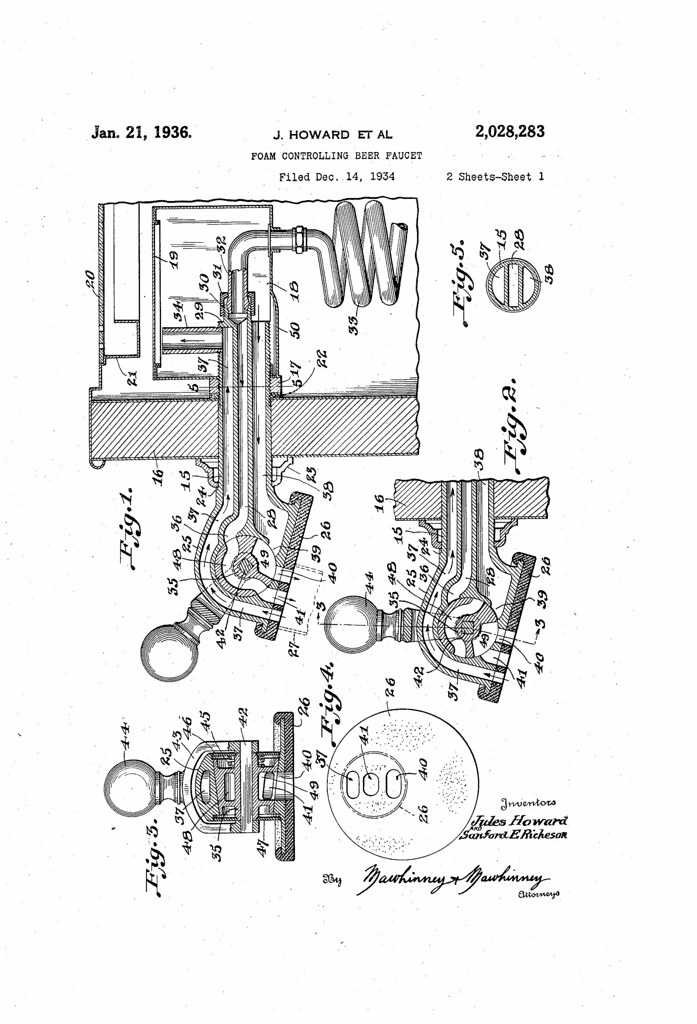
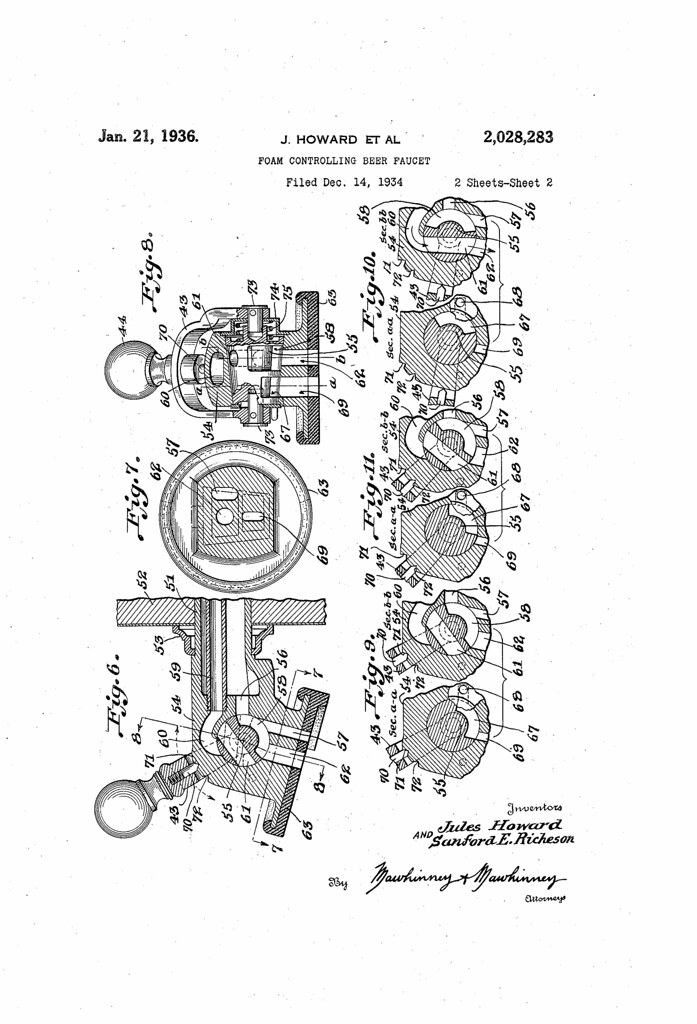
Today in 1936, US Patent 2028283 A was issued, an invention of Jules Howard and Sanford E. Richeson, for their “Foam Controlling Beer Faucet.” There’s no Abstract, but the description explains that the “invention relates to beer and like taps or valves for drawing off foamy liquid from a cooler or other container.” It was designed “to prevent loss of the liquid incident to foaming in the glass after standing for some time in the cooler or container, and at the same time to regulate the depth of the head or cap of foam at the top of the glass.”
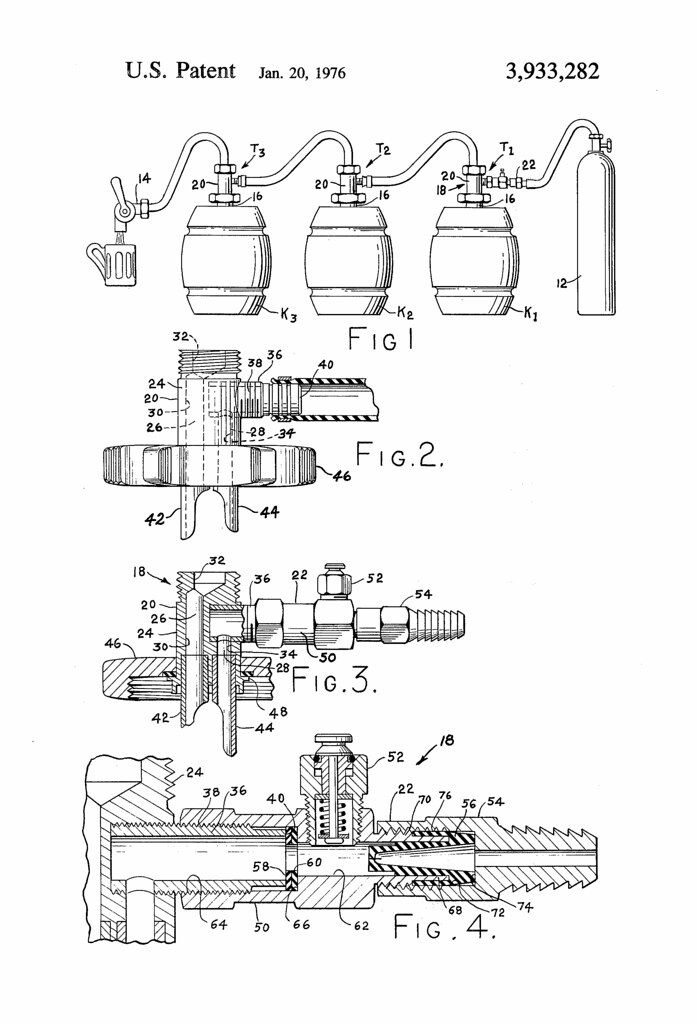
Patent No. 3933282A: Universal Tavern Unit For Keg Tapping Device
Today in 1976, US Patent 3933282 A was issued, an invention of Frederick F. Stevens, Jr., and assigned to Hoff-Stevens, Inc., for his “Universal Tavern Unit for Keg Tapping Device.” Here’s the Abstract:
A universal tavern unit for a keg tapping device comprises a basic tavern unit for connection to a keg unit permanently or semi-permanently connected to a keg. The basic tavern unit is adapted to cooperate with the keg unit to provide inlet and outlet passageways which communicate with the interior of the keg for the introduction of gas under pressure into the keg and the discharge of beer or other liquid therefrom. The universal tavern unit further includes a pressure relief check valve adaptor assembly for connection to the basic tavern unit to adapt it to the requirements of an associated beer or liquid distribution system.
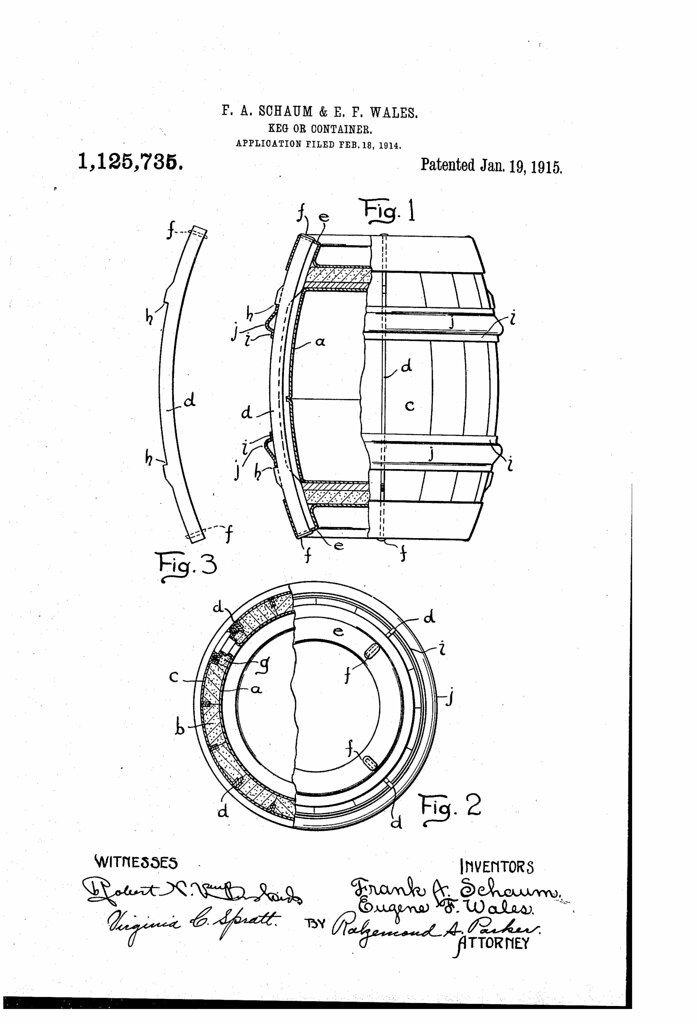
Patent No. 1125735A: Keg Or Container
Today in 1915, US Patent 1125735 A was issued, an invention of Frank A. Schaum and Eugene F. Wales, for their “Keg or Container.” There’s no Abstract, but the description explains that the “invention relates to kegs or other containers and has for its object reinforcing devices for strengthening the container.” They continue. “A further improvement is devices for holding the hoops in place. These devices may be made part of the reinforcing structure.”
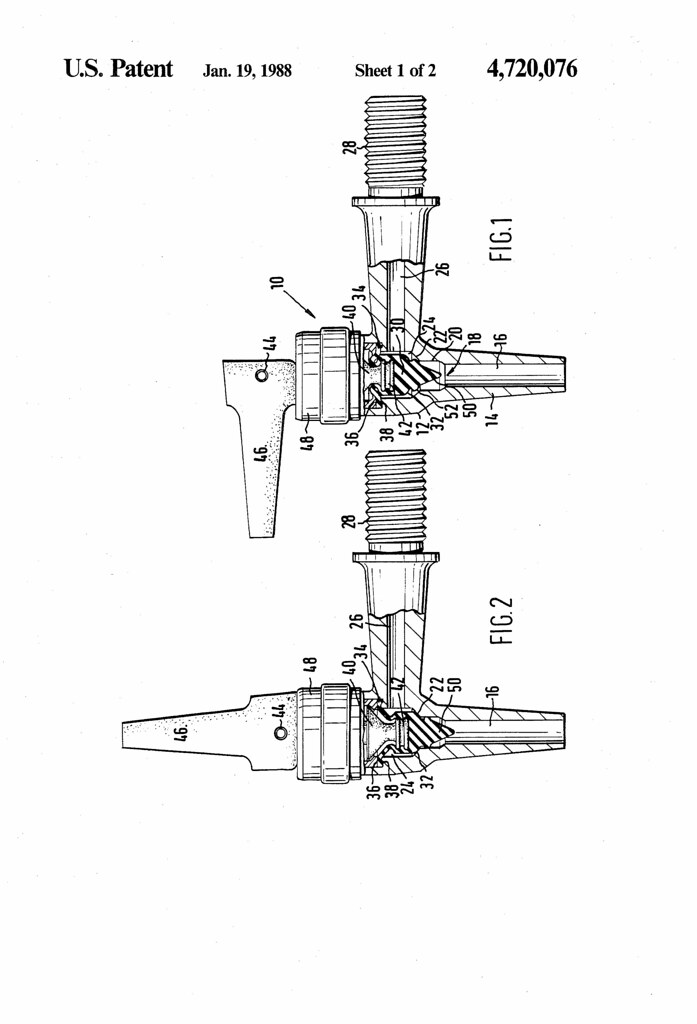
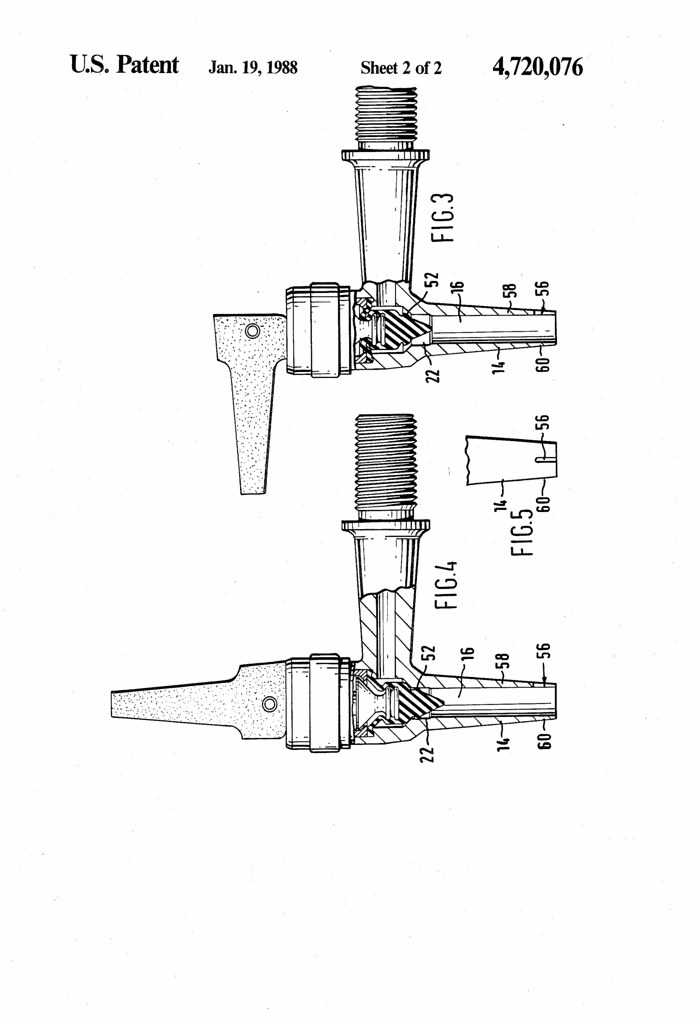
Patent No. 4720076A: For A Carbon Dioxide Gas Pressure Dispense System For Beer
Today in 1988, US Patent 4720076 A was issued, an invention of Roger J. Hyde, for his “Carbon Dioxide Gas Pressure Dispense System for Beer.” Here’s the Abstract:
A dispense tape (10) to control the flow of carbonated beers is configured to minimize pressure drop and turbulence in beer flow to an outlet nozzle (14) when open, the tap having flow restrictor means (52) operatively connected as a downstream extension of the tap valve (30), located in the path of beer flowing from the valve, arranged only to affect beer flow when the tap is nearly closed and configured to substantially restrict beer flow to maximize pressure drop and turbulence; choice of nozzle length/bore ratio enabling either a creamy flow or a squib of beer to be dispensed.
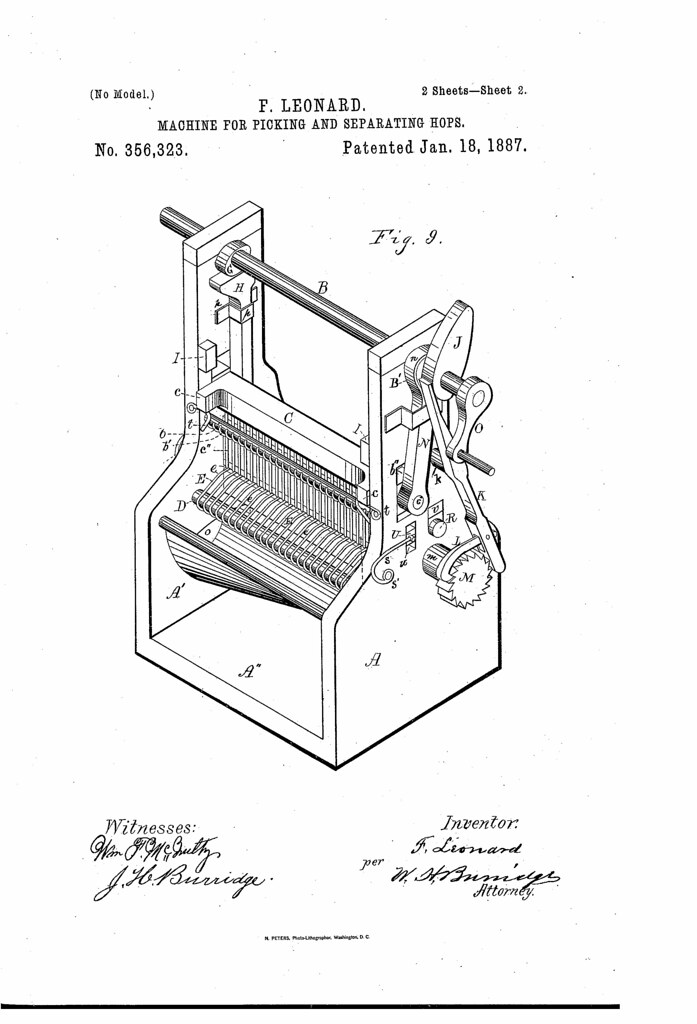
Patent No. 356323A: Machine For Picking And Separating Hops
Today in 1887, US Patent 356323 A was issued, an invention of Franklin Leonard, for his “Machine for Picking and Separating Hops.” There’s no Abstract, and the description is hard to read, as well, but it’s a “new and improved Machine for Picking and Separating Hops from the Vines.”

Wine vs. Beer, Big vs. Small, More Trademark Woes

Opened in 2012, the tiny Cambria Beer Co. is located in the equally small town of Cambria, described more as a “seaside village,” boasting about 6,000 residents. It’s located along Highway 1, in San Luis Obispo County, midway between San Francisco and L.A.
The brewery uses a small 3bbl brew sculpture system, and operates a small tap room on Cornwall Street. They offer a wide variety of beer styles, continually rotating. A recent list included five on, with two in the fermenters and three more scheduled right behind those. Beers sell out quickly, but they try to keep up. Owners Aaron and Jennifer Wharton decided that since they were the only brewery in town, that Cambria Beer Company was the right name for their decidedly local enterprise.
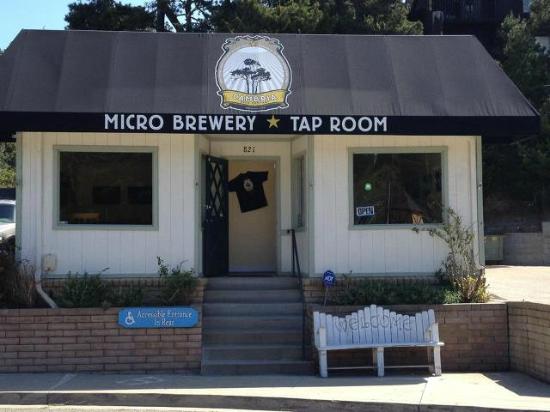
Not everyone agreed. The Jackson Family Farms is best known for Kendall-Jackson wine, but that’s just one of the more than a dozen wineries that they own. Another one of their labels is Cambria Estate Winery. So you’re probably thinking that makes sense, probably located right down the street. Nope. To get to the Cambria Estate Winery from the brewery, you’ll need to head south on Highway 1, then pick up Interstate 101 at the junction in San Luis Obispo. Drive south to Santa Maria, turn left in downtown and drive west out of town to the winery. All told, it will take you about one hour and twenty minutes to get there, because it’s nearly 80 miles away outside the town of Santa Maria, which is even in a different county (Santa Barbara County), too.
I first saw this on Grub Street, but the local newspaper, The Cambrian, naturally has the most complete account in When is Cambria not in Cambria? Apparently, the Whartons have been trying to negotiate to keep their name since they received the C&D letter from KJ’s lawyers on New Year’s Eve.
Unfortunately, as I understand it, when it comes to trademark law, alcohol is alcohol; they’re in the same class of goods as far as trademark is concerned. This is hardly the first time this has happened. Another small brewery in the Bay Area had to add a letter to their name because a spirits company was using the original spelling. A San Francisco brewery not long ago had to change the name of one of its beers, because there was a rum of the same name.
So there is some precedent here, it’s not totally out of left field. The Cambrian author wonders if every business in Cambria using Cambria in their name should be worried, rightly concluding no. But the fact that the winery is so far from the town and they serve largely a different demographic makes it not so cut and dry. A commenter on Reddit who claimed to be close to the parties involved mentioned that the brewery’s attorneys believed they had a strong case, but the $50,000 (minimum) price tag to fight it was too much for them, as it would be for almost any small company. So the brewery did what most people would in this situation, and decided to change their name. Last week, they posted that decision on their Facebook page, asking fans and customers to help them come up with a new name by leaving a comment. They’ve had a lot of suggestions so far, including several funny ones.
I’m starting to think that trademark law may need some modification. Clearly, alcohol is not alcohol anymore. Maybe there was a time when that made sense, but I think most of us can agree that we can tell the difference between beer and wine. And it seems to me geographic truth should trump whatever reason this winery is using a name that has nothing to do with where it’s located. I seem to recall another trademark case where the Boston Beer Company (Samuel Adams) sued Boston Beer Works and lost, the court ruling that “Boston” was too generic a term, ditto “beer.” Komlossy Law has a nice overview of the case, if you’re interested in learning more. And those were both beer companies, so it does seem like Cambria Beer might have had a decent shot at keeping their name. Still, you have to understand not wanting to spend a fortune going to court on an uncertain result. As we learned in “War Games,” sometimes “the only winning move is not to play.” If nothing else, I hope we can all support whatever new name they decide on and stop by and spend our money there the next time we drive by on our way to or from Los Angeles or the Bay Area. Success is always the best revenge.
The Drunkard’s Cloak

Once upon a time, society kept everybody in line through social pressure, and if that didn’t work, public humiliation. The pillory was a common punishment, and you’re undoubtedly familiar with the main type, a wooden stake with two perpendicular pieces of wood that fit together, with holes for a person’s head and both hands, so that once all three were secured, you were stuck in the public square for a period of time depending on the severity of your crime. But that was only the most common type, and there were several others, such as the scold’s bridle or the jougs. But there was also a specific pillory used in the case of public drunkenness. In England, it was known as a Drunkard’s Cloak.
According to one source, “Drunkenness was first made a civil offence in England by the Ale Houses Act 1551 and the drunkard’s cloak became a common method of punishing recidivists, especially during the Commonwealth of England. From 1655 Oliver Cromwell suppressed many of England’s alehouses, particularly in Royalist areas, and the authorities made regular use of the cloak.”
The 1655 publication England’s Grievance Discovered, by Ralph Gardiner, describes the Drunkard’s Cloak like this.
Men drove up and down the streets, with a great tub, or barrel, opened in the sides, with a hole in one end, to put through their heads, and to cover their shoulders and bodies, down to the small of their legs, and then close the same, called the new fashioned cloak, and so make them march to the view of all beholders; and this is their punishment for drunkards, or the like.
“Drunkards are to pay a fine of five shillings to the poor, to be paid within one week, or be set in.”
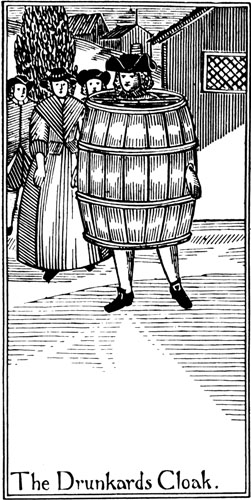
In 1655, John Willis claimed that in Newcastle-upon-Tyne, England, “he hath seen men drove up and down the streets with a great tub or barrel opened in the sides, with a hole in one end to put through their heads, and so cover their shoulders and bodies, down to the small of their legs, and then close the same, called the newfangled cloak, and so make them march to the view of all beholders; and this is their punishments for drunkards and the like.”
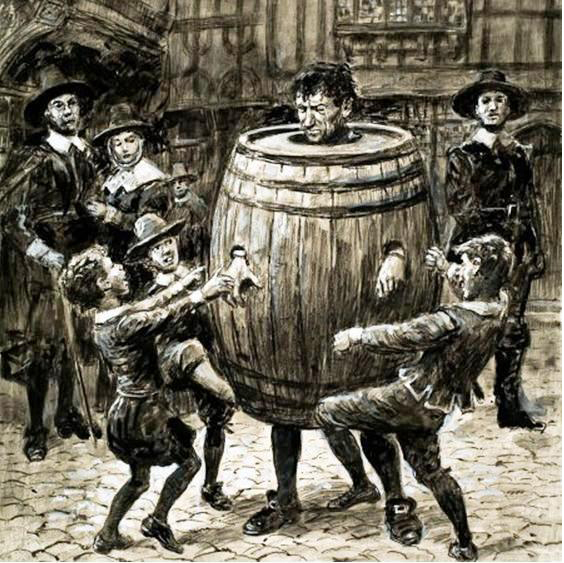
It was also used in other parts of Europe, though often called by different names, such as the Spanish Mantle or the Barrel Pillory. In Germany, it was called a Schandmantel, which means “coat of shame” or “barrel of shame.”
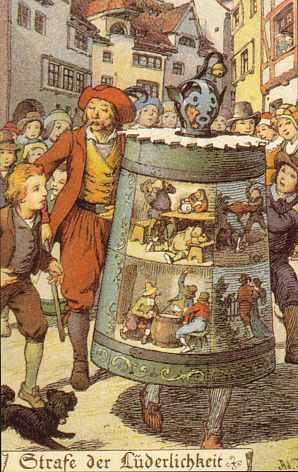
And there’s actual one in the torture museum in Freiburg im Breisgau, Germany.
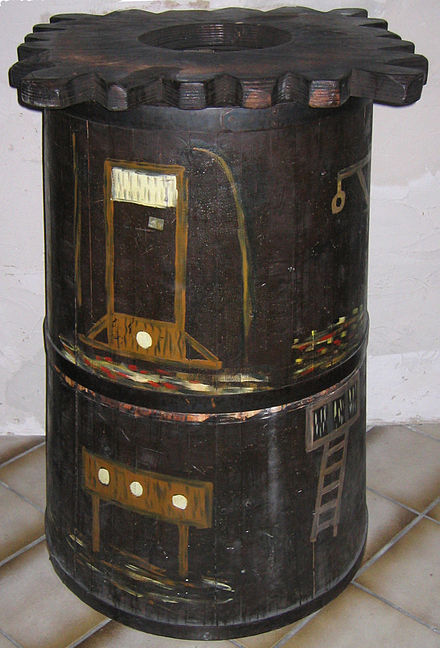
By some accounts, the Spanish Mantle may have been a more serious torture device, intended to inflict more than just humiliation.
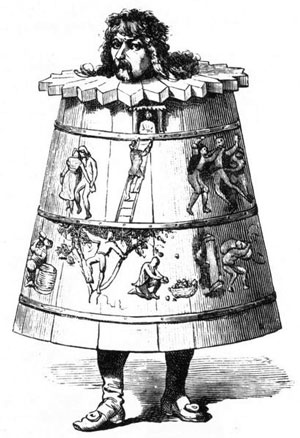
A 1641 diary entry by John Evelyn described one in Delft, Holland as “a weighty vessel of wood, not unlike a butter churn, which the adventurous woman that hath two husbands at one time is to wear on her shoulders, her head peeping out at the top only, and so led about the town, as a penance for her incontinence.”
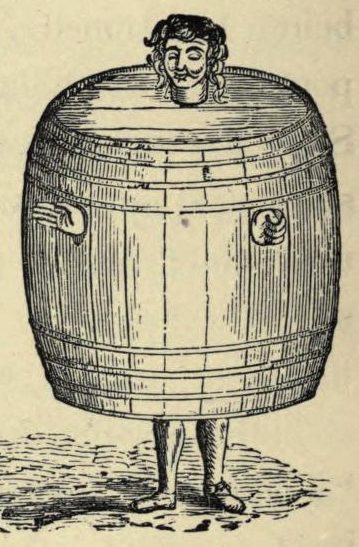
Apparently this type of punishment was not confined to Europe, and also made its way to the American colonies.
Massachusetts Bay Governor John Winthrop, in 1634, noted that Robert Cole (1598-1655), who had come to Massachusetts with the Winthrop Fleet in 1630, “having been oft punished for drunkenness, was now ordered to wear a red D about his neck for a year.” Some literature professors suggest that this was the origin of the story written by Nathaniel Hawthorne, The Scarlet Letter.
“Robert Cole was living in Roxbury, Massachusetts, when he petitioned to be made a “freeman” on 19 Oct 1630, and was granted that status by the General Court on 18 May 1631, along with 113 other men. He was disfranchised 4 Mar 1634, for a short time on account of his problem with drinking too much wine, when he was also ordered to wear a red letter “D” on his clothing for a year; however, his freeman status was reinstated about two months later on 14 May 1634, and the requirement to wear the letter ‘D’ was also revoked at that time.”
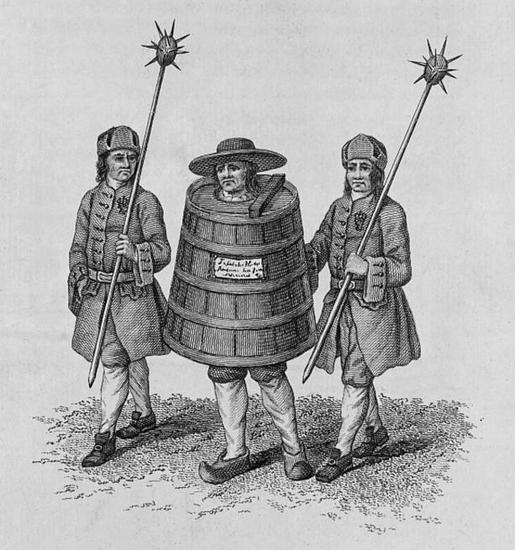
And according to Curious Punishments of Bygone Days, published in 1896 by Alice Morse Earle, it was used during the American Civil War, as well.
Another Union soldier, a member of Company B, Thirteenth Massachusetts Volunteers, writes that while with General Banks at Darnstown, Virginia, he saw a man thus punished who had been found guilty of stealing: With his head in one hole, and his arms in smaller holes on either side of the barrel, placarded “I am a thief,” he was under a corporal’s guard marched with a drum beating the rogue’s march through all the streets of the brigade to which his regiment was attached. Another officer tells me of thus punishing a man who stole liquor. His barrel was ornamented with bottles on either side simulating epaulets, and was labelled “I stole whiskey.” Many other instances might be given. There was usually no military authority for these punishments, but they were simply ordered in cases which seemed too petty for the formality of a court-martial.
This “barrel-shirt,” which was evidently so frequently used in our Civil War, was known as the Drunkard’s Cloak, and it was largely employed in past centuries on the Continent.
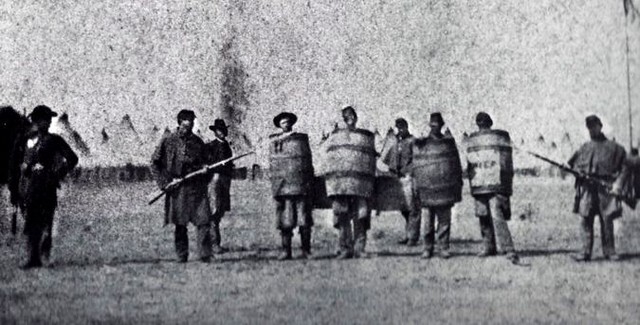
Another eyewitness account from 1862 described the scene as follows. “One wretched delinquent was gratuitously framed in oak, his head being thrust through a hole cut in one end of a barrel, the other end of which had been removed; and the poor fellow loafed about in the most disconsolate manner, looking for all the world like a half-hatched chicken.”
Surprisingly, the most recent example I found for the Drunkard’s Cloak was in 1932, when it was still in use in American prisons, such as the Sunbeam Prison Camp, in Florida, which is where the photo below was taken.
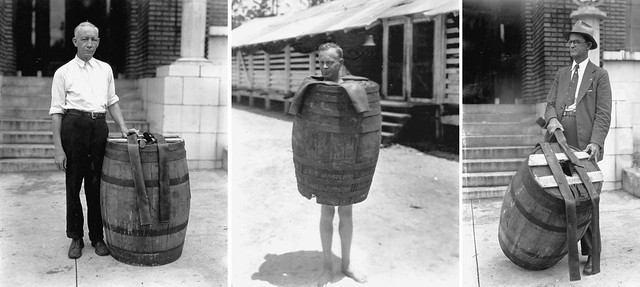
I’m certainly glad that public shaming has, for the most part, been removed from our justice system. Although I’ve never been arrested for public drunkenness, I’ve certainly made a fool of myself in private or with friends, and this certainly seems a bit excessive. Clearly, it was ineffective at controlling peoples’ behavior, but I wonder what it was in the end that finally stopped it being used as a punishment?
Where Can You Buy Beer In Grocery Stores?

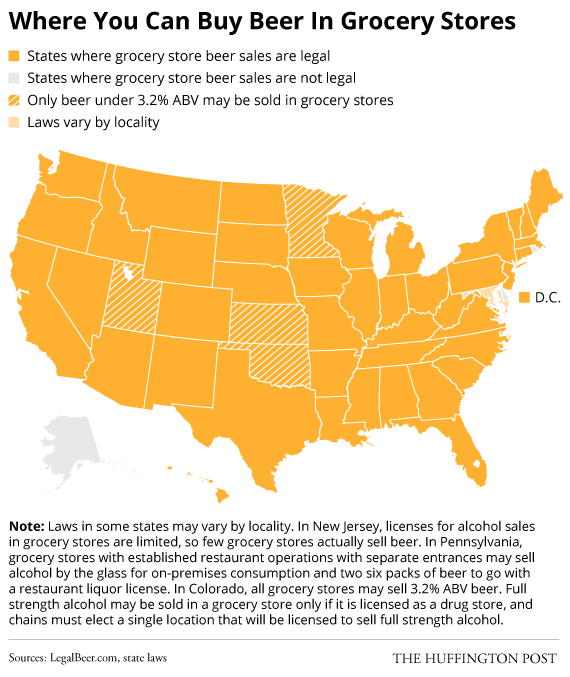
Late last month, the Huffington Post, of all place, actually had an interesting series of charts detailing the availability of different kinds of alcohol in each state. In Here Are The Rules To Buying Alcohol In Each State’s Grocery Stores they have charts for beer, wine, spirits and where you can but alcohol on Sundays. Check out the post for all of the charts, although the beer chart is below, which used data provided by Legal Beer.
How’d You Really Get That Drink?

Navigating the maze of state liquor laws is a challenge for anybody, but especially any bar, restaurant or brewery trying to do business in many, if not every, one of the states. A Chicago law firm, the Hays Firm LLC, with a practice area in Restaurant and Bar Services, created an interesting infographic detailing many of the quirky differences of U.S. Liquor License Laws & Facts, particularly their laws on licensing, BYOB and corkage, introduced with the following:
When you wind down at the end of the day or meet up for a social night with friends for a drink, have you thought about how and why you have access to alcohol? Maybe you ordered a beverage at a bar or restaurant, or maybe you picked up a bottle of wine or a six-pack of beer before watching a Sunday football game at home.
But, how’d you really get the drink in your hand? There are U.S. regulations that provide or limit public or business access to alcohol. Furthermore, alcohol sales and serving in restaurants, bars, liquor stores, grocery stores, and even patios and events are subject to local or state laws, or consumers or sellers risk losing permission to interact with it, which could result in legal penalties, and even decreased revenues that keep businesses thriving. Many restaurants aim to have alcohol sales account for 30% of their revenue, so not adhering to liquor license and Bring-Your-Own-Beverage (BYOB) laws, could drive customers away and negatively impact profitability.

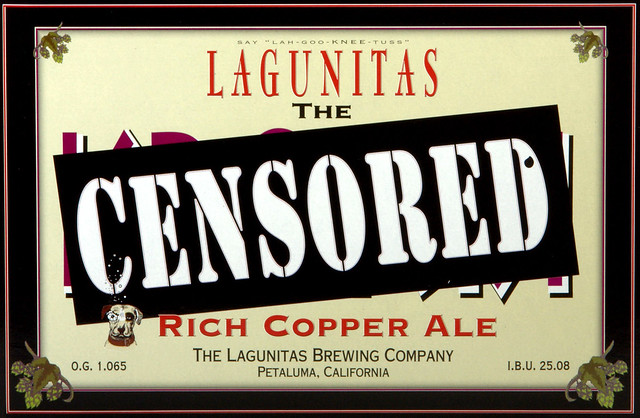
The Battle Over Beer Label Approval

The Daily Beast had an interesting profile of Kent “Battle” Martin, the person responsible for approving every single beer label at the Alcohol and Tobacco Tax and Trade Bureau, or TTB, in Meet the Beer Bottle Dictator. I’d heard of Martin — um, Battle, I mean — before, but didn’t realize he was the only person approving or denying label applications. I think I assumed he was simply part of a larger staff. I can’t say having a single person in charge of interpreting a fairly vague set of laws in a particularly good idea. There have been some very strange, seemingly nonsensical and contradictory decisions over the years, and I’d always thought that was because those were made by various people interpreting the regulations differently, the way the California ABC does, or the arbitrary way that movie ratings are given. I have to say, I don’t think that should be left to just one individual, no matter how dedicated or hard-working, as Battle apparently is, according to the article.