Brookston Beer Bulletin

Jay R. Brooks on Beer

  • Home
  • About
  • Editorial
  • Birthdays
  • Art & Beer

Socialize

  • Dribbble
  • Email
  • Facebook
  • Flickr
  • GitHub
  • Instagram
  • LinkedIn
  • Pinterest
  • RSS
  • Twitter
  • YouTube

Powered by Genesis

Brewing Up A Civilization

December 24, 2009 By Jay Brooks

history
There’s a wonderful article today in Germany’s Der Speigel showcasing University of Pennsylvania Archaeologist Patrick McGovern’s theory that alcohol is responsible for nothing short of civilization itself. Titled Alcohol’s Neolithic Origins: Brewing Up a Civilization, the story begins:

Did our Neolithic ancestors turn to agriculture so that they could be sure of a tipple? US Archaeologist Patrick McGovern thinks so. The expert on identifying traces of alcohol in prehistoric sites reckons the thirst for a brew was enough of an incentive to start growing crops.

It turns out the fall of man probably didn’t begin with an apple. More likely, it was a handful of mushy figs that first led humankind astray.

Here is how the story likely began — a prehistoric human picked up some dropped fruit from the ground and popped it unsuspectingly into his or her mouth. The first effect was nothing more than an agreeably bittersweet flavor spreading across the palate. But as alcohol entered the bloodstream, the brain started sending out a new message — whatever that was, I want more of it!

This is nothing new if you’ve been following McGovern and other scientists coming to similar conclusions as new evidence is continually being found to support the idea that it was the desire to brew beer that caused man to settle down and grow crops, leading to civilization’s genesis. But it’s quite nice to see it gaining traction in mainstream media.

McGovern’s latest book, Uncorking the Past: The Quest for Wine, Beer, and Other Alcoholic Beverages, is a fascinating read and I highly recommend it. McGovern is also the scientist that worked with Dogfish Head Brewery to create Midas Touch, Chateau Jiahu, along with their other historically based beers.

egyptian-brewery
An Egyptian wooden funerary model of a beer brewery in the National Archaeological Museum in Athens.

Filed Under: Beers, Just For Fun, Politics & Law Tagged With: History, Mainstream Coverage, Middle East

Bud Light Wheat Vs. Blue Moon

December 16, 2009 By Jay Brooks

bud-light-wheat
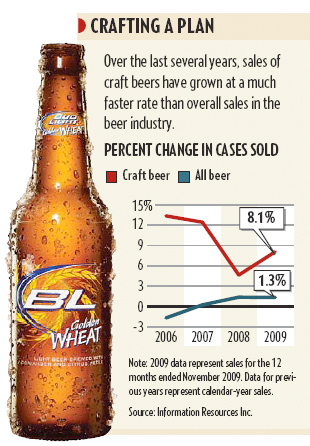
I confess that when Bud Light Golden Wheat first appeared in the market, I gave it almost no notice. It was yet another line extension in an increasingly crowded portfolio. If I had noticed that it also included citrus and coriander it might have been more apparent that it was conceived, at least in part, to attack Coors’ Blue Moon. Given Anheuser-Busch’s track record of going after literally every product on the market — no matter how small the niche — what’s more surprising in hindsight is that it took so long. Blue Moon first debuted in 1995.

Crain’s Chicago Business had an interesting article on Monday about the battle, entitled Budweiser Takes On MillerCoors’ Blue Moon In Craft Beer Brew-Haha.

crafting-a-plan

But since its debut last October, Bud Light Golden Wheat has made significant progress, showing just how important distribution and access to market can be.

Anheuser-Busch showed last month that it has the marketing muscle and distribution wingspan to make up lost ground quickly. It sold 263,000 cases of Bud Light Golden Wheat in November, nearly equaling Blue Moon’s total, IRI data show.

It’s an interesting read, and to me the takeaway is Harry Schuhmacher’s thoughts, as quoted in the article:

“It’s very important because craft beers are the only growing part of the business,” says Harry Schuhmacher, editor of San Antonio-based trade publication Beer Business Daily. “This is where the future of beer is going, and they want to make sure they are well-established in the category.”

Filed Under: Beers, Breweries Tagged With: Big Brewers, Mainstream Coverage, Statistics

Whither Goes News, Who Pays?

November 22, 2009 By Jay Brooks

newspaper
This is another one of my rambling rants that’s not really beer-related, or at least not beer-centric. If heavy media discussions are not your bag, feel free to stop here and just ignore this one. Beer topics will resume in a few moments. This topic does effect beer insofar as it effects everything in the world, the galaxy and the universe. I’ve long argued that as newspapers die their slow death, that people’s unwillingness to continue to support them and other “paid” media, will have a chilling effect on how the news is shaped, who shapes it, and ultimately how transparent and unbiased it is. I spoke a little bit about this during my time on The Brewing Network this past Sunday, and regular readers may recognize the topic, as well. I’ve been arguing that we have to be willing to pay for our news or we won’t have any news left, or at least not the diversity that’s essential to a free society. Now I realize the fourth estate is hardly free from bias as it stands now, but just wait until there’s only a couple of wire services left. We’re already going in that direction as smaller and regional newspapers lay off staff, create only their local news and rely on the wire services for state, national and world news. For almost any big story, especially overseas, the origin of the coverage is now from only a handful of sources, like the AP, Reuters or UPI.

In fact, there’s only two major U.S. news agencies (The Associated Press and United Press International) and maybe another five worldwide, all located in Europe. The other ones you’ve likely heard of include BBC News, Bloomberg, CNN and the PR Newswire. There’s many more smaller ones in addition, and Wikipedia list nearly fifty in total, which they consider “major”. The Mondo Times World Media Directory lists 34, and doesn’t appear to include the press release clearing houses. But there’s far less than there used to be, and the number is dropping all the time.

Once upon a time, most major papers, and at least the media groups, had “bureaus” all over the world with dedicated staff and reporters that were constantly monitoring local affairs and were ready at any time should a big story develop. Content varied widely and vigorous competition made each media outlet dig deeper and search for the fresh angle. Before that, most major cities had more than one newspaper competing for readership. That, too, made the news richer and fairer overall.

As much as I’d love that time to return, it’s just wishful thinking and the present is what it is. The internet, combined with other factors, have forever altered the way we consume information, and especially news. I’ve long thought that part of the reason for the media decline is because so much news is available free on the internet. As a result, people get their news from other sources than traditional media. The problem with that is, if people aren’t willing to continue paying for their news, then who’s going to collect it and report on it? Yes, blogging has taken up some of the slack in limited ways with amateur reporters finding unique voices and most media outlets now even have blogs as a part of the web presence.

But as cool as “citizen journalism” is, it can never completely replace traditional media, because somebody has to gather the original stories. The majority of blogs still rely on traditional media for source news. For example, I learn about a lot of the news in the beer world from a variety of sources. I get press releases from breweries and other beer-related companies. Friends in the industry let me know what they’re up to and send me samples. But I still have to rely on traditional media for some beer news, financial stuff, for example. Worldwide news, big brewery news, things like that are the type of things I have to rely upon other sources for. Like many bloggers, I strive to not just regurgitate the news, but analyze it, look deeper into its meaning or otherwise put my own stamp or spin on it. But if that source news isn’t there to comment on, all is lost. This is especially true for stories that aren’t clear cut or for which one side of it has an interest in being spun in a way that’s favorable to them. That’s already happening with dwindling media diversity where overworked newspapers don’t have the time or resources to tell the other side of a story or include contrary opinions so they instead rely heavily on press releases, which are notoriously one-sided. [I should disclose that I make a portion of my living writing for a traditional newspaper.]

I know plenty of people who work for different newspapers, and a lot of them are worried about their futures, personally, professionally and in a more general sense of what will happen when all the papers are no more. Yes, you can make the argument that all people resist change and history is littered with such examples. But I keep coming back to the point that if there are no more media (or more likely just a very few big) outlets paying reporters to gather the stories, then we’ll be relying on an ever decreasing number of sources for all news, which I can’t help but believe will make it easier to manipulate that news and spin it whichever way someone wants. Or at the very least, water it down more than it already is. And that’s what will happen if we don’t continue to support traditional media by paying for it.

My fears, I thought, were somewhat borne out by a recent poll reported in the New York Times. The article, entitled About Half in U.S. Would Pay for Online News, Study Finds, which concludes that “Americans, it turns out, are less willing than people in many other Western countries to pay for their online news.”

Among regular Internet users in the United States, 48 percent said in the survey, conducted in October, that they would pay to read news online, including on mobile devices. That result tied with Britain for the lowest figure among nine countries where Boston Consulting commissioned surveys. In several Western European countries, more than 60 percent said they would pay.

When asked how much they would pay, Americans averaged just $3 a month, tied with Australia for the lowest figure — and less than half the $7 average for Italians. The other countries included in the study were Germany, France, Spain, Norway and Finland.

“Consumer willingness and intent to pay is related to the availability of a rich amount of free content,” said John Rose, a senior partner and head of the group’s global media practice. “There is more, better, richer free in the United States than anywhere else.”

The question is of crucial interest to the American newspaper industry, which is weighing whether and how to put toll gates on its Web sites, to make up for plummeting print advertising.

Sounds bad, right? But here’s the thing, which in a weird way I think proves my point, at least to some extent. The Times article was based on a recent poll by the Boston Consulting Group. The title of their press release about that poll was News for Sale: Charges for Online News Are Set to Become the Norm as Most Consumers Say They Are Willing to Pay, According to The Boston Consulting Group, the title alone suggesting a different story than the one reported by the New York Times.

From the press release:

New research released today shows that consumers are willing to spend small monthly sums to receive news on their personal computers and mobile devices. In a survey of 5,000 individuals conducted in nine countries, BCG found that the average monthly amount that consumers would be prepared to pay ranges from $3 in the United States and Australia to $7 in Italy.

John Rose, a BCG senior partner based in New York who leads the firm’s global media sector, said, “The good news is that, contrary to conventional wisdom, consumers are willing to pay for meaningful content. The bad news is that they are not willing to pay much. But cumulatively, these payments could help offset one to three years of anticipated declines in advertising revenue.”

It has the same details as the Times, but the spin is completely the opposite. While the Times focuses on how little Americans are willing to pay, the BCG report emphasized the fact that their poll revealed people are willing to pay for news online, concluding that their “findings will benefit newspapers with unique voice and reporting and with strong subscriber bases[; i]n particular, national and local newspapers.” The only other story about this poll I could find was by Media Daily News, and they also spun it as bad news with the headline People Won’t Pay Much For Online Content. Is it possible they’re both taking a self-serving approach trying to persuade their readers that they should be willing to pay more? It seems to me if enough people are willing to pay a little bit, then it should work. Shouldn’t the better approach be to persuade people to pay something rather than berate them for not being willing to pay more?

So here’s a story that’s reasonably important, as what changes are occurring to our news effects every single one of us and the only two news outlets that cover it get it wrong, or at least recast it in a way that seems obviously more beneficial to them. One surprising tidbit that came out of the study is that the one group that appears to be willing to pay more are avid newspaper readers. Doesn’t that suggest that newspapers might be able to successfully move to a more online model? But instead of finding the news encouraging, America’s newspaper of record chastises the people most willing to pay for online content — their readers — for not being willing to pay enough. Strange times indeed.

But online or off, I continue to believe that we have to support traditional media or at least another model that achieves the same goal of having professional journalists as the primary source for news gathering. I absolutely love online media, and especially blogging, but I can’t see how it could supplant boots on the ground, so to speak. As a result, I subscribe to my local newspaper and also to online subscription websites like Salon. I’d encourage you to do the same. I don’t really believe news will disappear, of course. There will always be a demand for it, but the consolidation like we’ve seen in other industries (which I believe is always bad) is taking place. And the diversity that used to be readily available in news is most definitely in decline, even with the explosion of the internet. Information has undoubtedly increased online, but I’m not sure unique news online has kept pace. If we don’t support newspapers, all we’ll be left with is the USA Today. I shudder to think. I now return you to our regularly scheduled beer news.

Filed Under: Editorial, News, Related Pleasures Tagged With: Mainstream Coverage

Anchor’s Christmas Ale Artwork

November 21, 2009 By Jay Brooks

anchor-xmas09
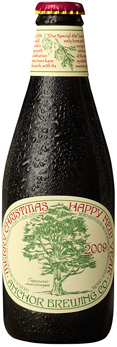
The Monday before Thanksgiving is the traditional date that Anchor Brewery used to release their Christmas Ale (a.k.a. Our Special Ale), undoubtedly the first annual holiday beer in the silver age of brewing. For the last few years, it’s been released earlier, usually the first week of November. Last year I lamented that loss of seasonality and I continue to celebrate what I call Anchor Christmas Ale Day on that Monday before Thanksgiving. This year is the 35th annual release of the beer, which except for the first few years has been a different recipe every year.

anchor-xmas09-btl
For the past few years, Anchor’s Christmas Ale has been fairly similar each year, unlike the roller coast years of the mid-1990s, which, I confess, I remember with a special fondness. (Plus I also have several magnums of each year stretching back a decade and 12 oz. bottles a little farther.) I had an opportunity to try some last weekend and it’s about how I remember it last year, still tasting quite good and will undoubtedly be the beer I enjoy with my Thanksgiving dinner.

anchor-xmas09
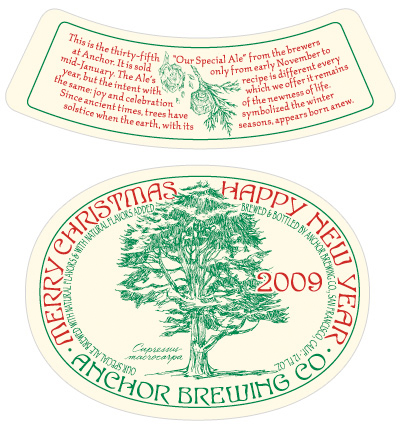
The reason I bring this up today, instead of on Monday, is that the San Francisco Chronicle profiled the 82-year old Jim Stitt, the artist who’s drawn virtually all of Anchor’s beer labels, including 35 different Christmas Ale labels, beginning with Anchor Porter in 1974. (There’s also a photo gallery with more of Stitt’s labels.)

This year’s label features the “iconic Monterey cypress near Stanyan and Fell Streets, where the Panhandle meets Golden Gate Park. Lit up from head to toe shortly after Thanksgiving every year, it’s San Francisco’s unofficial Christmas tree. And this year, it becomes the very first San Francisco native to have its portrait on Anchor Brewing Co.’s Christmas Ale.”

My favorite quote from Stitt is this. “It’s a handmade beer, so the label should be hand-drawn.” Below are all 35 of Stitt’s hand-drawn labels for Anchor Christmas Ale.

Anchor-Xmas-poster09

Filed Under: Art & Beer, Beers Tagged With: Beer Labels, California, Holidays, Mainstream Coverage, Northern California, San Francisco

Pubs Becoming Hubs?

November 20, 2009 By Jay Brooks

My friend and colleague, Pete Brown, who wrote Hops and Glory, tweeted this interesting editorial that ran on today’s Guardian Online, entitled Are Pubs Finally Becoming Hubs?. Definitely worth a read.

Filed Under: Breweries, Editorial Tagged With: Mainstream Coverage, Pubs, UK

Breweries Have 5th-Most Satisfied Customers

November 18, 2009 By Jay Brooks

acsi
According to a new survey, released yesterday by the American Consumer Satisfaction Index (and tweeted my way by Anat Baron — thanks!), Breweries ranked 5th in overall satisfaction by consumers among industries polled by the group. Here are the first five with their score in parentheses (out of 100):

  1. Personal Care & Cleaning Products (85)
  2. Soft Drinks (85)
  3. Full Service Restaurants (84)
  4. Automobiles & Light Vehicles (84)
  5. Breweries (84)

For breweries, this is the highest marks they’ve received since this poll began, and represents a 1.2% increase over last year.

As reported by Brand Week, comfort foods like candy and beer continued to do well.

Beer manufacturers reached their highest level to date with a score of 84 (out of a 100-point scale) to mark a 1.2 percent change from 2008 rankings. Top companies included Anheuser-Busch InBev (85) and SABMiller (83), which grew 3.7 percent and 1.2 percent respectively from last year. Molson Coors Brewing (81) dipped by 2.4 percent, while “all others” maintained their rank at 83.

The ACSI had their own take on beer in their analysis:

Beer: A Comfort Drink?

Beer drinker satisfaction has soared to an all-time high in ACSI. It too seems to follow the pattern of chocolate and sweets, but perhaps a bit less pronounced. The industry improved 1.2% to an ACSI score of 84, led by a 4% climb for Anheuser-Busch to a score of 85. Just a year after it was acquired by the Belgian-Brazilian conglomerate InBev, Anheuser-Busch matched its biggest ever single-year gain to reach its highest level ever. InBev has made a number of changes in business strategy—it sold the ten theme parks owned by Anheuser-Busch to reduce debt and focus on core business, cut over 1,000 employees, and overhauled management. The company has seen increased sales of lower-priced brands such as Natural Light and Busch and of newer products such as Bud Light Lime and Golden Wheat varieties.

Results for Miller and Coors brands, which market under a joint operating agreement, were mixed. Miller improved slightly, up 1% to 83, while Coors dropped 2% to 81, falling to the bottom of the industry. The Coors brand portfolio is composed of a greater proportion of high-end entities and more high-priced brands compared with Anheuser-Busch. In the midst of an economic downturn, customers typically look more to value for money. Coors drinkers report a sharp decline in value for money.

The ACSI also noted a pattern during economic downturns:

“The same thing happened in 2001 in the midst of the previous recession and also in 2004 when concern over the Iraq war and rising fuel prices appeared to be reflected in higher satisfaction with comfort foods,” said Professor Claes Fornell, founder of the ACSI and author of The Satisfied Customer, in a statement.

Newspapers and Cable/Satellite TV tied for last, though Airlines were a close second-to-last.

Filed Under: Breweries, Editorial, Just For Fun, News Tagged With: Mainstream Coverage, Statistics

Pinhead Drinking Statistics By Media Ignore Reality

November 13, 2009 By Jay Brooks

graphchart
The e-mail newsletter sent out Tuesday by Join Together, the anti-alcohol center at Columbia University, included a summary of an item in the USA Today from November 3, entitled Beer With Extra Buzz On Tap Up To 16%. Join Together’s emphasis on the article is about “More States Allowing High-Alcohol Beer” and similarly the USA Today article takes a cautionary tone as it starts out stating that a “growing number of states are moving to allow higher alcohol content in beer, despite concerns from some substance-abuse experts.” While admitting that 20 states “still place some kind of limit on the amount of alcohol in beer,” the recent changes to the alcohol laws in several states, such as Alabama, Georgia, Montana, North Carolina, Vermont, West Virginia, and others, are worrying the usual anti-alcohol folks.

Although they did talk to Paul Gatza from the Brewers Association, most of the voices in the article were from neo-prohibitionist groups expressing their “concerns.” For example, “David Rosenbloom, president of the National Center on Addiction and Substance Abuse at Columbia University in N.Y., said the more alcohol, ‘the faster you get drunk and the longer you stay drunk. … There’s no evidence that people will drink less, or fewer beers.’ And here’s Chuck Hurley, CEO of Mothers Against Drunk Driving, who said, “Our chief concern is that (higher-alcohol brews) be properly labeled so people understand it takes fewer beers to become intoxicated.”

But here’s why this is a non-story and why author Jessica Leving needs to go back to J-school. What’s not mentioned in this article is that wine and hard liquor, already much stronger than beer, in some cases many times stronger, is already available in those same states who’ve recently raised the allowable alcohol percentage for beer. Higher alcohol drinks have been available since at least 1933, and no doubt for a long time prior to 1920. That an infinitesimal portion of total beer sales can now include some higher alcohol ones is all but meaningless in that light. If someone wanted higher alcohol there’s been no shortage of opportunities for them to find such drinks. When this has come up before, the argument by Anti-Alcohol for why this matters is that more underage people drink beer. But that’s just propaganda. All people drink more beer than wine and spirits, so there’s nothing sinister or unique about beer and underage drinking. In fact, studies by neo-prohibitionist groups reveal that young people really prefer sweeter drinks, like wine and cocktails made with higher alcohol beverages.

The higher alcohol beers they’re all in a panic about are most often more bitter than the average young palate prefers. Those beers are the ones that a small percentage of the population — the beer geeks — want. Sales of those beers as compared to beer’s total is very, very small, I’d wager, and against all alcohol, virtually infinitesimal. So how was that ignored and this non-story published in a national newspaper? How was Rosenbloom allowed to get away with saying “[t]here’s no evidence that people will drink less, or fewer beers” when that’s clearly not true? Simple. Media outlets sell more papers or airtime or whatever by scaring the public and telling stories about what they should fear. What I fear is the lack of truth that accompanies these stories every time they’re told. Despite the fact that Leving at least (unlike many others) tried to include contrary opinions, the piece ends up just giving voice to the anti-alcohol agenda, while not asking the most basic questions that show that agenda to be riddled with misinformation and propaganda.

Filed Under: Beers, Editorial, Politics & Law Tagged With: Mainstream Coverage, Prohibitionists

Tragic Or Funny?

November 7, 2009 By Jay Brooks

bud-light
Depending on your point of view, this is either tragic or funny. It happened back in June, but one of the passersby, Scott Bradley, shot a video which he recently uploaded to YouTube, and sent me a tweet. He apparently shot the video on June 17, 2009 as he was driving cross country from New Jersey to California. I guess to him it was tragic as he laments that he “was unable to put any beer in my car because my car was full to the brim with all of my stuff that I was moving.” The incident took place near Dayton, Ohio and here’s the account from the Dayton Daily News, which also includes several photos.

Filed Under: Beers, Just For Fun Tagged With: Cans, Mainstream Coverage, Video

Pumpkin Beer On The HuffPost

November 2, 2009 By Jay Brooks

halloween
My friend and colleague Gregory Daurer had a nice overview on Pumpkin Beers on the Huffington Post entitled It’s the Great Pumpkin Beer, Andy Brown!

Filed Under: Beers, Just For Fun Tagged With: Mainstream Coverage

Seconding A Plea for Peaceful Coexistence

October 30, 2009 By Jay Brooks

pour-the
I’d like to second New York Times beverage writer Eric Asimov’s plea for the peaceful coexistence of wine and beer. In his blog, The Pour, on Tuesday Asimov wrote A Plea for Peaceful Coexistence, saying:

Beer and wine are not in competition. Yet people in the wine business, who I assure you drink an awful lot of beer, don’t often take it seriously as a beverage. And people in the beer business, perhaps in reaction to not-so-imaginary slights, rarely even acknowledge the existence of wine, much less deem it worthy of drinking.

Asimov is, in my opinion, one of the few wine writers who actually understands and appreciates beer. I’ve quoted him before here in the Bulletin, precisely because he’s not typical of a wine writer. He understands for example; “[c]raft beer’s battle is not against wine but against decades of cynical marketing from the giant breweries, which have done everything possible to portray beer drinkers as asinine fools.”

What he didn’t include (and I understand why) is that most of the attacks come from the wine side. The assaults are not by regular wine drinkers or even winemakers, who both happily consume beer, but primarily from lesser wine writers who, as far as I can tell, feel threatened by craft beer. But as a cross-drinker (I love wine, too), I’m constantly irritated when a wine writer lashes out against beer for no discernible reason. Regular Bulletin readers will no doubt recognize it’s a theme I’ve returned to many times — precisely because it keeps happening. Living and working in the heart of northern California’s wine region, I’m especially sensitive to the way wine coverage so completely overshadows coverage of craft beer. I believe my column, Brooks on Beer, is almost certainly the only newspaper column in the Bay Area that’s devoted to beer, while the ones exclusively wine-focused considerably outnumber mine.

Sure, there have been a growing number of beer vs. wine dinners, usually instigated by beer people, but that’s usually a defensive strategy and a way to prove a point. Even Asimov understands this, and I’ve quoted him before on this subject, where he’s said the following.

The two beverages in fact co-exist quite well, and therefore it irritates me when wine and beer are pitted against each other, especially when wine-lovers demean beer. Beer-lovers have a bit of catching up to do in terms of achieving status and understanding, so I have a little more tolerance for them when they feel compelled to demonstrate how well good beers can go with certain foods, usually at the expense of wine.

But in the end, his point is well-taken and one I would argue should be assimilated by any writer whose subject includes an alcoholic beverage. We’re all in this together. While we’re at it, I’d also like to suggest to all those media outlets who insist on calling their “sections” or “magazines” something along the lines of “Food and Wine,” yet include coverage of other beverages, change their name and obvious bias to something all-encompassing like “Food & Drink” or “Food & Beverages.”

Asimov’s parting words:

“Fellow wine lovers, fellow beer lovers, unite! We shall not permit ourselves to be pitted against one another. Do not be fooled by false choices. You do not have to choose beer or wine. Just good or bad.”

Amen to that.

Filed Under: Beers, Editorial, Food & Beer, Politics & Law Tagged With: Mainstream Coverage, New York Times, Wine

« Previous Page
Next Page »

Find Something

Northern California Breweries

Please consider purchasing my latest book, California Breweries North, available from Amazon, or ask for it at your local bookstore.

Recent Comments

  • Ernie Dewing on Historic Beer Birthday: Charles William Bergner 
  • Steve 'Pudgy' De Rose on Historic Beer Birthday: Jacob Schmidt
  • Jay Brooks on Beer Birthday: Bill Owens
  • Steve 'Pudgy' De Rose on Beer Birthday: Charles Finkel
  • Steve 'Pudgy' De Rose on Beer Birthday: Bill Owens

Recent Posts

  • Historic Beer Birthday: Simeon Hotz February 18, 2026
  • Beer Birthday: Teri Fahrendorf February 18, 2026
  • Beer In Ads #5207: Good News! Good Cheer! Dawson’s Bock Beer Is Here! February 17, 2026
  • Historic Beer Birthday: George Younger February 17, 2026
  • Historic Beer Birthday: Anton Geiger February 17, 2026

BBB Archives

Feedback

Head Quarter
This site is hosted and maintained by H25Q.dev. Any questions or comments for the webmaster can be directed here.