Brookston Beer Bulletin

Jay R. Brooks on Beer

  • Home
  • About
  • Editorial
  • Birthdays
  • Art & Beer

Socialize

  • Dribbble
  • Email
  • Facebook
  • Flickr
  • GitHub
  • Instagram
  • LinkedIn
  • Pinterest
  • RSS
  • Twitter
  • YouTube

Powered by Genesis

Patent No. 2305641A: Method Of And Apparatus For Making Beer

December 22, 2015 By Jay Brooks

patent-logo
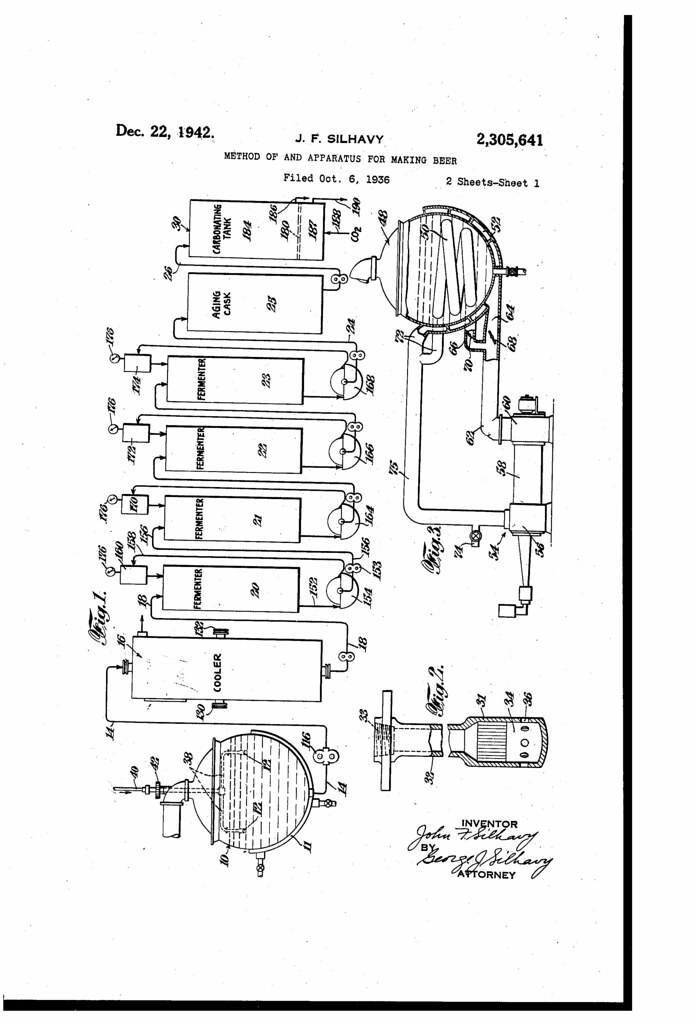
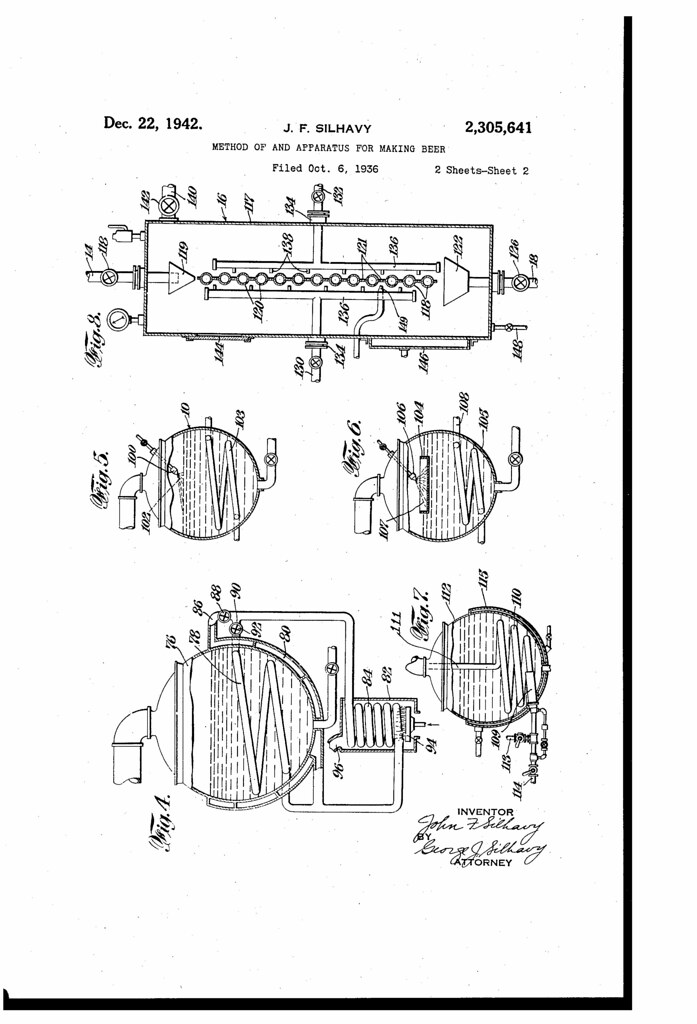
Today in 1942, US Patent 2305641 A was issued, an invention of John F. Silhavy, for his “Method of and Apparatus For Making Beer.” There’s no Abstract, although in the description it includes this summary:

I have invented new methods of and apparatus for heating `and boiling wort in the brew or hop kettle which will be described in connection with My invention is easily adaptable to and can be easily installed in existing kettles. When steam at 25 pounds gage pressure is used as a heating medium in the coil or jacket of a brew kettle, the temperature of the steam is about 265 F. According to my invention I employ heating means and mediums for the brew kettle which range in temperature from about 600 F to about 2000 F so that high’ heating temperatures far beyond those attainable by steam at ordinary pressures are obtained and by this new heating I obtain new and distinct advantages. In my heating systems I use high temperature heating mediums or means which are at a temperature greatly in excess of steam as now used and the wort is contacted with extremely hot surfaces or extremely hot gases. I have shown several ways in which these high and increased temperatures may be obtained but I- am not to be restricted thereto as any heating medium or means which produces high temperature is burned below the surface of the liquid mixture in the brew kettle. In Fig. 2 I have shown a simple form of a burner 3 which can be used but other submerged burners providing submerged combustion with high temperatures can be used. The burner has a tubular portion 32 with a threaded end 33, a combustion chamber 34 and outlet ports 35 for the combustion gases adjacent the combustion chamber. Gaseous fuels are preferably used and such fuels may be mixed with air in stoichiometric proportions in an industrial carburetor or the like and then forced under pressure through the tubular portion 32 and through the burner, being burned in the combustion chamber. By using excess gas a reducing flame is produced and by using excess air an oxidizing flame is obtained. Preferably purified gases such as hydrogen, C2H2 methane, or the like are used. The mixture of fuel and air is burned beneath the surface of the liquid mixture in the brew kettle. The burner may be positioned at any suitable height in the brew kettle but the burner should be placed sufficiently deep in the liquid being heated whereby the combustion gases will give up their heat to the liquid as they bubble through the liquid Wort, and so that the gases of combustion in escaping will not carry off valuable heat. The ideal position of the burner is to have the temperature of the outgoing combustion gases and the wort about the same.
US2305641-0
US2305641-1

Filed Under: Beers, Breweries, Just For Fun, Politics & Law, Related Pleasures Tagged With: Brewing Equipment, History, Law, Patent, Science of Brewing

Patent No. 1121930A: Metal Keg Or Cask

December 22, 2015 By Jay Brooks

patent-logo
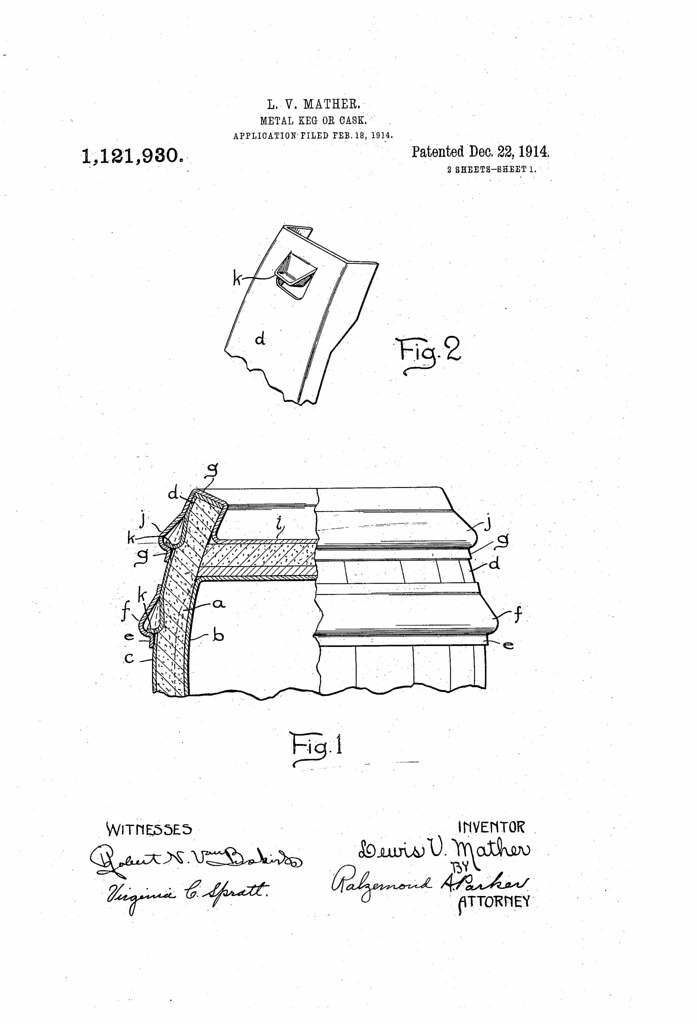
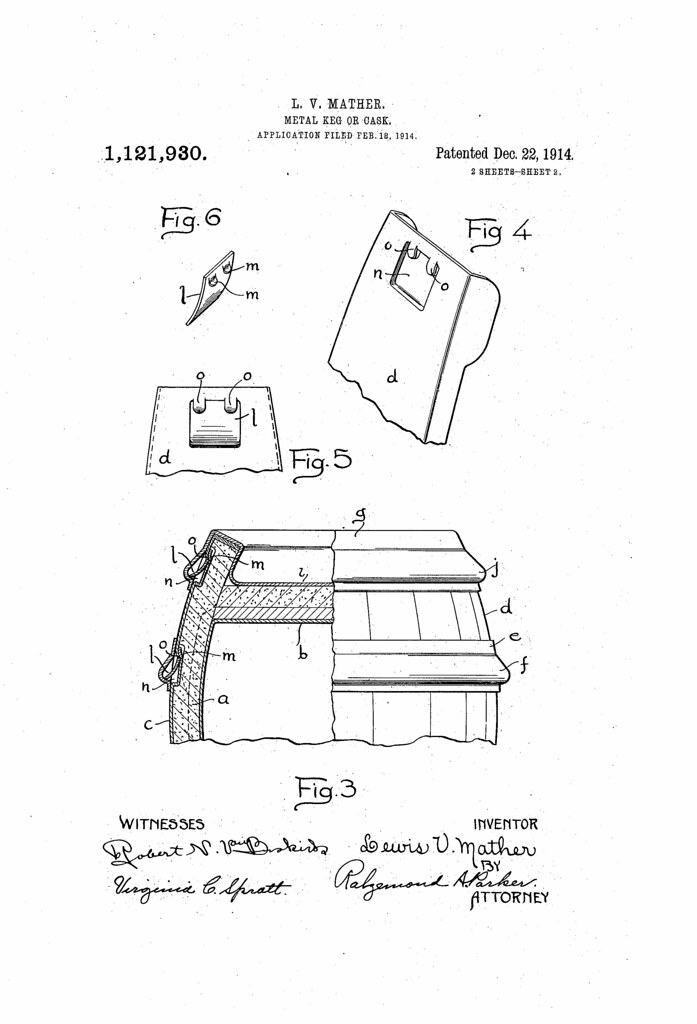
Today in 1914, US Patent 1121930 A was issued, an invention of Lewis V. Mather, assigned to Enameled Steel Package Corp., for his “Metal Keg or Cask.” There’s no Abstract, although in the description it includes this summary:

This invention relates to kegs or casks and has for its object a cask in which the hoops and the head rings are applied to the shell in an improved manner.

This invention consists essentially in the utilization of spring tongues on the shell or staves of the cask which spring out and lock with the hoops and the. head rings when the latter have been slipped into place.

US1121930-0
US1121930-1

Filed Under: Beers, Just For Fun, Politics & Law, Related Pleasures Tagged With: Cask, History, Kegs, Law, Patent

Patent No. 3998761A: Shampoo Compositions Containing Beer Solids

December 21, 2015 By Jay Brooks

patent-logo
Today in 1976, US Patent 3998761 A was issued, an invention of Herbert H. Gary, William Bess, and Frederick Hubner, assigned to the Bristol-Myers Company, for their “Shampoo Compositions Containing Beer Solids.” Here’s the Abstract, along with some additional claims:

Shampoo compositions containing beer solids.

What is claimed is:

1. A shampoo composition suitable for conditioning hair comprising at least one detergent and a waste liquid beer sludge concentrate distributed in an aqueous medium, the beer solids contained in said composition comprising from about 4% to 20% by weight based on the total weight of the shampoo composition and wherein said detergent comprises about 10 to 20% based on the total weight of the composition.

2. A shampoo composition according to claim 1 wherein the beer solids contained in said composition range from about 6% to 9% by weight based on the total weight of the shampoo composition.

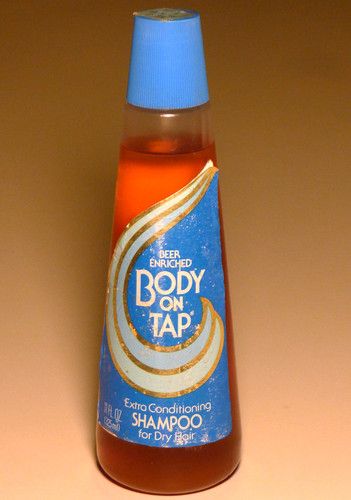
I’m not sure if this is the shampoo that resulted from this patent, but this was sold in the 1970s.

body-on-tap body-on-tap-2

Filed Under: Beers, Just For Fun, Politics & Law, Related Pleasures Tagged With: Health & Beer, History, Law, Patent

Patent No. 3628701A: Tapping Apparatus For Beverage Kegs

December 21, 2015 By Jay Brooks

patent-logo
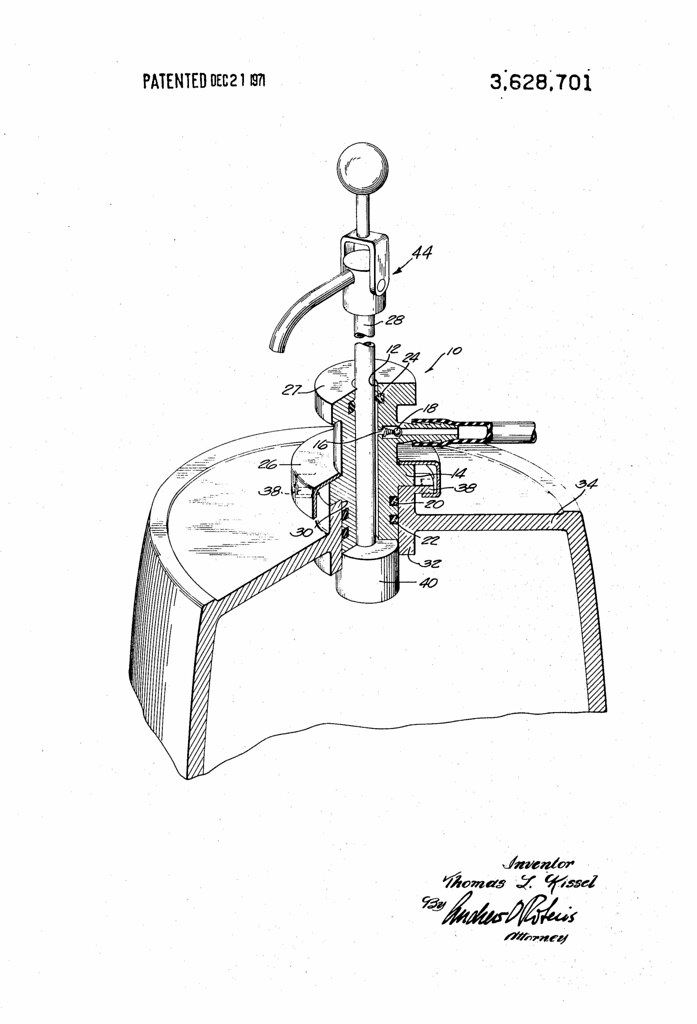
Today in 1971, US Patent 3628701 A was issued, an invention of Thomas L. Kissel, for his “Tapping Apparatus for Beverage Kegs.” There’s no Abstract, although in the description it includes this summary:

The principal object of the present invention is to provide tapping equipment which will not cause any escape of liquid during tapping of the keg.

Another and equally important object is to provide tapping equipment which will be less cumbersome, easier to operate and easier to fabricate than similar equipment used heretofore.

These objects are attained by providing a centrally apertured plug which is pushed into the taphole to partially push the stopper into the keg. The plug has two external O-ring seals which provide a seal between the taphole and the plug. An internal O-ring seal is located in the central aperture and provides a seal between the inside surface of the aperture and I the tap rod as it is inserted into the plug and is pushed downwardly against the stopper. The clearance between the tap rod and the aperture is fairly small, and as the stopper is removed the upward flow of the beverage and released gases is restricted to the narrow passage between the tap rod and aperture sidewall. For this reason, the O-ring seal is sufficient to prevent any beverage spray or leakage, which was encountered with prior commercial taps. The passage is, however, ample to permit a flow of gas under pressure from an entry port below the internal sealing means to the keg to, thus, permit the beverage to be maintained under sufficient pressure for operation of the tap.

US3628701-1

Filed Under: Beers, Just For Fun, Politics & Law, Related Pleasures Tagged With: History, Kegs, Law, Patent

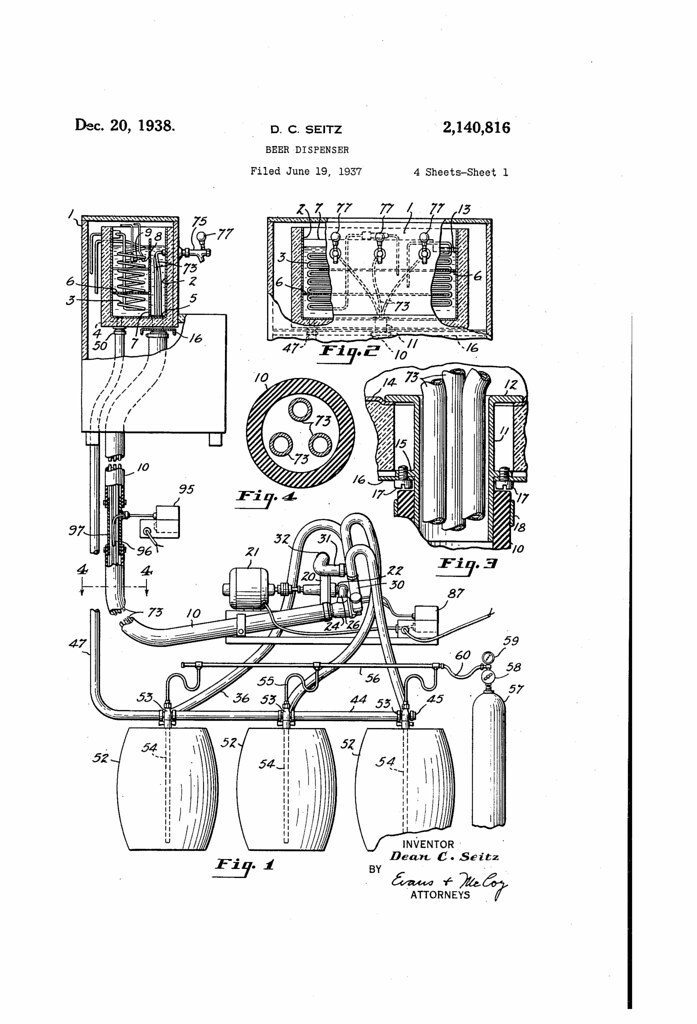
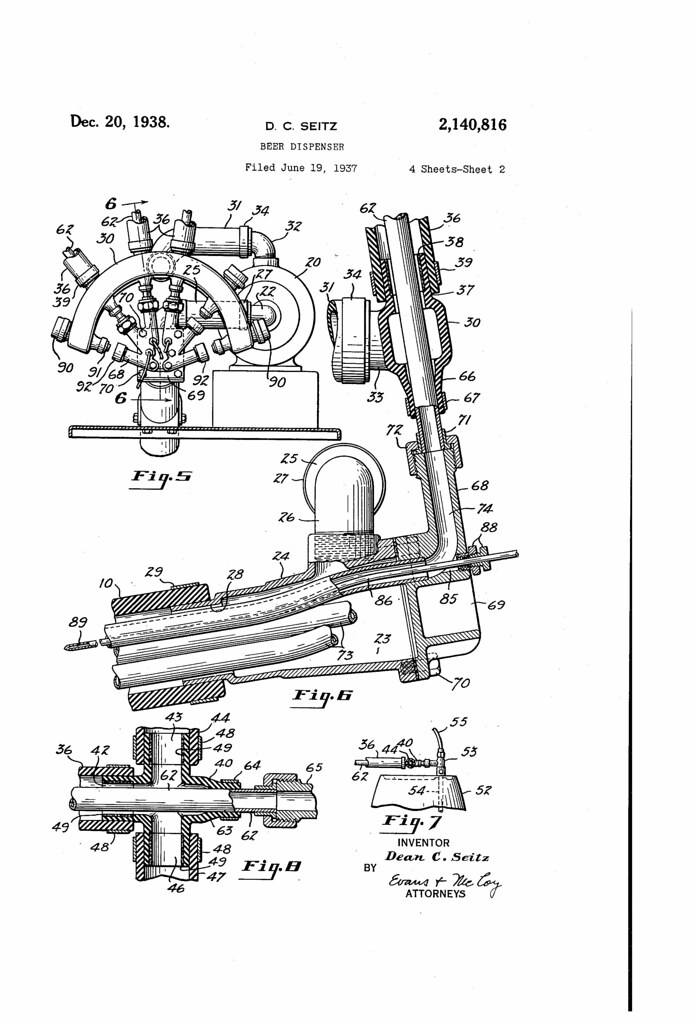
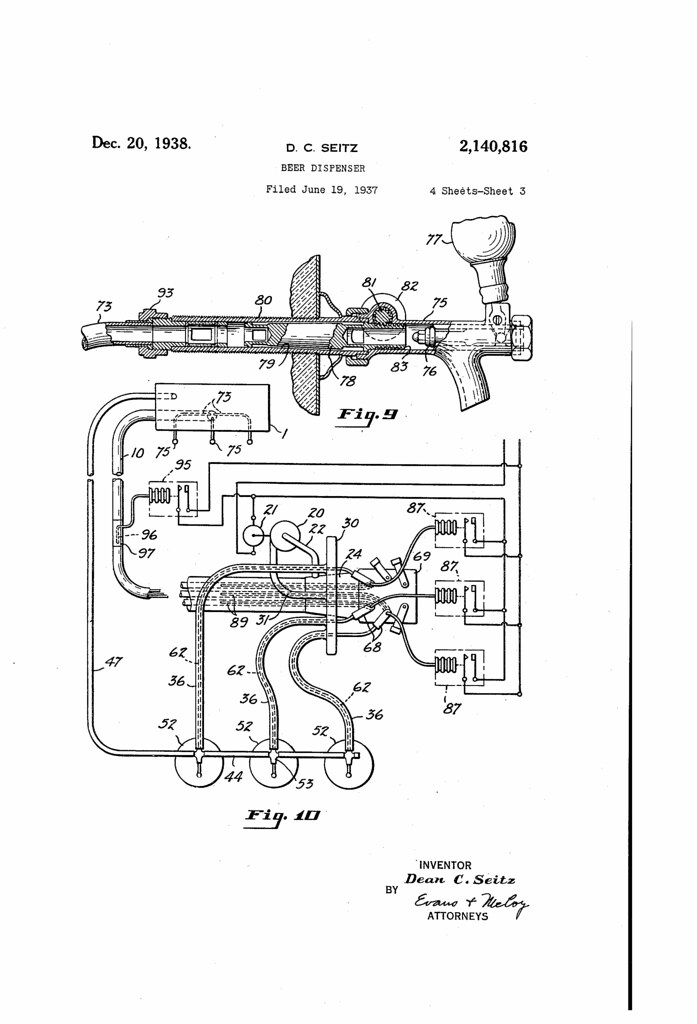
Patent No. 2140816A: Beer Dispenser

December 20, 2015 By Jay Brooks

patent-logo
Today in 1938, US Patent 2140816 A was issued, an invention of Dean C. Seitz, for his “Beer Dispenser.” There’s no Abstract, although in the description it includes this summary:

This invention relates to beverage dispensing systems and more particularly to a method and means for dispensing a brewed beverage such as beer. ale and the like.

US2140816-0
US2140816-1
US2140816-2

Filed Under: Beers, Just For Fun, Politics & Law, Related Pleasures Tagged With: History, Kegs, Law, Patent

Patent No. 3293040A: Method For Chill-Proofing Beer With Water Soluble Alkyl Cellulose Ethers

December 20, 2015 By Jay Brooks

patent-logo
Today in 1966, US Patent 3293040 A was issued, an invention of Raymond L. McAdam and Richard G. Shaler Jr., for their “Method for Chill-Proofing Beer with Water Soluble Alkyl Cellulose Ethers.” There’s no Abstract, although in the description it includes this summary:

This invention relates to beer, the treatment thereof during processing, and a novel composition having utility in such treatment and elsewhere. More particularly it relates to a method and composition for the treatment of beer during processing for chill-proofing the beer.

The present invention is in part an improvement in the now conventional method of chill-proofing beer by the addition to the beer of a swelling gelling clay such as hectorite during processing of the beer. In the preferred embodiment the present invention contemplates the combination of a water soluble cellulose ether with the clay. This combination is employed as the clay itself was previously employed. Through the use of the new combination it has been discovered that the chill-proofing properties of the clay are maintained as before but the sludge produced by the clay in the beer is substantially reduced. Also, it appears that the beer is less turbid than when the clay alone is used.

Sludge reduction is desirable since beer is trapped by the sludge and is lost when the sludge is removed. By reducing the sludge level a greater recovery and yield of beer is possible.

Thus the present invention provides an improvement in the method of treating beer with a swelling gelling clay to chill-proof the .beer which comprises adding about .120% with respect to the clay of a water soluble cellulose ether to the beer during the treatment thereof with the clay. The new composition of the present invention may be defined as a swelling gelling clay and about .1- 20% by weight with respect to the clay of a water soluble cellulose ether.

3293040

Filed Under: Beers, Breweries, Just For Fun, Politics & Law, Related Pleasures Tagged With: Brewing Equipment, History, Law, Patent, Science of Brewing

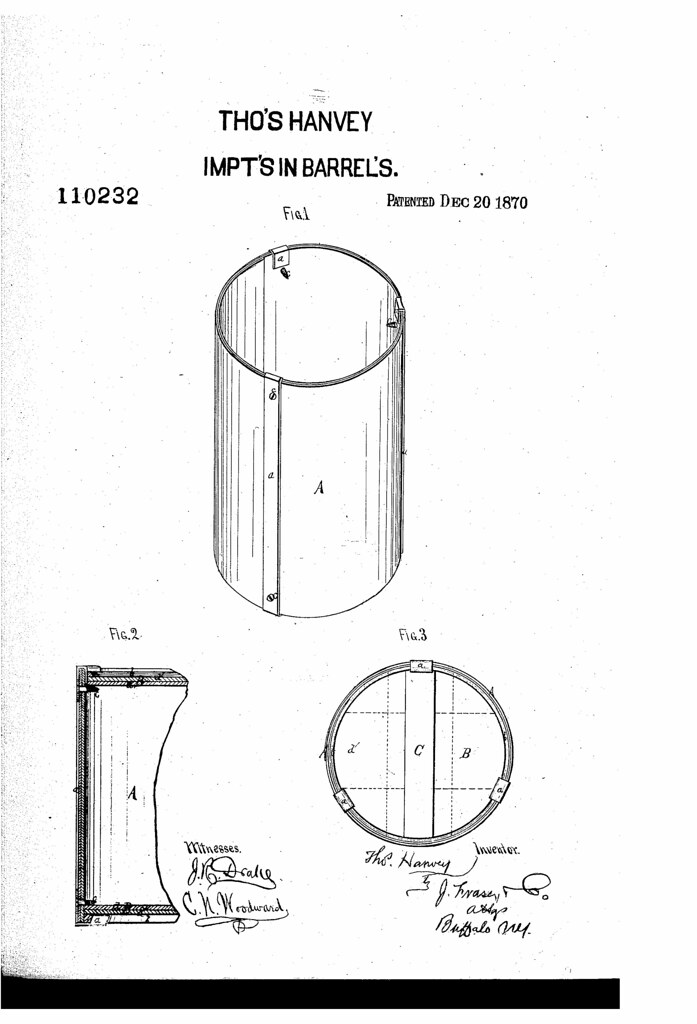
Patent No. 110232A: Improvement In Barrels

December 20, 2015 By Jay Brooks

patent-logo
Today in 1870, US Patent 110232 A was issued, an invention of Thomas Hanvey, for his “Improvement in Barrels.” There’s no Abstract, although in the description it includes this summary:

The invention relates to straight barrels, of two or more thicknesses, one overlying another, and consists in putting lengthwise on the outside of such barrels hoops or clamps, secured by screws, said screws also forming the rests for the heads. It also consists in the formation of the heads of two thicknesses, with the grain crossing, as hereinafter described General Description.

US110232-0

Filed Under: Beers, Just For Fun, Politics & Law, Related Pleasures Tagged With: Barrels, History, Kegs, Law, Patent

Patent No. D533739S1: Process For Energy Recovery In Beer Wort Boiling

December 19, 2015 By Jay Brooks

patent-logo
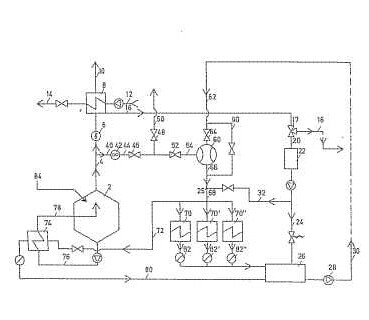
Today in 1985, US Patent D533739 S1 was issued, an invention of Jochen-Heiner Dipl-In Keilbach, assigned to Eichbaum Brauereien Ag, for his “Process for Energy Recovery in Beer Wort Boiling.” Here’s the Abstract:

The invention relates to a process for energy recovery in beer wort boiling by condensation of the vapours on heat exchangers, which is characterised in that, in a start-up phase, the vapours are conducted away virtually unpressurised via a copper vapour condenser (8), and the hop residue-containing condensate is discarded, whereupon in the main phase, part of the hop residue-free vapours is withdrawn virtually unpressurised with the exclusion of air using a steam jet pump (60) fed with superheated steam or saturated steam and condensed via further heat exchangers (70, 70′, 70”, 74) and fed to the steam circulation together with the condensate, likewise no longer containing hop residues, by the copper vapour condenser (8).

DE3424488

Filed Under: Beers, Breweries, Just For Fun, Politics & Law, Related Pleasures Tagged With: History, Law, Patent, Science of Brewing, Wort

Patent No. 2774229A: Draft Beer Dispenser

December 18, 2015 By Jay Brooks

patent-logo
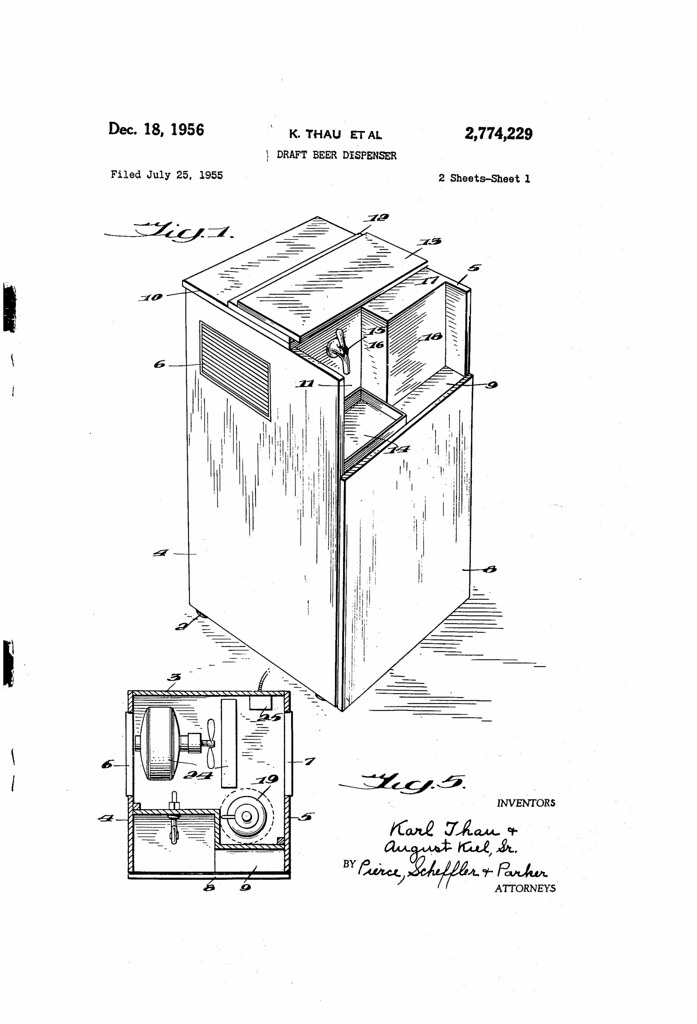
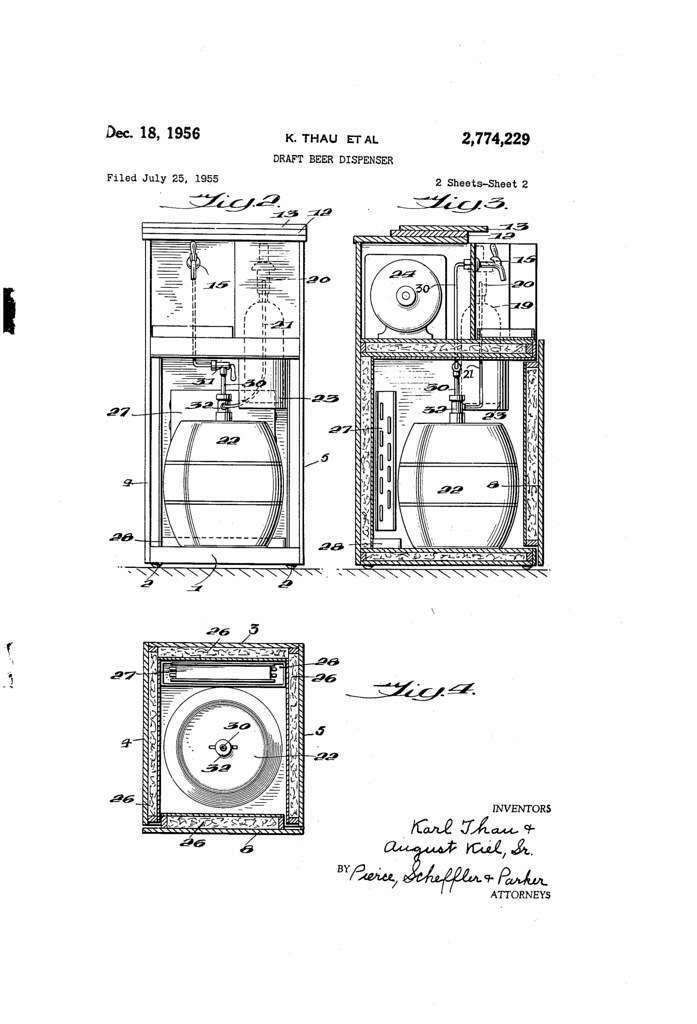
Today in 1956, US Patent 2774229 A was issued, an invention of Karl Thau and August Kiel Sr., for their “Draft Beer Dispenser.” There’s no Abstract, although in the description it includes this summary:

Draft beer, i.e. beer as it is drawn from a barrel or keg of relatively large size, e.g. 4 gallons or more generally is less expensive per unit of volume than beer in smaller containers such as tin cans or bottles. Draft beer also is preferred by many people.

Heretofore however the use of draft beer generally has been limited to situations in which the entire contents of a barrel or keg is consumed quickly e. g. within a day or so because beer is known to deteriorate rapidly after a portion of the beer in the container has been withdrawn and replaced by air.

It has been proposed to preserve the beer in large containers such as barrels and kegs by refrigeration, and by replacing the beer which is withdrawn with carbon dioxide gas but such attempts have not, so far as we are advised, been successful in making it practicable for a person or family to use the contents of a keg over a period of one or more weeks.

An object of my invention therefore is to provide a draft beer dispenser adapted for home use or for use on small boats and in other similar situations, which will preserve the beer and permit its use over a relatively long period of time.

A further object of my invention is to provide a portable unit which is capable of use wherever electric current is available.

US2774229-0
US2774229-1

Filed Under: Beers, Just For Fun, Politics & Law, Related Pleasures Tagged With: Bars, History, Kegs, Law, Patent

Patent No. 838735A: Beer-Racking Apparatus

December 18, 2015 By Jay Brooks

patent-logo
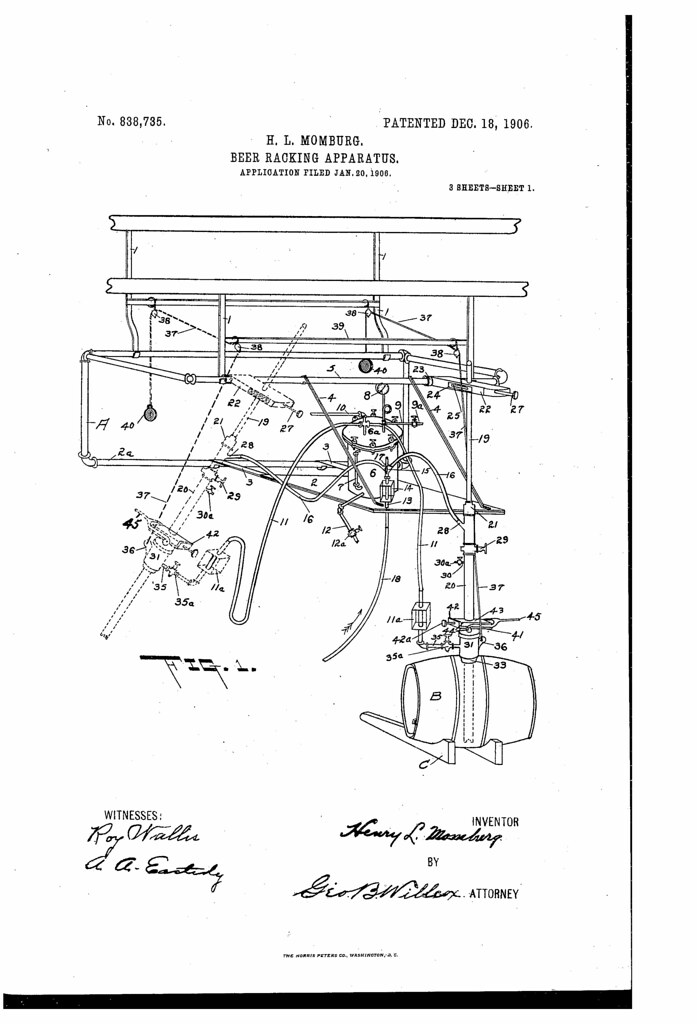
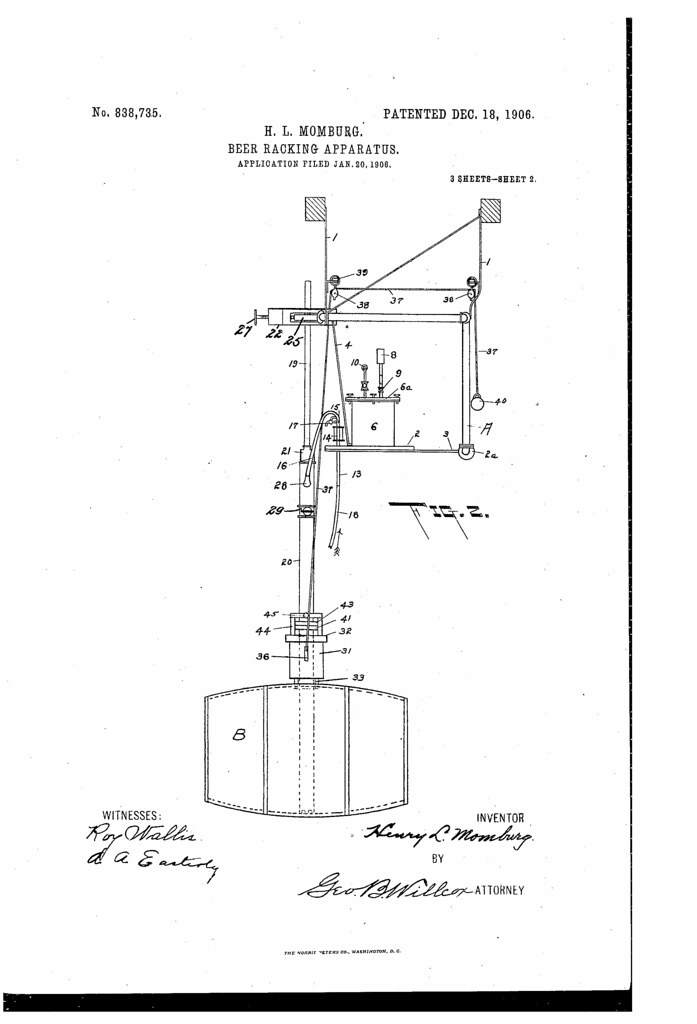
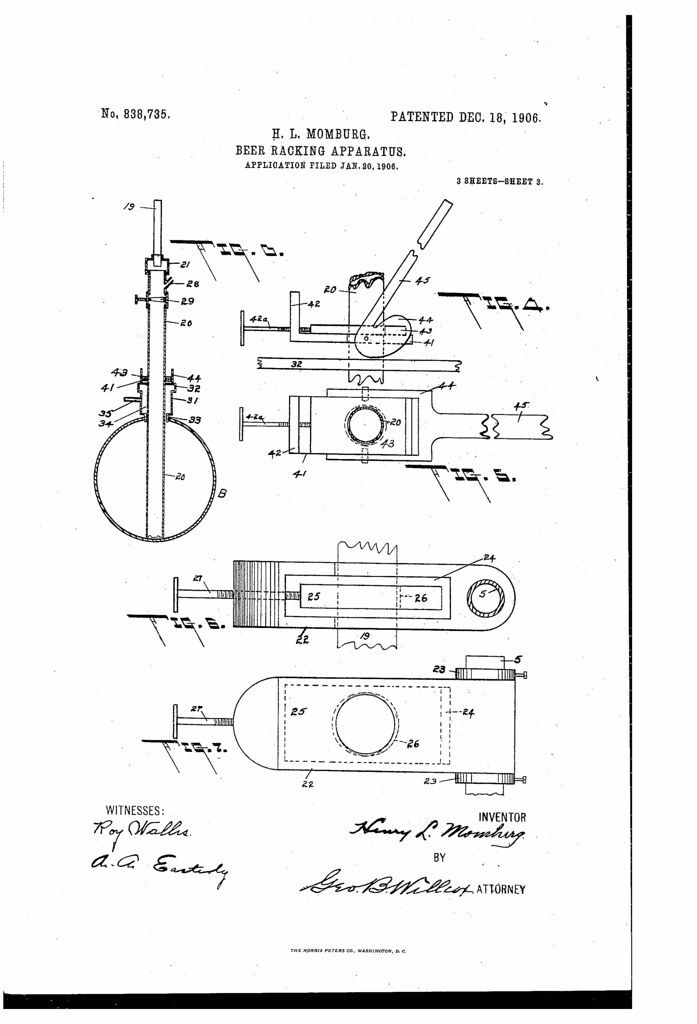
Today in 1906, US Patent 838735 A was issued, an invention of Henry L. Momburg, for his “Beer-Racking Apparatus.” There’s no Abstract, although in the description it includes this summary:

My invention is a means for filling receptacles, and I have chosen to illustrate the same in this application as embodied in a beer-racking apparatus.

One object of my invention is the provision of means for rapidlyfilling kegs or other receptacles with liquid.

Another object of my invention is the provision of means for completely filling the kegs or other receptacles with liquid without wasting the liquid.

As the liquid beer, for instance, is supplied to or introduced into the keg it will foam and the foam will float on top of the liquid as the keg is filled. Now in order to completely fill the keg it has been necessary to allow the foam to run out of the bunghole and be wasted, the beer also overflowing unless shut off just as the liquid reaches the bung-hole. This operates to waste considerable beer when filling a number of kegs,.and as the filling operation should be completed as speedily possible the drip and overflow beer wasted is a considerable amount.

My invention is designed to avoid all waste from any source whatever, and if a little care be used no appreciable amount of beer need be wasted.

Of course if the foam in the keg is not al lowed to overflow then short keg is the result, the beer not completely filling the keg, and the air commingled with the foam will operate to make the beer flat and destroy the taste and freshness. By the use of my apparatus this danger is avoided, since the keg is filled completely with beer, the foam being forced out of the keg, and hence when the bung is driven into the keg there is no air left in the keg and the beer retains its original strength, freshness, and taste.

Another object of my invent-ion is the provision of a means for receiving the foam and overflow beer from one keg and supplying it to the succeeding keg to be filled without impairing the beer in the slightest, and yet effect- I ing a saving of the liquid.

Another object of my invention is the provision of a novel means for retaining the filling-tube in the keg by releasably locking it 1 1place when inserted through the bungs vision of an inexpensive, simple, and neat racking apparatus which will effectually perform all the work required in a highly efficient manner.

To these ends my invention consists, broadly, of a suitable supporting-frame, upon which is carried the filling tube or tubes, which are provided with means for receiving the overflow beer, which means is also connected with a member, likewise carried by the frame, for causing the expulsion of the overflow beer into the next keg to be filled, together with means for connecting the filling tube with the source of supply.

US838735-0
US838735-1
US838735-2

Filed Under: Beers, Breweries, Just For Fun, Politics & Law, Related Pleasures Tagged With: Brewing Equipment, History, Kegs, Law, Patent

« Previous Page
Next Page »

Find Something

Northern California Breweries

Please consider purchasing my latest book, California Breweries North, available from Amazon, or ask for it at your local bookstore.

Recent Comments

  • Bob Paolino on Beer Birthday: Grant Johnston
  • Gambrinus on Historic Beer Birthday: A.J. Houghton
  • Ernie Dewing on Historic Beer Birthday: Charles William Bergner 
  • Steve 'Pudgy' De Rose on Historic Beer Birthday: Jacob Schmidt
  • Jay Brooks on Beer Birthday: Bill Owens

Recent Posts

  • Historic Beer Birthday: John J. Schlawig February 27, 2026
  • Beer In Ads #5134: Lord Bushkill On Bushkill Bock February 27, 2026
  • Historic Beer Birthday: William Henry Beadleston February 27, 2026
  • Beer In Ads #5133: Going… Going… SB Bock February 26, 2026
  • Beer Birthday: Art Larrance February 26, 2026

BBB Archives

Feedback

Head Quarter
This site is hosted and maintained by H25Q.dev. Any questions or comments for the webmaster can be directed here.